
It is often said that in 1492 a navigator discovered America.
The word “discover” deserves a closer look. One discovers a desert island, a cave, a star. One does not discover a place where people live.
Two worlds separated for millennia
To understand what happened after 1492, we need to gauge what existed before.
The Americas were peopled at least fifteen thousand years ago by groups who came from North-East Asia. Then sea levels rose, the passage closed, and the two halves of the world developed separately for millennia. Each developed its own plants, its own domestic animals, its own diseases and its own civilisations — the Maya, the Aztecs, the Incas, and hundreds of other societies.
This separation explains everything that follows. When the two worlds were abruptly reconnected, each brought the other what it had never encountered. Historians call this movement the Columbian exchange, after Christopher Columbus.1
It was made up of three flows, and they did not carry the same weight.
- Plants. Maize, the potato, the tomato, the bean, cacao, chilli pepper and tobacco left the Americas; wheat, rice and sugar cane arrived there. This transfer brought a lasting increase in the amount of food available throughout the world.
- Animals. The horse, the cow, the sheep and the pig arrived on a continent that had almost no large domestic animals — which overturned ways of travelling, farming and making war.
- Diseases. And this was the heaviest flow, almost one-way. Smallpox, measles and typhus, familiar in Europe, were unknown in the Americas. The populations there had no immunity, and they collapsed.2
Why one-way? The answer lies in the animals. Most of these diseases came from European farm animals, to which the inhabitants of the Americas had never been exposed. Influenza, smallpox, plague and others ravaged the Americas — and not vice versa.3
The Americas had almost no large domestic animals — the llama, the alpaca, the dog, the guinea pig and a few kinds of poultry, nothing comparable to the oxen, pigs, sheep and horses of Eurasia. No herds, therefore none of these diseases, therefore no immunity when they arrived all at once.
The two flows — animals and diseases — are therefore the same fact, seen from two sides.
This asymmetry is essential, because the rest of this page depends on it: the exchange was reciprocal for plants, but not for diseases. It is this imbalance, and not military superiority, that explains most of what happened.
How many people?
Researchers gathered one hundred and nineteen published estimates and derived a number from them: before 1492, the Americas had about sixty million inhabitants.4
This number is a midpoint, not a certainty: the middle half of the estimates ranges from forty-five to seventy-eight million. What matters is the order of magnitude, not the decimal place.5
So there was nothing to discover. There was an encounter between two halves of the world that knew nothing of each other.
What happened next
In less than a hundred years, epidemics from Europe carried off 90% of this population.6
Nine people in ten: researchers call this the Great Dying.
🦠 The causes of the decline:
- Diseases from Europe (smallpox, measles, influenza) to which no one was immune: the bulk of the deaths.
- War, forced labour and the destruction of crops: the rest.
To give a sense of scale, each of these diseases on its own killed about three people in ten — the order of magnitude of the Black Death in Europe. What happened in the Americas was a series of these epidemics in rapid succession, with no respite between them.7
A lesson about numbers
It remains to ask where this figure of “sixty million” comes from, because its origin is a lesson for this whole encyclopaedia.
Depending on the author, figures ranging from eight million to more than a hundred million have been proposed for the population before 1492.8
One example shows the scale of the problem. For a single Caribbean island, a sixteenth-century witness claimed four million inhabitants; a census taken in 1508, eleven years after the first epidemic, counted sixty thousand. If the first figure is believed, almost the entire population vanished; if not, the fall can no longer be measured.9
Why such a gap?
- The technical difficulty: A population has to be reconstructed without a census, from excavations, accounts and traces of fields.
- The historical bias: The earliest historians, who wrote from Europe, gave the lowest figures. A low figure makes the conquest smaller.
💡 Key question: It applies to every page of history: who produced this figure, and in what context?
An important clarification, to avoid a mistaken conclusion: the uncertainty concerns the count, not what happened. That researchers debate an order of magnitude does not mean that they debate the fact.
An effect no one expected
🧪 Scientific hypothesis:
Sixty million people farmed fields — a little over a hectare each. When they disappeared, the fields were abandoned and the forest grew back. And a growing forest absorbs carbon.10
The team that made this calculation estimates that nearly fifty-six million hectares were thus reclaimed by vegetation, and that the carbon absorbed, with its knock-on effects, accounts for between half and two thirds of:11
- A fall in carbon dioxide in the atmosphere in the late 1500s and early 1600s;
- A slight cooling of the planet — about 0.15 °C;
If this is correct, humans altered the Earth’s climate before the Industrial Revolution. They did so by dying.
This is the thesis of one team, published in a scientific journal and discussed by other researchers. Other studies, focusing on Amazonia, find no synchronous forest regrowth at that date. It is therefore not established.12
Follow the silver
Then comes the question that is almost never asked: what were all these ships for?
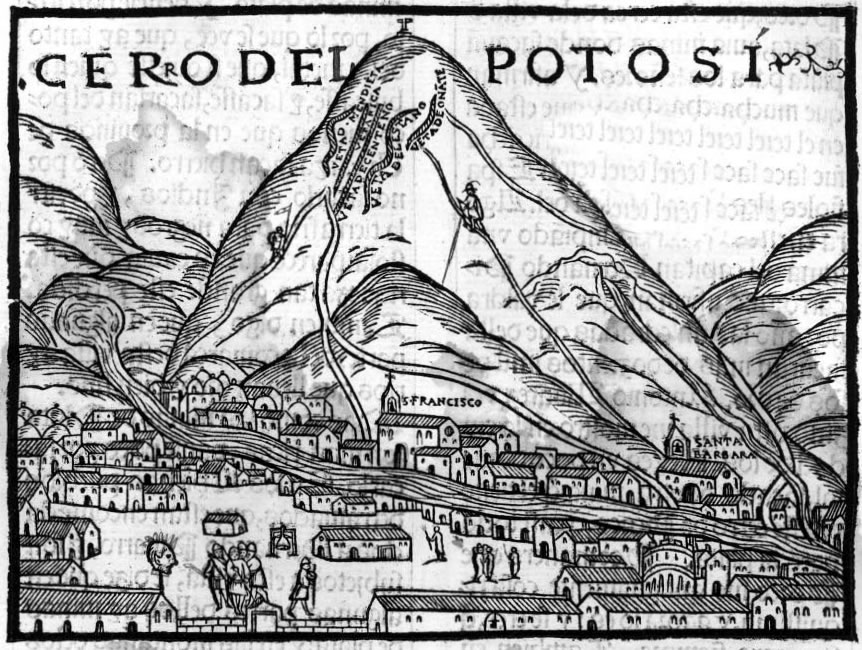
In the middle of the sixteenth century, silver was found in a mountain in the Andes, more than four thousand metres above sea level: the Cerro Rico. The town that sprang up at its foot is called Potosí.
Within a few decades, it grew from about fourteen thousand inhabitants to more than a hundred thousand — one of the most populous cities in the world at the time, larger than most cities in Europe.13
The underestimated destination
Between 1500 and 1800, Spanish America, with the Cerro Rico of Potosí and the mines of Mexico, produced about 80% of the world’s silver. What almost no one mentions: a very large share of this silver did not stay in Europe. It ended up in Asia, and above all in China.14
Estimates range from a third to about half depending on the author, and the silver reached it by two paths, not just one. The more spectacular was the Manila galleon, which crossed the Pacific from Acapulco from 1565 onwards: this was the direct route, and it carried something of the order of twenty to thirty thousand tonnes. But the bulk of the metal first passed through Europe, before setting off again for Asia via the Cape.15
In 1581, the Ming dynasty rolled out across the empire a fiscal reform known as the “Single Whip Law”: taxes — the land tax in some regions, corvée labour in others — were now paid in money rather than in kind, that is, in silver. A vast empire thus began to demand it, and the whole world began to bring it — across the Pacific as well as across the Indian Ocean.16
A clarification that changes the reading. This reform was not invented at the top. It had been proposed as early as 1530, then tried out for decades in southern provinces before being extended to the empire.17
The state did not impose silver: it ended up ratifying a practice that was already established. Major decisions often look like this — less an invention than a generalisation.18
In other words, what kept the ships of this era moving was not only the European desire to see what lay elsewhere. It was also, and perhaps above all, Chinese demand.
⚠️ Simplifications to avoid: “Everything came from China” would be as false as “everything came from Europe”. What should be remembered is that a circuit has several ends, and that we often see only one of them.
Who did the digging
It remains to say who went down into this mine.
Before the Spanish, the Incas had an institution called the mita: each community had to supply men (mitayos) for a given period, for works of collective interest (roads, terraces, temples), in exchange for feasts and redistributions by the Inca state.
The Spanish viceroy reorganised this system and kept the word. But he changed its nature: the colonial mita became forced service in the mines. It is estimated that about one adult man in seven was requisitioned in the surrounding Andean provinces, each serving one year in seven.19
Conditions and survival in Potosí
Popular accounts sometimes speak of “millions of deaths” in the depths of the Cerro Rico. Historians specialising in mining demography (such as Peter Bakewell or Nicholas Robins) offer a more precise picture:
- The service wore men out: maimed or sick, many young Andean men did not go home when their turn was over, whether they had served deep in the mines or in the refining mills.
- From the 1570s onwards, the introduction of the process of separating silver with mercury (amalgamation) poisoned the refinery workers (trapiches).20
A recurring device
What happened there is no mere detail: a new constraint was not merely imposed, it was given the name of an old institution so that it would look like continuity.
This is the third time this encyclopaedia has come across this device:
- In Sri Lanka: Colonial engineers attributed to the ancient builders an invention they could not prove.
- In Bali: An administration presented a control it had just established as traditional.
- In the Andes: The hijacking of the mita.
📌 Key point: Those who dominate do not only write history; they also borrow the vocabulary of what they replace.
What travelled, and what is on our plates
| Origin | Products / Items exchanged | Notes on cultural history |
|---|---|---|
| Americas ➔ World | Chilli pepper, maize, tomato, potato, bean, cacao, tobacco | Chilli reached China in the late 1500s as an ornamental plant (used for its heat 2 centuries later). The tomato remained a botanical curiosity in Europe for a century. |
| World ➔ Americas | Wheat, rice, sugar cane, horses, cows, diseases | Complete restructuring of American ecosystems and ways of life. |
| Maldives ➔ West Africa | Shells (cowries) | Shipped by the billion to serve as a currency of exchange in local and coastal markets. |
Note 1
In 1972, Alfred W. Crosby wrote a book called The Columbian Exchange. In it, the historian tells the story of Columbus’s landing in 1492 through the ecological ramifications it had on the New World. […] I recently spoke with the retired professor about “Columbian Exchange”—a term that has worked its way into historians’ vernacular—and the impacts of some of the living organisms that transferred between continents, beginning in the 15th century.
“Alfred W. Crosby on the Columbian Exchange”, interview, Smithsonian Magazine, Smithsonian Institution
Note 2
You might be surprised to learn that until the eighteenth century, the peoples of Asia, Europe, and Africa had not seen potatoes, tomatoes, corn, sweet potatoes, or peppers, which are now an integral part of their traditional cuisines. […] Scholars estimate one-third of all food crops grown in the world today are of American origin and were unknown to the Old World before the conquest of the Americas. Over time, these crops became integrated into European, Asian, and African cuisines. Likewise, foods previously unknown in the Americas—such as sugarcane, tea, coffee, oranges, rice, wheat, eggplants, bananas, mangoes, and so on—were brought over by European colonists.
Naithani, Sushma, History and Science of Cultivated Plants, Open Oregon State (Oregon State University), 2021, ch. 3 “Colonial Agriculture”
Note 3
Most of these diseases originated from domesticated farm animals from Europe to which Native Americans had no prior exposure
Koch, Alexander, Brierley, Chris, Maslin, Mark M. and Lewis, Simon L., “Earth System Impacts of the European Arrival and Great Dying in the Americas after 1492”, Quaternary Science Reviews, vol. 207, 2019, p. 13-36
Thus, influenza, smallpox, bubonic plague and other diseases ravaged the Americas, and not vice versa.
Koch, Alexander, Brierley, Chris, Maslin, Mark M. and Lewis, Simon L., “Earth System Impacts of the European Arrival and Great Dying in the Americas after 1492”, Quaternary Science Reviews, vol. 207, 2019, p. 13-36
Note 4
From 119 published regional population estimates we calculate a pre-1492 CE population of 60.5 million
Koch, Alexander, Brierley, Chris, Maslin, Mark M. and Lewis, Simon L., “Earth System Impacts of the European Arrival and Great Dying in the Americas after 1492”, Quaternary Science Reviews, vol. 207, 2019, p. 13-36
Note 5
60.5 million (interquartile range, IQR 44.8–78.2 million)
Koch, Alexander, Brierley, Chris, Maslin, Mark M. and Lewis, Simon L., “Earth System Impacts of the European Arrival and Great Dying in the Americas after 1492”, Quaternary Science Reviews, vol. 207, 2019, p. 13-36
Note 6
European epidemics removed 90% (IQR 87–92%) of the indigenous population over the next century
Koch, Alexander, Brierley, Chris, Maslin, Mark M. and Lewis, Simon L., “Earth System Impacts of the European Arrival and Great Dying in the Americas after 1492”, Quaternary Science Reviews, vol. 207, 2019, p. 13-36
Note 7
Such diseases typically individually killed ~30% or more of the initial population. Hence a series of epidemics in rapid succession could […]
Koch, Alexander, Brierley, Chris, Maslin, Mark M. and Lewis, Simon L., “Earth System Impacts of the European Arrival and Great Dying in the Americas after 1492”, Quaternary Science Reviews, vol. 207, 2019, p. 13-36
Note 8
The result is that 1491 population estimates for the Americas have varied wildly, from a lower-bound estimate of approximately 8 million (Kroeber, 1939) to an upper-bound estimate of over 110 million people (Dobyns, 1966).
Nunn, Nathan and Qian, Nancy, “The Columbian Exchange: A History of Disease, Food, and Ideas”, Journal of Economic Perspectives, vol. 24, no. 2, 2010, p. 163-188
Note 9
Following the first disease outbreak in 1497 CE on the island of Hispaniola, the first census for the whole island was established in 1508 CE and arrived at 60,000 indigenous people […] if Bartholomew Las Casas’ initial 4 million estimate was to be correct.
Koch, Alexander, Brierley, Chris, Maslin, Mark M. and Lewis, Simon L., “Earth System Impacts of the European Arrival and Great Dying in the Americas after 1492”, Quaternary Science Reviews, vol. 207, 2019, p. 13-36
Note 10
utilizing 1.04 ha land per capita (IQR 0.98–1.11)
Koch, Alexander, Brierley, Chris, Maslin, Mark M. and Lewis, Simon L., “Earth System Impacts of the European Arrival and Great Dying in the Americas after 1492”, Quaternary Science Reviews, vol. 207, 2019, p. 13-36
Note 11
This resulted in secondary succession of 55.8 Mha (IQR 39.0–78.4 Mha) of abandoned land
Koch, Alexander, Brierley, Chris, Maslin, Mark M. and Lewis, Simon L., “Earth System Impacts of the European Arrival and Great Dying in the Americas after 1492”, Quaternary Science Reviews, vol. 207, 2019, p. 13-36
We investigate whether the decline in global atmospheric CO2 concentration by 7–10 ppm in the late 1500s and early 1600s which globally lowered surface air temperatures by 0.15 °C […] Accounting for carbon cycle feedbacks plus LUC outside the Americas gives a total 5 ppm CO2 additional uptake into the land surface in the 1500s compared to the 1400s, 47–67% of the atmospheric CO2 decline.
Koch, Alexander, Brierley, Chris, Maslin, Mark M. and Lewis, Simon L., “Earth System Impacts of the European Arrival and Great Dying in the Americas after 1492”, Quaternary Science Reviews, vol. 207, 2019, p. 13-36
Note 12
On the basis of 39 Amazonian fossil pollen records, we show that there was no synchronous reforestation event associated with such an atmospheric carbon dioxide response after European arrival in Amazonia.
Bush, M. B., Nascimento, M. N., Åkesson, C. M. et al., “Widespread Reforestation before European Influence on Amazonia”, Science, vol. 372, no. 6541, 2021, p. 484-487
Note 13
From then on, for half a century, the boom around the cerro rico (rich hill) developed fantastically. In 1547 Potosi’s population was about 14,000, in 1571 perhaps 40,000, by 1600 at least 150,000.
Demos, John, “The High Place: Potosi”, Common-place, vol. 3, no. 4, July 2003
Note 14
More recent estimates coincide: Flynn and Giráldez argue “Spanish America was the source of approximately 150,000 tons of silver between 1500 and 1800, comprising perhaps 80% of world production.” […]
Marichal, Carlos, “The Spanish American Silver Peso: Export Commodity and Global Money of the Ancien Regime (16th-18th centuries)”, in Topik, Steven, Marichal, Carlos and Frank, Zephyr (eds.), Latin American Commodity Chains and the Building of Global Economy (XVI-XXth Centuries), Duke University Press, 2006, pp. 25-52
Destined ultimately for China, tens of thousands of tons of silver passed through Europe via long-distance maritime and overland trade routes.
Flynn, Dennis O. and Giráldez, Arturo, “Cycles of Silver: Global Economic Unity through the Mid-Eighteenth Century”, Journal of World History, vol. 13, no. 2, 2002, p. 391-427
Note 15
From 1565 to 1815, enormous and well-armed Spanish ships, known as galleons, sailed across the Pacific Ocean each year, traveling back and forth between Acapulco in Mexico and Manila in the Philippines.
Finnegan, Oliver, “The papers of Nuestra Señora de Covadonga, a Spanish treasure galleon”, The National Archives (UK)
Note 16
These reforms allowed some taxes - in some cases the land tax, in others the service levy - to be paid in cash rather than in kind. […] In 1581, the reform was made national by Grand Secretary Zhang Juzheng. […] The mid 16th century, called the Single Whip, the major tax reform that aimed to secure silver supply for the government. […] The farmer still had to pay taxes on silver.
HarvardX, “Week 22: Silver and Social Change in Late Ming”, online course transcript (SW12.5x), Harvard University / edX
Starting in the southeast in the mid-sixteenth century, local officials began to come up with a series of reforms […] In 1581, the reform was made national by Grand Secretary Zhang Juzheng.
HarvardX, “Week 22: Silver and Social Change in Late Ming”, online course transcript (SW12.5x), Harvard University / edX
Note 17
It was first proposed by Gui E in the ninth year of Jiajing (1530) […] Initially piloted in regions like Fujian and Guangdong in the mid-16th century
Von Glahn, Richard, Fountain of Fortune: Money and Monetary Policy in China, 1000-1700, University of California Press, 1996
Note 18
Second, merchants turned to silver for trade. […] By the mid-to-late 15th century, the government changed its policy to reflect these practicalities - trade in silver was allowed, and taxes were calculated in both copper cash and by weight of silver. […] Ultimately, many tax payments were monetized across the empire - this merely systematized a set of reforms that had already been underway, and closely reflected the economic realities of mid-Ming society.
HarvardX, “Week 22: Silver and Social Change in Late Ming”, online course transcript (SW12.5x), Harvard University / edX
Note 19
Thus, in 1572, Toledo began to devise a system for draft labor, which built on the Incan mita system. […] Toledo’s modification of the mita divided the hundreds of villages in Potosí into 17 districts and required them to send about 1/7 (16%) of their able-bodied men each year to work.
Padilla, Pamela, “A short story about Potosi—the largest South American silver mine—in the Library’s Collections (Part 2)”, Worlds Revealed (international collections blog), Library of Congress, 26 August 2022
Note 20
Maimed or sickened, many young Andean men did not go home when their turn was up, having served in the mines, the refining mills and many other tasks, including maintenance of the vast reservoir and canal system also implemented by Viceroy Toledo (see Figure 1).
Lane, Kris, “Potosí”, in Thurner, Mark and Pimentel, Juan (ed.), New World Objects of Knowledge: A Cabinet of Curiosities, University of London Press, 2021
These ores, often containing zinc, lead and even tin, resisted smelting in the guairas, so it was only with the construction of large-scale mercury amalgamation facilities after 1572 that the silver potential of these ores was unlocked. […] Resulting blobs of amalgam were collected, washed and fired in a still-like retort to drive off liquid mercury, much of it recovered through condensation for reuse, although some escaped to foul the air and poison workers.
Lane, Kris, “Potosí”, in Thurner, Mark and Pimentel, Juan (ed.), New World Objects of Knowledge: A Cabinet of Curiosities, University of London Press, 2021
Notes and sources
- ↑
Passage Historians call this movement the Columbian exchange
In 1972, Alfred W. Crosby wrote a book called The Columbian Exchange. In it, the historian tells the story of Columbus’s landing in 1492 through the ecological ramifications it had on the New World. […] I recently spoke with the retired professor about “Columbian Exchange”—a term that has worked its way into historians’ vernacular—and the impacts of some of the living organisms that transferred between continents, beginning in the 15th century.
Source “Alfred W. Crosby on the Columbian Exchange”, interview, Smithsonian Magazine, Smithsonian Institution, introduction to the interview, 1st and 3rd paragraphs.
Open access open the source · checked on 27 October 2026
- ↑
Passage Maize, the potato, the tomato […] left the Americas; wheat, rice and sugar cane arrived there.
You might be surprised to learn that until the eighteenth century, the peoples of Asia, Europe, and Africa had not seen potatoes, tomatoes, corn, sweet potatoes, or peppers, which are now an integral part of their traditional cuisines. […] Scholars estimate one-third of all food crops grown in the world today are of American origin and were unknown to the Old World before the conquest of the Americas. Over time, these crops became integrated into European, Asian, and African cuisines. Likewise, foods previously unknown in the Americas—such as sugarcane, tea, coffee, oranges, rice, wheat, eggplants, bananas, mangoes, and so on—were brought over by European colonists.
Source Naithani, Sushma, History and Science of Cultivated Plants, Open Oregon State (Oregon State University), 2021, ch. 3 “Colonial Agriculture”, ch. 3 (“Colonial Agriculture”), § 3.2 (“The Columbian Exchange”), paragraphs beginning “You might be surprised” and “Scholars estimate”.
Open access open the source · checked on 27 October 2026
- ↑
Passage Most of these diseases came from European farm animals, to which the inhabitants of the Americas had never been exposed.
Most of these diseases originated from domesticated farm animals from Europe to which Native Americans had no prior exposure
Source Koch, Alexander, Brierley, Chris, Maslin, Mark M. and Lewis, Simon L., “Earth System Impacts of the European Arrival and Great Dying in the Americas after 1492”, Quaternary Science Reviews, vol. 207, 2019, p. 13-36, section on diseases.
Open access open the source · checked on 9 September 2026
Passage Influenza, smallpox, plague and others ravaged the Americas — and not vice versa.
Thus, influenza, smallpox, bubonic plague and other diseases ravaged the Americas, and not vice versa.
Source Koch, Alexander, Brierley, Chris, Maslin, Mark M. and Lewis, Simon L., “Earth System Impacts of the European Arrival and Great Dying in the Americas after 1492”, Quaternary Science Reviews, vol. 207, 2019, p. 13-36, section on diseases.
Open access open the source · checked on 9 September 2026
- ↑
Passage Researchers gathered one hundred and nineteen published estimates and derived a number from them: before 1492, the Americas had about sixty million inhabitants.
From 119 published regional population estimates we calculate a pre-1492 CE population of 60.5 million
Source Koch, Alexander, Brierley, Chris, Maslin, Mark M. and Lewis, Simon L., “Earth System Impacts of the European Arrival and Great Dying in the Americas after 1492”, Quaternary Science Reviews, vol. 207, 2019, p. 13-36, abstract.
Open access open the source · checked on 9 September 2026
- ↑
Passage the middle half of the estimates ranges from forty-five to seventy-eight million
60.5 million (interquartile range, IQR 44.8–78.2 million)
Source Koch, Alexander, Brierley, Chris, Maslin, Mark M. and Lewis, Simon L., “Earth System Impacts of the European Arrival and Great Dying in the Americas after 1492”, Quaternary Science Reviews, vol. 207, 2019, p. 13-36, abstract.
Open access open the source · checked on 9 September 2026
- ↑
Passage epidemics from Europe carried off 90% of this population
European epidemics removed 90% (IQR 87–92%) of the indigenous population over the next century
Source Koch, Alexander, Brierley, Chris, Maslin, Mark M. and Lewis, Simon L., “Earth System Impacts of the European Arrival and Great Dying in the Americas after 1492”, Quaternary Science Reviews, vol. 207, 2019, p. 13-36, abstract.
Open access open the source · checked on 9 September 2026
- ↑
Passage each of these diseases on its own killed about three people in ten […] a series of these epidemics in rapid succession
Such diseases typically individually killed ~30% or more of the initial population. Hence a series of epidemics in rapid succession could […]
Source Koch, Alexander, Brierley, Chris, Maslin, Mark M. and Lewis, Simon L., “Earth System Impacts of the European Arrival and Great Dying in the Americas after 1492”, Quaternary Science Reviews, vol. 207, 2019, p. 13-36, section on diseases.
Open access open the source · checked on 9 September 2026
- ↑
Passage figures ranging from eight million to more than a hundred million have been proposed for the population before 1492
The result is that 1491 population estimates for the Americas have varied wildly, from a lower-bound estimate of approximately 8 million (Kroeber, 1939) to an upper-bound estimate of over 110 million people (Dobyns, 1966).
Source Nunn, Nathan and Qian, Nancy, “The Columbian Exchange: A History of Disease, Food, and Ideas”, Journal of Economic Perspectives, vol. 24, no. 2, 2010, p. 163-188, p. 166.
Open access open the source · checked on 27 October 2026
- ↑
Passage For a single Caribbean island, a sixteenth-century witness claimed four million inhabitants; a census taken in 1508, eleven years after the first epidemic, counted sixty thousand.
Following the first disease outbreak in 1497 CE on the island of Hispaniola, the first census for the whole island was established in 1508 CE and arrived at 60,000 indigenous people […] if Bartholomew Las Casas’ initial 4 million estimate was to be correct.
Source Koch, Alexander, Brierley, Chris, Maslin, Mark M. and Lewis, Simon L., “Earth System Impacts of the European Arrival and Great Dying in the Americas after 1492”, Quaternary Science Reviews, vol. 207, 2019, p. 13-36, § 4.1, p. 20.
Open access open the source · checked on 9 September 2026
- ↑
Passage Sixty million people farmed fields — a little over a hectare each.
utilizing 1.04 ha land per capita (IQR 0.98–1.11)
Source Koch, Alexander, Brierley, Chris, Maslin, Mark M. and Lewis, Simon L., “Earth System Impacts of the European Arrival and Great Dying in the Americas after 1492”, Quaternary Science Reviews, vol. 207, 2019, p. 13-36, abstract.
Open access open the source · checked on 9 September 2026
- ↑
Passage nearly fifty-six million hectares were thus reclaimed by vegetation
This resulted in secondary succession of 55.8 Mha (IQR 39.0–78.4 Mha) of abandoned land
Source Koch, Alexander, Brierley, Chris, Maslin, Mark M. and Lewis, Simon L., “Earth System Impacts of the European Arrival and Great Dying in the Americas after 1492”, Quaternary Science Reviews, vol. 207, 2019, p. 13-36, abstract.
Open access open the source · checked on 9 September 2026
Passage the carbon absorbed, with its knock-on effects, accounts for between half and two thirds of […] A fall in carbon dioxide in the atmosphere in the late 1500s and early 1600s; […] A slight cooling of the planet — about 0.15 °C
We investigate whether the decline in global atmospheric CO2 concentration by 7–10 ppm in the late 1500s and early 1600s which globally lowered surface air temperatures by 0.15 °C […] Accounting for carbon cycle feedbacks plus LUC outside the Americas gives a total 5 ppm CO2 additional uptake into the land surface in the 1500s compared to the 1400s, 47–67% of the atmospheric CO2 decline.
Source Koch, Alexander, Brierley, Chris, Maslin, Mark M. and Lewis, Simon L., “Earth System Impacts of the European Arrival and Great Dying in the Americas after 1492”, Quaternary Science Reviews, vol. 207, 2019, p. 13-36, abstract.
Open access open the source · checked on 9 September 2026
- ↑
Passage Other studies, focusing on Amazonia, find no synchronous forest regrowth at that date.
On the basis of 39 Amazonian fossil pollen records, we show that there was no synchronous reforestation event associated with such an atmospheric carbon dioxide response after European arrival in Amazonia.
Source Bush, M. B., Nascimento, M. N., Åkesson, C. M. et al., “Widespread Reforestation before European Influence on Amazonia”, Science, vol. 372, no. 6541, 2021, p. 484-487, abstract.
Paywalled open the source · checked on 9 September 2026
- ↑
Passage Within a few decades, it grew from about fourteen thousand inhabitants to more than a hundred thousand
From then on, for half a century, the boom around the cerro rico (rich hill) developed fantastically. In 1547 Potosi’s population was about 14,000, in 1571 perhaps 40,000, by 1600 at least 150,000.
Source Demos, John, “The High Place: Potosi”, Common-place, vol. 3, no. 4, July 2003, 9th paragraph (“From then on, for half a century”).
Open access open the source · checked on 27 October 2026
- ↑
Passage Spanish America, with the Cerro Rico of Potosí and the mines of Mexico, produced about 80% of the world’s silver
More recent estimates coincide: Flynn and Giráldez argue “Spanish America was the source of approximately 150,000 tons of silver between 1500 and 1800, comprising perhaps 80% of world production.” […]
Source Marichal, Carlos, “The Spanish American Silver Peso: Export Commodity and Global Money of the Ancien Regime (16th-18th centuries)”, in Topik, Steven, Marichal, Carlos and Frank, Zephyr (eds.), Latin American Commodity Chains and the Building of Global Economy (XVI-XXth Centuries), Duke University Press, 2006, pp. 25-52, p. 5 of the author’s version (note 6, citing Flynn and Giráldez 1995, p. 214).
Open access open the source · checked on 27 October 2026
Passage a very large share of this silver did not stay in Europe. It ended up in Asia, and above all in China.
Destined ultimately for China, tens of thousands of tons of silver passed through Europe via long-distance maritime and overland trade routes.
Source Flynn, Dennis O. and Giráldez, Arturo, “Cycles of Silver: Global Economic Unity through the Mid-Eighteenth Century”, Journal of World History, vol. 13, no. 2, 2002, p. 391-427, abstract.
Paywalled open the source · checked on 9 September 2026
- ↑
Passage the Manila galleon, which crossed the Pacific from Acapulco
From 1565 to 1815, enormous and well-armed Spanish ships, known as galleons, sailed across the Pacific Ocean each year, traveling back and forth between Acapulco in Mexico and Manila in the Philippines.
Source Finnegan, Oliver, “The papers of Nuestra Señora de Covadonga, a Spanish treasure galleon”, The National Archives (UK), section “Bridging the Pacific”, 1st paragraph.
Open access open the source · checked on 27 October 2026
- ↑
Passage the Ming dynasty rolled out across the empire a fiscal reform known as the “Single Whip Law”: taxes — the land tax in some regions, corvée labour in others — were now paid in money rather than in kind, that is, in silver
These reforms allowed some taxes - in some cases the land tax, in others the service levy - to be paid in cash rather than in kind. […] In 1581, the reform was made national by Grand Secretary Zhang Juzheng. […] The mid 16th century, called the Single Whip, the major tax reform that aimed to secure silver supply for the government. […] The farmer still had to pay taxes on silver.
Source HarvardX, “Week 22: Silver and Social Change in Late Ming”, online course transcript (SW12.5x), Harvard University / edX, subsection “The Single Whip”; section 8 (“Political Changes”); section 9 (“Conclusion”).
Open access open the source · checked on 27 October 2026
Passage In 1581, the Ming dynasty rolled out across the empire a fiscal reform known as the “Single Whip Law”
Starting in the southeast in the mid-sixteenth century, local officials began to come up with a series of reforms […] In 1581, the reform was made national by Grand Secretary Zhang Juzheng.
Source HarvardX, “Week 22: Silver and Social Change in Late Ming”, online course transcript (SW12.5x), Harvard University / edX, subsection “The Single Whip”.
Open access open the source · checked on 27 October 2026
- ↑
Passage It had been proposed as early as 1530, then tried out for decades in southern provinces before being extended to the empire.
It was first proposed by Gui E in the ninth year of Jiajing (1530) […] Initially piloted in regions like Fujian and Guangdong in the mid-16th century
Source Von Glahn, Richard, Fountain of Fortune: Money and Monetary Policy in China, 1000-1700, University of California Press, 1996, overviews of the Ming fiscal reform.
In libraries · checked on 9 September 2026
- ↑
Passage The state did not impose silver: it ended up ratifying a practice that was already established.
Second, merchants turned to silver for trade. […] By the mid-to-late 15th century, the government changed its policy to reflect these practicalities - trade in silver was allowed, and taxes were calculated in both copper cash and by weight of silver. […] Ultimately, many tax payments were monetized across the empire - this merely systematized a set of reforms that had already been underway, and closely reflected the economic realities of mid-Ming society.
Source HarvardX, “Week 22: Silver and Social Change in Late Ming”, online course transcript (SW12.5x), Harvard University / edX, section 2 “Why Silver?”, subsections “Ming Money System” and “The Single Whip”.
Open access open the source · checked on 27 October 2026
- ↑
Passage The Spanish viceroy reorganised this system and kept the word […] about one adult man in seven was requisitioned
Thus, in 1572, Toledo began to devise a system for draft labor, which built on the Incan mita system. […] Toledo’s modification of the mita divided the hundreds of villages in Potosí into 17 districts and required them to send about 1/7 (16%) of their able-bodied men each year to work.
Source Padilla, Pamela, “A short story about Potosi—the largest South American silver mine—in the Library’s Collections (Part 2)”, Worlds Revealed (international collections blog), Library of Congress, 26 August 2022, paragraph beginning “Toledo began tending to the mines”, 5th sentence; […] start of the next paragraph (“Toledo’s modification of the mita”).
Open access open the source · checked on 27 October 2026
- ↑
Passage maimed or sick, many young Andean men did not go home when their turn was over, whether they had served deep in the mines or in the refining mills
Maimed or sickened, many young Andean men did not go home when their turn was up, having served in the mines, the refining mills and many other tasks, including maintenance of the vast reservoir and canal system also implemented by Viceroy Toledo (see Figure 1).
Source Lane, Kris, “Potosí”, in Thurner, Mark and Pimentel, Juan (ed.), New World Objects of Knowledge: A Cabinet of Curiosities, University of London Press, 2021, 6th paragraph of the chapter.
Open access open the source · checked on 27 October 2026
Passage the introduction of the process of separating silver with mercury (amalgamation) poisoned the refinery workers
These ores, often containing zinc, lead and even tin, resisted smelting in the guairas, so it was only with the construction of large-scale mercury amalgamation facilities after 1572 that the silver potential of these ores was unlocked. […] Resulting blobs of amalgam were collected, washed and fired in a still-like retort to drive off liquid mercury, much of it recovered through condensation for reuse, although some escaped to foul the air and poison workers.
Source Lane, Kris, “Potosí”, in Thurner, Mark and Pimentel, Juan (ed.), New World Objects of Knowledge: A Cabinet of Curiosities, University of London Press, 2021, 3rd and 4th paragraphs of the chapter.
Open access open the source · checked on 27 October 2026
Bibliography
19
- “Alfred W. Crosby on the Columbian Exchange”, interview, Smithsonian Magazine, Smithsonian Institution, open access (Crosby’s 1972 book and the term “Columbian exchange”, now part of historians’ vocabulary). https://www.smithsonianmag.com/history/alfred-w-crosby-on-the-columbian-exchange-98116477/
- Bakewell, Peter, Miners of the Red Mountain: Indian Labor in Potosí, 1545-1650, University of New Mexico Press, 1984, in libraries (the viceroy’s reorganisation of the mita, one man in seven, numbers and working conditions).
- Bush, M. B., Nascimento, M. N., Åkesson, C. M. et al., “Widespread Reforestation before European Influence on Amazonia”, Science, vol. 372, no. 6541, 2021, p. 484-487, paywalled (the 39 Amazonian pollen records that show no synchronous forest regrowth after the arrival of Europeans). https://doi.org/10.1126/science.abf3870
- Crosby, Alfred W., The Columbian Exchange: Biological and Cultural Consequences of 1492, Greenwood, 1972, in libraries (the book that gave the Columbian exchange its name; what travelled in both directions).
- Demos, John, “The High Place: Potosi”, Common-place, vol. 3, no. 4, July 2003, open access (the growth of Potosí: about 14,000 inhabitants in 1547, at least 150,000 by 1600). https://commonplace.online/article/high-place-potosi/
- Denevan, William M. (ed.), The Native Population of the Americas in 1492, University of Wisconsin Press, 1992, in libraries (the range of estimates, from eight to more than a hundred million, and their history).
- Finnegan, Oliver, “The papers of Nuestra Señora de Covadonga, a Spanish treasure galleon”, The National Archives (UK), open access (the galleons that crossed the Pacific every year between Acapulco and Manila, from 1565 to 1815, carrying silver westward). https://www.nationalarchives.gov.uk/explore-the-collection/stories/papers-of-nuestra-senora-de-covadonga/
- Flynn, Dennis O. and Giráldez, Arturo, “Born with a "Silver Spoon": The Origin of World Trade in 1571”, Journal of World History, vol. 6, no. 2, 1995, p. 201-221, paywalled (silver flows to China, the Manila galleon, Ming taxation).
- Flynn, Dennis O. and Giráldez, Arturo, “Cycles of Silver: Global Economic Unity through the Mid-Eighteenth Century”, Journal of World History, vol. 13, no. 2, 2002, p. 391-427, paywalled (Spanish America’s share of world silver production; silver passing through Europe to end up in China).
- Hanke, Lewis, The Imperial City of Potosí, Martinus Nijhoff, 1956, in libraries (the growth of the city).
- HarvardX, “Week 22: Silver and Social Change in Late Ming”, online course transcript (SW12.5x), Harvard University / edX, open access. https://courses.edx.org/c4x/HarvardX/SW12.5x/asset/Week_22_Transcript__Silver_and_Social_Change_in_Late_Ming_.pdf
- Koch, Alexander, Brierley, Chris, Maslin, Mark M. and Lewis, Simon L., “Earth System Impacts of the European Arrival and Great Dying in the Americas after 1492”, Quaternary Science Reviews, vol. 207, 2019, p. 13-36, open access (the 119 estimates and the 60.5 million with its range; the 90% loss; the animal origin of the diseases and their one-way direction; the Caribbean example; the 55.8 million hectares reforested; the fall in carbon dioxide, of which reforestation and its effects would account for 47 to 67%, and the 0.15 °C). https://doi.org/10.1016/j.quascirev.2018.12.004
- Lane, Kris, “Potosí”, in Thurner, Mark and Pimentel, Juan (ed.), New World Objects of Knowledge: A Cabinet of Curiosities, University of London Press, 2021, open access. https://read.uolpress.co.uk/read/new-world-objects-of-knowledge/section/8931f828-06b4-495b-8171-38472a1abd0b
- Marichal, Carlos, “The Spanish American Silver Peso: Export Commodity and Global Money of the Ancien Regime (16th-18th centuries)”, in Topik, Steven, Marichal, Carlos and Frank, Zephyr (eds.), Latin American Commodity Chains and the Building of Global Economy (XVI-XXth Centuries), Duke University Press, 2006, pp. 25-52, open access (author’s version; Spanish America as the source of perhaps 80% of the world’s silver between 1500 and 1800, after Flynn and Giráldez). https://carlosmarichal.colmex.mx/From%20silver%20to%20cocaine.pdf
- Naithani, Sushma, History and Science of Cultivated Plants, Open Oregon State (Oregon State University), 2021, ch. 3 “Colonial Agriculture”, open access (the Columbian exchange: potato, tomato and maize to the Old World; sugar cane, rice and wheat to the Americas). https://open.oregonstate.education/cultivatedplants/chapter/colonialagriculture/
- Nunn, Nathan and Qian, Nancy, “The Columbian Exchange: A History of Disease, Food, and Ideas”, Journal of Economic Perspectives, vol. 24, no. 2, 2010, p. 163-188, open access (the range of estimates of the population of the Americas before 1492: from about 8 million to over 110 million). https://www.kellogg.northwestern.edu/faculty/qian/resources/NunnQianJEP.pdf
- Padilla, Pamela, “A short story about Potosi—the largest South American silver mine—in the Library’s Collections (Part 2)”, Worlds Revealed (international collections blog), Library of Congress, 26 August 2022, open access (Viceroy Toledo’s colonial mita, built on the Inca mita, and the levy of about one able-bodied man in seven). https://blogs.loc.gov/international-collections/2022/08/a-short-story-about-potosi-the-largest-south-american-silver-mine-in-the-librarys-collections-part-2-loclr-blogint/
- Robins, Nicholas A., Mercury, Mining, and Empire: The Human and Ecological Cost of Colonial Silver Mining in the Andes, Indiana University Press, 2011, in libraries (mercury, the refineries, mortality).
- Von Glahn, Richard, Fountain of Fortune: Money and Monetary Policy in China, 1000-1700, University of California Press, 1996, in libraries (the Ming fiscal reform and Chinese demand for silver).
Spotted an error or have a doubt? Write to us.