
Among familiar cuisines, the most “traditional” one is quite likely to be less than five centuries old.
What travels
The cuisine of Sichuan, in China, is reputed to be the spiciest in the world. It burns the mouth, and seems always to have done so.
Yet the chilli pepper comes from the Americas. It did not leave that continent until after 1492.
Its arrival in China can be followed almost year by year. It was first mentioned in 1591, by a playwright, Gao Lian, who used it as a decorative plant and was not much excited about it as a condiment or a medicine.1
It entered the kitchen much later, and not by way of the big cities. There, refined cuisine judged it too violent, too rustic. It was in the inland provinces, cold, damp and poor, that it was adopted: in Hunan around 1684, in Sichuan around 1749.
One reason among others: salt was expensive there, because the Chinese state held a monopoly on it and taxed it. A condiment that you grow in your garden replaces a condiment that you have to buy.2
Sichuan cuisine as we know it is therefore less than three centuries old.
And at home, exactly the same
The same goes for a plate of pasta with tomato sauce.
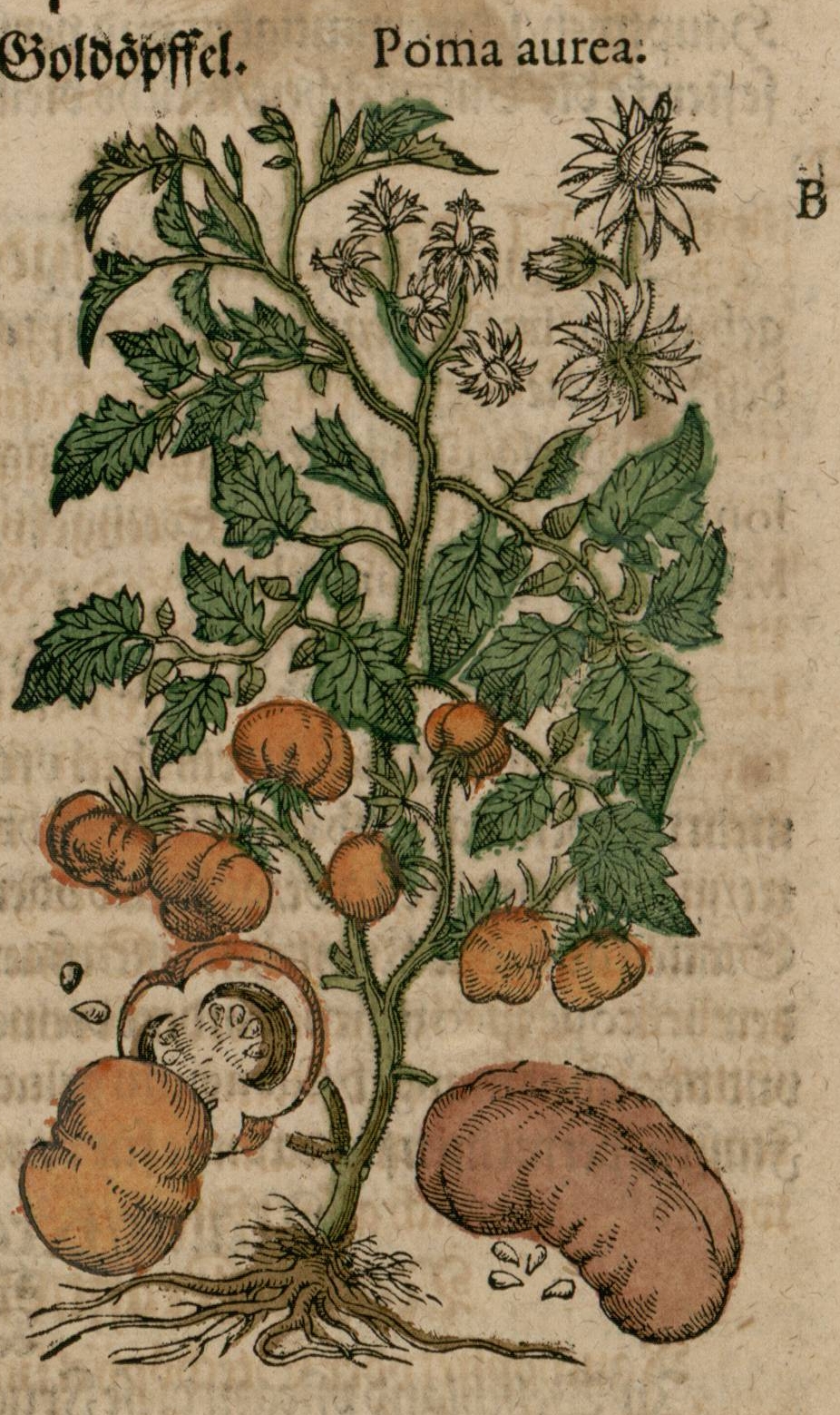
The tomato, too, comes from the Americas. It reached Europe in the sixteenth century (the years 1500 to 1599) and, for a long time, people distrusted it: it resembled poisonous plants. It was grown mostly as a curiosity; a few people already ate it, fried like aubergine.3
The first surviving recipe for tomato sauce dates from 1692. It was written in Naples by one Antonio Latini, and it accompanied boiled meat. Not pasta.4
It would take another century for someone to think of pouring this sauce over pasta.5
One detail deserves to be savoured. Latini was the steward of the prime minister of the Spanish viceroy of Naples. His recipe is called “tomato sauce in the Spanish style”.
The potato followed the same path. It too came from the Americas, and for a long time it was suspected of causing leprosy. It is often said that in 1748 the Parlement of Paris banned its cultivation — but the texts that say so do not cite the decree itself, and it is better to treat it as uncertain.6
The experiment is easy to carry out, and instructive. A search for this date brings it up in many texts, often with leprosy as the reason. It remains to be seen whether any of them cites the decree itself.7
A detail that everyone repeats and no one documents: that is exactly the signal that should raise the alarm.
Three invented origins, and datable ones
A cuisine readily gives itself an origin. Sometimes the day on which that origin was manufactured can be dated.
“Marco Polo brought pasta back from China.” The story was born in the late 1920s, in a trade journal of American pasta manufacturers. It recounts, in the manner of fiction, that one of Marco Polo’s sailors — named Spaghetti — saw a young woman making noodles. About ten years later, a film took up the scene.8
Yet pasta was already being eaten in Sicily. In 1154, a geographer described, near Palermo, a factory producing dried pasta exported to much of the Mediterranean. Marco Polo returned from China in 1295, a hundred and forty years later.9
“The Margherita pizza was created in 1889 for the queen.” All the evidence rests on a letter of thanks hanging on the wall of a pizzeria in Naples. A historian has examined it in three steps.10
Read it. It says only that the three kinds of pizza prepared were found delicious. Not a word about the tomato, the mozzarella, the basil, the flag, or the name Margherita. Even if genuine, it would not prove the story.
Compare it. The seal matches none of the official seals of the time — and it was applied with a rubber stamp. The signature does not resemble those of the same official. And the local records and the kingdom’s official gazette show no trace of the episode or of the letter.11
Ask who benefits from it. It is addressed to “Raffaele Esposito Brandi”. Brandi was his wife’s family name, which an Italian man of that time would not have borne. Her nephews took over the pizzeria in 1932 and called it “Brandi”.12
One last detail remains, the most delicious of all. This forgery was itself forged in turn. Another version of the letter circulates — the same, but without the name “Brandi” — which turned up in a Parisian pizzeria run by a distant relative of Esposito.13
When a document pays, it gets copied. When it gets copied, it gets touched up.
“Parmentier had his potato field guarded so that people would want to steal the potatoes.” It is found in 1814, shortly after Parmentier’s death, in a biography written by his friend Julien-Joseph Virey. A further clue undermines it decisively: a similar ruse is told of the King of Prussia. When the same story is told of two figures in two countries, it is no longer a memory.14
Three stories, three dates of invention: 1814, 1929, 1932. None is more Italian or more French than the others.
Cooking, and why
No human society eats its food as it finds it. All of them transform it, and they do so for four reasons, only one of which concerns pleasure.
- To make it edible. Many foods are indigestible, tough or toxic in their raw state. Cooking softens fibres, destroys certain poisons, and makes available nutrients that the body could not otherwise extract. Cooking is digestion done in advance, outside the body.
- To preserve it. A food deteriorates because micro-organisms settle in it. Depriving them of what they need stops them: drying removes water, salting makes it unavailable, smoking adds compounds that kill them, cooling slows them down, and sugaring or acidifying makes the medium uninhabitable for most of them.
- To make it safe. Heat destroys much of what makes people ill. This is the least visible function, and the most vital.
- To make it good. Taste comes last in this list, but it is taste that decides what we actually eat.
Taste combines five basic tastes perceived by the tongue — sweet, salty, sour, bitter and umami — with smells, temperature and texture. Much of what we call taste actually passes through the nose — precise percentages are often quoted, but without supporting evidence; most researchers agree that smell plays a dominant role. This is not the smell perceived as you bring the plate closer, but the one that rises from the back of the mouth to the nose while you chew. That is why everything seems bland when you have a cold, and why holding your nose makes it possible to swallow a bitter medicine.15
The tongue, for its part, distinguishes only the five basic tastes. The difference between a strawberry and a raspberry does not come from the tongue: it comes from the nose.
In practice, these four reasons cannot be separated. Smoking a fish preserves it, makes it safe and gives it its flavour — in a single action. That is precisely what makes the history of cooking hard to write: we do not always know which of the four reasons gave rise to a technique, nor whether those who used it knew themselves.
What is transformed
Cooking does not only make food good. It often makes it edible.
In Mesoamerica, maize is not cooked in plain water. It is cooked and soaked in limewater. The grain loses its outer coat and, above all, it releases a vitamin that otherwise remains locked away and unusable by the body.16
No one knew it in those terms. The vitamin was identified only in the twentieth century (the years 1900 to 1999). For three thousand years, people performed the right action without being able to explain it.
The same is true of fermentation. Fermenting is not letting food rot: it is deliberately introducing useful micro-organisms, which occupy the space and prevent others from settling. Bread, cheese, kimchi, injera, miso, fish sauces: a single principle, thousands of uses.
Here again, it was practised for millennia without anyone knowing why.
Understanding, when it finally came, did not come easily. Around 1835, three researchers — one Frenchman, two Germans — looked at yeast under the microscope and all three reached the same conclusion: it is a living being, and it is what produces fermentation.17
The greatest chemists of the day mocked them. Two of them even published a joke text, in which yeasts are described as tiny animals shaped like stills.18
It would take twenty years, and the work of Louis Pasteur, for the idea to be accepted. Both should be remembered: those who saw it first, and the one who got it accepted. They are not the same people.
And an error from which no one profited
A map of the tongue is often shown: sweet at the tip, salty and sour on the sides, bitter at the back. It is wrong. All areas of the tongue perceive all tastes.
It comes from a drawing published in 1942 by a Harvard professor, based on measurements made in 1901 and published without a scale. He misread them, and his textbook was authoritative. In 1974, the researcher Virginia Collings repeated the experiment and published the correction. That was more than fifty years ago, and the false map still appears in school textbooks.19
Here, no one stood to gain anything: no seller, no country to glorify, only a book that people took at its word. The case resembles that of the three researchers who were right about yeasts and were mocked for twenty years. Authority does not make something true. Nor does it make it false. It only decides what people listen to.
Measuring what is inside
Elsie Widdowson was a chemist. In 1933, in the kitchens of a London hospital, she approached a researcher named Robert McCance to tell him that he was using the wrong method to measure the sugar in apples. They would work together for sixty years.20
In 1940, they published a book giving, for most of the foods commonly eaten in Britain, what they contain — and what they still contain after cooking, something no one had done before. Almost all the nutritional tables in the world descend from it.21
Then the war restricted supplies, and the British government had to ration. Widdowson and McCance designed a diet based on what remained available: bread, cabbage, potatoes. They then did something unusual: they followed it themselves for three months, then set off to walk and climb in the mountains of northern England, in the depths of winter, to check that it was possible to work hard while eating this way.
Their conclusion changed the country’s policy: bread and vegetables remained off the ration, so that those doing heavy work would have enough energy. Their trials also led to calcium being added to all British bread, which is still done today.22
What is lost
Maize went round the world. The limewater technique, however, did not travel with it.
Where maize was adopted as a staple food without that technique being known — first in Europe, then in the United States — epidemics appeared: pellagra, a deficiency disease, with its sores, its fatigue and its disorders.23
A cuisine is therefore not a backdrop. It is a technique, and half of it can be lost along the way.
What we do not know
Almost all societies have rules about what may and may not be eaten. Some are religious, others are not.
So does ours, for that matter. There are animals that are eaten elsewhere and not eaten in France, without any law forbidding it. These rules go unnoticed because they are familiar.
Where do they come from? One explanation is often given: it was for hygiene, since meat used to spoil quickly.
Specialists do not accept it. First, because nothing was known about microbes at the time when these rules were laid down. Second, because it does not explain why one animal is forbidden and another is not, regardless of the danger.
An English anthropologist, Mary Douglas, proposed another idea in 1966: the animals set aside might be those that do not fit neatly into the categories of the world as these societies conceive it. Her phrase has stuck: dirt is matter out of place.24
Her explanation is debated too, and she acknowledged its weaknesses.
So we do not know. That is an honest answer.
What is lacking
In the global history of food, there is not only what circulates: there is also what is in short supply.
Five United Nations organisations publish a joint report on world hunger every year. In the mid-2020s, the figure announced is of the order of six hundred and fifty million people, or a little under eight in a hundred. It is falling slowly at the scale of the planet — but it is rising in Africa and Western Asia, and in Africa it now affects more than one person in five.25
This figure deserves a closer look, because it teaches something about figures themselves.
First, it is not an exact number: it is the middle of a range. For the year 2024, the report’s headline was “673 million”. But the body of the text states: between 638 and 720 million. Eighty-two million people separate the two bounds — and the number that gets remembered is simply the one in the middle.26
Second, it changes after the fact. The same year is put at 8.2% of the world population in one report, then at 8.1% in the next: estimates are revised as new data arrive. The report itself points out that recent global progress is partly explained by new data from India.27
This is not a flaw. It is how something so vast is measured. But it is better to know this before settling on a figure.
Note 1
The first written record of chili in China dates from 1591—and it isn’t exactly a rave review. Gao Lian, a playwright who lived near what is now Shanghai, wasn’t “all that excited about it as a condiment or a medicine,” Dott says of his account. Instead, he used it as a decorative plant.
Blakemore, Erin, “The surprising story of how chili crisp took over the world”, National Geographic, 12 April 2024
Note 2
Dott proposes that it became more prevalent in certain regions due to lack of access to salt (inland) as well as climate: […] Salt too was not cheap, as its production and marketing were government controlled and taxed.
Yee, Kristen, “‘The Chile Pepper in China: A Cultural Biography’ by Brian Dott”, Asian Review of Books, 11 May 2020
Note 3
Soon after the Spanish conquest of the Americas, the first tomatoes were presented as curiosities to the European elite and drew the attention of sixteenth-century Italian naturalists. […] In 1544, the Italian physician and botanist Pietro Andrea Matthioli (1501–1578) was the first person to mention the tomato in Europe […]
van Andel, Tinde, Vos, Rutger A., Michels, Ewout and Stefanaki, Anastasia, “Sixteenth-century tomatoes in Europe: who saw them, what they looked like, and where they came from”, PeerJ, vol. 10, e12790, 2022
It is well known that it took a long while for Italy to adopt the tomato as its national vegetable-like fruit. The tomato belongs to the nightshade family, along with a number of poisonous plants, not to mention tobacco, and its smell on the vine is not always reassuring.
Appelbaum, Robert, “Pomodoro! A History of the Tomato in Italy” (review of David Gentilcore’s book), Times Higher Education, 7 October 2010
When it arrived on the scene in Italy, it was strictly a curiosity for those who studied plants […] When people ate tomatoes, it was as a novelty.
History News Network, “Red Menace: David Gentilcore Talks the Tasty History of the Tomato”, 15 August 2010 (reprinted from the Boston Globe)
Another species [of eggplant, Solanum melongena L.] has been brought to Italy in our time, […] which is eaten in the same manner [as the eggplant: fried in oil with salt and pepper, like mushrooms]
van Andel, Tinde, Vos, Rutger A., Michels, Ewout and Stefanaki, Anastasia, “Sixteenth-century tomatoes in Europe: who saw them, what they looked like, and where they came from”, PeerJ, vol. 10, e12790, 2022
Note 4
salsa di pomodoro alla spagnuola
Spanish-style tomato sauce
Latini, Antonio, Lo scalco alla moderna, Naples, 1692-1694
Note 5
In the 19th century, with the south and especially Naples again leading the way, comes pasta al pomodoro, along with the pizza Margherita.
Appelbaum, Robert, “Pomodoro! A History of the Tomato in Italy” (review of David Gentilcore’s book), Times Higher Education, 7 October 2010
Note 6
où sa culture est interdite depuis 1748 par un arrêt du parlement de Paris.
where its cultivation has been banned since 1748 by a decree of the Parlement of Paris.
Académie nationale de médecine, “Antoine Parmentier (1737-1813), pharmacien, agronome, nutritionniste et hygiéniste”, s. d.
Note 7
and in 1748 growing potatoes was banned by parliament as they were thought to spread disease, especially leprosy.
The Connexion, “Potatoes were banned due to leprosy fears”, 19 July 2018
Note 8
The legend that noodles were brought to Italy by Marco Polo (1254–1324) is utterly spurious. The story was probably invented by the Macaroni National Manufacturers Association of America, and appeared in the late 1920s in their publication The Macaroni Journal.
Zancani, Diego, “Medieval Macaroni”, Lapham’s Quarterly, 12 December 2019 (excerpt from How We Fell in Love with Italian Food, Bodleian Library Publishing)
Note 9
We know from Muhammad al-Idrisi, the Moroccan-born geographer of Roger II, Norman king of Sicily, of a factory for dried pasta near Palermo in Sicily, which exported it to most of the Mediterranean.
Zancani, Diego, “Medieval Macaroni”, Lapham’s Quarterly, 12 December 2019 (excerpt from How We Fell in Love with Italian Food, Bodleian Library Publishing)
The task of constructing the world map and producing the book was accomplished in the month of Shawwal 548 (January 1154).
Ahmad, S. Maqbul, “Cartography of al-Sharīf al-Idrīsī”, in Harley, J. B. and Woodward, David (eds), The History of Cartography, vol. 2, book 1, Cartography in the Traditional Islamic and South Asian Societies, University of Chicago Press, 1992, pp. 156-174
Note 10
This article evaluates the creation myth of the pizza margherita as presented by those texts which presume to describe its history, as well as an alternative possibility for the story's genesis.
Nowak, Zachary, “Folklore, Fakelore, History: Invented Tradition and the Origins of the Pizza Margherita”, Food, Culture & Society, vol. 17, no. 1, 2014, p. 103-124, paywalled
Note 11
Samples of Galli's handwriting have been compared to the signature of the letter sent to Esposito; they do not match.
Phillips, Braden, “Pizza Margherita may be fit for a queen, but was it really named after one?”, National Geographic, 14 April 2022
the "seal" on the letter matches none of the historic official seals […] the royal seal was applied with a rubber stamp
Nowak, Zachary, “Folklore, Fakelore, History: Invented Tradition and the Origins of the Pizza Margherita”, Food, Culture & Society, vol. 17, no. 1, 2014, p. 103-124
Local records reveal no contemporary reference to the Esposito pizzeria incident. The Gazette of the Kingdom of Italy, which published royal news, has no mention of the queen's visit or Galli's letter to Esposito.
Phillips, Braden, “Pizza Margherita may be fit for a queen, but was it really named after one?”, National Geographic, 14 April 2022
Note 12
A possible clue lies in the name of the letter's recipient: Raffaele Esposito Brandi. […] Raffaele Esposito's wife, Maria Giovanna, had the maiden name of Brandi. […] Giovanni and Pasquale Brandi, Maria's nephews who took over the pizzeria in 1932.
Phillips, Braden, “Pizza Margherita may be fit for a queen, but was it really named after one?”, National Geographic, 14 April 2022
Note 13
Interestingly, this forgery was later forged: Benincasa reproduces another version of the letter (which does not have the name "Brandi"), apparently found in a Parisian pizzeria opened by a distant relative of Esposito.
Nowak, Zachary, “Folklore, Fakelore, History: Invented Tradition and the Origins of the Pizza Margherita”, Food, Culture & Society, vol. 17, no. 1, 2014, p. 103-124
Note 14
As Parmentier's collaborator Julien-Joseph Virey recounted in a posthumous biography of his friend and colleague, when these plants matured: […] Parmentier arranged for gendarmes to guard it – but only during the day. […] Nearly identical ruses were, allegedly, required to vanquish public opinion elsewhere in Europe.
Earle, Rebecca, Feeding the People: The Politics of the Potato, Cambridge University Press, 2020, chap. 2 “Enlightened Potatoes”, p. 52-78
Cependant celle des Sablons arrive à sa maturité. Parmentier obtient du lieutenant de police que des gendarmes en feront la garde pendant le jour seulement. C'était dans l'intention d'en faire voler pendant la nuit; le peuple n’y fit faute.
Meanwhile the crop on the Sablons field came to maturity. Parmentier obtained from the lieutenant of police that gendarmes would guard it during the day only. The intention was to have it stolen during the night; the people did not fail to do so.
Virey, Julien-Joseph, De la vie et des ouvrages d’Antoine Augustin Parmentier, Paris, impr. D. Colas, 1814, 21 p.
Der König, der sich mit der Psychologie offensichtlich gut auskannte, hat mit Schisslaweng noch einen Kniff eingesetzt: die königlichen Kartoffelanbauflächen sollten von Soldaten bewacht werden.
The king, who evidently knew a thing or two about psychology, used one more trick with panache: the royal potato fields were to be guarded by soldiers.
Gontarczyk-Krampe, Beata, “Kolumne „Aus der Zeit“: Von Weihnachtsbäumen und Erdbirnen”, Der Tagesspiegel, 27 December 2022
Note 15
Anyone whose enjoyment of food has been blunted by a bad cold knows that a good part of taste involves the sense of smell. Our taste buds distinguish five elemental sensations—sweet, sour, salty, savory and bitter—but food’s flavor arises from pleasant odors that enter our nasal passages through the back of the mouth.
Yale School of Medicine, “When it comes to taste, the nose knows”, Medicine@Yale, n. d.
It is frequently asserted that somewhere between 75 and 95 % of what we commonly think of as taste actually comes from the sense of smell. However, empirical evidence in support of such a precise-sounding quantitative claim is rarely, if ever, cited. […] most researchers would appear to agree that olfaction plays a “dominant” role in the tasting of food.
Spence, Charles, “Just how much of what we taste derives from the sense of smell?”, Flavour, vol. 4, art. 30, 2015
Odor molecules also reach the olfactory receptor cells via the retronasal route, from the back of the oral cavity through the nasopharynx into the back of the nasal cavity. Although the orthonasal route is the one usually used to test for smell perception, the retronasal route is the main source of the smells we perceive from foods and liquids within our mouths.
Shepherd, Gordon M., “The Human Sense of Smell: Are We Better Than We Think?”, PLoS Biology, vol. 2, no. 5, e146, 2004
Note 16
In maize, niacin is present in covalently bound complexes with small peptides and carbohydrates and is therefore unavailable when eaten. […] It has long been a tradition in Central America to soak maize in lime-water prior to the preparation of tortillas. […] This practice effectively liberates the bound niacin
World Health Organization, Pellagra and its prevention and control in major emergencies, WHO/NHD/00.10, WHO, 2000
Note 17
the independent proposals by a French physical engineer, Charles Cagniard-Latour [24], a medically-trained German investigator, Theodor Schwann [25], and a German pharmacist, Friedrich Kützing, that these microscopic unicellular organisms nourish themselves by the sugar that they ferment.
Dixon, Thomas A. and Pretorius, Isak S., “Drawing on the Past to Shape the Future of Synthetic Yeast Research”, International Journal of Molecular Sciences, vol. 21, no. 19, 7156, 2020
No less than three observers hit almost simultaneously upon the secret of fermentation and declared that yeast was a living organism. […] Cagniard-Latour […] who made a number of communications to the Academy and to the Société Philomatique in 1835–6, […] The observations upon which this memoir was based were almost exclusively microscopical.
Harden, Arthur, Alcoholic Fermentation, 2nd ed., London, Longmans, Green and Co., coll. “Monographs on Biochemistry”, 1914
Note 18
To the scorn of Berzelius was soon added the sarcasm of Wöhler and Liebig […] Wöhler prepared an elaborate skit on the subject, which he sent to Liebig, to whom it appealed so strongly that he added some touches of his own and published it […] consisting of eggs which developed into minute animals, shaped like a distilling apparatus
Harden, Arthur, Alcoholic Fermentation, 2nd ed., London, Longmans, Green and Co., coll. “Monographs on Biochemistry”, 1914
Note 19
The results showed greater differences between loci than previously reported. Contrary to older data, the threshold for bitter was found to be lower for the fungiform papillae at the front of the tongue and for the soft palate than for the vallate papillae.
Collings, Virginia B., “Human Taste Response as a Function of Locus of Stimulation on the Tongue and Soft Palate”, Perception & Psychophysics, vol. 16, no. 1, 1974, p. 169-174
Note 20
The turning point in her life came when, at the end of her PhD analysing apples for different carbohydrates, she decided to go to King's College Hospital to learn about large-scale cooking before starting a dietetics course. […] A trip to the kitchens brought her into contact with Robert McCance [Munk’s Roll, Vol.IX, p.327], who was analysing plant foods for carbohydrate to plan diabetic diets. In an inauspicious start, she had the cheek to tell him that he was using the wrong methods to determine the sugar content of apples! But no matter, this led to a scientific partnership that was to last 60 years.
Ashwell, Margaret, “Elsie May Widdowson”, Munk’s Roll, vol. XII, Royal College of Physicians
Note 21
By 1939, when the first edition of these tables was published, this systematised analytical procedure had been applied by Dr. McCance and his colleagues to most of the foods commonly eaten in Great Britain. The method of approach had been somewhat different from that of previous workers in the same field; for the foods had been analysed, not only in the raw state, but also as prepared for the table, and studies had been made of the losses introduced by cooking.
McCance, Robert A. and Widdowson, Elsie M., The Chemical Composition of Foods, 2nd revised ed., Brooklyn, Chemical Publishing Co., 1947 (authorised reprint of the British HMSO edition)
In 1940 their findings were published as Chemical composition of foods, the first of now regularly produced Standard Food Composition publications.
Wellcome Collection, “McCance, Robert Alexander (1898-1993), and Widdowson, Elsie May (1908-2000)”, archive collection record
Note 22
To show they could, McCance, Widdowson and several colleagues followed the diet to the letter for three months. […] Immediately after Christmas 1939, they set out for the Lake District. They hiked energetically across the fells for 10 days with little to eat but bread. […] The results proved clear cut: brown bread did reduce calcium absorption. As a result, every British loaf to this day is fortified with calcium carbonate.
Ashwell, Margaret, “Elsie May Widdowson”, Munk’s Roll, vol. XII, Royal College of Physicians
Note 23
To live in the American South in the early 1900s, you would have had to survive an uncontrolled epidemic known for its fatal consequences. The disease, pellagra, had been a worldwide scourge for about two centuries, with no known treatment. […] Goldberger had determined that pellagra was caused by a deficiency of unknown nutrients, rather than by infectious organisms.
Margolin, Gordon, “From the Annals of NIH History: Dr. Joseph Goldberger and Pellagra: A Fearsome Disease Tamed”, The NIH Catalyst, vol. 27, no. 6, November-December 2019
Note 24
Purity and Danger, a book exploring the concepts of pollution and taboo in societies around the world, made its author Mary Douglas one of Britain's most celebrated anthropologists. […] In 1966, Mary Douglas published Purity and Danger, which remains her best-known book.
British Academy, “Great Thinkers: Richard Fardon FBA on Mary Douglas FBA”, 1 July 2019
She began her biblical adventures in 1966 with "The Abominations of Leviticus," […] which remains her best-known and most frequently anthologized essay. In it she recast the study of biblical ritual into a new key – focusing on the anomalies ("dirt is matter out of place") that illuminate the conceptual categories at the heart of ancient Israel's religious and cosmological vision.
Hendel, Ronald and Olyan, Saul M., “Beyond Purity and Danger: Mary Douglas and the Hebrew Bible”, The Journal of Hebrew Scriptures, vol. 8, art. 7, 2008
Note 25
Every year, this most intensely scrutinized of FAO's reports presents the headline number of undernourished people […] SOFI is jointly produced with fellow UN agencies IFAD, UNICEF, WFP and WHO.
FAO, FIDA, UNICEF, PAM and OMS, L’État de la sécurité alimentaire et de la nutrition dans le monde, rapport annuel, Rome
Unfortunately, this positive trend contrasts with the continuing rise in hunger in most subregions of Africa and in Western Asia (Figure 2.2). […] The PoU in Africa surpassed 20 percent in 2024.
FAO, FIDA, UNICEF, PAM and OMS, L’État de la sécurité alimentaire et de la nutrition dans le monde, rapport annuel, Rome
Note 26
It is estimated that between 638 and 720 million people (7.8 to 8.8 percent of the global population) faced hunger in 2024. Considering the point estimate (673 million)
FAO, FIDA, UNICEF, PAM and OMS, L’État de la sécurité alimentaire et de la nutrition dans le monde, rapport annuel, Rome
Note 27
An estimated 8.2 percent of the global population, or about 673 million people, experienced hunger in 2024
FAO, FIDA, UNICEF, PAM and OMS, L’État de la sécurité alimentaire et de la nutrition dans le monde, rapport annuel, Rome
7.8 per cent of the global population faced hunger in 2025, down from 8.1 per cent in 2024
FAO, FIDA, UNICEF, PAM and OMS, L’État de la sécurité alimentaire et de la nutrition dans le monde, rapport annuel, Rome
The progress seen at the global level is driven by notable improvement in South-eastern Asia, Southern Asia – which mainly reflects the impact of new data from India
FAO, FIDA, UNICEF, PAM and OMS, L’État de la sécurité alimentaire et de la nutrition dans le monde, rapport annuel, Rome
Notes and sources
- ↑
Passage It was first mentioned in 1591
The first written record of chili in China dates from 1591—and it isn’t exactly a rave review. Gao Lian, a playwright who lived near what is now Shanghai, wasn’t “all that excited about it as a condiment or a medicine,” Dott says of his account. Instead, he used it as a decorative plant.
Source Blakemore, Erin, “The surprising story of how chili crisp took over the world”, National Geographic, 12 April 2024, section “A spicy introduction”, 2nd paragraph.
Open access open the source · checked on 27 October 2026
Passage by a playwright, Gao Lian, who used it as a decorative plant and was not much excited about it as a condiment or a medicine
The first written record of chili in China dates from 1591—and it isn’t exactly a rave review. Gao Lian, a playwright who lived near what is now Shanghai, wasn’t “all that excited about it as a condiment or a medicine,” Dott says of his account. Instead, he used it as a decorative plant.
Source Blakemore, Erin, “The surprising story of how chili crisp took over the world”, National Geographic, 12 April 2024, section “A spicy introduction”, 2nd paragraph.
Open access open the source · checked on 27 October 2026
- ↑
Passage salt was expensive there, because the Chinese state held a monopoly on it and taxed it
Dott proposes that it became more prevalent in certain regions due to lack of access to salt (inland) as well as climate: […] Salt too was not cheap, as its production and marketing were government controlled and taxed.
Source Yee, Kristen, “‘The Chile Pepper in China: A Cultural Biography’ by Brian Dott”, Asian Review of Books, 11 May 2020, online review, paragraph on Sichuan pepper and regional diffusion, then the indented quotation that follows it (3rd sentence).
Open access open the source · checked on 27 October 2026
- ↑
Passage It reached Europe in the sixteenth century
Soon after the Spanish conquest of the Americas, the first tomatoes were presented as curiosities to the European elite and drew the attention of sixteenth-century Italian naturalists. […] In 1544, the Italian physician and botanist Pietro Andrea Matthioli (1501–1578) was the first person to mention the tomato in Europe […]
Source van Andel, Tinde, Vos, Rutger A., Michels, Ewout and Stefanaki, Anastasia, “Sixteenth-century tomatoes in Europe: who saw them, what they looked like, and where they came from”, PeerJ, vol. 10, e12790, 2022, abstract (1st sentence) and section “The first mention of a tomato (1544)”, 1st sentence.
Open access open the source · checked on 27 October 2026
Passage for a long time, people distrusted it
It is well known that it took a long while for Italy to adopt the tomato as its national vegetable-like fruit. The tomato belongs to the nightshade family, along with a number of poisonous plants, not to mention tobacco, and its smell on the vine is not always reassuring.
Source Appelbaum, Robert, “Pomodoro! A History of the Tomato in Italy” (review of David Gentilcore’s book), Times Higher Education, 7 October 2010, online review, 4th paragraph, 1st and 2nd sentences.
Open access open the source · checked on 27 October 2026
Passage It was grown mostly as a curiosity
When it arrived on the scene in Italy, it was strictly a curiosity for those who studied plants […] When people ate tomatoes, it was as a novelty.
Source History News Network, “Red Menace: David Gentilcore Talks the Tasty History of the Tomato”, 15 August 2010 (reprinted from the Boston Globe), article, paragraphs on the tomato’s arrival in Italy.
Open access open the source · checked on 28 October 2026
Passage It was grown mostly as a curiosity; a few people already ate it, fried like aubergine.
Another species [of eggplant, Solanum melongena L.] has been brought to Italy in our time, […] which is eaten in the same manner [as the eggplant: fried in oil with salt and pepper, like mushrooms]
Source van Andel, Tinde, Vos, Rutger A., Michels, Ewout and Stefanaki, Anastasia, “Sixteenth-century tomatoes in Europe: who saw them, what they looked like, and where they came from”, PeerJ, vol. 10, e12790, 2022, section “The first mention of a tomato (1544)” (English translation of Matthioli’s text, 1544).
Open access open the source · checked on 28 October 2026
- ↑
Passage The first surviving recipe for tomato sauce dates from 1692 […] His recipe is called “tomato sauce in the Spanish style”.
salsa di pomodoro alla spagnuola
Editors’ translation Spanish-style tomato sauce
Source Latini, Antonio, Lo scalco alla moderna, Naples, 1692-1694, volume I.
Public domain open the source · checked on 9 September 2026
- ↑
Passage It would take another century for someone to think of pouring this sauce over pasta.
In the 19th century, with the south and especially Naples again leading the way, comes pasta al pomodoro, along with the pizza Margherita.
Source Appelbaum, Robert, “Pomodoro! A History of the Tomato in Italy” (review of David Gentilcore’s book), Times Higher Education, 7 October 2010, online review, paragraph on the chronology of the culinary use of the tomato.
Open access open the source · checked on 27 October 2026
- ↑
Passage It is often said that in 1748 the Parlement of Paris banned its cultivation — but the texts that say so do not cite the decree itself
où sa culture est interdite depuis 1748 par un arrêt du parlement de Paris.
Editors’ translation where its cultivation has been banned since 1748 by a decree of the Parlement of Paris.
Source Académie nationale de médecine, “Antoine Parmentier (1737-1813), pharmacien, agronome, nutritionniste et hygiéniste”, s. d., passage on the promotion of the potato in France.
Open access open the source · checked on 24 October 2026
- ↑
Passage often with leprosy as the reason
and in 1748 growing potatoes was banned by parliament as they were thought to spread disease, especially leprosy.
Source The Connexion, “Potatoes were banned due to leprosy fears”, 19 July 2018, body of the article.
Open access open the source · checked on 24 October 2026
- ↑
Passage in a trade journal of American pasta manufacturers
The legend that noodles were brought to Italy by Marco Polo (1254–1324) is utterly spurious. The story was probably invented by the Macaroni National Manufacturers Association of America, and appeared in the late 1920s in their publication The Macaroni Journal.
Source Zancani, Diego, “Medieval Macaroni”, Lapham’s Quarterly, 12 December 2019 (excerpt from How We Fell in Love with Italian Food, Bodleian Library Publishing), online article (book excerpt), paragraph on the Marco Polo legend.
Open access open the source · checked on 27 October 2026
Passage The story was born in the late 1920s
The legend that noodles were brought to Italy by Marco Polo (1254–1324) is utterly spurious. The story was probably invented by the Macaroni National Manufacturers Association of America, and appeared in the late 1920s in their publication The Macaroni Journal.
Source Zancani, Diego, “Medieval Macaroni”, Lapham’s Quarterly, 12 December 2019 (excerpt from How We Fell in Love with Italian Food, Bodleian Library Publishing), online article (excerpt from the book), paragraph on the Marco Polo legend.
Open access open the source · checked on 27 October 2026
- ↑
Passage near Palermo, a factory producing dried pasta exported to much of the Mediterranean
We know from Muhammad al-Idrisi, the Moroccan-born geographer of Roger II, Norman king of Sicily, of a factory for dried pasta near Palermo in Sicily, which exported it to most of the Mediterranean.
Source Zancani, Diego, “Medieval Macaroni”, Lapham’s Quarterly, 12 December 2019 (excerpt from How We Fell in Love with Italian Food, Bodleian Library Publishing), online article (book excerpt), paragraph on the earliest dried pasta.
Open access open the source · checked on 27 October 2026
Passage In 1154, a geographer described
The task of constructing the world map and producing the book was accomplished in the month of Shawwal 548 (January 1154).
Source Ahmad, S. Maqbul, “Cartography of al-Sharīf al-Idrīsī”, in Harley, J. B. and Woodward, David (eds), The History of Cartography, vol. 2, book 1, Cartography in the Traditional Islamic and South Asian Societies, University of Chicago Press, 1992, pp. 156-174.
Open access open the source · checked on 27 October 2026
- ↑
Passage The Margherita pizza was created in 1889 for the queen
This article evaluates the creation myth of the pizza margherita as presented by those texts which presume to describe its history, as well as an alternative possibility for the story's genesis.
Source Nowak, Zachary, “Folklore, Fakelore, History: Invented Tradition and the Origins of the Pizza Margherita”, Food, Culture & Society, vol. 17, no. 1, 2014, p. 103-124, paywalled, abstract (first sentence).
Paywalled · checked on 25 October 2026
- ↑
Passage The signature does not resemble those of the same official
Samples of Galli's handwriting have been compared to the signature of the letter sent to Esposito; they do not match.
Source Phillips, Braden, “Pizza Margherita may be fit for a queen, but was it really named after one?”, National Geographic, 14 April 2022, online article, passage on the authenticity of the letter.
Open access open the source · checked on 27 October 2026
Passage The seal matches none of the official seals of the time — and it was applied with a rubber stamp
the "seal" on the letter matches none of the historic official seals […] the royal seal was applied with a rubber stamp
Source Nowak, Zachary, “Folklore, Fakelore, History: Invented Tradition and the Origins of the Pizza Margherita”, Food, Culture & Society, vol. 17, no. 1, 2014, p. 103-124.
Paywalled · checked on 9 September 2026
Passage the local records and the kingdom’s official gazette show no trace of the episode or of the letter
Local records reveal no contemporary reference to the Esposito pizzeria incident. The Gazette of the Kingdom of Italy, which published royal news, has no mention of the queen's visit or Galli's letter to Esposito.
Source Phillips, Braden, “Pizza Margherita may be fit for a queen, but was it really named after one?”, National Geographic, 14 April 2022, online article, section “Changing cuisines”, paragraph beginning “Local records reveal”.
Open access open the source · checked on 27 October 2026
- ↑
Passage It is addressed to “Raffaele Esposito Brandi”. Brandi was his wife’s family name […] Her nephews took over the pizzeria in 1932
A possible clue lies in the name of the letter's recipient: Raffaele Esposito Brandi. […] Raffaele Esposito's wife, Maria Giovanna, had the maiden name of Brandi. […] Giovanni and Pasquale Brandi, Maria's nephews who took over the pizzeria in 1932.
Source Phillips, Braden, “Pizza Margherita may be fit for a queen, but was it really named after one?”, National Geographic, 14 April 2022, online article, passage on the recipient of the letter and the Brandi nephews.
Open access open the source · checked on 27 October 2026
- ↑
Passage This forgery was itself forged in turn. Another version of the letter circulates — the same, but without the name “Brandi”
Interestingly, this forgery was later forged: Benincasa reproduces another version of the letter (which does not have the name "Brandi"), apparently found in a Parisian pizzeria opened by a distant relative of Esposito.
Source Nowak, Zachary, “Folklore, Fakelore, History: Invented Tradition and the Origins of the Pizza Margherita”, Food, Culture & Society, vol. 17, no. 1, 2014, p. 103-124.
Paywalled · checked on 9 September 2026
- ↑
Passage It is found in 1814, shortly after Parmentier’s death, in a biography written by his friend Julien-Joseph Virey.
As Parmentier's collaborator Julien-Joseph Virey recounted in a posthumous biography of his friend and colleague, when these plants matured: […] Parmentier arranged for gendarmes to guard it – but only during the day. […] Nearly identical ruses were, allegedly, required to vanquish public opinion elsewhere in Europe.
Source Earle, Rebecca, Feeding the People: The Politics of the Potato, Cambridge University Press, 2020, chap. 2 “Enlightened Potatoes”, p. 52-78, chap. 2 “Enlightened Potatoes” (p. 52-78), passage on Parmentier and the following paragraph.
Open access open the source · checked on 24 October 2026
Passage It is found in 1814, shortly after Parmentier’s death, in a biography written by his friend Julien-Joseph Virey.
Cependant celle des Sablons arrive à sa maturité. Parmentier obtient du lieutenant de police que des gendarmes en feront la garde pendant le jour seulement. C'était dans l'intention d'en faire voler pendant la nuit; le peuple n’y fit faute.
Editors’ translation Meanwhile the crop on the Sablons field came to maturity. Parmentier obtained from the lieutenant of police that gendarmes would guard it during the day only. The intention was to have it stolen during the night; the people did not fail to do so.
Source Virey, Julien-Joseph, De la vie et des ouvrages d’Antoine Augustin Parmentier, Paris, impr. D. Colas, 1814, 21 p., p. 12 (image 64 of the copy digitised by the Wellcome Collection, bound after Cadet de Gassicourt’s eulogy); title page (image 53): “PAR J.-J. VIREY”, “A PARIS, DE L’IMPRIMERIE DE D. COLAS”, “JANVIER 1814”.
Public domain open the source · checked on 27 October 2026
Passage a similar ruse is told of the King of Prussia.
Der König, der sich mit der Psychologie offensichtlich gut auskannte, hat mit Schisslaweng noch einen Kniff eingesetzt: die königlichen Kartoffelanbauflächen sollten von Soldaten bewacht werden.
Editors’ translation The king, who evidently knew a thing or two about psychology, used one more trick with panache: the royal potato fields were to be guarded by soldiers.
Source Gontarczyk-Krampe, Beata, “Kolumne „Aus der Zeit“: Von Weihnachtsbäumen und Erdbirnen”, Der Tagesspiegel, 27 December 2022, body of the column, passage on Frederick II and the potato.
Open access open the source · checked on 24 October 2026
- ↑
Passage Much of what we call taste actually passes through the nose
Anyone whose enjoyment of food has been blunted by a bad cold knows that a good part of taste involves the sense of smell. Our taste buds distinguish five elemental sensations—sweet, sour, salty, savory and bitter—but food’s flavor arises from pleasant odors that enter our nasal passages through the back of the mouth.
Source Yale School of Medicine, “When it comes to taste, the nose knows”, Medicine@Yale, n. d., online article, 1st paragraph.
Open access open the source · checked on 27 October 2026
Passage precise percentages are often quoted, but without supporting evidence; most researchers agree that smell plays a dominant role
It is frequently asserted that somewhere between 75 and 95 % of what we commonly think of as taste actually comes from the sense of smell. However, empirical evidence in support of such a precise-sounding quantitative claim is rarely, if ever, cited. […] most researchers would appear to agree that olfaction plays a “dominant” role in the tasting of food.
Source Spence, Charles, “Just how much of what we taste derives from the sense of smell?”, Flavour, vol. 4, art. 30, 2015, abstract, 1st, 2nd and 7th sentences.
Open access open the source · checked on 28 October 2026
Passage the one that rises from the back of the mouth to the nose while you chew
Odor molecules also reach the olfactory receptor cells via the retronasal route, from the back of the oral cavity through the nasopharynx into the back of the nasal cavity. Although the orthonasal route is the one usually used to test for smell perception, the retronasal route is the main source of the smells we perceive from foods and liquids within our mouths.
Source Shepherd, Gordon M., “The Human Sense of Smell: Are We Better Than We Think?”, PLoS Biology, vol. 2, no. 5, e146, 2004, section “Humans Receive Richer Retronasal Smells”, 2nd and 3rd sentences.
Open access open the source · checked on 27 October 2026
- ↑
Passage soaked in limewater […] it releases a vitamin that otherwise remains locked away
In maize, niacin is present in covalently bound complexes with small peptides and carbohydrates and is therefore unavailable when eaten. […] It has long been a tradition in Central America to soak maize in lime-water prior to the preparation of tortillas. […] This practice effectively liberates the bound niacin
Source World Health Organization, Pellagra and its prevention and control in major emergencies, WHO/NHD/00.10, WHO, 2000, chapter “Sources of niacin and its stability in foods”, section “Availability in foods”, p. 15.
Open access open the source · checked on 27 October 2026
- ↑
Passage three researchers — one Frenchman, two Germans — looked at yeast under the microscope and all three reached the same conclusion
the independent proposals by a French physical engineer, Charles Cagniard-Latour [24], a medically-trained German investigator, Theodor Schwann [25], and a German pharmacist, Friedrich Kützing, that these microscopic unicellular organisms nourish themselves by the sugar that they ferment.
Source Dixon, Thomas A. and Pretorius, Isak S., “Drawing on the Past to Shape the Future of Synthetic Yeast Research”, International Journal of Molecular Sciences, vol. 21, no. 19, 7156, 2020, section 2 “The Effervescent Spirit of Yeast Fermentation”.
Open access open the source · checked on 27 October 2026
Passage Around 1835, three researchers […] looked at yeast under the microscope and all three reached the same conclusion
No less than three observers hit almost simultaneously upon the secret of fermentation and declared that yeast was a living organism. […] Cagniard-Latour […] who made a number of communications to the Academy and to the Société Philomatique in 1835–6, […] The observations upon which this memoir was based were almost exclusively microscopical.
Source Harden, Arthur, Alcoholic Fermentation, 2nd ed., London, Longmans, Green and Co., coll. “Monographs on Biochemistry”, 1914, chap. I, “Historical Introduction”.
Public domain open the source · checked on 27 October 2026
- ↑
Passage Two of them even published a joke text, in which yeasts are described as tiny animals shaped like stills.
To the scorn of Berzelius was soon added the sarcasm of Wöhler and Liebig […] Wöhler prepared an elaborate skit on the subject, which he sent to Liebig, to whom it appealed so strongly that he added some touches of his own and published it […] consisting of eggs which developed into minute animals, shaped like a distilling apparatus
Source Harden, Arthur, Alcoholic Fermentation, 2nd ed., London, Longmans, Green and Co., coll. “Monographs on Biochemistry”, 1914, chapter I “Historical Introduction”.
Public domain open the source · checked on 27 October 2026
- ↑
Passage In 1974, the researcher Virginia Collings repeated the experiment and published the correction.
The results showed greater differences between loci than previously reported. Contrary to older data, the threshold for bitter was found to be lower for the fungiform papillae at the front of the tongue and for the soft palate than for the vallate papillae.
Source Collings, Virginia B., “Human Taste Response as a Function of Locus of Stimulation on the Tongue and Soft Palate”, Perception & Psychophysics, vol. 16, no. 1, 1974, p. 169-174, abstract.
Paywalled open the source · checked on 25 October 2026
- ↑
Passage in the kitchens of a London hospital, she approached a researcher named Robert McCance to tell him that he was using the wrong method to measure the sugar in apples. They would work together for sixty years.
The turning point in her life came when, at the end of her PhD analysing apples for different carbohydrates, she decided to go to King's College Hospital to learn about large-scale cooking before starting a dietetics course. […] A trip to the kitchens brought her into contact with Robert McCance [Munk’s Roll, Vol.IX, p.327], who was analysing plant foods for carbohydrate to plan diabetic diets. In an inauspicious start, she had the cheek to tell him that he was using the wrong methods to determine the sugar content of apples! But no matter, this led to a scientific partnership that was to last 60 years.
Source Ashwell, Margaret, “Elsie May Widdowson”, Munk’s Roll, vol. XII, Royal College of Physicians, online entry, paragraphs on the beginnings of her career.
Open access open the source · checked on 9 September 2026
- ↑
Passage In 1940, they published a book giving, for most of the foods commonly eaten in Britain, what they contain — and what they still contain after cooking
By 1939, when the first edition of these tables was published, this systematised analytical procedure had been applied by Dr. McCance and his colleagues to most of the foods commonly eaten in Great Britain. The method of approach had been somewhat different from that of previous workers in the same field; for the foods had been analysed, not only in the raw state, but also as prepared for the table, and studies had been made of the losses introduced by cooking.
Source McCance, Robert A. and Widdowson, Elsie M., The Chemical Composition of Foods, 2nd revised ed., Brooklyn, Chemical Publishing Co., 1947 (authorised reprint of the British HMSO edition), preface (unpaginated in the digitised text), 1st and 2nd sentences of the passage on the first edition.
Public domain open the source · checked on 27 October 2026
Passage In 1940, they published a book
In 1940 their findings were published as Chemical composition of foods, the first of now regularly produced Standard Food Composition publications.
Source Wellcome Collection, “McCance, Robert Alexander (1898-1993), and Widdowson, Elsie May (1908-2000)”, archive collection record, archive collection record, “Description” field.
Open access open the source · checked on 27 October 2026
- ↑
Passage they followed it themselves for three months, then set off to walk and climb in the mountains […] Their trials also led to calcium being added to all British bread, which is still done today.
To show they could, McCance, Widdowson and several colleagues followed the diet to the letter for three months. […] Immediately after Christmas 1939, they set out for the Lake District. They hiked energetically across the fells for 10 days with little to eat but bread. […] The results proved clear cut: brown bread did reduce calcium absorption. As a result, every British loaf to this day is fortified with calcium carbonate.
Source Ashwell, Margaret, “Elsie May Widdowson”, Munk’s Roll, vol. XII, Royal College of Physicians, online entry, paragraphs on the war.
Open access open the source · checked on 9 September 2026
- ↑
Passage epidemics appeared: pellagra, a deficiency disease
To live in the American South in the early 1900s, you would have had to survive an uncontrolled epidemic known for its fatal consequences. The disease, pellagra, had been a worldwide scourge for about two centuries, with no known treatment. […] Goldberger had determined that pellagra was caused by a deficiency of unknown nutrients, rather than by infectious organisms.
Source Margolin, Gordon, “From the Annals of NIH History: Dr. Joseph Goldberger and Pellagra: A Fearsome Disease Tamed”, The NIH Catalyst, vol. 27, no. 6, November-December 2019, 2nd paragraph (first two sentences) and 7th paragraph.
Open access open the source · checked on 27 October 2026
- ↑
Passage An English anthropologist, Mary Douglas, proposed another idea in 1966
Purity and Danger, a book exploring the concepts of pollution and taboo in societies around the world, made its author Mary Douglas one of Britain's most celebrated anthropologists. […] In 1966, Mary Douglas published Purity and Danger, which remains her best-known book.
Source British Academy, “Great Thinkers: Richard Fardon FBA on Mary Douglas FBA”, 1 July 2019, podcast page, introductory paragraph, then passage on Purity and Danger.
Open access open the source · checked on 27 October 2026
Passage the animals set aside might be those that do not fit neatly into the categories of the world
She began her biblical adventures in 1966 with "The Abominations of Leviticus," […] which remains her best-known and most frequently anthologized essay. In it she recast the study of biblical ritual into a new key – focusing on the anomalies ("dirt is matter out of place") that illuminate the conceptual categories at the heart of ancient Israel's religious and cosmological vision.
Source Hendel, Ronald and Olyan, Saul M., “Beyond Purity and Danger: Mary Douglas and the Hebrew Bible”, The Journal of Hebrew Scriptures, vol. 8, art. 7, 2008, introduction, p. 2, 1st paragraph.
Open access open the source · checked on 27 October 2026
- ↑
Passage Five United Nations organisations publish a joint report on world hunger every year.
Every year, this most intensely scrutinized of FAO's reports presents the headline number of undernourished people […] SOFI is jointly produced with fellow UN agencies IFAD, UNICEF, WFP and WHO.
Source FAO, FIDA, UNICEF, PAM and OMS, L’État de la sécurité alimentaire et de la nutrition dans le monde, rapport annuel, Rome, presentation page of the publication (fao.org/publications/sofi).
Open access open the source · checked on 9 September 2026
Passage it is rising in Africa and Western Asia, and in Africa it now affects more than one person in five
Unfortunately, this positive trend contrasts with the continuing rise in hunger in most subregions of Africa and in Western Asia (Figure 2.2). […] The PoU in Africa surpassed 20 percent in 2024.
Source FAO, FIDA, UNICEF, PAM and OMS, L’État de la sécurité alimentaire et de la nutrition dans le monde, rapport annuel, Rome, 2025 edition, section 2.1.1 (Prevalence of undernourishment).
Open access open the source · checked on 9 September 2026
- ↑
Passage the report’s headline was “673 million”. But the body of the text states: between 638 and 720 million.
It is estimated that between 638 and 720 million people (7.8 to 8.8 percent of the global population) faced hunger in 2024. Considering the point estimate (673 million)
Source FAO, FIDA, UNICEF, PAM and OMS, L’État de la sécurité alimentaire et de la nutrition dans le monde, rapport annuel, Rome, 2025 edition, section 2.1.1 (Prevalence of undernourishment).
Open access open the source · checked on 9 September 2026
- ↑
Passage The same year is put at 8.2% of the world population in one report
An estimated 8.2 percent of the global population, or about 673 million people, experienced hunger in 2024
Source FAO, FIDA, UNICEF, PAM and OMS, L’État de la sécurité alimentaire et de la nutrition dans le monde, rapport annuel, Rome, 2025 edition, joint launch press release (July 2025).
Open access open the source · checked on 24 October 2026
Passage then at 8.1% in the next
7.8 per cent of the global population faced hunger in 2025, down from 8.1 per cent in 2024
Source FAO, FIDA, UNICEF, PAM and OMS, L’État de la sécurité alimentaire et de la nutrition dans le monde, rapport annuel, Rome, 2026 edition, joint launch press release (July 2026).
Open access open the source · checked on 24 October 2026
Passage The report itself points out that recent global progress is partly explained by new data from India
The progress seen at the global level is driven by notable improvement in South-eastern Asia, Southern Asia – which mainly reflects the impact of new data from India
Source FAO, FIDA, UNICEF, PAM and OMS, L’État de la sécurité alimentaire et de la nutrition dans le monde, rapport annuel, Rome, body of the report.
Open access open the source · checked on 9 September 2026
Bibliography
39
- Académie nationale de médecine, “Antoine Parmentier (1737-1813), pharmacien, agronome, nutritionniste et hygiéniste”, s. d., document diffusé par la bibliothèque universitaire de l’université de Picardie, open access (an example of a text that repeats the 1748 ban without citing the decree). https://bu-old.u-picardie.fr/wp-content/uploads/PDF/PDFSante/Picards/AntoineParmentier.pdf
- Ahmad, S. Maqbul, “Cartography of al-Sharīf al-Idrīsī”, in Harley, J. B. and Woodward, David (eds), The History of Cartography, vol. 2, book 1, Cartography in the Traditional Islamic and South Asian Societies, University of Chicago Press, 1992, pp. 156-174, open access (al-Idrisi’s book for Roger II, completed in January 1154). https://www.press.uchicago.edu/books/hoc/HOC_V2_B1/HOC_VOLUME2_Book1_chapter7.pdf
- Appelbaum, Robert, “Pomodoro! A History of the Tomato in Italy” (review of David Gentilcore’s book), Times Higher Education, 7 October 2010, open access (pasta with tomato, which appeared in the nineteenth century, with Naples in the lead). https://www.timeshighereducation.com/node/80992
- Ashwell, Margaret, “Elsie May Widdowson”, Munk’s Roll, vol. XII, Royal College of Physicians, open access (the meeting with McCance in the kitchens of King’s College Hospital, the wartime diet tested on themselves, the calcium added to bread). https://history.rcp.ac.uk/inspiring-physicians/elsie-may-widdowson
- Ashwell, Margaret, “Elsie May Widdowson, C.H., 21 October 1906 – 14 June 2000”, Biographical Memoirs of Fellows of the Royal Society, vol. 48, 2002, p. 483-506, paywalled.
- Barnett, James A., “A History of Research on Yeasts 1: Work by Chemists and Biologists 1789-1850”, Yeast, vol. 14, no. 16, 1998, p. 1439-1451; and “A History of Research on Yeasts 2: Louis Pasteur and His Contemporaries, 1850-1880”, Yeast, vol. 16, no. 8, 2000, p. 755-771, paywalled (the three researchers of 1835, the satire published against them, and the belated acceptance of their thesis).
- Blakemore, Erin, “The surprising story of how chili crisp took over the world”, National Geographic, 12 April 2024, open access (after the historian Brian R. Dott: the first written mention of chilli in China, in 1591, by Gao Lian, who treats it as a decorative plant). https://www.nationalgeographic.com/history/article/chili-crisp-condiment-pepper-china
- British Academy, “Great Thinkers: Richard Fardon FBA on Mary Douglas FBA”, 1 July 2019, open access (Mary Douglas, British anthropologist, and the publication of Purity and Danger in 1966). https://www.thebritishacademy.ac.uk/podcasts/great-thinkers-richard-fardon-mary-douglas/
- Collings, Virginia B., “Human Taste Response as a Function of Locus of Stimulation on the Tongue and Soft Palate”, Perception & Psychophysics, vol. 16, no. 1, 1974, p. 169-174, paywalled (the refutation of the tongue map). https://doi.org/10.3758/BF03203270
- The Connexion, “Potatoes were banned due to leprosy fears”, 19 July 2018, open access (an example of a text that gives leprosy as the reason for the 1748 ban, without citing any decree). https://www.connexionfrance.com/magazine/potatoes-were-banned-due-to-leprosy-fears/460705
- Dixon, Thomas A. and Pretorius, Isak S., “Drawing on the Past to Shape the Future of Synthetic Yeast Research”, International Journal of Molecular Sciences, vol. 21, no. 19, 7156, 2020, open access (Cagniard-Latour, Schwann and Kützing, and their independent conclusions on living yeast). https://doi.org/10.3390/ijms21197156
- Dott, Brian R., The Chile Pepper in China: A Cultural Biography, Columbia University Press, 2020, in libraries (the arrival of the chilli pepper, its late adoption in the inland provinces, the role of the salt monopoly).
- Douglas, Mary, Purity and Danger: An Analysis of Concepts of Pollution and Taboo, Routledge & Kegan Paul, 1966, in libraries (food prohibitions as a matter of categories). French translation: De la souillure, Maspero, 1971.
- Earle, Rebecca, Feeding the People: The Politics of the Potato, Cambridge University Press, 2020, chap. 2 “Enlightened Potatoes”, p. 52-78, read online on Cambridge Core (the account of the field guarded by day only, reported by Julien-Joseph Virey in a posthumous biography of Parmentier, and the nearly identical ruses told elsewhere in Europe). https://core-prod.cambridgecore.org/core/product/2469660530148990247DA2DA543F8989/core-reader
- FAO, FIDA, UNICEF, PAM and OMS, L’État de la sécurité alimentaire et de la nutrition dans le monde, rapport annuel, Rome, open access (the number of people affected by hunger, the range of the estimate, the rise in Africa and Western Asia, the revision of estimates and the effect of the new data from India). https://www.fao.org/publications/sofi/
- Gentilcore, David, Pomodoro! A History of the Tomato in Italy, Columbia University Press, 2010, in libraries (the distrust of the tomato, Latini’s recipe, and the century that separates the sauce from pasta).
- Gontarczyk-Krampe, Beata, “Kolumne „Aus der Zeit“: Von Weihnachtsbäumen und Erdbirnen”, Der Tagesspiegel, 27 December 2022, open access (a similar ruse, fields guarded by soldiers, told of King Frederick II of Prussia). https://www.tagesspiegel.de/berlin/berliner-wirtschaft/kolumne-aus-der-zeit-von-weihnachtsbaumen-und-erdbirnen-9080908.html
- Harden, Arthur, Alcoholic Fermentation, 2nd ed., London, Longmans, Green and Co., coll. “Monographs on Biochemistry”, 1914, public domain (the first studies of 1835-1837 and Wöhler and Liebig’s satire). https://gutenberg.org/cache/epub/44985/pg44985-images.html
- Hendel, Ronald and Olyan, Saul M., “Beyond Purity and Danger: Mary Douglas and the Hebrew Bible”, The Journal of Hebrew Scriptures, vol. 8, art. 7, 2008, open access (“The Abominations of Leviticus”, 1966: the anomalies that illuminate the categories). https://doi.org/10.5508/jhs.2008.v8.a7
- History News Network, “Red Menace: David Gentilcore Talks the Tasty History of the Tomato”, 15 August 2010 (reprinted from the Boston Globe), open access (the tomato, a mere curiosity for botanists on its arrival in Italy, eaten as a novelty; physician Sala’s “strange and horrible things” in 1628). https://historynewsnetwork.org/article/130641
- Katz, Solomon H., Hediger, Mary L. and Valleroy, Linda A., “Traditional Maize Processing Techniques in the New World”, Science, vol. 184, 1974, p. 765-773, paywalled (the treatment of maize with limewater, the vitamin released, and pellagra where the technique did not travel).
- Latini, Antonio, Lo scalco alla moderna, Naples, 1692-1694, public domain (the first surviving recipe for tomato sauce, called “in the Spanish style”).
- Margolin, Gordon, “From the Annals of NIH History: Dr. Joseph Goldberger and Pellagra: A Fearsome Disease Tamed”, The NIH Catalyst, vol. 27, no. 6, November-December 2019, open access. https://irp.nih.gov/catalyst/27/6/from-the-annals-of-nih-history
- McCance, Robert A. and Widdowson, Elsie M., The Chemical Composition of Foods, 2nd revised ed., Brooklyn, Chemical Publishing Co., 1947 (authorised reprint of the British HMSO edition), public domain, digitised by the University of Florida Libraries (the preface on the first edition: most of the foods commonly eaten in Great Britain, analysed raw and as served). https://archive.org/details/chemicalcomposit00mcca
- McCance, Robert A. and Widdowson, Elsie M., The Chemical Composition of Foods, HMSO, Londres, 1940, in libraries (the food composition tables, raw and cooked).
- Nowak, Zachary, “Folklore, Fakelore, History: Invented Tradition and the Origins of the Pizza Margherita”, Food, Culture & Society, vol. 17, no. 1, 2014, p. 103-124, paywalled (the examination of the 1889 letter: content, seal, signature, paper, and the name Brandi).
- Phillips, Braden, “Pizza Margherita may be fit for a queen, but was it really named after one?”, National Geographic, 14 April 2022, open access (the signature of the 1889 letter compared with Camillo Galli’s handwriting; the name Brandi, that of Esposito’s wife; the takeover of the pizzeria by her nephews in 1932). https://www.nationalgeographic.com/history/history-magazine/article/pizza-margherita-may-be-fit-for-a-queen-but-was-it-named-after-one
- Serventi, Silvano and Sabban, Françoise, Les Pâtes. Histoire d’une culture universelle, Actes Sud, 2001, in libraries (the dried pasta of Sicily in the twelfth century; the invention of the Marco Polo story in an American trade journal).
- Shepherd, Gordon M., “The Human Sense of Smell: Are We Better Than We Think?”, PLoS Biology, vol. 2, no. 5, e146, 2004, open access (the retronasal route, from the back of the mouth to the nose, the main source of the smells of food in the mouth). https://doi.org/10.1371/journal.pbio.0020146
- Shepherd, Gordon M., Neurogastronomy: How the Brain Creates Flavor and Why It Matters, Columbia University Press, 2012, in libraries (the smell that rises from the back of the mouth to the nose and its share in the perception of taste).
- Spence, Charles, “Just how much of what we taste derives from the sense of smell?”, Flavour, vol. 4, art. 30, 2015, open access (the percentages commonly quoted for the share of smell in taste, without supporting evidence; the dominant role of smell). https://doi.org/10.1186/s13411-015-0040-2
- van Andel, Tinde, Vos, Rutger A., Michels, Ewout and Stefanaki, Anastasia, “Sixteenth-century tomatoes in Europe: who saw them, what they looked like, and where they came from”, PeerJ, vol. 10, e12790, 2022, open access (the first tomatoes in Europe, curiosities for Italian naturalists; the first mention by Matthioli in 1544, who says it was eaten fried like aubergine). https://doi.org/10.7717/peerj.12790
- Wellcome Collection, “1st edition of The chemical composition of foods, HMSO, 1940”, catalogue record, open access (the date of the first edition). https://wellcomecollection.org/works/cj7b7hes
- Wellcome Collection, “McCance, Robert Alexander (1898-1993), and Widdowson, Elsie May (1908-2000)”, archive collection record, open access (the publication of their findings in 1940 as Chemical composition of foods). https://wellcomecollection.org/works/pnk7nu9f
- World Health Organization, Pellagra and its prevention and control in major emergencies, WHO/NHD/00.10, WHO, 2000, open access (the bound, unusable niacin of maize; soaking in limewater, which releases it). https://www.unhcr.org/uk/sites/uk/files/legacy-pdf/4cbeefad9.pdf
- Virey, Julien-Joseph, De la vie et des ouvrages d’Antoine Augustin Parmentier, Paris, impr. D. Colas, 1814, 21 p., public domain, digitised by the Bibliothèque interuniversitaire de santé (the year of publication of the biography in which the anecdote appears). https://numerabilis.u-paris.fr/ressources/pdf/medica/bibnum/90945x05x07/90945x05x07.pdf
- Yale School of Medicine, “When it comes to taste, the nose knows”, Medicine@Yale, n. d., open access (the share of smell in taste; odours that reach the nose through the back of the mouth). https://medicine.yale.edu/news/medicineatyale/article/when-it-comes-to-taste-the-nose-knows
- Yee, Kristen, “‘The Chile Pepper in China: A Cultural Biography’ by Brian Dott”, Asian Review of Books, 11 May 2020, open access (review of Dott’s book: salt controlled and taxed by the state, and the spread of the chilli where salt was scarce). https://asianreviewofbooks.com/the-chile-pepper-in-china-a-cultural-biography-by-brian-dott/
- Zancani, Diego, “Medieval Macaroni”, Lapham’s Quarterly, 12 December 2019 (excerpt from How We Fell in Love with Italian Food, Bodleian Library Publishing), open access (the Marco Polo legend, which appeared in the late 1920s in The Macaroni Journal; the dried-pasta factory near Palermo described by al-Idrisi). https://www.laphamsquarterly.org/node/10234
Spotted an error or have a doubt? Write to us.