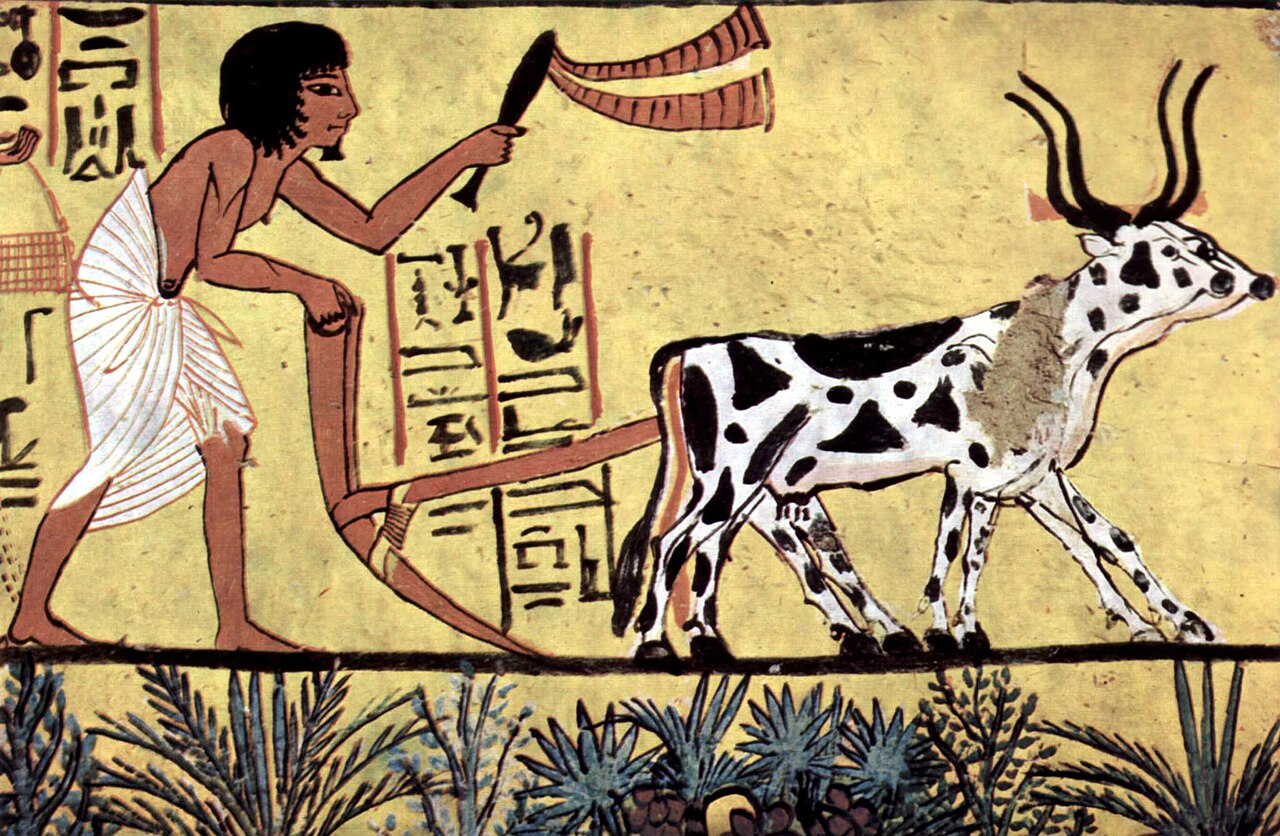

Agriculture is often told as the great step forward that made everything possible. For some years now, it has also been told as humanity’s worst mistake.
Both stories are too clear-cut. The reality is far more mixed, as the scientific data reveal.
1. It was invented at least eleven times
There is no single cradle of agriculture.
Populations began to cultivate plants and raise animals separately, in at least eleven regions of the world, without knowing one another.1
Domesticate: to gradually transform a wild plant or animal into a variety that depends on humans — and on which humans depend in turn.
| Geographical centre | Domesticated species |
|---|---|
| Near East | Wheat, barley, sheep, goats (the best-documented centre) |
| China | Rice, millet, pigs |
| Mesoamerica | Maize, beans, squash |
| Andes | Potatoes, llamas |
| Sub-Saharan Africa | Sorghum, African rice, yams |
| North America | Sunflower, squash |
| New Guinea | Taro, bananas |
Sources for the table2
2. Before, people did not merely gather
Saying that hunter-gatherers wandered and gathered denies them any intention. In reality, they actively shaped their environment.
- Controlled fire: burning small areas made it possible to:
- Stimulate the regrowth of tender young shoots;
- Attract game;
- Open safe passages;
- Prevent the spread of large, uncontrollable wildfires.
This was not passive movement through untouched nature, but genuine landscape management.3
Thinking about words
The term “nomad” poses a similar problem: it describes as wandering what is in reality a highly structured territorial cycle. When a label describes a population, it is worth asking whether it acknowledges that population’s skills or erases them.
3. What the skeletons say
Compared with hunter-gatherers, osteological analysis of the first farmers reveals counter-intuitive health indicators:
- Lower average stature;
- Increased signs of malnutrition;
- Poorer oral health (caries, early wear).4
Why would greater calorie availability damage health?
- A monotonous diet: access to a more stable volume of calories, but a loss of nutritional variety.
- Density and crowding: life in close-packed communities alongside domestic animals, facilitating the spread of zoonoses and epidemics.
- Heavier toil: an increase in physical workload from labour in the fields.
Lessons from a study of hundreds of skeletons from Central and Southeast Europe
- The decline in stature was reversed very slowly, over several thousand years.
- The gradual improvement was more pronounced among women.5
4. The second misconception, to be handled with care
Since the publication of a popular article by Jared Diamond in 1987, the phrase describing agriculture as the “worst mistake in the history of the human race” has become a widespread cliché.6
What this simplifying phrase leaves out:
- It was not a scientific article. It appeared in a popular-science magazine, without a scholarly apparatus. And the famous phrase is the title; the text only gives a variant of it, near the end.
- A frequent decline, not a universal one. The studies on which he relied do not show the same effect everywhere: health declines in 19 of the 21 societies studied, but not in the other two.
- The thesis evolved. Ten years later, in a far more famous book, the same author made agriculture the main driver of the development of societies.
- A repeated choice. If agriculture had been nothing but a constraint imposed on people, its independent adoption on eleven occasions would be very strange.7
5. What farming does to the land
Farming irreversibly transforms the structure and chemistry of the soil.
In Mesopotamia, intensive irrigation in an arid environment without adequate drainage caused salinisation: the rapid evaporation of water draws mineral salts up to the surface, gradually sterilising the crops.8
This phenomenon was not an isolated accident, but a recurrent environmental mechanism that still affects many agricultural regions.
6. Livestock farming: much more than meat
Livestock farming makes it possible to use land unsuited to cultivation. Grasslands and rangelands cover a considerable share of the land surface — the exact proportion depends on what one decides to include — and support around one billion people.9
The 3 fundamental contributions of livestock farming
- Manure: an organic soil improver essential for maintaining soil fertility.
- Draught power: working the land and transporting loads.
- A store of value: the herd acts as savings on the hoof, which can be drawn on in an economic or climate crisis.
The environmental cost
- Greenhouse gas emissions: livestock farming contributes a significant share of them if the whole chain is counted, from growing fodder to transport; ruminant digestion is the largest item.
- A lasting footprint: in Kenya, researchers measured old livestock enclosures abandoned for varying lengths of time, up to forty years. They emit around ten times more nitrous oxide than the neighbouring savanna. At the scale of the continent, these abandoned enclosures are thought to account for nearly 5% of Africa’s emissions of this gas from human activities.10
This last point deserves emphasis: a land use that ceased forty years ago can still be measured in the air today.
Transhumance and desertification
Nomadic pastoralism was long blamed for degrading soils. Recent research shows that, on the contrary, herd mobility is the best way to make the most of arid and changing climates. Yet for a long time efforts were made to reduce this mobility, or even to eliminate it.11
7. Fishing and the state of the oceans
The FAO has tracked the state of the world’s fish stocks since the 1970s, using a fixed list of stocks, so that the figures remain comparable from one year to the next.12
In 1974, 90% of stocks were exploited sustainably. In 2021, 62.3%. Conversely, the share of overfished stocks rose from 10% to 37.7%.13
Two figures, two questions
The next point is more subtle. Alongside this 62.3%, the FAO publishes another number: 76.9%.
It does not contradict the first. It answers a different question.
- 62.3% is the share of stocks. Each stock counts as one, whether it is huge or tiny.
- 76.9% is the share of fish caught. The large stocks, which are better monitored, carry more weight in it.14
In other words: the majority of stocks are in good shape, and an even larger majority of the fish consumed comes from stocks in good shape — but many small stocks are in poor shape.
Counting stocks or counting fish does not give the same answer. Neither is wrong.
Targeted management works
Overfishing is not inevitable: it is a matter of rules.
The best-managed areas have more than three quarters of their stocks at sustainable levels, while the worst-off fall to a third. And among tuna stocks, 87% are fished sustainably — thanks to quotas based on scientific assessments.15
The FAO itself draws the conclusion: effective fisheries management reaps positive outcomes. What is lacking is not the method, but its application.16
Note 1
At least 11 regions of the Old and New World were involved as independent centers of origin, encompassing geographically isolated regions on most continents, but several more have been suggested (Fig. 1) (3, 7, 11, 15, 16).
Larson, Greger et al., “Current Perspectives and the Future of Domestication Studies”, Proceedings of the National Academy of Sciences, vol. 111, no. 17, 2014, p. 6139-6146
Note 2
In the Near East it was grains like wheat and barley. […] In Mesoamerica it was squash and later maize, or corn, and in China millet and rice. […] Later they added crops like beans, squash, and peppers. Farther south, in the Andean region, around five thousand years ago people began to grow potatoes. […] Some of the many animals domesticated in the Neolithic Age were sheep and goats in the Near East around ten thousand years ago, chickens in south Asia around eight thousand years ago, horses in central Asia around six thousand years ago, and llamas in Peru about the same time. […] The people domesticated pigs and dogs and supplemented their diets of rice and millet by hunting, fishing, and gathering wild plants.
Kordas, Ann, Lynch, Ryan J., Nelson, Brooke and Tatlock, Julie, World History, Volume 1: to 1500, OpenStax, 2023, section 2.3 “The Neolithic Revolution”
Note 3
Aboriginal burning in Australia has long been assumed to be a "resource management" strategy, but no quantitative tests of this hypothesis have ever been conducted. […] Anthropogenic landscapes contain a greater diversity of successional stages than landscapes under a lightning fire regime […] The maintenance of small-scale habitat mosaics increases small-animal hunting productivity.
Bliege Bird, Rebecca et al., “The "Fire Stick Farming" Hypothesis: Australian Aboriginal Foraging Strategies, Biodiversity, and Anthropogenic Fire Mosaics”, Proceedings of the National Academy of Sciences, vol. 105, 2008, p. 14796-14801
Note 4
However, empirical studies of societies shifting subsistence from foraging to primary food production have found evidence for deteriorating health from an increase in infectious and dental disease and a rise in nutritional deficiencies. […] The trend towards a decrease in adult height and a general reduction of overall health during times of subsistence change remains valid, with the majority of studies finding stature to decline as the reliance on agriculture increased.
Mummert, Amanda, Esche, Emily, Robinson, Joshua and Armelagos, George J., “Stature and robusticity during the agricultural transition: Evidence from the bioarchaeological record”, Economics & Human Biology, vol. 9, no. 3, 2011, p. 284-301, abstract
Note 5
Overall, results suggest that the transition to agriculture in Central/Southeast Europe was challenging for early farming populations, but was followed by gradual amelioration across thousands of years, particularly among Central European women.
Macintosh, Alison A., Pinhasi, Ron and Stock, Jay T., “Early Life Conditions and Physiological Stress following the Transition to Farming in Central/Southeast Europe: Skeletal Growth Impairment and 6000 Years of Gradual Recovery”, PLOS ONE, vol. 11, no. 2, e0148468, 2016
Among subsequent agriculturalists, temporal increases in mean stature, body mass, and crural index were more pronounced among Central European women, driving declines in the magnitude of sexual dimorphism through time.
Macintosh, Alison A., Pinhasi, Ron and Stock, Jay T., “Early Life Conditions and Physiological Stress following the Transition to Farming in Central/Southeast Europe: Skeletal Growth Impairment and 6000 Years of Gradual Recovery”, PLOS ONE, vol. 11, no. 2, e0148468, 2016
Note 6
The All-Creating Eye […] The May 1987 issue of Discover Magazine
Diamond, Jared, “The Worst Mistake in the History of the Human Race”, Discover Magazine, May 1987, p. 64-66
Note 7
The Worst Mistake in the History of the Human Race […] Archaeologists studying the rise of farming have reconstructed a crucial stage at which we made the worst mistake in human history.
Diamond, Jared, “The Worst Mistake in the History of the Human Race”, Discover Magazine, May 1987, p. 64-66
In Paleopathology at the Origins of Agriculture (Cohen and Armelagos, 1984), this trend towards declining health was observed for 19 of 21 societies undergoing the agricultural transformation.
Mummert, Amanda, Esche, Emily, Robinson, Joshua and Armelagos, George J., “Stature and robusticity during the agricultural transition: Evidence from the bioarchaeological record”, Economics & Human Biology, vol. 9, no. 3, 2011, p. 284-301
In his Pulitzer Prize-winning book Guns, Germs and Steel, scientist Jared Diamond argues that the answer is geography. […] It's overwhelmingly due to the difference in the wild plant and animal species suitable to domestication that the continents made available. All the interesting stuff like technology, writing, and empires requires a productive economy that is producing enough food to feed technological experts, bureaucrats, kings, and scribes. Hunter-gatherer societies don't produce enough food surpluses to support those extra people.
Lovgren, Stefan, “’Guns, Germs and Steel’: Jared Diamond on Geography as Power”, National Geographic News, 6 July 2005
Guns, Germs and Steel: The Fates of Human Societies, by Jared Diamond (W.W. Norton) […] Copyright: 1997, W.W. Norton
The Pulitzer Prizes, “Guns, Germs and Steel: The Fates of Human Societies, by Jared Diamond (W.W. Norton)”, 1998 prize, General Nonfiction
Note 8
Salinization, specifically the addition of sodium chloride to agricultural fields, often occurs in areas where there is poor drainage, naturally high levels of salt in soils (e.g., saline-alkali soils) as well as excessive irrigation water, low rainfall, a high water table, insufficient plant uptake of crop water, and high levels of evaporation (Chhabra 1996; Smedema and Shiati 2002). […] In 3rd and 2nd millennium BC southern Mesopotamia, the combination of poor drainage, capillary action (and thus a high water table), rapid evaporation, lack of rainfall, effective leaching, and salty irrigation water, are together assumed to have been the leading reasons as to why progressive salinization became a major problem for irrigation agriculture (Jacobsen and Adams 1958; Gibson 1974; Artzy and Hillel 1988).
Altaweel, Mark, “Simulating the Effects of Salinization on Irrigation Agriculture in Southern Mesopotamia”, in Wilkinson, T. J., Gibson, M., Christiansen, J. and Widell, M. (eds), Models of Mesopotamian Landscapes: How Small-Scale Processes Contributed to the Growth of Early Civilizations, Oxford, Archaeopress, 2013, p. 219-239
Note 9
Twenty-six percent of the Planet’s ice-free land is used for livestock grazing […] One billion poor people, mostly pastoralists in South Asia and sub-Saharan Africa, depend on livestock for food and livelihoods.
FAO, Livestock and Landscapes, Rome, 2012
Note 10
The findings from GLEAM reveal that livestock agrifood systems – which include cattle, buffaloes, sheep, goats, pigs and chickens – are responsible for 6.2 gigatonnes (Gt) of carbon dioxide equivalent (CO2eq) emissions. This accounts for approximately 12 percent of all anthropogenic GHG emissions based on the reference year 2015. […] Enteric fermentation (CH4) 46%
FAO, Pathways towards Lower Emissions, Rome, 2023
Here we present in-situ measurements of N2O fluxes from 46 bomas in Kenya and show that even after 40 years following abandonment, fluxes are still ~one magnitude higher than those from adjacent savanna sites.
Butterbach-Bahl, Klaus et al., “Livestock Enclosures in Drylands of Sub-Saharan Africa Are Overlooked Hotspots of N₂O Emissions”, Nature Communications, vol. 11, art. 4644, 2020
Using maps of livestock distribution, we scaled our finding to SSA and found that abandoned bomas are significant hotspots for atmospheric N2O at the continental scale, contributing ~5% of the current estimate of total anthropogenic N2O emissions for all of Africa.
Butterbach-Bahl, Klaus et al., “Livestock Enclosures in Drylands of Sub-Saharan Africa Are Overlooked Hotspots of N₂O Emissions”, Nature Communications, vol. 11, art. 4644, 2020
Note 11
Efforts in this direction made no distinction between variability in inputs (the environment) and variability in processes (the pastoral system) and concentrated on changing the pastoral system by reducing or eliminating mobility. […] Mobility is key to making the most of variable environments
FAO, Pastoralism: Making Variability Work, Rome, 2021
Note 12
To promote consistency and comparability across time, these analyses were based on a fixed list of stocks (445 aggregated stocks accounting for approximately 72 percent of global marine fisheries production) and a clear process and methodology that has only had minor adjustments since the start of the series (FAO, 2011a).
FAO, La Situation mondiale des pêches et de l’aquaculture 2024, Rome, 2024
Note 13
the fraction of fishery stocks within biologically sustainable levels decreased to 62.3 percent in 2021 […] This fraction was 90 percent in 1974.
FAO, La Situation mondiale des pêches et de l’aquaculture 2024, Rome, 2024
the percentage of stocks fished at unsustainable levels has been increasing since the mid-1970s, from 10 percent in 1974 to 37.7 percent in 2021
FAO, La Situation mondiale des pêches et de l’aquaculture 2024, Rome, 2024
Note 14
This calculation treats all fishery stocks equally, regardless of abundance and catch.
FAO, La Situation mondiale des pêches et de l’aquaculture 2024, Rome, 2024
When weighted by their production levels, biologically sustainable stocks account for 76.9 percent of the 2021 landings of assessed stocks monitored by FAO.
FAO, La Situation mondiale des pêches et de l’aquaculture 2024, Rome, 2024
Note 15
the Eastern Central Pacific (area 77), Northeast Atlantic (area 27), Northeast Pacific (area 67) and Southwest Pacific (area 81) had the highest percentage of stocks fished at sustainable levels (84–76 percent). […] the Southeast Pacific (area 87), where just 33.3 percent of stocks were fished at sustainable levels in 2021.
FAO, La Situation mondiale des pêches et de l’aquaculture 2024, Rome, 2024
Globally, 87 percent of tuna stocks are sustainably fished, and 13 percent are considered overfished.
FAO, La Situation mondiale des pêches et de l’aquaculture 2024, Rome, 2024
Note 16
This further demonstrates that the larger stocks are better managed, and that effective fisheries management reaps positive outcomes.
FAO, La Situation mondiale des pêches et de l’aquaculture 2024, Rome, 2024
Notes and sources
- ↑
Passage Populations began to cultivate plants and raise animals separately, in at least eleven regions of the world, without knowing one another.
At least 11 regions of the Old and New World were involved as independent centers of origin, encompassing geographically isolated regions on most continents, but several more have been suggested (Fig. 1) (3, 7, 11, 15, 16).
Source Larson, Greger et al., “Current Perspectives and the Future of Domestication Studies”, Proceedings of the National Academy of Sciences, vol. 111, no. 17, 2014, p. 6139-6146, section “Spatial and Temporal Patterns of Domestication”, third paragraph.
Open access open the source · checked on 24 October 2026
- ↑
Passage Near East […] Wheat, barley, sheep, goats […] China […] Rice, millet, pigs […] Mesoamerica […] Maize, beans, squash […] Andes […] Potatoes, llamas
In the Near East it was grains like wheat and barley. […] In Mesoamerica it was squash and later maize, or corn, and in China millet and rice. […] Later they added crops like beans, squash, and peppers. Farther south, in the Andean region, around five thousand years ago people began to grow potatoes. […] Some of the many animals domesticated in the Neolithic Age were sheep and goats in the Near East around ten thousand years ago, chickens in south Asia around eight thousand years ago, horses in central Asia around six thousand years ago, and llamas in Peru about the same time. […] The people domesticated pigs and dogs and supplemented their diets of rice and millet by hunting, fishing, and gathering wild plants.
Source Kordas, Ann, Lynch, Ryan J., Nelson, Brooke and Tatlock, Julie, World History, Volume 1: to 1500, OpenStax, 2023, section 2.3 “The Neolithic Revolution”, § 2.3 (“The Neolithic Revolution”), parts “The Development of Agriculture” and “Neolithic Peoples” (China).
Open access open the source · checked on 27 October 2026
- ↑
Passage burning small areas […] This was not passive movement through untouched nature, but genuine landscape management.
Aboriginal burning in Australia has long been assumed to be a "resource management" strategy, but no quantitative tests of this hypothesis have ever been conducted. […] Anthropogenic landscapes contain a greater diversity of successional stages than landscapes under a lightning fire regime […] The maintenance of small-scale habitat mosaics increases small-animal hunting productivity.
Source Bliege Bird, Rebecca et al., “The "Fire Stick Farming" Hypothesis: Australian Aboriginal Foraging Strategies, Biodiversity, and Anthropogenic Fire Mosaics”, Proceedings of the National Academy of Sciences, vol. 105, 2008, p. 14796-14801, abstract.
Open access open the source · checked on 24 October 2026
- ↑
Passage Lower average stature […] Increased signs of malnutrition […] Poorer oral health
However, empirical studies of societies shifting subsistence from foraging to primary food production have found evidence for deteriorating health from an increase in infectious and dental disease and a rise in nutritional deficiencies. […] The trend towards a decrease in adult height and a general reduction of overall health during times of subsistence change remains valid, with the majority of studies finding stature to decline as the reliance on agriculture increased.
Source Mummert, Amanda, Esche, Emily, Robinson, Joshua and Armelagos, George J., “Stature and robusticity during the agricultural transition: Evidence from the bioarchaeological record”, Economics & Human Biology, vol. 9, no. 3, 2011, p. 284-301, abstract, abstract, 2nd and 6th sentences.
Open access open the source · checked on 27 October 2026
- ↑
Passage The decline in stature was reversed very slowly, over several thousand years.
Overall, results suggest that the transition to agriculture in Central/Southeast Europe was challenging for early farming populations, but was followed by gradual amelioration across thousands of years, particularly among Central European women.
Source Macintosh, Alison A., Pinhasi, Ron and Stock, Jay T., “Early Life Conditions and Physiological Stress following the Transition to Farming in Central/Southeast Europe: Skeletal Growth Impairment and 6000 Years of Gradual Recovery”, PLOS ONE, vol. 11, no. 2, e0148468, 2016, abstract.
Open access open the source · checked on 9 September 2026
Passage The gradual improvement was more pronounced among women.
Among subsequent agriculturalists, temporal increases in mean stature, body mass, and crural index were more pronounced among Central European women, driving declines in the magnitude of sexual dimorphism through time.
Source Macintosh, Alison A., Pinhasi, Ron and Stock, Jay T., “Early Life Conditions and Physiological Stress following the Transition to Farming in Central/Southeast Europe: Skeletal Growth Impairment and 6000 Years of Gradual Recovery”, PLOS ONE, vol. 11, no. 2, e0148468, 2016, abstract.
Open access open the source · checked on 24 October 2026
- ↑
Passage Since the publication of a popular article by Jared Diamond in 1987
The All-Creating Eye […] The May 1987 issue of Discover Magazine
Source Diamond, Jared, “The Worst Mistake in the History of the Human Race”, Discover Magazine, May 1987, p. 64-66, page of the May 1987 issue on the magazine’s website (https://www.discovermagazine.com/magazine/issue/may-1987), which lists the article; the article page, posted online on 1999-05-01, points to this issue (“Published in:”).
Open access open the source · checked on 27 October 2026
- ↑
Passage It appeared in a popular-science magazine, without a scholarly apparatus. And the famous phrase is the title; the text only gives a variant of it, near the end.
The Worst Mistake in the History of the Human Race […] Archaeologists studying the rise of farming have reconstructed a crucial stage at which we made the worst mistake in human history.
Source Diamond, Jared, “The Worst Mistake in the History of the Human Race”, Discover Magazine, May 1987, p. 64-66, title of the article; then the paragraph beginning “At this point it’s instructive to recall”, near the end (Discover Magazine, May 1987).
Open access open the source · checked on 27 October 2026
Passage The studies on which he relied do not show the same effect everywhere: health declines in 19 of the 21 societies studied, but not in the other two.
In Paleopathology at the Origins of Agriculture (Cohen and Armelagos, 1984), this trend towards declining health was observed for 19 of 21 societies undergoing the agricultural transformation.
Source Mummert, Amanda, Esche, Emily, Robinson, Joshua and Armelagos, George J., “Stature and robusticity during the agricultural transition: Evidence from the bioarchaeological record”, Economics & Human Biology, vol. 9, no. 3, 2011, p. 284-301, abstract (freely readable at https://europepmc.org/article/MED/21507735).
Paywalled open the source · checked on 27 October 2026
Passage in a far more famous book, the same author made agriculture the main driver of the development of societies
In his Pulitzer Prize-winning book Guns, Germs and Steel, scientist Jared Diamond argues that the answer is geography. […] It's overwhelmingly due to the difference in the wild plant and animal species suitable to domestication that the continents made available. All the interesting stuff like technology, writing, and empires requires a productive economy that is producing enough food to feed technological experts, bureaucrats, kings, and scribes. Hunter-gatherer societies don't produce enough food surpluses to support those extra people.
Source Lovgren, Stefan, “’Guns, Germs and Steel’: Jared Diamond on Geography as Power”, National Geographic News, 6 July 2005, article standfirst, 2nd paragraph, then J. Diamond’s answer to the first question (“Why over the past 10,000 years has the development of different societies…”), 1st paragraph.
Open access open the source · checked on 27 October 2026
Passage Ten years later
Guns, Germs and Steel: The Fates of Human Societies, by Jared Diamond (W.W. Norton) […] Copyright: 1997, W.W. Norton
Source The Pulitzer Prizes, “Guns, Germs and Steel: The Fates of Human Societies, by Jared Diamond (W.W. Norton)”, 1998 prize, General Nonfiction, winner’s page (“1998 Prize Winners”, “Winners in General Nonfiction”), title line then “Copyright” line.
Open access open the source · checked on 27 October 2026
- ↑
Passage intensive irrigation in an arid environment without adequate drainage caused salinisation
Salinization, specifically the addition of sodium chloride to agricultural fields, often occurs in areas where there is poor drainage, naturally high levels of salt in soils (e.g., saline-alkali soils) as well as excessive irrigation water, low rainfall, a high water table, insufficient plant uptake of crop water, and high levels of evaporation (Chhabra 1996; Smedema and Shiati 2002). […] In 3rd and 2nd millennium BC southern Mesopotamia, the combination of poor drainage, capillary action (and thus a high water table), rapid evaporation, lack of rainfall, effective leaching, and salty irrigation water, are together assumed to have been the leading reasons as to why progressive salinization became a major problem for irrigation agriculture (Jacobsen and Adams 1958; Gibson 1974; Artzy and Hillel 1988).
Source Altaweel, Mark, “Simulating the Effects of Salinization on Irrigation Agriculture in Southern Mesopotamia”, in Wilkinson, T. J., Gibson, M., Christiansen, J. and Widell, M. (eds), Models of Mesopotamian Landscapes: How Small-Scale Processes Contributed to the Growth of Early Civilizations, Oxford, Archaeopress, 2013, p. 219-239, section “The Process of Salinization”, p. 4 of the author’s deposited version (UCL Discovery).
Open access open the source · checked on 27 October 2026
- ↑
Passage Grasslands and rangelands cover a considerable share of the land surface […] and support around one billion people.
Twenty-six percent of the Planet’s ice-free land is used for livestock grazing […] One billion poor people, mostly pastoralists in South Asia and sub-Saharan Africa, depend on livestock for food and livelihoods.
Source FAO, Livestock and Landscapes, Rome, 2012, first page (“Sustainability Pathways” presentation).
Open access open the source · checked on 24 October 2026
- ↑
Passage livestock farming contributes a significant share of them if the whole chain is counted […] ruminant digestion is the largest item
The findings from GLEAM reveal that livestock agrifood systems – which include cattle, buffaloes, sheep, goats, pigs and chickens – are responsible for 6.2 gigatonnes (Gt) of carbon dioxide equivalent (CO2eq) emissions. This accounts for approximately 12 percent of all anthropogenic GHG emissions based on the reference year 2015. […] Enteric fermentation (CH4) 46%
Source FAO, Pathways towards Lower Emissions, Rome, 2023, “Key messages”, p. x; table 1, p. 7 (share of enteric fermentation in livestock emissions).
Open access open the source · checked on 24 October 2026
Passage researchers measured old livestock enclosures abandoned for varying lengths of time, up to forty years. They emit around ten times more nitrous oxide than the neighbouring savanna.
Here we present in-situ measurements of N2O fluxes from 46 bomas in Kenya and show that even after 40 years following abandonment, fluxes are still ~one magnitude higher than those from adjacent savanna sites.
Source Butterbach-Bahl, Klaus et al., “Livestock Enclosures in Drylands of Sub-Saharan Africa Are Overlooked Hotspots of N₂O Emissions”, Nature Communications, vol. 11, art. 4644, 2020, abstract.
Open access open the source · checked on 24 October 2026
Passage At the scale of the continent, these abandoned enclosures are thought to account for nearly 5% of Africa’s emissions of this gas from human activities.
Using maps of livestock distribution, we scaled our finding to SSA and found that abandoned bomas are significant hotspots for atmospheric N2O at the continental scale, contributing ~5% of the current estimate of total anthropogenic N2O emissions for all of Africa.
Source Butterbach-Bahl, Klaus et al., “Livestock Enclosures in Drylands of Sub-Saharan Africa Are Overlooked Hotspots of N₂O Emissions”, Nature Communications, vol. 11, art. 4644, 2020, abstract, last sentence.
Open access open the source · checked on 24 October 2026
- ↑
Passage herd mobility is the best way to make the most of arid and changing climates. Yet for a long time efforts were made to reduce this mobility, or even to eliminate it.
Efforts in this direction made no distinction between variability in inputs (the environment) and variability in processes (the pastoral system) and concentrated on changing the pastoral system by reducing or eliminating mobility. […] Mobility is key to making the most of variable environments
Source FAO, Pastoralism: Making Variability Work, Rome, 2021, p. 9 then p. 12 (FAO Animal Production and Health Paper No. 185).
Open access open the source · checked on 24 October 2026
- ↑
Passage The FAO has tracked the state of the world’s fish stocks […] using a fixed list of stocks, so that the figures remain comparable from one year to the next.
To promote consistency and comparability across time, these analyses were based on a fixed list of stocks (445 aggregated stocks accounting for approximately 72 percent of global marine fisheries production) and a clear process and methodology that has only had minor adjustments since the start of the series (FAO, 2011a).
Source FAO, La Situation mondiale des pêches et de l’aquaculture 2024, Rome, 2024, Marine fisheries — Status of resources.
Open access open the source · checked on 9 September 2026
- ↑
Passage In 1974, 90% of stocks were exploited sustainably. In 2021, 62.3%.
the fraction of fishery stocks within biologically sustainable levels decreased to 62.3 percent in 2021 […] This fraction was 90 percent in 1974.
Source FAO, La Situation mondiale des pêches et de l’aquaculture 2024, Rome, 2024, section “Status of fishery resources”.
Open access open the source · checked on 9 September 2026
Passage the share of overfished stocks rose from 10% to 37.7%
the percentage of stocks fished at unsustainable levels has been increasing since the mid-1970s, from 10 percent in 1974 to 37.7 percent in 2021
Source FAO, La Situation mondiale des pêches et de l’aquaculture 2024, Rome, 2024, section “Status of fishery resources”.
Open access open the source · checked on 9 September 2026
- ↑
Passage 62.3% is the share of stocks. Each stock counts as one, whether it is huge or tiny.
This calculation treats all fishery stocks equally, regardless of abundance and catch.
Source FAO, La Situation mondiale des pêches et de l’aquaculture 2024, Rome, 2024, section “Status of fishery resources”.
Open access open the source · checked on 9 September 2026
Passage 76.9% is the share of fish caught.
When weighted by their production levels, biologically sustainable stocks account for 76.9 percent of the 2021 landings of assessed stocks monitored by FAO.
Source FAO, La Situation mondiale des pêches et de l’aquaculture 2024, Rome, 2024, section “Status of fishery resources”.
Open access open the source · checked on 9 September 2026
- ↑
Passage The best-managed areas have more than three quarters of their stocks at sustainable levels, while the worst-off fall to a third.
the Eastern Central Pacific (area 77), Northeast Atlantic (area 27), Northeast Pacific (area 67) and Southwest Pacific (area 81) had the highest percentage of stocks fished at sustainable levels (84–76 percent). […] the Southeast Pacific (area 87), where just 33.3 percent of stocks were fished at sustainable levels in 2021.
Source FAO, La Situation mondiale des pêches et de l’aquaculture 2024, Rome, 2024, Marine fisheries — Status of resources.
Open access open the source · checked on 9 September 2026
Passage among tuna stocks, 87% are fished sustainably
Globally, 87 percent of tuna stocks are sustainably fished, and 13 percent are considered overfished.
Source FAO, La Situation mondiale des pêches et de l’aquaculture 2024, Rome, 2024, Marine fisheries — Status and trends by major species.
Open access open the source · checked on 9 September 2026
- ↑
Passage effective fisheries management reaps positive outcomes
This further demonstrates that the larger stocks are better managed, and that effective fisheries management reaps positive outcomes.
Source FAO, La Situation mondiale des pêches et de l’aquaculture 2024, Rome, 2024, Marine fisheries — Status and trends by major species.
Open access open the source · checked on 9 September 2026
Bibliography
17
- Altaweel, Mark, “Simulating the Effects of Salinization on Irrigation Agriculture in Southern Mesopotamia”, in Wilkinson, T. J., Gibson, M., Christiansen, J. and Widell, M. (eds), Models of Mesopotamian Landscapes: How Small-Scale Processes Contributed to the Growth of Early Civilizations, Oxford, Archaeopress, 2013, p. 219-239, open access (author’s deposited version; poor drainage, rapid evaporation, lack of rain and salty irrigation water held to be the causes of progressive salinisation in southern Mesopotamia, after Jacobsen and Adams 1958). https://discovery.ucl.ac.uk/id/eprint/1412087
- Bliege Bird, Rebecca et al., “The "Fire Stick Farming" Hypothesis: Australian Aboriginal Foraging Strategies, Biodiversity, and Anthropogenic Fire Mosaics”, Proceedings of the National Academy of Sciences, vol. 105, 2008, p. 14796-14801, open access (fire as landscape management). https://doi.org/10.1073/pnas.0804757105
- Butterbach-Bahl, Klaus et al., “Livestock Enclosures in Drylands of Sub-Saharan Africa Are Overlooked Hotspots of N₂O Emissions”, Nature Communications, vol. 11, art. 4644, 2020, open access (the enclosures measured in Kenya, abandoned for up to forty years, emitting ten times more than the neighbouring savanna; nearly 5% of Africa’s emissions of this gas from human activities). https://doi.org/10.1038/s41467-020-18359-y
- Cohen, Mark Nathan and Armelagos, George J. (ed.), Paleopathology at the Origins of Agriculture, Academic Press, 1984, in libraries (skeletal indicators of health at the beginnings of agriculture, and the diversity of results from region to region).
- Diamond, Jared, “The Worst Mistake in the History of the Human Race”, Discover Magazine, May 1987, p. 64-66, open access (the popular article from which the phrase comes: it is the title, and the text only gives a variant of it, near the end). https://www.discovermagazine.com/the-worst-mistake-in-the-history-of-the-human-race-12157
- Diamond, Jared, Guns, Germs, and Steel: The Fates of Human Societies, W. W. Norton, 1997, in libraries (agriculture presented ten years later as the driver of the development of societies).
- FAO, La Situation mondiale des pêches et de l’aquaculture 2024, Rome, 2024, open access (90% of stocks sustainable in 1974 against 62.3% in 2021; 37.7% of stocks overfished; 76.9% of landings from sustainable stocks; 87% of tuna stocks; the differences between areas; the conclusion on management). https://www.fao.org/3/cd0683en/online/sofia/2024/status-of-fishery-resources.html
- FAO, Livestock and Landscapes, Rome, 2012, open access (grazing areas and the billion people who live from livestock farming).
- FAO, Pastoralism: Making Variability Work, Rome, 2021, open access (pastoral mobility as an adaptation to arid environments; overgrazing linked to sedentarisation).
- FAO, Pathways towards Lower Emissions, Rome, 2023, open access (the share of livestock farming in global emissions and the weight of ruminant digestion).
- Jacobsen, Thorkild and Adams, Robert M., “Salt and Silt in Ancient Mesopotamian Agriculture”, Science, vol. 128, 1958, p. 1251-1258, paywalled (the salinisation of irrigated land).
- Kordas, Ann, Lynch, Ryan J., Nelson, Brooke and Tatlock, Julie, World History, Volume 1: to 1500, OpenStax, 2023, section 2.3 “The Neolithic Revolution”, open access (the plants and animals domesticated in each centre: Near East, China, Mesoamerica, Andes, Africa, New Guinea). https://openstax.org/books/world-history-volume-1/pages/2-3-the-neolithic-revolution
- Larson, Greger et al., “Current Perspectives and the Future of Domestication Studies”, Proceedings of the National Academy of Sciences, vol. 111, no. 17, 2014, p. 6139-6146, open access (at least eleven independent centres of domestication and the species involved). https://doi.org/10.1073/pnas.1323964111
- Lovgren, Stefan, “’Guns, Germs and Steel’: Jared Diamond on Geography as Power”, National Geographic News, 6 July 2005, open access (interview with Jared Diamond on the thesis of his book: domesticable species, then food production, as the origin of technology, writing and empires). https://www.nationalgeographic.com/science/article/news-guns-germs-steel-jared-diamond-interview
- Macintosh, Alison A., Pinhasi, Ron and Stock, Jay T., “Early Life Conditions and Physiological Stress following the Transition to Farming in Central/Southeast Europe: Skeletal Growth Impairment and 6000 Years of Gradual Recovery”, PLOS ONE, vol. 11, no. 2, e0148468, 2016, open access (the decline in stature, the slow recovery over millennia, the more pronounced improvement among women). https://doi.org/10.1371/journal.pone.0148468
- Mummert, Amanda, Esche, Emily, Robinson, Joshua and Armelagos, George J., “Stature and robusticity during the agricultural transition: Evidence from the bioarchaeological record”, Economics & Human Biology, vol. 9, no. 3, 2011, p. 284-301, paywalled, abstract open access (declining health observed in 19 of the 21 societies in Paleopathology at the Origins of Agriculture). https://doi.org/10.1016/j.ehb.2011.03.004
- The Pulitzer Prizes, “Guns, Germs and Steel: The Fates of Human Societies, by Jared Diamond (W.W. Norton)”, 1998 prize, General Nonfiction, open access (Jared Diamond’s book, published in 1997 by W. W. Norton). https://www.pulitzer.org/winners/jared-diamond
Spotted an error or have a doubt? Write to us.