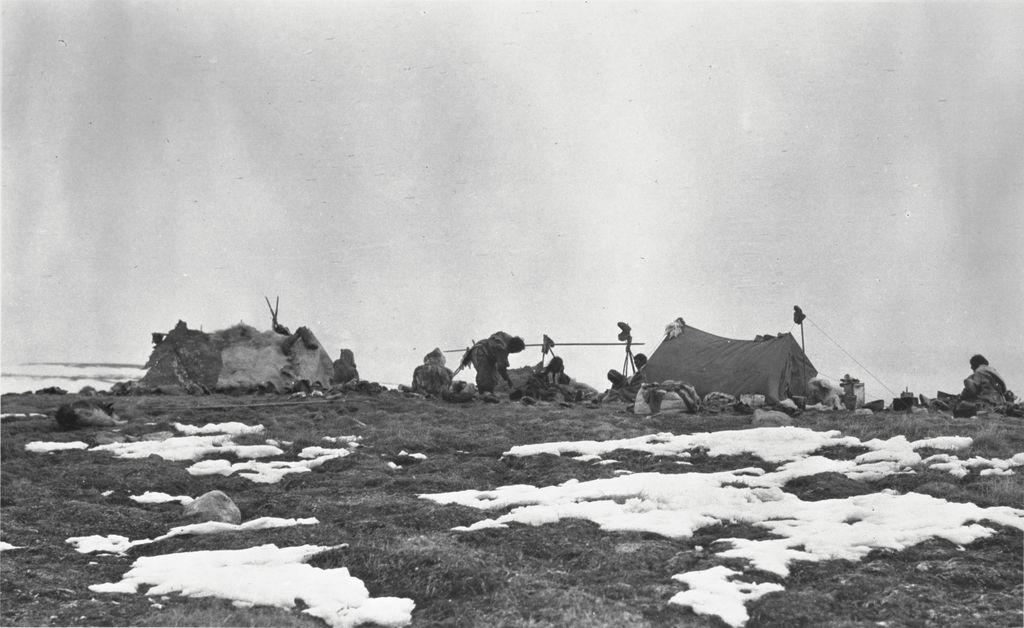

The igloo is not the home of the Inuit. It is a winter shelter, built in a single region of the Arctic, by a people who have several other kinds.
The world’s best-known image of a dwelling is wrong on three counts.
The illusion of the single image
The igloo often appears in books with this caption: here is the home of the Inuit.
- First error: it is a winter shelter, and often a hunting shelter. In summer, people live in skin tents and, over the last few decades, in canvas tents.
- Second error: the snow house is not built throughout the Arctic. It is built in one specific region, between the Mackenzie delta and Labrador. Elsewhere, people build differently.
- Third error: a single society does not have just one house; it has several. Among the Inuit, there is also the qarmaq (an autumn house with walls of stone, turf and whale bone, roofed with skins) and the tupiq (a portable tent).1
The igloo exists, it is very effective, and building one requires real skill: it requires dense, wind-packed snow, cut with a knife into large blocks laid in a spiral.2
But a single image cannot represent a people. Rather than drawing up a catalogue of the world’s houses, we will take the problems one by one.
What a shelter does
A shelter maintains, inside, conditions that the outside does not provide. It contends with four constraints, and every society solves these four problems with whatever it has to hand.
- Temperature. A thick wall does not block heat; it delays it: it absorbs heat during the day and releases it at night, which evens out temperature swings. Builders call this thermal inertia, not to be confused with insulation: the first shifts heat in time, the second prevents it from passing through. A stone wall has a great deal of inertia and insulates poorly. This is why earth or stone houses in hot regions have massive walls and few openings. Elsewhere, the aim is instead to insulate — to trap still air in a wall, because air that does not circulate is an excellent insulator. Packed snow, straw, wool and foam all work on this principle.
- Water. Rain must be drained away before it gets in. Hence the shape of roofs: the more it rains or snows, the steeper they are. A flat roof appears only where there is little rain.
- Wind. It chills, erodes and tears away. It is countered by shape — rounded rather than angular — or by orientation.
- Intruders. Animals, insects, sometimes other humans. This explains houses on stilts, narrow entrances and enclosures.
Materials are almost never chosen for their beauty: they are chosen because they are there. Raw earth is among the most widely used materials in all of human history, and a significant share of the world’s population still lives in earth buildings today. People build in wood where there are trees, in stone where there is rock, in snow where there is nothing else.
A house is therefore first and foremost a response to a place. This is what makes the idea of a “typical house” for a given people absurd — the same community may have several shelters, differing according to season and use.
1. Protecting against heat
A first example: a town in the Australian desert, Coober Pedy.
It is a mining town born of the discovery of opal deposits, in a desert where, in summer, the temperature can reach 52 °C.3
To escape it, a large proportion of the inhabitants live underground, in houses dug into the soft rock. Inside, the temperature stays moderate and stable all year round, without air conditioning or heating. There are also underground churches, hotels and shops.4
These are not people of the past, nor an isolated people, but twentieth-century miners who used their tools to dig their way out of the heat.
Physical principle
The mass of earth above the dwelling evens out temperature swings. It is a universal phenomenon found in Cappadocia (Turkey), in southern Tunisia, in northern China and in the cave dwellings of the Loire hillsides.
Same problem, same solution: it is not a matter of culture, it is a matter of physics.
2. Protecting against water
When the water rises, the structure is raised on piles: these are stilts.
They are often wrongly seen as something distant and exotic. Around the Alps, people built on stilts for millennia: more than a hundred of these sites, in Switzerland, France, Italy, Germany, Austria and Slovenia, are now jointly inscribed as World Heritage.5
Another context, another reason: in Benin, the lake city of Ganvié is built on water. The Tofinu people took refuge there at the time of the slave trade, to escape the soldiers who were hunting them: the soldiers feared the lake, where, they believed, a demon lived. Ganvié is not a picturesque village: it is a refuge city.6
The same reversal holds elsewhere. The rice terraces of the Philippines, long presented as two thousand years old, are apparently much more recent according to excavations: they were reportedly built in reaction to the Spanish conquest, by populations retreating to the highlands. A landscape thought to be ancestral is often the trace of a threat.7
These structures demand constant maintenance: wooden stilts must be replaced regularly as they rot. The same goes for the great earthen mosque of Djenné (Mali), replastered every year: what endures over time endures only because it is repaired.8
3. Moving around
Some dwellings are designed to be taken down and transported. The way of life associated with them — nomadism — is often misunderstood.
| Notion | Definition |
|---|---|
| Nomadism | Cyclical, regular movements between known and organised points along a route. |
| Migration | Linear, permanent movement from a point A to a point B with no planned return. |
In Africa, herders’ transhumance rests on agreements negotiated with farmers: the herds graze on crop residues and fertilise the fields in return. This is a well-established system, not spontaneous wandering.9
In the twentieth century, many states sought to settle these populations. In Inner Asia, many herding households move less than they used to; but where the collective farms changed earlier practices least, as in Mongolia, the mobility of certain types of herds was kept, or even enhanced.10
4. Living together
How many people make up a household? The answer depends heavily on the region of the world.
The most widespread arrangement worldwide is not the household of parents and children alone, but the extended family — the one that brings grandparents, uncles and cousins together under one roof.11
The differences between regions are enormous. Nearly half of the inhabitants of the Asia-Pacific region live in extended families, compared with one in ten in North America. The average household size ranges from 6.9 people in sub-Saharan Africa to 3.1 in Europe, and 3.3 in North America.12
It is not only a matter of taste: it is also about pooling incomes, sharing out tasks, looking after children and elders. A survey covering a hundred and thirty countries also observes that the richer a country is, the smaller its households.13
5. Who builds?
Yasmeen Lari, Pakistan’s first woman architect, spent many years designing towers of steel and glass. Then she changed course and developed what she calls “barefoot architecture”:
- raised shelters of earth, lime and bamboo, very cheap and flood-resistant;
- building techniques passed on directly to the inhabitants, so that they build for themselves;
- raised, smokeless cooking stoves, which spare women’s lungs and protect children from burns.14
In 2023 she received the Royal Gold Medal, awarded by the Royal Institute of British Architects: one of the highest distinctions in the world for an architect.15
6. Here, today
Access to decent housing remains a challenge throughout the world today, including in developed countries.
In France, the Fondation pour le logement des défavorisés — formerly the Fondation Abbé Pierre — publishes an annual report on the situation. It shows that the number of homeless people has risen sharply in a little over ten years, and that far more people still have no home of their own: on the street, in squats, in emergency accommodation or staying with others.16
These figures are updated every year. It is better to consult them, with their date, in the most recent report than to rely on figures that a page such as this one might have copied.
Note 1
igloo, temporary winter home or hunting-ground dwelling of Canadian and Greenland Inuit (Eskimos).
Encyclopædia Britannica, article “Igloo”
The igloo, usually made from blocks of snow and dome-shaped, is used only in the area between the Mackenzie River delta and Labrador
Encyclopædia Britannica, article “Igloo”
There are two types of transitional season houses, or qarmat, that Inuit inhabited in the autumn. A common form of qarmaq was a semi-permanent, small structure made from walls of stone, turf, whale bones, a stone platform, and skin roof (p. 52).
Simon Fraser University, Inuit Housing: A Survey of the Literature, “Eskimo Architecture: Dwelling and Structure in the Early Historic Period” (résumé de Lee, Molly et Reinhardt, Gregory A., Eskimo Architecture: Dwelling and Structure in the Early Historic Period, University of Alaska Press, 2003)
une simple tente, appelée tupiq (au pluriel tupiit) […] Le tupiq est la parfaite structure portable pour ces activités.
a simple tent, called a tupiq (plural tupiit) […] The tupiq is the perfect portable structure for these activities.
Mills, Edward and Kalman, Harold D., mis à jour par Filice, Michelle, “Tupiq”, L’Encyclopédie canadienne, Historica Canada, 30 April 2020
Note 2
the builder takes a deep snowdrift of fine-grained, compact snow and cuts it into blocks with a snow knife […] Additional blocks are added to the spiral to draw it inward until the dome is completed
Encyclopædia Britannica, article “Igloo”
Note 3
Residents of the Australian opal-mining town of Coober Pedy beat the heat by living underground. […] The hottest summer temperatures in this treeless, rocky desert reportedly reach 52 degrees Celsius (126 degrees Fahrenheit). […] The discovery of opal in the area led to the establishment of the town
NASA Earth Observatory, “Keeping It Cool in the Outback”, 2023
Note 4
About half of them live underground. […] Hidden from satellite view is a network of subterranean spaces dug out of the soft, porous bedrock. […] In these homes, hotels, and restaurants, the temperature remains an almost constant 23°C (73°F).
NASA Earth Observatory, “Keeping It Cool in the Outback”, 2023
Note 5
Ce bien en série regroupe 111 sites où se trouvent des vestiges d'établissements préhistoriques palafittiques (sur pilotis) dans et autour des Alpes. Datant d'environ 5 000 à environ 500 av. J.-C., ils sont situés sur les bords de lacs, de rivières ou de terres marécageuses.
This serial property comprises 111 sites containing the remains of prehistoric pile-dwelling (on stilts) settlements in and around the Alps. Dating from around 5000 to around 500 BC, they are located on the shores of lakes, rivers or marshlands.
UNESCO, “Sites palafittiques préhistoriques autour des Alpes”, Liste du patrimoine mondial
Note 6
its unique history starts in the era of slavery. […] The ancestors of today's residents fled to the lake which was feared by the soldiers who believed a terrible demon lived under its surface.
Katanich, Doloresz (avec Reuters), “"Venice of Africa": This Village in the Middle of a Lake Has a Unique Story to Tell”, Euronews, 29 April 2022
Note 7
Previously, the dating of the inception of the Ifugao rice terraces was placed at 2,000 years ago. The findings of the Ifugao Archaeological Project (IAP), however, suggest that the construction of the terraces coincided with the arrival of the Spanish in the northern Philippines. […] Recent ethnohistoric work and archaeological research show that the origins of the rice terraces were a response to Spanish colonial incursions after the seventeenth and eighteenth centuries (Acabado 2009, 2015).
Acabado, Stephen, Martin, Marlon and Datar, Francisco, “Ifugao Archaeology: Collaborative and Indigenous Archaeology in the Northern Philippines”, Advances in Archaeological Practice, vol. 5, no. 1, 2017, p. 1-11
Note 8
In the Sahel—the transitional zone between the Sahara and the humid savannas to the south—adobe and mud buildings such as the Great Mosque require periodic and often annual re-plastering. If re-plastering does not occur, the exteriors of the structures melt in the rainy season. […] During the annual festival of the Crépissage de la Grand Mosquée, the entire city contributes to the re-plastering of the mosque’s exterior […]
Dainese, Elisa, “Great Mosque of Djenné”, Smarthistory, 9 August 2015
Note 9
Pastoral livelihoods in these areas have historically depended on negotiated, non-exclusive access to water and reciprocal land use agreements among pastoralists and between pastoralists and agriculturalists (Brooks, 2006).
Organisation des Nations unies pour l’alimentation et l’agriculture, Pastoralism in Africa’s Drylands, Rome, 2018
Various exchange relationships between pastoralists and farmers exist that allow animals to graze crop residues and animals to manure farmers' fields (McCown et al, 1979; Toulmin, 1983).
Powell, J. M. and Williams, T. O., Livestock, Nutrient Cycling and Sustainable Agriculture in the West African Sahel, International Institute for Environment and Development (IIED), Gatekeeper Series no. SA37, Londres, s. d.
Note 10
privatisation of livestock and individualisation of land use had been a reduction in the amount of movement undertaken by many pastoral households […] In regions (such as Mongolia and Tuva [Russia]) where land use most closely resembled earlier pre-socialist practices — and where the collectives made fewest changes to earlier patterns and kept, or even enhanced, pastoral mobility for certain types of herds
University of Cambridge, “Pastoralism”, REF2014 impact case study CS-24Z-02 (research by Caroline Humphrey and David Sneath)
Note 11
Globally, the most common household type is the extended family, accounting for 38% of the world's population.
Pew Research Center, Religion and Living Arrangements Around the World, 12 December 2019
Note 12
almost half of all people in the Asia-Pacific region live with extended family, compared with just one-in-ten North Americans
Pew Research Center, Religion and Living Arrangements Around the World, 12 December 2019
By region, people tend to form the smallest households in Europe (3.1) and North America (3.3). The biggest households are in sub-Saharan Africa (6.9)
Pew Research Center, Religion and Living Arrangements Around the World, 12 December 2019
Note 13
A new Pew Research Center analysis of data from 130 countries and territories reveals that the size and composition of households often vary by religious affiliation. […] Smaller households are prevalent in wealthier countries, which tend to have aging populations and lower birth rates.
Pew Research Center, Religion and Living Arrangements Around the World, 12 December 2019
Note 14
They require only locally available materials: lime, clay, bamboo and thatching. […] The village’s elevated homes are protected from rushing water, while their bamboo skeletons — pierced deep into the ground — can withstand pressure without being uprooted. […] With straightforward training to locals, they can be assembled at a cost of around US$170 (RM782) — around an eighth of the cost of a cement and brick house.
“The octogenarian architect working to flood-proof Pakistan”, Malay Mail, dépêche ETX Studio, 28 May 2023, open access
Elevated from the ground, the stoves protect children from burns and reduce smoke inhalation, a major health issue for women.
World Habitat, “Pakistan Chulahs: The smokeless stoves empowering women and changing lives”, World Habitat Awards, lauréat 2018, open access
Note 15
The Royal Institute of British Architects (RIBA) is delighted to announce that Pakistan’s first female architect, Professor Yasmeen Lari, will receive the 2023 Royal Gold Medal for architecture. […] One of the world's highest accolades for architecture, the Royal Gold Medal is personally approved by the monarch
Royal Institute of British Architects, “Yasmeen Lari to receive the 2023 Royal Gold Medal”, 2023
Note 16
Au-delà des enfants à la rue, plus d’un million de personnes ne disposent pas de logement personnel. […] Entre 2012 et 2025, le nombre de personnes sans domicile a augmenté d’environ 145 %, pour atteindre 350 000 aujourd’hui.
Beyond the children on the street, more than a million people do not have a home of their own. […] Between 2012 and 2025, the number of homeless people rose by about 145%, reaching 350,000 today.
Fondation pour le logement des défavorisés (ex-Fondation Abbé Pierre), L’État du mal-logement en France, rapport annuel
Notes and sources
- ↑
Passage it is a winter shelter, and often a hunting shelter
igloo, temporary winter home or hunting-ground dwelling of Canadian and Greenland Inuit (Eskimos).
Source Encyclopædia Britannica, article “Igloo”, article “Igloo”, first sentence.
Open access open the source · checked on 9 September 2026
Passage the snow house is not built throughout the Arctic. It is built in one specific region, between the Mackenzie delta and Labrador.
The igloo, usually made from blocks of snow and dome-shaped, is used only in the area between the Mackenzie River delta and Labrador
Source Encyclopædia Britannica, article “Igloo”, article “Igloo”, 1st paragraph.
Open access open the source · checked on 9 September 2026
Passage there is also the qarmaq (an autumn house with walls of stone, turf and whale bone, roofed with skins)
There are two types of transitional season houses, or qarmat, that Inuit inhabited in the autumn. A common form of qarmaq was a semi-permanent, small structure made from walls of stone, turf, whale bones, a stone platform, and skin roof (p. 52).
Source Simon Fraser University, Inuit Housing: A Survey of the Literature, “Eskimo Architecture: Dwelling and Structure in the Early Historic Period” (résumé de Lee, Molly et Reinhardt, Gregory A., Eskimo Architecture: Dwelling and Structure in the Early Historic Period, University of Alaska Press, 2003), summary, passage on transitional-season houses (reference to the book, p. 52).
Open access open the source · checked on 24 October 2026
Passage and the tupiq (a portable tent)
une simple tente, appelée tupiq (au pluriel tupiit) […] Le tupiq est la parfaite structure portable pour ces activités.
Editors’ translation a simple tent, called a tupiq (plural tupiit) […] The tupiq is the perfect portable structure for these activities.
Source Mills, Edward and Kalman, Harold D., mis à jour par Filice, Michelle, “Tupiq”, L’Encyclopédie canadienne, Historica Canada, 30 April 2020, beginning of the article.
Open access open the source · checked on 24 October 2026
- ↑
Passage it requires dense, wind-packed snow, cut with a knife into large blocks laid in a spiral
the builder takes a deep snowdrift of fine-grained, compact snow and cuts it into blocks with a snow knife […] Additional blocks are added to the spiral to draw it inward until the dome is completed
Source Encyclopædia Britannica, article “Igloo”, article “Igloo”, paragraph on construction.
Open access open the source · checked on 9 September 2026
- ↑
Passage It is a mining town born of the discovery of opal deposits, in a desert where, in summer, the temperature can reach 52 °C.
Residents of the Australian opal-mining town of Coober Pedy beat the heat by living underground. […] The hottest summer temperatures in this treeless, rocky desert reportedly reach 52 degrees Celsius (126 degrees Fahrenheit). […] The discovery of opal in the area led to the establishment of the town
Source NASA Earth Observatory, “Keeping It Cool in the Outback”, 2023, standfirst, then 1st and 2nd paragraphs of the text.
Open access open the source · checked on 9 September 2026
- ↑
Passage a large proportion of the inhabitants live underground, in houses dug into the soft rock. Inside, the temperature stays moderate and stable all year round
About half of them live underground. […] Hidden from satellite view is a network of subterranean spaces dug out of the soft, porous bedrock. […] In these homes, hotels, and restaurants, the temperature remains an almost constant 23°C (73°F).
Source NASA Earth Observatory, “Keeping It Cool in the Outback”, 2023, 1st and 4th paragraphs of the text.
Open access open the source · checked on 9 September 2026
- ↑
Passage Around the Alps, people built on stilts for millennia: more than a hundred of these sites, in Switzerland, France, Italy, Germany, Austria and Slovenia, are now jointly inscribed as World Heritage.
Ce bien en série regroupe 111 sites où se trouvent des vestiges d'établissements préhistoriques palafittiques (sur pilotis) dans et autour des Alpes. Datant d'environ 5 000 à environ 500 av. J.-C., ils sont situés sur les bords de lacs, de rivières ou de terres marécageuses.
Editors’ translation This serial property comprises 111 sites containing the remains of prehistoric pile-dwelling (on stilts) settlements in and around the Alps. Dating from around 5000 to around 500 BC, they are located on the shores of lakes, rivers or marshlands.
Source UNESCO, “Sites palafittiques préhistoriques autour des Alpes”, Liste du patrimoine mondial, description of the property; the six States Parties (Germany, Austria, France, Italy, Slovenia, Switzerland) are listed on the property’s page.
Open access open the source · checked on 9 September 2026
- ↑
Passage in Benin, the lake city of Ganvié is built on water. The Tofinu people took refuge there at the time of the slave trade, to escape the soldiers who were hunting them: the soldiers feared the lake, where, they believed, a demon lived.
its unique history starts in the era of slavery. […] The ancestors of today's residents fled to the lake which was feared by the soldiers who believed a terrible demon lived under its surface.
Source Katanich, Doloresz (avec Reuters), “"Venice of Africa": This Village in the Middle of a Lake Has a Unique Story to Tell”, Euronews, 29 April 2022, article.
Open access open the source · checked on 24 October 2026
- ↑
Passage The rice terraces of the Philippines […] are apparently much more recent according to excavations: they were reportedly built in reaction to the Spanish conquest
Previously, the dating of the inception of the Ifugao rice terraces was placed at 2,000 years ago. The findings of the Ifugao Archaeological Project (IAP), however, suggest that the construction of the terraces coincided with the arrival of the Spanish in the northern Philippines. […] Recent ethnohistoric work and archaeological research show that the origins of the rice terraces were a response to Spanish colonial incursions after the seventeenth and eighteenth centuries (Acabado 2009, 2015).
Source Acabado, Stephen, Martin, Marlon and Datar, Francisco, “Ifugao Archaeology: Collaborative and Indigenous Archaeology in the Northern Philippines”, Advances in Archaeological Practice, vol. 5, no. 1, 2017, p. 1-11, abstract; section “Archaeological Models of Ifugao History”.
Open access open the source · checked on 9 September 2026
- ↑
Passage the great earthen mosque of Djenné (Mali), replastered every year: what endures over time endures only because it is repaired
In the Sahel—the transitional zone between the Sahara and the humid savannas to the south—adobe and mud buildings such as the Great Mosque require periodic and often annual re-plastering. If re-plastering does not occur, the exteriors of the structures melt in the rainy season. […] During the annual festival of the Crépissage de la Grand Mosquée, the entire city contributes to the re-plastering of the mosque’s exterior […]
Source Dainese, Elisa, “Great Mosque of Djenné”, Smarthistory, 9 August 2015, section “The first Great Mosque and its reconstructions”, then section “Re-plastering the mosque”, 1st sentence.
Open access open the source · checked on 27 October 2026
- ↑
Passage herders’ transhumance rests on agreements negotiated with farmers
Pastoral livelihoods in these areas have historically depended on negotiated, non-exclusive access to water and reciprocal land use agreements among pastoralists and between pastoralists and agriculturalists (Brooks, 2006).
Source Organisation des Nations unies pour l’alimentation et l’agriculture, Pastoralism in Africa’s Drylands, Rome, 2018, p. 4.
Open access open the source · checked on 25 October 2026
Passage the herds graze on crop residues and fertilise the fields in return
Various exchange relationships between pastoralists and farmers exist that allow animals to graze crop residues and animals to manure farmers' fields (McCown et al, 1979; Toulmin, 1983).
Source Powell, J. M. and Williams, T. O., Livestock, Nutrient Cycling and Sustainable Agriculture in the West African Sahel, International Institute for Environment and Development (IIED), Gatekeeper Series no. SA37, Londres, s. d., p. 3.
Open access open the source · checked on 25 October 2026
- ↑
Passage In Inner Asia, many herding households move less than they used to; but where the collective farms changed earlier practices least, as in Mongolia, the mobility of certain types of herds was kept, or even enhanced.
privatisation of livestock and individualisation of land use had been a reduction in the amount of movement undertaken by many pastoral households […] In regions (such as Mongolia and Tuva [Russia]) where land use most closely resembled earlier pre-socialist practices — and where the collectives made fewest changes to earlier patterns and kept, or even enhanced, pastoral mobility for certain types of herds
Source University of Cambridge, “Pastoralism”, REF2014 impact case study CS-24Z-02 (research by Caroline Humphrey and David Sneath), section “Underpinning research”.
Open access open the source · checked on 27 October 2026
- ↑
Passage The most widespread arrangement worldwide is not the household of parents and children alone, but the extended family
Globally, the most common household type is the extended family, accounting for 38% of the world's population.
Source Pew Research Center, Religion and Living Arrangements Around the World, 12 December 2019, report, introduction (overview of the findings).
Open access open the source · checked on 9 September 2026
- ↑
Passage Nearly half of the inhabitants of the Asia-Pacific region live in extended families, compared with one in ten in North America.
almost half of all people in the Asia-Pacific region live with extended family, compared with just one-in-ten North Americans
Source Pew Research Center, Religion and Living Arrangements Around the World, 12 December 2019, report, regional section.
Open access open the source · checked on 9 September 2026
Passage The average household size ranges from 6.9 people in sub-Saharan Africa to 3.1 in Europe, and 3.3 in North America.
By region, people tend to form the smallest households in Europe (3.1) and North America (3.3). The biggest households are in sub-Saharan Africa (6.9)
Source Pew Research Center, Religion and Living Arrangements Around the World, 12 December 2019, report, section on household size.
Open access open the source · checked on 9 September 2026
- ↑
Passage A survey covering a hundred and thirty countries also observes that the richer a country is, the smaller its households.
A new Pew Research Center analysis of data from 130 countries and territories reveals that the size and composition of households often vary by religious affiliation. […] Smaller households are prevalent in wealthier countries, which tend to have aging populations and lower birth rates.
Source Pew Research Center, Religion and Living Arrangements Around the World, 12 December 2019, report, introduction: 1st sentence, then passage on household size (before the subheading “Household types defined”).
Open access open the source · checked on 9 September 2026
- ↑
Passage raised shelters of earth, lime and bamboo, very cheap and flood-resistant
They require only locally available materials: lime, clay, bamboo and thatching. […] The village’s elevated homes are protected from rushing water, while their bamboo skeletons — pierced deep into the ground — can withstand pressure without being uprooted. […] With straightforward training to locals, they can be assembled at a cost of around US$170 (RM782) — around an eighth of the cost of a cement and brick house.
Source “The octogenarian architect working to flood-proof Pakistan”, Malay Mail, dépêche ETX Studio, 28 May 2023, open access, body of the article (village of Pono Colony, Sindh).
Open access open the source · checked on 24 October 2026
Passage raised, smokeless cooking stoves
Elevated from the ground, the stoves protect children from burns and reduce smoke inhalation, a major health issue for women.
Source World Habitat, “Pakistan Chulahs: The smokeless stoves empowering women and changing lives”, World Habitat Awards, lauréat 2018, open access, project presentation (page title: “The smokeless stoves…”).
Open access open the source · checked on 24 October 2026
- ↑
Passage In 2023 she received the Royal Gold Medal, awarded by the Royal Institute of British Architects: one of the highest distinctions in the world for an architect.
The Royal Institute of British Architects (RIBA) is delighted to announce that Pakistan’s first female architect, Professor Yasmeen Lari, will receive the 2023 Royal Gold Medal for architecture. […] One of the world's highest accolades for architecture, the Royal Gold Medal is personally approved by the monarch
Source Royal Institute of British Architects, “Yasmeen Lari to receive the 2023 Royal Gold Medal”, 2023, announcement “Yasmeen Lari to receive the 2023 Royal Gold Medal” (architecture.com), 1st sentence of the first paragraph and beginning of the second paragraph.
Open access open the source · checked on 24 October 2026
- ↑
Passage the number of homeless people has risen sharply in a little over ten years, and […] far more people still have no home of their own
Au-delà des enfants à la rue, plus d’un million de personnes ne disposent pas de logement personnel. […] Entre 2012 et 2025, le nombre de personnes sans domicile a augmenté d’environ 145 %, pour atteindre 350 000 aujourd’hui.
Editors’ translation Beyond the children on the street, more than a million people do not have a home of their own. […] Between 2012 and 2025, the number of homeless people rose by about 145%, reaching 350,000 today.
Source Fondation pour le logement des défavorisés (ex-Fondation Abbé Pierre), L’État du mal-logement en France, rapport annuel, 2026 report (31st), summary dossier: first section “Inégalités et mal-logement”, p. 2; third section “Municipales, élections décisives face au mal-logement”, p. 4.
Open access open the source · checked on 24 October 2026
Bibliography
18
- Acabado, Stephen, Martin, Marlon and Datar, Francisco, “Ifugao Archaeology: Collaborative and Indigenous Archaeology in the Northern Philippines”, Advances in Archaeological Practice, vol. 5, no. 1, 2017, p. 1-11, open access (the old dating to two thousand years ago, the recent dating of the terraces and their construction in reaction to the Spanish conquest). https://doi.org/10.1017/aap.2016.7
- Dainese, Elisa, “Great Mosque of Djenné”, Smarthistory, 9 August 2015, open access (the periodic, often annual, replastering without which the earthen mosque melts in the rainy season). https://smarthistory.org/great-mosque-of-djenne/
- Encyclopædia Britannica, article “Igloo”, open access (winter shelter, construction area between the Mackenzie delta and Labrador, blocks of packed snow laid in a spiral). https://www.britannica.com/technology/igloo
- Fondation pour le logement des défavorisés (ex-Fondation Abbé Pierre), L’État du mal-logement en France, rapport annuel, open access (homeless people and people without a home of their own; figures to be consulted with their date). https://www.fondationpourlelogement.fr/
- Humphrey, Caroline and Sneath, David, The End of Nomadism? Society, State and the Environment in Inner Asia, Duke University Press, 1999, in libraries (sedentarisation and the decline of pastoral mobility).
- Katanich, Doloresz (avec Reuters), “"Venice of Africa": This Village in the Middle of a Lake Has a Unique Story to Tell”, Euronews, 29 April 2022, open access (the city built on water and its origin: flight from the soldiers of the Fon and Dahomey kingdoms, in the era of the slave trade). https://www.euronews.com/2022/04/30/venice-of-africa-this-village-in-the-middle-of-a-lake-has-a-unique-story-to-tell
- Marchand, Trevor H. J., The Masons of Djenné, Indiana University Press, 2009, in libraries (the annual replastering).
- Mills, Edward and Kalman, Harold D., mis à jour par Filice, Michelle, “Tupiq”, L’Encyclopédie canadienne, Historica Canada, 30 April 2020, open access (the tupiq, a portable skin tent, and the igloo as the winter shelter of the same society). https://www.thecanadianencyclopedia.ca/fr/article/tupiq
- NASA Earth Observatory, “Keeping It Cool in the Outback”, 2023, open access (Coober Pedy: the desert heat and the thermal stability of underground dwellings). https://earthobservatory.nasa.gov/images/152094/keeping-it-cool-in-the-outback
- “The octogenarian architect working to flood-proof Pakistan”, Malay Mail, dépêche ETX Studio, 28 May 2023, open access (Yasmeen Lari’s raised houses of lime, clay and bamboo, their very low cost, their resistance to flooding and the training of the inhabitants who assemble them themselves). https://www.malaymail.com/news/life/2023/05/28/the-octogenarian-architect-working-to-flood-proof-pakistan/71412
- Organisation des Nations unies pour l’alimentation et l’agriculture, Pastoralism in Africa’s Drylands, Rome, 2018, open access (transhumance and agreements between herders and farmers). https://www.fao.org/documents/card/en/c/CA1312EN/
- Pew Research Center, Religion and Living Arrangements Around the World, 12 December 2019, open access (130 countries; the extended family as the most common arrangement; regional differences; average household sizes; the link with the country’s wealth). https://www.pewresearch.org/religion/2019/12/12/religion-and-living-arrangements-around-the-world/
- Powell, J. M. and Williams, T. O., Livestock, Nutrient Cycling and Sustainable Agriculture in the West African Sahel, International Institute for Environment and Development (IIED), Gatekeeper Series no. SA37, Londres, s. d., open access (in the Sahel, the herds of transhumant herders graze on farmers’ crop residues and manure their fields in exchange; consulted on 24 October 2026). https://www.iied.org/sites/default/files/pdfs/migrate/6051IIED.pdf
- Royal Institute of British Architects, “Yasmeen Lari to receive the 2023 Royal Gold Medal”, 2023, open access (the award and her career). https://www.architecture.com/knowledge-and-resources/knowledge-landing-page/yasmeen-lari-to-receive-the-2023-royal-gold-medal
- Simon Fraser University, Inuit Housing: A Survey of the Literature, “Eskimo Architecture: Dwelling and Structure in the Early Historic Period” (résumé de Lee, Molly et Reinhardt, Gregory A., Eskimo Architecture: Dwelling and Structure in the Early Historic Period, University of Alaska Press, 2003), open access (the qarmaq, an autumn house with walls of stone, turf and whale bone, roofed with skins). https://www.sfu.ca/inuithousing/inuit-housing-summaries/eskimo-architecture--dwelling-and-structure-in-the-early-histori.html
- UNESCO, “Sites palafittiques préhistoriques autour des Alpes”, Liste du patrimoine mondial, open access (more than a hundred sites spread across six countries). https://whc.unesco.org/fr/list/1363/
- University of Cambridge, “Pastoralism”, REF2014 impact case study CS-24Z-02 (research by Caroline Humphrey and David Sneath), open access (less movement for many herding households, but mobility kept for certain types of herds in Mongolia and Tuva). https://impact.ref.ac.uk/casestudies/CaseStudy.aspx?Id=14582
- World Habitat, “Pakistan Chulahs: The smokeless stoves empowering women and changing lives”, World Habitat Awards, lauréat 2018, open access (the raised, smokeless cooking stoves of the Heritage Foundation of Pakistan, which reduce the smoke inhaled by women and protect children from burns). https://world-habitat.org/awards/winners/pakistan-chulahs/
Spotted an error or have a doubt? Write to us.