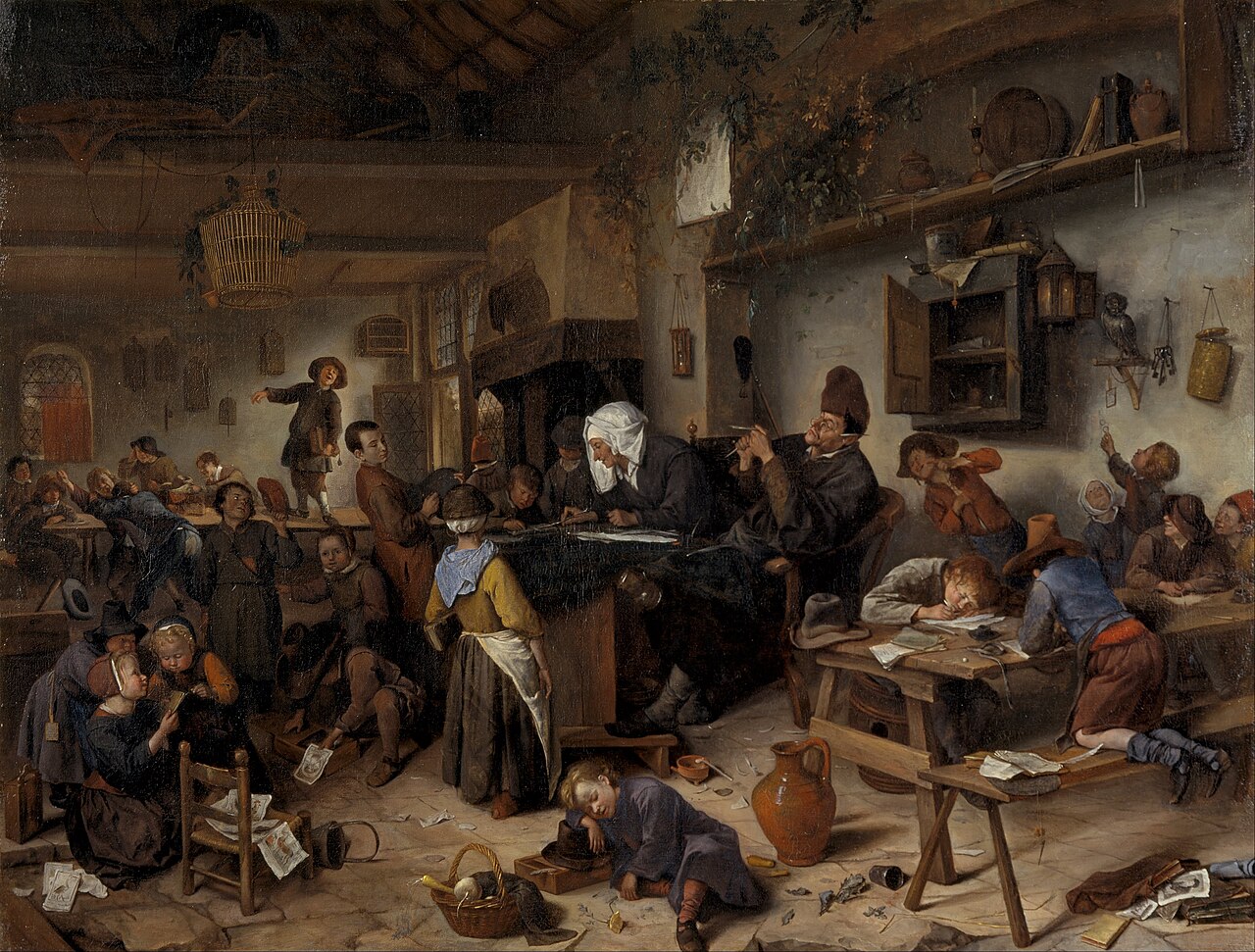

School is neither the only way of passing knowledge from one generation to the next, nor the oldest.
Learning by doing
In Djenné, in Mali, the great mosque is built of earth. Every year, the whole town comes to replaster it: the render is prepared, people climb the poles that jut out from the walls, and they fill in what the rain has washed away.1
This is not just maintenance. This is how the craft is passed on. The young climb up with those who know, and learn by practising, a little more each year.2
Nothing is written down, and no one sits an exam. Yet the know-how has been handed down through the generations for a long time, because it is used.
The same principle, with a contract
In Europe, in the Middle Ages and afterwards, people also learned a trade by practising it. But a written agreement was signed.
A child would go to live with a master for several years. The child’s parents signed a contract with this master, and the trade’s guild oversaw the agreement.3
This contract set out the obligations of each party. The master lodged, fed and clothed the child and taught them his trade. Some contracts also required him to send the child to learn to read and write, or to provide the child’s tools. The apprentice, for their part, had to obey and abide by rules of conduct.
Girls were apprentices too, for instance in some textile trades.4
A caveat is needed here, and it applies to all documents. A contract says what was supposed to happen. It does not say what actually happened.
Apprenticeship is often portrayed in two opposite ways: as an opportunity offered to a poor child, or as the exploitation of a defenceless child. The documents bear out neither. There were real obligations on the master’s side, and real constraints on the child’s side. The rest depended on the people involved.
Learning by heart — and it is a technique
It is sometimes said that learning by heart means learning mindlessly. One case shows the opposite.
In South Asia, certain very long texts have been passed down orally over the millennia. To keep them from becoming distorted, people did not merely make pupils repeat them. They invented several interlocking ways of reciting them.5
First, the text straight through. Then word by word, each word taken on its own. Then in pairs. Then in braided forms, where the words come back in crossed orders, forwards and backwards.
The method is ingenious. If someone forgets a word, it no longer matches the other ways of reciting. The error reveals itself through simple comparison.6
It is a way of checking without writing anything down — something that writing, on its own, does not allow: a tired copyist copies a mistake without anything alerting him to it.
School — older and younger than we think
Two surprises, once again pointing in opposite directions.
Older than we think. The oldest educational institution still in operation is neither in Oxford nor in Bologna. It is in Fez, in Morocco: al-Qarawiyyin, founded in the ninth century. It predates the European universities by several centuries.
Moroccan tradition attributes its founding to a woman, Fatima al-Fihri, who is said to have devoted the money she had inherited to it.
How do we know? Almost everything we know about her comes from a single chronicle, written several centuries after the events. This is the case for many foundations of that period, whether they are attributed to women or to men.
Younger than we think. Compulsory schooling, the kind the state requires people to attend, is recent: most major countries introduced it only in the nineteenth century, some in the twentieth. France, then, is not a forerunner. It follows.7
The motive is surprising. Compulsory schooling did not spread primarily because children had been recognised as having a right to knowledge. Military defeats had a great deal to do with it: several major school reforms come after a lost war, and aim to bind the country together as much as to educate it.8
This does not mean that school served only that purpose. These laws taught millions of people to read, and they took children out of the workshops. The motive of those who vote for a law and the effect it produces are two different things, and neither cancels out the other.
One last remark, and it matters. Japan, in 1872, builds its school system by drawing on several Western models, the French one among them. Then it changes course several times. This is not a school system passively received: it is a country that chooses, tries, and changes.9
Meanwhile, children were working
In France, the first law limiting child labour dates from 22 March 1841.
It sets the minimum age at eight. From eight to twelve, eight hours a day at most. From twelve to sixteen, twelve hours.
One article of this law is surprising today: children aged eight to twelve had to attend school in order to be allowed to work. School was not the opposite of work. It was its precondition.10
This law applied only to mechanised factories and to workshops with more than twenty workers. Above all, enforcing it was entrusted to local notables, serving as volunteers and appointed by the prefect — that is, to men from the same society as the employers they were supposed to inspect.11
They hardly did so. In 1847, a politician, Baron Dupin, pointed out to his colleagues that the law was failing. It was not until 1874 that real labour inspectors, paid by the state, came into being.12
A lesson worth applying often: a law is not a fact. It is a written intention. Faced with a law, the question to ask is always: who was supposed to enforce it?
It would be wrong to conclude that it achieved nothing. It was the first time the French state had decided to intervene between an employer and the workers. What a text opens up counts as much as what it fails to achieve.
What the archives do not say
Before going further, it is important to know the main flaw of this history: the archives are written by adults.
We have apprenticeship contracts by the thousand, laws, registers, school regulations. All of them say what adults expected of children. Almost nothing says what children did and thought. Children write little, and what they write is not kept.
This does not prevent us from doing history. It obliges us to know what we are talking about: what we know is mostly the rules, not the lives.
A famous thesis, and a wrong one
In 1960, the French historian Philippe Ariès published a book in which he argued that in the Middle Ages the “sense of childhood” did not exist: the child was supposedly treated as a miniature adult. The book’s success spread far beyond the circle of historians.13
Since then, specialists in the Middle Ages have shown that this was wrong. They have found traces of affection for young children, a real concern to educate them, and even a particular way of burying them. Ariès, moreover, was not a medievalist.14
Why does his thesis still circulate? The answer is instructive: the thesis had left the circle of historians very early on. Sociologists, psychologists and a wide public had adopted it. The criticisms, for their part, appeared mainly in historians’ journals.15
A correction does not travel as far as the error it corrects.
It should be added that Ariès listened to his critics. When he reissued his book in 1973, he qualified several claims in his preface — while maintaining the core of his thesis.16
One last clarification, because this is exactly the kind of error to be avoided: Ariès was not wrong about everything. His book showed that our way of seeing childhood is in no way self-evident and that it has changed over time. That remains true. It is the specific thesis he drew from it that does not hold up.
Today
Children still work. They are counted.
According to the joint estimates of the International Labour Organization and UNICEF, published in June 2025, nearly 138 million children aged 5 to 17 were working in 2024 — 59 million girls and 78 million boys, or almost eight per cent of all the world’s children. Among them, 54 million do work that is hazardous to their health or safety: two in five.17
They numbered 246 million in 2000. The number has thus almost halved. But states had set themselves the goal of ending it by 2025, and they have not succeeded: at the pace of the last four years, progress would have to be eleven times faster to get there in five years.18
Child labour is concentrated in agriculture — 61% of cases — followed by services and industry.19
What this figure does not count: It rests on an economic definition of work. It therefore leaves out a large part of the tasks done at home — housework, fetching water, looking after younger children. Yet these tasks fall mainly on girls.
The figure is accurate. It is also incomplete. And what it leaves out is not distributed at random.20
Note 1
Le bien est caractérisé par un usage intensif et remarquable de la terre particulièrement dans son architecture. La mosquée exceptionnelle, de grande valeur monumentale et religieuse, en est un exemple éloquent.
The property is characterised by an intensive and remarkable use of earth, particularly in its architecture. The exceptional mosque, of great monumental and religious value, is an eloquent example of this.
UNESCO, “Villes anciennes de Djenné”, Liste du patrimoine mondial
Every year the structure is replastered with mud in a celebration that brings out all of the city's residents.
“How the City of Mud Stays Standing: Meet the Masons of Djenné, Mali”, Smithsonian Magazine, 30 September 2013
Note 2
The annual ceremony renews bonds among the town's citizens and between the various town quarters. It also provides an important forum for youth to learn about their architectural heritage and religious identity, and it introduces young men to basic building techniques that they can apply in the upkeep of their own homes.
Marchand, Trevor H. J., “The Djenné Mosque: World Heritage and Social Renewal in a West African Town”, in Verkaaik, Oskar (ed.), Religious Architecture: Anthropological Perspectives, Amsterdam University Press, 2013, p. 117-148, abstract
Note 3
L’apprentissage est régi par un acte notarié qui lie le jeune, ses parents et le maître. […] Leur nom est alors inscrit au Registre de la corporation […] Ce sont le doyen et les jurés dudit métier qui indiqueront un maître aux apprentis pour parfaire suffisamment leur apprentissage et sans fraude.
Apprenticeship is governed by a notarial deed binding the young person, his parents and the master. […] Their name is then entered in the Register of the guild […] It is the dean and the sworn masters of the said trade who will assign a master to the apprentices so that they may complete their apprenticeship adequately and without fraud.
Brunon, Claudine, “Quels apprentissages peut-on lire dans les traités de peinture médiévaux ?”, Topiques, Études satoriennes, vol. 4 (“Maître-disciple : une relation topique”), 2018
Note 4
From the exhaustive work of Teresa Vinyoles, we learn that women in Barcelona were able to join some male guilds such as the coral and linen working guilds, and were active as instructors for female apprentices. […] From the very first lines of the second chapter we enter into the heart of the historiographical debate by demolishing a series of stereotypes: from the absence of female apprenticeships to the denial of a clear-cut contrast between corporate and non-corporate work.
Colesanti, Gemma T., review of Zanoboni, Maria Paola, Donne al lavoro nell’Italia e nell’Europa medievali (secoli XIII-XV), Jouvence, 2016, SVMMA. Revista de Cultures Medievals, no. 13, 2019, p. 178-180
Note 5
Les Veda sont un vaste corpus de poésie sanscrite […] Le patrimoine védique rassemble de très nombreux écrits et interprétations répartis en quatre Veda couramment appelés « livres de la connaissance », bien qu’ils aient été transmis oralement. […] La valeur de cette tradition ne réside pas tant dans le riche contenu de sa littérature orale que dans les techniques ingénieuses employées par les brahmanes pour préserver les textes inchangés au fil des millénaires.
The Vedas are a vast corpus of Sanskrit poetry […] The Vedic heritage brings together a great many texts and interpretations divided into four Vedas commonly called “books of knowledge”, even though they have been transmitted orally. […] The value of this tradition lies not so much in the rich content of its oral literature as in the ingenious techniques employed by the Brahmin priests to preserve the texts unchanged over the millennia.
UNESCO, “La tradition du chant védique”, Liste représentative du patrimoine culturel immatériel de l’humanité
Note 6
'strengthen' the oral tradition, that is, minimize the chance of a single word being lost. […] for if a pair were forgotten, the continuity between the succession of pairs would show a break.
Staal, Frits, “The Fidelity of Oral Tradition and the Origins of Science”, Mededelingen der Koninklijke Nederlandse Akademie van Wetenschappen, Afd. Letterkunde, new series, vol. 49, no. 8, Amsterdam, North-Holland, 1986
Note 7
il faudra attendre la fin du 19e siècle pour que la plupart des pays européens emboîtent le pas […] En Belgique, il faudra encore attendre mai 1914.
it would take until the end of the 19th century for most European countries to follow suit […] In Belgium, it would take until May 1914.
Marlet, Pierre, “Qui a eu cette idée folle, un jour d’inventer l’école ? Non, ce n’est pas Charlemagne”, RTBF (La Première), 28 August 2023
Note 8
after the humiliating defeat to Napoleon I in Jena in 1806, […] The turning point was the French defeat against Prussia in 1870. […] In 1882, he made school enrollment compulsory from age six to thirteen; […] Finally, the reforms appear to have increased the sense of patriotism and national unity.
Aghion, Philippe, Persson, Torsten and Rouzet, Dorothée, “Education and Military Rivalry”, document de travail, Department of Economics, Harvard University, 2012
Note 9
due to the high regard many leaders had for the French educational system […] this Order reflected elements from various Western models rather than being drawn from a single example
Ministry of Education, Culture, Sports, Science and Technology of Japan (MEXT), Japan’s Modern Educational System, section “(1) Planning for the Establishment of a Modern Educational System”
Part II: The First Decade of Modern Education, 1870s: The American Model […] The Third National Plan for Education: The Reverse Course, 1880-1885 […] Education for the State: The German Model, 1886-1889
Duke, Benjamin, The History of Modern Japanese Education: Constructing the National School System, 1872-1890, Rutgers University Press, 2009
Note 10
Art. 2 : Les enfants devront, pour être admis, avoir au moins huit ans. De huit à douze ans, ils ne pourront être employés au travail effectif plus de huit heures sur vingt-quatre, divisées par un repos. […] Nul enfant âgé de moins de douze ans ne pourra être admis qu’autant que ses parents ou tuteur justifieront qu’il fréquente actuellement une des écoles publiques ou privées existant dans la localité.
Art. 2: To be admitted, children must be at least eight years old. From eight to twelve, they may not be employed in actual work for more than eight hours out of twenty-four, divided by a rest break. […] No child under the age of twelve may be admitted unless his parents or guardian prove that he is currently attending one of the public or private schools existing in the locality.
Loi du 22 March 1841 relative au travail des enfants employés dans les manufactures, usines ou ateliers, texte intégral (PDF), open access
Note 11
Après le vote de la loi du 22 mars 1841, le Gouvernement commença par établir des inspections gratuites. […] des commissions composées d’hommes connus pour leur bienfaisance et leur dévouement à la chose publique, […] Les résultats obtenus furent à peu près nuls, et, dès 1847, l’on songea à organiser autre chose.
After the law of 22 March 1841 was passed, the Government began by establishing unpaid inspections. […] committees composed of men known for their benevolence and their devotion to public affairs, […] The results obtained were practically nil, and, as early as 1847, thought was given to organising something else.
Bouquet, Louis, “Organisation de l’inspection des fabriques en France”, extrait du rapport présenté au Congrès international des accidents du travail de Milan, Bulletin de l’Inspection du travail, 1895, p. 91-110, open access
vous vous occupiez de l’organisation du mode de surveillance le plus propre à atteindre le but. […] sans exclure aucune notabilité.
you would attend to the organisation of the method of supervision best suited to achieving the aim. […] without excluding any notable.
Archives départementales de Maine-et-Loire, “Le travail des enfants et des filles mineures en Anjou (1841-1892)”, fiche pédagogique, open access
Note 12
Depuis six ans, la loi française échoue, disait-il dans son rapport ; d’abord exécutée un peu, puis, de moins en moins, on a fini par oser la déclarer inexécutable, parce que nous n’avons pas institué des inspecteurs puissants, indépendants et respectés comme ceux de l’Angleterre. […] Des inspecteurs, les uns divisionnaires, nommés et rétribués par le Gouvernement, les autres départementaux,
For six years, the French law has been failing, he said in his report; at first enforced a little, then less and less, people have finally dared to declare it unenforceable, because we have not instituted powerful, independent and respected inspectors like those of England. […] Inspectors, some divisional, appointed and paid by the Government, others departmental,
Bouquet, Louis, “Organisation de l’inspection des fabriques en France”, extrait du rapport présenté au Congrès international des accidents du travail de Milan, Bulletin de l’Inspection du travail, 1895, p. 91-110, open access
Note 13
L’origine des études contemporaines de l’enfance remonte à l’ouvrage L’enfant et la vie familiale sous l’Ancien Régime (1960), dans lequel l’auteur, Philippe Ariès, expliqua qu’à l’époque médiévale, le sentiment de l’enfance, soit la conscience de la particularité enfantine, n’existait pas (Ariès 1960 : 134 ; Stephens 1995 : 5).
Contemporary childhood studies originate in the book L’enfant et la vie familiale sous l’Ancien Régime (1960), in which the author, Philippe Ariès, explained that in the medieval period the sense of childhood, that is, the awareness of what is specific to children, did not exist (Ariès 1960: 134; Stephens 1995: 5).
Girard, Marie-Pier, “Enfance”, Anthropen, Université Laval, 2019
Ariès, Philippe (1914-1984) […] Pays : France […] Historien des mentalités.
Ariès, Philippe (1914-1984) […] Country: France […] Historian of mentalities.
Bibliothèque nationale de France, “Ariès, Philippe (1914-1984)”, person authority record, BnF Catalogue général
Note 14
Medievalists never seem to tire of proving Ariès to be wrong.
Retford, Kate, “Philippe Ariès’s “discovery of childhood”: imagery and historical evidence”, Continuity and Change, vol. 31, no. 3, 2016, p. 391-418, paywalled
Note 15
the enthusiastic extension of Ariès' insights, especially by American sociologists and psychologists of the 1960s
Times Higher Education, “The Canon: Centuries of Childhood: A Social History of Family Life by Philippe Ariès”, 26 August 2010, open access
Note 16
[…] obiezioni che gli vengono mosse fin dalla prima edizione di L'enfant et la vie familiale, espresse da storici accreditati (Flandrin, la Zemon Davis in primo luogo), e che lo spingono, nel 1973 a ristampare l'opera del 1960, corredandola con una prefazione in cui discute le maggiori critiche […] Si tratta di una proposta, di un insieme di idee nuove, di una tesi – come egli la chiama usando il termine in modo abbastanza elastico[9] – cui rimane affezionato, ma che è anche disposto a rivedere, almeno in parte […]
[…] objections raised against him from the first edition of L’enfant et la vie familiale onwards, voiced by established historians (Flandrin and Natalie Zemon Davis above all), which prompted him in 1973 to reissue the 1960 work with a preface in which he discusses the main criticisms […] It is a proposal, a set of new ideas, a thesis – as he calls it, using the term rather loosely[9] – to which he remains attached, but which he is also prepared to revise, at least in part […]
Becchi, Egle, “Il bambino di ieri: breve storia di una storiografia”, Studi sulla formazione, vol. 13, no. 1, Firenze University Press, 2010, pp. 7-21
Note 17
Nearly 138 million children – 59 million girls and 78 million boys – are in child labour, accounting for almost 8 per cent of all children globally.
Organisation internationale du travail and UNICEF, Child Labour: Global Estimates 2024, Trends and the Road Forward, 11 June 2025
Among all children in child labour, two in five (54 million) perform hazardous work.
Organisation internationale du travail and UNICEF, Child Labour: Global Estimates 2024, Trends and the Road Forward, 11 June 2025
Note 18
Since 2000, child labour has almost halved, from 246 million to 138 million, yet current rates remain too slow, and the world has fallen short of reaching the 2025 global elimination target.
Organisation internationale du travail and UNICEF, “Despite progress, child labour still affects 138 million children globally – ILO, UNICEF”, communiqué de presse, Genève et New York, 11 June 2025
With the adoption of the SDGs, the international community committed to ending child labour by 2025. It is now clear that the world has fallen short of this ambitious target. […] Meeting SDG Target 8.7 by 2030, the endpoint for the SDGs, would require a pace of change that is 11 times faster than it has been in the last four years.
Organisation internationale du travail and UNICEF, Child Labour: Global Estimates 2024, Trends and the Road Forward, 11 June 2025
Note 19
Agriculture accounts for the largest share of children in child labour, at 61 per cent globally. […] Services, including domestic work in third-party households, small-scale commerce and other informal service work, comprise 27 per cent of all child labour. Industry, encompassing construction, manufacturing and mining, makes up the remaining 13 per cent.
Organisation internationale du travail and UNICEF, Child Labour: Global Estimates 2024, Trends and the Road Forward, 11 June 2025
Note 20
Unpaid household services or household chores refer to services that children provide without pay for their own households. […] In more technical terms, these tasks constitute a 'non-economic' form of production and are excluded from consideration in the United Nations System of National Accounts, the internationally agreed-upon guidelines for measuring national economic activity. […] The child labour definition underlying it does not consider involvement in household chores in children’s own homes.
Organisation internationale du travail and UNICEF, Child Labour: Global Estimates 2024, Trends and the Road Forward, 11 June 2025
Notes and sources
- ↑
Passage In Djenné, in Mali, the great mosque is built of earth.
Le bien est caractérisé par un usage intensif et remarquable de la terre particulièrement dans son architecture. La mosquée exceptionnelle, de grande valeur monumentale et religieuse, en est un exemple éloquent.
Editors’ translation The property is characterised by an intensive and remarkable use of earth, particularly in its architecture. The exceptional mosque, of great monumental and religious value, is an eloquent example of this.
Source UNESCO, “Villes anciennes de Djenné”, Liste du patrimoine mondial, brief synthesis.
Open access open the source · checked on 9 September 2026
Passage Every year, the whole town comes to replaster it
Every year the structure is replastered with mud in a celebration that brings out all of the city's residents.
Source “How the City of Mud Stays Standing: Meet the Masons of Djenné, Mali”, Smithsonian Magazine, 30 September 2013, 9th paragraph (“Tensions came to a head in 2009…”), 2nd sentence.
Open access open the source · checked on 27 October 2026
- ↑
Passage This is how the craft is passed on.
The annual ceremony renews bonds among the town's citizens and between the various town quarters. It also provides an important forum for youth to learn about their architectural heritage and religious identity, and it introduces young men to basic building techniques that they can apply in the upkeep of their own homes.
Source Marchand, Trevor H. J., “The Djenné Mosque: World Heritage and Social Renewal in a West African Town”, in Verkaaik, Oskar (ed.), Religious Architecture: Anthropological Perspectives, Amsterdam University Press, 2013, p. 117-148, abstract, abstract (SOAS Research Online repository record), 8th and 9th sentences.
Open access open the source · checked on 27 October 2026
- ↑
Passage The child’s parents signed a contract with this master, and the trade’s guild oversaw the agreement.
L’apprentissage est régi par un acte notarié qui lie le jeune, ses parents et le maître. […] Leur nom est alors inscrit au Registre de la corporation […] Ce sont le doyen et les jurés dudit métier qui indiqueront un maître aux apprentis pour parfaire suffisamment leur apprentissage et sans fraude.
Editors’ translation Apprenticeship is governed by a notarial deed binding the young person, his parents and the master. […] Their name is then entered in the Register of the guild […] It is the dean and the sworn masters of the said trade who will assign a master to the apprentices so that they may complete their apprenticeship adequately and without fraud.
Source Brunon, Claudine, “Quels apprentissages peut-on lire dans les traités de peinture médiévaux ?”, Topiques, Études satoriennes, vol. 4 (“Maître-disciple : une relation topique”), 2018, 1st page of the PDF (notarial deed) and 2nd page of the PDF (Tournai ordinances of 1480: entry in the register, role of the dean and sworn masters).
Open access open the source · checked on 27 October 2026
- ↑
Passage Girls were apprentices too, for instance in some textile trades.
From the exhaustive work of Teresa Vinyoles, we learn that women in Barcelona were able to join some male guilds such as the coral and linen working guilds, and were active as instructors for female apprentices. […] From the very first lines of the second chapter we enter into the heart of the historiographical debate by demolishing a series of stereotypes: from the absence of female apprenticeships to the denial of a clear-cut contrast between corporate and non-corporate work.
Source Colesanti, Gemma T., review of Zanoboni, Maria Paola, Donne al lavoro nell’Italia e nell’Europa medievali (secoli XIII-XV), Jouvence, 2016, SVMMA. Revista de Cultures Medievals, no. 13, 2019, p. 178-180, p. 178 (second half of the review) and p. 179 (paragraph on apprenticeships and guilds).
Open access open the source · checked on 27 October 2026
- ↑
Passage In South Asia, certain very long texts have been passed down orally over the millennia.
Les Veda sont un vaste corpus de poésie sanscrite […] Le patrimoine védique rassemble de très nombreux écrits et interprétations répartis en quatre Veda couramment appelés « livres de la connaissance », bien qu’ils aient été transmis oralement. […] La valeur de cette tradition ne réside pas tant dans le riche contenu de sa littérature orale que dans les techniques ingénieuses employées par les brahmanes pour préserver les textes inchangés au fil des millénaires.
Editors’ translation The Vedas are a vast corpus of Sanskrit poetry […] The Vedic heritage brings together a great many texts and interpretations divided into four Vedas commonly called “books of knowledge”, even though they have been transmitted orally. […] The value of this tradition lies not so much in the rich content of its oral literature as in the ingenious techniques employed by the Brahmin priests to preserve the texts unchanged over the millennia.
Source UNESCO, “La tradition du chant védique”, Liste représentative du patrimoine culturel immatériel de l’humanité, description of the element (1st, 2nd and 3rd paragraphs).
Open access open the source · checked on 9 September 2026
- ↑
Passage They invented several interlocking ways of reciting them […] If someone forgets a word, it no longer matches the other ways of reciting.
'strengthen' the oral tradition, that is, minimize the chance of a single word being lost. […] for if a pair were forgotten, the continuity between the succession of pairs would show a break.
Source Staal, Frits, “The Fidelity of Oral Tradition and the Origins of Science”, Mededelingen der Koninklijke Nederlandse Akademie van Wetenschappen, Afd. Letterkunde, new series, vol. 49, no. 8, Amsterdam, North-Holland, 1986, p. 265-266 (p. 17-18 in the article’s own pagination), passage on the ‘modifications’ (vikṛti) and the Kramapāṭha.
Open access open the source · checked on 27 October 2026
- ↑
Passage most major countries introduced it only in the nineteenth century, some in the twentieth
il faudra attendre la fin du 19e siècle pour que la plupart des pays européens emboîtent le pas […] En Belgique, il faudra encore attendre mai 1914.
Editors’ translation it would take until the end of the 19th century for most European countries to follow suit […] In Belgium, it would take until May 1914.
Source Marlet, Pierre, “Qui a eu cette idée folle, un jour d’inventer l’école ? Non, ce n’est pas Charlemagne”, RTBF (La Première), 28 August 2023, subheadings “La couverture scolaire en France et en Belgique, sous l’œil critique de l’Église” and “L’enseignement obligatoire en Belgique né juste avant la Première Guerre mondiale”.
Open access open the source · checked on 24 October 2026
- ↑
Passage several major school reforms come after a lost war, and aim to bind the country together as much as to educate it
after the humiliating defeat to Napoleon I in Jena in 1806, […] The turning point was the French defeat against Prussia in 1870. […] In 1882, he made school enrollment compulsory from age six to thirteen; […] Finally, the reforms appear to have increased the sense of patriotism and national unity.
Source Aghion, Philippe, Persson, Torsten and Rouzet, Dorothée, “Education and Military Rivalry”, document de travail, Department of Economics, Harvard University, 2012, section 2.1 “Prussia under Stein and Humboldt”, p. 6; section 2.2 “Jules Ferry’s France”, pp. 9-11.
Open access open the source · checked on 24 October 2026
- ↑
Passage Japan, in 1872, builds its school system by drawing on several Western models, the French one among them.
due to the high regard many leaders had for the French educational system […] this Order reflected elements from various Western models rather than being drawn from a single example
Source Ministry of Education, Culture, Sports, Science and Technology of Japan (MEXT), Japan’s Modern Educational System, section “(1) Planning for the Establishment of a Modern Educational System”, section “(1) Planning for the Establishment of a Modern Educational System”, 4th and 5th paragraphs.
Open access open the source · checked on 27 October 2026
Passage Then it changes course several times.
Part II: The First Decade of Modern Education, 1870s: The American Model […] The Third National Plan for Education: The Reverse Course, 1880-1885 […] Education for the State: The German Model, 1886-1889
Source Duke, Benjamin, The History of Modern Japanese Education: Constructing the National School System, 1872-1890, Rutgers University Press, 2009, table of contents (Parts II and III, chapters 16 and 17), read on the book’s Project MUSE page: https://muse.jhu.edu/book/6150.
In libraries · checked on 27 October 2026
- ↑
Passage In France, the first law limiting child labour dates from 22 March 1841 […] children aged eight to twelve had to attend school in order to be allowed to work.
Art. 2 : Les enfants devront, pour être admis, avoir au moins huit ans. De huit à douze ans, ils ne pourront être employés au travail effectif plus de huit heures sur vingt-quatre, divisées par un repos. […] Nul enfant âgé de moins de douze ans ne pourra être admis qu’autant que ses parents ou tuteur justifieront qu’il fréquente actuellement une des écoles publiques ou privées existant dans la localité.
Editors’ translation Art. 2: To be admitted, children must be at least eight years old. From eight to twelve, they may not be employed in actual work for more than eight hours out of twenty-four, divided by a rest break. […] No child under the age of twelve may be admitted unless his parents or guardian prove that he is currently attending one of the public or private schools existing in the locality.
Source Loi du 22 March 1841 relative au travail des enfants employés dans les manufactures, usines ou ateliers, texte intégral (PDF), open access, articles 2 and 5 of the law.
Open access open the source · checked on 24 October 2026
- ↑
Passage local notables, serving as volunteers and appointed by the prefect […] They hardly did so
Après le vote de la loi du 22 mars 1841, le Gouvernement commença par établir des inspections gratuites. […] des commissions composées d’hommes connus pour leur bienfaisance et leur dévouement à la chose publique, […] Les résultats obtenus furent à peu près nuls, et, dès 1847, l’on songea à organiser autre chose.
Editors’ translation After the law of 22 March 1841 was passed, the Government began by establishing unpaid inspections. […] committees composed of men known for their benevolence and their devotion to public affairs, […] The results obtained were practically nil, and, as early as 1847, thought was given to organising something else.
Source Bouquet, Louis, “Organisation de l’inspection des fabriques en France”, extrait du rapport présenté au Congrès international des accidents du travail de Milan, Bulletin de l’Inspection du travail, 1895, p. 91-110, open access, first part, on the enforcement of the 1841 law (document not paginated online; pp. 91-110 of the Bulletin).
Open access open the source · checked on 24 October 2026
Passage local notables, serving as volunteers and appointed by the prefect […] They hardly did so
vous vous occupiez de l’organisation du mode de surveillance le plus propre à atteindre le but. […] sans exclure aucune notabilité.
Editors’ translation you would attend to the organisation of the method of supervision best suited to achieving the aim. […] without excluding any notable.
Source Archives départementales de Maine-et-Loire, “Le travail des enfants et des filles mineures en Anjou (1841-1892)”, fiche pédagogique, open access, p. 3, document 2: ministerial circular to the prefects of 25 March 1841.
Open access open the source · checked on 24 October 2026
- ↑
Passage In 1847, a politician, Baron Dupin, pointed out to his colleagues […] until 1874
Depuis six ans, la loi française échoue, disait-il dans son rapport ; d’abord exécutée un peu, puis, de moins en moins, on a fini par oser la déclarer inexécutable, parce que nous n’avons pas institué des inspecteurs puissants, indépendants et respectés comme ceux de l’Angleterre. […] Des inspecteurs, les uns divisionnaires, nommés et rétribués par le Gouvernement, les autres départementaux,
Editors’ translation For six years, the French law has been failing, he said in his report; at first enforced a little, then less and less, people have finally dared to declare it unenforceable, because we have not instituted powerful, independent and respected inspectors like those of England. […] Inspectors, some divisional, appointed and paid by the Government, others departmental,
Source Bouquet, Louis, “Organisation de l’inspection des fabriques en France”, extrait du rapport présenté au Congrès international des accidents du travail de Milan, Bulletin de l’Inspection du travail, 1895, p. 91-110, open access, passage on the bill submitted to the Chamber of Peers on 14 February 1847 (Baron Dupin, rapporteur), then passage on the 1874 law.
Open access open the source · checked on 24 October 2026
- ↑
Passage In 1960, […] Philippe Ariès published a book in which he argued that in the Middle Ages the “sense of childhood” did not exist
L’origine des études contemporaines de l’enfance remonte à l’ouvrage L’enfant et la vie familiale sous l’Ancien Régime (1960), dans lequel l’auteur, Philippe Ariès, expliqua qu’à l’époque médiévale, le sentiment de l’enfance, soit la conscience de la particularité enfantine, n’existait pas (Ariès 1960 : 134 ; Stephens 1995 : 5).
Editors’ translation Contemporary childhood studies originate in the book L’enfant et la vie familiale sous l’Ancien Régime (1960), in which the author, Philippe Ariès, explained that in the medieval period the sense of childhood, that is, the awareness of what is specific to children, did not exist (Ariès 1960: 134; Stephens 1995: 5).
Source Girard, Marie-Pier, “Enfance”, Anthropen, Université Laval, 2019, 1st paragraph, 1st sentence.
Open access open the source · checked on 27 October 2026
Passage the French historian Philippe Ariès
Ariès, Philippe (1914-1984) […] Pays : France […] Historien des mentalités.
Editors’ translation Ariès, Philippe (1914-1984) […] Country: France […] Historian of mentalities.
Source Bibliothèque nationale de France, “Ariès, Philippe (1914-1984)”, person authority record, BnF Catalogue général, person authority record, heading, “Pays” field and biographical note.
Open access open the source · checked on 27 October 2026
- ↑
Passage Since then, specialists in the Middle Ages have shown that this was wrong
Medievalists never seem to tire of proving Ariès to be wrong.
Source Retford, Kate, “Philippe Ariès’s “discovery of childhood”: imagery and historical evidence”, Continuity and Change, vol. 31, no. 3, 2016, p. 391-418, paywalled, note 14 (quotation from Hugh Cunningham, Children and Childhood in Western Society since 1500, 1995, p. 30), with reference to the criticisms by S. Shahar (1990) and N. Orme (2001).
Paywalled open the source · checked on 24 October 2026
- ↑
Passage the thesis had left the circle of historians very early on. Sociologists, psychologists and a wide public had adopted it
the enthusiastic extension of Ariès' insights, especially by American sociologists and psychologists of the 1960s
Source Times Higher Education, “The Canon: Centuries of Childhood: A Social History of Family Life by Philippe Ariès”, 26 August 2010, open access, whole article (paragraph on the book’s reception); see also “a broader, post Dr Spock reading market fascinated with child-rearing practices”.
Open access open the source · checked on 24 October 2026
- ↑
Passage When he reissued his book in 1973, he qualified several claims in his preface — while maintaining the core of his thesis.
[…] obiezioni che gli vengono mosse fin dalla prima edizione di L'enfant et la vie familiale, espresse da storici accreditati (Flandrin, la Zemon Davis in primo luogo), e che lo spingono, nel 1973 a ristampare l'opera del 1960, corredandola con una prefazione in cui discute le maggiori critiche […] Si tratta di una proposta, di un insieme di idee nuove, di una tesi – come egli la chiama usando il termine in modo abbastanza elastico[9] – cui rimane affezionato, ma che è anche disposto a rivedere, almeno in parte […]
Editors’ translation […] objections raised against him from the first edition of L’enfant et la vie familiale onwards, voiced by established historians (Flandrin and Natalie Zemon Davis above all), which prompted him in 1973 to reissue the 1960 work with a preface in which he discusses the main criticisms […] It is a proposal, a set of new ideas, a thesis – as he calls it, using the term rather loosely[9] – to which he remains attached, but which he is also prepared to revise, at least in part […]
Source Becchi, Egle, “Il bambino di ieri: breve storia di una storiografia”, Studi sulla formazione, vol. 13, no. 1, Firenze University Press, 2010, pp. 7-21, p. 9 (1973 preface) and pp. 10-11 (attachment to the thesis).
Open access open the source · checked on 27 October 2026
- ↑
Passage nearly 138 million children aged 5 to 17 were working in 2024 — 59 million girls and 78 million boys, or almost eight per cent of all the world’s children
Nearly 138 million children – 59 million girls and 78 million boys – are in child labour, accounting for almost 8 per cent of all children globally.
Source Organisation internationale du travail and UNICEF, Child Labour: Global Estimates 2024, Trends and the Road Forward, 11 June 2025, report, section “Global levels and trends”, p. 15.
Open access open the source · checked on 9 September 2026
Passage Among them, 54 million do work that is hazardous to their health or safety: two in five.
Among all children in child labour, two in five (54 million) perform hazardous work.
Source Organisation internationale du travail and UNICEF, Child Labour: Global Estimates 2024, Trends and the Road Forward, 11 June 2025, report, section “Hazardous work”, p. 38.
Open access open the source · checked on 9 September 2026
- ↑
Passage They numbered 246 million in 2000. The number has thus almost halved.
Since 2000, child labour has almost halved, from 246 million to 138 million, yet current rates remain too slow, and the world has fallen short of reaching the 2025 global elimination target.
Source Organisation internationale du travail and UNICEF, “Despite progress, child labour still affects 138 million children globally – ILO, UNICEF”, communiqué de presse, Genève et New York, 11 June 2025, press release, 12th paragraph.
Open access open the source · checked on 9 September 2026
Passage states had set themselves the goal of ending it by 2025, and they have not succeeded: at the pace of the last four years, progress would have to be eleven times faster
With the adoption of the SDGs, the international community committed to ending child labour by 2025. It is now clear that the world has fallen short of this ambitious target. […] Meeting SDG Target 8.7 by 2030, the endpoint for the SDGs, would require a pace of change that is 11 times faster than it has been in the last four years.
Source Organisation internationale du travail and UNICEF, Child Labour: Global Estimates 2024, Trends and the Road Forward, 11 June 2025, report, section “Global levels and trends”, p. 15.
Open access open the source · checked on 9 September 2026
- ↑
Passage Child labour is concentrated in agriculture — 61% of cases — followed by services and industry.
Agriculture accounts for the largest share of children in child labour, at 61 per cent globally. […] Services, including domestic work in third-party households, small-scale commerce and other informal service work, comprise 27 per cent of all child labour. Industry, encompassing construction, manufacturing and mining, makes up the remaining 13 per cent.
Source Organisation internationale du travail and UNICEF, Child Labour: Global Estimates 2024, Trends and the Road Forward, 11 June 2025, report, section “Sectors of economic activity”, 1st paragraph.
Open access open the source · checked on 9 September 2026
- ↑
Passage It rests on an economic definition of work. It therefore leaves out a large part of the tasks done at home
Unpaid household services or household chores refer to services that children provide without pay for their own households. […] In more technical terms, these tasks constitute a 'non-economic' form of production and are excluded from consideration in the United Nations System of National Accounts, the internationally agreed-upon guidelines for measuring national economic activity. […] The child labour definition underlying it does not consider involvement in household chores in children’s own homes.
Source Organisation internationale du travail and UNICEF, Child Labour: Global Estimates 2024, Trends and the Road Forward, 11 June 2025, report, “Statistical definitions” (p. 12) then “Profile by sex” (p. 29).
Open access open the source · checked on 9 September 2026
Bibliography
25
- Aghion, Philippe, Persson, Torsten and Rouzet, Dorothée, “Education and Military Rivalry”, document de travail, Department of Economics, Harvard University, 2012, open access (the school reforms of Prussia after the defeat at Jena in 1806 and of France after the defeat of 1870, with compulsory schooling in 1882 and the aim of strengthening patriotism and national unity; version published with Xavier Jaravel in the Journal of the European Economic Association, vol. 17, no. 2, 2019, pp. 376-412). https://dash.harvard.edu/bitstreams/7312037d-e4b2-6bd4-e053-0100007fdf3b/download
- Alexandre-Bidon, Danièle and Lett, Didier, Les Enfants au Moyen Âge, Vᵉ-XVᵉ siècle, Hachette, 1997, in libraries (apprenticeship contracts and the obligations of each party; girls as apprentices).
- Archives départementales de Maine-et-Loire, “Le travail des enfants et des filles mineures en Anjou (1841-1892)”, fiche pédagogique, open access (the circular of 25 March 1841 instructing the prefects to organise the supervision of the law by calling on local notables). https://archives.maine-et-loire.fr/fileadmin/decouvrir_apprendre/offre_pedagogique/fiches_pedagogiques/28_Travail_enfants_BD.pdf
- Ariès, Philippe, L’Enfant et la vie familiale sous l’Ancien Régime, Plon, 1960, in libraries (the thesis that the “sense of childhood” was absent in the Middle Ages).
- Ariès, Philippe, L’Enfant et la vie familiale sous l’Ancien Régime, new ed., Paris, Seuil, coll. “L’Univers historique”, 1973, in libraries (the preface in which the author qualifies several claims without abandoning his thesis).
- Becchi, Egle, “Il bambino di ieri: breve storia di una storiografia”, Studi sulla formazione, vol. 13, no. 1, Firenze University Press, 2010, pp. 7-21, open access. https://oajournals.fupress.net/index.php/sf/article/download/8990/8988/8867
- Bibliothèque nationale de France, “Ariès, Philippe (1914-1984)”, person authority record, BnF Catalogue général, open access. https://catalogue.bnf.fr/ark:/12148/cb11889082p
- Bouquet, Louis, “Organisation de l’inspection des fabriques en France”, extrait du rapport présenté au Congrès international des accidents du travail de Milan, Bulletin de l’Inspection du travail, 1895, p. 91-110, open access (the unpaid inspections entrusted to committees of notables, their practically nil results, Baron Dupin’s report in 1847, the state-paid inspectors established in 1874). https://dicom-portail-travail2.cegedim.cloud/IMG/pdf/Organisation_de_l_inspection_des_fabriques_en_France.pdf
- Brunon, Claudine, “Quels apprentissages peut-on lire dans les traités de peinture médiévaux ?”, Topiques, Études satoriennes, vol. 4 (“Maître-disciple : une relation topique”), 2018, open access. https://journals.uvic.ca/index.php/sator/article/view/18676
- Colesanti, Gemma T., review of Zanoboni, Maria Paola, Donne al lavoro nell’Italia e nell’Europa medievali (secoli XIII-XV), Jouvence, 2016, SVMMA. Revista de Cultures Medievals, no. 13, 2019, p. 178-180, open access. https://revistes.ub.edu/index.php/SVMMA/article/download/29234/29597/119750
- Duke, Benjamin, The History of Modern Japanese Education: Constructing the National School System, 1872-1890, Rutgers University Press, 2009, in libraries (the 1872 Gakusei and the American model of the 1870s, then the reverse course of 1880 and the German model of 1886).
- Girard, Marie-Pier, “Enfance”, Anthropen, Université Laval, 2019, open access. https://doi.org/10.17184/eac.anthropen.109
- “How the City of Mud Stays Standing: Meet the Masons of Djenné, Mali”, Smithsonian Magazine, 30 September 2013, open access. https://www.smithsonianmag.com/smithsonian-institution/how-the-city-of-mud-stays-standing-meet-the-masons-of-djenne-mali-224225/
- Loi du 22 March 1841 relative au travail des enfants employés dans les manufactures, usines ou ateliers, texte intégral (PDF), open access (the minimum age of eight, working hours, the obligation to attend school before the age of twelve, the establishments covered). https://dicom-portail-travail2.cegedim.cloud/IMG/pdf/loi_22_mars_1841-2.pdf
- Marchand, Trevor H. J., The Masons of Djenné, Indiana University Press, 2009, in libraries (apprenticeship through replastering and the passing on of the craft).
- Marchand, Trevor H. J., “The Djenné Mosque: World Heritage and Social Renewal in a West African Town”, in Verkaaik, Oskar (ed.), Religious Architecture: Anthropological Perspectives, Amsterdam University Press, 2013, p. 117-148, open-access abstract. https://eprints.soas.ac.uk/16842/
- Marlet, Pierre, “Qui a eu cette idée folle, un jour d’inventer l’école ? Non, ce n’est pas Charlemagne”, RTBF (La Première), 28 August 2023, open access (compulsory education, introduced early in Prussia and Austria, reached most European countries only at the end of the nineteenth century; Belgium waited until 1914). https://www.rtbf.be/article/qui-a-eu-cette-idee-folle-un-jour-d-inventer-l-ecole-non-ce-n-est-pas-charlemagne-11246840
- Ministry of Education, Culture, Sports, Science and Technology of Japan (MEXT), Japan’s Modern Educational System, section “(1) Planning for the Establishment of a Modern Educational System”, open access (the 1872 Gakusei, drawing on several Western models, at a time of high regard for the French system). https://www.mext.go.jp/b_menu/hakusho/html/others/detail/1317243.htm
- Organisation internationale du travail and UNICEF, Child Labour: Global Estimates 2024, Trends and the Road Forward, 11 June 2025, open access (138 million children, 54 million of them in hazardous work, the missed 2025 target, the breakdown by sector, the definition used and what it excludes). https://www.ilo.org/publications/major-publications/child-labour-global-estimates-2024-trends-and-road-forward
- Organisation internationale du travail and UNICEF, “Despite progress, child labour still affects 138 million children globally – ILO, UNICEF”, communiqué de presse, Genève et New York, 11 June 2025, open access (246 million children working in 2000, a number almost halved). https://www.unicef.org/press-releases/despite-progress-child-labour-still-affects-138-million-children-globally-ilo-unicef
- Retford, Kate, “Philippe Ariès’s “discovery of childhood”: imagery and historical evidence”, Continuity and Change, vol. 31, no. 3, 2016, p. 391-418, paywalled (medievalists, notably Shulamith Shahar and Nicholas Orme, have challenged Ariès’s thesis for the Middle Ages; Hugh Cunningham’s remark that they never tire of proving Ariès wrong). https://doi.org/10.1017/S0268416016000254
- Staal, Frits, “The Fidelity of Oral Tradition and the Origins of Science”, Mededelingen der Koninklijke Nederlandse Akademie van Wetenschappen, Afd. Letterkunde, new series, vol. 49, no. 8, Amsterdam, North-Holland, 1986, open access (interlocking recitations as a safeguard against the loss of a word). https://dwc.knaw.nl/DL/publications/PU00009938.pdf
- Times Higher Education, “The Canon: Centuries of Childhood: A Social History of Family Life by Philippe Ariès”, 26 August 2010, open access (the thesis taken up enthusiastically by American sociologists and psychologists of the 1960s, and by a wide readership of parents). https://timeshighereducation.com/node/80927
- UNESCO, “La tradition du chant védique”, Liste représentative du patrimoine culturel immatériel de l’humanité, open access (the oral transmission of very long texts and its techniques). https://ich.unesco.org/fr/RL/la-tradition-du-chant-vedique-00062
- UNESCO, “Villes anciennes de Djenné”, Liste du patrimoine mondial, open access (the mosque, an example of the use of earth in architecture). https://whc.unesco.org/fr/list/116/
Spotted an error or have a doubt? Write to us.