
A simple box of cereal may have travelled in a metal crate whose doors nobody opened for the whole journey.
A good part of what a kitchen contains has travelled this way. It has become commonplace; seventy years ago it was not.
A transport network is roads, rails, rivers, ports — and above all rules that allow what leaves one end to arrive at the other. Such networks existed long before the story we are about to tell: caravans, ports of call, railways, each with its own rules. But these rules did not always agree with one another. One country’s rails did not always have the same gauge as its neighbour’s, and at the border everything had to be unloaded to be loaded again.
This page tells the story of the day when goods acquired what they had been missing: an agreement.
How a ship used to be loaded
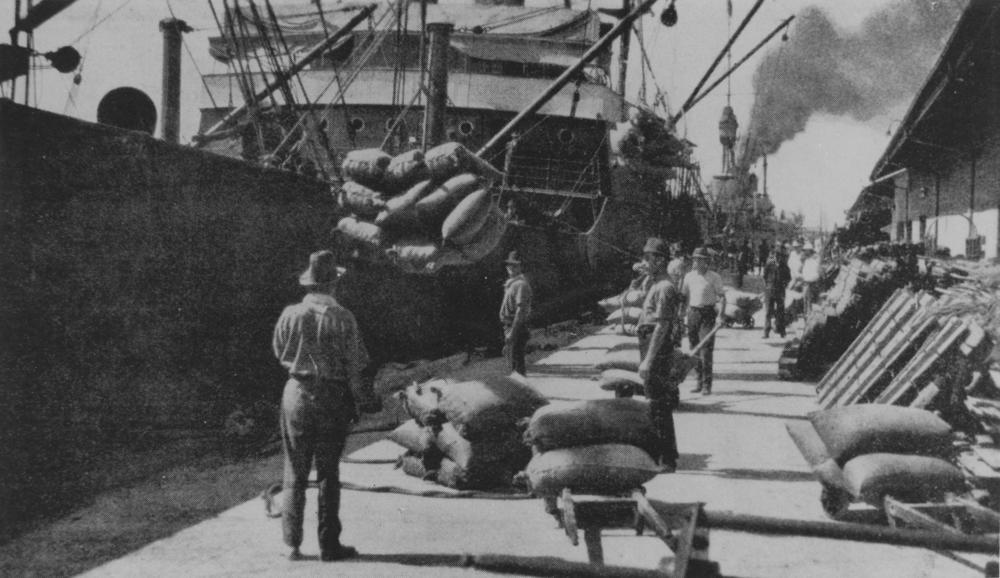
In the 1950s, a merchant ship carried about two hundred thousand different packages. Crates, sacks, barrels, bales, arriving separately.1
Each of these packages was taken off a lorry, carried into a warehouse, taken out again, placed on a pallet, hoisted by a crane, then stowed by hand in the hold by dockers.2
On arrival, it all started again in reverse.
A ship could spend more time at the quayside than at sea.3
A crate, and five days
On 26 April 1956, in Newark, New Jersey, fifty-eight metal crates were loaded onto a converted oil tanker, the Ideal-X.4
Five days later, in Houston, fifty-eight lorries came to collect them and drove off again.5
The man who organised the operation was Malcom McLean. He was not a shipowner: he was a road haulier. His crates were thirty-five feet long, exactly the length of American lorry trailers of the time.6
One calculation decided everything. Loading a ton of goods by hand cost five dollars and eighty-three cents. Loading it in containers, on this first voyage: less than sixteen cents.7
That is thirty-seven times cheaper.
What he invented, and what he did not
On this point, the story is often told wrongly.
McLean did not invent the crate. Containers already existed. Entire railway wagons had been taken on board ships as early as 1929. Armies had built them during the war.8
What did not exist was agreement between the objects.
A crate is useless if the lorry cannot carry it, if the crane cannot grip it, if the ship has no slot of its size, if the quay at the other end does not have the same crane. All of this had to be agreed in advance, everywhere, by people who do not know one another.
That is what McLean put in place: not a box but a system.9
An idea that recurs three times elsewhere
In this encyclopaedia, the same idea appears in four guises:
- A standard weight makes it possible to compare a commodity from one city to another.
- A guaranteed coin makes it possible to count instead of weighing, and therefore to trade with someone one does not know.
- A written rule allows two teams that have never met to play against each other.
- A crate of agreed dimensions allows a lorry, a crane and a ship that have never met to pass a load to one another without opening it.
Four times the same invention, in four different worlds: agreeing in advance on a measure, so as to be able to deal with a stranger.
It is neither a machine nor a material. It is a convention. It changes more than most machines do.
Who paid
On the day the Ideal-X left, a dockers’ union official watched it sail away. According to a witness, he said they would do better to sink that ship.
Loading a ship by hand, item by item, required many men. The container required a handful and a crane. The dockers’ unions opposed it because they knew exactly what was going to happen — and that is what happened.
Some ports took a very long time to adapt: more than a quarter of a century after the Matson company’s first container ship, the Port of San Francisco was still struggling to find a viable policy for the container.10
Not that the old trade was enviable.
A port needed many hands on some days and very few on others. As a result, dockers had to come every morning and ask for work, in a public and humiliating selection. Nobody knew the day before whether he would work the next day.11
It was not a good past replaced by a bad present. It was a hard and uncertain trade, replaced by fewer trades.
And at the end of the voyage
A ship does not last for ever. It has to be taken apart, and that too has a price, paid by people we do not see.
In 2025, 321 ships were dismantled worldwide. Two hundred and fourteen of them were dismantled in South Asia, in Bangladesh, India and Pakistan — and three beaches in these countries alone received 85% of global tonnage.12
To measure the gap: the same year, forty-nine ships were dismantled in Turkey, and fourteen in the whole of the European Union. The method is called beaching: the ship is driven at full speed onto the beach at high tide, then cut up on the sand, with neither quay nor dry dock. The International Labour Organization regards this work as one of the most dangerous in the world.13
Since 2009, an organisation campaigning for reform of this sector — it therefore has a point of view, which should be borne in mind — has counted around 480 deaths and 520 injuries at work on these beaches, out of some 8,200 beached ships. There is no official count at the main site in Bangladesh; that is why the figures come from this organisation.14
A rule does exist, however. An international convention on the safe recycling of ships was adopted in 2009.15
It entered into force sixteen years later, on 26 June 2025.16
Why the delay? Because a treaty of this kind enters into force only if enough States ratify it. Here it needed fifteen States representing 40% of the world merchant fleet, and sufficient dismantling capacity. The threshold was reached only in June 2023 — when Bangladesh and Liberia joined the treaty.17
Ironically, the country where these workers died is the one whose signature made the rule applicable.
The mechanism matters too, for it explains what followed: the convention divides responsibilities between shipowners, yards and States — the flag State, the port State, the dismantling State — and it is up to each State to check that its yards comply with it. Yards have been certified as compliant — twenty-three out of thirty-one in Bangladesh.18
On 14 August 2026, nine workers died in one of these certified yards. Among them was a seventeen-year-old. They were cutting an opening in the ballast tank of a former LNG carrier; hydrogen sulphide escaped from it into the enclosed space where they were working. Six others were injured.19
Two details make this case instructive.
The first: this yard was certified, and it was already being prosecuted. One month earlier, the Bangladeshi labour administration had taken legal action against it for repeated safety failures.20
The second: it was not an exception. A labour research institute recorded, between the entry into force of the convention and this accident, 84 accidents in the country’s yards: 15 dead and 81 injured. A third of them at a single establishment.21
One last figure raises the real question. A local organisation that has kept these records since 2014 counts three deaths in 2025 and twelve in 2026 — the year in which certification has been more widespread than ever.22
A certification describes facilities. It does not describe what happens inside them. Impermeable floors, a drainage system and waste management are real and visible improvements; they replace neither training, nor inspection, nor the right to refuse to go down into a tank.
The rule and the measured result do not coincide. This is a fact, stated here without comment.
A question of words decides everything else: is a ship at the end of its life hazardous waste that is exported, or a commodity that is sold? Two international treaties compete for the answer. Depending on which answer is adopted, different rules apply.23
Note 1
Break bulk is general cargo, loaded into a ship or transport mode as individual or bundled pieces, not stowed into a container, or not transported in ship-sized liquid or dry bulk loads. […] Barrels, sacks, and crates were used to haul the cargo along maritime trade routes. […] Examples of man load are bags of sugar, cotton bales, and drums of liquids.
Notteboom, Theo, Pallis, Athanasios and Rodrigue, Jean-Paul, Port Economics, Management and Policy, 2e éd., Routledge, 2026, chapitre 5.1 “Breakbulk”
Note 2
In 1937, while delivering cotton bales from North Carolina (Lafayette) to New York Harbor, McLean was forced to wait several days while longshoremen manually loaded the cargo.
Rodrigue, Jean-Paul, The Geography of Transport Systems, 6e éd., Routledge, 2024, section “First Containership, Ideal-X, 1956”
Note 3
It also meant that ships had to spend a lot of time in port. Port turnaround times were very long, sometimes exceeding the time at sea.
Notteboom, Theo, “Breakbulk”, chapter 5.1, in Notteboom, Theo, Pallis, Athanasios and Rodrigue, Jean-Paul, Port Economics, Management and Policy, 2nd ed., New York, Routledge, 2026, companion website
Note 4
On April 26th, 1956, the Ideal-X left the Port of Newark, New Jersey, for the Port of Houston, Texas, which was called five days later. It carried 58 35-feet (8 feet wide by 8 feet high) containers […] This first containership was converted from a T2 oil tanker
Rodrigue, Jean-Paul, The Geography of Transport Systems, 6e éd., Routledge, 2024, section “First Containership, Ideal-X, 1956”
Note 5
On April 26th, 1956, the Ideal-X left the Port of Newark, New Jersey, for the Port of Houston, Texas, which was called five days later.
Rodrigue, Jean-Paul, The Geography of Transport Systems, 6e éd., Routledge, 2024, section “First Containership, Ideal-X, 1956”
Note 6
Malcolm McLean (1914-2001), a trucking magnate who saw the tremendous potential of containerization
Rodrigue, Jean-Paul, The Geography of Transport Systems, 6e éd., Routledge, 2024, section “First Containership, Ideal-X, 1956”
The 35-foot unit was the standard truck size in the United States at that time
Rodrigue, Jean-Paul, The Geography of Transport Systems, 6e éd., Routledge, 2024, section “First Containership, Ideal-X, 1956”
Note 7
McLean calculated that in 1956, loading a medium-sized ship the conventional way cost $5.83 a ton. By comparison, loading containers (using the Ideal-X as a frame of reference) would cost less than $0.16 per ton.
Rodrigue, Jean-Paul, The Geography of Transport Systems, 6e éd., Routledge, 2024, section “First Containership, Ideal-X, 1956”
Note 8
In many ways, McLean's vision was nothing new. As far back as 1929, Seatrain had carried railroad boxcars on its sea vessels to transport goods between New York and Cuba. In addition, it was not uncommon for ships to randomly carry large boxes on board, but no shipping business was dedicated to a systematic process of hauling boxed cargo.
Mayo, Anthony and Nohria, Nitin, “The Truck Driver Who Reinvented Shipping”, HBS Working Knowledge, Harvard Business School, 3 October 2005 (excerpt from In Their Time: The Greatest Business Leaders of the Twentieth Century, Harvard Business School Press, 2005)
Note 9
The choice of size was his alone since he designed the system; however, in 1956 it clearly was not yet a system but rather an interesting innovation in the well-established shipping industry.
Fawcett, James A., “14. Container Cranes: Linking Ship to Shore”, USC Sea Grant, University of Southern California, 30 July 2021, open access
Note 10
[…] stowed item by item in a ship's hold by hand, a process which had been dependent on manual labor for as long as ships had carried cargo. […] This new, mechanized system threatened the jobs of longshoremen on the docks […]. […] More than a quarter of a century after Matson's first container ship sailed under the Golden Gate, the Port of San Francisco still struggles to create a viable policy to meet the demands of this now universally accepted maritime technology.
Fitzgerald, Donald, A History of Containerization in the California Maritime Industry: The Case of San Francisco, California Sea Grant College Program, University of California, 1986
Note 11
You arrive at the dock anywhere from 4am to 7am, along with up to a hundred other men seeking 30 to 50 job openings for that morning. The hiring boss, […] chooses who he wants to work. […] This degrading, corrupt and haphazard system of hiring casual labor ruled the waterfronts for decades.
Kasin, Peter, “The Human Stories of Dock Labor - Part 1”, San Francisco Maritime National Historical Park, National Park Service, 8 May 2020
Note 12
321 vessels were dismantled globally last year, of which 214 ended up in South Asia.
NGO Shipbreaking Platform, “Press Release – Platform publishes list of ships dismantled worldwide in 2025”, 2 February 2026, et 2025 Annual List of Ships Scrapped Worldwide, open access
The data reveals that 85% of the global tonnage scrapped last year was broken down on three beaches in Bangladesh, India, and Pakistan.
NGO Shipbreaking Platform, “Press Release – Platform publishes list of ships dismantled worldwide in 2025”, 2 February 2026, et 2025 Annual List of Ships Scrapped Worldwide, open access
Note 13
Shipyards in Bangladesh use a method called 'beaching' in which ships sail full steam onto the beach during high tide to be taken apart directly on the sand instead of using a dock or contained platform.
Human Rights Watch, Trading Lives for Profit: How the Shipping Industry Circumvents Regulations to Scrap Toxic Ships on Bangladesh’s Beaches, 28 September 2023, open access
Shipbreaking is one of the most hazardous occupations
Organisation internationale du travail, Safety and Health in Shipbreaking: Guidelines for Asian Countries and Turkey, Genève, 2004
By comparison, 49 ships went to Turkey (under 700,000 GT), 44 ships in other parts of the world, and only 14 ships were dismantled in the EU.
Maritime Executive (The), “NGO Shipbreaking Platform Reports on 2025 and Calls for More Regulation”, 6 February 2026, open access
Note 14
Claudia Mahler, noted that 'while accidents regularly happen, sometimes leading to death,' no statistical data on deaths and disabilities caused by accidents is collected.
Human Rights Watch, Trading Lives for Profit: How the Shipping Industry Circumvents Regulations to Scrap Toxic Ships on Bangladesh’s Beaches, 28 September 2023, open access
Note 15
The Hong Kong International Convention for the Safe and Environmentally Sound Recycling of Ships enters into force on 26 June 2025, establishing mandatory regulations to govern the way ships are recycled.
Organisation maritime internationale, Convention internationale de Hong Kong pour le recyclage sûr et écologiquement rationnel des navires, adoptée le 15 May 2009, entrée en vigueur le 26 June 2025. https://www.imo.org/
Note 16
The Hong Kong International Convention for the Safe and Environmentally Sound Recycling of Ships (the Hong Kong Convention) will enter into force on 26 June 2025.
Organisation maritime internationale, “Recycling of ships and the Hong Kong Convention”, page d’information
Note 17
This marked the moment that all required criteria were met: not less than 15 States; not less than 40% of the world's merchant shipping by gross tonnage; and ship recycling capacity of not less than 3% of the gross tonnage of the combined merchant shipping of those States mentioned above.
Organisation maritime internationale, “Recycling of ships and the Hong Kong Convention”, page “Hot Topics” du site de l’OMI
The date of the Hong Kong Convention's entry into force was set in June 2023 when Bangladesh and Liberia became Contracting States to it.
Organisation maritime internationale, Convention internationale de Hong Kong pour le recyclage sûr et écologiquement rationnel des navires, adoptée le 15 May 2009, entrée en vigueur le 26 June 2025. https://www.imo.org/
Note 18
There are 31 functioning shipyards, of which 23 have "gone green"
Daily Star (The), Dacca, “Shipbreaking Yards: "Green" on Paper, Deadly on Ground”, 16 August 2026
The Hong Kong Convention addresses all environmental and safety aspects relating to ship recycling by placing responsibilities and obligations on all parties concerned – shipowners, ship building yards, ship recycling facilities, flag States, port States, and recycling States - regarding the responsible management and disposal of associated waste streams in a safe and environmentally sound manner. […] Governments will be required to ensure that recycling facilities under their jurisdiction comply with the Hong Kong Convention.
Organisation maritime internationale, “Recycling of ships and the Hong Kong Convention”, page “Hot Topics” du site de l’OMI
Note 19
On 14 August, nine workers died after exposure to toxic gas inside the LNG carrier MT RASI (IMO 9176008) at Ferdous Steel in Chattogram, Bangladesh. Among those killed was a 17-year-old. […] The tragedy occurred at a yard certified as compliant with the Hong Kong Convention (HKC).
NGO Shipbreaking Platform, communiqué du 17 August 2026, “Nine Shipbreaking Workers Killed in Bangladesh”, open access
Note 20
Only one month earlier, Bangladesh's Department of Inspection for Factories and Establishments had taken legal action against Ferdous Steel following repeated occupational safety failures.
NGO Shipbreaking Platform, communiqué du 17 August 2026, “Nine Shipbreaking Workers Killed in Bangladesh”, open access
Note 21
According to data compiled by Bangladesh Institute of Labour Studies (BILS), the 84 accidents recorded between June 26, 2025, and August 14, 2026, claimed 15 lives and injured 81 workers. […] KR Steel Yard in Lalbagh, Sitakunda, recorded the highest number, with 29 accidents leaving 29 workers injured.
Daily Star (The), Dacca, “Shipbreaking Yards: "Green" on Paper, Deadly on Ground”, 16 August 2026
Note 22
The data records five deaths in 2023, seven in 2024 and three in 2025. […] With the latest fatalities, 12 workers have already died in 2026
Business Standard (The), Dacca, Illius, Shamsuddin, “How "Green" Are Bangladesh’s Shipbreaking Yards if Workers Keep Dying?”, 15 August 2026
Note 23
At the seventh meeting of the Conference of the Parties in 2004, while Basel Parties recognised that ship may become waste as defined in Article 2 of the Basel Convention, they also invited the International Maritime Organization (IMO) to continue work aimed at the establishment of mandatory requirements […] The Hong Kong International Convention for the Safe and Environmentally Sound Recycling of Ships was adopted at a diplomatic conference in Hong Kong, China, in May 2009.
Convention de Bâle sur le contrôle des mouvements transfrontières de déchets dangereux et de leur élimination, adoptée le 22 March 1989 par la Conférence de plénipotentiaires réunie à Bâle, entrée en vigueur le 5 May 1992
Notes and sources
- ↑
Passage Crates, sacks, barrels, bales, arriving separately.
Break bulk is general cargo, loaded into a ship or transport mode as individual or bundled pieces, not stowed into a container, or not transported in ship-sized liquid or dry bulk loads. […] Barrels, sacks, and crates were used to haul the cargo along maritime trade routes. […] Examples of man load are bags of sugar, cotton bales, and drums of liquids.
Source Notteboom, Theo, Pallis, Athanasios and Rodrigue, Jean-Paul, Port Economics, Management and Policy, 2e éd., Routledge, 2026, chapitre 5.1 “Breakbulk”, chapter 5.1 “Breakbulk”, section 1 “The Origins of the Breakbulk Market”, A “Breakbulk cargo” and B “The pre-container era”.
Open access open the source · checked on 9 September 2026
- ↑
Passage then stowed by hand in the hold by dockers
In 1937, while delivering cotton bales from North Carolina (Lafayette) to New York Harbor, McLean was forced to wait several days while longshoremen manually loaded the cargo.
Source Rodrigue, Jean-Paul, The Geography of Transport Systems, 6e éd., Routledge, 2024, section “First Containership, Ideal-X, 1956”, page “First Containership, Ideal-X, 1956”, body of the article (1937 anecdote).
Open access open the source · checked on 9 September 2026
- ↑
Passage A ship could spend more time at the quayside than at sea.
It also meant that ships had to spend a lot of time in port. Port turnaround times were very long, sometimes exceeding the time at sea.
Source Notteboom, Theo, “Breakbulk”, chapter 5.1, in Notteboom, Theo, Pallis, Athanasios and Rodrigue, Jean-Paul, Port Economics, Management and Policy, 2nd ed., New York, Routledge, 2026, companion website, chapter 5.1 (“Breakbulk”), § 1 (“The Origins of the Breakbulk Market”), B (pre-container era).
Open access open the source · checked on 27 October 2026
- ↑
Passage On 26 April 1956, in Newark, New Jersey, fifty-eight metal crates were loaded onto a converted oil tanker, the Ideal-X.
On April 26th, 1956, the Ideal-X left the Port of Newark, New Jersey, for the Port of Houston, Texas, which was called five days later. It carried 58 35-feet (8 feet wide by 8 feet high) containers […] This first containership was converted from a T2 oil tanker
Source Rodrigue, Jean-Paul, The Geography of Transport Systems, 6e éd., Routledge, 2024, section “First Containership, Ideal-X, 1956”, page “First Containership, Ideal-X, 1956”, body of the article.
Open access open the source · checked on 9 September 2026
- ↑
Passage Five days later, in Houston
On April 26th, 1956, the Ideal-X left the Port of Newark, New Jersey, for the Port of Houston, Texas, which was called five days later.
Source Rodrigue, Jean-Paul, The Geography of Transport Systems, 6e éd., Routledge, 2024, section “First Containership, Ideal-X, 1956”, page “First Containership, Ideal-X, 1956”, body of the article.
Open access open the source · checked on 9 September 2026
- ↑
Passage He was not a shipowner: he was a road haulier.
Malcolm McLean (1914-2001), a trucking magnate who saw the tremendous potential of containerization
Source Rodrigue, Jean-Paul, The Geography of Transport Systems, 6e éd., Routledge, 2024, section “First Containership, Ideal-X, 1956”, body of the article.
Open access open the source · checked on 9 September 2026
Passage His crates were thirty-five feet long, exactly the length of American lorry trailers of the time.
The 35-foot unit was the standard truck size in the United States at that time
Source Rodrigue, Jean-Paul, The Geography of Transport Systems, 6e éd., Routledge, 2024, section “First Containership, Ideal-X, 1956”, page “First Containership, Ideal-X, 1956”, body of the article.
Open access open the source · checked on 9 September 2026
- ↑
Passage Loading a ton of goods by hand cost five dollars and eighty-three cents. Loading it in containers, on this first voyage: less than sixteen cents.
McLean calculated that in 1956, loading a medium-sized ship the conventional way cost $5.83 a ton. By comparison, loading containers (using the Ideal-X as a frame of reference) would cost less than $0.16 per ton.
Source Rodrigue, Jean-Paul, The Geography of Transport Systems, 6e éd., Routledge, 2024, section “First Containership, Ideal-X, 1956”, page “First Containership, Ideal-X, 1956”, body of the article.
Open access open the source · checked on 9 September 2026
- ↑
Passage Containers already existed. Entire railway wagons had been taken on board ships as early as 1929
In many ways, McLean's vision was nothing new. As far back as 1929, Seatrain had carried railroad boxcars on its sea vessels to transport goods between New York and Cuba. In addition, it was not uncommon for ships to randomly carry large boxes on board, but no shipping business was dedicated to a systematic process of hauling boxed cargo.
Source Mayo, Anthony and Nohria, Nitin, “The Truck Driver Who Reinvented Shipping”, HBS Working Knowledge, Harvard Business School, 3 October 2005 (excerpt from In Their Time: The Greatest Business Leaders of the Twentieth Century, Harvard Business School Press, 2005), 5th paragraph of the article body (the one beginning “For the next decade and a half”).
Open access open the source · checked on 27 October 2026
- ↑
For this whole section
Passage in 1956, the container was not yet a system but an innovation in a well-established seafaring trade
The choice of size was his alone since he designed the system; however, in 1956 it clearly was not yet a system but rather an interesting innovation in the well-established shipping industry.
Source Fawcett, James A., “14. Container Cranes: Linking Ship to Shore”, USC Sea Grant, University of Southern California, 30 July 2021, open access, section “The Birth of the Container”.
Open access open the source · checked on 24 October 2026
- ↑
Passage Loading a ship by hand, item by item, required many men. […] Some ports took a very long time to adapt: more than a quarter of a century after the Matson company’s first container ship, the Port of San Francisco was still struggling to find a viable policy for the container.
[…] stowed item by item in a ship's hold by hand, a process which had been dependent on manual labor for as long as ships had carried cargo. […] This new, mechanized system threatened the jobs of longshoremen on the docks […]. […] More than a quarter of a century after Matson's first container ship sailed under the Golden Gate, the Port of San Francisco still struggles to create a viable policy to meet the demands of this now universally accepted maritime technology.
Source Fitzgerald, Donald, A History of Containerization in the California Maritime Industry: The Case of San Francisco, California Sea Grant College Program, University of California, 1986, abstract, first, third and last sentences.
Open access open the source · checked on 27 October 2026
- ↑
Passage dockers had to come every morning and ask for work, in a public and humiliating selection
You arrive at the dock anywhere from 4am to 7am, along with up to a hundred other men seeking 30 to 50 job openings for that morning. The hiring boss, […] chooses who he wants to work. […] This degrading, corrupt and haphazard system of hiring casual labor ruled the waterfronts for decades.
Source Kasin, Peter, “The Human Stories of Dock Labor - Part 1”, San Francisco Maritime National Historical Park, National Park Service, 8 May 2020, paragraph “What was a "shape-up"?” and the following paragraph (“Not hired?”).
Open access open the source · checked on 27 October 2026
- ↑
Passage In 2025, 321 ships were dismantled worldwide. Two hundred and fourteen of them were dismantled in South Asia
321 vessels were dismantled globally last year, of which 214 ended up in South Asia.
Source NGO Shipbreaking Platform, “Press Release – Platform publishes list of ships dismantled worldwide in 2025”, 2 February 2026, et 2025 Annual List of Ships Scrapped Worldwide, open access, press release of 2 February 2026, second paragraph.
Open access open the source · checked on 24 October 2026
Passage and three beaches in these countries alone received 85% of global tonnage
The data reveals that 85% of the global tonnage scrapped last year was broken down on three beaches in Bangladesh, India, and Pakistan.
Source NGO Shipbreaking Platform, “Press Release – Platform publishes list of ships dismantled worldwide in 2025”, 2 February 2026, et 2025 Annual List of Ships Scrapped Worldwide, open access, press release of 2 February 2026.
Open access open the source · checked on 24 October 2026
- ↑
Passage The method is called beaching: the ship is driven at full speed onto the beach at high tide, then cut up on the sand
Shipyards in Bangladesh use a method called 'beaching' in which ships sail full steam onto the beach during high tide to be taken apart directly on the sand instead of using a dock or contained platform.
Source Human Rights Watch, Trading Lives for Profit: How the Shipping Industry Circumvents Regulations to Scrap Toxic Ships on Bangladesh’s Beaches, 28 September 2023, open access, section “Beaching Toxic Ships on Bangladesh Shores”.
Open access open the source · checked on 24 October 2026
Passage The International Labour Organization regards this work as one of the most dangerous in the world.
Shipbreaking is one of the most hazardous occupations
Source Organisation internationale du travail, Safety and Health in Shipbreaking: Guidelines for Asian Countries and Turkey, Genève, 2004, p. 4, section 2.3 “Problems of the industry”, subheading 2.3.1.
Open access open the source · checked on 24 October 2026
Passage forty-nine ships were dismantled in Turkey, and fourteen in the whole of the European Union
By comparison, 49 ships went to Turkey (under 700,000 GT), 44 ships in other parts of the world, and only 14 ships were dismantled in the EU.
Source Maritime Executive (The), “NGO Shipbreaking Platform Reports on 2025 and Calls for More Regulation”, 6 February 2026, open access, article of 6 February 2026, based on the NGO Shipbreaking Platform’s 2025 annual list.
Open access open the source · checked on 24 October 2026
- ↑
Passage There is no official count at the main site in Bangladesh
Claudia Mahler, noted that 'while accidents regularly happen, sometimes leading to death,' no statistical data on deaths and disabilities caused by accidents is collected.
Source Human Rights Watch, Trading Lives for Profit: How the Shipping Industry Circumvents Regulations to Scrap Toxic Ships on Bangladesh’s Beaches, 28 September 2023, open access, section “I. Dangers of Shipbreaking in Bangladesh” (visit by the UN independent expert, November 2022).
Open access open the source · checked on 24 October 2026
- ↑
Passage An international convention on the safe recycling of ships
The Hong Kong International Convention for the Safe and Environmentally Sound Recycling of Ships enters into force on 26 June 2025, establishing mandatory regulations to govern the way ships are recycled.
Source Organisation maritime internationale, Convention internationale de Hong Kong pour le recyclage sûr et écologiquement rationnel des navires, adoptée le 15 May 2009, entrée en vigueur le 26 June 2025. https://www.imo.org/, IMO press release “Hong Kong Convention entry into force” (2025), third paragraph.
Open access open the source · checked on 24 October 2026
- ↑
Passage It entered into force sixteen years later, on 26 June 2025.
The Hong Kong International Convention for the Safe and Environmentally Sound Recycling of Ships (the Hong Kong Convention) will enter into force on 26 June 2025.
Source Organisation maritime internationale, “Recycling of ships and the Hong Kong Convention”, page d’information, page “Recycling of ships and the Hong Kong Convention”, first paragraph.
Open access open the source · checked on 9 September 2026
- ↑
Passage Here it needed fifteen States representing 40% of the world merchant fleet, and sufficient dismantling capacity.
This marked the moment that all required criteria were met: not less than 15 States; not less than 40% of the world's merchant shipping by gross tonnage; and ship recycling capacity of not less than 3% of the gross tonnage of the combined merchant shipping of those States mentioned above.
Source Organisation maritime internationale, “Recycling of ships and the Hong Kong Convention”, page “Hot Topics” du site de l’OMI, paragraph on entry into force (criteria met in June 2023).
Open access open the source · checked on 9 September 2026
Passage The threshold was reached only in June 2023 — when Bangladesh and Liberia joined the treaty.
The date of the Hong Kong Convention's entry into force was set in June 2023 when Bangladesh and Liberia became Contracting States to it.
Source Organisation maritime internationale, Convention internationale de Hong Kong pour le recyclage sûr et écologiquement rationnel des navires, adoptée le 15 May 2009, entrée en vigueur le 26 June 2025. https://www.imo.org/, convention page.
Open access open the source · checked on 9 September 2026
- ↑
Passage twenty-three out of thirty-one in Bangladesh
There are 31 functioning shipyards, of which 23 have "gone green"
Source Daily Star (The), Dacca, “Shipbreaking Yards: "Green" on Paper, Deadly on Ground”, 16 August 2026, article of 16 August 2026.
Open access open the source · checked on 9 September 2026
Passage the convention divides responsibilities between shipowners, yards and States — the flag State, the port State, the dismantling State — and it is up to each State to check that its yards comply with it
The Hong Kong Convention addresses all environmental and safety aspects relating to ship recycling by placing responsibilities and obligations on all parties concerned – shipowners, ship building yards, ship recycling facilities, flag States, port States, and recycling States - regarding the responsible management and disposal of associated waste streams in a safe and environmentally sound manner. […] Governments will be required to ensure that recycling facilities under their jurisdiction comply with the Hong Kong Convention.
Source Organisation maritime internationale, “Recycling of ships and the Hong Kong Convention”, page “Hot Topics” du site de l’OMI, presentation of the convention, then passage on the requirements for recycling facilities.
Open access open the source · checked on 9 September 2026
- ↑
Passage On 14 August 2026, nine workers died in one of these certified yards. Among them was a seventeen-year-old.
On 14 August, nine workers died after exposure to toxic gas inside the LNG carrier MT RASI (IMO 9176008) at Ferdous Steel in Chattogram, Bangladesh. Among those killed was a 17-year-old. […] The tragedy occurred at a yard certified as compliant with the Hong Kong Convention (HKC).
Source NGO Shipbreaking Platform, communiqué du 17 August 2026, “Nine Shipbreaking Workers Killed in Bangladesh”, open access, press release “Press Release – Nine shipbreaking workers killed in Bangladesh”, 17 August 2026, 2nd and 3rd paragraphs.
Open access open the source · checked on 9 September 2026
- ↑
Passage One month earlier, the Bangladeshi labour administration had taken legal action against it for repeated safety failures.
Only one month earlier, Bangladesh's Department of Inspection for Factories and Establishments had taken legal action against Ferdous Steel following repeated occupational safety failures.
Source NGO Shipbreaking Platform, communiqué du 17 August 2026, “Nine Shipbreaking Workers Killed in Bangladesh”, open access, press release.
Open access open the source · checked on 9 September 2026
- ↑
Passage 84 accidents in the country’s yards: 15 dead and 81 injured. A third of them at a single establishment.
According to data compiled by Bangladesh Institute of Labour Studies (BILS), the 84 accidents recorded between June 26, 2025, and August 14, 2026, claimed 15 lives and injured 81 workers. […] KR Steel Yard in Lalbagh, Sitakunda, recorded the highest number, with 29 accidents leaving 29 workers injured.
Source Daily Star (The), Dacca, “Shipbreaking Yards: "Green" on Paper, Deadly on Ground”, 16 August 2026, article of 16 August 2026 (Sifayet Ullah, Arun Bikash Dey and Zyma Islam).
Open access open the source · checked on 9 September 2026
- ↑
Passage three deaths in 2025 and twelve in 2026
The data records five deaths in 2023, seven in 2024 and three in 2025. […] With the latest fatalities, 12 workers have already died in 2026
Source Business Standard (The), Dacca, Illius, Shamsuddin, “How "Green" Are Bangladesh’s Shipbreaking Yards if Workers Keep Dying?”, 15 August 2026, record kept by the organisation YPSA, body of the article.
Open access open the source · checked on 9 September 2026
- ↑
Passage is a ship at the end of its life hazardous waste that is exported, or a commodity that is sold? Two international treaties compete for the answer.
At the seventh meeting of the Conference of the Parties in 2004, while Basel Parties recognised that ship may become waste as defined in Article 2 of the Basel Convention, they also invited the International Maritime Organization (IMO) to continue work aimed at the establishment of mandatory requirements […] The Hong Kong International Convention for the Safe and Environmentally Sound Recycling of Ships was adopted at a diplomatic conference in Hong Kong, China, in May 2009.
Source Convention de Bâle sur le contrôle des mouvements transfrontières de déchets dangereux et de leur élimination, adoptée le 22 March 1989 par la Conférence de plénipotentiaires réunie à Bâle, entrée en vigueur le 5 May 1992, official website of the Basel Convention, “Ship Dismantling” section, “Legal Aspects” page (https://www.basel.int/Implementation/ShipDismantling/LegalAspects/Overview/tabid/2766/Default.aspx), 3rd and 5th paragraphs.
Open access open the source · checked on 24 October 2026
Bibliography
19
- Business Standard (The), Dacca, Illius, Shamsuddin, “How "Green" Are Bangladesh’s Shipbreaking Yards if Workers Keep Dying?”, 15 August 2026, open access (the record kept by the organisation YPSA: 161 deaths between 2014 and August 2026, including three in 2025 and twelve in 2026; the gap between the yards’ equipment and the application of procedures). https://www.tbsnews.net/analysis/how-green-are-bangladeshs-shipbreaking-yards-if-workers-keep-dying-1515571
- Convention de Bâle sur le contrôle des mouvements transfrontières de déchets dangereux et de leur élimination, adoptée le 22 March 1989 par la Conférence de plénipotentiaires réunie à Bâle, entrée en vigueur le 5 May 1992, open access (the treaty arose from the outcry caused in the 1980s by the discovery, in Africa and elsewhere, of dumps of toxic waste imported from abroad). https://www.basel.int/theconvention/overview/tabid/1271/default.aspx
- Daily Star (The), Dacca, “Shipbreaking Yards: "Green" on Paper, Deadly on Ground”, 16 August 2026, open access (the 84 accidents recorded by the Bangladesh Institute of Labour Studies between 26 June 2025 and 14 August 2026: 15 dead and 81 injured, a third of them in a single yard; twenty-three “green” yards out of thirty-one in operation). https://www.thedailystar.net/news/bangladesh/news/shipbreaking-yards-green-paper-deadly-ground-4248676
- Fawcett, James A., “14. Container Cranes: Linking Ship to Shore”, USC Sea Grant, University of Southern California, 30 July 2021, open access (in 1956, the container was not yet a system but an innovation in a well-established seafaring trade). https://dornsife.usc.edu/uscseagrant/2021/07/30/14-container-cranes-linking-ship-to-shore/
- Fitzgerald, Donald, A History of Containerization in the California Maritime Industry: The Case of San Francisco, California Sea Grant College Program, University of California, 1986, open access (cargo stowed item by item by hand; the dockers’ jobs threatened; more than a quarter of a century after Matson’s first container ship, the Port of San Francisco still seeking a viable policy). https://escholarship.org/uc/item/02k7415n
- Human Rights Watch, Trading Lives for Profit: How the Shipping Industry Circumvents Regulations to Scrap Toxic Ships on Bangladesh’s Beaches, 28 September 2023, open access (the beaching method: ships driven full steam onto the beach at high tide, then cut up on the sand; the UN independent expert: no statistics on deaths and disabilities are collected in Bangladesh). https://www.hrw.org/report/2023/09/28/trading-lives-profit/how-shipping-industry-circumvents-regulations-scrap-toxic
- Kasin, Peter, “The Human Stories of Dock Labor - Part 1”, San Francisco Maritime National Historical Park, National Park Service, 8 May 2020, open access (the “shape-up” on the New York docks before the container: every morning, up to a hundred men for 30 to 50 openings, picked by the hiring boss; a “degrading” system; after Charles P. Larrowe, Shape-up and Hiring Hall, 1955). https://www.nps.gov/safr/blogs/the-human-stories-of-dock-labor-part-1.htm
- Levinson, Marc, The Box: How the Shipping Container Made the World Smaller and the World Economy Bigger, Princeton University Press, 2006 ; 2e éd. 2016 (the first voyage, the 194,582 packages of a ship of the 1950s, 5.83 dollars against 15.8 cents per ton, the dockers, the ports). French translation: The Box. Comment le conteneur a changé le monde, Max Milo, 2011.
- Maritime Executive (The), “NGO Shipbreaking Platform Reports on 2025 and Calls for More Regulation”, 6 February 2026, open access (49 ships in Turkey, 44 elsewhere in the world and only 14 in the European Union in 2025). https://maritime-executive.com/article/ngo-shipbreaking-platform-reports-on-2025-and-calls-for-more-regulation
- Mayo, Anthony and Nohria, Nitin, “The Truck Driver Who Reinvented Shipping”, HBS Working Knowledge, Harvard Business School, 3 October 2005 (excerpt from In Their Time: The Greatest Business Leaders of the Twentieth Century, Harvard Business School Press, 2005), open access (McLean’s idea was not new: ships already carried large boxes; as early as 1929, Seatrain carried railway boxcars between New York and Cuba). https://www.library.hbs.edu/working-knowledge/the-truck-driver-who-reinvented-shipping
- NGO Shipbreaking Platform, “Press Release – Platform publishes list of ships dismantled worldwide in 2025”, 2 February 2026, et 2025 Annual List of Ships Scrapped Worldwide, open access (321 ships dismantled in 2025, including 214 in South Asia; 85% of tonnage on three beaches in Bangladesh, India and Pakistan; data cross-checked “where possible” — campaigning organisation). https://shipbreakingplatform.org/platform-publishes-list-2025/
- NGO Shipbreaking Platform, communiqué du 17 August 2026, “Nine Shipbreaking Workers Killed in Bangladesh”, open access (the nine deaths of 14 August 2026 in Chattogram, including a seventeen-year-old minor; the yard certified as compliant; the legal action taken a month earlier for repeated safety failures — campaigning organisation). https://shipbreakingplatform.org/nine-shipbreaking-workers-killed-in-bangladesh/
- Notteboom, Theo, “Breakbulk”, chapter 5.1, in Notteboom, Theo, Pallis, Athanasios and Rodrigue, Jean-Paul, Port Economics, Management and Policy, 2nd ed., New York, Routledge, 2026, open-access companion website. https://porteconomicsmanagement.org/pemp/contents/part5/break-bulk/
- Notteboom, Theo, Pallis, Athanasios and Rodrigue, Jean-Paul, Port Economics, Management and Policy, 2e éd., Routledge, 2026, chapitre 5.1 “Breakbulk”, open access (before the container, cargo loaded piece by piece: crates, sacks, barrels, bales). https://porteconomicsmanagement.org/pemp/contents/part5/break-bulk/
- Organisation internationale du travail, Safety and Health in Shipbreaking: Guidelines for Asian Countries and Turkey, Genève, 2004 (shipbreaking among the most dangerous occupations).
- Organisation maritime internationale, Convention internationale de Hong Kong pour le recyclage sûr et écologiquement rationnel des navires, adoptée le 15 May 2009, entrée en vigueur le 26 June 2025. https://www.imo.org/
- Organisation maritime internationale, “Recycling of ships and the Hong Kong Convention”, page “Hot Topics” du site de l’OMI, open access (the conditions for entry into force; responsibilities shared between shipowners, yards, and flag, port and recycling States). https://www.imo.org/en/MediaCentre/HotTopics/Pages/Recycling-of-ships-and-Hong-Kong-Convention.aspx
- Organisation maritime internationale, “Recycling of ships and the Hong Kong Convention”, page d’information, open access (adoption in 2009 in Hong Kong; entry into force on 26 June 2025). https://www.imo.org/en/MediaCentre/HotTopics/Pages/Recycling-of-ships-and-Hong-Kong-Convention.aspx
- Rodrigue, Jean-Paul, The Geography of Transport Systems, 6e éd., Routledge, 2024, section “First Containership, Ideal-X, 1956”. https://transportgeography.org/
Spotted an error or have a doubt? Write to us.