How many languages are there in the world?
Two major catalogues provide an answer. They do not give the same number.
Two answers, no mistake
Ethnologue, the most widely consulted catalogue, counts just over 7,100. Glottolog, maintained by a Max Planck institute, counts several hundred more.1
Nobody has made a mistake.
The explanation lies in the criterion used. To decide whether two ways of speaking are two languages or a single one, the main test is whether their speakers understand each other without prior learning: this is what is called mutual intelligibility. If it exists, we speak of two dialects of the same language; if not, of two languages.
Yet mutual understanding is not a matter of yes or no, but of degree.
There are regions where each village understands its neighbours very well, the villages beyond a little less well, and those at the far end of the chain not at all. Where should the line be drawn? Depending on where the boundary is placed, a different number comes out.
Another factor comes into play. Swedish, Norwegian and Danish are similar enough for their speakers to understand one another in part. Yet they are called three languages, largely because they belong to three countries.
This is the key point: this number is not a fact that we observe, but the result of a sorting rule. Changing the rule means changing the number.
What is more, this number changes constantly, for three very real reasons: previously unknown languages are documented, which pushes it up; languages die out, which brings it down; and the catalogues sometimes revise their classification of a way of speaking, which makes it jump one way or the other.2
What a language is, and the channels through which it travels
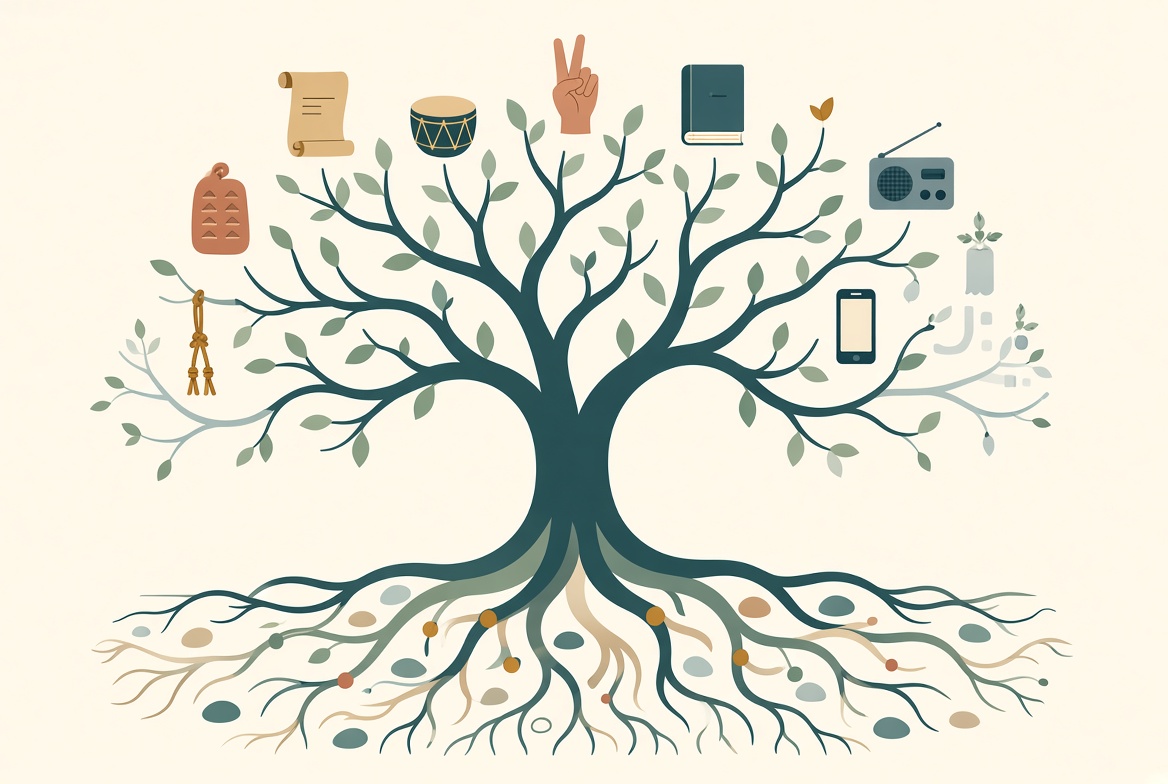
A language is a shared system that makes it possible to produce an unlimited number of messages from a limited number of elements. This is the idea that the linguist Wilhelm von Humboldt defended in the nineteenth century when he argued that a language makes infinite use of finite means. A few dozen sounds, combined, give thousands of words; rules of grammar combine these words into sentences that no one has ever uttered before and that everyone nevertheless understands. It is this capacity to make something new out of something known that distinguishes a language from a mere repertoire of signals.3
It travels through several channels, and none is more “real” than the others.
- Speech is the oldest and most universal channel. All known human societies speak.
- Sign languages use the hands, the face and space. They are not gestural translations of a spoken language: they are complete languages, with their own grammar, and there are hundreds of them, differing from one country to another.
- Writing is a late and rare addition. It was invented only three or four times in history, and the great majority of the world’s languages have never been written. A language without writing is neither poorer nor less structured: it is simply more fragile, because it does not outlive its last speakers.
Languages have families
Languages change constantly, and when groups that spoke the same language separate for long enough, they end up no longer understanding one another. This is how Latin gave rise to French, Spanish, Italian, Portuguese and Romanian — which are thus, literally, Latin that has evolved separately.
Languages descended from the same ancestor are grouped into families. French belongs to the Indo-European family, which also includes English, Russian, Greek, Persian and Hindi. There are dozens of isolate languages, which are not linked to any family — Basque in Europe, Ainu in Japan, Burushaski in Pakistan, Zuni in North America.
As for the number of families, it depends on the catalogue consulted, like the number of languages itself: some count about a hundred and forty, others several hundred, depending on whether one tends to group languages together or to split them apart. This is exactly the problem this page is about, applied one level higher.
The boundary between “two languages” and “two ways of speaking the same one” is far from obvious, and this is exactly the problem that the rest of this page deals with.
The real subject is not the total
How they are distributed matters more, because that is where the figures become astonishing:
Papua New Guinea, with a modest population, has on its own more than eight hundred languages — more than the whole of Europe.4
In other words, there is no relationship between the number of speakers and the number of languages they speak.
At the other end of the scale, one figure reveals the true shape of diversity. Just twenty-three languages are spoken by more than half of humanity — that is, about 0.3% of languages.5
A few enormous languages, and thousands of very small ones.
This page deals with spoken languages. Their writing, printing and preservation are covered on page 9.13.
Many languages are endangered
About four in ten living languages are classified as endangered — roughly three thousand. Many have fewer than a thousand speakers.6
The classification, moreover, states precisely what “endangered” means: it is no longer the norm, in that community, for children to learn and use the language. The criterion is not the number of living speakers; it is transmission.7
One claim often circulates: “*a language disappears every two weeks*”. It can be found everywhere. Its origin is instructive.
It goes back to an article published in 1992 by an American linguist, Michael Krauss, in a scientific journal. In it, he estimated that a large proportion of the world’s languages were doomed to disappear over the coming century.8
Krauss was not writing for the general public. He was writing to his fellow linguists, and he was warning them: their discipline risked going down in history as the only science that had watched its own subject disappear without reacting.9
So it was a warning figure, meant to shake people up.
This is why the rates one reads do not agree: one language every two weeks, every month, every three months. These are not counts; they are different projections.
That said, the opposite conclusion should not be drawn. Languages really are disappearing, and other studies have confirmed it since: a major 2022 study estimates that, without swift action, more than 1,500 languages may cease to be spoken by the end of the century. It is the rate that is uncertain, not the fact.10
This story cannot be reduced to a tally of losses. In many places, people are recording, writing down and teaching their own language to their children, from within their own community.
One last detail about Krauss. He had headed the Alaska Native Language Center, and he was the specialist in a language called Eyak. This language died out in January 2008. He was still alive.11
How a language disappears
It does not evaporate. Usually, its speakers stop passing it on to their children, and something has pushed them to do so.
An example close to home illustrates this.
In Brittany, and in the same way in the south of France for Occitan, there was an object at school called the symbol (the signal, in Occitan). A pupil caught speaking their language was given it. As soon as they heard a classmate speaking Breton, they passed it on to them. Whoever still had it at the end of the day was punished.12
The school administration in Brittany laid down the principle that not a single word of Breton was to be spoken, either in class or in the playground.13
As the page on school points out, the same laws that taught millions of children to read were also used for this. Both happened in the same classroom. An institution is almost never all of a piece.
And now, a language that was born
Much is said about dying languages. Here, by contrast, is one that came into being.
In Nicaragua, before the end of the 1970s, there was no sign language. Deaf children stayed at home, each with a few gestures invented with their family, and almost never met other deaf children.
At the end of the 1970s, the state opened a centre for special education in Managua. For the first time, deaf children found themselves together in large numbers in the same place.
The school, for its part, taught them spoken Spanish and lip-reading. It discouraged signing, and failed. But by bringing them together, it had unintentionally created what was missing: a group.
In the playground and on the bus, the children pooled their gestures. They built a language — a real one, with its grammar, its vocabulary and its rules. Neither the teachers nor the state made it: the pupils did.
The Ministry of Education, which did not understand what these children were saying to each other, brought in a linguist, Judy Kegl, to explain it. Other researchers followed, including Ann Senghas, who showed something surprising: it was the youngest newcomers who made the language more regular. Each new wave of children improved the grammar of the previous one. It was the first time that a language could be followed from its birth.14
A historian tells the story differently. Laura Polich worked in the national archives of Nicaragua, visited special schools and interviewed deaf people, including the oldest members of the national association. Her conclusion: the adoption of a common sign language was not sudden. It took years, and it only really took hold once a community began to meet regularly — in adulthood, not only at school.15
What holds in both versions: children built among themselves a system that no one had taught them, and the following waves made it more regular. What is disputed: the speed, and the degree of isolation. The linguists observed children signing; the historian read archives and interviewed adults. It is not that one of them is wrong: it is that they are not looking in the same place.
We now need to go back a century. A major international congress held in Milan had recommended teaching deaf children to speak and to lip-read, abandoning sign languages. This approach was followed for a very long time. The deaf participants had been excluded from the vote.16
This is exactly the mechanism of the Breton symbol, in the same period and on another continent: a school that forbids a language to those who speak it.
Note 1
7,164 languages are in use today.
Ethnologue, “How many languages are there in the world?”, SIL International, open access
Glottolog is an initiative of the Max Planck Institute for Evolutionary Anthropology, Leipzig. […] Currently 2026-03-02 there are 7674 spoken L1 languages
Hammarström, Harald, Forkel, Robert, Haspelmath, Martin and Bank, Sebastian, Glottolog, Max Planck Institute for Evolutionary Anthropology, base mise à jour en continu
Note 2
That number changes as knowledge of the world’s languages improves. […] This is the result of changes in the extinction status of some languages and of updating Ethnologue to keep it aligned with the ISO 639-3 inventory of languages.
Simons, Gary, “Welcome to the 24th edition”, Ethnoblog, Ethnologue, SIL International, 22 February 2021, open access
Note 3
Sie muſs daher von endlichen Mitteln einen unendlichen Gebrauch machen
It must therefore make infinite use of finite means
Humboldt, Wilhelm von, Über die Verschiedenheit des menschlichen Sprachbaues, Berlin, 1836
Note 4
Papua New Guinea has the most languages in the world – over 800.
Ethnologue, “What countries have the most languages?”, SIL International, open access
Note 5
just 23 languages account for more than half the world’s population.
Ethnologue, “How many languages are there in the world?”, SIL International, open access
just 23 languages account for more than half the world’s population.
Ethnologue, “How many languages are there in the world?”, SIL International, open access
Note 6
3,045 languages are endangered today. […] While about 42% of languages are endangered based on our EGIDS measurement tool
Ethnologue, “How many languages are endangered?”, SIL International, open access
This is a fragile time: Roughly 40% of languages are now endangered, often with fewer than 1,000 users remaining.
Ethnologue, “How many languages are there in the world?”, SIL International, open access
Note 7
Endangered — It is no longer the norm that children learn and use this language.
Ethnologue, “Zeem”, fiche de langue, SIL International, open access
Note 8
Therefore, I consider it a plausible calculation that—at the rate things are going—the coming century will see either the death or the doom of 90% of mankind's languages.
Krauss, Michael, “The World’s Languages in Crisis”, Language, vol. 68, no. 1, March 1992, p. 4-10
Note 9
Obviously we must do some serious rethinking of our priorities, lest linguistics go down in history as the only science that presided obliviously over the disappearance of 90% of the very field to which it is dedicated.
Krauss, Michael, “The World’s Languages in Crisis”, Language, vol. 68, no. 1, March 1992, p. 4-10
Note 10
To avoid the loss of over 1,500 languages by the end of the century, urgent investment is needed in language documentation, bilingual education programmes and other community-based programmes.
Bromham, Lindell et al., “Global Predictors of Language Endangerment and the Future of Linguistic Diversity”, Nature Ecology & Evolution, vol. 6, 2022, p. 163-173
Note 11
Michael E. Krauss (August 15, 1934 – August 11, 2019) was an American linguist, professor emeritus, founder, and long-time head of the Alaska Native Language Center.
Alaska Native Language Center, “In Memoriam: Michael Krauss”, University of Alaska Fairbanks
Michael E. Krauss (August 15, 1934 – August 11, 2019) was an American linguist, professor emeritus, founder, and long-time head of the Alaska Native Language Center.
Alaska Native Language Center, “In Memoriam: Michael Krauss”, University of Alaska Fairbanks
Note 12
[…] l’étude du symbole, cet objet stigmatisant que certains écoliers bas-bretons ont été contraints de porter, parfois d’exhiber, à titre de punition pour avoir parlé breton dans l’enceinte de l’école. […] Il est frappant d’observer combien le procédé est partout similaire : l’élève coupable de s’être exprimé dans sa langue maternelle – interdite – est affublé d’un objet infamant. Il est censé épier ses camarades, en vue de prendre l’un d’eux en faute et de se débarrasser de l’objet à ses dépens ; car, souvent, seul le dernier porteur écope d’une punition à la fin de la journée.
[…] the study of the symbol, that stigmatising object which some Lower-Breton schoolchildren were forced to wear, sometimes to display, as a punishment for having spoken Breton within the school grounds. […] It is striking how similar the procedure is everywhere: the pupil guilty of having spoken in his mother tongue – a forbidden one – is saddled with a shameful object. He is supposed to spy on his classmates, in order to catch one of them out and get rid of the object at that pupil’s expense; for, often, only the last holder is punished at the end of the day.
Le Bihan, Jean, “Bretagne, une extinction linguistique”, La Vie des idées, 9 October 2025 (review of Milin, Rozenn, La Honte et le Châtiment. Imposer le français (Bretagne, France, Afrique et autres territoires), Champ Vallon, 2025)
Note 13
Cette déclaration de la part de J. Dosimont, inspecteur d'académie en 1897, paraît aujourd'hui très catégorique: «Un principe qui ne saurait jamais fléchir : pas un mot de breton en classe ni dans la cour de récréation.»
This statement by J. Dosimont, inspecteur d’académie in 1897, seems very categorical today: “A principle that must never waver: not a word of Breton in class or in the playground.”
Leclerc, Jacques, Histoire du français, chapter 9, “Le français contemporain”, CEFAN, Université Laval
Note 14
Nicaraguan education officials had invited Shepard-Kegl, a young sign-language expert, to visit the school. Officials in the Central American country wanted her insight into the gestures they saw happening among hearing-impaired students.
Bouchard, Kelley, “Seeing the signs: Renowned USM professor reflects on life-changing language discovery”, Portland Press Herald, 19 March 2018
As second and third cohorts learned the language in the mid-1980s and 1990s, they rapidly made this segmented, sequenced construction the preferred means of expressing motion events. […] Using their early learning skills, those who were still children in the mid-1980s developed NSL into the more discrete and combinatorial system that they, and the children that followed in the 1990s, still exhibit today.
Senghas, Ann, Kita, Sotaro and Özyürek, Aslı, “Children Creating Core Properties of Language: Evidence from an Emerging Sign Language in Nicaragua”, Science, vol. 305, 2004, p. 1779-1782
Note 15
Polich crafted The Emergence of the Deaf Community in Nicaragua from her copious research in Nicaragua’s National Archives, field observations of deaf pupils in 20 special education schools, […] and interviews with the oldest members of the National Nicaraguan Association of the Deaf. […] The adoption of NSL did not happen suddenly, but took many years and was fed by multiple influences.
Gallaudet University Press, description of Polich, Laura, The Emergence of the Deaf Community in Nicaragua: “With Sign Language You Can Learn So Much”, 2005
Note 16
The Congress — Considering the incontestable superiority of speech over signs in restoring the deaf-mute to society, and in giving him a more perfect knowledge of language, Declares — That the Oral method ought to be preferred to that of signs for the education and instruction of the deaf and dumb. […] The Congress — Considering that the simultaneous use of speech and signs has the disadvantage of injuring speech, lip-reading, and precision of ideas, Declares — That the Pure Oral method ought to be preferred.
Report of the Proceedings of the International Congress on the Education of the Deaf, held at Milan, September 6th-11th, 1880, London, W. H. Allen & Co., 1880
Lane, Harlan, When the Mind Hears: A History of the Deaf, Random House, 1984
Notes and sources
- ↑
Passage Ethnologue, the most widely consulted catalogue, counts just over 7,100.
7,164 languages are in use today.
Source Ethnologue, “How many languages are there in the world?”, SIL International, open access, page “How many languages are there in the world?”, opening figure.
Open access open the source · checked on 24 October 2026
Passage Glottolog, maintained by a Max Planck institute, counts several hundred more.
Glottolog is an initiative of the Max Planck Institute for Evolutionary Anthropology, Leipzig. […] Currently 2026-03-02 there are 7674 spoken L1 languages
Source Hammarström, Harald, Forkel, Robert, Haspelmath, Martin and Bank, Sebastian, Glottolog, Max Planck Institute for Evolutionary Anthropology, base mise à jour en continu, home page (presentation) and page “Glottolog information” (https://glottolog.org/glottolog/glottologinformation), language count.
Open access open the source · checked on 24 October 2026
- ↑
Passage previously unknown languages are documented, which pushes it up; languages die out, which brings it down; and the catalogues sometimes revise their classification
That number changes as knowledge of the world’s languages improves. […] This is the result of changes in the extinction status of some languages and of updating Ethnologue to keep it aligned with the ISO 639-3 inventory of languages.
Source Simons, Gary, “Welcome to the 24th edition”, Ethnoblog, Ethnologue, SIL International, 22 February 2021, open access, post introducing the 24th edition, first paragraphs (the post then specifies: 5 languages removed, 4 of them merged into others and 1 extinct; 27 languages added, some of them split off from existing languages).
Open access open the source · checked on 24 October 2026
- ↑
Passage a language makes infinite use of finite means
Sie muſs daher von endlichen Mitteln einen unendlichen Gebrauch machen
Editors’ translation It must therefore make infinite use of finite means
Source Humboldt, Wilhelm von, Über die Verschiedenheit des menschlichen Sprachbaues, Berlin, 1836, § 13, p. 106.
Public domain open the source · checked on 9 September 2026
- ↑
Passage Papua New Guinea […] has on its own more than eight hundred languages
Papua New Guinea has the most languages in the world – over 800.
Source Ethnologue, “What countries have the most languages?”, SIL International, open access, page “What countries have the most languages?”, beginning (the page adds: “More than twice the number of languages spoken across Europe can be found in Papua New Guinea alone.”).
Open access open the source · checked on 24 October 2026
- ↑
Passage Just twenty-three languages are spoken by more than half of humanity
just 23 languages account for more than half the world’s population.
Source Ethnologue, “How many languages are there in the world?”, SIL International, open access, page “How many languages are there in the world?”, introductory paragraph.
Open access open the source · checked on 24 October 2026
Passage about 0.3% of languages
just 23 languages account for more than half the world’s population.
Source Ethnologue, “How many languages are there in the world?”, SIL International, open access, page “How many languages are there in the world?”, introductory paragraph; 0.3% is the calculation 23 ÷ 7,164 ≈ 0.32%, using the total given on the same page.
Open access open the source · checked on 24 October 2026
- ↑
Passage About four in ten living languages are classified as endangered
3,045 languages are endangered today. […] While about 42% of languages are endangered based on our EGIDS measurement tool
Source Ethnologue, “How many languages are endangered?”, SIL International, open access, page “How many languages are endangered?”, opening figure and second paragraph (the page “How many languages are there in the world?” gives “Roughly 40%”).
Open access open the source · checked on 24 October 2026
Passage Many have fewer than a thousand speakers.
This is a fragile time: Roughly 40% of languages are now endangered, often with fewer than 1,000 users remaining.
Source Ethnologue, “How many languages are there in the world?”, SIL International, open access, page “How many languages are there in the world?”, introductory paragraph.
Open access open the source · checked on 24 October 2026
- ↑
Passage it is no longer the norm, in that community, for children to learn and use the language
Endangered — It is no longer the norm that children learn and use this language.
Source Ethnologue, “Zeem”, fiche de langue, SIL International, open access, language entry “Zeem”, vitality scale (legend common to the language entries).
Open access open the source · checked on 24 October 2026
- ↑
Passage an article published in 1992 by an American linguist, Michael Krauss […] In it, he estimated that a large proportion of the world’s languages were doomed to disappear over the coming century.
Therefore, I consider it a plausible calculation that—at the rate things are going—the coming century will see either the death or the doom of 90% of mankind's languages.
Source Krauss, Michael, “The World’s Languages in Crisis”, Language, vol. 68, no. 1, March 1992, p. 4-10, p. 7.
Paywalled · checked on 25 October 2026
- ↑
Passage their discipline risked going down in history as the only science that had watched its own subject disappear without reacting
Obviously we must do some serious rethinking of our priorities, lest linguistics go down in history as the only science that presided obliviously over the disappearance of 90% of the very field to which it is dedicated.
Source Krauss, Michael, “The World’s Languages in Crisis”, Language, vol. 68, no. 1, March 1992, p. 4-10, p. 10, last paragraph of the article.
Paywalled · checked on 25 October 2026
- ↑
Passage a major 2022 study estimates that, without swift action, more than 1,500 languages may cease to be spoken by the end of the century.
To avoid the loss of over 1,500 languages by the end of the century, urgent investment is needed in language documentation, bilingual education programmes and other community-based programmes.
Source Bromham, Lindell et al., “Global Predictors of Language Endangerment and the Future of Linguistic Diversity”, Nature Ecology & Evolution, vol. 6, 2022, p. 163-173, abstract, last sentence.
Open access open the source · checked on 24 October 2026
- ↑
Passage He had headed the Alaska Native Language Center
Michael E. Krauss (August 15, 1934 – August 11, 2019) was an American linguist, professor emeritus, founder, and long-time head of the Alaska Native Language Center.
Source Alaska Native Language Center, “In Memoriam: Michael Krauss”, University of Alaska Fairbanks, introductory paragraph of the page.
Open access open the source · checked on 9 September 2026
Passage He was still alive.
Michael E. Krauss (August 15, 1934 – August 11, 2019) was an American linguist, professor emeritus, founder, and long-time head of the Alaska Native Language Center.
Source Alaska Native Language Center, “In Memoriam: Michael Krauss”, University of Alaska Fairbanks, introductory paragraph of the page (dates of birth and death).
Open access open the source · checked on 9 September 2026
- ↑
Passage there was an object at school called the symbol […] Whoever still had it at the end of the day was punished.
[…] l’étude du symbole, cet objet stigmatisant que certains écoliers bas-bretons ont été contraints de porter, parfois d’exhiber, à titre de punition pour avoir parlé breton dans l’enceinte de l’école. […] Il est frappant d’observer combien le procédé est partout similaire : l’élève coupable de s’être exprimé dans sa langue maternelle – interdite – est affublé d’un objet infamant. Il est censé épier ses camarades, en vue de prendre l’un d’eux en faute et de se débarrasser de l’objet à ses dépens ; car, souvent, seul le dernier porteur écope d’une punition à la fin de la journée.
Editors’ translation […] the study of the symbol, that stigmatising object which some Lower-Breton schoolchildren were forced to wear, sometimes to display, as a punishment for having spoken Breton within the school grounds. […] It is striking how similar the procedure is everywhere: the pupil guilty of having spoken in his mother tongue – a forbidden one – is saddled with a shameful object. He is supposed to spy on his classmates, in order to catch one of them out and get rid of the object at that pupil’s expense; for, often, only the last holder is punished at the end of the day.
Source Le Bihan, Jean, “Bretagne, une extinction linguistique”, La Vie des idées, 9 October 2025 (review of Milin, Rozenn, La Honte et le Châtiment. Imposer le français (Bretagne, France, Afrique et autres territoires), Champ Vallon, 2025), section “Généalogie du symbole”, 1st and 4th paragraphs.
Open access open the source · checked on 27 October 2026
- ↑
Passage The school administration in Brittany laid down the principle that not a single word of Breton was to be spoken, either in class or in the playground.
Cette déclaration de la part de J. Dosimont, inspecteur d'académie en 1897, paraît aujourd'hui très catégorique: «Un principe qui ne saurait jamais fléchir : pas un mot de breton en classe ni dans la cour de récréation.»
Editors’ translation This statement by J. Dosimont, inspecteur d’académie in 1897, seems very categorical today: “A principle that must never waver: not a word of Breton in class or in the playground.”
Source Leclerc, Jacques, Histoire du français, chapter 9, “Le français contemporain”, CEFAN, Université Laval, chapter 9, § 1.2 (“La loi Ferry”).
Open access open the source · checked on 27 October 2026
- ↑
Passage The Ministry of Education […] brought in a linguist, Judy Kegl
Nicaraguan education officials had invited Shepard-Kegl, a young sign-language expert, to visit the school. Officials in the Central American country wanted her insight into the gestures they saw happening among hearing-impaired students.
Source Bouchard, Kelley, “Seeing the signs: Renowned USM professor reflects on life-changing language discovery”, Portland Press Herald, 19 March 2018, 3rd paragraph.
Open access open the source · checked on 27 October 2026
Passage it was the youngest newcomers who made the language more regular. Each new wave of children improved the grammar of the previous one.
As second and third cohorts learned the language in the mid-1980s and 1990s, they rapidly made this segmented, sequenced construction the preferred means of expressing motion events. […] Using their early learning skills, those who were still children in the mid-1980s developed NSL into the more discrete and combinatorial system that they, and the children that followed in the 1990s, still exhibit today.
Source Senghas, Ann, Kita, Sotaro and Özyürek, Aslı, “Children Creating Core Properties of Language: Evidence from an Emerging Sign Language in Nicaragua”, Science, vol. 305, 2004, p. 1779-1782, main text, discussion of the results (accepted manuscript deposited on WRAP, pp. 6-8).
Paywalled open the source · checked on 25 October 2026
- ↑
Passage Laura Polich worked in the national archives of Nicaragua […] the adoption of a common sign language was not sudden.
Polich crafted The Emergence of the Deaf Community in Nicaragua from her copious research in Nicaragua’s National Archives, field observations of deaf pupils in 20 special education schools, […] and interviews with the oldest members of the National Nicaraguan Association of the Deaf. […] The adoption of NSL did not happen suddenly, but took many years and was fed by multiple influences.
Source Gallaudet University Press, description of Polich, Laura, The Emergence of the Deaf Community in Nicaragua: “With Sign Language You Can Learn So Much”, 2005, book description, 2nd paragraph (single sentence) and 3rd paragraph (2nd sentence).
Open access open the source · checked on 27 October 2026
- ↑
Passage A major international congress held in Milan had recommended teaching deaf children to speak and to lip-read
The Congress — Considering the incontestable superiority of speech over signs in restoring the deaf-mute to society, and in giving him a more perfect knowledge of language, Declares — That the Oral method ought to be preferred to that of signs for the education and instruction of the deaf and dumb. […] The Congress — Considering that the simultaneous use of speech and signs has the disadvantage of injuring speech, lip-reading, and precision of ideas, Declares — That the Pure Oral method ought to be preferred.
Source Report of the Proceedings of the International Congress on the Education of the Deaf, held at Milan, September 6th-11th, 1880, London, W. H. Allen & Co., 1880, resolutions I and II (text of the resolutions at the head of the report, around p. 5; votes around pp. 20 and 31).
Public domain open the source · checked on 27 October 2026
Passage The deaf participants had been excluded from the vote.
Source Lane, Harlan, When the Mind Hears: A History of the Deaf, Random House, 1984, chapter on the Milan congress.
In libraries · checked on 27 October 2026
Bibliography
20
- Alaska Native Language Center, “In Memoriam: Michael Krauss”, University of Alaska Fairbanks, open access (Krauss as founder and long-time head of the Alaska Native Language Center; his dates, 1934-2019). https://uaf.edu/anlc/our-community/elders/krauss.php
- Bouchard, Kelley, “Seeing the signs: Renowned USM professor reflects on life-changing language discovery”, Portland Press Herald, 19 March 2018, open access. https://www.pressherald.com/?p=1349658
- Bromham, Lindell et al., “Global Predictors of Language Endangerment and the Future of Linguistic Diversity”, Nature Ecology & Evolution, vol. 6, 2022, p. 163-173, open access (at least 1,500 languages lost by the end of the century). https://doi.org/10.1038/s41559-021-01604-y
- Broudic, Fañch, Le breton, une langue en questions, Emgleo Breiz, 2007, in libraries (the symbol, the instructions of the school administration, the investigation of the sources).
- Ethnologue, “How many languages are there in the world?”, SIL International, open access (the number of living languages, 7,164 in the version read; the total that varies because languages are better known; about 40% of languages endangered, often with fewer than a thousand speakers; twenty-three languages for more than half of the world’s population; page updated with each edition). https://ethnologue.com/insights/how-many-languages
- Ethnologue, “How many languages are endangered?”, SIL International, open access (the roughly three thousand endangered languages, about 42% of languages). https://www.ethnologue.com/insights/how-many-languages-endangered/
- Ethnologue, “What countries have the most languages?”, SIL International, open access (Papua New Guinea and its more than eight hundred languages, more than twice the number of languages spoken in Europe). https://ethnologue.com/insights/countries-most-languages
- Ethnologue, “Zeem”, fiche de langue, SIL International, open access (the vitality scale shown on Ethnologue’s language entries: “endangered” defined by transmission to children). https://www.ethnologue.com/language/zem
- Gallaudet University Press, description of Polich, Laura, The Emergence of the Deaf Community in Nicaragua: “With Sign Language You Can Learn So Much”, 2005, open access. https://gupress.gallaudet.edu/Books/T/The-Emergence-of-the-Deaf-Community-in-Nicaragua
- Hammarström, Harald, Forkel, Robert, Haspelmath, Martin and Bank, Sebastian, Glottolog, Max Planck Institute for Evolutionary Anthropology, base mise à jour en continu, open access (the second catalogue and its different classification). https://glottolog.org/
- Humboldt, Wilhelm von, Über die Verschiedenheit des menschlichen Sprachbaues, Berlin, 1836, public domain (the formula on the infinite use of finite means).
- Kegl, Judy, Senghas, Ann and Coppola, Marie, “Creation through Contact: Sign Language Emergence and Sign Language Change in Nicaragua”, dans DeGraff, Michel (dir.), Language Creation and Language Change, MIT Press, 1999, p. 179-237, in libraries (the arrival of the linguist and the first observations).
- Krauss, Michael, “The World’s Languages in Crisis”, Language, vol. 68, no. 1, March 1992, p. 4-10, paywalled (the warning estimate and the warning addressed to linguists).
- Lane, Harlan, When the Mind Hears: A History of the Deaf, Random House, 1984, in libraries (the Milan congress and the exclusion of the deaf participants).
- Le Bihan, Jean, “Bretagne, une extinction linguistique”, La Vie des idées, 9 October 2025 (review of Milin, Rozenn, La Honte et le Châtiment. Imposer le français (Bretagne, France, Afrique et autres territoires), Champ Vallon, 2025), open access. https://laviedesidees.fr/Rozenn-Milin-La-Honte-et-le-Chatiment
- Leclerc, Jacques, Histoire du français, chapter 9, “Le français contemporain”, CEFAN, Université Laval, open access. https://axl.cefan.ulaval.ca/francophonie/HIST_FR_s9_Fr-contemporain.htm
- Polich, Laura, The Emergence of the Deaf Community in Nicaragua, Gallaudet University Press, 2005, in libraries (the archives, the interviews, the slower pace of the emergence).
- Report of the Proceedings of the International Congress on the Education of the Deaf, held at Milan, September 6th-11th, 1880, London, W. H. Allen & Co., 1880, public domain (digitised copy from Gallaudet University Library). https://archive.org/details/gu_reportproce1880iced
- Senghas, Ann, Kita, Sotaro and Özyürek, Aslı, “Children Creating Core Properties of Language: Evidence from an Emerging Sign Language in Nicaragua”, Science, vol. 305, 2004, p. 1779-1782, paywalled (the successive waves of children and the regularisation of the grammar). https://doi.org/10.1126/science.1100199
- Simons, Gary, “Welcome to the 24th edition”, Ethnoblog, Ethnologue, SIL International, 22 February 2021, open access (why the number of living languages changes from one edition to the next: better knowledge of languages, changes in extinction status, alignment with the ISO 639-3 inventory, which merges or splits languages). https://www.ethnologue.com/ethnoblog/welcome-24th-edition
Spotted an error or have a doubt? Write to us.