
What do you write on when paper does not exist?
This is the question that every society wishing to keep a record has had to ask itself. Each answered it with what it had to hand, and that choice decided what has come down to us.
Writing on what is to hand
In Mesopotamia, clay is everywhere. People incise it with a cut reed, then leave it to dry. In Egypt, sheets are made from the stem of a marsh plant, papyrus. In China, people first write on bamboo slips bound together with cords, and on silk. In South Asia, writing is incised on palm leaves. In Central Asia, people write on birch bark. In Mesoamerica, a paper is made from the beaten bark of certain trees.
None of these solutions is better than the others: each depends on what grows nearby.
What remains and what has vanished
An important, and somewhat unfair, fact must be stated here.
Fired clay passes through the millennia unscathed. A tablet buried four thousand years ago can still be read. Palm leaf, by contrast, rots; bamboo splits; papyrus crumbles as soon as it is damp.
As a result, we know Mesopotamia very well, and societies that wrote just as much, but on fragile materials, far less well. Not that they wrote less: their writings have vanished.
Every history book is written with what has survived, not with everything that existed.
Paper and its long journey
Paper was born in China. For a long time, the inventor’s name and the date were even given: a court official, Cai Lun, in the year 105. One man, one year, one city: that is what the official histories of the period state.
Archaeology has undermined this fine story. Since the 1980s, much older fragments of paper have been found. In tombs in Gansu discovered in 1986, a map drawn on paper, about two thousand two hundred years old, was even unearthed — nearly three centuries before Cai Lun. So people already knew how to make paper well before him.1
Cai Lun did exist, and he did something real: he developed a paper made from bark, hemp, old rags and fishing nets, and he found out how to produce it in large quantities. That is important, but it is not the same thing as inventing.2
From China, the technique travelled west, reaching Central Asia, the Arabic-speaking world, then Europe, where it arrived only after several centuries. It is one of the slowest and most important journeys in the history of technology.
Printing, long before Gutenberg
In East Asia, printing was done with wooden blocks: an entire page was carved in relief, in reverse, then inked, and the paper was pressed onto it.
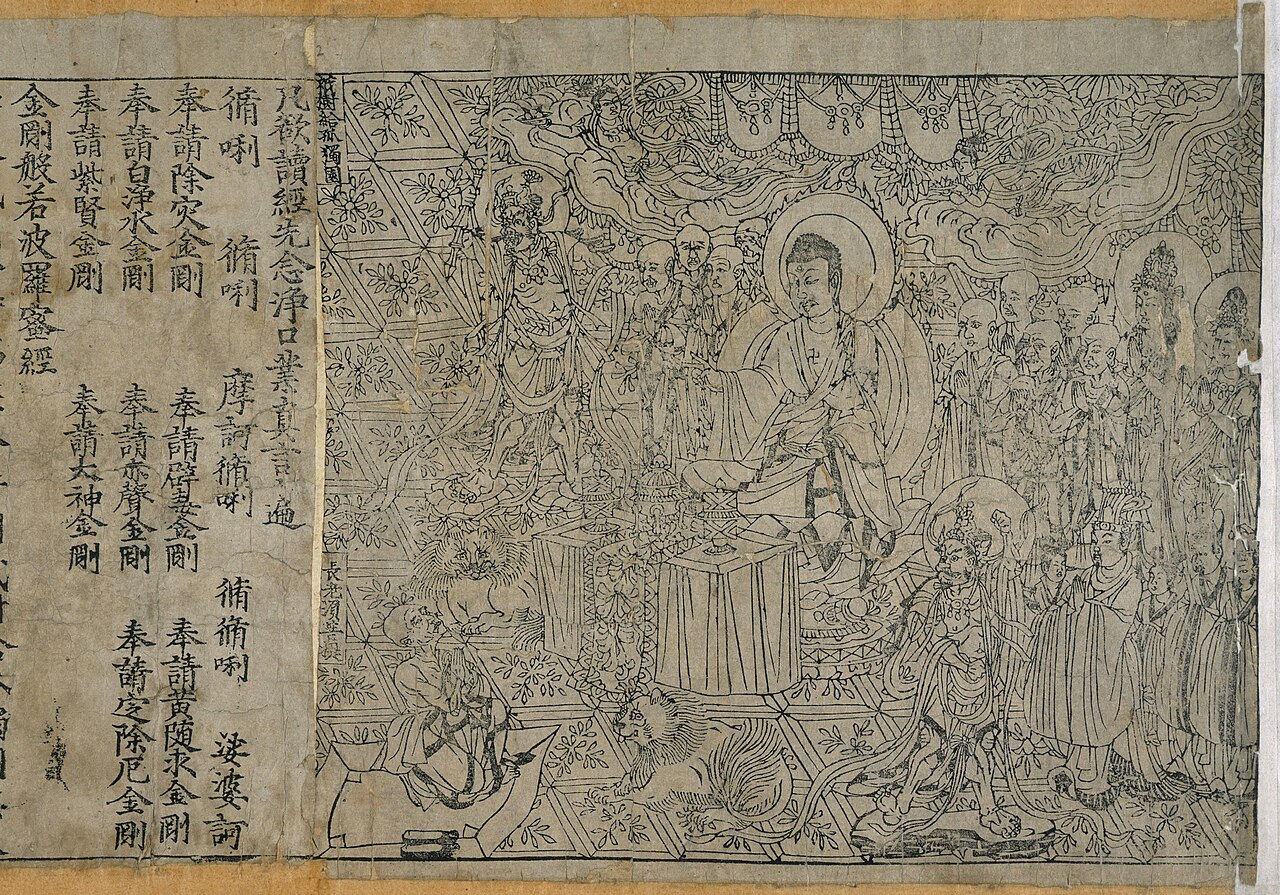
The oldest printed book whose exact date is known is called the Diamond Sutra. It was printed in 868. It was found at the beginning of the twentieth century, among tens of thousands of scrolls, in a desert cave at Dunhuang where it had been walled up for centuries.3
That is six hundred years before Gutenberg.
The sentence written at the end
The date is known because the person who had it printed inscribed it at the end of the scroll, together with his name and the reason he did so.
Reverently made for universal free distribution by Wang Jie on behalf of his two parents.4
These words are worth pausing on. The oldest dated printed book in the world has borne, for more than eleven centuries, a statement of free distribution.
In other words, this book was made to be given to everyone, free of charge.5
This also sheds light on a wider phenomenon. In this tradition, copying the words of the Buddha is a meritorious act — and the more copies one distributes, the greater the merit. Printing was therefore not a business: it was a way of multiplying a good deed.6
This is one of the reasons why printing appeared early in this part of the world. Where a copy is valued for its distribution, there is every advantage in knowing how to copy quickly.
One last detail is delightful. The paper of these scrolls was dyed yellow, a sacred colour. As it happens, this dye is insecticidal — which contributed to their preservation. Religious devotion unwittingly did the work of a museum conservator.7
Characters that can be moved
Around 1040, a Chinese man named Bi Sheng made separate characters, in fired clay, that could be stored and reused. He also tried wood, but it swelled as it absorbed the ink and the result became irregular.8
At the end of the thirteenth century, another Chinese inventor, the agronomist Wang Zhen, perfected the system by shaping characters from hardwoods and by inventing a revolving table to sort the ideograms and find them quickly.
Korea went further: there, characters were cast in metal, which was stronger and more precise. The oldest surviving book printed in this way is called the Jikji. It dates from 1377, nearly eighty years before the Gutenberg Bible.9
Why, then, did China mostly continue to carve whole blocks? Because Chinese writing has thousands of different characters. Making, storing and finding thousands of pieces of type costs more than carving a block. With an alphabet of twenty-six letters, the calculation works the other way. It is not a question of being ahead or behind: it is a question of language.
What about Gutenberg, in the 1440s?
When he came along, here is what already existed. The press already existed: it was used for grapes and for printing on fabric. Punches, metal characters and alloys already existed: they were the trade of goldsmiths and coin makers. Thick oil-based ink already existed: it was used for printing textiles.
Everything was already there. One historian summed up the invention of printing in a telling phrase: a recombination of processes used for something else entirely.
Gutenberg’s own contribution was a mould and an alloy strong enough to cast characters in series, always identical. That is no small thing: it is what made the process industrial. He worked with partners who contributed expertise and money.
His forty-two-line Bible was printed in a run of about one hundred and eighty copies. Forty-eight survive today.
One last, troubling detail: Gutenberg died in 1468, and it was only around 1471 that a printed book named him for the first time as the inventor of printing. It was a letter by Guillaume Fichet, printed in Paris. The great inventor was named in a book three years after his death.10
Interactive
The origin of printing
The invention of printing is often credited to Gutenberg. Put these events in order: you will see what already existed before his name appeared.
The question
Who invented printing?
What you do The five cards are out of order. Arrange them from oldest (at the top) to most recent (at the bottom): drag a card by its handle ⠿, or use the arrows ▲ ▼. Then press “Check”.
Without JavaScript, here are the animation’s data.
| Event | Date | Source |
|---|---|---|
| A map drawn on paper, buried in a tomb in Gansu (China) | between 179 and 141 BCE | 1 |
| The Diamond Sutra, the oldest dated printed book | 868 | 2 |
| Bi Sheng makes movable type in fired clay | around 1040 | 3 |
| The Jikji, printed in Korea with movable metal type | 1377 | 4 |
| A printed book names Gutenberg as the inventor of printing | around 1471 | 5 |
The Gansu map comes from a tomb dated 179 to 141 BCE; the timeline places it in the middle of that range.
The takeaway Paper, printing and movable type existed in East Asia centuries before Gutenberg was named as the inventor of printing.
Photo credits 4
- Fragment of a paper map drawn in black ink, found in 1986 on the chest of the occupant of Tomb 5 at Fangmatan (Gansu); the tomb dates from the early Western Han. Size: 5.6 × 2.6 cm. Unknown author, Public domain, source
- Frontispiece of a printed, dated copy of the Diamond Sutra: ink on paper, woodblock print (British Library, Or.8210/P.2). International Dunhuang Project, Public domain, source
- Two pages (4v and 5r) of the 1377 Jikji, the oldest example of printing with movable metal type, held and digitised by the Department of Manuscripts of the Bibliothèque nationale de France. Bibliothèque nationale de France, Public domain, source
- Guillaume Fichet (right), rector of the University of Paris, presents his Rhetoric, printed in Paris in 1471, to Cardinal Bessarion: illumination in the presentation copy (Venice, Biblioteca Nazionale Marciana). Anonymous illuminator, Public domain, source


Sources 5
Li Qingling (李清凌), “【溯源甘肃】天水放马滩秦汉墓的三个“第一”” [Aux sources du Gansu : les trois “premières” des tombes Qin-Han de Fangmatan, à Tianshui], Gansu ribao (甘肃日报), 6 August 2020, repris par le Réseau chinois des sciences sociales (中国社会科学网, Académie chinoise des sciences sociales), beginning of the article (discovery) and part on the third Chinese “first”, the paper of the early Western Han.
1986年4月的一天,一场大雨过后,小陇山林业局放马滩工区的职工清理宿舍后墙淤泥的时候,发现了一个古墓洞穴。[…] 其中年代最早的是甘肃天水放马滩五号墓出土的纸图残片。[…] 放马滩五号墓是汉文帝、汉景帝时(前179—前141年)的墓葬,残纸上可见有墨线标识的山川道路图。[…] 将中国造纸术的发明时间,比蔡伦造纸的记载至少提前了近300年。
Editors’ translation One day in April 1986, after a heavy rainstorm, workers of the Fangmatan work area of the Xiaolongshan Forestry Bureau, while clearing silt from behind the rear wall of their dormitory, discovered the cavity of an ancient tomb. […] The earliest of them is the fragment of a paper map unearthed from tomb no. 5 at Fangmatan, Tianshui, Gansu. […] Fangmatan tomb no. 5 is a burial from the time of Emperor Wen and Emperor Jing of the Han (179–141 BCE); on the remaining paper, a map of mountains, rivers and roads marked with ink lines can be seen. […] This pushes back the date of the invention of Chinese papermaking by at least nearly 300 years compared with the record of Cai Lun’s papermaking.
Open access open the source · checked on 24 October 2026
Swift, Vic, “The Diamond Sutra”, International Dunhuang Programme, British Library, 26 January 2010, open access, blog post of 26 January 2010, presentation of the scroll Or.8210/P.2.
is the world's earliest dated printed book, and was made in AD 868
Open access open the source · checked on 24 October 2026
Citéco (Cité de l’économie, Banque de France), “First Use of Movable Type Made in Terra Cotta”, timeline 10,000 Years of Economic History, section “Antiquity to Middle Ages”, undated page, entry dated “1040 AD”, 1st and 2nd sentences.
1040 AD […] In China, under the Sung dynasty (960−1279), Bi Sheng improved printing techniques by inventing the movable type. He fashioned clay cubes that were sculpted, baked and assembled onto an iron frame using wax and resin.
Open access open the source · checked on 27 October 2026
Bibliothèque nationale de France, “Le “Jikji”, un trésor de l’imprimerie”, open access, BnF page, presentation (same page: “Datant de 1377, le Jikji a été imprimé dans le temple Heungdeok-sa de Cheongju”).
Le Jikji est le plus ancien livre au monde, connu à ce jour, imprimé au moyen de caractères métalliques mobiles.
Editors’ translation The Jikji is the oldest book in the world known to date to have been printed with movable metal type.
Open access open the source · checked on 24 October 2026
The Morgan Library & Museum, notice de l’incunable PML 21586 : Barzizza, Gasparino, Orthographia, avec la lettre de Guillaume Fichet à Robert Gaguin, Paris, Ulrich Gering, Martin Crantz et Michael Friburger, peu après le 1 January 1470/71, open access, catalogue record, note; imprint: “[Paris : Ulrich Gering, Martin Crantz and Michael Friburger, shortly after 1 Jan. 1470/71]”.
Fichet's letter contains the earliest report in print naming Gutenberg as the inventor of printing.
Open access open the source · checked on 24 October 2026
Libraries in homes
There is an immense written tradition that is rarely spoken of.
In West Africa, manuscripts were copied for centuries. In Timbuktu, in Mali, the oldest surviving ones date back to the eleventh century (the years 1000 to 1099). They contain law, astronomy, mathematics, medicine, merchants’ accounts, and methods for settling conflicts between villages.
These books are not in a museum, but in private homes. They belong to families, who pass them down from generation to generation. Some bear a note on the very first page stating that they must be neither sold nor divided at the time of an inheritance — so that the library is never broken up.
In 2012, when armed groups occupied northern Mali, the manuscripts of more than thirty of these family libraries were taken to safety: they were locked in 1,400 metal boxes, then carried by boat and truck to Bamako, the capital. More than four manuscripts in five were saved in this way.11
This image is an answer to the notion that West Africa had “no writing”: it had so much that entire libraries had to be moved to protect it.
Meanwhile, copying by hand goes on
Printing did not do away with manuscript copying, which continued for centuries. Each copy was transcribed and painted by hand, page after page.
Some copyists signed their work. In July 975, in a monastery in the north of the Iberian Peninsula, a large painted book was completed. At the end, two names are inscribed: that of a monk, Emeterius, and that of a woman, “painter and servant of God”. She is the first known woman book painter in the history of Spain.12
Her name itself is hard to read. Depending on how the letters of the colophon are divided, she is called Ende or En. Specialists remain divided: the art historian Pamela Patton considers Ende the more probable reading, because the word pintrix is the more frequent one in medieval texts. The first woman painter in Europe whose name has come down to us is therefore someone whose name we do not quite know.13
But these books are also fragile in another way.
On 12 July 1562, in a town in Yucatán, a Spanish cleric, head of the Franciscans in the region and future bishop, had Maya books burned in public, together with thousands of sacred objects. Today, only three Maya books painted before the arrival of the Europeans remain in the world — plus a fourth, long debated by specialists.14
How many were burned? One often reads “hundreds”. In reality, no one knows. The bishop himself, in the account he left, speaks of a “great number” of books, without a figure. The number twenty-seven, which one also reads, goes back only to a letter written in 1805 by a Jesuit from Yucatán, Domingo Rodríguez, who speaks of “27 rolls” of signs and hieroglyphs on deer skin. The figure of “hundreds” became established through being copied over and over.15
This does not lessen the loss. It only makes it impossible to measure, which is perhaps worse: we will never know what was in those books.
The Diamond Sutra, for its part, survived only because it was walled up. Once found, it was taken to the other side of the world, to a foreign library, where it remains.
Written knowledge is not lost only by accident.
Summary: What was written on?
| Medium | Location / Origin | Development & Preservation over time |
|---|---|---|
| Fired clay | Mesopotamia | Passes through the millennia unaltered. |
| Papyrus | Egypt | Crumbles quickly, except in a very dry climate. |
| Bamboo and silk | China | Organic materials rarely preserved. |
| Palm leaf | South Asia | Rots; requires constant recopying. |
| Birch bark | Central Asia | Very fragile medium. |
| Bark paper | Mesoamerica | Only a few codices have survived. |
| Parchment | Several regions | Durable but costly to make. |
| Paper | China, then worldwide spread | Preservation depends on the environment. |
| Bound manuscript paper | West Africa | Kept in family libraries (threatened by climate/conflict). |
Note 1
1986年4月的一天,一场大雨过后,小陇山林业局放马滩工区的职工清理宿舍后墙淤泥的时候,发现了一个古墓洞穴。[…] 其中年代最早的是甘肃天水放马滩五号墓出土的纸图残片。[…] 放马滩五号墓是汉文帝、汉景帝时(前179—前141年)的墓葬,残纸上可见有墨线标识的山川道路图。[…] 将中国造纸术的发明时间,比蔡伦造纸的记载至少提前了近300年。
One day in April 1986, after a heavy rainstorm, workers of the Fangmatan work area of the Xiaolongshan Forestry Bureau, while clearing silt from behind the rear wall of their dormitory, discovered the cavity of an ancient tomb. […] The earliest of them is the fragment of a paper map unearthed from tomb no. 5 at Fangmatan, Tianshui, Gansu. […] Fangmatan tomb no. 5 is a burial from the time of Emperor Wen and Emperor Jing of the Han (179–141 BCE); on the remaining paper, a map of mountains, rivers and roads marked with ink lines can be seen. […] This pushes back the date of the invention of Chinese papermaking by at least nearly 300 years compared with the record of Cai Lun’s papermaking.
Li Qingling (李清凌), “【溯源甘肃】天水放马滩秦汉墓的三个“第一”” [Aux sources du Gansu : les trois “premières” des tombes Qin-Han de Fangmatan, à Tianshui], Gansu ribao (甘肃日报), 6 August 2020, repris par le Réseau chinois des sciences sociales (中国社会科学网, Académie chinoise des sciences sociales)
Note 2
倫乃造意,用樹膚、麻頭及敝布、魚網以為紙。
Cai Lun then conceived the idea of making paper from tree bark, hemp waste, old rags and fishing nets.
Fan Ye, Hou Hanshu (Book of the Later Han), 5th century, chap. 78, biography of Cai Lun, Chinese text on Wikisource
Note 3
is the world's earliest dated printed book, and was made in AD 868
Swift, Vic, “The Diamond Sutra”, International Dunhuang Programme, British Library, 26 January 2010, open access
Note 4
Reverently made for universal free distribution by Wang Jie on behalf of his two parents’
Hotson, Howard, “The world’s earliest dated printed book: The Diamond Sutra, 868 CE”, Cabinet, University of Oxford, May 2018, open access
Note 5
Reverently made for universal free distribution by Wang Jie on behalf of his two parents’
Hotson, Howard, “The world’s earliest dated printed book: The Diamond Sutra, 868 CE”, Cabinet, University of Oxford, May 2018, open access
Note 6
Scribes could likewise gain merit by copying the sutras for others to read, and artists and their patrons could gain merit by creating images of the Buddha for others to see. Printing mechanised this process, multiplying the amount of merit one could send out into the world
Hotson, Howard, “The world’s earliest dated printed book: The Diamond Sutra, 868 CE”, Cabinet, University of Oxford, May 2018, open access
Note 7
protected by the insecticidal properties of the yellow dye (a sacred colour) used to colour the paper of Buddhist sutras.
Hotson, Howard, “The world’s earliest dated printed book: The Diamond Sutra, 868 CE”, Cabinet, University of Oxford, May 2018, open access
Note 8
1040 AD […] In China, under the Sung dynasty (960−1279), Bi Sheng improved printing techniques by inventing the movable type. He fashioned clay cubes that were sculpted, baked and assembled onto an iron frame using wax and resin.
Citéco (Cité de l’économie, Banque de France), “First Use of Movable Type Made in Terra Cotta”, timeline 10,000 Years of Economic History, section “Antiquity to Middle Ages”, undated page
Note 9
Le Jikji est le plus ancien livre au monde, connu à ce jour, imprimé au moyen de caractères métalliques mobiles.
The Jikji is the oldest book in the world known to date to have been printed with movable metal type.
Bibliothèque nationale de France, “Le “Jikji”, un trésor de l’imprimerie”, open access
Note 10
Fichet's letter contains the earliest report in print naming Gutenberg as the inventor of printing.
The Morgan Library & Museum, notice de l’incunable PML 21586 : Barzizza, Gasparino, Orthographia, avec la lettre de Guillaume Fichet à Robert Gaguin, Paris, Ulrich Gering, Martin Crantz et Michael Friburger, peu après le 1 January 1470/71, open access
Note 11
After the retaking of the city by French paratroopers in January 2013, it emerged that almost all of Timbuktu's libraries had been relocated to Bamako, Mali's capital, in advance of the occupation. […] She showed me photos of the 1,400 metal boxes—containing manuscripts from more than 30 family libraries—being transported by boat and truck to Bamako.
Stewart, Columba Andrew, “A Decade in Mali”, Hill Museum & Manuscript Library (HMML), 25 July 2024
Près de 90% de ces documents ont pu être sauvés grâce à l’action de la population organisée autour de l’ONG Sauvegarde et valorisation des manuscrits pour la défense de la culture islamique (SAVAMA-DCI)
Nearly 90% of these documents were saved thanks to the action of the population, organised around the NGO Sauvegarde et valorisation des manuscrits pour la défense de la culture islamique (SAVAMA-DCI, Safeguarding and Promotion of Manuscripts for the Defence of Islamic Culture)
UNESCO, Centre du patrimoine mondial, “La Conférence de Bamako propose des mesures d’urgence pour les manuscrits du Mali”, actualité du 30 January 2015
En 2012 et 2013, l’occupation des régions du nord du pays par des groupes armés s’est traduite par d’importants dégâts causés au patrimoine culturel, notamment aux manuscrits anciens.
In 2012 and 2013, the occupation of the country’s northern regions by armed groups resulted in considerable damage to cultural heritage, notably to ancient manuscripts.
UNESCO, Centre du patrimoine mondial, “La Conférence de Bamako propose des mesures d’urgence pour les manuscrits du Mali”, actualité du 30 January 2015
Note 12
El Beato de Gerona, culminado en el 6 de julio 975, confeccionado en el monasterio de Tábara, y firmado por sus iluminadores “Ende, pintora y ayudante de Dios; Emeterio, hermano y sacerdote”.
The Girona Beatus, completed on 6 July 975, made in the monastery of Tábara, and signed by its illuminators “Ende, painter and helper of God; Emeterius, brother and priest”.
Belén, Yessy, “Ende: la primera iluminadora de la historia de España”, Scriptorium, no. 29, Pontificia Universidad Católica Argentina, Departamento de Historia, 2021, p. 20-31
De esta forma, en este artículo se recupera, a través de un trabajo monográfico, la figura de Ende, la primera mujer iluminadora conocida de la historia de España.
In this way, this article recovers, through a monographic study, the figure of Ende, the first known woman illuminator in the history of Spain.
Belén, Yessy, “Ende: la primera iluminadora de la historia de España”, Scriptorium, no. 29, Pontificia Universidad Católica Argentina, Departamento de Historia, 2021, p. 20-31
Note 13
Si bien es un personaje estudiado, que aparece en diccionarios, investigaciones académicas y algunos libros de Historia del Arte […], en algunos lugares aparece como “En”, y en otros como “Ende”, en base al estudio paleográfico sobre su firma en el manuscrito […]. […] Hay discrepancias sobre la lectura de su firma: Algunos entienden “Ende pintrix” y otros “En depintrix”.
Although she is a figure who has been studied, appearing in dictionaries, academic research and some art history books […], in some places she appears as “En” and in others as “Ende”, on the basis of palaeographic study of her signature in the manuscript […]. […] There are disagreements over the reading of her signature: some understand “Ende pintrix” and others “En depintrix”.
Belén, Yessy, “Ende: la primera iluminadora de la historia de España”, Scriptorium, no. 29, Pontificia Universidad Católica Argentina, Departamento de Historia, 2021, p. 20-31
Hay discrepancias sobre la lectura de su firma: Algunos entienden “Ende pintrix” y otros “En depintrix”. Pamela A. Patton considera que por la frecuencia en que se utiliza el primer término en los textos medievales, sugiere que “Ende pintrix” es la forma, probablemente, correcta
There are disagreements over the reading of her signature: some understand “Ende pintrix” and others “En depintrix”. Pamela A. Patton considers that, given how frequently the first term is used in medieval texts, “Ende pintrix” is probably the correct form
Belén, Yessy, “Ende: la primera iluminadora de la historia de España”, Scriptorium, no. 29, Pontificia Universidad Católica Argentina, Departamento de Historia, 2021, p. 20-31
Note 14
On ne connaissait que trois manuscrits pictographiques mayas. Les datations, les analyses physico-chimiques de matériaux, l’entomologie, les études iconographiques et stylistiques récemment effectuées au Mexique sont venues confirmer en 2018 l’authenticité d’un quatrième, le codex Grolier, désormais appelé CódiceMaya de México.
Only three Maya pictographic manuscripts were known. Datings, physico-chemical analyses of the materials, entomology, and iconographic and stylistic studies recently carried out in Mexico confirmed in 2018 the authenticity of a fourth, the Grolier Codex, now called the Códice Maya de México.
“Codex mayas”, Encyclopædia Universalis
This reign of terror reached its height on Sunday, July 12, 1562. On that day in Maní, Landa presided over an auto-da-fé […] Also burned were 27 codices, folded books featuring hieroglyphs written on bark paper that recorded details of Maya ritual practice. […] In 1561, however, Yucatán became its own province, and Landa was made head of the Franciscan order there. […] When Toral died in 1572, Landa was sent back to Yucatán as the new bishop.
Weiss, Daniel, “Acts of Faith”, Archaeology, novembre-December 2025
Note 15
Usaba también esta gente de ciertos caracteres o letras con las cuales escribían en sus libros sus cosas antiguas y sus ciencias […] Hallámosle gran número […] de estas sus letras, y porque no tenían cosas en que no hubiese superstición y falsedad del demonio, se los quemamos todos […] cuando en julio de 1562 hizo quemar en Maní veintisiete códices.
These people also used certain characters or letters, with which they wrote in their books their ancient matters and their sciences […] We found a great number […] of these letters of theirs, and because they contained nothing in which there was not superstition and falsehood of the devil, we burned them all […] when in July 1562 he had twenty-seven codices burned at Maní.
Carreño Velázquez, Elvia, “A 550 años de la aparición de la imprenta y la pérdida del pasado escrito”, Apoyo al Desarrollo de Archivos y Bibliotecas de México (ADABI), n.d.
véase la referencia de Carrillo y Ancona a la carta que escribió un jesuita yucateco, Domingo Rodríguez, al obispo de Yucatán Estévez y Ugarte el 20 de marzo de 1805 desde Bolonia […] según la cual la parafernalia maya confiscada y quemada incluía "5,000 ídolos de distintas formas y tamaños, […] 27 rollos de signos y jeroglíficos en piel de venado,
Chuchiak IV, John F., “El regreso de los autos de fe: fray Diego de Landa y la extirpación de idolatrías en Yucatán, 1573-1579”, Península (UNAM), vol. I, no. 0, 2005, pp. 29-47
Notes and sources
- ↑
Passage In tombs in Gansu discovered in 1986, a map drawn on paper, about two thousand two hundred years old, was even unearthed
1986年4月的一天,一场大雨过后,小陇山林业局放马滩工区的职工清理宿舍后墙淤泥的时候,发现了一个古墓洞穴。[…] 其中年代最早的是甘肃天水放马滩五号墓出土的纸图残片。[…] 放马滩五号墓是汉文帝、汉景帝时(前179—前141年)的墓葬,残纸上可见有墨线标识的山川道路图。[…] 将中国造纸术的发明时间,比蔡伦造纸的记载至少提前了近300年。
Editors’ translation One day in April 1986, after a heavy rainstorm, workers of the Fangmatan work area of the Xiaolongshan Forestry Bureau, while clearing silt from behind the rear wall of their dormitory, discovered the cavity of an ancient tomb. […] The earliest of them is the fragment of a paper map unearthed from tomb no. 5 at Fangmatan, Tianshui, Gansu. […] Fangmatan tomb no. 5 is a burial from the time of Emperor Wen and Emperor Jing of the Han (179–141 BCE); on the remaining paper, a map of mountains, rivers and roads marked with ink lines can be seen. […] This pushes back the date of the invention of Chinese papermaking by at least nearly 300 years compared with the record of Cai Lun’s papermaking.
Source Li Qingling (李清凌), “【溯源甘肃】天水放马滩秦汉墓的三个“第一”” [Aux sources du Gansu : les trois “premières” des tombes Qin-Han de Fangmatan, à Tianshui], Gansu ribao (甘肃日报), 6 August 2020, repris par le Réseau chinois des sciences sociales (中国社会科学网, Académie chinoise des sciences sociales), beginning of the article (discovery) and part on the third Chinese “first”, the paper of the early Western Han.
Open access open the source · checked on 24 October 2026
- ↑
Passage he developed a paper made from bark, hemp, old rags and fishing nets
倫乃造意,用樹膚、麻頭及敝布、魚網以為紙。
Editors’ translation Cai Lun then conceived the idea of making paper from tree bark, hemp waste, old rags and fishing nets.
Source Fan Ye, Hou Hanshu (Book of the Later Han), 5th century, chap. 78, biography of Cai Lun, Chinese text on Wikisource, chap. 78 (“Biographies of the Eunuchs”), biography of Cai Lun (蔡倫).
Public domain open the source · checked on 27 October 2026
- ↑
Passage The oldest printed book whose exact date is known is called the Diamond Sutra. It was printed in 868.
is the world's earliest dated printed book, and was made in AD 868
Source Swift, Vic, “The Diamond Sutra”, International Dunhuang Programme, British Library, 26 January 2010, open access, blog post of 26 January 2010, presentation of the scroll Or.8210/P.2.
Open access open the source · checked on 24 October 2026
- ↑
Passage Reverently made for universal free distribution by Wang Jie on behalf of his two parents.
Reverently made for universal free distribution by Wang Jie on behalf of his two parents’
Source Hotson, Howard, “The world’s earliest dated printed book: The Diamond Sutra, 868 CE”, Cabinet, University of Oxford, May 2018, open access, paragraph on the colophon (the sentence continues: “and all sentient beings in the world”).
Open access open the source · checked on 24 October 2026
- ↑
Passage In other words, this book was made to be given to everyone, free of charge.
Reverently made for universal free distribution by Wang Jie on behalf of his two parents’
Source Hotson, Howard, “The world’s earliest dated printed book: The Diamond Sutra, 868 CE”, Cabinet, University of Oxford, May 2018, open access, paragraph on the colophon.
Open access open the source · checked on 24 October 2026
- ↑
Passage the more copies one distributes, the greater the merit
Scribes could likewise gain merit by copying the sutras for others to read, and artists and their patrons could gain merit by creating images of the Buddha for others to see. Printing mechanised this process, multiplying the amount of merit one could send out into the world
Source Hotson, Howard, “The world’s earliest dated printed book: The Diamond Sutra, 868 CE”, Cabinet, University of Oxford, May 2018, open access, paragraph on Buddhist merit.
Open access open the source · checked on 24 October 2026
- ↑
Passage The paper of these scrolls was dyed yellow, a sacred colour. As it happens, this dye is insecticidal
protected by the insecticidal properties of the yellow dye (a sacred colour) used to colour the paper of Buddhist sutras.
Source Hotson, Howard, “The world’s earliest dated printed book: The Diamond Sutra, 868 CE”, Cabinet, University of Oxford, May 2018, open access, paragraph on the preservation of the Dunhuang scrolls.
Open access open the source · checked on 24 October 2026
- ↑
Passage Around 1040, a Chinese man named Bi Sheng made separate characters, in fired clay
1040 AD […] In China, under the Sung dynasty (960−1279), Bi Sheng improved printing techniques by inventing the movable type. He fashioned clay cubes that were sculpted, baked and assembled onto an iron frame using wax and resin.
Source Citéco (Cité de l’économie, Banque de France), “First Use of Movable Type Made in Terra Cotta”, timeline 10,000 Years of Economic History, section “Antiquity to Middle Ages”, undated page, entry dated “1040 AD”, 1st and 2nd sentences.
Open access open the source · checked on 27 October 2026
- ↑
Passage The oldest surviving book printed in this way is called the Jikji. It dates from 1377
Le Jikji est le plus ancien livre au monde, connu à ce jour, imprimé au moyen de caractères métalliques mobiles.
Editors’ translation The Jikji is the oldest book in the world known to date to have been printed with movable metal type.
Source Bibliothèque nationale de France, “Le “Jikji”, un trésor de l’imprimerie”, open access, BnF page, presentation (same page: “Datant de 1377, le Jikji a été imprimé dans le temple Heungdeok-sa de Cheongju”).
Open access open the source · checked on 24 October 2026
- ↑
Passage it was only around 1471 that a printed book named him for the first time as the inventor of printing
Fichet's letter contains the earliest report in print naming Gutenberg as the inventor of printing.
Source The Morgan Library & Museum, notice de l’incunable PML 21586 : Barzizza, Gasparino, Orthographia, avec la lettre de Guillaume Fichet à Robert Gaguin, Paris, Ulrich Gering, Martin Crantz et Michael Friburger, peu après le 1 January 1470/71, open access, catalogue record, note; imprint: “[Paris : Ulrich Gering, Martin Crantz and Michael Friburger, shortly after 1 Jan. 1470/71]”.
Open access open the source · checked on 24 October 2026
- ↑
Passage the manuscripts of more than thirty of these family libraries were taken to safety: they were locked in 1,400 metal boxes, then carried by boat and truck to Bamako, the capital.
After the retaking of the city by French paratroopers in January 2013, it emerged that almost all of Timbuktu's libraries had been relocated to Bamako, Mali's capital, in advance of the occupation. […] She showed me photos of the 1,400 metal boxes—containing manuscripts from more than 30 family libraries—being transported by boat and truck to Bamako.
Source Stewart, Columba Andrew, “A Decade in Mali”, Hill Museum & Manuscript Library (HMML), 25 July 2024, part on the Timbuktu libraries, then account of the meeting with Deborah (photos of the boxes).
Open access open the source · checked on 25 October 2026
Passage More than four manuscripts in five were saved in this way.
Près de 90% de ces documents ont pu être sauvés grâce à l’action de la population organisée autour de l’ONG Sauvegarde et valorisation des manuscrits pour la défense de la culture islamique (SAVAMA-DCI)
Editors’ translation Nearly 90% of these documents were saved thanks to the action of the population, organised around the NGO Sauvegarde et valorisation des manuscrits pour la défense de la culture islamique (SAVAMA-DCI, Safeguarding and Promotion of Manuscripts for the Defence of Islamic Culture)
Source UNESCO, Centre du patrimoine mondial, “La Conférence de Bamako propose des mesures d’urgence pour les manuscrits du Mali”, actualité du 30 January 2015, body of the news item.
Open access open the source · checked on 25 October 2026
Passage In 2012, when armed groups occupied northern Mali
En 2012 et 2013, l’occupation des régions du nord du pays par des groupes armés s’est traduite par d’importants dégâts causés au patrimoine culturel, notamment aux manuscrits anciens.
Editors’ translation In 2012 and 2013, the occupation of the country’s northern regions by armed groups resulted in considerable damage to cultural heritage, notably to ancient manuscripts.
Source UNESCO, Centre du patrimoine mondial, “La Conférence de Bamako propose des mesures d’urgence pour les manuscrits du Mali”, actualité du 30 January 2015, news item of 30 January 2015, beginning of the text.
Open access open the source · checked on 24 October 2026
- ↑
Passage In July 975, in a monastery […] a large painted book was completed.
El Beato de Gerona, culminado en el 6 de julio 975, confeccionado en el monasterio de Tábara, y firmado por sus iluminadores “Ende, pintora y ayudante de Dios; Emeterio, hermano y sacerdote”.
Editors’ translation The Girona Beatus, completed on 6 July 975, made in the monastery of Tábara, and signed by its illuminators “Ende, painter and helper of God; Emeterius, brother and priest”.
Source Belén, Yessy, “Ende: la primera iluminadora de la historia de España”, Scriptorium, no. 29, Pontificia Universidad Católica Argentina, Departamento de Historia, 2021, p. 20-31, p. 24, 1st paragraph.
Open access open the source · checked on 27 October 2026
Passage She is the first known woman book painter in the history of Spain.
De esta forma, en este artículo se recupera, a través de un trabajo monográfico, la figura de Ende, la primera mujer iluminadora conocida de la historia de España.
Editors’ translation In this way, this article recovers, through a monographic study, the figure of Ende, the first known woman illuminator in the history of Spain.
Source Belén, Yessy, “Ende: la primera iluminadora de la historia de España”, Scriptorium, no. 29, Pontificia Universidad Católica Argentina, Departamento de Historia, 2021, p. 20-31, p. 22, introduction.
Open access open the source · checked on 25 October 2026
- ↑
Passage Depending on how the letters of the colophon are divided, she is called Ende or En.
Si bien es un personaje estudiado, que aparece en diccionarios, investigaciones académicas y algunos libros de Historia del Arte […], en algunos lugares aparece como “En”, y en otros como “Ende”, en base al estudio paleográfico sobre su firma en el manuscrito […]. […] Hay discrepancias sobre la lectura de su firma: Algunos entienden “Ende pintrix” y otros “En depintrix”.
Editors’ translation Although she is a figure who has been studied, appearing in dictionaries, academic research and some art history books […], in some places she appears as “En” and in others as “Ende”, on the basis of palaeographic study of her signature in the manuscript […]. […] There are disagreements over the reading of her signature: some understand “Ende pintrix” and others “En depintrix”.
Source Belén, Yessy, “Ende: la primera iluminadora de la historia de España”, Scriptorium, no. 29, Pontificia Universidad Católica Argentina, Departamento de Historia, 2021, p. 20-31, p. 24, 2nd paragraph and footnote 9.
Open access open the source · checked on 27 October 2026
Passage Specialists remain divided: the art historian Pamela Patton considers Ende the more probable reading, because the word pintrix is the more frequent one in medieval texts.
Hay discrepancias sobre la lectura de su firma: Algunos entienden “Ende pintrix” y otros “En depintrix”. Pamela A. Patton considera que por la frecuencia en que se utiliza el primer término en los textos medievales, sugiere que “Ende pintrix” es la forma, probablemente, correcta
Editors’ translation There are disagreements over the reading of her signature: some understand “Ende pintrix” and others “En depintrix”. Pamela A. Patton considers that, given how frequently the first term is used in medieval texts, “Ende pintrix” is probably the correct form
Source Belén, Yessy, “Ende: la primera iluminadora de la historia de España”, Scriptorium, no. 29, Pontificia Universidad Católica Argentina, Departamento de Historia, 2021, p. 20-31, p. 24, footnote 9 (citing Pamela A. Patton, “Ende”, in Delia Gaze (ed.), Dictionary of Women Artists, London, Fitzroy Dearborn, 1997, p. 498).
Open access open the source · checked on 27 October 2026
- ↑
Passage only three Maya books painted before the arrival of the Europeans remain in the world — plus a fourth
On ne connaissait que trois manuscrits pictographiques mayas. Les datations, les analyses physico-chimiques de matériaux, l’entomologie, les études iconographiques et stylistiques récemment effectuées au Mexique sont venues confirmer en 2018 l’authenticité d’un quatrième, le codex Grolier, désormais appelé CódiceMaya de México.
Editors’ translation Only three Maya pictographic manuscripts were known. Datings, physico-chemical analyses of the materials, entomology, and iconographic and stylistic studies recently carried out in Mexico confirmed in 2018 the authenticity of a fourth, the Grolier Codex, now called the Códice Maya de México.
Source “Codex mayas”, Encyclopædia Universalis, standfirst (introduction) of the article; see also the subheading “De multiples supports d’écriture”, 2nd paragraph.
Open access open the source · checked on 24 October 2026
Passage On 12 July 1562, in a town in Yucatán, a Spanish cleric, head of the Franciscans in the region and future bishop, had Maya books burned
This reign of terror reached its height on Sunday, July 12, 1562. On that day in Maní, Landa presided over an auto-da-fé […] Also burned were 27 codices, folded books featuring hieroglyphs written on bark paper that recorded details of Maya ritual practice. […] In 1561, however, Yucatán became its own province, and Landa was made head of the Franciscan order there. […] When Toral died in 1572, Landa was sent back to Yucatán as the new bishop.
Source Weiss, Daniel, “Acts of Faith”, Archaeology, novembre-December 2025, body of the article: account of the auto-da-fé of Maní, then the paragraph “When Landa arrived” on his career.
Open access open the source · checked on 9 September 2026
- ↑
Passage The bishop himself, in the account he left, speaks of a “great number” of books, without a figure.
Usaba también esta gente de ciertos caracteres o letras con las cuales escribían en sus libros sus cosas antiguas y sus ciencias […] Hallámosle gran número […] de estas sus letras, y porque no tenían cosas en que no hubiese superstición y falsedad del demonio, se los quemamos todos […] cuando en julio de 1562 hizo quemar en Maní veintisiete códices.
Editors’ translation These people also used certain characters or letters, with which they wrote in their books their ancient matters and their sciences […] We found a great number […] of these letters of theirs, and because they contained nothing in which there was not superstition and falsehood of the devil, we burned them all […] when in July 1562 he had twenty-seven codices burned at Maní.
Source Carreño Velázquez, Elvia, “A 550 años de la aparición de la imprenta y la pérdida del pasado escrito”, Apoyo al Desarrollo de Archivos y Bibliotecas de México (ADABI), n.d., quotation from Landa’s Relación, then the sentence on the auto-da-fé of Maní (no note for the figure).
Open access open the source · checked on 28 October 2026
Passage The number twenty-seven, which one also reads, goes back only to a letter written in 1805 by a Jesuit from Yucatán, Domingo Rodríguez, who speaks of “27 rolls” of signs and hieroglyphs on deer skin.
véase la referencia de Carrillo y Ancona a la carta que escribió un jesuita yucateco, Domingo Rodríguez, al obispo de Yucatán Estévez y Ugarte el 20 de marzo de 1805 desde Bolonia […] según la cual la parafernalia maya confiscada y quemada incluía "5,000 ídolos de distintas formas y tamaños, […] 27 rollos de signos y jeroglíficos en piel de venado,
Source Chuchiak IV, John F., “El regreso de los autos de fe: fray Diego de Landa y la extirpación de idolatrías en Yucatán, 1573-1579”, Península (UNAM), vol. I, no. 0, 2005, pp. 29-47, p. 31, note 8.
Open access open the source · checked on 28 October 2026
Bibliography
18
- Beatus de Gérone, Museu de la Catedral de Girona, no. inv. 7(11), completed on 6 July 975, probably at the scriptorium of Tábara (Zamora); the colophon names two illuminators, one designated as pintrix et Dei aiutrix, “painter and servant of God”, the other as the monk Emeterius. The reading of the name is disputed: the colophon can be read ENDE PINTRIX or EN DEPINTRIX, and specialists remain divided.
- Belén, Yessy, “Ende: la primera iluminadora de la historia de España”, Scriptorium, no. 29, Pontificia Universidad Católica Argentina, Departamento de Historia, 2021, p. 20-31, open access (Ende, the first known woman illuminator in the history of Spain; the disagreement over the reading of her signature and Pamela Patton’s view, footnote 9). https://repositorio.uca.edu.ar/handle/123456789/20310
- Bibliothèque nationale de France, “Le “Jikji”, un trésor de l’imprimerie”, open access (the oldest known book printed with movable metal type, dated 1377, that is 78 years before the Gutenberg Bible; held in the Department of Manuscripts under the shelfmark Coréen 109; inscribed on the Memory of the World Register on 4 September 2001). https://www.bnf.fr/fr/le-jikji-un-tresor-de-limprimerie
- Carreño Velázquez, Elvia, “A 550 años de la aparición de la imprenta y la pérdida del pasado escrito”, Apoyo al Desarrollo de Archivos y Bibliotecas de México (ADABI), n.d., open access (the passage of Landa’s Relación on the burned books, which gives no number; the figure of twenty-seven codices put forward without a source). https://file.adabi.org.mx/recursos/publicaciones/articulos_especiales/libroAntiguo/hagamosMemoria/aparicionImprenta.pdf
- Chuchiak IV, John F., “El regreso de los autos de fe: fray Diego de Landa y la extirpación de idolatrías en Yucatán, 1573-1579”, Península (UNAM), vol. I, no. 0, 2005, pp. 29-47, open access (the origin of the figure of twenty-seven: a letter by the Jesuit Domingo Rodríguez, 1805, quoted by Carrillo y Ancona). https://revistas.unam.mx/index.php/peninsula/article/download/44243/39997/115691
- Citéco (Cité de l’économie, Banque de France), “First Use of Movable Type Made in Terra Cotta”, timeline 10,000 Years of Economic History, section “Antiquity to Middle Ages”, undated page, open access (around 1040, Bi Sheng’s movable type, clay cubes carved and fired). https://www.citeco.fr/10000-years-history-economics/antiquity-to-middle-ages/first-use-of-movable-type-made-in-terra-cotta
- “Codex mayas”, Encyclopædia Universalis (the surviving manuscripts and what can be said about their destruction; the authentication of the Grolier Codex, now called the Códice Maya de México, confirmed in 2018). https://www.universalis.fr/encyclopedie/codex-mayas/
- Fan Ye, Hou Hanshu (Book of the Later Han), 5th century, chap. 78, biography of Cai Lun, Chinese text on Wikisource, public domain (Cai Lun’s paper made from tree bark, hemp waste, old rags and fishing nets, presented to the emperor in 105). https://zh.wikisource.org/wiki/後漢書/卷78
- Hotson, Howard, “The world’s earliest dated printed book: The Diamond Sutra, 868 CE”, Cabinet, University of Oxford, May 2018, open access (the date of 11 May 868; the colophon “for universal free distribution” on behalf of Wang Jie’s two parents; the walled-up cave; merit multiplied by printing; the yellow dye, a sacred colour, which protects against insects). https://www.cabinet.ox.ac.uk/worlds-earliest-dated-printed-book-diamond-sutra-868-ce
- Li Qingling (李清凌), “【溯源甘肃】天水放马滩秦汉墓的三个“第一”” [Aux sources du Gansu : les trois “premières” des tombes Qin-Han de Fangmatan, à Tianshui], Gansu ribao (甘肃日报), 6 August 2020, repris par le Réseau chinois des sciences sociales (中国社会科学网, Académie chinoise des sciences sociales), open access (the discovery of the tombs in 1986, the fragment of a map on paper from tomb no. 5, dated 179 to 141 BCE, and the lead of nearly 300 years over Cai Lun). https://cssn.cn/kgxc/kgxc_kgsb/202207/t20220728_5431451.shtml
- The Morgan Library & Museum, notice de l’incunable PML 21586 : Barzizza, Gasparino, Orthographia, avec la lettre de Guillaume Fichet à Robert Gaguin, Paris, Ulrich Gering, Martin Crantz et Michael Friburger, peu après le 1 January 1470/71, open access (Fichet’s letter, the earliest printed text naming Gutenberg as the inventor of printing). https://www.themorgan.org/incunables/133641
- Stewart, Columba Andrew, “A Decade in Mali”, Hill Museum & Manuscript Library (HMML), 25 July 2024, open access (the evacuation to Bamako of the manuscripts of more than thirty family libraries of Timbuktu, in 1,400 metal boxes). https://hmml.org/stories/a-decade-in-mali/
- Swift, Vic, “The Diamond Sutra”, International Dunhuang Programme, British Library, 26 January 2010, open access (the Diamond Sutra, shelfmark Or.8210/P.2, the oldest dated printed book, made in 868; its discovery at the beginning of the twentieth century among tens of thousands of scrolls in a hidden cave). https://idp.bl.uk/blog/the-diamond-sutra/
- Taladoire, Éric, Les trois codex mayas, Balland, Paris, 2012, 240 p. (why the figure of “hundreds of codices destroyed” is not established: it is put forward without support, and nothing makes it possible to estimate the number or the nature of the documents lost in the auto-da-fé of Maní in 1562). Éric Taladoire is professor emeritus at the University of Paris 1 Panthéon-Sorbonne.
- Tsien, Tsuen-Hsuin, Science and Civilisation in China, vol. V : Chemistry and Chemical Technology, partie 1 : Paper and Printing, dir. Joseph Needham, Cambridge University Press, 1985 (Bi Sheng’s movable type, Wang Zhen’s improvement and Chinese woodblock printing). This part is by Tsien alone; Needham edits the series.
- UNESCO, Centre du patrimoine mondial, “La Conférence de Bamako propose des mesures d’urgence pour les manuscrits du Mali”, actualité du 30 January 2015 (the family libraries and the 2012 evacuation: 4,203 manuscripts of the Ahmed Baba Institute burned or stolen, and nearly 90% of the whole saved thanks to the population organised around the NGO SAVAMA-DCI). https://whc.unesco.org/fr/actualites/1228/
- Weiss, Daniel, “Acts of Faith”, Archaeology, novembre-December 2025, open access (the auto-da-fé of Maní on 12 July 1562; Diego de Landa, then head of the Franciscans of Yucatán, appointed bishop in 1572). https://archaeology.org/issues/november-december-2025/features/acts-of-faith/
- Williams, John, The Illustrated Beatus: A Corpus of the Illustrations of the Commentary on the Apocalypse, vol. II : The Ninth and Tenth Centuries, Harvey Miller, Londres, 1994, p. 51-52.
Diagrams: generated images, checked element by element.
Spotted an error or have a doubt? Write to us.