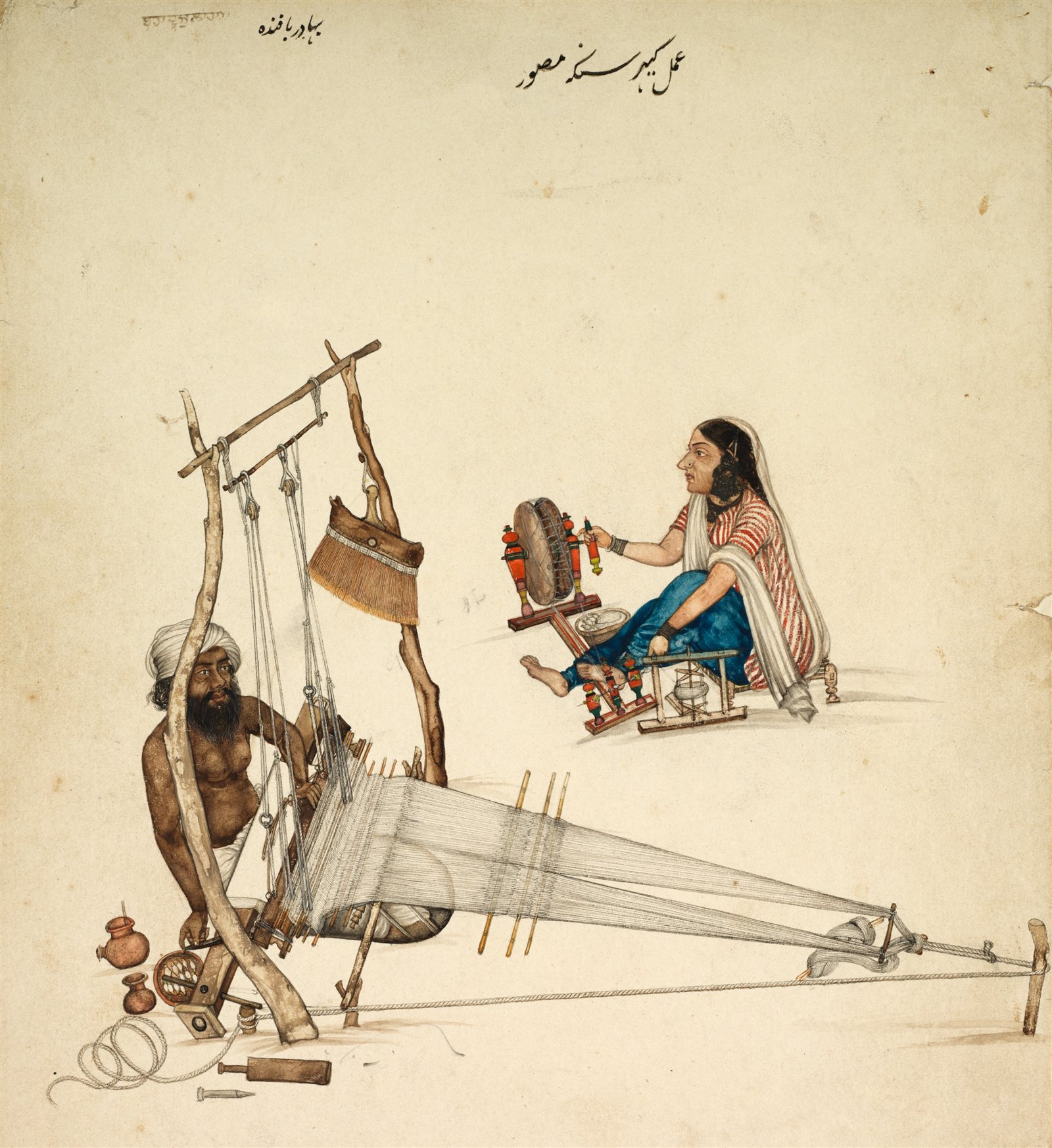
Asked to name an important invention, people probably think of the wheel, fire or printing.
Few answer: string. Yet it is one of the most decisive, and one of the oldest.
The age of string
All it takes is to pick up short, fragile plant fibres and twist them together to obtain a long, supple, tough thread, far stronger than each of the fibres taken separately.
With thread, you make ties, bags, fishing nets, traps, ropes, and finally clothes. Without thread, almost none of this exists.
The archaeologist Elizabeth Wayland Barber has proposed calling this moment the String Revolution — and suggested that the Stone Age would have been better called the String Age.1
Her argument is stronger than it seems:
So powerful, in fact, is simple string in taming the world to human will and ingenuity that I suspect it to be the unseen weapon that allowed the human race to conquer the earth, that enabled us to move out into every econiche on the globe.2
The unseen weapon: not the flint point, not fire, but thread, which makes it possible to tie, to carry, to trap, to bind.
Why is it never mentioned? Because thread rots.
Stone survives a hundred thousand years. A fabric disappears in a few centuries. Almost everything that has been spun and woven in human history has disappeared without a trace. What survives comes from exceptional places: very dry deserts, peat bogs, frozen ground, or objects sealed inside a monument.3
This history escapes us because the materials themselves have not survived. Not having left a trace is not the same thing as not having existed.
Different fibres everywhere
Each region spun what its environment provided.
- Flax: the Mediterranean and the Near East.
- Wool: sheep in Western Asia and Europe.
- Silk: East Asia (reeling the cocoon of the mulberry silkworm).
- Camelids (llama, alpaca, vicuña): the Andes (the vicuña providing one of the finest fibres in the world).
- Cotton: South Asia and the Americas.
- Agave: Mesoamerica.
- Raffia: Central Africa.
Several species of cotton were cultivated separately on different continents by populations with no contact between them. In northern Peru, cotton has been cultivated for at least 7,800 years.4
In Oceania, cloth is made differently: the bark of certain trees is beaten until it yields a supple, wide material (tapa), without thread or weaving.
Spinning, then weaving
Spinning requires a simple and effective tool: a small stick, the spindle, weighted with a little disc pierced through its centre, the spindle whorl. The disc gives the spindle its rotational momentum to twist the fibre evenly.5
These spindle whorls of fired clay or stone are found by the thousand on archaeological sites; they are often the only remains of a vanished textile industry.
Weaving means stretching a series of parallel threads — the warp — and passing another thread across them — the weft. The tool that holds the warp is called a loom, and it comes in several forms:
- Vertical looms: the threads hang down, tensioned by clay weights (loom weights) found in excavations.
- Belt looms (backstrap): very widespread in Asia and the Americas, they are attached between a fixed point and the body of the weaver, who controls the tension. Light and portable, this tool imposes a physical constraint: the width of the cloth does not exceed the reach of the arms (generally 75 cm at most).6
Making rope, and why it changes everything
Weaving is not the only use of thread. Twisting together several threads that have already been twisted gives a rope, and rope is probably the oldest and most consequential application.
The principle comes down to a reversed twist: the strands are twisted in one direction, then assembled by twisting in the other. Each then tries to untwist, which presses them against one another. A rope does not hold because it has been knotted: it holds because its strands are fighting one another. That is what allows it to be much stronger than the sum of its fibres, and not to come apart under tension.7
Without rope, almost nothing works. No bow, no harpoon bound to its shaft, no trap, no fishing net, no load carried on the back, no sail or rigging — and therefore no navigation. You can make a stone tool without thread; you cannot haft it without a binding.
The materials used are not those of clothing: flax and hemp of course, but above all fibres too rough for the skin — bark, lianas, palm leaves, animal sinew, horsehair. A rope does not need to be soft: it simply must not break.
That is why these objects have almost entirely disappeared from the archaeological record: plant fibres rot. The existence of ropes is deduced from what they made possible — a notched handle, a drilled hole, a stone that only makes sense when tied.
Two recent discoveries have nevertheless provided direct evidence, and they are older than anyone imagined.
In a rock shelter in the south of France, a fragment of cord remained stuck beneath a flake of flint. It measures six millimetres long and half a millimetre wide. Under the microscope, three bundles of fibres twisted in one direction, then assembled by twisting in the other can be made out — exactly the principle described above. It was made by Neanderthals.8
What this half-centimetre of string tells us
The fibres come from the inner bark of a tree, probably a conifer. This is where the detail becomes interesting.9
This fibrous layer does not come away equally easily all year round. It separates much more easily in early spring, when the sap rises. Then the fibres grow larger and thicker as the tree grows.10
Making this cord therefore required knowing at what time of year to go and gather the material. Not just a technique, but a calendar.
The authors go further, and their argument deserves to be read by anyone who has followed this domain from the beginning. Twisting fibres, they write, implies a multi-component technology — and an understanding of pairs, sets and numbers.11
In other words: to make a three-strand rope, you have to count to three, and know that three things form a set. Thread and number go together.
A cave in Germany has also yielded a baton of mammoth ivory pierced with holes bearing spiral grooves, about thirty-five thousand years old.12
Archaeologists made a replica of it and tried it out. With four people — three twisting the fibres, one assembling them in the opposite direction — they produced five metres of strong rope in ten minutes. So the object was not a mysterious ornament: it was a tool, and it required several people working together.13
Colour
Fixing a colour permanently on a fibre is a matter of applied chemistry, developed long before this science was formalised.
Indigo (Blue)
The blue pigment comes from plants containing indican (indigo plant, woad). The plant does not directly contain the blue colour: the leaves have to be fermented, the active principle dissolved, the cloth dipped, then exposed to the air. It is oxidation on contact with oxygen that reveals the blue hue.
At Huaca Prieta (northern Peru), fragments of woven cotton dated to about 6,000 years ago bear blue traces of indigo (chemical analysis, 2016). This is the oldest known use in the world, predating the Egyptian specimens by 1,500 years.14
Murex (Purple / Violet)
Extracted from the hypobranchial gland of sea molluscs (Murex), Tyrian purple required thousands of shells for a few grams of dye. The process also relies on a photochemical transformation in air and sunlight.
Cochineal (Red)
In Mesoamerica, the carmine pigment is produced from cochineal (Dactylopius coccus), a parasite of Opuntia cacti. Astonished by the intensity of this red, the Spanish organised a commercial monopoly on it from the sixteenth century. In the fleet of the Indies, cochineal was the most valuable cargo after gold and silver.
When cloth is worth more than gold
In the Inca Empire (Tawantinsuyu), the supreme value lay not in precious metals but in fine cloth, cumbi (or kumpi).
- Political and social use: It served as an attribute of power, as a reward for distinguished warriors and as a diplomatic gift.
- Ritual: Pieces of cumbi, representing hundreds of hours of specialised work, were burned as religious offerings.
- Tax and labour: The Inca state supplied raw materials (wool, cotton) to subject populations, who had to return fixed lengths of cloth (textile mit’a).15
At first contact, the Incas offered high-value textiles to the conquistadors, who saw them as mere fabrics, of secondary importance compared with gold.
Economic dimorphism and forced labour
The industrial history of textiles is inseparable from the organisation of forced labour on a global scale.
- Slavery and cotton: Before industrialisation, cotton was processed locally. The advent of British mechanised spinning mills in the nineteenth century created a massive demand for raw material. This expansion relied on the forced labour of enslaved people in the American South (about 2 million people in 1830).
- Mechanisation and craft: The massive export of British machine-made cloth to India in the nineteenth century disrupted local craft structures. Indian weavers adapted in part by using imported industrial yarn, thus changing their modes of production.16
Summary of textile fibres
| Fibre | Origin | Main region |
|---|---|---|
| Flax | Flax stem (Linum usitatissimum) | Mediterranean basin, Near East |
| Wool | Fleece of sheep | Western Asia, Europe |
| Silk | Silkworm cocoon (Bombyx mori) | East Asia |
| Cotton | Seed fibres (Gossypium) | South Asia, the Americas |
| Alpaca / Vicuña | Fleece of camelids | Andes |
| Agave | Leaf fibres (Sisal, Henequen) | Mesoamerica |
| Raffia | Leaflets of Raphia palms | Central Africa |
| Beaten bark | Tree bast (Tapa) | Oceania |
Note 1
We could call it the String Revolution.
Barber, Elizabeth J. W., Women’s Work: The First 20,000 Years. Women, Cloth, and Society in Early Times, W. W. Norton, New York, 1994
Note 2
So powerful, in fact, is simple string in taming the world to human will and ingenuity that I suspect it to be the unseen weapon that allowed the human race to conquer the earth, that enabled us to move out into every econiche on the globe during the Upper Paleolithic.
Barber, Elizabeth J. W., Women’s Work: The First 20,000 Years. Women, Cloth, and Society in Early Times, W. W. Norton, New York, 1994
Note 3
Fiber technology (cordage and textile) has played a central role in all human societies for thousands of years, and its production, application and exchange have deep roots in prehistory. However, fiber remains have only rarely been observed in prehistoric sites because they tend to decay quickly in normal environmental conditions.
Liu, Li, Levin, Maureece J., Klimscha, Florian and Rosenberg, Danny, “The Earliest Cotton Fibers and Pan-regional Contacts in the Near East”, Frontiers in Plant Science, vol. 13, 2022, art. 1045554
Note 4
Archaeological research has identified the use of cultivated cotton (Gossypium barbadense) in the ancient Andes dating back to at least 7800 years ago.
Splitstoser, Jeffrey C., Dillehay, Tom D., Wouters, Jan and Claro, Ana, “Early Pre-Hispanic Use of Indigo Blue in Peru”, Science Advances, vol. 2, no. 9, 2016, e1501623
Note 5
A spindle consists of two parts; a stick, the rod, and a weight attached to it, the whorl. With the weight of the whorl as a stabiliser, the spindle can rotate around its own axis […]
Statens historiska museer (Swedish History Museum, Stockholm), “14. Spindle whorls, bone, lead, stone”, website Massakern vid muren: Slaget om Gotland 1361, undated page
Throughout time some basic tools used in creating complex textiles have remained constant, such as the ones used for spinning thread: wooden spindles (smooth wooden sticks) and ceramic spindle whorls (disks threaded on the spindle).
Michael C. Carlos Museum (Emory University), “Spinning and Weaving Tools”, exhibition Threads of Time: Tradition and Change in Indigenous American Textiles, 2017
Note 6
The width of the fabric woven on the backstrap loom does not exceed the distance across which the weaver could pass a shuttle from hand to hand (usually about 60-75 cm).
Textile Museum of Canada, online exhibition Cloth and Clay, “Construction” page, open access (the width of backstrap-loom cloth, limited by the distance the shuttle can be passed from hand to hand). https://textilemuseum.ca/cloth_clay/learn/textiles_construction.html
Note 7
3 bundles of fibres with S-twist which were then plied together with a Z-twist to form a 3-ply cord
Hardy, Bruce L. et al., “Direct Evidence of Neanderthal Fibre Technology and Its Cognitive and Behavioral Implications”, Scientific Reports, vol. 10, 2020
Note 8
The cord is approximately 6.2 mm in length and approximately 0.5 mm in width
Hardy, Bruce L. et al., “Direct Evidence of Neanderthal Fibre Technology and Its Cognitive and Behavioral Implications”, Scientific Reports, vol. 10, 2020
While it is clear that the cord from Abri du Maras demonstrates Neanderthals’ ability to manufacture cordage
Hardy, Bruce L. et al., “Direct Evidence of Neanderthal Fibre Technology and Its Cognitive and Behavioral Implications”, Scientific Reports, vol. 10, 2020
Note 9
The cord from Abri du Maras consists of fibres derived from the inner bark of gymnosperms, likely conifers.
Hardy, Bruce L. et al., “Direct Evidence of Neanderthal Fibre Technology and Its Cognitive and Behavioral Implications”, Scientific Reports, vol. 10, 2020
Note 10
Bast fibres are easier to separate from the bark and the underlying wood in early spring as the sap begins to rise. The fibres increase in size and thickness as growth continues.
Hardy, Bruce L. et al., “Direct Evidence of Neanderthal Fibre Technology and Its Cognitive and Behavioral Implications”, Scientific Reports, vol. 10, 2020
Note 11
Understanding and use of twisted fibres implies the use of complex multi-component technology as well as a mathematical understanding of pairs, sets, and numbers.
Hardy, Bruce L. et al., “Direct Evidence of Neanderthal Fibre Technology and Its Cognitive and Behavioral Implications”, Scientific Reports, vol. 10, 2020
Note 12
On the basis of the discovery of a more than 35,000-year-old perforated baton made from mammoth ivory at Hohle Fels Cave in Ach Valley of southwestern Germany together with experimental studies, we are now able to demonstrate one way people of the early Upper Paleolithic manufactured rope. […] Independent of their size, all holes preserve uniform, incised grooves at regular distances with a smooth rotation
Conard, Nicholas J. and Rots, Veerle, “Rope Making in the Aurignacian of Central Europe More Than 35,000 Years Ago”, Science Advances, vol. 10, no. 5, eadh5217, 31 January 2024
Note 13
Our experiments using cattail and four or five participants typically produced 5 m of strong and supple rope in 10 min (text S5).
Conard, Nicholas J. and Rots, Veerle, “Rope Making in the Aurignacian of Central Europe More Than 35,000 Years Ago”, Science Advances, vol. 10, no. 5, eadh5217, 31 January 2024
Note 14
suggesting that the two textiles from stratum 44 are about 6200 to 6000 years old. They are both weft twining […] decorated with warp stripes where natural colored cotton, which is a light tan, contrasts with cotton dyed blue
Splitstoser, Jeffrey C., Dillehay, Tom D., Wouters, Jan and Claro, Ana, “Early Pre-Hispanic Use of Indigo Blue in Peru”, Science Advances, vol. 2, no. 9, 2016, e1501623
6000-year-old cotton fabrics from the Preceramic site of Huaca Prieta on the north coast of Peru retained traces of a blue pigment that was analyzed and positively identified as an indigoid dye (indigotin), making it the earliest known use of indigo in the world […] This predates by ~1500 years the earliest reported use of indigo in the Old World, from Fifth Dynasty Egypt [ca. 4400 BP (before present)].
Splitstoser, Jeffrey C., Dillehay, Tom D., Wouters, Jan and Claro, Ana, “Early Pre-Hispanic Use of Indigo Blue in Peru”, Science Advances, vol. 2, no. 9, 2016, e1501623
Note 15
Finely woven tunics were signifiers of high status in the Andes since at least the first centuries AD. […] Inca rulers bestowed fine tapestry tunics on warriors who distinguished themselves on the battlefield. Uncus, furthermore, were given as diplomatic gifts, part of a sophisticated strategy of imperial control.
The Metropolitan Museum of Art, New York, Tunic with Diamond Band, Inca, 1460-1540, no. 1982.365
Note 16
A demand for it already existed in the industrial textile mills in Great Britain, and in time, a steady stream of slave-grown American cotton would also supply northern textile mills. Southern cotton, picked and processed by enslaved labor, helped fuel the nineteenth-century Industrial Revolution in both the United States and Great Britain. […] The enslaved people who built this cotton kingdom with their forced labor started by clearing the land.
Corbett, P. Scott, Janssen, Volker, Lund, John M., Pfannestiel, Todd, Waskiewicz, Sylvie and Vickery, Paul, U.S. History, OpenStax, Rice University, section 12.1 “The Economics of Cotton”
Table 1. United States - Race and Hispanic Origin: 1790 to 1990 […] 1830 . 12 860 702 10 532 060 2 328 642 (NA) (NA) 2 328 642 319 599 2 009 043
Gibson, Campbell and Jung, Kay, “Historical Census Statistics on Population Totals by Race, 1790 to 1990, and by Hispanic Origin, 1970 to 1990, for the United States, Regions, Divisions, and States”, U.S. Census Bureau, Population Division, Working Paper no. 56, 2002
Until about 1870, hand-spun yarn was still being used extensively, but imports of machine-spun yarn eventually wiped out hand spinning in India, with the resultant loss of employment and income for millions of women. […] Hand-loom weaving and production of patterned cloth survived, however, by switching to the more cost-effective, though not necessarily better, inputs.
Mukund, Kanakalatha, “Small-Scale and Cottage Industry, 1800–1947”, Encyclopedia of India, online at Encyclopedia.com
Notes and sources
- ↑
Passage Elizabeth Wayland Barber has proposed calling this moment the String Revolution — and suggested that the Stone Age would have been better called the String Age.
We could call it the String Revolution.
Source Barber, Elizabeth J. W., Women’s Work: The First 20,000 Years. Women, Cloth, and Society in Early Times, W. W. Norton, New York, 1994, p. 45.
In libraries · checked on 9 September 2026
- ↑
Passage So powerful, in fact, is simple string in taming the world to human will and ingenuity that I suspect it to be the unseen weapon that allowed the human race to conquer the earth, that enabled us to move out into every econiche on the globe.
So powerful, in fact, is simple string in taming the world to human will and ingenuity that I suspect it to be the unseen weapon that allowed the human race to conquer the earth, that enabled us to move out into every econiche on the globe during the Upper Paleolithic.
Source Barber, Elizabeth J. W., Women’s Work: The First 20,000 Years. Women, Cloth, and Society in Early Times, W. W. Norton, New York, 1994, p. 45.
In libraries · checked on 9 September 2026
- ↑
Passage Almost everything that has been spun and woven in human history has disappeared without a trace.
Fiber technology (cordage and textile) has played a central role in all human societies for thousands of years, and its production, application and exchange have deep roots in prehistory. However, fiber remains have only rarely been observed in prehistoric sites because they tend to decay quickly in normal environmental conditions.
Source Liu, Li, Levin, Maureece J., Klimscha, Florian and Rosenberg, Danny, “The Earliest Cotton Fibers and Pan-regional Contacts in the Near East”, Frontiers in Plant Science, vol. 13, 2022, art. 1045554, abstract, 1st and 2nd sentences.
Open access open the source · checked on 27 October 2026
- ↑
Passage In northern Peru, cotton has been cultivated for at least 7,800 years.
Archaeological research has identified the use of cultivated cotton (Gossypium barbadense) in the ancient Andes dating back to at least 7800 years ago.
Source Splitstoser, Jeffrey C., Dillehay, Tom D., Wouters, Jan and Claro, Ana, “Early Pre-Hispanic Use of Indigo Blue in Peru”, Science Advances, vol. 2, no. 9, 2016, e1501623, Abstract; the introduction specifies: “the earliest reported G. barbadense is from the Nanchoc Valley in north Peru, dated to around 7800 cal BP”.
Open access open the source · checked on 24 October 2026
- ↑
Passage a small stick, the spindle, weighted […] the spindle whorl
A spindle consists of two parts; a stick, the rod, and a weight attached to it, the whorl. With the weight of the whorl as a stabiliser, the spindle can rotate around its own axis […]
Source Statens historiska museer (Swedish History Museum, Stockholm), “14. Spindle whorls, bone, lead, stone”, website Massakern vid muren: Slaget om Gotland 1361, undated page, entry “14. Spindle whorls, bone, lead, stone”, 2nd and 3rd sentences.
Open access open the source · checked on 27 October 2026
Passage a little disc pierced through its centre, the spindle whorl
Throughout time some basic tools used in creating complex textiles have remained constant, such as the ones used for spinning thread: wooden spindles (smooth wooden sticks) and ceramic spindle whorls (disks threaded on the spindle).
Source Michael C. Carlos Museum (Emory University), “Spinning and Weaving Tools”, exhibition Threads of Time: Tradition and Change in Indigenous American Textiles, 2017, page “Spinning and Weaving Tools”, 1st paragraph.
Open access open the source · checked on 27 October 2026
- ↑
Passage Light and portable, this tool imposes a physical constraint: the width of the cloth does not exceed the reach of the arms (generally 75 cm at most)
The width of the fabric woven on the backstrap loom does not exceed the distance across which the weaver could pass a shuttle from hand to hand (usually about 60-75 cm).
Source Textile Museum of Canada, online exhibition Cloth and Clay, “Construction” page, open access (the width of backstrap-loom cloth, limited by the distance the shuttle can be passed from hand to hand). https://textilemuseum.ca/cloth_clay/learn/textiles_construction.html, online exhibition Cloth and Clay (pre-Hispanic cultures of Central and South America), “Learn How” section, “Construction” page (textiles); the Michael C. Carlos Museum (Emory University) gives an even smaller width: “typically up to about eighteen inches wide” (https://threads-of-time.carlos.emory.edu/spinning).
Open access open the source · checked on 27 October 2026
- ↑
Passage the strands are twisted in one direction, then assembled by twisting in the other
3 bundles of fibres with S-twist which were then plied together with a Z-twist to form a 3-ply cord
Source Hardy, Bruce L. et al., “Direct Evidence of Neanderthal Fibre Technology and Its Cognitive and Behavioral Implications”, Scientific Reports, vol. 10, 2020, body of the article.
Open access open the source · checked on 9 September 2026
- ↑
Passage It measures six millimetres long and half a millimetre wide.
The cord is approximately 6.2 mm in length and approximately 0.5 mm in width
Source Hardy, Bruce L. et al., “Direct Evidence of Neanderthal Fibre Technology and Its Cognitive and Behavioral Implications”, Scientific Reports, vol. 10, 2020, body of the article.
Open access open the source · checked on 9 September 2026
Passage It was made by Neanderthals.
While it is clear that the cord from Abri du Maras demonstrates Neanderthals’ ability to manufacture cordage
Source Hardy, Bruce L. et al., “Direct Evidence of Neanderthal Fibre Technology and Its Cognitive and Behavioral Implications”, Scientific Reports, vol. 10, 2020, Results and Discussion.
Open access open the source · checked on 9 September 2026
- ↑
Passage The fibres come from the inner bark of a tree, probably a conifer.
The cord from Abri du Maras consists of fibres derived from the inner bark of gymnosperms, likely conifers.
Source Hardy, Bruce L. et al., “Direct Evidence of Neanderthal Fibre Technology and Its Cognitive and Behavioral Implications”, Scientific Reports, vol. 10, 2020, Results and Discussion.
Open access open the source · checked on 9 September 2026
- ↑
Passage It separates much more easily in early spring, when the sap rises.
Bast fibres are easier to separate from the bark and the underlying wood in early spring as the sap begins to rise. The fibres increase in size and thickness as growth continues.
Source Hardy, Bruce L. et al., “Direct Evidence of Neanderthal Fibre Technology and Its Cognitive and Behavioral Implications”, Scientific Reports, vol. 10, 2020, body of the article.
Open access open the source · checked on 9 September 2026
- ↑
Passage a multi-component technology — and an understanding of pairs, sets and numbers
Understanding and use of twisted fibres implies the use of complex multi-component technology as well as a mathematical understanding of pairs, sets, and numbers.
Source Hardy, Bruce L. et al., “Direct Evidence of Neanderthal Fibre Technology and Its Cognitive and Behavioral Implications”, Scientific Reports, vol. 10, 2020, abstract.
Open access open the source · checked on 9 September 2026
- ↑
Passage a baton of mammoth ivory pierced with holes bearing spiral grooves, about thirty-five thousand years old
On the basis of the discovery of a more than 35,000-year-old perforated baton made from mammoth ivory at Hohle Fels Cave in Ach Valley of southwestern Germany together with experimental studies, we are now able to demonstrate one way people of the early Upper Paleolithic manufactured rope. […] Independent of their size, all holes preserve uniform, incised grooves at regular distances with a smooth rotation
Source Conard, Nicholas J. and Rots, Veerle, “Rope Making in the Aurignacian of Central Europe More Than 35,000 Years Ago”, Science Advances, vol. 10, no. 5, eadh5217, 31 January 2024, Abstract; then the “Results” section.
Open access open the source · checked on 24 October 2026
- ↑
Passage they produced five metres of strong rope in ten minutes
Our experiments using cattail and four or five participants typically produced 5 m of strong and supple rope in 10 min (text S5).
Source Conard, Nicholas J. and Rots, Veerle, “Rope Making in the Aurignacian of Central Europe More Than 35,000 Years Ago”, Science Advances, vol. 10, no. 5, eadh5217, 31 January 2024, “Results” section, paragraph beginning “Turning to the use of multiple holes” (PMC10830101).
Open access open the source · checked on 24 October 2026
- ↑
Passage fragments of woven cotton dated to about 6,000 years ago bear blue traces of indigo
suggesting that the two textiles from stratum 44 are about 6200 to 6000 years old. They are both weft twining […] decorated with warp stripes where natural colored cotton, which is a light tan, contrasts with cotton dyed blue
Source Splitstoser, Jeffrey C., Dillehay, Tom D., Wouters, Jan and Claro, Ana, “Early Pre-Hispanic Use of Indigo Blue in Peru”, Science Advances, vol. 2, no. 9, 2016, e1501623, Introduction.
Open access open the source · checked on 24 October 2026
Passage fragments of woven cotton dated to about 6,000 years ago bear blue traces of indigo […] predating the Egyptian specimens by 1,500 years
6000-year-old cotton fabrics from the Preceramic site of Huaca Prieta on the north coast of Peru retained traces of a blue pigment that was analyzed and positively identified as an indigoid dye (indigotin), making it the earliest known use of indigo in the world […] This predates by ~1500 years the earliest reported use of indigo in the Old World, from Fifth Dynasty Egypt [ca. 4400 BP (before present)].
Source Splitstoser, Jeffrey C., Dillehay, Tom D., Wouters, Jan and Claro, Ana, “Early Pre-Hispanic Use of Indigo Blue in Peru”, Science Advances, vol. 2, no. 9, 2016, e1501623, Abstract.
Open access open the source · checked on 24 October 2026
- ↑
Passage It served as an attribute of power, as a reward for distinguished warriors and as a diplomatic gift.
Finely woven tunics were signifiers of high status in the Andes since at least the first centuries AD. […] Inca rulers bestowed fine tapestry tunics on warriors who distinguished themselves on the battlefield. Uncus, furthermore, were given as diplomatic gifts, part of a sophisticated strategy of imperial control.
Source The Metropolitan Museum of Art, New York, Tunic with Diamond Band, Inca, 1460-1540, no. 1982.365, object entry, 4th paragraph (beginning “Finely woven tunics were signifiers of high status”).
Open access open the source · checked on 27 October 2026
- ↑
Passage This expansion relied on the forced labour of enslaved people in the American South
A demand for it already existed in the industrial textile mills in Great Britain, and in time, a steady stream of slave-grown American cotton would also supply northern textile mills. Southern cotton, picked and processed by enslaved labor, helped fuel the nineteenth-century Industrial Revolution in both the United States and Great Britain. […] The enslaved people who built this cotton kingdom with their forced labor started by clearing the land.
Source Corbett, P. Scott, Janssen, Volker, Lund, John M., Pfannestiel, Todd, Waskiewicz, Sylvie and Vickery, Paul, U.S. History, OpenStax, Rice University, section 12.1 “The Economics of Cotton”, section 12.1, introduction, then subsection “King Cotton”.
Open access open the source · checked on 27 October 2026
Passage about 2 million people in 1830
Table 1. United States - Race and Hispanic Origin: 1790 to 1990 […] 1830 . 12 860 702 10 532 060 2 328 642 (NA) (NA) 2 328 642 319 599 2 009 043
Source Gibson, Campbell and Jung, Kay, “Historical Census Statistics on Population Totals by Race, 1790 to 1990, and by Hispanic Origin, 1970 to 1990, for the United States, Regions, Divisions, and States”, U.S. Census Bureau, Population Division, Working Paper no. 56, 2002, table 1, 1830 row, last column (“Slave”, under “Black”): 2,009,043 enslaved people.
Open access open the source · checked on 27 October 2026
Passage Indian weavers adapted in part by using imported industrial yarn
Until about 1870, hand-spun yarn was still being used extensively, but imports of machine-spun yarn eventually wiped out hand spinning in India, with the resultant loss of employment and income for millions of women. […] Hand-loom weaving and production of patterned cloth survived, however, by switching to the more cost-effective, though not necessarily better, inputs.
Source Mukund, Kanakalatha, “Small-Scale and Cottage Industry, 1800–1947”, Encyclopedia of India, online at Encyclopedia.com, section “Survival of Handicrafts”, 3rd paragraph.
Open access open the source · checked on 27 October 2026
Bibliography
17
- Barber, Elizabeth J. W., Prehistoric Textiles: The Development of Cloth in the Neolithic and Bronze Ages with Special Reference to the Aegean, Princeton University Press, Princeton, 1991 (spinning and weaving techniques, spindle whorls and loom weights).
- Barber, Elizabeth J. W., Women’s Work: The First 20,000 Years. Women, Cloth, and Society in Early Times, W. W. Norton, New York, 1994 (textile work and its place in ancient societies).
- Beckert, Sven, Empire of Cotton: A Global History, Vintage Books, New York, 2014 (the world economy of cotton, slavery and industrialisation). French translation: L’Empire du coton. Une histoire globale, Seuil, 2017.
- Conard, Nicholas J. and Rots, Veerle, “Rope Making in the Aurignacian of Central Europe More Than 35,000 Years Ago”, Science Advances, vol. 10, no. 5, eadh5217, 31 January 2024 (the ivory baton from Hohle Fels, 20 cm long and pierced with four holes; the four-person rope-making experiment). https://doi.org/10.1126/sciadv.adh5217
- Corbett, P. Scott, Janssen, Volker, Lund, John M., Pfannestiel, Todd, Waskiewicz, Sylvie and Vickery, Paul, U.S. History, OpenStax, Rice University, section 12.1 “The Economics of Cotton”, open access (the demand from British mills; Southern cotton grown and picked by enslaved people, a driver of the Industrial Revolution). https://openstax.org/books/us-history/pages/12-1-the-economics-of-cotton
- Gibson, Campbell and Jung, Kay, “Historical Census Statistics on Population Totals by Race, 1790 to 1990, and by Hispanic Origin, 1970 to 1990, for the United States, Regions, Divisions, and States”, U.S. Census Bureau, Population Division, Working Paper no. 56, 2002, table 1, open access (2,009,043 enslaved people counted in the United States in 1830). https://www2.census.gov/library/working-papers/2002/demo/pop-twps0056/table01.pdf
- Hardy, Bruce L. et al., “Direct Evidence of Neanderthal Fibre Technology and Its Cognitive and Behavioral Implications”, Scientific Reports, vol. 10, 2020 (the three-ply cord fragment from the Abri du Maras). https://doi.org/10.1038/s41598-020-61839-w
- Hardy, Karen, “Prehistoric String Theory: How Twisted Fibres Helped to Shape the World”, Antiquity, vol. 82, no. 316, 2008, p. 271-280 (the antiquity and importance of twisted fibres, and their near-absence from the archaeological record). https://doi.org/10.1017/S0003598X00096794
- Liu, Li, Levin, Maureece J., Klimscha, Florian and Rosenberg, Danny, “The Earliest Cotton Fibers and Pan-regional Contacts in the Near East”, Frontiers in Plant Science, vol. 13, 2022, art. 1045554, open access (fibres, cordage and textiles, central to all human societies, but rarely found at prehistoric sites because they decay quickly). https://doi.org/10.3389/fpls.2022.1045554
- Michael C. Carlos Museum (Emory University), “Spinning and Weaving Tools”, exhibition Threads of Time: Tradition and Change in Indigenous American Textiles, 2017, open access (wooden spindles and spindle whorls, discs threaded on the spindle). https://threads-of-time.carlos.emory.edu/spinning
- Mukund, Kanakalatha, “Small-Scale and Cottage Industry, 1800–1947”, Encyclopedia of India, online at Encyclopedia.com, open access. https://www.encyclopedia.com/international/encyclopedias-almanacs-transcripts-and-maps/small-scale-and-cottage-industry-1800-1947
- Murra, John V., “Cloth and Its Functions in the Inca State”, American Anthropologist, vol. 64, no. 4, 1962, p. 710-728 (cloth as a political and fiscal instrument in the Inca Empire).
- Riello, Giorgio, Cotton: The Fabric that Made the Modern World, Cambridge University Press, Cambridge, 2013 (the circuits of cotton before and after industrialisation).
- Splitstoser, Jeffrey C., Dillehay, Tom D., Wouters, Jan and Claro, Ana, “Early Pre-Hispanic Use of Indigo Blue in Peru”, Science Advances, vol. 2, no. 9, 2016, e1501623 (the indigo-dyed cotton fragments from Huaca Prieta, dated to about 6,000 years ago).
- Statens historiska museer (Swedish History Museum, Stockholm), “14. Spindle whorls, bone, lead, stone”, website Massakern vid muren: Slaget om Gotland 1361, undated page, open access (the spindle, a stick weighted with the whorl, which steadies its rotation). https://massakern.historiska.se/?p=758
- Textile Museum of Canada, online exhibition Cloth and Clay, “Construction” page, open access (the width of backstrap-loom cloth, limited by the distance the shuttle can be passed from hand to hand). https://textilemuseum.ca/cloth_clay/learn/textiles_construction.html
- The Metropolitan Museum of Art, New York, Tunic with Diamond Band, Inca, 1460-1540, no. 1982.365, open access (fine tunics as marks of high rank, bestowed on distinguished warriors and given as diplomatic gifts). https://www.metmuseum.org/art/collection/search/314528
Diagrams: generated images, checked element by element.
Spotted an error or have a doubt? Write to us.