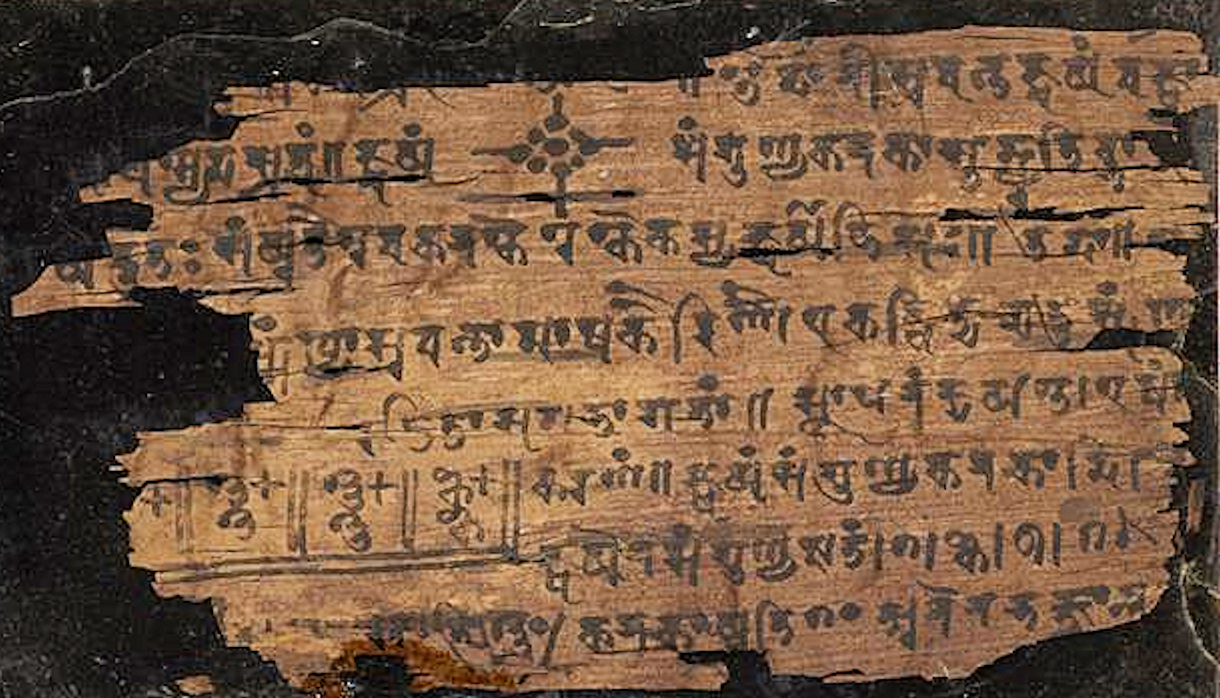

There is a digit that counts nothing. And yet, without it, almost nothing works.
That digit is zero. It took a very long time to come into existence, and it set mathematicians problems that they did not all manage to solve.
A hole in the number
Two hundred and five is written in digits as 205. Here the zero does not indicate the presence of something: it indicates that there are no tens.
This is its first function: to mark an empty place. Without it, 205 and 25 would be written the same way, and it would no longer be possible to tell them apart.
The idea seems simple. Yet many counting systems lacked it. In Mesopotamia, a scribe perhaps left a little more space, which was ambiguous. In China, the square was left empty on the rod board: the method worked, but only as long as the rods stayed in place.1
To write a number on a medium and pass it on, a sign was needed.
The day nothing became a number
Marking an empty place is one thing; treating zero as a number with which one can calculate is another.
In 628, in South Asia, the mathematician Brahmagupta took that step. He wrote rules: what you get when you add zero, when you subtract it or when you use it with negative quantities — such as debts.2
But he stumbled over one question: what happens when you divide by zero?
- Brahmagupta (628) states that zero divided by zero is zero.
- Mahavira (c. 850) states that a number divided by zero does not change.
- Bhaskara II (1150) proposes that the result is infinity.3
Three mathematicians, three answers, and none of them works. In mathematics, division by zero is quite simply impossible. It took more than a thousand years to accept this.
Counting grains of sand
At the other end of the learned world, people were asking the opposite question: how far can one go towards the very large?
In the third century BCE, the Greek scholar Archimedes tried to calculate how many grains of sand it would take to fill the universe. To answer, he invented a system capable of naming gigantic numbers, far beyond the words that existed in his language.4
In the same period, in South Asia, texts gave names to immense numbers. No merchant needed them: these numbers served to explore abstract ideas, not to count sacks of rice.
Writing down is not calculating
For centuries, people did not calculate directly with written digits. The digits served to record the result, while the calculation was done with objects.
- In the Mediterranean, counters were moved on a board called an abacus.
- In China, rods were used, then the beads of an abacus.
- In the Andes, Inca accountants handled counters on a board with compartments called a yupana.5
It was the system that came from South Asia that changed everything: with place value and zero, one can set out a sum and calculate directly on paper.
Around 825, in Baghdad, the scholar al-Khwarizmi set out these methods of calculation in detail. His name gave us the word algorithm, and the title of one of his books gave us the word algebra. A century later, in Damascus, the mathematician al-Uqlidisi adapted these techniques to paper and wrote the oldest known text on digits after the decimal point.6
A regulation that does not say why
Between 1299 and 1316, in Florence, the statutes of the moneychangers’ guild forbade its members to enter amounts in Indo-Arabic numerals in their account books. They could still use them to calculate.7
It was long claimed that this ban was meant to prevent fraud, since a 0 could be altered into a 6 or a 9. But this explanation is only one hypothesis among others: it does not appear in the text of 1299.8
The story went far beyond that
An even stronger version circulates widely: zero is supposed to have frightened medieval Europe, to have been associated with the Devil or with black magic, and the Church is supposed to have banned these numerals.9
One historian has gone back over the evidence piece by piece. His conclusion is blunt: this narrative is false or unsubstantiated at nearly every level.10
He did better than refute it: he dated its birth.
Its foundations were laid in 1905, by a German scholar of Romance languages. Other authors then embellished it. The historian distinguishes two sources: some elements come from an unwarranted interpretation of real medieval sources, others from the imagination of certain modern authors.11
This point is worth pausing on, for it reflects the approach of this whole encyclopaedia.
A legend about the Middle Ages, born at the beginning of the twentieth century, copied for more than a century — and one that can be dated, because someone took the trouble to trace the chain of citations back.
The Middle Ages were not afraid of zero. It is we who needed them to be afraid of it.
The adoption of these numerals was held back not by fear but by the force of habit. As early as 976, in the monastery of San Martín de Albelda, in La Rioja, the copyist Vigila and his two companions were already copying out the Indian numerals, writing that the Indians must be acknowledged to have a most subtle genius, and be granted the advantage in arithmetic and geometry.
But something is missing, and it is precisely the subject of this page: the codex shows only nine figures. Zero is not there. The sign for empty places would take centuries more to make the journey.12
Calculating with what?
| Instrument | Region | Operating principle |
|---|---|---|
| Counter abacus | Mediterranean basin | Moving counters in grooves or columns |
| Counting rods | China | Arranging wooden or bone sticks on a grid-ruled board |
| Bead abacus | East Asia | Sliding beads threaded on rigid rods |
| Yupana | Andes | Board with hollows for distributing stones or seeds |
| Written calculation | South Asia, then the world | Writing out the steps of the operation directly with written numerals |
Note 1
A much more serious problem was the fact that there was no zero to put into an empty position. The numbers sexagesimal numbers 1 and 1,0, namely 1 and 60 in decimals, had exactly the same representation and now there was no way that spacing could help. […] Perhaps the scribe left a little more space than usual between the 6 and the 9 than he would have done had he been representing 6,9. Now if the empty space caused a problem with integers then there was an even bigger problem with Babylonian sexagesimal fractions.
O’Connor, John J. and Robertson, Edmund F., “Babylonian Numerals”, MacTutor History of Mathematics, University of St Andrews, December 2000
A counting board consisted of a checker board with rows and columns. Numbers were represented by little rods made from bamboo or ivory. […] Rods moving slightly along the row, or not being placed centrally in the squares, would lead to the incorrect number being represented. […] There was still no need for a zero on the counting board for a square was simply left blank.
O’Connor, John J. and Robertson, Edmund F., “Chinese Numerals”, MacTutor History of Mathematics, University of St Andrews, January 2004
Note 2
In particular he wrote Brahmasphutasiddhanta (Correctly Established Doctrine of Brahma), in 628. […] He gave some properties as follows:- When zero is added to a number or subtracted from a number, the number remains unchanged; and a number multiplied by zero becomes zero. He also gives arithmetical rules in terms of fortunes (positive numbers) and debts (negative numbers):-
O’Connor, John J. and Robertson, Edmund F., “Brahmagupta”, MacTutor History of Mathematics, University of St Andrews, November 2000
Note 3
In 628 CE, the Indian mathematician and astronomer Brahmagupta claimed that “zero divided by a zero is zero.” At around 850 CE, another Indian mathematician, Mahavira, more explicitly argued that any number divided by zero leaves that number unchanged, so then, for example, 24 ÷ 0 = 24. Later, around 1150, the mathematician Bhaskara gave yet another result for such operations. He argued that a quantity divided by zero becomes an infinite quantity.
Martinez, Alberto, “Dividing by Nothing”, Not Even Past, Department of History, University of Texas at Austin, 12 April 2011
Note 4
The Sandreckoner is a remarkable work in which Archimedes proposes a number system capable of expressing numbers up to […] He argues in this work that this number is large enough to count the number of grains of sand which could be fitted into the universe. There are also important historical remarks in this work, for Archimedes has to give the dimensions of the universe to be able to count the number of grains of sand which it could contain.
O’Connor, John J. and Robertson, Edmund F., “Archimedes of Syracuse”, MacTutor History of Mathematics, University of St Andrews, January 1999
Note 5
Numerical calculations were done on a variety of yupanas in which piles of tokens, seeds, or pebbles were moved between different compartments of the yupana for the calculation to take place.
Kak, Subhash, “Guáman Poma’s Yupana and Inca Astronomy”, Indian Journal of History of Science, vol. 54, no. 4, 2019, p. 398-404
Quipucamayoc with a quipu and an Andean calculation board, called yupana. […] Researchers believe that one of the methods that the Incas had to make accounts was using small stones for more complex mathematical operations by a kind of ‘abacus’, called yupana.
Museo Chileno de Arte Precolombino, “Does the quipu was analogous to a system of calculation?”, exhibition Quipu: Counting with knots in the Inka Empire, 2003
Note 6
Algoritmi de numero Indorum in English Al-Khwarizmi on the Hindu Art of Reckoning gave rise to the word algorithm deriving from his name in the title
O’Connor, John J. and Robertson, Edmund F., “Abu Ja’far Muhammad ibn Musa Al-Khwarizmi”, MacTutor History of Mathematics, University of St Andrews, July 1999, open access
His algebra treatise Hisab al-jabr w'al-muqabala gives us the word algebra
O’Connor, John J. and Robertson, Edmund F., “Abu Ja’far Muhammad ibn Musa Al-Khwarizmi”, MacTutor History of Mathematics, University of St Andrews, July 1999, open access
The dust board allowed this in the same sort of way that one can use a blackboard, chalk and a blackboard eraser. However, al-Uqlidisi showed how to modify the methods for pen and paper use. […] Al-Uqlidisi's work is historically important as it is the earliest known text offering a direct treatment of decimal fractions.
O’Connor, John J. and Robertson, Edmund F., “Abu’l Hasan Ahmad ibn Ibrahim Al-Uqlidisi”, MacTutor History of Mathematics, University of St Andrews, November 1999
Note 7
Ainsi, à Florence, entre 1299 et 1316, il est interdit aux changeurs et prêteurs d’argent de la ville d’utiliser des chiffres arabes dans leur comptabilité (Quod nullus de arte scribat in suo libro per abbacum).
Thus, in Florence, between 1299 and 1316, the city’s moneychangers and moneylenders were forbidden to use Arabic numerals in their accounts (Quod nullus de arte scribat in suo libro per abbacum [that no member of the guild shall write in his book by means of the abacus]).
Conti, Marco, “Chiffres arabes et logiques administratives : premières notes sur l’utilisation des chiffres arabes dans la documentation fiscale de la commune de Bologne (milieu XIVᵉ-début XVᵉ siècle)”, Hypothèses, no. 24, 2023, p. 307-316, open access
Note 8
The reasons behind this prohibition are a matter of speculation. A concern that the Hindu-Arabic numerals, which existed in a variety of forms, might lend themselves to forgery or fraud has been one of the more popular explanations, but other possibilities exist. […] It should be emphasized that no such comment appears in the source text.
Nothaft, C. Philipp E., “Medieval Europe’s Satanic Ciphers: On the Genesis of a Modern Myth”, British Journal for the History of Mathematics, vol. 35, no. 2, 2020, p. 107-136, open access
Note 9
According to one of the core elements of this story, the number or symbol for zero was the cause of much anxiety in medieval Europe, as its unusual properties caused it to be associated with the Devil or with black magic. This anxiety is supposed to have extended to the entire system of Hindu-Arabic numerals, such that the use of these numerals was banned by the Church or by other powerful institutions.
Nothaft, C. Philipp E., “Medieval Europe’s Satanic Ciphers: On the Genesis of a Modern Myth”, British Journal for the History of Mathematics, vol. 35, no. 2, 2020, p. 107-136, open access
Note 10
I shall argue that this narrative is false or unsubstantiated at nearly every level of analysis.
Nothaft, C. Philipp E., “Medieval Europe’s Satanic Ciphers: On the Genesis of a Modern Myth”, British Journal for the History of Mathematics, vol. 35, no. 2, 2020, p. 107-136, open access
Note 11
The narrative’s main foundations were laid in 1905 by Leo Jordan, a German scholar of Romance languages, whose claims regarding a supposed quarrel between ‘abacists’ and ‘algorists’ in later medieval Europe exerted a strong influence on the modern historiography.
Nothaft, C. Philipp E., “Medieval Europe’s Satanic Ciphers: On the Genesis of a Modern Myth”, British Journal for the History of Mathematics, vol. 35, no. 2, 2020, p. 107-136, open access
Some elements arose from an unwarranted interpretation of medieval sources, while others are based on the unbridled imagination of certain modern authors.
Nothaft, C. Philipp E., “Medieval Europe’s Satanic Ciphers: On the Genesis of a Modern Myth”, British Journal for the History of Mathematics, vol. 35, no. 2, 2020, p. 107-136, open access
Note 12
This becomes manifest in nine figures, each of which designate a specific [numeric] position. These are the forms of each position: 987654321. Note that the list of numbers still lacks zero.
Qandil, Samer Sayed and König, Daniel G., “984: Some Letters to and by Gerbert d’Aurillac Dealing with ‘Arabic’ Mathematics and Astronomy”, Transmediterranean History, vol. 3, no. 1, 2021, p. 1-20
Notes and sources
- ↑
Passage In Mesopotamia, a scribe perhaps left a little more space, which was ambiguous.
A much more serious problem was the fact that there was no zero to put into an empty position. The numbers sexagesimal numbers 1 and 1,0, namely 1 and 60 in decimals, had exactly the same representation and now there was no way that spacing could help. […] Perhaps the scribe left a little more space than usual between the 6 and the 9 than he would have done had he been representing 6,9. Now if the empty space caused a problem with integers then there was an even bigger problem with Babylonian sexagesimal fractions.
Source O’Connor, John J. and Robertson, Edmund F., “Babylonian Numerals”, MacTutor History of Mathematics, University of St Andrews, December 2000, “Babylonian numerals” article: passage on the absence of zero, then the example of the square of 2,27 (tablet AO 17264).
Open access open the source · checked on 25 October 2026
Passage In China, the square was left empty on the rod board: the method worked, but only as long as the rods stayed in place.
A counting board consisted of a checker board with rows and columns. Numbers were represented by little rods made from bamboo or ivory. […] Rods moving slightly along the row, or not being placed centrally in the squares, would lead to the incorrect number being represented. […] There was still no need for a zero on the counting board for a square was simply left blank.
Source O’Connor, John J. and Robertson, Edmund F., “Chinese Numerals”, MacTutor History of Mathematics, University of St Andrews, January 2004, “Chinese numerals” article, part on the counting board.
Open access open the source · checked on 25 October 2026
- ↑
Passage In 628 […] Brahmagupta took that step. He wrote rules
In particular he wrote Brahmasphutasiddhanta (Correctly Established Doctrine of Brahma), in 628. […] He gave some properties as follows:- When zero is added to a number or subtracted from a number, the number remains unchanged; and a number multiplied by zero becomes zero. He also gives arithmetical rules in terms of fortunes (positive numbers) and debts (negative numbers):-
Source O’Connor, John J. and Robertson, Edmund F., “Brahmagupta”, MacTutor History of Mathematics, University of St Andrews, November 2000, biography, paragraph “Brahmagupta, whose father was Jisnugupta…”, then paragraph “Brahmagupta’s understanding of the number systems…”.
Open access open the source · checked on 27 October 2026
- ↑
Passage Brahmagupta (628) states that zero divided by zero is zero. Mahavira (c. 850) […] Bhaskara II (1150) proposes that the result is infinity.
In 628 CE, the Indian mathematician and astronomer Brahmagupta claimed that “zero divided by a zero is zero.” At around 850 CE, another Indian mathematician, Mahavira, more explicitly argued that any number divided by zero leaves that number unchanged, so then, for example, 24 ÷ 0 = 24. Later, around 1150, the mathematician Bhaskara gave yet another result for such operations. He argued that a quantity divided by zero becomes an infinite quantity.
Source Martinez, Alberto, “Dividing by Nothing”, Not Even Past, Department of History, University of Texas at Austin, 12 April 2011, 2nd paragraph.
Open access open the source · checked on 27 October 2026
- ↑
Passage the Greek scholar Archimedes tried to calculate how many grains of sand it would take to fill the universe
The Sandreckoner is a remarkable work in which Archimedes proposes a number system capable of expressing numbers up to […] He argues in this work that this number is large enough to count the number of grains of sand which could be fitted into the universe. There are also important historical remarks in this work, for Archimedes has to give the dimensions of the universe to be able to count the number of grains of sand which it could contain.
Source O’Connor, John J. and Robertson, Edmund F., “Archimedes of Syracuse”, MacTutor History of Mathematics, University of St Andrews, January 1999, MacTutor biography, paragraph on The Sandreckoner.
Open access open the source · checked on 25 October 2026
- ↑
Passage handled counters on a board with compartments called a yupana
Numerical calculations were done on a variety of yupanas in which piles of tokens, seeds, or pebbles were moved between different compartments of the yupana for the calculation to take place.
Source Kak, Subhash, “Guáman Poma’s Yupana and Inca Astronomy”, Indian Journal of History of Science, vol. 54, no. 4, 2019, p. 398-404, p. 399, § 1 (introduction), paragraph “Numerical information associated with administrative, military, and business uses…”.
Open access open the source · checked on 27 October 2026
Passage Inca accountants
Quipucamayoc with a quipu and an Andean calculation board, called yupana. […] Researchers believe that one of the methods that the Incas had to make accounts was using small stones for more complex mathematical operations by a kind of ‘abacus’, called yupana.
Source Museo Chileno de Arte Precolombino, “Does the quipu was analogous to a system of calculation?”, exhibition Quipu: Counting with knots in the Inka Empire, 2003, page “Does the quipu was analogous to a system of calculation?”, caption of the illustration (drawing by Guamán Poma de Ayala, 1615) then main paragraph.
Open access open the source · checked on 27 October 2026
- ↑
Passage His name gave us the word algorithm, and the title of one of his books gave us the word algebra.
Algoritmi de numero Indorum in English Al-Khwarizmi on the Hindu Art of Reckoning gave rise to the word algorithm deriving from his name in the title
Source O’Connor, John J. and Robertson, Edmund F., “Abu Ja’far Muhammad ibn Musa Al-Khwarizmi”, MacTutor History of Mathematics, University of St Andrews, July 1999, open access, biography, paragraph on the arithmetic treatise.
Open access open the source · checked on 24 October 2026
Passage His name gave us the word algorithm, and the title of one of his books gave us the word algebra.
His algebra treatise Hisab al-jabr w'al-muqabala gives us the word algebra
Source O’Connor, John J. and Robertson, Edmund F., “Abu Ja’far Muhammad ibn Musa Al-Khwarizmi”, MacTutor History of Mathematics, University of St Andrews, July 1999, open access, summary at the head of the biography.
Open access open the source · checked on 24 October 2026
Passage the mathematician al-Uqlidisi adapted these techniques to paper and wrote the oldest known text on digits after the decimal point
The dust board allowed this in the same sort of way that one can use a blackboard, chalk and a blackboard eraser. However, al-Uqlidisi showed how to modify the methods for pen and paper use. […] Al-Uqlidisi's work is historically important as it is the earliest known text offering a direct treatment of decimal fractions.
Source O’Connor, John J. and Robertson, Edmund F., “Abu’l Hasan Ahmad ibn Ibrahim Al-Uqlidisi”, MacTutor History of Mathematics, University of St Andrews, November 1999, “Biography” section, 6th and 7th paragraphs (7th and 8th if the indented quotation is counted).
Open access open the source · checked on 9 September 2026
- ↑
Passage Between 1299 and 1316, in Florence, the statutes of the moneychangers’ guild forbade its members to enter amounts in Indo-Arabic numerals
Ainsi, à Florence, entre 1299 et 1316, il est interdit aux changeurs et prêteurs d’argent de la ville d’utiliser des chiffres arabes dans leur comptabilité (Quod nullus de arte scribat in suo libro per abbacum).
Editors’ translation Thus, in Florence, between 1299 and 1316, the city’s moneychangers and moneylenders were forbidden to use Arabic numerals in their accounts (Quod nullus de arte scribat in suo libro per abbacum [that no member of the guild shall write in his book by means of the abacus]).
Source Conti, Marco, “Chiffres arabes et logiques administratives : premières notes sur l’utilisation des chiffres arabes dans la documentation fiscale de la commune de Bologne (milieu XIVᵉ-début XVᵉ siècle)”, Hypothèses, no. 24, 2023, p. 307-316, open access, p. 308 and note 6 (reference to the Statuti dell’Arte del cambio di Firenze, ed. G. Camerani Marri, 1955, p. 166).
Open access open the source · checked on 24 October 2026
- ↑
Passage this explanation is only one hypothesis among others: it does not appear in the text of 1299
The reasons behind this prohibition are a matter of speculation. A concern that the Hindu-Arabic numerals, which existed in a variety of forms, might lend themselves to forgery or fraud has been one of the more popular explanations, but other possibilities exist. […] It should be emphasized that no such comment appears in the source text.
Source Nothaft, C. Philipp E., “Medieval Europe’s Satanic Ciphers: On the Genesis of a Modern Myth”, British Journal for the History of Mathematics, vol. 35, no. 2, 2020, p. 107-136, open access, section 1, p. 16 of the accepted manuscript (ORA), text and note 22.
Open access open the source · checked on 24 October 2026
- ↑
Passage zero is supposed to have frightened medieval Europe, to have been associated with the Devil or with black magic, and the Church is supposed to have banned these numerals
According to one of the core elements of this story, the number or symbol for zero was the cause of much anxiety in medieval Europe, as its unusual properties caused it to be associated with the Devil or with black magic. This anxiety is supposed to have extended to the entire system of Hindu-Arabic numerals, such that the use of these numerals was banned by the Church or by other powerful institutions.
Source Nothaft, C. Philipp E., “Medieval Europe’s Satanic Ciphers: On the Genesis of a Modern Myth”, British Journal for the History of Mathematics, vol. 35, no. 2, 2020, p. 107-136, open access, abstract (ORA page).
Open access open the source · checked on 24 October 2026
- ↑
Passage this narrative is false or unsubstantiated at nearly every level
I shall argue that this narrative is false or unsubstantiated at nearly every level of analysis.
Source Nothaft, C. Philipp E., “Medieval Europe’s Satanic Ciphers: On the Genesis of a Modern Myth”, British Journal for the History of Mathematics, vol. 35, no. 2, 2020, p. 107-136, open access, abstract (ORA page).
Open access open the source · checked on 24 October 2026
- ↑
Passage Its foundations were laid in 1905, by a German scholar of Romance languages.
The narrative’s main foundations were laid in 1905 by Leo Jordan, a German scholar of Romance languages, whose claims regarding a supposed quarrel between ‘abacists’ and ‘algorists’ in later medieval Europe exerted a strong influence on the modern historiography.
Source Nothaft, C. Philipp E., “Medieval Europe’s Satanic Ciphers: On the Genesis of a Modern Myth”, British Journal for the History of Mathematics, vol. 35, no. 2, 2020, p. 107-136, open access, abstract of the accepted manuscript (ORA), p. 1.
Open access open the source · checked on 24 October 2026
Passage some elements come from an unwarranted interpretation of real medieval sources, others from the imagination of certain modern authors
Some elements arose from an unwarranted interpretation of medieval sources, while others are based on the unbridled imagination of certain modern authors.
Source Nothaft, C. Philipp E., “Medieval Europe’s Satanic Ciphers: On the Genesis of a Modern Myth”, British Journal for the History of Mathematics, vol. 35, no. 2, 2020, p. 107-136, open access, abstract (ORA page).
Open access open the source · checked on 24 October 2026
- ↑
Passage the codex shows only nine figures. Zero is not there.
This becomes manifest in nine figures, each of which designate a specific [numeric] position. These are the forms of each position: 987654321. Note that the list of numbers still lacks zero.
Source Qandil, Samer Sayed and König, Daniel G., “984: Some Letters to and by Gerbert d’Aurillac Dealing with ‘Arabic’ Mathematics and Astronomy”, Transmediterranean History, vol. 3, no. 1, 2021, p. 1-20, p. 10, footnote 58 (to Figure 1: Codex Vigilanus, El Escorial, MS D.I.2, fol. 12v).
Open access open the source · checked on 27 October 2026
Bibliography
16
- Codex conciliorum Albeldensis seu Vigilanus, copié en 976 au monastère de San Martín de Albelda par Vigila, Sarracino et García, Bibliothèque de l’Escurial, ms. D.I.2, open access (the oldest depiction of Indo-Arabic numerals in a Latin manuscript: nine figures, without zero). See Kunitzsch, Paul, “The Transmission of Hindu-Arabic Numerals Reconsidered”, dans Hogendijk, Jan P. et Sabra, Abdelhamid I. (dir.), The Enterprise of Science in Islam, MIT Press, 2003, p. 3-21, in libraries.
- Conti, Marco, “Chiffres arabes et logiques administratives : premières notes sur l’utilisation des chiffres arabes dans la documentation fiscale de la commune de Bologne (milieu XIVᵉ-début XVᵉ siècle)”, Hypothèses, no. 24, 2023, p. 307-316, open access (the ban on the moneychangers and moneylenders of Florence, between 1299 and 1316, using Arabic numerals in their accounts). https://doi.org/10.3917/hyp.201.0307
- Kak, Subhash, “Guáman Poma’s Yupana and Inca Astronomy”, Indian Journal of History of Science, vol. 54, no. 4, 2019, p. 398-404, open access (the yupana, a calculating board with compartments on which tokens, seeds or pebbles were moved). https://cahc.jainuniversity.ac.in/assets/ijhs/Vol54_4_2019__Art01.pdf
- Martinez, Alberto, “Dividing by Nothing”, Not Even Past, Department of History, University of Texas at Austin, 12 April 2011, open access (the three Indian answers to division by zero: Brahmagupta in 628, Mahavira around 850, Bhaskara around 1150). https://notevenpast.org/dividing-nothing/
- Museo Chileno de Arte Precolombino, “Does the quipu was analogous to a system of calculation?”, exhibition Quipu: Counting with knots in the Inka Empire, 2003, open access (the quipucamayoc with his quipu and calculating board, the yupana; Inca accounts made with small stones). https://precolombino.cl/wp/en/?p=35544
- Nothaft, C. Philipp E., “Medieval Europe’s Satanic Ciphers: On the Genesis of a Modern Myth”, British Journal for the History of Mathematics, vol. 35, no. 2, 2020, p. 107-136, open access (the story of zero associated with the Devil and banned by the Church, judged false or unsubstantiated at nearly every level; the foundations laid in 1905 by Leo Jordan, a German Romance scholar; the distinction between an unwarranted reading of medieval sources and the invention of modern authors; the motives for the Florentine ban of 1299, a matter of mere hypotheses). https://ora.ox.ac.uk/objects/uuid:71f4c8ca-2b6a-4393-94dc-8d81096985bc
- O’Connor, John J. and Robertson, Edmund F., “Abu Ja’far Muhammad ibn Musa Al-Khwarizmi”, MacTutor History of Mathematics, University of St Andrews, July 1999, open access (the word “algorithm” taken from his name, through the Latin title Algoritmi de numero Indorum; the word “algebra” taken from the title of his treatise on algebra; the Arabic title of the arithmetic treatise unknown). https://mathshistory.st-andrews.ac.uk/Biographies/Al-Khwarizmi/
- O’Connor, John J. and Robertson, Edmund F., “Babylonian Numerals”, MacTutor History of Mathematics, University of St Andrews, December 2000, open access (the absence of a zero to mark an empty place; the scribe who leaves a little more space, and the resulting ambiguity). https://mathshistory.st-andrews.ac.uk/HistTopics/Babylonian_numerals/
- O’Connor, John J. and Robertson, Edmund F., “Brahmagupta”, MacTutor History of Mathematics, University of St Andrews, November 2000, open access (the Brahmasphutasiddhanta written in 628; zero defined as the result of subtracting a number from itself; rules of calculation with zero, “fortunes” and “debts”). https://mathshistory.st-andrews.ac.uk/Biographies/Brahmagupta/
- O’Connor, John J. and Robertson, Edmund F., “Chinese Numerals”, MacTutor History of Mathematics, University of St Andrews, January 2004, open access (the counting board and its rods: a square simply left empty in place of zero; errors as soon as the rods shift). https://mathshistory.st-andrews.ac.uk/HistTopics/Chinese_numerals/
- O’Connor, John J. and Robertson, Edmund F., “Archimedes of Syracuse”, MacTutor History of Mathematics, University of St Andrews, January 1999, open access (The Sand Reckoner or Psammites, dedicated to Gelon: a number system capable of expressing immense numbers, large enough to count the grains of sand the universe could contain). https://mathshistory.st-andrews.ac.uk/Biographies/Archimedes/
- O’Connor, John J. and Robertson, Edmund F., “Abu’l Hasan Ahmad ibn Ibrahim Al-Uqlidisi”, MacTutor History of Mathematics, University of St Andrews, November 1999, open access (the methods of calculation adapted to paper; the oldest known text dealing with decimal fractions). https://mathshistory.st-andrews.ac.uk/Biographies/Al-Uqlidisi/
- Plofker, Kim, Mathematics in India, Princeton University Press, 2009, in libraries (Brahmagupta, Mahavira, Bhaskara II, and their three different answers on division by zero).
- Qandil, Samer Sayed and König, Daniel G., “984: Some Letters to and by Gerbert d’Aurillac Dealing with ‘Arabic’ Mathematics and Astronomy”, Transmediterranean History, vol. 3, no. 1, 2021, p. 1-20, open access (folio 12v of the Codex Vigilanus, transcribed and translated: nine figures, without zero). https://doi.org/10.18148/tmh/2021.3.1.63
- Saidan, Ahmad S., “The Earliest Extant Arabic Arithmetic: Kitab al-Fusul fi al-Hisab al-Hindi of Abu al-Hasan Ahmad ibn Ibrahim al-Uqlidisi”, Isis, vol. 57, no. 4, 1966, p. 475-490, paywalled. https://doi.org/10.1086/350163
- Tun, Molly, “Yupana”, dans Selin, Helaine (dir.), Encyclopaedia of the History of Science, Technology, and Medicine in Non-Western Cultures, Springer, 2016, in libraries (the Andean calculating board).
Iconography: Diagrams and visual elements taken from documentary archive collections.
Spotted an error or have a doubt? Write to us.