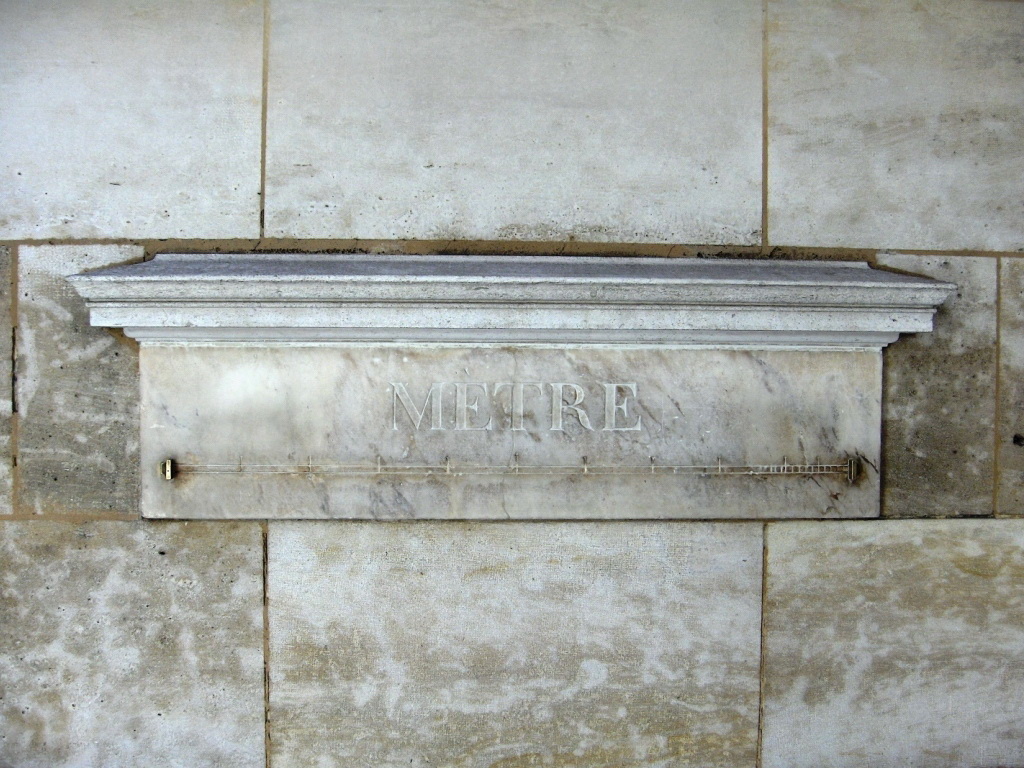

How long is a metre?
You can show it with your hands, roughly. But “roughly” is not enough when it comes to selling cloth, building a bridge or paying a tax. So people had to agree. Agreeing on a length turned out to be far more complicated than one might imagine.
Whose foot?
The first measures come from the body. The foot, the cubit — from the elbow to the fingertips — the span — the distance between the thumb and the little finger, with the hand open — the fathom — both arms outstretched.
It is practical: you always carry your instruments with you. But the flaw is obvious. Whose foot? An adult’s foot and a child’s foot are not the same length. Two people measuring the same field do not get the same result.
As long as you measure for yourself, it does not matter. As soon as you trade, it does.
Making a reference object
The first solution was a material one: make an object that serves as a model, and compare all the others to it. This is called a standard.
In Egypt, rulers of stone or wood were cut to give the official cubit. Some survive. They measure about 52 centimetres. On them the cubit is divided into seven palms, and each palm into four fingers: the hand serves as the scale.1
An aside, because it is instructive. The most famous of these rulers, kept in Turin, has imprecise subdivisions. The museum therefore thinks it was a prestige object, given to a high official, and not a tool for building work. The most photographed standard may not be a standard that was ever used.2
The most impressive case comes from the Indus Valley, more than four thousand years ago. At more than forty sites spread over two thousand kilometres, small cubes of hard stone used as weights have been found. They are practically identical from one site to another.
They follow a simple rule: each weight is worth double the previous one. One, two, four, eight, sixteen, thirty-two. The smallest weighs less than a gram. The most common weighs a little under fourteen grams.3
We cannot read this civilisation’s script. So we cannot read what they wrote on their weights. But the objects themselves speak: someone, somewhere, had decided the value of the local gram, and everyone kept to it.
A little further west, in Mesopotamia, people weighed with a beam balance: a bar suspended at its middle, with a pan at each end. First the empty pans are balanced, then the object is placed on one side and known weights on the other. The principle is so convenient that it is found everywhere, from Egypt to China.4
The weights themselves are often carved from a black, polished stone, in the shape of a duck or a lion. Sixty small ones make a medium one, sixty medium ones make a large one: the shekel, the mina, the talent. Base sixty once again: the base of the Babylonian tablets and of our sixty minutes. The smallest weight found weighs fourteen hundredths of a gram — so people weighed tiny things, and did so deliberately.5
The standard that carries its own law
In China, in 221 BCE, a king had just conquered all the others and proclaimed himself emperor. His very first act was neither a war nor a temple: it was an edict unifying the weights and measures of the empire.
The most interesting part is how he went about it. The edict was not merely posted: it was engraved, or cast in metal, into the weights and measures themselves. The object carries the text that makes it compulsory. An iron weight found in the north weighs thirty-two kilograms and bears forty characters inlaid in copper.6
This is how we know that the measure was really applied: such objects have been found in provinces very far apart from one another. The order from the capital reached the furthest borders, and it arrived in the form of an object that could be placed on a balance.
The lord’s bushel
This is where measurement stops being only a matter of science.
For a very long time, taxes were paid in grain. The peasant brought his harvest and poured it into a wooden container, the bushel. If this container was a little larger than it should be, the peasant gave more without it showing. Should it be filled to the brim, or heaped up until it overflowed? The difference could reach several per cent.
The bushel, as it happens, belonged to the lord. Measuring, weighing, checking the instruments: these were rights he held, and they earned him money.
Before the Revolution, France had roughly eight hundred unit names. The worst was not their number, but that the same name did not mean the same thing everywhere. The king’s pound weighed 489 grams, but other pounds in use weighed from 404 to 456 grams. The pint was less than a litre in Paris and nearly a litre and a half in Saint-Denis, a few kilometres away. A setier held twelve bushels of wheat, but sixteen of salt, twenty-four of oats and thirty-two of charcoal.7
In 1789, when the French were asked to write down their grievances, the demand came up everywhere. In the Pas-de-Calais, it appears in several cahiers. The one from the village of Oppy calls for the establishment of a single weight and a single measure throughout the kingdom. (The cahier writes “poid”, without an s: spelling was not yet fixed.) Elsewhere, the lord was targeted directly: everyone, says one cahier, has his own different bushel.8
These papers have been preserved, and you can go and read them. The originals even have shelf marks — 2 B 881 to 2 B 884 — and anyone can request them from the departmental archives.9
The story should not, however, be oversimplified. The demand also appears in the cahiers of the nobility and the clergy, often presented as a hindrance to trade rather than as an injustice. Not everyone wanted it: one municipality feared that standardising grain measures would drive away the merchants, part of whose profit came precisely from these discrepancies.
On the night of 4 August 1789, privileges were abolished — and with them the seigneurial right to measure, to weigh and to check the instruments.
Measuring the Earth to define the metre
On 26 March 1791, a decision was taken in France: a unit would be created that depended on no one. Not on a king’s foot, not on an object kept in some city. The text says so explicitly: a unit containing nothing arbitrary, and nothing particular to any nation on the globe.
The idea adopted was to derive it from the Earth itself. The metre would be the ten-millionth part of the distance between the North Pole and the equator.10
That distance still had to be measured. Two astronomers, Delambre and Méchain, set out in 1792 to measure, triangle by triangle, the arc of meridian between Dunkirk and Barcelona. The mission was supposed to last a year. It lasted six. They worked in the middle of a war, and were arrested, suspected, held up.11
In 1795, the metric system was established by law. In 1799, the definitive length was fixed and cast in a platinum bar.
Then comes the part of the story that is rarely told: this measurement is wrong.
In Barcelona, Méchain obtained two series of results. Each was carefully made. They did not agree.
Today, we would know what to do with such a discrepancy: there is a science of measurement errors. In his day, it did not yet exist — it would be born in the following century. Méchain therefore believed he had made a mistake. He did not dare say so, and it would torment him for the rest of his life.
He did worse than keep quiet. His papers, found much later, show that he altered his figures to bring them closer to those of his colleague. The remarkable agreement between the two astronomers, so reassuring at the time, was partly fabricated.12
The irony of history is cruel. The data he set aside because they troubled him are closer to today’s accepted value than those he kept.13
He suppressed the good ones.
After his death, Delambre went through his notebooks and understood. He wrote in the margin that he would not speak of it to the public, and put the papers under seal.
What this story eventually produced
The 1799 metre is too short by about two tenths of a millimetre — the thickness of two pages of a book.14
Méchain’s error, incidentally, has little to do with it: the real problem is that the Earth does not have the regular shape it was assumed to have. Their measurements were so fine that they no longer fitted any neat curve. They were measuring very accurately an object they pictured wrongly.
A cruel detail: their result, obtained over seven years, turned out to be less accurate than a provisional value adopted in 1793 on the basis of an earlier, and yet less precise, survey.15
Yet it was from this failure that a crucial idea emerged, and it is used on every page of this site.
No measurement is free of error. A researcher must therefore not only reduce their error: they must estimate it and state it. A published result is not a true value, it is a value accompanied by its uncertainty — one acknowledges the error in order to control it.16
This seems obvious to us. It was not. Méchain died without ever having been granted that right.
Units that can no longer be distorted
A platinum bar is better than a king’s foot. But it is still an object, and an object has a life of its own.
The cylinder that defined the kilogram, kept under three glass bell jars near Paris, did not stay equal to its copies. Over a century, a gap of about fifty micrograms opened up between it and its official copies — the weight of an eyelash. Had the copies grown heavier, or had it grown lighter? It is impossible to decide. Since all the masses in the world were referred to it, if it lost a little, the entire universe grew heavier by the same amount, simply by definition.17
So, in 2018, an international conference decided to take the final step: units would no longer rest on any object. They would be defined from constants of nature — numbers that never change, wherever one is in the universe. The change came into force in 2019.18
To do this, these constants had to be measured with extreme precision. In the United States, the physicist Darine Haddad and her team spent three years measuring one of them on a balance of a special kind, in which the weight of an object is offset by an electric current. It is this number that defines the kilogram today.
No one can distort the kilogram any more. It is the culmination of an idea two centuries old, and of a problem several thousand years old.
That said, the body has not disappeared. Screens are still measured in inches, and aircraft give their altitude in feet. The nautical mile, by contrast, owes nothing to the body: it is worth about one minute of arc of meridian, and it was fixed at exactly 1,852 metres by an international conference in 1929.19
To finish, a detail that should be reassuring about the Mesopotamians. Their shekel, so well defined, weighed 7.8 grams here and 9.4 grams there, and some fifteen different values are known for it. Exactly like the pint of Paris and that of Saint-Denis, three thousand years later. The same name not meaning the same thing from place to place: this is the permanent problem of measurement, and it took until 2019 to truly escape it.
Four ways to fix a measure
| What it rests on | Example | Weak point |
|---|---|---|
| The human body | foot, cubit, span | varies from person to person |
| A grain, a seed | the Mesopotamian shekel, about 180 grains of barley | grains are not all alike |
| A reference object | Indus weights, Egyptian cubit, Qin weights, platinum metre | the object can be deformed or lost |
| A constant of nature | current units since 2019 | none, but very difficult to measure |
Note 1
Surviving cubit rods: […] From these examples, it has been calculated that the cubit corresponded to 52 centimetres. Divisions of the cubit: One cubit = 7 palms (Egyptian Ssp) One cubit = 28 fingers (Egyptian Dba)
University College London, “Measuring length in Ancient Egypt”, Digital Egypt for Universities, 2002
Note 2
Varie imprecisioni nelle misure e nelle loro suddivisioni fanno pensare che si tratti di un oggetto esclusivamente di prestigio, non destinato a essere usato, che celebra il legame fra il re e questo potente funzionario, responsabile della provvista di grano dello Stato.
Various imprecisions in the measurements and their subdivisions suggest that this is purely a prestige object, not intended to be used, which celebrates the bond between the king and this powerful official, responsible for the State’s grain supply.
Museo Egizio, Turin, Coudée royale d’Amenemope, Cat. 6347
Note 3
These weights conform to the standard Harappan binary weight system that was used in all of the settlements. The smallest weight in this series is 0.856 grams and the most common weight is approximately 13.7 grams, which is in the 16th ratio.
Kenoyer, Jonathan M. and Meadow, Richard H. (ed.), “Weights”, Harappa Archaeological Research Project
Note 4
allows them to sit in a balance pan without rolling […] An additive sequence makes perfect sense for weighing with hand balances.
Hafford, William B., “Hanging in the Balance: Precision Weighing in Antiquity”, Expedition, vol. 47, no. 2, 2005, p. 35-37
Note 5
According to the Sumerian sexagesimal system, the talent was divided into 60 minas, and a mina was divided into 60 shekels.
The Metropolitan Museum of Art, New York, Weight in shape of frog, époque paléo-babylonienne (vers 2000-1600 avant notre ère), no. 1988.301
Note 6
After annexing his opponent states, the Qin First Emperor in 221 bce issued an edict to regulate the measurement system of lengths, volumes, and weights throughout the empire. This edict was inscribed on a great number of metal objects to be used as prototypes or standards for the measurement system.
Li, Kin Sum, “To Rule by Manufacture: Measurement Regulation and Metal Weight Production in the Qin Empire”, T’oung Pao, vol. 103, no. 1-3, 2017, p. 1-32
Note 7
Si l’on se réfère au système royal du poids de marc, la livre vaut 489,506 grammes. Mais il existait d’autres référencements : le poids de table, le poids de crochet, le poids de Valence, le poids de pays… Selon les tableaux comparatifs de la période révolutionnaire, ces différentes livres varient de 404 à 456 grammes.
If one refers to the royal poids de marc system, the pound is worth 489.506 grams. But there were other references: the poids de table, the poids de crochet, the poids de Valence, the poids de pays… According to the comparative tables of the revolutionary period, these different pounds vary from 404 to 456 grams.
Archives départementales de l’Isère, “Faites poids et mesures… Les unités de mesure en Dauphiné, du Moyen Âge à la fin du XVIIIᵉ siècle”, Chroniques d’Archives, September 2012
Note 8
13. L'établissement d'un seul poid et d'une seule mesure partout le royaume.
13. The establishment of a single weight and a single measure throughout the kingdom.
Loriquet, Henri, Cahiers de doléances de 1789 dans le département du Pas-de-Calais, Arras, Crépel, 1891, tome 1, public domain
2. Qu'il n'y eût qu'un seul poid et une seule mesure dans la province. […] 40. Qu'il ne soit établi qu'un seul poid et une seule mesure dans toute la France.
2. That there be only one weight and one measure in the province. […] 40. That only one weight and one measure be established throughout France.
Loriquet, Henri, Cahiers de doléances de 1789 dans le département du Pas-de-Calais, Arras, Crépel, 1891, tome 1, public domain
Note 9
L'ouvrage contient l'édition intégrale de tous les cahiers de doléances qui existaient à cette époque aux archives départementales du Pas-de-Calais (les originaux sont conservés actuellement sous les cotes 2 B 881-884 et 9 B 54).
The work contains the complete edition of all the cahiers de doléances that existed at that time in the departmental archives of the Pas-de-Calais (the originals are currently kept under the shelf marks 2 B 881-884 and 9 B 54).
Archives départementales du Pas-de-Calais, “Le Pas-de-Calais pendant la Révolution (1789-1800) : bibliographie”, Histoire et Mémoire, no. 48, December 2006, p. 22, open access
Tirés presque tous des Archives publiques où ils existent encore en minutes ou en copies certifiées, les Cahiers offriront
Taken almost all from the public archives, where they still exist as originals or certified copies, the Cahiers will offer
Loriquet, Henri (ed.), Cahiers de doléances de 1789 dans le département du Pas-de-Calais, Arras, 1891, 2 vol., public domain
Note 10
Introduced on 26 March 1791, the metre was defined as being equal to the ten millionth part of one quarter of the terrestrial meridian. […] The metre materialised the idea of a "unit which in its determination was neither arbitrary nor related to any particular nation on the globe".
Laboratoire national de métrologie et d’essais, “L’évolution historique des unités”
Note 11
It was decided to measure, using the method of triangulation with sightings made with the Borda repeating circle […] that part of the meridian between Dunkerque and Barcelona. […] on 5 May 1792 Delambre was given charge of the Dunkerque to Rodez sector and Méchain the Rodez to Barcelona sector. Delambre set out in June and began to seek triangulation points round Paris.
O’Connor, John J. and Robertson, Edmund F., “Jean-Baptiste-Joseph Delambre”, MacTutor History of Mathematics, University of St Andrews, April 2003
Note 12
It now appeared that Méchain had also doctored his data for the latitude of the Panthéon, so as to approach Delambre's value. The stunning convergence had been a sham, the moral theater a mirror show.
Alder, Ken, The Measure of All Things: The Seven-Year Odyssey and Hidden Error That Transformed the World, The Free Press, New York, 2002
Note 13
The irony—which neither Méchain nor Delambre could know—is that Méchain's suppressed data more closely approximate today's accepted latitude for the Observatory.
Alder, Ken, The Measure of All Things: The Seven-Year Odyssey and Hidden Error That Transformed the World, The Free Press, New York, 2002
Note 14
the meter calculated by Delambre and Méchain falls roughly 0.2 millimeters short, or about the thickness of two pages of this book
Alder, Ken, The Measure of All Things: The Seven-Year Odyssey and Hidden Error That Transformed the World, The Free Press, New York, 2002
Note 15
Their estimate of the length of a meter differs by 0.2 mm from its target value of 10−7 of that arc length—actually less accurate than a provisional value adopted in 1793 based on an earlier and less precise survey!
Stephenson, Bruce, recension de The Measure of All Things, Physics Today, vol. 56, no. 7, July 2003
Note 16
Reported measurements are taken not as true values but as statistics, in which one acknowledges the error in order to control it. Although that attitude is second nature to modern scientists, it arose only in the 19th century.
Stephenson, Bruce, recension de The Measure of All Things, Physics Today, vol. 56, no. 7, July 2003
Note 17
The trend during the past century had been for most of BIPM's official copies to gain mass relative to the IPK, although by somewhat different amounts, averaging around 50 micrograms (millionths of a gram) over 100 years. But an alternative explanation is that the IPK was losing mass relative to its copies.
National Institute of Standards and Technology (NIST), “Kilogram: The Present”, dossier SI Redefinition, open access
Note 18
However, the revision voted in 2018 and come into effect in May 2019 is exceptional in that it formally amends all the unit definitions at once, revising four of them in a fundamental way […] The basic principle of the revision of the SI is to base it not on the units themselves as it previously was, but on 7 constants of physics: this is the paradigm shift of 2018.
Laboratoire national de métrologie et d’essais, “L’évolution historique des unités”
Note 19
The nautical mile is a special unit employed for marine and aerial navigation to express distance. The conventional value given here was adopted by the First International Extraordinary Hydrographic Conference, Monaco 1929, under the name “International nautical mile”. […] The unit was originally chosen, and continues to be used, because one nautical mile on the surface of the Earth subtends approximately one minute of angle at the centre of the Earth, which is convenient when latitude and longitude are measured in degrees and minutes of angle.
Bureau international des poids et mesures, The International System of Units (SI), 8ᵉ édition, 2006
Notes and sources
- ↑
Passage Some survive. They measure about 52 centimetres. On them the cubit is divided into seven palms, and each palm into four fingers
Surviving cubit rods: […] From these examples, it has been calculated that the cubit corresponded to 52 centimetres. Divisions of the cubit: One cubit = 7 palms (Egyptian Ssp) One cubit = 28 fingers (Egyptian Dba)
Source University College London, “Measuring length in Ancient Egypt”, Digital Egypt for Universities, 2002, page “Measuring length in Ancient Egypt”, sections “Surviving cubit rods” and “Divisions of the cubit”.
Open access open the source · checked on 25 October 2026
- ↑
Passage has imprecise subdivisions. The museum therefore thinks it was a prestige object, given to a high official, and not a tool for building work
Varie imprecisioni nelle misure e nelle loro suddivisioni fanno pensare che si tratti di un oggetto esclusivamente di prestigio, non destinato a essere usato, che celebra il legame fra il re e questo potente funzionario, responsabile della provvista di grano dello Stato.
Editors’ translation Various imprecisions in the measurements and their subdivisions suggest that this is purely a prestige object, not intended to be used, which celebrates the bond between the king and this powerful official, responsible for the State’s grain supply.
Source Museo Egizio, Turin, Coudée royale d’Amenemope, Cat. 6347, online catalogue entry for the object (collezioni.museoegizio.it), description.
Open access open the source · checked on 24 October 2026
- ↑
Passage each weight is worth double the previous one […] The smallest weighs less than a gram. The most common weighs a little under fourteen grams.
These weights conform to the standard Harappan binary weight system that was used in all of the settlements. The smallest weight in this series is 0.856 grams and the most common weight is approximately 13.7 grams, which is in the 16th ratio.
Source Kenoyer, Jonathan M. and Meadow, Richard H. (ed.), “Weights”, Harappa Archaeological Research Project, caption of the photograph “Cubical weights in graduated sizes”.
Open access open the source · checked on 24 October 2026
- ↑
Passage people weighed with a beam balance
allows them to sit in a balance pan without rolling […] An additive sequence makes perfect sense for weighing with hand balances.
Source Hafford, William B., “Hanging in the Balance: Precision Weighing in Antiquity”, Expedition, vol. 47, no. 2, 2005, p. 35-37, pp. 35-37.
Open access open the source · checked on 25 October 2026
- ↑
Passage Sixty small ones make a medium one, sixty medium ones make a large one: the shekel, the mina, the talent.
According to the Sumerian sexagesimal system, the talent was divided into 60 minas, and a mina was divided into 60 shekels.
Source The Metropolitan Museum of Art, New York, Weight in shape of frog, époque paléo-babylonienne (vers 2000-1600 avant notre ère), no. 1988.301, online catalogue entry for the object, description.
Open access open the source · checked on 25 October 2026
- ↑
Passage The edict was not merely posted: it was engraved, or cast in metal, into the weights and measures themselves.
After annexing his opponent states, the Qin First Emperor in 221 bce issued an edict to regulate the measurement system of lengths, volumes, and weights throughout the empire. This edict was inscribed on a great number of metal objects to be used as prototypes or standards for the measurement system.
Source Li, Kin Sum, “To Rule by Manufacture: Measurement Regulation and Metal Weight Production in the Qin Empire”, T’oung Pao, vol. 103, no. 1-3, 2017, p. 1-32, abstract (English).
Paywalled · checked on 25 October 2026
- ↑
Passage The king’s pound weighed 489 grams, but other pounds in use weighed from 404 to 456 grams.
Si l’on se réfère au système royal du poids de marc, la livre vaut 489,506 grammes. Mais il existait d’autres référencements : le poids de table, le poids de crochet, le poids de Valence, le poids de pays… Selon les tableaux comparatifs de la période révolutionnaire, ces différentes livres varient de 404 à 456 grammes.
Editors’ translation If one refers to the royal poids de marc system, the pound is worth 489.506 grams. But there were other references: the poids de table, the poids de crochet, the poids de Valence, the poids de pays… According to the comparative tables of the revolutionary period, these different pounds vary from 404 to 456 grams.
Source Archives départementales de l’Isère, “Faites poids et mesures… Les unités de mesure en Dauphiné, du Moyen Âge à la fin du XVIIIᵉ siècle”, Chroniques d’Archives, September 2012, feature “Faites poids et mesures…”, box “Les mesures de poids ou de masse”.
Open access open the source · checked on 9 September 2026
- ↑
Passage The one from the village of Oppy calls for the establishment of a single weight and a single measure throughout the kingdom […] The cahier writes “poid”
13. L'établissement d'un seul poid et d'une seule mesure partout le royaume.
Editors’ translation 13. The establishment of a single weight and a single measure throughout the kingdom.
Source Loriquet, Henri, Cahiers de doléances de 1789 dans le département du Pas-de-Calais, Arras, Crépel, 1891, tome 1, public domain, volume 1, cahier of Oppy (heading “OPPY” on page 648 of the scan), article 13, page 649 of the Internet Archive scan (OCR text).
Public domain open the source · checked on 24 October 2026
Passage In the Pas-de-Calais, it appears in several cahiers.
2. Qu'il n'y eût qu'un seul poid et une seule mesure dans la province. […] 40. Qu'il ne soit établi qu'un seul poid et une seule mesure dans toute la France.
Editors’ translation 2. That there be only one weight and one measure in the province. […] 40. That only one weight and one measure be established throughout France.
Source Loriquet, Henri, Cahiers de doléances de 1789 dans le département du Pas-de-Calais, Arras, Crépel, 1891, tome 1, public domain, volume 1, pages 410 and 557 of the Internet Archive scan (OCR text); same demand on pages 265, 366, 417, 486, 669 and 696.
Public domain open the source · checked on 24 October 2026
- ↑
Passage The originals even have shelf marks — 2 B 881 to 2 B 884
L'ouvrage contient l'édition intégrale de tous les cahiers de doléances qui existaient à cette époque aux archives départementales du Pas-de-Calais (les originaux sont conservés actuellement sous les cotes 2 B 881-884 et 9 B 54).
Editors’ translation The work contains the complete edition of all the cahiers de doléances that existed at that time in the departmental archives of the Pas-de-Calais (the originals are currently kept under the shelf marks 2 B 881-884 and 9 B 54).
Source Archives départementales du Pas-de-Calais, “Le Pas-de-Calais pendant la Révolution (1789-1800) : bibliographie”, Histoire et Mémoire, no. 48, December 2006, p. 22, open access, p. 22, bibliography, entry for Loriquet’s work.
Open access open the source · checked on 24 October 2026
Passage These papers have been preserved, and you can go and read them.
Tirés presque tous des Archives publiques où ils existent encore en minutes ou en copies certifiées, les Cahiers offriront
Editors’ translation Taken almost all from the public archives, where they still exist as originals or certified copies, the Cahiers will offer
Source Loriquet, Henri (ed.), Cahiers de doléances de 1789 dans le département du Pas-de-Calais, Arras, 1891, 2 vol., public domain, vol. 1, foreword, p. VIII.
Public domain · checked on 9 September 2026
- ↑
Passage On 26 March 1791 […] The metre would be the ten-millionth part of the distance between the North Pole and the equator.
Introduced on 26 March 1791, the metre was defined as being equal to the ten millionth part of one quarter of the terrestrial meridian. […] The metre materialised the idea of a "unit which in its determination was neither arbitrary nor related to any particular nation on the globe".
Source Laboratoire national de métrologie et d’essais, “L’évolution historique des unités”, page “History of units”, section on the birth of the metre.
Open access and in libraries open the source · checked on 24 October 2026
- ↑
Passage Two astronomers, Delambre and Méchain, set out in 1792 to measure, triangle by triangle, the arc of meridian between Dunkirk and Barcelona.
It was decided to measure, using the method of triangulation with sightings made with the Borda repeating circle […] that part of the meridian between Dunkerque and Barcelona. […] on 5 May 1792 Delambre was given charge of the Dunkerque to Rodez sector and Méchain the Rodez to Barcelona sector. Delambre set out in June and began to seek triangulation points round Paris.
Source O’Connor, John J. and Robertson, Edmund F., “Jean-Baptiste-Joseph Delambre”, MacTutor History of Mathematics, University of St Andrews, April 2003, biography, passage on the measurement of the meridian.
Open access open the source · checked on 27 October 2026
- ↑
Passage His papers […] show that he altered his figures to bring them closer to those of his colleague.
It now appeared that Méchain had also doctored his data for the latitude of the Panthéon, so as to approach Delambre's value. The stunning convergence had been a sham, the moral theater a mirror show.
Source Alder, Ken, The Measure of All Things: The Seven-Year Odyssey and Hidden Error That Transformed the World, The Free Press, New York, 2002, chapter “Méchain’s Mistake, Delambre’s Peace”.
In libraries · checked on 9 September 2026
- ↑
Passage The data he set aside […] are closer to today’s accepted value than those he kept.
The irony—which neither Méchain nor Delambre could know—is that Méchain's suppressed data more closely approximate today's accepted latitude for the Observatory.
Source Alder, Ken, The Measure of All Things: The Seven-Year Odyssey and Hidden Error That Transformed the World, The Free Press, New York, 2002, chapter “Méchain’s Mistake, Delambre’s Peace”.
In libraries · checked on 9 September 2026
- ↑
Passage The 1799 metre is too short by about two tenths of a millimetre — the thickness of two pages of a book.
the meter calculated by Delambre and Méchain falls roughly 0.2 millimeters short, or about the thickness of two pages of this book
Source Alder, Ken, The Measure of All Things: The Seven-Year Odyssey and Hidden Error That Transformed the World, The Free Press, New York, 2002, presentation of the book.
In libraries · checked on 9 September 2026
- ↑
Passage their result […] turned out to be less accurate than a provisional value adopted in 1793
Their estimate of the length of a meter differs by 0.2 mm from its target value of 10−7 of that arc length—actually less accurate than a provisional value adopted in 1793 based on an earlier and less precise survey!
Source Stephenson, Bruce, recension de The Measure of All Things, Physics Today, vol. 56, no. 7, July 2003, review.
Open access open the source · checked on 9 September 2026
- ↑
Passage A published result is not a true value, it is a value accompanied by its uncertainty — one acknowledges the error in order to control it.
Reported measurements are taken not as true values but as statistics, in which one acknowledges the error in order to control it. Although that attitude is second nature to modern scientists, it arose only in the 19th century.
Source Stephenson, Bruce, recension de The Measure of All Things, Physics Today, vol. 56, no. 7, July 2003, review.
Open access open the source · checked on 9 September 2026
- ↑
Passage The cylinder that defined the kilogram […] did not stay equal to its copies. Over a century, a gap of about fifty micrograms opened up between it and its official copies […] Had the copies grown heavier, or had it grown lighter? It is impossible to decide.
The trend during the past century had been for most of BIPM's official copies to gain mass relative to the IPK, although by somewhat different amounts, averaging around 50 micrograms (millionths of a gram) over 100 years. But an alternative explanation is that the IPK was losing mass relative to its copies.
Source National Institute of Standards and Technology (NIST), “Kilogram: The Present”, dossier SI Redefinition, open access, section “Artifacts and Uncertainty”.
Open access open the source · checked on 24 October 2026
- ↑
Passage in 2018, an international conference decided […] They would be defined from constants of nature […] The change came into force in 2019.
However, the revision voted in 2018 and come into effect in May 2019 is exceptional in that it formally amends all the unit definitions at once, revising four of them in a fundamental way […] The basic principle of the revision of the SI is to base it not on the units themselves as it previously was, but on 7 constants of physics: this is the paradigm shift of 2018.
Source Laboratoire national de métrologie et d’essais, “L’évolution historique des unités”, page “History of units”, section on the revision of the SI.
Open access and in libraries open the source · checked on 24 October 2026
- ↑
Passage The nautical mile, by contrast, owes nothing to the body: it is worth about one minute of arc of meridian, and it was fixed at exactly 1,852 metres by an international conference in 1929.
The nautical mile is a special unit employed for marine and aerial navigation to express distance. The conventional value given here was adopted by the First International Extraordinary Hydrographic Conference, Monaco 1929, under the name “International nautical mile”. […] The unit was originally chosen, and continues to be used, because one nautical mile on the surface of the Earth subtends approximately one minute of angle at the centre of the Earth, which is convenient when latitude and longitude are measured in degrees and minutes of angle.
Source Bureau international des poids et mesures, The International System of Units (SI), 8ᵉ édition, 2006, table 8, note (d), p. 127.
Open access open the source · checked on 9 September 2026
Bibliography
16
- Alder, Ken, The Measure of All Things: The Seven-Year Odyssey and Hidden Error That Transformed the World, The Free Press, New York, 2002, in libraries (the Barcelona discrepancy; the data altered by Méchain to converge with Delambre’s; the irony of the suppressed data, closer to today’s accepted value; Delambre’s note in the margin and the placing under seal; the gap of about two tenths of a millimetre; the irregular shape of the Earth revealed by the very fineness of the surveys).
- Archives départementales de l’Isère, “Faites poids et mesures… Les unités de mesure en Dauphiné, du Moyen Âge à la fin du XVIIIᵉ siècle”, Chroniques d’Archives, September 2012, open access (the measures of the Ancien Régime and their diversity). https://archives.isere.fr/sites/isere-archives-fr/files/inline-files/ca_13_poids_mesures_protege.pdf
- Archives départementales du Pas-de-Calais, “Le Pas-de-Calais pendant la Révolution (1789-1800) : bibliographie”, Histoire et Mémoire, no. 48, December 2006, p. 22, open access (the originals of the department’s cahiers de doléances, kept under the shelf marks 2 B 881-884 and 9 B 54). https://archivespasdecalais.fr/archives/content/download/28148/375038/file/Histoire_et_Memoire_48.pdf
- Bureau international des poids et mesures, The International System of Units (SI), 8ᵉ édition, 2006, p. 127, open access (the nautical mile, with its conventional value of 1,852 m adopted in 1929 in Monaco, and close to one minute of arc). https://doi.org/10.59161/CCDJ5825
- Hafford, William B., “Hanging in the Balance: Precision Weighing in Antiquity”, Expedition, vol. 47, no. 2, 2005, p. 35-37, open access (the shekel, the beam balance, the fineness of Mesopotamian weighing and the variability of values). https://www.penn.museum/sites/expedition?p=9719
- Kenoyer, Jonathan M. and Meadow, Richard H. (ed.), “Weights”, Harappa Archaeological Research Project, open access (the binary progression of the cubical weights and their uniformity across all sites). https://www.harappa.com/indus/21.html
- Laboratoire national de métrologie et d’essais, “L’évolution historique des unités”, open access (the birth of the metre in 1791 and the expedition of Delambre and Méchain); and Le SI et la métrologie en France, EDP Sciences, 2019, in libraries (the 2018 revision, which came into force in 2019, basing the seven base units on constants of nature). https://metrologie-francaise.lne.fr/en/metrology/history-units
- Li, Kin Sum, “To Rule by Manufacture: Measurement Regulation and Metal Weight Production in the Qin Empire”, T’oung Pao, vol. 103, no. 1-3, 2017, p. 1-32, paywalled (the edict of 221 BCE engraved on the weights themselves, and its spread to distant provinces).
- Loriquet, Henri (ed.), Cahiers de doléances de 1789 dans le département du Pas-de-Calais, Arras, 1891, 2 vol., public domain (the printed edition of the department’s cahiers).
- Loriquet, Henri, Cahiers de doléances de 1789 dans le département du Pas-de-Calais, Arras, Crépel, 1891, tome 1, public domain (the cahier of Oppy, article 13, and the same demand for a single weight and a single measure in several other cahiers of Artois). https://archive.org/details/cahiersdedolan01loriuoft
- The Metropolitan Museum of Art, New York, Weight in shape of frog, époque paléo-babylonienne (vers 2000-1600 avant notre ère), no. 1988.301, open access (the talent divided into 60 minas and the mina into 60 shekels). https://www.metmuseum.org/art/collection/search/327369
- Museo Egizio, Turin, Coudée royale d’Amenemope, Cat. 6347, open access (the Egyptian standard of length, and the imprecision of its graduations suggesting a prestige object rather than a working instrument).
- National Institute of Standards and Technology (NIST), “Kilogram: The Present”, dossier SI Redefinition, open access (over a century, an average gap of about 50 micrograms between the international prototype of the kilogram and its official copies: did the copies gain mass or did the prototype lose it? probably both). https://www.nist.gov/si-redefinition/kilogram/kilogram-present
- O’Connor, John J. and Robertson, Edmund F., “Jean-Baptiste-Joseph Delambre”, MacTutor History of Mathematics, University of St Andrews, April 2003, open access (the triangulation of the meridian from Dunkirk to Barcelona, divided in 1792 between Delambre and Méchain; Delambre’s departure in June 1792). https://mathshistory.st-andrews.ac.uk/Biographies/Delambre/
- Stephenson, Bruce, recension de The Measure of All Things, Physics Today, vol. 56, no. 7, July 2003, open access (the 1799 result less accurate than the provisional value of 1793; the nineteenth-century origin of the modern notion of measurement error, in which a result is accompanied by its uncertainty). https://physicstoday.aip.org/reviews/the-measure-of-all-things-the-seven-year-odyssey-and-hidden-error-that-transformed-the-world
- University College London, “Measuring length in Ancient Egypt”, Digital Egypt for Universities, 2002, open access (the surviving cubit rods, the cubit of about 52 centimetres, divided into 7 palms and 28 fingers). https://www.ucl.ac.uk/museums-static/digitalegypt/weights/lenght.html
Diagrams: generated images, checked element by element.
Spotted an error or have a doubt? Write to us.