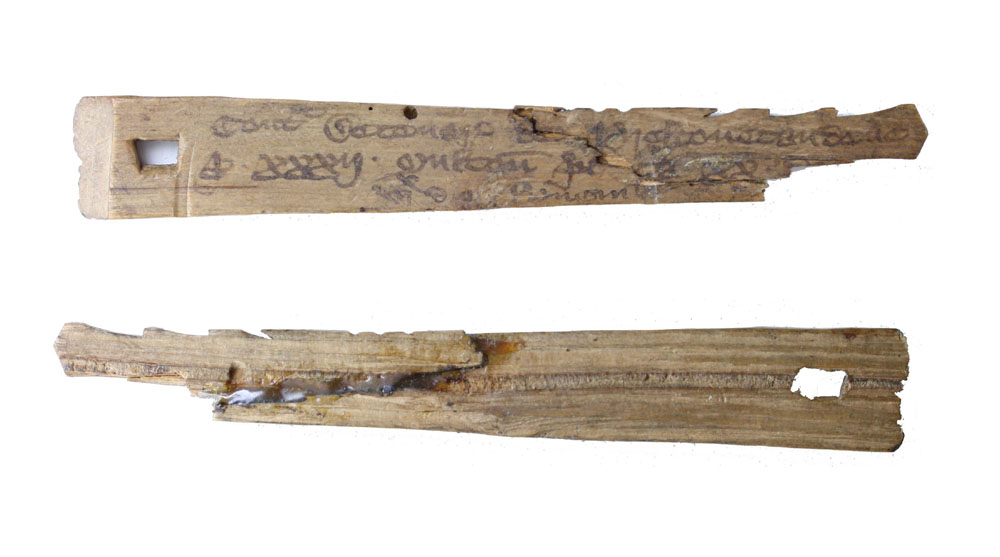

To obtain what they do not have, humans have devised many means. Only one of them is called “buying”.
What money is for
The economy is the way in which a human group produces what it needs, distributes it among its members, and decides what is worth doing. Every society settles these three questions, with or without money.
Where money exists, it performs three distinct roles, and it is worth keeping them apart, because an object can perform one without the others.
- It is used to compare. Without money, you have to ask how many sacks of wheat a goat is worth, how many pots a sack of wheat is worth, and so on for every pair. With it, everything comes down to a single scale. The gain is enormous, and yet it is the least spectacular of the three roles.
- It is used to exchange. It spares you the need to find someone who owns exactly what you want and who wants exactly what you have.
- It is used to store. You can keep it for later, which is impossible with milk or fish.1
Textbooks often add a fourth, the one that most concerns this page: it is used to defer. It makes it possible to agree today on a payment that will take place in a year’s time — and therefore to lend, to borrow, to go into debt. Without a common unit recognised in advance, a promise expressed in figures makes no sense.
The third role, storing, explains the form that money took for millennia. It needed to be a durable object, hard to imitate, easy to carry, and divisible without losing its value. Metals meet these conditions; shells, salt, livestock or copper bars have met them elsewhere.
But the value of a currency does not come from the material it is made of. A banknote is worth nothing in itself. A gold coin was worth barely more than its metal. What gives a currency its value is that everyone is convinced that others will accept it — a shared trust, usually guaranteed by an authority that mints, prints or records.2
That is why the real subject of this page is not money, but what makes exchange possible between people who do not know one another. Money is one answer to this problem. It is neither the first nor the only one.
The story that is usually told
It is simple and widespread.
In the beginning, it is said, people exchanged one object for another: three fish for a pot. This is called barter. But barter is inconvenient: you have to find someone who wants precisely those fish and who has precisely a pot. Money was then supposedly invented to solve this difficulty.
This story has an author and a date. It was written in 1776 by a Scottish scholar, Adam Smith, in a book on the wealth of nations. He was not recounting what he had seen: he was imagining what must have happened.3
Since then, the question has been studied. A Cambridge anthropologist, Caroline Humphrey, made a close study of barter among a Himalayan people, the Lhomi. Her conclusion, in 1985: no society living solely by barter has ever been described, still less a currency that emerged from one.4
This does not mean that barter does not exist. It does, but mainly between people who do not know one another, or among people who are used to money but find themselves without it. Within a group, something else happens.
What really happens: people give, and people owe
On the northwest coast of North America, among the Kwakwaka’wakw, the Haida and their neighbours, there is a ceremony founded on giving: the potlatch. It marks a marriage, the passing on of a title, the naming of a child.
Whoever gives a great deal rises in rank. Whoever receives must give in turn. It is neither trade nor charity, but a system, with its own rules.
One fact shows that this was not mere folklore. The government of Canada banned it. The law came into force on 1 January 1885, and it would not be repealed until 1951. For sixty-six years, taking part in a potlatch was an offence. People were arrested, sometimes for dancing.5
So a state judged this form of exchange threatening enough to outlaw it.
The story is, however, more complex than “the settlers against the others”: a significant number of Indigenous people themselves asked for the ban. The law was poorly enforced, partly because it was poorly drafted.6
The potlatch survived in secret. Today, it is once again held openly, and it has been growing since the 1970s. Among the Haida, it serves as the foundation of law.
Remembering what is owed
Giving and owing require keeping track of what is owed. The oldest known written texts, in Mesopotamia, are neither poems nor laws: they are, for the most part, accounts. They record quantities and debts.7
Debt was no light matter. In Mesopotamia, a family that could not repay gave up its fields, then its members. In Athens, before the reforms of Solon, the poor farmed the land of the rich in return for a share of the harvest; anyone who did not pay could be seized and end up enslaved along with their family.8
Kings sometimes wiped the slate clean. The debt tablets were then handed back to be broken, those who were working to repay were freed, and land was returned. The edict of a king of Babylon named Ammisaduqa is the only one whose text has come down to us almost complete. It even anticipates the tricks designed to get round it.9
Two clarifications are needed, because this is where the fine story ends.
These edicts did not free everyone. People bought as slaves, often women captured in war, were not freed: they were returned to their former owners. What was restored was the previous situation, not everyone’s freedom.10
It had to be done again several times — a sign that the problem had not been solved.
Trusting someone you do not know
This is the real problem of trade, and it is this problem that money solves.
Between strangers, metal has to be weighed, checked to ensure it has not been adulterated, argued over. The coin settles the question at a stroke: a weight of metal, an official mark that guarantees that weight. You can then count instead of weigh, and put your scales away.
This invention was not made just once. Specialists consider that the first coins were minted in three regions of the world: China, Lydia — in Anatolia — and India. Three different techniques: three solutions to the same problem.11
In Lydia, pieces of an alloy of gold and silver were stamped. In India, sheets of silver were cut into small pieces, punch-marked with five small symbols. In China, coins in the shape of spades were cast.12
And the workshop has been found. At Guanzhuang, in Henan, archaeologists excavated a bronze foundry, found coin moulds there and carbon-dated it: it began minting coins between 640 and 550 BCE. It is the oldest minting workshop in the world whose date is securely established.13
Two details are worth noting. First, the foundry had existed for a century and a half before it turned to coins: it made ritual vessels, weapons, tools. No workshop was built to invent money; it was an existing workshop that took it up.14
Second, the moulds found are almost all identical, made using a measuring instrument. So this was not an isolated experiment: it was controlled mass production. From the outset, what matters is not the coin, but the fact that they are all alike.15
Paper, more delicate than it seems
In Sichuan, China, iron coins were used. A thousand coins weighed about a dozen kilograms, and four times as many were needed to buy a piece of silk. Trading while carrying one’s money was impossible.
Merchant houses then began issuing paper receipts: you deposited your coins in one place, took away a piece of paper, and could settle your purchase elsewhere without carrying the metal. Sixteen of the largest joined forces so that these papers would be uniform and recognised.
Then several of these houses issued more paper than they held in coin. They could no longer pay out. They went bankrupt, and trade in the region was thrown into disorder.
It was at this point, in 1023, that the state took over the business: it relaunched the notes and opened offices where they could be exchanged for coins. The world’s first paper money was therefore born not of a brilliant idea, but of a bankruptcy. Later, the state itself would print too much of it.16
One point still holds true today: a banknote is not a piece of paper that replaces coins. It is a piece of paper to which someone attaches a promise. The whole question is whether you believe that promise.
A shell is not a curiosity
Books often show curious currencies: shells, salt, iron bars. The image is appealing.
One of them deserves close examination. The cowrie is a small shell gathered in the Maldives, in the Indian Ocean. It served as currency in West Africa for centuries.17
This was no village currency. European merchants shipped them to West Africa by the boatload: more than ten billion shells for the Dutch and the English alone, before the end of the eighteenth century (the years 1700 to 1799). The historians who have studied this trade call the cowrie “the shell money of the slave trade”.
In other words: these shells were used to buy human beings.
A currency is never just a picturesque object. You must always ask what it was used to buy.
Arranging to meet
To exchange, people have to be in the same place on the same day. This detail gave rise to calendars.
Among the Igbo, in southeastern Nigeria, the week has four days, and these days are market days.18
Neighbouring villages do not hold their market on the same day: they share out the four days of the cycle among themselves. There is thus a market somewhere every day, and traders keep moving without ever stopping.
Here, the calendar does not come from the sky. It follows neither the Sun nor the Moon: it follows trade. This four-day week still exists, alongside the seven-day week.
And taxation
A state that wants to levy taxes needs the population to have the currency in which it levies them.
In several African colonies, European administrations introduced a tax on dwellings (such as the British Hut Tax), which had to be paid in colonial currency. Many families did not have this currency and had no use for it. To obtain it, they had to go and work for a wage: in the mines, on a plantation, on a building site.19
Historians still debate how effective this system really was. What is certain is that it was deliberate.20
Today
In Kenya, in 2007, a mobile phone operator launched M-Pesa, a service that makes it possible to send money by text message, without a bank account. Within a few years, the great majority of Kenyan households were using it.21
The country soon had more than twenty thousand points where money could be deposited and withdrawn. And these points are not banks but grocery shops, petrol stations and mobile phone shops.22
Two things must be distinguished. The technology was developed by a British company. But it was in Kenya, and nowhere else, that it became a mass practice. The origin of an invention and the place where it takes root are two different questions.
At the end of this long road, this is what remains: people send each other money without seeing one another, trusting the local grocer and a company. Trust and a written record — exactly what this page began with.
Note 1
First, money serves as a medium of exchange […] Second, money must serve as a store of value. Third, money serves as a unit of account […] Finally, another function of money is that it must serve as a standard of deferred payment.
Greenlaw, Steven A. and Shapiro, David, Principles of Economics, OpenStax, chapitre “Defining Money by Its Functions”
Note 2
Fiat money has no intrinsic value, but is declared by a government to be a country's legal tender. […] The only backing of our money is universal faith and trust that the currency has value, and nothing more.
Greenlaw, Steven A. and Shapiro, David, Principles of Economics, OpenStax, chapitre “Defining Money by Its Functions”
Note 3
But when the division of labour first began to take place, this power of exchanging must frequently have been very much clogged and embarrassed in its operations.
Smith, Adam, An Inquiry into the Nature and Causes of the Wealth of Nations, Londres, 1776, livre I, chap. 4
Note 4
Its whole substance consists of a very detailed study of a single contemporary population: the Lhomi in the Himalayas.
Ganev, Georgy, “Has the Barter Theory of the Origins of Money Been Rejected?”, MPRA Paper no. 124237, Munich Personal RePEc Archive, 2025
No example of a barter economy, pure and simple, has ever been described, let alone the emergence from it of money; all available ethnography suggests that there never has been such a thing.
Ganev, Georgy, “Has the Barter Theory of the Origins of Money Been Rejected?”, MPRA Paper no. 124237, Munich Personal RePEc Archive, 2025
Note 5
From 1885 to 1951, the Indigenous ceremony known as the Potlatch was banned by the federal government of Canada. […] Though the Potlatch was illegal during this period of time, the ban was only ever sporadically enforced.
Noakes, Taylor C., “Potlatch Ban”, The Canadian Encyclopedia, 2023
From 1885 to 1951, the Indigenous ceremony known as the Potlatch was banned by the federal government of Canada.
Noakes, Taylor C., “Potlatch Ban”, The Canadian Encyclopedia, 2023
Note 6
Though the Potlatch was illegal during this period of time, the ban was only ever sporadically enforced. This was in part a result of the vagueness of the wording of the law.
Noakes, Taylor C., “Potlatch Ban”, The Canadian Encyclopedia, 2023
This restraint is interesting, given that a significant number of Indians had petitioned in favour of the potlatch law and continued to support it.
Foster, Hamar, review of Cole, Douglas and Chaikin, Ira, An Iron Hand upon the People, BC Studies, no. 91-92, 1991-1992, pp. 218-224
Note 7
This system of proto-writing, which is probably the oldest one and, at the same time, the only one that is documented by an abundance of preserved original texts, shows a number of characteristics […] The reason for this is, of course, that most of them are bookkeeping documents, representing activities of economic administration rather than stories, arguments or descriptions. The only texts that do not reflect administrative activities are those that are generally classified as school texts, primarily lexical lists.
Damerow, Peter, “The Origins of Writing as a Problem of Historical Epistemology”, Cuneiform Digital Library Journal, 2006:1
Note 8
the poor themselves and also their wives and children were actually in slavery to the rich; and they were called Clients, and Sixth-part-tenants (for that was the rent they paid for the rich men's land which they farmed, and the whole of the country was in few hands), and if they ever failed to pay their rents, they themselves and their children were liable to arrest; and all borrowing was on the security of the debtors' persons down to the time of Solon
Aristote, Constitution d’Athènes, chap. 2-12
Note 9
Ammi-saduqa’s is the only misharum edict for which the (almost) complete text survives.
“Ammi-saduqa”, World Eras, Gale, online at Encyclopedia.com
Note 10
A recurring and illustrative example is the release from debt-slavery through royal decrees; some former free-persons bound in debt-bondage were manumitted, whilst house-born slaves were expressly excluded in the edicts from the royal manumission.
Gaertner, Lorraine, The Motives for the Mēšarum Edict of King Ammiṣaduqa of the Old Babylonian Period: Ethics, Ego or Economics?, MPhil thesis (Ancient Cultures), Stellenbosch University, 2008
L'un des instruments de la justice était l'andurârum, qu'il faut comprendre comme le « retour au statut d'origine » : cette mesure royale annulait les dettes, permettait aux vendeurs de récupérer leurs terres, etc. […] Il ne s'agissait pas de mesures de « progrès social » : rien de plus étranger au monde mésopotamien que la réforme au sens des réformistes modernes.
One of the instruments of justice was the andurārum, which must be understood as the “return to the original status”: this royal measure cancelled debts, allowed sellers to recover their land, and so on. […] These were not measures of “social progress”: nothing was more foreign to the Mesopotamian world than reform in the sense of modern reformers.
Charpin, Dominique, “La justice : l’andurârum, retour à la situation d’origine”, lecture series « Depuis ce jour, plus rien n’a été inventé ». Aux origines de la civilisation en Mésopotamie, Collège de France, 21 February 2022
Note 11
The earliest coins are thought to have been minted in China, Lydia (in Western Asia Minor) and India.
Zhao, Hao et al., “Radiocarbon-dating an Early Minting Site: The Emergence of Standardised Coinage in China”, Antiquity, vol. 95, no. 383, 2021, p. 1161-1178
Note 12
The earliest coins are simple electrum (a naturally occurring alloy of gold and silver found in the rivers of central Asia Minor) lumps with regular weights and a pattern of lines impressed upon them on one side and an incuse depression or series of depressions on the back. […] The first coinage that can be identified with a kingdom comes from Lydia in central Asia Minor. Lydian coins feature the head of a lion, the heraldic badge of the ruling dynasty.
American Numismatic Association, Money Museum, “Lydia & the First Coins”, virtual exhibition
The most-commonly encountered punch-marked coins were often made from cut-up sheets of silver, hence their rectangular shape, and were stamped with five small symbols (Fig. 1).
Cribb, Joe, “The Origins of the Indian Coinage Tradition”, South Asian Studies, vol. 19, 2003, p. 1-19
Note 13
Recent excavations of an Eastern Zhou period (c. 770–220 BC) bronze foundry at Guanzhuang in Henan Province, China, have yielded clay moulds for casting spade coins. […] Systematic AMS radiocarbon-dating indicates that well-organised minting developed c. 640–550 BC
Zhao, Hao et al., “Radiocarbon-dating an Early Minting Site: The Emergence of Standardised Coinage in China”, Antiquity, vol. 95, no. 383, 2021, p. 1161-1178
making Guanzhuang the world's oldest-known, securely dated minting site.
Zhao, Hao et al., “Radiocarbon-dating an Early Minting Site: The Emergence of Standardised Coinage in China”, Antiquity, vol. 95, no. 383, 2021, p. 1161-1178
Note 14
its foundry—where bronze was cast and beaten into ritual vessels, weapons, and tools—opened in 770 B.C., according to Hao Zhao, an archaeologist at Zhengzhou University and the paper’s lead author. But it wasn’t for another 150 years that workers began minting coins outside the southern gate of the inner city.
Kramer, Jillian, “’World’s oldest’ coin factory discovered in China”, National Geographic, 5 August 2021
Note 15
The minting techniques employed at Guanzhuang are characterised by batch production and a high degree of standardisation and quality control, indicating that the production of spade coins was not a small-scale, sporadic experiment
Zhao, Hao et al., “Radiocarbon-dating an Early Minting Site: The Emergence of Standardised Coinage in China”, Antiquity, vol. 95, no. 383, 2021, p. 1161-1178
Note 16
Consequently, heavy Sichuan iron coins were deposited in bulk in return for promissory notes that had since been issued and regulated by sixteen of the wealthiest families in the region.⁴ […] Indeed, China's experience with paper money could have been a very short one if the newly-appointed Chengdu prefect, Xue Tian 薛田, had not decided to re-instate jiaozi as a public-order currency in 1023, and to set up provincial exchange bureaus to administer the conversion between jiaozi and metallic currencies for a modest commission of 3%.
Horesh, Niv, “From Chengdu to Stockholm: A Comparative Study of the Emergence of Paper Money in East and West”, Provincial China, vol. 4, no. 1, 2012, p. 68-99
Critically, note regulation was taken over by officialdom once the Song had firmly asserted its authority in the Southwest. […] Indeed, China's experience with paper money could have been a very short one if the newly-appointed Chengdu prefect, Xue Tian 薛田, had not decided to re-instate jiaozi as a public-order currency in 1023, and to set up provincial exchange bureaus to administer the conversion between jiaozi and metallic currencies for a modest commission of 3%.
Horesh, Niv, “From Chengdu to Stockholm: A Comparative Study of the Emergence of Paper Money in East and West”, Provincial China, vol. 4, no. 1, 2012, p. 68-99
Note 17
They are the shells of a mollusc found only in certain areas around the Maldives and other Indian Ocean islands. When European traders realized how valued these shells were in Africa, they imported them in vast quantities to trade for slaves and other goods across the continent.
Understanding Slavery Initiative, “Cowrie-shell belt”, object entry (Bristol Museums, Galleries & Archives, E1545)
Note 18
They also operated on the four traditional markets days, namely: Eke, Oye, Afor and Nkwo. Each of these markets was held on a rotational four-day basis known as Izu […] (the Igbo word for the traditional week).
Chuks-Ezekwibe, Ogechukwu M. and Chukwu, Dan O., “Markets and its Origin in Onitsha before 1900”, Ochendo: An African Journal of Innovative Studies, vol. 4, no. 4, 2023, pp. 317-330
Note 19
In the European colonies, land expropriation and forced labor were used, but another important means of forcing indigenous populations to work as wage-laborers or produce cash crops was taxation and the requirement that taxes be paid in colonial currency.
Forstater, Mathew, “Taxation and Primitive Accumulation: The Case of Colonial Africa”, Research in Political Economy, vol. 22, 2005, p. 51-64
Note 20
In East Africa to secure local labour the colonial government introduced a hut tax were to force Africans to seek waged employment on German plantations, often far away from their household farms.
Meier zu Selhausen, Felix, “German Colonialism in Africa and the Pacific, 1884-1914”, African Economic History Working Paper no. 80, African Economic History Network, 2025
Various scholars have questioned the often-stated migrant labour-taxation causal nexus. They have rejected the overworked stereotype that Africans entered labour service to pay taxes, obtain more livestock and marry more wives. […] In the case of Kenya, Sharon Stichter in Migrant Labour in Kenya, and Van Zwanenberg, in Colonial Capitalism in Kenya, have also cautioned about overstating the role of taxation in compelling the acceptance of migrant wage labour.10
Tarus, Isaac, “Taxation, Migration and the Creation of a Working Class in Kenya”, Africa Development, vol. 30, no. 4, CODESRIA, 2005, p. 121-138
Note 21
In March 2007, the leading cell phone company in Kenya, Safaricom, formalized this procedure with the launch of M-PESA, an SMS-based money transfer system that allows individuals to deposit, send, and withdraw funds using their cell phone. M-PESA has grown rapidly, reaching approximately 65 percent of Kenyan households by the end of 2009, and is widely viewed as a success story to be emulated across the developing world.
Jack, William and Suri, Tavneet, “Mobile Money: The Economics of M-PESA”, NBER Working Paper no. 16721, 2011
Note 22
To facilitate purchases and sales of e-float, M-PESA maintains and operates an extensive network of over 23,000 agents across Kenya.
Jack, William and Suri, Tavneet, “Mobile Money: The Economics of M-PESA”, NBER Working Paper no. 16721, 2011
Notes and sources
- ↑
Passage It is used to compare […] to exchange […] to store […] it is used to defer
First, money serves as a medium of exchange […] Second, money must serve as a store of value. Third, money serves as a unit of account […] Finally, another function of money is that it must serve as a standard of deferred payment.
Source Greenlaw, Steven A. and Shapiro, David, Principles of Economics, OpenStax, chapitre “Defining Money by Its Functions”, section 27.1 “Defining Money by Its Functions”.
Open access open the source · checked on 9 September 2026
- ↑
Passage A banknote is worth nothing in itself […] What gives a currency its value is that everyone is convinced that others will accept it
Fiat money has no intrinsic value, but is declared by a government to be a country's legal tender. […] The only backing of our money is universal faith and trust that the currency has value, and nothing more.
Source Greenlaw, Steven A. and Shapiro, David, Principles of Economics, OpenStax, chapitre “Defining Money by Its Functions”, section 27.1 “Defining Money by Its Functions”.
Open access open the source · checked on 9 September 2026
- ↑
Passage It was written in 1776 by a Scottish scholar, Adam Smith […] He was not recounting what he had seen: he was imagining what must have happened.
But when the division of labour first began to take place, this power of exchanging must frequently have been very much clogged and embarrassed in its operations.
Source Smith, Adam, An Inquiry into the Nature and Causes of the Wealth of Nations, Londres, 1776, livre I, chap. 4, book I, chapter 4 “Of the Origin and Use of Money”, beginning of the chapter.
Public domain open the source · checked on 9 September 2026
- ↑
Passage A Cambridge anthropologist, Caroline Humphrey, made a close study of barter among a Himalayan people, the Lhomi.
Its whole substance consists of a very detailed study of a single contemporary population: the Lhomi in the Himalayas.
Source Ganev, Georgy, “Has the Barter Theory of the Origins of Money Been Rejected?”, MPRA Paper no. 124237, Munich Personal RePEc Archive, 2025, p. 11, § V (Va, “The absence of evidence”), on Humphrey (1985).
Open access open the source · checked on 28 October 2026
Passage Her conclusion, in 1985: no society living solely by barter has ever been described, still less a currency that emerged from one.
No example of a barter economy, pure and simple, has ever been described, let alone the emergence from it of money; all available ethnography suggests that there never has been such a thing.
Source Ganev, Georgy, “Has the Barter Theory of the Origins of Money Been Rejected?”, MPRA Paper no. 124237, Munich Personal RePEc Archive, 2025, p. 8, § III, block quotation from Humphrey (1985, p. 48).
Open access open the source · checked on 27 October 2026
- ↑
Passage The government of Canada banned it […] For sixty-six years, taking part in a potlatch was an offence.
From 1885 to 1951, the Indigenous ceremony known as the Potlatch was banned by the federal government of Canada. […] Though the Potlatch was illegal during this period of time, the ban was only ever sporadically enforced.
Source Noakes, Taylor C., “Potlatch Ban”, The Canadian Encyclopedia, 2023, introduction (standfirst of the article, before the subheading “Potlatch”).
Open access open the source · checked on 24 October 2026
Passage The government of Canada banned it. The law came into force on 1 January 1885, and it would not be repealed until 1951.
From 1885 to 1951, the Indigenous ceremony known as the Potlatch was banned by the federal government of Canada.
Source Noakes, Taylor C., “Potlatch Ban”, The Canadian Encyclopedia, 2023, introduction (standfirst of the article).
Open access open the source · checked on 24 October 2026
- ↑
Passage The law was poorly enforced, partly because it was poorly drafted.
Though the Potlatch was illegal during this period of time, the ban was only ever sporadically enforced. This was in part a result of the vagueness of the wording of the law.
Source Noakes, Taylor C., “Potlatch Ban”, The Canadian Encyclopedia, 2023, introduction (lead of the article, before the “Potlatch” heading).
Open access open the source · checked on 27 October 2026
Passage a significant number of Indigenous people themselves asked for the ban
This restraint is interesting, given that a significant number of Indians had petitioned in favour of the potlatch law and continued to support it.
Source Foster, Hamar, review of Cole, Douglas and Chaikin, Ira, An Iron Hand upon the People, BC Studies, no. 91-92, 1991-1992, pp. 218-224, p. 222.
Open access open the source · checked on 27 October 2026
- ↑
Passage The oldest known written texts, in Mesopotamia, are neither poems nor laws: they are, for the most part, accounts.
This system of proto-writing, which is probably the oldest one and, at the same time, the only one that is documented by an abundance of preserved original texts, shows a number of characteristics […] The reason for this is, of course, that most of them are bookkeeping documents, representing activities of economic administration rather than stories, arguments or descriptions. The only texts that do not reflect administrative activities are those that are generally classified as school texts, primarily lexical lists.
Source Damerow, Peter, “The Origins of Writing as a Problem of Historical Epistemology”, Cuneiform Digital Library Journal, 2006:1, § 4.1 and § 5 (“Proto-cuneiform does not match the syntax of oral language”).
Open access open the source · checked on 27 October 2026
- ↑
Passage In Athens, before the reforms of Solon, the poor farmed the land of the rich in return for a share of the harvest; anyone who did not pay could be seized and end up enslaved along with their family.
the poor themselves and also their wives and children were actually in slavery to the rich; and they were called Clients, and Sixth-part-tenants (for that was the rent they paid for the rich men's land which they farmed, and the whole of the country was in few hands), and if they ever failed to pay their rents, they themselves and their children were liable to arrest; and all borrowing was on the security of the debtors' persons down to the time of Solon
Source Aristote, Constitution d’Athènes, chap. 2-12, Chapter 2, § 2.
Public domain open the source · checked on 24 October 2026
- ↑
Passage The edict of a king of Babylon named Ammisaduqa is the only one whose text has come down to us almost complete.
Ammi-saduqa’s is the only misharum edict for which the (almost) complete text survives.
Source “Ammi-saduqa”, World Eras, Gale, online at Encyclopedia.com, entry “Ammi-saduqa”, paragraph on the misharum edict.
Open access open the source · checked on 27 October 2026
- ↑
Passage These edicts did not free everyone.
A recurring and illustrative example is the release from debt-slavery through royal decrees; some former free-persons bound in debt-bondage were manumitted, whilst house-born slaves were expressly excluded in the edicts from the royal manumission.
Source Gaertner, Lorraine, The Motives for the Mēšarum Edict of King Ammiṣaduqa of the Old Babylonian Period: Ethics, Ego or Economics?, MPhil thesis (Ancient Cultures), Stellenbosch University, 2008, pp. 16-17, § 2.3 (“The Concept of Social Justice”).
Open access open the source · checked on 27 October 2026
Passage What was restored was the previous situation, not everyone’s freedom.
L'un des instruments de la justice était l'andurârum, qu'il faut comprendre comme le « retour au statut d'origine » : cette mesure royale annulait les dettes, permettait aux vendeurs de récupérer leurs terres, etc. […] Il ne s'agissait pas de mesures de « progrès social » : rien de plus étranger au monde mésopotamien que la réforme au sens des réformistes modernes.
Editors’ translation One of the instruments of justice was the andurārum, which must be understood as the “return to the original status”: this royal measure cancelled debts, allowed sellers to recover their land, and so on. […] These were not measures of “social progress”: nothing was more foreign to the Mesopotamian world than reform in the sense of modern reformers.
Source Charpin, Dominique, “La justice : l’andurârum, retour à la situation d’origine”, lecture series « Depuis ce jour, plus rien n’a été inventé ». Aux origines de la civilisation en Mésopotamie, Collège de France, 21 February 2022, lecture summary (under “Lecture audio”).
Open access open the source · checked on 27 October 2026
- ↑
Passage the first coins were minted in three regions of the world: China, Lydia — in Anatolia — and India
The earliest coins are thought to have been minted in China, Lydia (in Western Asia Minor) and India.
Source Zhao, Hao et al., “Radiocarbon-dating an Early Minting Site: The Emergence of Standardised Coinage in China”, Antiquity, vol. 95, no. 383, 2021, p. 1161-1178, introduction of the article.
Paywalled open the source · checked on 9 September 2026
- ↑
Passage In Lydia, pieces of an alloy of gold and silver were stamped.
The earliest coins are simple electrum (a naturally occurring alloy of gold and silver found in the rivers of central Asia Minor) lumps with regular weights and a pattern of lines impressed upon them on one side and an incuse depression or series of depressions on the back. […] The first coinage that can be identified with a kingdom comes from Lydia in central Asia Minor. Lydian coins feature the head of a lion, the heraldic badge of the ruling dynasty.
Source American Numismatic Association, Money Museum, “Lydia & the First Coins”, virtual exhibition, page text, 1st paragraph (before the “Did You Know?” box).
Open access open the source · checked on 27 October 2026
Passage In India, sheets of silver were cut into small pieces, punch-marked with five small symbols.
The most-commonly encountered punch-marked coins were often made from cut-up sheets of silver, hence their rectangular shape, and were stamped with five small symbols (Fig. 1).
Source Cribb, Joe, “The Origins of the Indian Coinage Tradition”, South Asian Studies, vol. 19, 2003, p. 1-19, section “The Indian coinage tradition”, p. 2.
Paywalled · checked on 25 October 2026
- ↑
Passage At Guanzhuang, in Henan, archaeologists excavated a bronze foundry, found coin moulds there and carbon-dated it: it began minting coins between 640 and 550 BCE.
Recent excavations of an Eastern Zhou period (c. 770–220 BC) bronze foundry at Guanzhuang in Henan Province, China, have yielded clay moulds for casting spade coins. […] Systematic AMS radiocarbon-dating indicates that well-organised minting developed c. 640–550 BC
Source Zhao, Hao et al., “Radiocarbon-dating an Early Minting Site: The Emergence of Standardised Coinage in China”, Antiquity, vol. 95, no. 383, 2021, p. 1161-1178, abstract.
Paywalled open the source · checked on 9 September 2026
Passage It is the oldest minting workshop in the world whose date is securely established.
making Guanzhuang the world's oldest-known, securely dated minting site.
Source Zhao, Hao et al., “Radiocarbon-dating an Early Minting Site: The Emergence of Standardised Coinage in China”, Antiquity, vol. 95, no. 383, 2021, p. 1161-1178, abstract.
Paywalled open the source · checked on 9 September 2026
- ↑
Passage the foundry had existed for a century and a half before it turned to coins: it made ritual vessels, weapons, tools
its foundry—where bronze was cast and beaten into ritual vessels, weapons, and tools—opened in 770 B.C., according to Hao Zhao, an archaeologist at Zhengzhou University and the paper’s lead author. But it wasn’t for another 150 years that workers began minting coins outside the southern gate of the inner city.
Source Kramer, Jillian, “’World’s oldest’ coin factory discovered in China”, National Geographic, 5 August 2021, body of the article.
Open access open the source · checked on 9 September 2026
- ↑
Passage the moulds found are almost all identical, made using a measuring instrument […] it was controlled mass production
The minting techniques employed at Guanzhuang are characterised by batch production and a high degree of standardisation and quality control, indicating that the production of spade coins was not a small-scale, sporadic experiment
Source Zhao, Hao et al., “Radiocarbon-dating an Early Minting Site: The Emergence of Standardised Coinage in China”, Antiquity, vol. 95, no. 383, 2021, p. 1161-1178, the authors’ conclusion.
Paywalled open the source · checked on 9 September 2026
- ↑
Passage In Sichuan, China, iron coins were used […] the state took over the business: it relaunched the notes and opened offices where they could be exchanged for coins.
Consequently, heavy Sichuan iron coins were deposited in bulk in return for promissory notes that had since been issued and regulated by sixteen of the wealthiest families in the region.⁴ […] Indeed, China's experience with paper money could have been a very short one if the newly-appointed Chengdu prefect, Xue Tian 薛田, had not decided to re-instate jiaozi as a public-order currency in 1023, and to set up provincial exchange bureaus to administer the conversion between jiaozi and metallic currencies for a modest commission of 3%.
Source Horesh, Niv, “From Chengdu to Stockholm: A Comparative Study of the Emergence of Paper Money in East and West”, Provincial China, vol. 4, no. 1, 2012, p. 68-99, p. 70, then p. 71-72.
Open access open the source · checked on 27 October 2026
Passage in 1023, that the state took over the business: it relaunched the notes and opened offices where they could be exchanged for coins
Critically, note regulation was taken over by officialdom once the Song had firmly asserted its authority in the Southwest. […] Indeed, China's experience with paper money could have been a very short one if the newly-appointed Chengdu prefect, Xue Tian 薛田, had not decided to re-instate jiaozi as a public-order currency in 1023, and to set up provincial exchange bureaus to administer the conversion between jiaozi and metallic currencies for a modest commission of 3%.
Source Horesh, Niv, “From Chengdu to Stockholm: A Comparative Study of the Emergence of Paper Money in East and West”, Provincial China, vol. 4, no. 1, 2012, p. 68-99, p. 70, then p. 71-72.
Open access open the source · checked on 25 October 2026
- ↑
Passage The cowrie is a small shell gathered in the Maldives […] these shells were used to buy human beings.
They are the shells of a mollusc found only in certain areas around the Maldives and other Indian Ocean islands. When European traders realized how valued these shells were in Africa, they imported them in vast quantities to trade for slaves and other goods across the continent.
Source Understanding Slavery Initiative, “Cowrie-shell belt”, object entry (Bristol Museums, Galleries & Archives, E1545), object entry (cowrie-shell belt, Bristol Museums, Galleries & Archives, E1545), 2nd and 3rd sentences.
Open access open the source · checked on 27 October 2026
- ↑
Passage Among the Igbo, in southeastern Nigeria, the week has four days, and these days are market days.
They also operated on the four traditional markets days, namely: Eke, Oye, Afor and Nkwo. Each of these markets was held on a rotational four-day basis known as Izu […] (the Igbo word for the traditional week).
Source Chuks-Ezekwibe, Ogechukwu M. and Chukwu, Dan O., “Markets and its Origin in Onitsha before 1900”, Ochendo: An African Journal of Innovative Studies, vol. 4, no. 4, 2023, pp. 317-330, p. 319.
Open access open the source · checked on 27 October 2026
- ↑
Passage European administrations introduced a tax […] which had to be paid in colonial currency
In the European colonies, land expropriation and forced labor were used, but another important means of forcing indigenous populations to work as wage-laborers or produce cash crops was taxation and the requirement that taxes be paid in colonial currency.
Source Forstater, Mathew, “Taxation and Primitive Accumulation: The Case of Colonial Africa”, Research in Political Economy, vol. 22, 2005, p. 51-64, abstract.
Paywalled · checked on 9 September 2026
- ↑
Passage What is certain is that it was deliberate.
In East Africa to secure local labour the colonial government introduced a hut tax were to force Africans to seek waged employment on German plantations, often far away from their household farms.
Source Meier zu Selhausen, Felix, “German Colonialism in Africa and the Pacific, 1884-1914”, African Economic History Working Paper no. 80, African Economic History Network, 2025, p. 12, § 4 (“Financing the German colonial state”).
Open access open the source · checked on 27 October 2026
Passage Historians still debate how effective this system really was.
Various scholars have questioned the often-stated migrant labour-taxation causal nexus. They have rejected the overworked stereotype that Africans entered labour service to pay taxes, obtain more livestock and marry more wives. […] In the case of Kenya, Sharon Stichter in Migrant Labour in Kenya, and Van Zwanenberg, in Colonial Capitalism in Kenya, have also cautioned about overstating the role of taxation in compelling the acceptance of migrant wage labour.10
Source Tarus, Isaac, “Taxation, Migration and the Creation of a Working Class in Kenya”, Africa Development, vol. 30, no. 4, CODESRIA, 2005, p. 121-138, abstract (p. 121), then p. 125.
Open access open the source · checked on 27 October 2026
- ↑
Passage In Kenya, in 2007, a mobile phone operator launched M-Pesa […] Within a few years, the great majority of Kenyan households were using it.
In March 2007, the leading cell phone company in Kenya, Safaricom, formalized this procedure with the launch of M-PESA, an SMS-based money transfer system that allows individuals to deposit, send, and withdraw funds using their cell phone. M-PESA has grown rapidly, reaching approximately 65 percent of Kenyan households by the end of 2009, and is widely viewed as a success story to be emulated across the developing world.
Source Jack, William and Suri, Tavneet, “Mobile Money: The Economics of M-PESA”, NBER Working Paper no. 16721, 2011, section I, “Introduction”, third paragraph (two consecutive sentences).
Open access open the source · checked on 24 October 2026
- ↑
Passage The country soon had more than twenty thousand points where money could be deposited and withdrawn.
To facilitate purchases and sales of e-float, M-PESA maintains and operates an extensive network of over 23,000 agents across Kenya.
Source Jack, William and Suri, Tavneet, “Mobile Money: The Economics of M-PESA”, NBER Working Paper no. 16721, 2011, section II “Context”, subsection “How does M-PESA work”.
Open access open the source · checked on 24 October 2026
Bibliography
31
- American Numismatic Association, Money Museum, “Lydia & the First Coins”, virtual exhibition, open access (the first electrum coins and Lydian coinage). https://www.money.org/money-museum/virtual-exhibits-hom-case1/
- “Ammi-saduqa”, World Eras, Gale, online at Encyclopedia.com, open access (the only misharum edict whose almost complete text survives). https://encyclopedia.com/history/news-wires-white-papers-and-books/ammi-saduqa
- Aristote, Constitution d’Athènes, chap. 2-12, public domain (debts before Solon and their cancellation).
- Charpin, Dominique, “La justice : l’andurârum, retour à la situation d’origine”, lecture series « Depuis ce jour, plus rien n’a été inventé ». Aux origines de la civilisation en Mésopotamie, Collège de France, 21 February 2022, open access (andurārum as a return to the original status, not social progress). https://www.college-de-france.fr/agenda/cours/depuis-ce-jour-plus-rien-ete-invente-aux-origines-de-la-civilisation-en-mesopotamie/la-justice-andurarum-retour-la-situation-origine
- Charpin, Dominique, “Les édits de "restauration" des rois babyloniens et leur application”, dans Nicolet, Claude (dir.), Du pouvoir dans l’Antiquité : mots et réalités, Droz, 1990, p. 13-24, in libraries (what these edicts cancelled and what they did not).
- Chuks-Ezekwibe, Ogechukwu M. and Chukwu, Dan O., “Markets and its Origin in Onitsha before 1900”, Ochendo: An African Journal of Innovative Studies, vol. 4, no. 4, 2023, pp. 317-330, open access (the four market days and the Igbo week, izu; markets named after their day). https://www.apas.africa/journal/OAAJIS_4_4_21.pdf
- Cole, Douglas and Chaikin, Ira, An Iron Hand upon the People: The Law Against the Potlatch on the Northwest Coast, Douglas & McIntyre, 1990, in libraries (the ban, its faulty drafting, the arrests, the repeal).
- Cribb, Joe, “The Origins of the Indian Coinage Tradition”, South Asian Studies, vol. 19, 2003, p. 1-19, paywalled (the punch-marked coins of northern India).
- Damerow, Peter, “The Origins of Writing as a Problem of Historical Epistemology”, Cuneiform Digital Library Journal, 2006:1, open access (proto-cuneiform, probably the oldest writing, was used mainly for bookkeeping). https://cdli.earth/articles/cdlj/2006-1
- Forstater, Mathew, “Taxation and Primitive Accumulation: The Case of Colonial Africa”, Research in Political Economy, vol. 22, 2005, p. 51-64, paywalled (colonial taxation payable in currency and the resort to wage labour).
- Foster, Hamar, review of Cole, Douglas and Chaikin, Ira, An Iron Hand upon the People, BC Studies, no. 91-92, 1991-1992, pp. 218-224, open access (a law long left undefined and seldom enforced; Indigenous supporters of the ban). https://doi.org/10.14288/bcs.v0i91/92.185830
- Gaertner, Lorraine, The Motives for the Mēšarum Edict of King Ammiṣaduqa of the Old Babylonian Period: Ethics, Ego or Economics?, MPhil thesis (Ancient Cultures), Stellenbosch University, 2008, open access (house-born slaves excluded from royal manumission). https://scholar.sun.ac.za/items/dca7cf13-9cff-4827-acd6-e29341f58a66
- Ganev, Georgy, “Has the Barter Theory of the Origins of Money Been Rejected?”, MPRA Paper no. 124237, Munich Personal RePEc Archive, 2025, open access (quotes verbatim the opening sentences of Humphrey’s 1985 article and discusses them). https://mpra.ub.uni-muenchen.de/124237/
- Graeber, David, Debt: The First 5,000 Years, Melville House, 2011, in libraries (the barter myth; ancient debts; colonial taxation). French translation: Dette. 5 000 ans d’histoire, Les Liens qui libèrent, 2013.
- Greenlaw, Steven A. and Shapiro, David, Principles of Economics, OpenStax, chapitre “Defining Money by Its Functions”, open access (the functions of money, including deferred payment; commodity money and fiat money). https://openstax.org/details/books/principles-economics-2e
- Hogendorn, Jan and Johnson, Marion, The Shell Money of the Slave Trade, Cambridge University Press, 1986, in libraries (the cowries of the Maldives, the volumes shipped to West Africa, and their use in the slave trade).
- Horesh, Niv, “From Chengdu to Stockholm: A Comparative Study of the Emergence of Paper Money in East and West”, Provincial China, vol. 4, no. 1, 2012, p. 68-99, open access (the sixteen merchant houses of Chengdu, their unredeemed notes, and the takeover of the jiaozi by the administration in 1023 with official bureaus). https://epress.lib.uts.edu.au/journals/index.php/provincial_china/article/view/2844
- Humphrey, Caroline, “Barter and Economic Disintegration”, Man, nouvelle série, vol. 20, no. 1, March 1985, p. 48-72, paywalled (no society of pure barter ever described).
- Jack, William and Suri, Tavneet, “Mobile Money: The Economics of M-PESA”, NBER Working Paper no. 16721, 2011, open access (the launch, the mass adoption, the deposit points compared with bank branches). https://www.nber.org/papers/w16721
- Kramer, Jillian, “’World’s oldest’ coin factory discovered in China”, National Geographic, 5 August 2021, open access (the Guanzhuang foundry, opened a century and a half before coins were minted there, and what it made before). https://www.nationalgeographic.com/history/article/worlds-oldest-coin-factory-discovered-in-china
- Kraus, Fritz Rudolf, Königliche Verfügungen in altbabylonischer Zeit, Brill, 1984, in libraries (the edict of Ammisaduqa, the only one preserved almost complete).
- Kroll, John H., “The Monetary Background of Early Coinage”, dans Metcalf, William E. (dir.), The Oxford Handbook of Greek and Roman Coinage, Oxford University Press, 2012, in libraries (Lydia and electrum).
- Meier zu Selhausen, Felix, “German Colonialism in Africa and the Pacific, 1884-1914”, African Economic History Working Paper no. 80, African Economic History Network, 2025, open access (the hut tax in German East Africa, introduced to push people into wage labour). https://aehnetwork.org/wp-content/uploads/2025/04/80_MzS.pdf
- Nissen, Hans J., Damerow, Peter and Englund, Robert K., Archaic Bookkeeping, University of Chicago Press, 1993, in libraries (the oldest written texts are accounts).
- Noakes, Taylor C., “Potlatch Ban”, The Canadian Encyclopedia, 2023, open access (the potlatch ban and its lifting). https://thecanadianencyclopedia.ca/en/article/potlatch-ban
- Smith, Adam, An Inquiry into the Nature and Causes of the Wealth of Nations, Londres, 1776, livre I, chap. 4, public domain (the account of barter and of the invention of money).
- Tarus, Isaac, “Taxation, Migration and the Creation of a Working Class in Kenya”, Africa Development, vol. 30, no. 4, CODESRIA, 2005, p. 121-138, open access (the debate among historians on the real role of colonial taxation in the move to wage labour). https://journals.codesria.org/index.php/ad/article/view/1917
- Uchendu, Victor C., The Igbo of Southeast Nigeria, Holt, Rinehart and Winston, 1965, in libraries (the four-day week and the rotating markets).
- Understanding Slavery Initiative, “Cowrie-shell belt”, object entry (Bristol Museums, Galleries & Archives, E1545), open access (Maldivian cowries imported by Europeans to buy slaves). https://understandingslavery.com/artefact/cowrie-shell-belt/
- Von Glahn, Richard, Fountain of Fortune: Money and Monetary Policy in China, 1000-1700, University of California Press, 1996, in libraries (the iron coins of Sichuan, the merchant houses, the bankruptcy and the takeover by the state).
- Zhao, Hao et al., “Radiocarbon-dating an Early Minting Site: The Emergence of Standardised Coinage in China”, Antiquity, vol. 95, no. 383, 2021, p. 1161-1178, paywalled (the Guanzhuang workshop dated to between 640 and 550 BC; the three regions of origin of the first coins; the standardised moulds and mass production). https://doi.org/10.15184/aqy.2021.94
Spotted an error or have a doubt? Write to us.