
Writing the number twenty is easy. Writing it as a Babylonian scribe did four thousand years ago is much less so.
The difficulty is that there is not just one way of counting. There are many, and several peoples invented very different ones, each on their own.
Counting means making bundles
When we count a great many objects, we cannot name them one by one. So we group them. We make bundles, then bundles of bundles.
The size of the bundle is called the base. In our system, the base is ten. This is no accident: we have ten fingers. Our ancestors counted on their hands, and our system still bears the trace.
But there is nothing compulsory about ten.
- In Mesoamerica, people counted in bundles of twenty (the fingers and the toes).
- In West Africa, the Yoruba language also uses base twenty, with a subtlety: the units from one to four are added to the ten, those from five to nine are subtracted from the next ten. Fifteen is said as “five less than twenty”, eighteen as “two less than twenty”. Sixty is said as “three twenties”.1
Two further details are worth adding. The odd tens from fifty upwards are also formed by subtraction — fifty is “sixty minus ten” — exactly as in Danish. And the base twenty probably stems from the counting of cowries, the shells that served as money.2
Yet another number system born of accounting.
- In Mesopotamia, people counted in bundles of sixty.
Three independent inventions
1. Additive numeration in Egypt
In ancient Egypt, a single symbol was drawn for 1, another for 10, another for 100, and so on up to a million. To write 300, the sign for 100 was repeated three times. This is an additive system: the total value corresponds to the sum of the symbols written.3
The method is simple but takes up a lot of space: writing 276 requires fifteen signs. To overcome this drawback, the Egyptians developed hieratic script, a second, more cursive system in which the number 9,999 is written with only four signs.
2. Counting rods in China
In China, small rods were laid out on a chequerboard to represent quantities. Each column was worth ten times more than the column to its right. An empty square indicated the absence of a value. To carry out operations, these rods were physically moved.4
3. The sexagesimal system in Mesopotamia
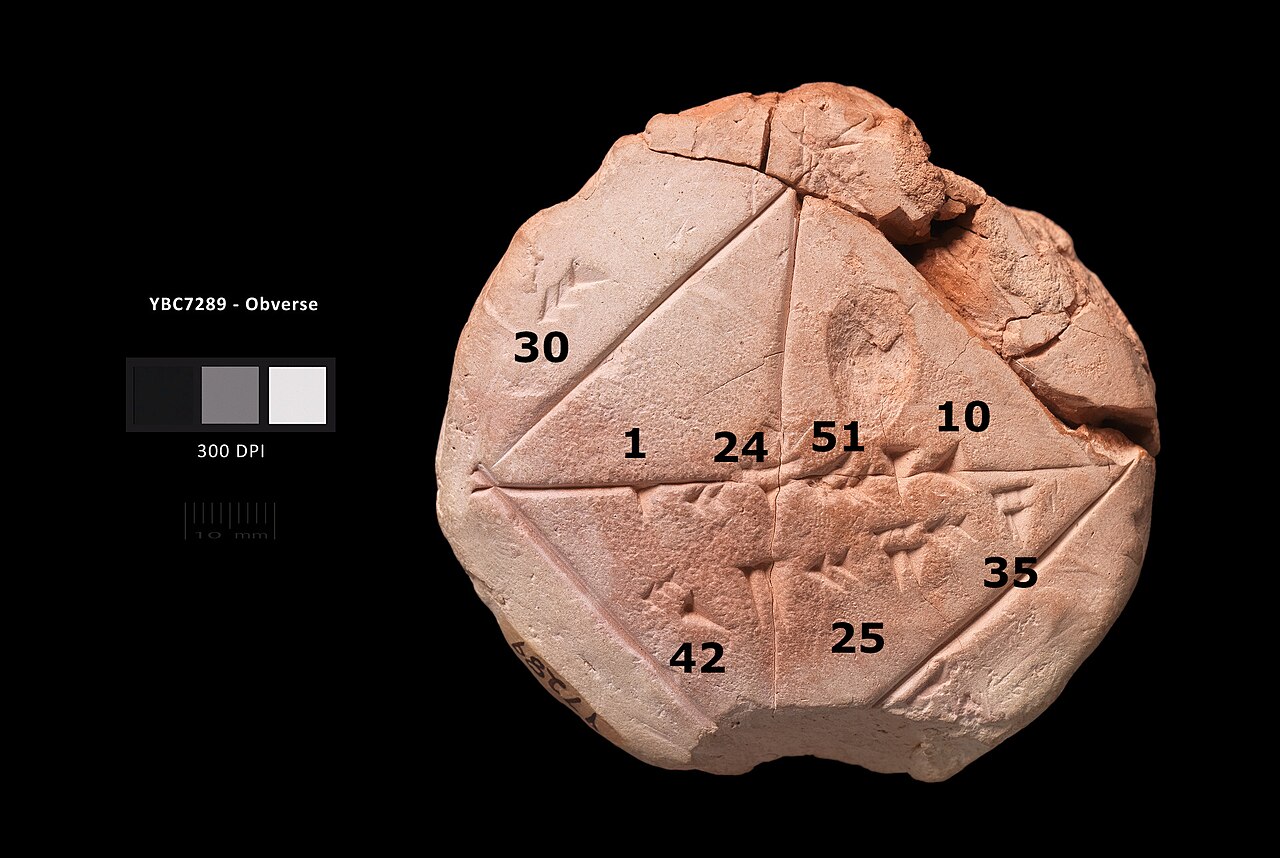
In Mesopotamia, scribes pressed wedge-shaped marks into fresh clay with a stylus. These accounting practices appeared alongside urbanisation, to record harvests, allocations and debts. Before numerals were formalised, clay tokens (calculi) were sealed inside hollow clay envelopes to secure transactions.
Their base sixty still structures our measurements today:
- An hour is divided into 60 minutes.
- A minute is divided into 60 seconds.
- A full circle measures 360 degrees (6 × 60).
Babylonian units of mass followed the same progression: 60 shekels made a mina, and 60 minas a talent. This system, devised more than four millennia ago, still governs the display of today’s watches.
Why base sixty? It is often explained by its remarkable divisibility: 60 is the smallest number divisible by 1, 2, 3, 4 and 5, and it has 12 whole-number divisors (1, 2, 3, 4, 5, 6, 10, 12, 15, 20, 30, 60). But historians find this reason rather too scholarly, and other explanations have been proposed. It makes it easy to divide quantities without leaving awkward remainders.5
The emergence of place value
In the number 55, the two digits look identical but do not express the same quantity. The 5 on the left represents fifty, the one on the right represents five units.
This is the principle of place value: the position occupied by a digit determines its value. This innovation makes it possible to write any number, however large, with a small set of symbols.
This system does, however, require marking the absence of a power. In two hundred and five (205), it is essential to indicate the absence of tens to avoid any confusion with twenty-five (25).
Mesopotamian scribes long made up for this lack with a simple space, before belatedly introducing (in the second half of the first millennium BCE) a separator made of two slanting wedges. However, this sign was used only in an internal position and never acquired the status of a mathematical operator.6
Interactive
One number, three ways of writing it
The Egyptians repeated a sign as many times as needed. The scribes of Mesopotamia and Chinese calculators gave a digit its value by its place.
The question
To write 9,999, do you need thirty-six signs, or just four?
What you do Choose a number, or start the counter. See how many signs Egypt needs, where symbols are added up, and how many places are needed when position gives the value.
Without JavaScript, here are the animation’s data.
| System | Principle | Source |
|---|---|---|
| Egypt | Additive, base 10: one sign for 1, for 10, for 100, for 1,000…, repeated as many times as needed | 1 |
| Mesopotamia | Positional, base 60: an empty place, long marked by a simple space | 2 |
| China (rods) | Positional, base 10: each column is worth ten times the next; an empty square for no value | 3 |
| Number | Egyptian signs | Places in base 60 | Columns on the board |
|---|---|---|---|
| 20 | 2 | 20 | 2 · 0 |
| 276 | 15 | 4 · 36 | 2 · 7 · 6 |
| 205 | 7 | 3 · 25 | 2 · empty · 5 |
| 3,601 | 10 | 1 · empty · 1 | 3 · 6 · empty · 1 |
| 9,999 | 36 | 2 · 46 · 39 | 9 · 9 · 9 · 9 |
The values in the second table are calculated. In the animation, the Egyptian signs are drawn in simplified form, and the base-60 places are written with our digits.
The takeaway In an additive system, the number of signs grows with the number. With place value, a few places are enough, but an empty place has to be marked.
Photo credits 6
- The Rhind Mathematical Papyrus, detail: Egyptian calculation problems (British Museum, EA 10057). Ahmes (scribe), Public domain, source
- Tablet YBC 7289, Old Babylonian period: a square, its diagonal and base-60 numbers giving an approximation of the square root of 2 (Yale Peabody Museum). A. Urcia, Yale Peabody Museum of Natural History, CC0, source
- Lead counting rods, Western Han period (National Museum of China; Xi’an, 1982). Gary Todd, CC0, source
- The Egyptian sign for ten (V20 in Gardiner’s list), drawn in the Abydos font. George Douros, Public domain, source
- The Egyptian sign for a hundred (V1 in Gardiner’s list), drawn in the Abydos font. George Douros, Public domain, source
- The Egyptian sign for a thousand (M12 in Gardiner’s list), drawn in the Abydos font. George Douros, Public domain, source


Sources 3
O’Connor, John J. and Robertson, Edmund F., “Babylonian Numerals” et “Egyptian Numerals”, MacTutor History of Mathematics, University of St Andrews, “Egyptian numerals” (MacTutor), 4th paragraph (“The Egyptians had a bases 10 system…”) and 6th paragraph (“As can easily be seen…”).
The Egyptians had a bases 10 system of hieroglyphs for numerals. By this we mean that they has separate symbols for one unit, one ten, one hundred, one thousand, one ten thousand, one hundred thousand, and one million. […] One just adds the individual symbols, but replacing ten copies of a symbol by a single symbol of the next higher value.
Open access open the source · checked on 24 October 2026
O’Connor, John J. and Robertson, Edmund F., “Babylonian Numerals”, example of tablet AO 17264.
Perhaps the scribe left a little more space than usual between the 6 and the 9
Open access open the source · checked on 27 October 2026
O’Connor, John J. and Robertson, Edmund F., “Chinese Numerals”, MacTutor History of Mathematics, University of St Andrews, January 2004, “Chinese numerals” article, part on the counting board.
A counting board consisted of a checker board with rows and columns. Numbers were represented by little rods made from bamboo or ivory. […] There was still no need for a zero on the counting board for a square was simply left blank.
Open access open the source · checked on 27 October 2026
Zero, invented several times
No one travelled from one continent to another to pass on the recipe for zero. Peoples very far apart came up against the same problem and solved it, each on their own.
- In Central America: More than 1,600 years ago, long before the arrival of Europeans, the Maya wrote a sign for zero. In their books, it took the form of a small shell. This sign served above all to count the days in a very precise calendar.
- In South-East Asia: On a stone carved in Cambodia in the year 683, archaeologists found a small dot. It is the oldest written zero of the family from which our present-day digits come.7
The story of this stone
It was found in 1891. For forty years, no one paid it any attention.8
A French scholar finally deciphered it, and understood what he was holding. He published in 1931 — and it was not a neutral article: it opens with the thesis of a British scholar, G. R. Kaye, who saw positional zero as a Western invention, not an Indian one. The stone contradicted him.9
The rest of the inscription deserves attention. It is not a learned text: it is a bill of sale, mentioning slaves, five pairs of oxen and sacks of white rice. The oldest known zero appears on an invoice — which confirms what the beginning of this page says: numerals are born of accounting, not of philosophy.10
The story does not end there. Under the Khmer Rouge, more than ten thousand artefacts were destroyed in Cambodia. The stone disappeared.11
A mathematician spent years searching for it — in libraries, then on the ground, in Thailand, Laos, Vietnam and Cambodia. He found it again in 2013, in a shed near Angkor, among thousands of fragments of broken statues.12
It is now on display in the National Museum of Cambodia.13
The world’s oldest zero was thus lost twice: once to oblivion, once to destruction. And found twice.
- In India: Around the year 628, the mathematician Brahmagupta made a crucial discovery. For him, zero was no longer merely a sign to mark an empty square: it was a true number with which one could calculate.14
Material numeration: the Andean quipus
In the Andean world, the handling of numerical data relied on quipus (sets of knotted cotton or wool cords).
Among the Incas, the structure is strictly decimal. The height of a knot on a pendant cord determines its order of magnitude (units, tens, hundreds, thousands), while the absence of a knot represents zero.15
Quipus predate the Inca Empire: the oldest known specimens are attributed to the Wari culture (sixth–eleventh centuries). Although the numerical value of the knots has been deciphered, part of the coding (colours, twists of the threads) is still the subject of research.16
The spread to the West
The digits in everyday use in Europe come from the mathematics of South Asia:
- Baghdad (early ninth century): The mathematician Al-Khwarizmi wrote a treatise on Indian calculation, whose Arabic original is lost, setting out methodically for the first time the Indian positional decimal system.
- Western Europe (1202): Leonardo Fibonacci published the Liber Abaci. This work introduced Indo-Arabic calculation to Italian merchants and bankers.
- Gradual adoption: Despite its efficiency, this system did not finally prevail over accounting in Roman numerals until some time in the sixteenth century.17
Comparative overview of number systems
| Region | Period of appearance | Base | Structure | Representation of zero |
|---|---|---|---|---|
| Mesopotamia | Third millennium BC | 60 | Positional | Empty space, then internal double wedge (c. 300 BC) |
| Egypt | Third millennium BC | 10 | Additive | No dedicated symbol |
| China | Fifth century BC | 10 | Positional | Space left empty on the chequerboard |
| Mesoamerica | First century BC | 20 | Positional | Stylised glyph (shell) |
| South-East Asia | Seventh century (attested in 683) | 10 | Positional | Dot (bindu) |
| South Asia | Seventh century (attested in 628) | 10 | Positional and operational | Circle / dot with arithmetical rules |
| Andes (Incas) | Sixth – sixteenth century | 10 | Material positional | Absence of a knot on the cord |
Note 1
For instance, to form numbers “eleven” to “fourteen”, numbers “one” to “four” are added to “ten” in that order (8a-d); but to form “fifteen” to “nineteen”, numbers “five” to “one” are subtracted from “twenty” in that reverse order (8e-i). […] Five less than 20 “15”
Adeniyi, K. and Jayeola, W. A., “Tonal Alternation in Yoruba Numerals”, JOLAN: Journal of the Linguistic Association of Nigeria, vol. 23, no. 1, 2020, p. 181-190
Note 2
Numerals 50, 70, 90, 110, 130, 150 and 170 are expressed as 10 deducted (aadín) from the next multiple of 20. […] 50 was derived by deducting 10 from 60 (ọ̀gọ́ta).
Akinadé, Olúgbénga O. and Ọdẹ́jọbí, Ọdẹ́túnjí A., “Computational modelling of Yorùbá numerals in a number-to-text conversion system”, Journal of Language Modelling, vol. 2, no. 1, 2014, p. 167-211
In accordance with this halvtredje would mean ‘three minus half’ so 2½, halvfjerde would mean ‘four minus half’ so 3½ etc. […] halvtredsindstyve 2½ times 20 = 50
Garczyński, Błażej, “A Short Research in Danish Cardinal and Ordinal Numerals on Indo-European Background”, Folia Scandinavica Posnaniensia, vol. 16, 2014, p. 17-40
Another observable feature of the Yorùbá numeral system is the use of base 20 (vigesimal), which likely stems from the counting of cowry shells as described by Mann: Here we may explain the origin of this somewhat cumbersome system; it springs from the way in which the large sum of money (cowries) are counted.
Akinadé, Olúgbénga O. and Ọdẹ́jọbí, Ọdẹ́túnjí A., “Computational modelling of Yorùbá numerals in a number-to-text conversion system”, Journal of Language Modelling, vol. 2, no. 1, 2014, p. 167-211
Note 3
The Egyptians had a bases 10 system of hieroglyphs for numerals. By this we mean that they has separate symbols for one unit, one ten, one hundred, one thousand, one ten thousand, one hundred thousand, and one million. […] One just adds the individual symbols, but replacing ten copies of a symbol by a single symbol of the next higher value.
O’Connor, John J. and Robertson, Edmund F., “Babylonian Numerals” et “Egyptian Numerals”, MacTutor History of Mathematics, University of St Andrews
Note 4
A counting board consisted of a checker board with rows and columns. Numbers were represented by little rods made from bamboo or ivory. […] There was still no need for a zero on the counting board for a square was simply left blank.
O’Connor, John J. and Robertson, Edmund F., “Chinese Numerals”, MacTutor History of Mathematics, University of St Andrews, January 2004
Note 5
Theon's answer was that 60 was the smallest number divisible by 1, 2, 3, 4, and 5 so the number of divisors was maximised. Although this is true it appears too scholarly a reason.
O’Connor, John J. and Robertson, Edmund F., “Babylonian Numerals” et “Egyptian Numerals”, MacTutor History of Mathematics, University of St Andrews
Note 6
Perhaps the scribe left a little more space than usual between the 6 and the 9
O’Connor, John J. and Robertson, Edmund F., “Babylonian Numerals”
It was not until around 400 BC that the Babylonians put two wedge symbols into the place where we would put zero
O’Connor, John J. and Robertson, Edmund F., “A History of Zero”
Note 7
In the bark-paper screenfold manuscripts (extant in four Precolumbian codices) the Maya drew zero in the form of a stylized image of an oliva seashell (fig. 9).
Blume, Anna, “Maya Concepts of Zero”, Proceedings of the American Philosophical Society, vol. 155, no. 1, 2011, p. 51-86
Sixty-five years later, at Uaxactun on Stela 18 and 19, the Maya scribe included another new element by depicting explicit zeros in k'atun endings on these Long Count inscriptions: 8.16.0.0.0 (AD 357). […] The use of these zero signs at Uaxactun marks the beginning of a visualized zero in Mesoamerica.
Blume, Anna, “Maya Concepts of Zero”, Proceedings of the American Philosophical Society, vol. 155, no. 1, 2011, p. 51-86
Note 8
The chronological inscription is contained on a stone stele first discovered in 1891 and designated in archaeological coding as K-127.
Mathematical Association of America, “Mathematical Treasure: The Cambodian Zero”
Note 9
The inscription was deciphered and its numerical significance noted by the French philologist, historian, and archaeologist Georges Coedès (1886–1969) in 1931.
Mathematical Association of America, “Mathematical Treasure: The Cambodian Zero”
L’origine des chiffres que nous appelons “ arabes ” parce qu’ils ont été introduits en Europe par les Arabes, et de la notation arithmétique basée sur leur valeur de position avec l’emploi du symbole zéro, a donné lieu à des recherches qui ont abouti à des résultats opposés: certains auteurs ont affirmé l’origine indienne du système, tandis que d’autres ont voulu y voir une invention occidentale. Parmi ces derniers, M. G. R. Kaye s'est fait remarquer par son hostilité contre la thèse de l’origine indienne.
The origin of the numerals we call “Arabic” because they were brought into Europe by the Arabs, and of the arithmetical notation based on their place value with the use of the zero symbol, has given rise to research reaching opposite conclusions: some authors have asserted the Indian origin of the system, while others have sought to see in it a Western invention. Among the latter, Mr G. R. Kaye has stood out for his hostility to the theory of Indian origin.
Cœdès, George, “À propos de l’origine des chiffres arabes”, Bulletin of the School of Oriental Studies, vol. 6, no. 2, 1931, p. 323-328
Leicester 1866 — Tunbridge Wells, Kent 1.7.1929. British Teacher and Indologist in India.
Karttunen, Klaus, “Kaye, George Rusby”, Persons of Indian Studies
Note 10
the inscription reads like a bill of sale and includes references to slaves, five pairs of oxen and sacks of white rice
Aczel, Amir D., Finding Zero: A Mathematician’s Odyssey to Uncover the Origins of Numbers, Palgrave Macmillan, 2015
Note 11
But K-127 disappeared during the Khmer Rouge's rule of terror, when more than 10,000 artifacts were deliberately destroyed.
Aczel, Amir D., Finding Zero: A Mathematician’s Odyssey to Uncover the Origins of Numbers, Palgrave Macmillan, 2015
Note 12
I opened the door of a makeshift shed with a corrugated tin roof […] Thousands of chunks and slabs of stone covered the dirt floor: smashed heads of statues of Khmer kings and Hindu gods, […] directed me to the sheds at Angkor Conservation, a restoration and storage site closed to the public. […] in early January 2013, I was invited in. […] And yet, within two hours, the roulette wheel had spun in my favor.
Aczel, Amir D., Finding Zero: A Mathematician’s Odyssey to Uncover the Origins of Numbers, Palgrave Macmillan, 2015
Note 13
Aczel and his wife, Debra, worked with Cambodian authorities to have the stele transferred from a storage shed to the National Museum of Cambodia.
Mathematical Association of America, “Mathematical Treasure: The Cambodian Zero”
Note 14
In particular he wrote Brahmasphutasiddhanta (Correctly Established Doctrine of Brahma), in 628. […] Brahmagupta's understanding of the number systems went far beyond that of others of the period. In the Brahmasphutasiddhanta (Correctly Established Doctrine of Brahma) he defined zero as the result of subtracting a number from itself. He gave some properties as follows:- When zero is added to a number or subtracted from a number, the number remains unchanged; and a number multiplied by zero becomes zero.
O’Connor, John J. and Robertson, Edmund F., “Brahmagupta”, MacTutor History of Mathematics, University of St Andrews, November 2000
Note 15
As far as we know, the Inkas lacked a unique sign for zero, other than to leave the corresponding cord or place value blank—that is, unknotted. […] So, of a pendant cord registering the number 2,035, we would expect to see two overhand knots in the thousands’ place (closest to the horizontal primary cord), followed by no knots in the hundreds place, three overhand knots in the tens’ place, and a long knot with five turns in the ones’ place.
Medrano, Manuel, “Knot Just Numbers: Mathematics and More in Andean Khipu Strings”, lecture, Gresham College, 20 October 2021, transcript
Note 16
How such a distinction would, or could, have been noted in the original knotted accounts is unclear, though we might be tempted to speculate that this was indicated by some binary aspect of the khipus in question, like spin and ply or attachment knot, though of course other elements are possible. […] Jon Clindaniel (2019: chap. 5) has since found Hyland’s decipherment of colour patterning to hold relatively well across hundreds of digitized examples. Moving forward will require assessing these patterns across different types of registered information.
Medrano, Manuel, “Knot Just Numbers: Mathematics and More in Andean Khipu Strings”, lecture, Gresham College, 20 October 2021, transcript
Note 17
Al-Khwarizmi also wrote a treatise on Hindu-Arabic numerals. The Arabic text is lost […] al-Khwarizmi's work was the first to expound it systematically.
O’Connor, John J. and Robertson, Edmund F., “Abu Ja’far Muhammad ibn Musa Al-Khwarizmi”, MacTutor History of Mathematics, université de St Andrews, July 1999, open access
Incipit liber Abaci Compositus a leonardo filio Bonacij Pisano In Anno M° cc° ij°. […] Nouem figure indorum he sunt 9 8 7 6 5 4 3 2 1. Cum his itaque nouem figuris, et cum hoc signo 0, quod arabice zephirum appellatur, scribitur quilibet numerus
Here begins the Book of Calculation composed by Leonardo, son of Bonacci, of Pisa, in the year 1202. […] The nine figures of the Indians are these: 9 8 7 6 5 4 3 2 1. With these nine figures, and with this sign 0, which in Arabic is called zephirum, any number whatsoever is written
Fibonacci, Leonardo, Liber Abaci, Pise, 1202
Liber abaci, published in 1202 after Fibonacci's return to Italy, was dedicated to Scotus.
O’Connor, John J. and Robertson, Edmund F., “Leonardo Pisano Fibonacci”, MacTutor History of Mathematics, University of St Andrews, October 1998
Notes and sources
- ↑
Passage the units from one to four are added to the ten, those from five to nine are subtracted from the next ten. Fifteen is said as “five less than twenty”
For instance, to form numbers “eleven” to “fourteen”, numbers “one” to “four” are added to “ten” in that order (8a-d); but to form “fifteen” to “nineteen”, numbers “five” to “one” are subtracted from “twenty” in that reverse order (8e-i). […] Five less than 20 “15”
Source Adeniyi, K. and Jayeola, W. A., “Tonal Alternation in Yoruba Numerals”, JOLAN: Journal of the Linguistic Association of Nigeria, vol. 23, no. 1, 2020, p. 181-190, p. 184, example (8e).
Open access open the source · checked on 9 September 2026
- ↑
Passage The odd tens from fifty upwards are also formed by subtraction — fifty is “sixty minus ten” —
Numerals 50, 70, 90, 110, 130, 150 and 170 are expressed as 10 deducted (aadín) from the next multiple of 20. […] 50 was derived by deducting 10 from 60 (ọ̀gọ́ta).
Source Akinadé, Olúgbénga O. and Ọdẹ́jọbí, Ọdẹ́túnjí A., “Computational modelling of Yorùbá numerals in a number-to-text conversion system”, Journal of Language Modelling, vol. 2, no. 1, 2014, p. 167-211, p. 175 and p. 178.
Open access open the source · checked on 27 October 2026
Passage exactly as in Danish
In accordance with this halvtredje would mean ‘three minus half’ so 2½, halvfjerde would mean ‘four minus half’ so 3½ etc. […] halvtredsindstyve 2½ times 20 = 50
Source Garczyński, Błażej, “A Short Research in Danish Cardinal and Ordinal Numerals on Indo-European Background”, Folia Scandinavica Posnaniensia, vol. 16, 2014, p. 17-40, p. 30, § 3.4 (“The Decades 50-90”).
Open access open the source · checked on 27 October 2026
Passage the base twenty probably stems from the counting of cowries
Another observable feature of the Yorùbá numeral system is the use of base 20 (vigesimal), which likely stems from the counting of cowry shells as described by Mann: Here we may explain the origin of this somewhat cumbersome system; it springs from the way in which the large sum of money (cowries) are counted.
Source Akinadé, Olúgbénga O. and Ọdẹ́jọbí, Ọdẹ́túnjí A., “Computational modelling of Yorùbá numerals in a number-to-text conversion system”, Journal of Language Modelling, vol. 2, no. 1, 2014, p. 167-211, p. 170.
Open access open the source · checked on 27 October 2026
- ↑
Passage In ancient Egypt, a single symbol was drawn for 1, another for 10 […] This is an additive system
The Egyptians had a bases 10 system of hieroglyphs for numerals. By this we mean that they has separate symbols for one unit, one ten, one hundred, one thousand, one ten thousand, one hundred thousand, and one million. […] One just adds the individual symbols, but replacing ten copies of a symbol by a single symbol of the next higher value.
Source O’Connor, John J. and Robertson, Edmund F., “Babylonian Numerals” et “Egyptian Numerals”, MacTutor History of Mathematics, University of St Andrews, “Egyptian numerals” (MacTutor), 4th paragraph (“The Egyptians had a bases 10 system…”) and 6th paragraph (“As can easily be seen…”).
Open access open the source · checked on 24 October 2026
- ↑
Passage In China, small rods were laid out on a chequerboard […] An empty square indicated the absence of a value.
A counting board consisted of a checker board with rows and columns. Numbers were represented by little rods made from bamboo or ivory. […] There was still no need for a zero on the counting board for a square was simply left blank.
Source O’Connor, John J. and Robertson, Edmund F., “Chinese Numerals”, MacTutor History of Mathematics, University of St Andrews, January 2004, “Chinese numerals” article, part on the counting board.
Open access open the source · checked on 27 October 2026
- ↑
Passage It is often explained by its remarkable divisibility: 60 is the smallest number divisible by 1, 2, 3, 4 and 5 […] But historians find this reason rather too scholarly
Theon's answer was that 60 was the smallest number divisible by 1, 2, 3, 4, and 5 so the number of divisors was maximised. Although this is true it appears too scholarly a reason.
Source O’Connor, John J. and Robertson, Edmund F., “Babylonian Numerals” et “Egyptian Numerals”, MacTutor History of Mathematics, University of St Andrews, “Babylonian numerals” (MacTutor), paragraph beginning “Theon’s answer…”.
Open access open the source · checked on 24 October 2026
- ↑
Passage Mesopotamian scribes long made up for this lack with a simple space
Perhaps the scribe left a little more space than usual between the 6 and the 9
Source O’Connor, John J. and Robertson, Edmund F., “Babylonian Numerals”, example of tablet AO 17264.
Open access open the source · checked on 27 October 2026
Passage before belatedly introducing (in the second half of the first millennium BCE) a separator made of two slanting wedges
It was not until around 400 BC that the Babylonians put two wedge symbols into the place where we would put zero
Source O’Connor, John J. and Robertson, Edmund F., “A History of Zero”, passage on the Babylonians.
Open access open the source · checked on 27 October 2026
- ↑
Passage In Central America […] In their books, it took the form of a small shell.
In the bark-paper screenfold manuscripts (extant in four Precolumbian codices) the Maya drew zero in the form of a stylized image of an oliva seashell (fig. 9).
Source Blume, Anna, “Maya Concepts of Zero”, Proceedings of the American Philosophical Society, vol. 155, no. 1, 2011, p. 51-86, p. 53.
Paywalled open the source · checked on 24 October 2026
Passage In Central America: More than 1,600 years ago, long before the arrival of Europeans, the Maya wrote a sign for zero
Sixty-five years later, at Uaxactun on Stela 18 and 19, the Maya scribe included another new element by depicting explicit zeros in k'atun endings on these Long Count inscriptions: 8.16.0.0.0 (AD 357). […] The use of these zero signs at Uaxactun marks the beginning of a visualized zero in Mesoamerica.
Source Blume, Anna, “Maya Concepts of Zero”, Proceedings of the American Philosophical Society, vol. 155, no. 1, 2011, p. 51-86, p. 58-59.
Paywalled open the source · checked on 24 October 2026
- ↑
Passage It was found in 1891.
The chronological inscription is contained on a stone stele first discovered in 1891 and designated in archaeological coding as K-127.
Source Mathematical Association of America, “Mathematical Treasure: The Cambodian Zero”, entry on the stele.
Open access open the source · checked on 9 September 2026
- ↑
Passage A French scholar finally deciphered it, and understood what he was holding. He published in 1931
The inscription was deciphered and its numerical significance noted by the French philologist, historian, and archaeologist Georges Coedès (1886–1969) in 1931.
Source Mathematical Association of America, “Mathematical Treasure: The Cambodian Zero”, 3rd paragraph.
Open access open the source · checked on 27 October 2026
Passage it opens with the thesis of a British scholar, G. R. Kaye, who saw positional zero as a Western invention, not an Indian one. The stone contradicted him.
L’origine des chiffres que nous appelons “ arabes ” parce qu’ils ont été introduits en Europe par les Arabes, et de la notation arithmétique basée sur leur valeur de position avec l’emploi du symbole zéro, a donné lieu à des recherches qui ont abouti à des résultats opposés: certains auteurs ont affirmé l’origine indienne du système, tandis que d’autres ont voulu y voir une invention occidentale. Parmi ces derniers, M. G. R. Kaye s'est fait remarquer par son hostilité contre la thèse de l’origine indienne.
Editors’ translation The origin of the numerals we call “Arabic” because they were brought into Europe by the Arabs, and of the arithmetical notation based on their place value with the use of the zero symbol, has given rise to research reaching opposite conclusions: some authors have asserted the Indian origin of the system, while others have sought to see in it a Western invention. Among the latter, Mr G. R. Kaye has stood out for his hostility to the theory of Indian origin.
Source Cœdès, George, “À propos de l’origine des chiffres arabes”, Bulletin of the School of Oriental Studies, vol. 6, no. 2, 1931, p. 323-328, p. 323, 1st paragraph (first page, shown as an extract on the publisher’s site).
First page open access open the source · checked on 27 October 2026
Passage a British scholar, G. R. Kaye
Leicester 1866 — Tunbridge Wells, Kent 1.7.1929. British Teacher and Indologist in India.
Source Karttunen, Klaus, “Kaye, George Rusby”, Persons of Indian Studies, entry “KAYE, George Rusby”, heading.
Open access open the source · checked on 27 October 2026
- ↑
Passage it is a bill of sale, mentioning slaves, five pairs of oxen and sacks of white rice
the inscription reads like a bill of sale and includes references to slaves, five pairs of oxen and sacks of white rice
Source Aczel, Amir D., Finding Zero: A Mathematician’s Odyssey to Uncover the Origins of Numbers, Palgrave Macmillan, 2015, Smithsonian article.
In libraries and open access open the source · checked on 9 September 2026
- ↑
Passage Under the Khmer Rouge, more than ten thousand artefacts were destroyed in Cambodia. The stone disappeared.
But K-127 disappeared during the Khmer Rouge's rule of terror, when more than 10,000 artifacts were deliberately destroyed.
Source Aczel, Amir D., Finding Zero: A Mathematician’s Odyssey to Uncover the Origins of Numbers, Palgrave Macmillan, 2015, Smithsonian article.
In libraries and open access open the source · checked on 9 September 2026
- ↑
Passage He found it again in 2013, in a shed near Angkor, among thousands of fragments of broken statues.
I opened the door of a makeshift shed with a corrugated tin roof […] Thousands of chunks and slabs of stone covered the dirt floor: smashed heads of statues of Khmer kings and Hindu gods, […] directed me to the sheds at Angkor Conservation, a restoration and storage site closed to the public. […] in early January 2013, I was invited in. […] And yet, within two hours, the roulette wheel had spun in my favor.
Source Aczel, Amir D., Finding Zero: A Mathematician’s Odyssey to Uncover the Origins of Numbers, Palgrave Macmillan, 2015, Smithsonian article, account of the rediscovery.
In libraries and open access open the source · checked on 9 September 2026
- ↑
Passage It is now on display in the National Museum of Cambodia.
Aczel and his wife, Debra, worked with Cambodian authorities to have the stele transferred from a storage shed to the National Museum of Cambodia.
Source Mathematical Association of America, “Mathematical Treasure: The Cambodian Zero”, entry on the stele.
Open access open the source · checked on 9 September 2026
- ↑
Passage Around the year 628, the mathematician Brahmagupta […] zero was no longer merely a sign to mark an empty square: it was a true number
In particular he wrote Brahmasphutasiddhanta (Correctly Established Doctrine of Brahma), in 628. […] Brahmagupta's understanding of the number systems went far beyond that of others of the period. In the Brahmasphutasiddhanta (Correctly Established Doctrine of Brahma) he defined zero as the result of subtracting a number from itself. He gave some properties as follows:- When zero is added to a number or subtracted from a number, the number remains unchanged; and a number multiplied by zero becomes zero.
Source O’Connor, John J. and Robertson, Edmund F., “Brahmagupta”, MacTutor History of Mathematics, University of St Andrews, November 2000, biography, paragraph “Brahmagupta, whose father was Jisnugupta…”, then paragraph “Brahmagupta’s understanding of the number systems…”.
Open access open the source · checked on 27 October 2026
- ↑
Passage The height of a knot on a pendant cord determines its order of magnitude […] the absence of a knot represents zero.
As far as we know, the Inkas lacked a unique sign for zero, other than to leave the corresponding cord or place value blank—that is, unknotted. […] So, of a pendant cord registering the number 2,035, we would expect to see two overhand knots in the thousands’ place (closest to the horizontal primary cord), followed by no knots in the hundreds place, three overhand knots in the tens’ place, and a long knot with five turns in the ones’ place.
Source Medrano, Manuel, “Knot Just Numbers: Mathematics and More in Andean Khipu Strings”, lecture, Gresham College, 20 October 2021, transcript, transcript, p. 3, paragraph “Arranged in horizontal levels like in the diagram…”.
Open access open the source · checked on 27 October 2026
- ↑
Passage part of the coding (colours, twists of the threads) is still the subject of research
How such a distinction would, or could, have been noted in the original knotted accounts is unclear, though we might be tempted to speculate that this was indicated by some binary aspect of the khipus in question, like spin and ply or attachment knot, though of course other elements are possible. […] Jon Clindaniel (2019: chap. 5) has since found Hyland’s decipherment of colour patterning to hold relatively well across hundreds of digitized examples. Moving forward will require assessing these patterns across different types of registered information.
Source Medrano, Manuel, “Knot Just Numbers: Mathematics and More in Andean Khipu Strings”, lecture, Gresham College, 20 October 2021, transcript, transcript, p. 8 (twist of the threads) and p. 9 (colours).
Open access open the source · checked on 27 October 2026
- ↑
Passage The mathematician Al-Khwarizmi wrote a treatise on Indian calculation, whose Arabic original is lost, setting out methodically for the first time the Indian positional decimal system.
Al-Khwarizmi also wrote a treatise on Hindu-Arabic numerals. The Arabic text is lost […] al-Khwarizmi's work was the first to expound it systematically.
Source O’Connor, John J. and Robertson, Edmund F., “Abu Ja’far Muhammad ibn Musa Al-Khwarizmi”, MacTutor History of Mathematics, université de St Andrews, July 1999, open access, biography, paragraph on the arithmetic treatise (quotation from G. J. Toomer).
Open access open the source · checked on 24 October 2026
Passage Leonardo Fibonacci published the Liber Abaci.
Incipit liber Abaci Compositus a leonardo filio Bonacij Pisano In Anno M° cc° ij°. […] Nouem figure indorum he sunt 9 8 7 6 5 4 3 2 1. Cum his itaque nouem figuris, et cum hoc signo 0, quod arabice zephirum appellatur, scribitur quilibet numerus
Editors’ translation Here begins the Book of Calculation composed by Leonardo, son of Bonacci, of Pisa, in the year 1202. […] The nine figures of the Indians are these: 9 8 7 6 5 4 3 2 1. With these nine figures, and with this sign 0, which in Arabic is called zephirum, any number whatsoever is written
Source Fibonacci, Leonardo, Liber Abaci, Pise, 1202, incipit and beginning of chapter 1, p. 1 of the Boncompagni edition (Scritti di Leonardo Pisano, vol. I, Rome, 1857).
Public domain open the source · checked on 24 October 2026
Passage Western Europe (1202): Leonardo Fibonacci published the Liber Abaci
Liber abaci, published in 1202 after Fibonacci's return to Italy, was dedicated to Scotus.
Source O’Connor, John J. and Robertson, Edmund F., “Leonardo Pisano Fibonacci”, MacTutor History of Mathematics, University of St Andrews, October 1998, biography, paragraph “Liber abaci, published in 1202…”.
Open access open the source · checked on 27 October 2026
Bibliography
21
- Aczel, Amir D., Finding Zero: A Mathematician’s Odyssey to Uncover the Origins of Numbers, Palgrave Macmillan, 2015, in libraries (the disappearance of the stele under the Khmer Rouge, the search lasting several years and its rediscovery in 2013 in the storerooms at Angkor, then its transfer to the National Museum of Cambodia). See also “The Origin of the Number Zero”, Smithsonian Magazine, 2014, open access (the content of the inscription: a bill of sale mentioning slaves, oxen and rice). https://www.smithsonianmag.com/history/origin-number-zero-180953392/
- Adeniyi, K. and Jayeola, W. A., “Tonal Alternation in Yoruba Numerals”, JOLAN: Journal of the Linguistic Association of Nigeria, vol. 23, no. 1, 2020, p. 181-190, open access (in Yoruba, one to four are added to ten, five to one are subtracted from twenty; fifteen, “five less than twenty”). https://jolan.com.ng/index.php/home/article/download/274/203/200
- Akinadé, Olúgbénga O. and Ọdẹ́jọbí, Ọdẹ́túnjí A., “Computational modelling of Yorùbá numerals in a number-to-text conversion system”, Journal of Language Modelling, vol. 2, no. 1, 2014, p. 167-211, open access (the formation of the odd tens by subtraction in Yoruba: fifty, ten taken from sixty; the base twenty linked to the counting of cowries). https://yadda.icm.edu.pl/baztech/element/bwmeta1.element.baztech-7ac043b4-5f7d-4a03-87ca-bcb98011cbae/c/Akinade_Computational_modelling_of_Yoruba_numerals_1_2014.pdf
- Blume, Anna, “Maya Concepts of Zero”, Proceedings of the American Philosophical Society, vol. 155, no. 1, 2011, p. 51-86, paywalled, online copy on Academia.edu (the first signs for zero in Maya inscriptions, in AD 357; the shell-shaped zero in the Maya books). https://www.academia.edu/9741859/Maya_Concepts_of_Zero
- Cœdès, George, “À propos de l’origine des chiffres arabes”, Bulletin of the School of Oriental Studies, vol. 6, no. 2, 1931, p. 323-328, first page open access (the 1931 article opens with the controversy: G. R. Kaye, hostile to the Indian origin of place-value notation with zero, saw it as a Western invention; the inscriptions of Cambodia are cited in the notes). https://doi.org/10.1017/S0041977X00092806
- Chrisomalis, Stephen, Numerical Notation: A Comparative History, Cambridge University Press, 2010, in libraries (comparative overview of number systems around the world).
- Coedès, George, “A propos de l’origine des chiffres arabes”, Bulletin of the School of Oriental Studies, vol. 6, no. 2, 1931, p. 323-328, paywalled (the Cambodian inscription K-127, discovered in 1891 and dated to AD 683; the refutation of the thesis of a Western origin for positional zero).
- Fibonacci, Leonardo, Liber Abaci, Pise, 1202, public domain. Annotated translation: Sigler, Laurence E., Fibonacci’s Liber Abaci, Springer, 2002, in libraries.
- Garczyński, Błażej, “A Short Research in Danish Cardinal and Ordinal Numerals on Indo-European Background”, Folia Scandinavica Posnaniensia, vol. 16, 2014, p. 17-40, open access (repository of Adam Mickiewicz University, Poznań: the Danish tens 50, 70 and 90, built on “three minus half”, “four minus half”… times twenty). https://repozytorium.amu.edu.pl/handle/10593/12697
- Ifrah, Georges, Histoire universelle des chiffres, Robert Laffont, 1994, in libraries (comparative overview, including the Chinese rods, Yoruba numeration and the quipus).
- Karttunen, Klaus, “Kaye, George Rusby”, Persons of Indian Studies, open access (G. R. Kaye, British teacher and Indologist in India, 1866-1929). https://whowaswho-indology.info/3405/kaye-george-rusby/
- Mathematical Association of America, “Mathematical Treasure: The Cambodian Zero”, open access (the stele K-127, its decipherment and its present display). https://old.maa.org/press/periodicals/convergence/mathematical-treasure-the-cambodian-zero
- Medrano, Manuel, “Knot Just Numbers: Mathematics and More in Andean Khipu Strings”, lecture, Gresham College, 20 October 2021, transcript, open access (Inka khipus: the position of knots on the pendant cord by decimal place, from thousands near the primary cord down to units; a place left unknotted for zero). https://www.gresham.ac.uk/sites/default/files/transcript/2021-10-20-1600_MEDRANO_BSHM-T.pdf
- O’Connor, John J. and Robertson, Edmund F., “A History of Zero”, MacTutor History of Mathematics, University of St Andrews, open access (the two-wedge sign placed where we would put a zero, around 400 BC according to the authors; other, older marks at Kish). https://mathshistory.st-andrews.ac.uk/HistTopics/Zero/
- O’Connor, John J. and Robertson, Edmund F., “Babylonian Numerals” et “Egyptian Numerals”, MacTutor History of Mathematics, University of St Andrews, open access (the sexagesimal system and its divisibility; Egyptian additive numeration). https://mathshistory.st-andrews.ac.uk/
- O’Connor, John J. and Robertson, Edmund F., “Abu Ja’far Muhammad ibn Musa Al-Khwarizmi”, MacTutor History of Mathematics, université de St Andrews, July 1999, open access (the treatise on Indian numerals, lost in Arabic, known through a Latin translation; the first systematic exposition of the decimal place-value system; al-Khwarizmi born around 780, died around 850). https://mathshistory.st-andrews.ac.uk/Biographies/Al-Khwarizmi/
- O’Connor, John J. and Robertson, Edmund F., “Brahmagupta”, MacTutor History of Mathematics, University of St Andrews, November 2000, open access (the Brahmasphutasiddhanta written in 628; zero defined as the result of subtracting a number from itself; rules of calculation with zero, “fortunes” and “debts”). https://mathshistory.st-andrews.ac.uk/Biographies/Brahmagupta/
- O’Connor, John J. and Robertson, Edmund F., “Chinese Numerals”, MacTutor History of Mathematics, University of St Andrews, January 2004, open access (the chequerboard counting board and its bamboo or ivory rods; a square simply left empty in place of zero). https://mathshistory.st-andrews.ac.uk/HistTopics/Chinese_numerals/
- O’Connor, John J. and Robertson, Edmund F., “Leonardo Pisano Fibonacci”, MacTutor History of Mathematics, University of St Andrews, October 1998, open access (the Liber abaci published in 1202, followed by a second edition in 1228). https://mathshistory.st-andrews.ac.uk/Biographies/Fibonacci/
- Plofker, Kim, Mathematics in India, Princeton University Press, 2009, in libraries (Brahmagupta and zero as an operational number).
- Urton, Gary, Signs of the Inka Khipu: Binary Coding in the Andean Knotted-String Records, University of Texas Press, 2003, in libraries (the decimal structure of the quipus, the absence of a knot marking zero, and what remains undeciphered).
Iconography: Map produced on a Natural Earth base (Equal Earth projection).
Spotted an error or have a doubt? Write to us.