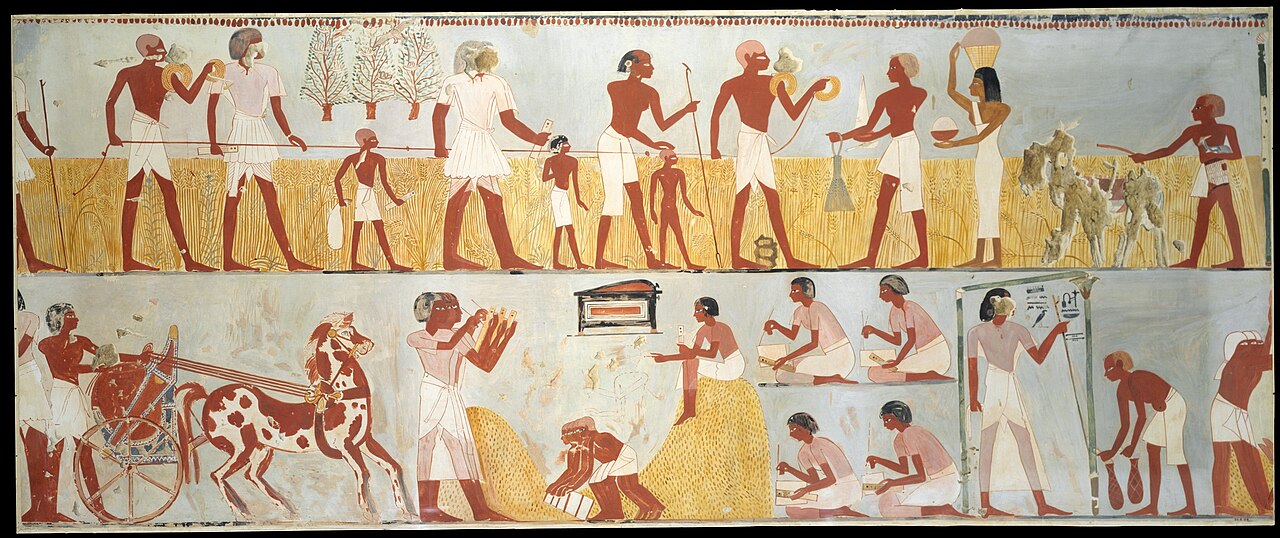

You need to mark out a right angle in a field, without a set square.
How do you do it? The answer has existed for a very long time, it fits in a length of rope, and that is where geometry begins.
Measuring the land
The word says it: geometry means measurement of the land.
It is not a science born in the minds of idle scholars. It arises from a very concrete problem: after a flood, the boundaries of the fields have vanished under the mud. They have to be marked out again. Who owns what? Where does the edge run?
For that, you need to know how to draw a straight line, make a right angle, calculate an area.
The simplest tool is a rope with regularly spaced knots. Stretched by three people to form a triangle whose sides measure three, four and five intervals, it gives a perfect right angle. Neither calculation nor instrument: a rope and three pairs of hands. The method can easily be repeated in a school playground.
Two words of caution, however, about this appealing story:
- A late theory: the idea that geometry was born of the floods of the Nile does not come from the Egyptians. It is the explanation given by a Greek traveller, Herodotus, long after the events.
- The absence of material evidence: it is said everywhere that Egyptian surveyors used this three-four-five rope. The surveyors existed, they can be seen at work in tomb paintings, their knotted ropes existed, and their right angles are very precise. But no papyrus, no inscription, no object shows the three-four-five triangle. That particular story is a conjecture, put forward in 1880 by the German historian of mathematics Moritz Cantor, and it has been copied ever since as if it were an established fact.1
The same rule, four times
Take the triangle of the rope: three, four, five. If a square is built on each side, the large square has exactly the area of the two small ones put together. This is no accident, and it is true of all right-angled triangles.
In France this rule is called Pythagoras’ theorem. It appears in turn:
- Mesopotamia: almost four thousand years ago, scribes used it. A clay tablet held in New York, covered in numbers, lists fifteen examples — including a triangle with sides of 12,709, 13,500 and 18,541. Such numbers are not found by trial and error: the scribes knew how to construct them. They did not call it a theorem, but the rule of the diagonal.2
An important reservation, however. For a long time people wanted to see this tablet as a trigonometric table, or as the application of a learned formula. The historian who re-examined it has shown that neither reading holds up: the first because the concept of angle as we use it did not exist at that time. The numbers come from a technique well attested elsewhere — pairs of reciprocal numbers — and the tablet looks like a teaching aid.3
They had mastered the rule. They did not do with it what we would have done.
A warning that applies to this whole site
The title of this reassessment article is worth knowing: “Neither Sherlock Holmes nor Babylon”.
Its argument fits in one sentence. An ancient mathematical object must be read in the context of its time, and not treated as a self-contained puzzle to be solved in the manner of a detective story.4
For that is exactly the temptation: to see a tablet covered in numbers, to look in it for the most ingenious method imaginable, and to conclude that its authors had found it. We then lend them our questions, and marvel at their answers — which are our own.
Reading the past does not mean looking in it for what we know how to do today.
- South Asia: around 800 BCE, texts in Sanskrit explain how to build ritual altars: turning a square into a circle of the same area, enlarging a figure without distorting it. One of them states the rule and illustrates it with six examples.
- China: a book brings together hundreds of problems and the way to solve them: here is a field, here is how to find its area; here is a wall, here is how much earth it contains.
- Greece: around 300 BCE, Euclid did something no one had done before: he proved. Instead of checking on examples, he established that the statement is true for all possible cases, without exception, by linking chains of reasoning.
Proving, and proving differently
Here one must be wary of a claim that is often repeated: the Greeks supposedly invented proof, and the others had only recipes.
That is false, and it has long been known. In AD 263, a Chinese mathematician named Liu Hui wrote a commentary on the great book of problems. He did not add exercises: he established, one by one, why the book’s procedures give the right result. He proved the rule of the right-angled triangle. He calculated the area of a circle by inscribing ever finer polygons in it, and found for π the value 3.141024 (with a 96-sided polygon), which he then rounded to 3.14. No early copy of the book has come down to us without his commentary: in China, it has always been read with its proofs.5
That does not make it the same thing as in Euclid, and this is where the comparison becomes interesting. Euclid proves that a figure has a given property. Liu Hui proves that a method of calculation is correct — that it will work in every case. Two ways of being sure, not a good one and a less good one.
A French researcher, Karine Chemla, argued for this reading by working for years on the Chinese text, and, with Guo Shuchun, published an edition of it running to more than a thousand pages.6
Patterns, a geometry without calculation
There is a geometry that is neither written down nor proved: that of patterns.
The geometric decoration of the Islamic worlds, Andean textiles, woven baskets and the cotton cloths of West Africa all rest on rules of repetition, rotation and reflection. The craftspeople did not write them down. They had them in their hands and in their eyes, and passed them on by example.
Mathematicians have tried to count these symmetries. In 1944, Edith Müller identified twelve of them among the decorations of the Alhambra, in Spain, in her doctoral thesis. It is often said that there are seventeen, that is to say all those that exist; the figure is disputed.7
In 2006 the mathematician Branko Grünbaum raised an even more awkward objection: nobody, at the time, knew these categories. The complete classification of the seventeen groups dates from 1891 and is due to Evgraf Fedorov. Looking for the seventeen in the Alhambra means grading craftspeople on a scale that did not exist.8
Tiling the plane
A question that is simple to ask turns out to be very difficult to answer: which shapes can be repeated endlessly to cover a surface, with no gaps or overlaps?
With squares or equilateral triangles, it is easy. With pentagons, it is a real problem, and it held out for a hundred years.
In 1975, a San Diego mother, Marjorie Rice, read a popular science magazine that her son received at home. The article explained that the list of pentagons able to tile the plane had just been completed. She had taken only one year of mathematics at secondary school. She set to work all the same, at the kitchen table, with a system of notation she invented for herself.9
Between 1975 and 1977, she discovered four new types of pentagon that the professionals had missed.10
She sent off her results, written in her home-made notation. They reached the mathematician Doris Schattschneider, a specialist in the subject, who was at first puzzled by this unusual notation. She examined them carefully — and validated them.
Two things are worth remembering:
- Discoveries can still be made in geometry with a pencil and paper.
- A discovery becomes knowledge only when someone takes the time to check it.
The list was gradually completed. The fifteenth and last type was found in 2015 by three researchers, including Jennifer McLoud-Mann, with the help of a computer. Then, in 2017, Michaël Rao ran a program over the 371 possible configurations and proved that there were no others. The problem is settled. Another mathematician checked his program.11
Who owns the field?
Let us go back to the beginning. If geometry serves to mark out the boundaries of a field again, then it serves to say who owns the land.
Whoever owns the land pays the tax, or makes others pay it. The surveyor who measures a plot is not only doing a technical job: he determines a fortune, a debt, a right.
Geometry has been, from its beginnings, an instrument of property as much as a game of the mind.
Some ways of posing a geometry problem
| Where | Form of knowledge | Example question |
|---|---|---|
| South Asia | Rules of construction | How do you make an altar of a given area? |
| China | Solved problems | What is the area of this field? |
| Mesopotamia | Tables of numbers | Which triangles come out exactly? |
| Greece | Proof | Is it true for all triangles? |
| China (Liu Hui) | Proof of a procedure | Does this calculation work every time? |
| Workshops and trades | Patterns passed on by hand | How do you repeat without it showing? |
Note 1
For this reason Egypt was cut up; and they said that this king distributed the land to all the Egyptians, giving an equal square portion to each man […] and I think that thus the art of geometry was found out and afterwards came into Hellas also.
Herodotus, Histories, book II, chap. 109, c. 430 BCE, trans. G. C. Macaulay, The History of Herodotus, Macmillan, 1890, public domain
But there seems to be no evidence that they knew that the triangle (3, 4, 5) is right-angled; indeed, according to the latest authority (T. Eric Peet, The Rhind Mathematical Papyrus, 1923), nothing in Egyptian mathematics suggests that the Egyptians were acquainted with this or any special cases of the Pythagorean theorem.
Heath, Thomas L., The Thirteen Books of Euclid’s Elements, vol. 1, 2nd ed., Cambridge University Press, 1925, commentary on Proposition I.47, transcription by David R. Wilkins, Trinity College Dublin, public domain
Denken wir uns, gegenwärtig allerdings noch ohne jede Begründung, den Aegyptern sei bekannt gewesen, dass die drei Seiten von der Länge 3, 4, 5 zu einem Dreiecke verbunden ein solches mit einem rechten Winkel zwischen den beiden kleineren Seiten bilden, […]
Let us suppose, for the present admittedly still without any justification, that the Egyptians knew that the three sides of length 3, 4, 5, joined to form a triangle, make one with a right angle between the two smaller sides, […]
Cantor, Moritz, Vorlesungen über Geschichte der Mathematik, vol. 1, Teubner, Leipzig, 1880
Note 2
The name “Plimpton 322” denotes that it is the 322nd item in Mendelsohn’s catalogue of the cuneiform tablets held by the libraries of the University of Columbia, New York. […] Each of the four remaining columns contains a heading in a mixture of Sumerian and Akkadian and 15 rows of numerical data.
Robson, Eleanor, “Neither Sherlock Holmes nor Babylon: A Reassessment of Plimpton 322”, Historia Mathematica, vol. 28, 2001, p. 167-206
Note 3
I show that the popular view of it as some sort of trigonometric table cannot be correct, given what is now known of the concept of angle in the Old Babylonian period.
Robson, Eleanor, “Neither Sherlock Holmes nor Babylon: A Reassessment of Plimpton 322”, Historia Mathematica, vol. 28, 2001, p. 167-206
I recast it using regular reciprocal pairs, Høyrup's analysis of contemporaneous "naïve geometry," and a new reading of the table's headings.
Robson, Eleanor, “Neither Sherlock Holmes nor Babylon: A Reassessment of Plimpton 322”, Historia Mathematica, vol. 28, 2001, p. 167-206
Note 4
Ancient mathematical texts and artefacts, if we are to understand them fully, must be viewed in the light of their mathematico-historical context, and not treated as artificial, self-contained creations in the style of detective stories.
Robson, Eleanor, “Neither Sherlock Holmes nor Babylon: A Reassessment of Plimpton 322”, Historia Mathematica, vol. 28, 2001, p. 167-206
Note 5
His fame rests on the commentary he completed in 263 on Jiuzhang suanshu […]. Liu’s commentary on The Nine Chapters proved the correctness of its algorithms.
Chemla, Karine, “Liu Hui”, Encyclopædia Britannica, online
the area of an inscribed regular 12-gon equals 3 times the radius times one side of an inscribed regular 6-gon […] cut after cut until no more cut is possible, then it coincides with the circle and there is no leftover
Siu, Man-Keung, “Proof and Pedagogy in Ancient China: Examples from Liu Hui’s Commentary on Jiu Zhang Suan Shu*”, *Educational Studies in Mathematics, vol. 24, 1993, p. 345-357
Liu Hui obtained the accurate value 3.14 by taking the ratio of the perimeter of a regular polygon of ninety-six sides […] Hence π = 6.282048/2 = 3.141024, or approximately 3.14.
Ho Peng-Yoke, “Liu Hui”, Dictionary of Scientific Biography, Charles Scribner’s Sons, reprinted in the Complete Dictionary of Scientific Biography, 2008 (copy on MacTutor History of Mathematics, University of St Andrews)
Note 6
Paris (Dunod). 2004. ISBN 2-10-007778-3. XVII+1117 pp. […] One thesis she defends is that some commentaries provide “demonstrations” of the correctness of the algorithms given in the text.
Horiuchi, Annick, review of Chemla, Karine and Guo, Shuchun, Les Neuf Chapitres : le classique mathématique de la Chine ancienne et ses commentaires, SCIAMVS, vol. 7, 2006, p. 213-218
Note 7
The first to investigate it was Edith Müller in her 1944 Ph.D. thesis at the Universität Zürich, written under the guidance of Andreas Speiser.² In her thesis [7] Müller documents the appearance of twelve wallpaper groups among the ornaments of the Alhambra.³
Grünbaum, Branko, “What Symmetry Groups Are Present in the Alhambra?”, Notices of the American Mathematical Society, vol. 53, 2006, pp. 670-673
Note 8
Groups of symmetry had no relevance to artists and artisans who decorated the Alhambra. […] Naturally, nobody did, since nobody knew about symmetry groups for the next five centuries.
Grünbaum, Branko, “What Symmetry Groups Are Present in the Alhambra?”, Notices of the American Mathematical Society, vol. 53, no. 6, 2006, p. 670-673
In 1891, Evgraf Fedorov proved there are precisely 17 plane crystallographic groups: the group of symmetries of any given wallpaper tiling is one of the following in the table:
Chavez-Caliz, Ana, “The Palace of Alhambra and the Crystallographic Groups”, STRUCTURES Blog, pôle d’excellence STRUCTURES, Université de Heidelberg, 9 January 2023
Note 9
But Rice, who took only one year of math in high school, was actually discovering new families of tessellating pentagons
Wolchover, Natalie, “Marjorie Rice’s Secret Pentagons”, Quanta Magazine, 11 July 2017
Note 10
But Rice, who took only one year of math in high school, was actually discovering new families of tessellating pentagons, and never-before-seen patterns, beyond those listed in Gardner's column. […] Using this method, Rice eventually found four new tessellating convex pentagons and nearly 60 different tessellations.
Wolchover, Natalie, “Marjorie Rice’s Secret Pentagons”, Quanta Magazine, 11 July 2017
Note 11
Previous to this article, there were 14 known distinct kinds of convex pentagons that admit tilings of the plane. […] We will present the methods of this algorithm and the results of the computer searches so far, which includes a complete classification of all pentagons admitting i-block transitive tilings for i ≤ 4, among which is a new 15th type of convex pentagon that admits a tile-3-transitive tiling.
Mann, Casey, McLoud-Mann, Jennifer and Von Derau, David, “Convex Pentagons That Admit i-Block Transitive Tilings”, Geometriae Dedicata, vol. 194, 2018, p. 141-167
We present an exhaustive search of all families of convex pentagons which tile the plane. This research shows that there are no more than the already 15 known families. […] The key point is that there are only finitely many, 371, families of angle conditions to consider.
Rao, Michaël, “Exhaustive Search of Convex Pentagons Which Tile the Plane”, preprint, École normale supérieure de Lyon, 2017
Notes and sources
- ↑
Passage the idea that geometry was born of the floods of the Nile does not come from the Egyptians. It is the explanation given by a Greek traveller, Herodotus
For this reason Egypt was cut up; and they said that this king distributed the land to all the Egyptians, giving an equal square portion to each man […] and I think that thus the art of geometry was found out and afterwards came into Hellas also.
Source Herodotus, Histories, book II, chap. 109, c. 430 BCE, trans. G. C. Macaulay, The History of Herodotus, Macmillan, 1890, public domain.
Public domain open the source · checked on 27 October 2026
Passage no papyrus, no inscription, no object shows the three-four-five triangle
But there seems to be no evidence that they knew that the triangle (3, 4, 5) is right-angled; indeed, according to the latest authority (T. Eric Peet, The Rhind Mathematical Papyrus, 1923), nothing in Egyptian mathematics suggests that the Egyptians were acquainted with this or any special cases of the Pythagorean theorem.
Source Heath, Thomas L., The Thirteen Books of Euclid’s Elements, vol. 1, 2nd ed., Cambridge University Press, 1925, commentary on Proposition I.47, transcription by David R. Wilkins, Trinity College Dublin, public domain, commentary on Proposition I.47 (pp. 350-368 of the edition), passage on the Egyptians and Cantor, 3rd page of the transcription.
Public domain open the source · checked on 27 October 2026
Passage a conjecture, put forward in 1880 by the German historian of mathematics Moritz Cantor
Denken wir uns, gegenwärtig allerdings noch ohne jede Begründung, den Aegyptern sei bekannt gewesen, dass die drei Seiten von der Länge 3, 4, 5 zu einem Dreiecke verbunden ein solches mit einem rechten Winkel zwischen den beiden kleineren Seiten bilden, […]
Editors’ translation Let us suppose, for the present admittedly still without any justification, that the Egyptians knew that the three sides of length 3, 4, 5, joined to form a triangle, make one with a right angle between the two smaller sides, […]
Source Cantor, Moritz, Vorlesungen über Geschichte der Mathematik, vol. 1, Teubner, Leipzig, 1880, vol. 1, chapter on Egyptian geometry, passage on the “Harpedonapten” (Seilspanner); view 70 of the digitisation.
Public domain open the source · checked on 24 October 2026
- ↑
Passage A clay tablet held in New York, covered in numbers, lists fifteen examples
The name “Plimpton 322” denotes that it is the 322nd item in Mendelsohn’s catalogue of the cuneiform tablets held by the libraries of the University of Columbia, New York. […] Each of the four remaining columns contains a heading in a mixture of Sumerian and Akkadian and 15 rows of numerical data.
Source Robson, Eleanor, “Neither Sherlock Holmes nor Babylon: A Reassessment of Plimpton 322”, Historia Mathematica, vol. 28, 2001, p. 167-206, p. 172-173 (presentation of the tablet).
Open access open the source · checked on 24 October 2026
- ↑
Passage For a long time people wanted to see this tablet as a trigonometric table […] the concept of angle as we use it did not exist at that time
I show that the popular view of it as some sort of trigonometric table cannot be correct, given what is now known of the concept of angle in the Old Babylonian period.
Source Robson, Eleanor, “Neither Sherlock Holmes nor Babylon: A Reassessment of Plimpton 322”, Historia Mathematica, vol. 28, 2001, p. 167-206, abstract.
Open access open the source · checked on 9 September 2026
Passage The numbers come from a technique well attested elsewhere — pairs of reciprocal numbers
I recast it using regular reciprocal pairs, Høyrup's analysis of contemporaneous "naïve geometry," and a new reading of the table's headings.
Source Robson, Eleanor, “Neither Sherlock Holmes nor Babylon: A Reassessment of Plimpton 322”, Historia Mathematica, vol. 28, 2001, p. 167-206, abstract.
Open access open the source · checked on 9 September 2026
- ↑
Passage An ancient mathematical object must be read in the context of its time, and not treated as a self-contained puzzle to be solved in the manner of a detective story.
Ancient mathematical texts and artefacts, if we are to understand them fully, must be viewed in the light of their mathematico-historical context, and not treated as artificial, self-contained creations in the style of detective stories.
Source Robson, Eleanor, “Neither Sherlock Holmes nor Babylon: A Reassessment of Plimpton 322”, Historia Mathematica, vol. 28, 2001, p. 167-206, abstract.
Open access open the source · checked on 9 September 2026
- ↑
Passage In AD 263, a Chinese mathematician named Liu Hui […] established, one by one, why the book’s procedures give the right result.
His fame rests on the commentary he completed in 263 on Jiuzhang suanshu […]. Liu’s commentary on The Nine Chapters proved the correctness of its algorithms.
Source Chemla, Karine, “Liu Hui”, Encyclopædia Britannica, online, 1st paragraph of the article body (beginning “All that is known about the life of Liu Hui”).
Open access open the source · checked on 27 October 2026
Passage He calculated the area of a circle by inscribing ever finer polygons in it
the area of an inscribed regular 12-gon equals 3 times the radius times one side of an inscribed regular 6-gon […] cut after cut until no more cut is possible, then it coincides with the circle and there is no leftover
Source Siu, Man-Keung, “Proof and Pedagogy in Ancient China: Examples from Liu Hui’s Commentary on Jiu Zhang Suan Shu*”, *Educational Studies in Mathematics, vol. 24, 1993, p. 345-357, p. 347-348.
Open access open the source · checked on 27 October 2026
Passage found for π the value 3.141024 (with a 96-sided polygon), which he then rounded to 3.14.
Liu Hui obtained the accurate value 3.14 by taking the ratio of the perimeter of a regular polygon of ninety-six sides […] Hence π = 6.282048/2 = 3.141024, or approximately 3.14.
Source Ho Peng-Yoke, “Liu Hui”, Dictionary of Scientific Biography, Charles Scribner’s Sons, reprinted in the Complete Dictionary of Scientific Biography, 2008 (copy on MacTutor History of Mathematics, University of St Andrews), passage on the value of π.
Open access open the source · checked on 27 October 2026
- ↑
Passage A French researcher, Karine Chemla, argued for this reading […] and, with Guo Shuchun, published an edition of it running to more than a thousand pages.
Paris (Dunod). 2004. ISBN 2-10-007778-3. XVII+1117 pp. […] One thesis she defends is that some commentaries provide “demonstrations” of the correctness of the algorithms given in the text.
Source Horiuchi, Annick, review of Chemla, Karine and Guo, Shuchun, Les Neuf Chapitres : le classique mathématique de la Chine ancienne et ses commentaires, SCIAMVS, vol. 7, 2006, p. 213-218, p. 213 (bibliographic header) and p. 215.
Open access open the source · checked on 27 October 2026
- ↑
Passage In 1944, Edith Müller identified twelve of them among the decorations of the Alhambra
The first to investigate it was Edith Müller in her 1944 Ph.D. thesis at the Universität Zürich, written under the guidance of Andreas Speiser.² In her thesis [7] Müller documents the appearance of twelve wallpaper groups among the ornaments of the Alhambra.³
Source Grünbaum, Branko, “What Symmetry Groups Are Present in the Alhambra?”, Notices of the American Mathematical Society, vol. 53, 2006, pp. 670-673, deposited copy, p. 2, paragraph “The question which of the seventeen wallpaper groups…”.
Open access open the source · checked on 27 October 2026
- ↑
Passage nobody, at the time, knew these categories.
Groups of symmetry had no relevance to artists and artisans who decorated the Alhambra. […] Naturally, nobody did, since nobody knew about symmetry groups for the next five centuries.
Source Grünbaum, Branko, “What Symmetry Groups Are Present in the Alhambra?”, Notices of the American Mathematical Society, vol. 53, no. 6, 2006, p. 670-673, p. 673.
Open access open the source · checked on 25 October 2026
Passage The complete classification of the seventeen groups dates from 1891 and is due to Evgraf Fedorov.
In 1891, Evgraf Fedorov proved there are precisely 17 plane crystallographic groups: the group of symmetries of any given wallpaper tiling is one of the following in the table:
Source Chavez-Caliz, Ana, “The Palace of Alhambra and the Crystallographic Groups”, STRUCTURES Blog, pôle d’excellence STRUCTURES, Université de Heidelberg, 9 January 2023, blog post, part on the plane crystallographic groups; references: Fedorov’s article published in Russian in the Proceedings of the Imperial St. Petersburg Mineralogical Society.
Open access open the source · checked on 25 October 2026
- ↑
Passage She had taken only one year of mathematics at secondary school.
But Rice, who took only one year of math in high school, was actually discovering new families of tessellating pentagons
Source Wolchover, Natalie, “Marjorie Rice’s Secret Pentagons”, Quanta Magazine, 11 July 2017, body of the article.
Open access open the source · checked on 24 October 2026
- ↑
Passage she discovered four new types of pentagon that the professionals had missed
But Rice, who took only one year of math in high school, was actually discovering new families of tessellating pentagons, and never-before-seen patterns, beyond those listed in Gardner's column. […] Using this method, Rice eventually found four new tessellating convex pentagons and nearly 60 different tessellations.
Source Wolchover, Natalie, “Marjorie Rice’s Secret Pentagons”, Quanta Magazine, 11 July 2017, body of the article.
Open access open the source · checked on 9 September 2026
- ↑
Passage The fifteenth and last type was found in 2015 by three researchers […] with the help of a computer.
Previous to this article, there were 14 known distinct kinds of convex pentagons that admit tilings of the plane. […] We will present the methods of this algorithm and the results of the computer searches so far, which includes a complete classification of all pentagons admitting i-block transitive tilings for i ≤ 4, among which is a new 15th type of convex pentagon that admits a tile-3-transitive tiling.
Source Mann, Casey, McLoud-Mann, Jennifer and Von Derau, David, “Convex Pentagons That Admit i-Block Transitive Tilings”, Geometriae Dedicata, vol. 194, 2018, p. 141-167, abstract.
Paywalled · checked on 25 October 2026
Passage in 2017, Michaël Rao ran a program over the 371 possible configurations and proved that there were no others
We present an exhaustive search of all families of convex pentagons which tile the plane. This research shows that there are no more than the already 15 known families. […] The key point is that there are only finitely many, 371, families of angle conditions to consider.
Source Rao, Michaël, “Exhaustive Search of Convex Pentagons Which Tile the Plane”, preprint, École normale supérieure de Lyon, 2017, abstract; section 1 (Introduction).
Open access · checked on 24 October 2026
Bibliography
19
- Cantor, Moritz, Vorlesungen über Geschichte der Mathematik, vol. 1, Teubner, Leipzig, 1880, public domain (the origin of the conjecture attributing the three-four-five triangle to the Egyptian surveyors).
- Chavez-Caliz, Ana, “The Palace of Alhambra and the Crystallographic Groups”, STRUCTURES Blog, pôle d’excellence STRUCTURES, Université de Heidelberg, 9 January 2023, open access (the proof by Evgraf Fedorov, in 1891, that there are exactly seventeen symmetry groups of the plane). https://structures.uni-heidelberg.de/blog/posts/2023_01_palace_crystallographic/index.php
- Chemla, Karine and Guo, Shuchun, Les Neuf Chapitres : le classique mathématique de la Chine ancienne et ses commentaires, Dunod, 2004, in libraries (the critical edition of the Chinese text and of Liu Hui’s commentary).
- Chemla, Karine, “Liu Hui”, Encyclopædia Britannica, online, open access (the commentary completed in 263; the proof of the correctness of the algorithms of the Nine Chapters). https://www.britannica.com/biography/Liu-Hui
- Cooke, Roger L., The History of Mathematics: A Brief Course, Wiley, 2012, in libraries (the surveyors’ knotted rope; the absence of material evidence for the 3-4-5 triangle in ancient Egypt and the persistence of the conjecture).
- Grünbaum, Branko, “What Symmetry Groups Are Present in the Alhambra?”, Notices of the American Mathematical Society, vol. 53, 2006, pp. 670-673, open access (copy deposited at the University of Washington: Edith Müller’s thesis, Zurich, 1944, identifies twelve wallpaper groups in the Alhambra; the figure of seventeen discussed). https://hdl.handle.net/1773/2349
- Grünbaum, Branko, “What Symmetry Groups Are Present in the Alhambra?”, Notices of the American Mathematical Society, vol. 53, no. 6, 2006, p. 670-673, open access (the actual count of symmetry groups and the critique of the anachronistic “seventeen”).
- Heath, Thomas L., The Thirteen Books of Euclid’s Elements, vol. 1, 2nd ed., Cambridge University Press, 1925, commentary on Proposition I.47, transcription by David R. Wilkins, Trinity College Dublin, public domain (Egyptian knowledge of the 3-4-5 triangle, inferred by Cantor, with no evidence in Egyptian mathematics, according to T. E. Peet). https://www.maths.tcd.ie/~dwilkins/Euclid/Euclid_HeathCommentaries/EuclidElements_HeathCommentary_ElementsBk1Prop47_DraftTranscription.pdf
- Herodotus, Histories, book II, chap. 109, c. 430 BCE, trans. G. C. Macaulay, The History of Herodotus, Macmillan, 1890, public domain (the division of the land as reported by the Egyptian priests, then Herodotus’s own hypothesis: geometry born of surveying after the floods). https://lexundria.com/hdt/2.109/mcly
- Ho Peng-Yoke, “Liu Hui”, Dictionary of Scientific Biography, Charles Scribner’s Sons, reprinted in the Complete Dictionary of Scientific Biography, 2008, copy on MacTutor History of Mathematics, University of St Andrews, open access (the value 3.141024 obtained from the 96-sided polygon, rounded to 3.14). https://mathshistory.st-andrews.ac.uk/DSB/Liu_Hui.pdf
- Horiuchi, Annick, review of Chemla, Karine and Guo, Shuchun, Les Neuf Chapitres : le classique mathématique de la Chine ancienne et ses commentaires, SCIAMVS, vol. 7, 2006, p. 213-218, open access (the edition of XVII + 1117 pages; the thesis, argued by Chemla and presented as “one point of view”, that the commentaries “demonstrate” the correctness of the algorithms). https://sciamvs.org/files/SCIAMVS_07_213-218_Review_Horiuchi_On_Chemla_Guo.pdf
- Liu Hui, commentaire aux Neuf Chapitres sur l’art mathématique, 263 de notre ère, public domain (the calculation of π by nested polygons, the proof of the rule of the hypotenuse).
- Mann, Casey, McLoud-Mann, Jennifer and Von Derau, David, “Convex Pentagons That Admit i-Block Transitive Tilings”, Geometriae Dedicata, vol. 194, 2018, p. 141-167, paywalled (the fifteenth type, found by computer in 2015).
- Müller, Edith, Gruppentheoretische und Strukturanalytische Untersuchungen der Maurischen Ornamente aus der Alhambra in Granada, thèse, Universität Zürich, 1944, in libraries.
- Rao, Michaël, “Exhaustive Search of Convex Pentagons Which Tile the Plane”, preprint, École normale supérieure de Lyon, 2017, open access (the 371 configurations tested and the closing of the problem).
- Robson, Eleanor, “Neither Sherlock Holmes nor Babylon: A Reassessment of Plimpton 322”, Historia Mathematica, vol. 28, 2001, p. 167-206, open access (the requirement to read an ancient object in its context rather than as a detective puzzle; the impossibility of a trigonometric table for want of a concept of angle at that time; the interpretation through reciprocal pairs). https://ora.ox.ac.uk/objects/uuid:e3d8eedb-e745-45b3-8612-71f8951599aa
- Schattschneider, Doris, “In Praise of Amateurs”, dans Klarner, David A. (dir.), The Mathematical Gardner, Wadsworth, 1981, p. 140-166, in libraries ; et “Marjorie Rice and the MAA Tiling”, Journal of Mathematics and the Arts, vol. 12, no. 2-3, 2018, p. 114-127, paywalled. https://doi.org/10.1080/17513472.2018.1453740
- Siu, Man-Keung, “Proof and Pedagogy in Ancient China: Examples from Liu Hui’s Commentary on Jiu Zhang Suan Shu*”, *Educational Studies in Mathematics, vol. 24, 1993, p. 345-357, open access on the author’s site (the area of the circle approached by inscribed regular polygons, and Liu Hui’s inequality on their areas). https://hkumath.hku.hk/~mks/ProofAndPedagogyInAncientChina.pdf
- Wolchover, Natalie, “Marjorie Rice’s Secret Pentagons”, Quanta Magazine, 11 July 2017, open access (Marjorie Rice’s discovery and her very brief training in mathematics). https://www.quantamagazine.org/marjorie-rices-secret-pentagons-20170711/
Diagrams: generated images, checked element by element.
Spotted an error or have a doubt? Write to us.