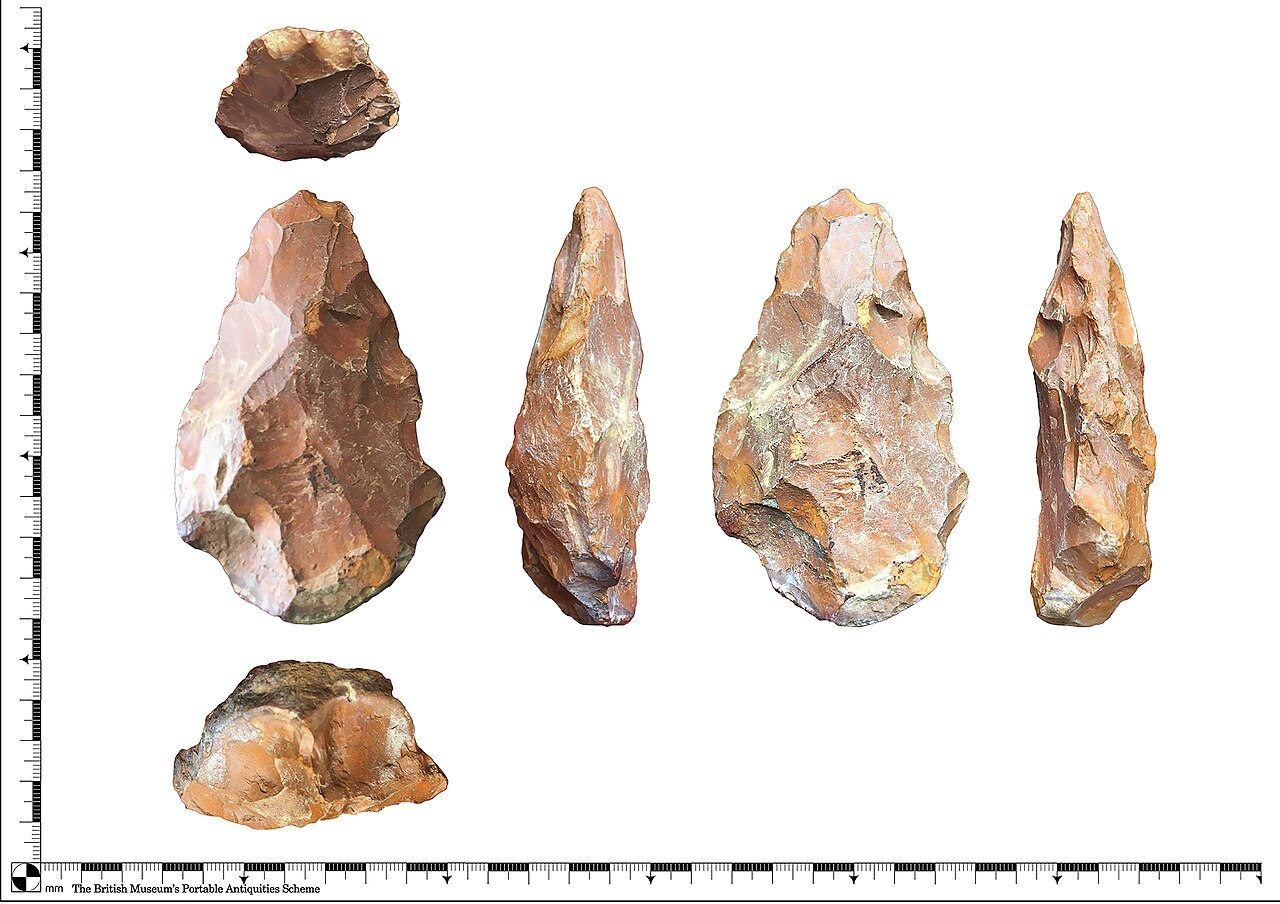

On the face of it, all you would need to do is strike two stones together.
That way you get random flakes, and probably a crushed finger. Getting a clean cutting edge, in the place you want it, requires knowing several things. It is the oldest technical knowledge to have left any trace.
A stone that breaks the right way
Not every rock will do. You need one with a very fine grain, which splits in a regular way instead of crumbling. Flint is one, but there are many others. When they break, they leave a curved, smooth surface, rather like the inside of a shell — prehistorians call this a conchoidal fracture.1
Next, you have to strike in the right place and at the right angle. The angle between the surface that is struck (the striking platform) and the face from which the flake is to come away matters a great deal: if it is badly chosen, nothing good comes off. Too flat, and nothing happens. Too close to the edge, and the stone shatters haphazardly.
The choice of hammer matters too. A hard stone does not give the same result as a soft stone or a piece of antler. You can strike directly, place an intermediate piece between the hammer and the stone, or press instead of striking (pressure).2
In the narrow zone where everything is right, the blow detaches a flake with an edge finer than a razor blade.
Knapping, then, is not bashing. It is choosing a material, taking aim, and knowing in advance what is going to happen.
Older than us
For a long time, it was thought that the first tools had been made by the first representatives of our genus, Homo. It was a fine story: the tool and the human appeared together.3
It even contained a second one, which is often forgotten: this technological development was supposedly brought about by climate change and the spread of savannah grasslands. Retreating forests, open spaces, ancestors forced to adapt — and the tool is born of constraint.4
In 2015, a team co-led by the archaeologist Sonia Harmand published the discovery of the site of Lomekwi 3, west of Lake Turkana, in Kenya. Stone tools were knapped there 3.3 million years ago.5
That is 700,000 years before the oldest tools known until then (Oldowan). Above all, it is before the appearance of the genus Homo.6
In other words, someone was knapping stone before us. Probably Australopithecus or Kenyanthropus.
The second part of the fine story falls too: the site lay in a wooded environment, not in an open savannah.7
This can be compared with our page on grasslands, which shows that forests and grasslands coexisted in a mosaic much earlier than was believed. Two different disciplines, the same story coming apart: that of our ancestors driven out of the trees by drought.
These tools — one hundred and forty-nine pieces — are also different. They are larger, more roughly knapped, and the traces show that the stone was held in both hands, or set on another stone serving as an anvil, before being struck.8
The authors are cautious in their own abstract: they write that these knappers had a developing understanding of stone’s fracture properties. Not mastery. Knowledge in the making.9
The fine story was false. The true one is more interesting: the tool does not wait for the human, it comes before it.
All that we no longer see
We call this period the “Stone Age”. The name is misleading.
These hominins did not live in a world of stone. They used wood, bark, plant fibres, hides, tendons, bone, shells. Doubtless far more than stone.
But organic matter rots. Only the stone remains.
So we name this period after the content of what has survived, rather as if archaeologists of the future, finding only our glass bins, decided that we lived in the Glass Age.
A very few wooden objects have escaped this fate. At Schöningen, in Germany, hunting spears of spruce and pine have been found, perfectly preserved in waterlogged sediment, next to the bones of wild horses.
Their age, moreover, has just been revised. They had been dated to about 300,000 years; a 2025 study, based on amino acid dating of the opercula of freshwater snails found in the same layers, puts them at around 200,000 years. They therefore date from the time of the early Neanderthals.10
They are enough to show what we have lost everywhere else.
How the gesture is recovered
Since objects do not speak, researchers have two methods.
The first is to do it again. You get hold of the same rock, sit down, and knap it again. By trying, you understand which gestures produce which traces. This is experimental archaeology.
The second is to look very closely. Under the microscope, an edge that has cut meat, wood or hide does not wear in the same way. This is use-wear analysis.11
To read these traces, researchers make replicas, use them on different materials, and record the marks obtained in order to build up a reference collection.
Then, when analysing an ancient tool, they can determine the movement made — scraping, cutting, piercing — the material worked, and sometimes whether the tool was hafted.
What remains, what is missing
| Material | Preservation | Level of knowledge |
|---|---|---|
| Knapped stone | Excellent (indefinite) | Very high |
| Bone and antler | Moderate to good depending on the soil | High |
| Wood | Very rare (anoxic/waterlogged settings) | Occasional but precise |
| Fibres, cordage, basketry | Exceptional cases only | Very low |
| Hides and leather | Exceptional cases only | Very low |
Note 1
The term conchoidal is used to describe fracture with smooth, curved surfaces that resemble the interior of a seashell; it is commonly observed in quartz and glass.
Encyclopædia Britannica, “Conchoidal fracture”, mise à jour le 24 June 2026
Note 2
On peut détacher un éclat en frappant ou en pressant. […] Le nucléus est débité soit au percuteur dur, soit au percuteur tendre par percussion directe ou indirecte. Dans ce dernier cas, on utilise une pièce intermédiaire posée sur le bord du nucléus
A flake can be detached by striking or by pressing. […] The core is reduced either with a hard hammer or with a soft hammer, by direct or indirect percussion. In the latter case, an intermediate piece placed on the edge of the core is used
Tixier, Jacques, “Préhistoire – La taille expérimentale des roches dures”, Encyclopædia Universalis, section “Les grandes lignes de la taille des roches dures”
Note 3
Human evolutionary scholars have long supposed that the earliest stone tools were made by the genus Homo
Harmand, Sonia et al., “3.3-Million-Year-Old Stone Tools from Lomekwi 3, West Turkana, Kenya”, Nature, vol. 521, 2015, p. 310-315
Note 4
and that this technological development was directly linked to climate change and the spread of savannah grasslands
Harmand, Sonia et al., “3.3-Million-Year-Old Stone Tools from Lomekwi 3, West Turkana, Kenya”, Nature, vol. 521, 2015, p. 310-315
Note 5
We report the discovery of Lomekwi 3, a 3.3-million-year-old archaeological site
Harmand, Sonia et al., “3.3-Million-Year-Old Stone Tools from Lomekwi 3, West Turkana, Kenya”, Nature, vol. 521, 2015, p. 310-315
Sonia Harmand and Jason Lewis, research professors with the Turkana Basin Institute (TBI) and Department of Anthropology at Stony Brook University and co-leaders of the West Turkana Archaeological Project (WTAP), learned that firsthand when they unearthed the earliest stone tools ever found, dated at 3.3 million years old.
Stony Brook University, “Stony Brook Scientists Discover Oldest Stone Tools on Record”, communiqué, 20 May 2015
Note 6
we propose for it the name 'Lomekwian', which predates the Oldowan by 700,000 years
Harmand, Sonia et al., “3.3-Million-Year-Old Stone Tools from Lomekwi 3, West Turkana, Kenya”, Nature, vol. 521, 2015, p. 310-315
Note 7
where in situ stone artefacts occur in spatiotemporal association with Pliocene hominin fossils in a wooded palaeoenvironment
Harmand, Sonia et al., “3.3-Million-Year-Old Stone Tools from Lomekwi 3, West Turkana, Kenya”, Nature, vol. 521, 2015, p. 310-315
Note 8
The assemblage includes 149 artefacts, with significant evidence of core reduction and battering activities.
Harmand, Sonia et al., “3.3-Million-Year-Old Stone Tools from Lomekwi 3, West Turkana, Kenya”, Nature, vol. 521, 2015, p. 310-315
Note 9
The Lomekwi 3 knappers, with a developing understanding of stone's fracture properties, combined core reduction with battering activities.
Harmand, Sonia et al., “3.3-Million-Year-Old Stone Tools from Lomekwi 3, West Turkana, Kenya”, Nature, vol. 521, 2015, p. 310-315
Note 10
Here, we report age estimates for the "Spear Horizon" based on amino acid geochronology of fossils obtained directly from the find-bearing deposits. Together with a reassessment of regional Middle Pleistocene chronostratigraphy, these data place the Schöningen spears at ~200,000 years. […] AAG data were obtained using a reverse-phase high-performance liquid chromatograph (RP-HPLC) from the intracrystalline fraction of four Bithynia tentaculata opercula (Table 2).
Hutson, Jarod M., Bittmann, Felix, Fischer, Peter et al., “Revised Age for Schöningen Hunting Spears Indicates Intensification of Neanderthal Cooperative Behavior around 200,000 Years Ago”, Science Advances, vol. 11, no. 19, eadv0752, 2025
After an earlier correction of the age of the famous hunting spears from 400,000 to 300,000 years, the new data show that the age of the Spear Horizon must be revised again by around 100,000 years to an age of 200,000 years. […] With its revised age, Schöningen now dates to the Middle Palaeolithic period and the time of early Neanderthals.
Leibniz-Zentrum für Archäologie and Johannes Gutenberg-Universität Mainz, communiqué du 12 May 2025 sur la révision de l’âge des épieux de Schöningen
Initial estimates placed the site at around 400,000 years; this age was later revised to roughly 300,000 years. Here, we report age estimates for the "Spear Horizon" based on amino acid geochronology of fossils obtained directly from the find-bearing deposits. Together with a reassessment of regional Middle Pleistocene chronostratigraphy, these data place the Schöningen spears at ~200,000 years.
Hutson, Jarod M., Bittmann, Felix, Fischer, Peter et al., “Revised Age for Schöningen Hunting Spears Indicates Intensification of Neanderthal Cooperative Behavior around 200,000 Years Ago”, Science Advances, vol. 11, no. 19, eadv0752, 2025
Note 11
L'expérimentation permet au tracéologue, en reproduisant les gestes passés, d'interpréter les traces qu'il observe sur les objets archéologiques. […] Le tracéologue étudie les traces d'usure sur les objets archéologiques : outils, armatures, parures, récipients… […] Ensuite les traces sont recherchées à l'œil nu, puis à plusieurs niveaux de grossissement : loupe binoculaire (10 à 40 fois), microscope métallographique (50 à 500 fois), voire microscope électronique à balayage (jusqu'à 10 000 fois).
By reproducing past gestures, experimentation allows the use-wear analyst to interpret the traces he observes on archaeological objects. […] The use-wear analyst studies the traces of wear on archaeological objects: tools, projectile points, ornaments, vessels… […] The traces are then looked for with the naked eye, then at several levels of magnification: binocular magnifier (10 to 40 times), metallographic microscope (50 to 500 times), or even scanning electron microscope (up to 10,000 times).
Institut national de recherches archéologiques préventives, fiche thématique sur la tracéologie et l’archéologie expérimentale
Notes and sources
- ↑
Passage When they break, they leave a curved, smooth surface […] a conchoidal fracture.
The term conchoidal is used to describe fracture with smooth, curved surfaces that resemble the interior of a seashell; it is commonly observed in quartz and glass.
Source Encyclopædia Britannica, “Conchoidal fracture”, mise à jour le 24 June 2026, definition at the top of the page (taken from the article “mineral”, part “Cleavage and fracture”).
Open access open the source · checked on 24 October 2026
- ↑
Passage You can strike directly, place an intermediate piece between the hammer and the stone, or press instead of striking
On peut détacher un éclat en frappant ou en pressant. […] Le nucléus est débité soit au percuteur dur, soit au percuteur tendre par percussion directe ou indirecte. Dans ce dernier cas, on utilise une pièce intermédiaire posée sur le bord du nucléus
Editors’ translation A flake can be detached by striking or by pressing. […] The core is reduced either with a hard hammer or with a soft hammer, by direct or indirect percussion. In the latter case, an intermediate piece placed on the edge of the core is used
Source Tixier, Jacques, “Préhistoire – La taille expérimentale des roches dures”, Encyclopædia Universalis, section “Les grandes lignes de la taille des roches dures”, section 4, “Les grandes lignes de la taille des roches dures”.
Paywalled open the source · checked on 24 October 2026
- ↑
Passage it was thought that the first tools had been made by the first representatives of our genus, Homo
Human evolutionary scholars have long supposed that the earliest stone tools were made by the genus Homo
Source Harmand, Sonia et al., “3.3-Million-Year-Old Stone Tools from Lomekwi 3, West Turkana, Kenya”, Nature, vol. 521, 2015, p. 310-315, abstract.
Paywalled open the source · checked on 9 September 2026
- ↑
Passage this technological development was supposedly brought about by climate change and the spread of savannah grasslands
and that this technological development was directly linked to climate change and the spread of savannah grasslands
Source Harmand, Sonia et al., “3.3-Million-Year-Old Stone Tools from Lomekwi 3, West Turkana, Kenya”, Nature, vol. 521, 2015, p. 310-315, abstract.
Paywalled open the source · checked on 9 September 2026
- ↑
Passage Stone tools were knapped there 3.3 million years ago.
We report the discovery of Lomekwi 3, a 3.3-million-year-old archaeological site
Source Harmand, Sonia et al., “3.3-Million-Year-Old Stone Tools from Lomekwi 3, West Turkana, Kenya”, Nature, vol. 521, 2015, p. 310-315, abstract.
Paywalled open the source · checked on 9 September 2026
Passage In 2015, a team co-led by the archaeologist Sonia Harmand published the discovery
Sonia Harmand and Jason Lewis, research professors with the Turkana Basin Institute (TBI) and Department of Anthropology at Stony Brook University and co-leaders of the West Turkana Archaeological Project (WTAP), learned that firsthand when they unearthed the earliest stone tools ever found, dated at 3.3 million years old.
Source Stony Brook University, “Stony Brook Scientists Discover Oldest Stone Tools on Record”, communiqué, 20 May 2015, second sentence of the press release.
Open access open the source · checked on 9 September 2026
- ↑
Passage That is 700,000 years before the oldest tools known until then
we propose for it the name 'Lomekwian', which predates the Oldowan by 700,000 years
Source Harmand, Sonia et al., “3.3-Million-Year-Old Stone Tools from Lomekwi 3, West Turkana, Kenya”, Nature, vol. 521, 2015, p. 310-315, abstract.
Paywalled open the source · checked on 9 September 2026
- ↑
Passage the site lay in a wooded environment, not in an open savannah
where in situ stone artefacts occur in spatiotemporal association with Pliocene hominin fossils in a wooded palaeoenvironment
Source Harmand, Sonia et al., “3.3-Million-Year-Old Stone Tools from Lomekwi 3, West Turkana, Kenya”, Nature, vol. 521, 2015, p. 310-315, abstract.
Paywalled open the source · checked on 9 September 2026
- ↑
Passage These tools — one hundred and forty-nine pieces — are also different.
The assemblage includes 149 artefacts, with significant evidence of core reduction and battering activities.
Source Harmand, Sonia et al., “3.3-Million-Year-Old Stone Tools from Lomekwi 3, West Turkana, Kenya”, Nature, vol. 521, 2015, p. 310-315, presentation of the article.
Paywalled open the source · checked on 9 September 2026
- ↑
Passage these knappers had a developing understanding of stone’s fracture properties
The Lomekwi 3 knappers, with a developing understanding of stone's fracture properties, combined core reduction with battering activities.
Source Harmand, Sonia et al., “3.3-Million-Year-Old Stone Tools from Lomekwi 3, West Turkana, Kenya”, Nature, vol. 521, 2015, p. 310-315, abstract.
Paywalled open the source · checked on 9 September 2026
- ↑
Passage a 2025 study, based on amino acid dating of the opercula of freshwater snails […] puts them at around 200,000 years
Here, we report age estimates for the "Spear Horizon" based on amino acid geochronology of fossils obtained directly from the find-bearing deposits. Together with a reassessment of regional Middle Pleistocene chronostratigraphy, these data place the Schöningen spears at ~200,000 years. […] AAG data were obtained using a reverse-phase high-performance liquid chromatograph (RP-HPLC) from the intracrystalline fraction of four Bithynia tentaculata opercula (Table 2).
Source Hutson, Jarod M., Bittmann, Felix, Fischer, Peter et al., “Revised Age for Schöningen Hunting Spears Indicates Intensification of Neanderthal Cooperative Behavior around 200,000 Years Ago”, Science Advances, vol. 11, no. 19, eadv0752, 2025, abstract; section “Results”.
Open access open the source · checked on 24 October 2026
Passage They therefore date from the time of the early Neanderthals.
After an earlier correction of the age of the famous hunting spears from 400,000 to 300,000 years, the new data show that the age of the Spear Horizon must be revised again by around 100,000 years to an age of 200,000 years. […] With its revised age, Schöningen now dates to the Middle Palaeolithic period and the time of early Neanderthals.
Source Leibniz-Zentrum für Archäologie and Johannes Gutenberg-Universität Mainz, communiqué du 12 May 2025 sur la révision de l’âge des épieux de Schöningen, joint LEIZA / JGU Mainz press release of 12 May 2025: beginning of the release, then the part on human evolution.
Open access · checked on 24 October 2026
Passage They had been dated to about 300,000 years; a 2025 study […] puts them at around 200,000 years
Initial estimates placed the site at around 400,000 years; this age was later revised to roughly 300,000 years. Here, we report age estimates for the "Spear Horizon" based on amino acid geochronology of fossils obtained directly from the find-bearing deposits. Together with a reassessment of regional Middle Pleistocene chronostratigraphy, these data place the Schöningen spears at ~200,000 years.
Source Hutson, Jarod M., Bittmann, Felix, Fischer, Peter et al., “Revised Age for Schöningen Hunting Spears Indicates Intensification of Neanderthal Cooperative Behavior around 200,000 Years Ago”, Science Advances, vol. 11, no. 19, eadv0752, 2025, abstract.
Open access open the source · checked on 24 October 2026
- ↑
Passage The first is to do it again […] This is experimental archaeology. The second is to look very closely […] This is use-wear analysis.
L'expérimentation permet au tracéologue, en reproduisant les gestes passés, d'interpréter les traces qu'il observe sur les objets archéologiques. […] Le tracéologue étudie les traces d'usure sur les objets archéologiques : outils, armatures, parures, récipients… […] Ensuite les traces sont recherchées à l'œil nu, puis à plusieurs niveaux de grossissement : loupe binoculaire (10 à 40 fois), microscope métallographique (50 à 500 fois), voire microscope électronique à balayage (jusqu'à 10 000 fois).
Editors’ translation By reproducing past gestures, experimentation allows the use-wear analyst to interpret the traces he observes on archaeological objects. […] The use-wear analyst studies the traces of wear on archaeological objects: tools, projectile points, ornaments, vessels… […] The traces are then looked for with the naked eye, then at several levels of magnification: binocular magnifier (10 to 40 times), metallographic microscope (50 to 500 times), or even scanning electron microscope (up to 10,000 times).
Source Institut national de recherches archéologiques préventives, fiche thématique sur la tracéologie et l’archéologie expérimentale, caption of the experimentation photo; section “La tracéologie”; section “Les différentes échelles d’observations”.
Open access open the source · checked on 24 October 2026
Bibliography
7
- Encyclopædia Britannica, “Conchoidal fracture”, mise à jour le 24 June 2026, open access (conchoidal fracture: smooth, curved surfaces that resemble the inside of a shell). https://www.britannica.com/science/conchoidal-fracture
- Harmand, Sonia et al., “3.3-Million-Year-Old Stone Tools from Lomekwi 3, West Turkana, Kenya”, Nature, vol. 521, 2015, p. 310-315, paywalled (the former hypothesis linking the first tools to the genus Homo and to the spread of savannahs; the site dated to 3.3 million years in a wooded environment; the one hundred and forty-nine pieces; a developing understanding of fracture properties; the 700,000-year precedence over the Oldowan). https://doi.org/10.1038/nature14464
- Hutson, Jarod M., Bittmann, Felix, Fischer, Peter et al., “Revised Age for Schöningen Hunting Spears Indicates Intensification of Neanderthal Cooperative Behavior around 200,000 Years Ago”, Science Advances, vol. 11, no. 19, eadv0752, 2025, open access (amino acid dating of freshwater snail opercula, the revised age and the attribution to Neanderthals). https://doi.org/10.1126/sciadv.adv0752
- Institut national de recherches archéologiques préventives, fiche thématique sur la tracéologie et l’archéologie expérimentale, open access. https://www.inrap.fr/
- Leibniz-Zentrum für Archäologie and Johannes Gutenberg-Universität Mainz, communiqué du 12 May 2025 sur la révision de l’âge des épieux de Schöningen, open access.
- Stony Brook University, “Stony Brook Scientists Discover Oldest Stone Tools on Record”, communiqué, 20 May 2015, open access (Sonia Harmand and Jason Lewis, co-leaders of the West Turkana Archaeological Project, discoverers of the 3.3-million-year-old tools). https://news.stonybrookmedicine.edu/news/stony-brook-scientists-discover-oldest-stone-tools-on-record-2/
- Tixier, Jacques, “Préhistoire – La taille expérimentale des roches dures”, Encyclopædia Universalis, section “Les grandes lignes de la taille des roches dures”, paywalled, beginning of the section freely readable (direct or indirect percussion, with an intermediate piece, with a hard or soft hammer, and detachment by pressure). https://www.universalis.fr/encyclopedie/prehistoire-la-taille-experimentale-des-roches-dures/4-les-grandes-lignes-de-la-taille-des-roches-dures/
Spotted an error or have a doubt? Write to us.