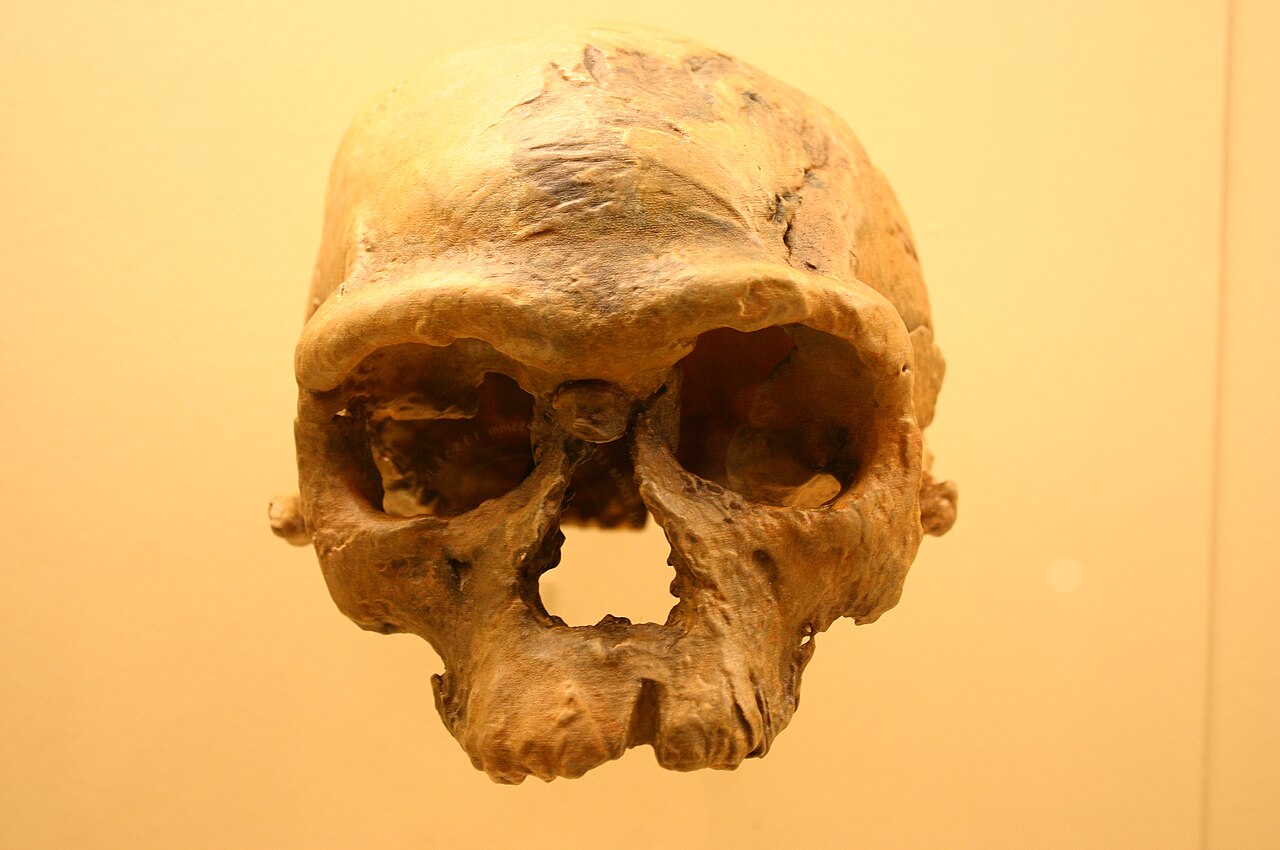

In 1961, Moroccan miners looking for barite uncovered a skull. It is almost complete, which is extremely rare.
This fossil has not changed by a single millimetre. We, on the other hand, have changed our minds about it three times.1
Where we come from
Our species is called Homo sapiens. It belongs to a genus, Homo, that has included several species — and this is the first point to correct: for almost all of history, several human species lived at the same time. There is only one human species today, and that is an exceptional situation, not the rule.
The lineage that leads to us split from that of chimpanzees about seven million years ago, in Africa. What appears first is neither the large brain nor tools: it is bipedalism, walking upright. The brain grew much later, and the oldest known knapped stone tools, discovered at Lomekwi in Kenya, date to about 3.3 million years ago — whereas the first tools were thought to have been made by the genus Homo.2
Homo sapiens appeared in Africa, and this is where the skull comes in: the Moroccan fossils this page deals with are now dated to about 315,000 years ago, which makes them the oldest attributed to our species. Previously, this appearance was placed at around 200,000 years ago and in East Africa only.3
Other humans lived at the same time. Neanderthals occupied Europe and western Asia; Denisovans, known mainly from their DNA, occupied Asia; still other species existed in Indonesia and the Philippines.
Leaving, and mixing
Groups of Homo sapiens left Africa on several occasions. The departure that populated the rest of the world dates to about 50,000 to 70,000 years ago; recent genetic work tends to place it towards the lower end of this range. Step by step, over thousands of years, these populations reached Asia, Australia (at least 50,000 years ago, and perhaps 65,000 according to a site in the north of the continent whose dating remains disputed, which in any case implies sea crossings), Europe, then the Americas via north-east Asia.4
These groups met the other humans, and they had children with them. This is not a hypothesis: it can be read in the DNA of living people.
Humans whose ancestors did not stay in Africa carry Neanderthal DNA. In what proportion? Estimates hover around 2%, but they vary with the methods and the populations: the sequencing of a complete Neanderthal genome, in 2014, gave a range of 1.5 to 2.1%, later revised to 1.8-2.6% outside Oceania. Some populations in Asia and Oceania also carry Denisovan DNA.5
This is the detail that makes the figure so interesting. At the time of interbreeding, the proportion was probably greater than 5%.6
Much of this DNA has therefore since disappeared from genomes. Not by chance: selection removed it mainly from the parts of the genome that have a function, over the generations.7
What remains is not what was passed on. It is what survived the sorting.
It is the shape of this story that should be remembered. It is not a straight line running from ape to human, nor a ladder on which each species replaces the one before. It is a bush: lineages that split, coexist, interbreed again, and almost all die out. We are the only remaining branch — and we carry, in our cells, the trace of those that have disappeared.
Three readings of the same object
- First reading (1961): The skull has a large cranial capacity, but an elongated shape. The conclusion is that it is an African Neanderthal.
- Second reading (2007): A tooth is dated to about 160,000 years ago. The skull becomes the late remnant of a species older than ours that survived in Morocco.
- Third reading (2017): New excavations at the Jebel Irhoud site, led by Jean-Jacques Hublin’s team, yield new human fossils — in all, the site has yielded the remains of at least five people, including a child and an adolescent — as well as flint tools and animal bones. The date is overturned: about 315,000 years.8
And this figure does not rest on a single measurement. The flints had been heated in fire: the moment of that heating can therefore be dated. Fourteen measurements were made; for the fossil layer, their average gives 315,000 years, give or take 34,000 years. A different method, applied to a tooth, gives 286,000 years. And the animal species found at the site — zebra, leopard, antelope — are consistent with these ages.9
Three independent lines, three results that converge. This is how a date becomes solid: not because a device displayed it, but because several unrelated methods arrive at the same result.
Its face, apart from a few minor differences, is already ours. It looks enough like that of a present-day human to go unnoticed in the street today, although its braincase retains a more elongated shape.10
What this changes (and what it does not)
The conclusion calls for caution: it is more subtle than it seems.
This does not mean that “the cradle of humanity is in Morocco”.
The overall map looks like this:
- North (Morocco): 315,000 years
- East (Ethiopia): at least 233,000 years (the figure given was about 197,000 until a new dating in 2022)
- South (South Africa): about 260,000 years, the age of a Florisbad tooth assumed to belong with the skull, a link since called into question11
Our species does not spring from a single point: it takes shape across the entire continent, through movements and encounters between isolated groups.12
During certain humid periods, the Sahara turned green again: lakes and rivers offered passages where there is desert today.13
Methodological note: the exact classification of the Jebel Irhoud fossils as “fully fledged Homo sapiens” is still debated within the scientific community.14
What to remember
Back to the 1961 skull. It has not changed. What has evolved are the dating tools and the network of comparison.
Against the idea that “scientists change their minds all the time”, one point must be made: each of the three readings was the best interpretation possible with the data of the time.
A date that moves back is not an error being corrected. It is an instrument being refined.
What has disappeared
Stone is preserved. Bones, sometimes. Wood, fibres, skins, ropes and baskets: almost never.
We call this era “the Stone Age”. This name does not describe the reality of the objects that were made, but the nature of the materials that have survived. The humans of the Palaeolithic worked above all with plant and animal materials.
Likewise, saying that they “wandered” or “gathered” denies them any strategy. In reality, they shaped their environment — notably through controlled fire, which stimulated plant regrowth and attracted game.
Note 1
An almost complete skull (Irhoud 1) was accidentally unearthed in 1961, prompting excavations […]. The interpretation of the Irhoud hominins has long been complicated by persistent uncertainties surrounding their geological age. They were initially assigned to a time period ca. 40 ka ago and considered to be an African form of Neanderthal9. […] An attempt to date one of the hominins directly by U series-ESR3 suggested an age of 160 ± 16 ka13. […] It has therefore been suggested that the archaic features of the Irhoud fossils may indicate that North African H. sapiens interbred with Neanderthals17, or that the Irhoud hominins represented a North African, late surviving, archaic population18. New excavations at Irhoud have recovered in situ archaeological material and established a precise chronology for the deposits, which are much older than previously thought3.
Hublin, Jean-Jacques et al., “New Fossils from Jebel Irhoud, Morocco, and the Pan-African Origin of Homo sapiens*”, *Nature, vol. 546, 8 June 2017, p. 289-292, author’s accepted manuscript (Kent Academic Repository)
Note 2
We report the discovery of Lomekwi 3, a 3.3-million-year-old archaeological site where in situ stone artefacts occur in spatiotemporal association with Pliocene hominin fossils in a wooded palaeoenvironment.
Harmand, Sonia et al., “3.3-Million-Year-Old Stone Tools from Lomekwi 3, West Turkana, Kenya”, Nature, vol. 521, no. 7552, 2015, p. 310-315
Human evolutionary scholars have long supposed that the earliest stone tools were made by the genus Homo […] We report the discovery of Lomekwi 3, a 3.3-million-year-old archaeological site where in situ stone artefacts occur in spatiotemporal association with Pliocene hominin fossils in a wooded palaeoenvironment. […] we propose for it the name 'Lomekwian', which predates the Oldowan by 700,000 years and marks a new beginning to the known archaeological record.
Harmand, Sonia et al., “3.3-Million-Year-Old Stone Tools from Lomekwi 3, West Turkana, Kenya”, Nature, vol. 521, no. 7552, 2015, p. 310-315
Note 3
an age of 315 ± 34 thousand years […] makes Jebel Irhoud the oldest and richest African Middle Stone Age hominin site that documents early stages of the H. sapiens clade
Hublin, Jean-Jacques et al., “New Fossils from Jebel Irhoud, Morocco, and the Pan-African Origin of Homo sapiens*”, *Nature, vol. 546, 8 June 2017, p. 289-292
Consistent with some genetic evidence14, fossils from Ethiopia (Omo Kibish is considered to be as old as approximately 195 kyr (ref. 15) and Herto has been dated to approximately 160 thousand years ago (ka)16) are commonly regarded as the first early anatomically modern humans (EMH).
Hublin, Jean-Jacques et al., “New Fossils from Jebel Irhoud, Morocco, and the Pan-African Origin of Homo sapiens*”, *Nature, vol. 546, 8 June 2017, p. 289-292
it is unclear whether the present day 'modern' morphology rapidly emerged approximately 200 thousand years ago (ka) among earlier representatives of H. sapiens or evolved gradually over the last 400 thousand years
Hublin, Jean-Jacques et al., “New Fossils from Jebel Irhoud, Morocco, and the Pan-African Origin of Homo sapiens*”, *Nature, vol. 546, 8 June 2017, p. 289-292
In combination with an age of 315±34 thousand years (as determined by thermoluminescence dating)3, this evidence makes Jebel Irhoud the oldest and richest African Middle Stone Age hominin site that documents early stages of the H. sapiens clade in which key features of modern morphology were established.
Hublin, Jean-Jacques et al., “New Fossils from Jebel Irhoud, Morocco, and the Pan-African Origin of Homo sapiens*”, *Nature, vol. 546, 8 June 2017, p. 289-292
Note 4
Here we report the results of new excavations conducted at Madjedbebe, a rock shelter in northern Australia. […] Human occupation began around 65,000 years ago, with a distinctive stone tool assemblage including grinding stones, ground ochres, reflective additives and ground-edge hatchet heads.
Clarkson, Chris et al., “Human Occupation of Northern Australia by 65,000 Years Ago”, Nature, vol. 547, no. 7663, 2017, p. 306-310
Note 5
Using the high-coverage Neandertal genome in conjunction with the two other Neandertal genomes, we now estimate that the proportion of Neandertal-derived DNA in people outside Africa is 1.5–2.1%
Prüfer, Kay, Racimo, Fernando, Patterson, Nick et al., “The Complete Genome Sequence of a Neanderthal from the Altai Mountains”, Nature, vol. 505, 2014, p. 43-49, open access
We find that non-African populations outside Oceania carry between 1.8-2.6% Neandertal DNA (Fig. 4A), higher than previous estimates of 1.5-2.1% (2).
Prüfer, Kay, de Filippo, Cesare, Grote, Steffi et al., “A High-Coverage Neandertal Genome from Vindija Cave in Croatia”, Science, vol. 358, no. 6363, 2017, p. 655-658, open access
Note 6
the initial introgression pulse was likely greater than 5% […], indicating that much of the Neanderthal DNA was purged from modern human genomes
Pfennig, Aaron and Lachance, Joseph, “Limited Selection on Neanderthal DNA in 30,780 Recently Admixed Genomes with African-like Ancestry”, Molecular Biology and Evolution, vol. 43, no. 7, 2026, open access
Note 7
much of the Neanderthal DNA was purged from modern human genomes. […] Observations that this purging was particularly pronounced from functional genomic elements
Pfennig, Aaron and Lachance, Joseph, “Limited Selection on Neanderthal DNA in 30,780 Recently Admixed Genomes with African-like Ancestry”, Molecular Biology and Evolution, vol. 43, no. 7, 2026, open access
Note 8
An almost complete skull (Irhoud 1) was accidentally unearthed in 1961 […] They were initially considered to be around 40 thousand years (kyr) old and an African form of Neanderthals9.
Hublin, Jean-Jacques et al., “New Fossils from Jebel Irhoud, Morocco, and the Pan-African Origin of Homo sapiens*”, *Nature, vol. 546, 8 June 2017, p. 289-292
Here, an application of x-ray synchrotron microtomography reveals that an early Homo sapiens juvenile from Morocco dated at 160,000 years before present displays an equivalent degree of tooth development to modern European children at the same age. […] Recent direct uranium series/electron spin resonance dates on the specimen confirm earlier dates, suggesting an age of 160,000 ± 16,000 ybp
Smith, Tanya M. et al., “Earliest Evidence of Modern Human Life History in North African Early Homo sapiens*”, *Proceedings of the National Academy of Sciences, vol. 104, 2007, p. 6128-6133
New excavations at Irhoud have enabled the recovery of in situ archaeological material and the establishment of a precise chronology of the deposits, which are much older than previously thought3. The excavation yielded a new series of hominin remains, including an adult skull (Irhoud 10) comprising a distorted braincase and fragments of the face (Fig. 1), a nearly complete adult mandible (Irhoud 11) (Fig. 2), one maxilla, several postcranial elements and abundant dental material (Extended Data Table 1). […] This concentration, stratigraphic observations made by previous excavators and the anatomical similarity with earlier discoveries strongly suggest that most, if not all, of the hominin remains from the site were accumulated in a rather constrained window of time corresponding to the formation of layer 7. This layer contains the remains of at least five individuals (three adults, one adolescent and one immature individual, around 7.5 years old).
Hublin, Jean-Jacques et al., “New Fossils from Jebel Irhoud, Morocco, and the Pan-African Origin of Homo sapiens*”, *Nature, vol. 546, 8 June 2017, p. 289-292
an age of 315 ± 34 thousand years (as determined by thermoluminescence dating)
Hublin, Jean-Jacques et al., “New Fossils from Jebel Irhoud, Morocco, and the Pan-African Origin of Homo sapiens*”, *Nature, vol. 546, 8 June 2017, p. 289-292
This layer contains the remains of at least five individuals (three adults, one adolescent and one immature individual, around 7.5 years old).
Hublin, Jean-Jacques et al., “New Fossils from Jebel Irhoud, Morocco, and the Pan-African Origin of Homo sapiens*”, *Nature, vol. 546, 8 June 2017, p. 289-292
Note 9
Here we report the ages, determined by thermoluminescence dating, of fire-heated flint artefacts obtained from new excavations at the Middle Stone Age site of Jebel Irhoud, Morocco, which are directly associated with newly discovered remains of H. sapiens8. […] the high percentage of visibly (37%) heated flint artefacts allows thermoluminescence dating of the archaeological assemblage and associated human remains.
Richter, Daniel et al., “The Age of the Hominin Fossils from Jebel Irhoud, Morocco, and the Origins of the Middle Stone Age”, Nature, vol. 546, 8 June 2017, p. 293-296
except for one tooth (Irhoud-1653), all the newly discovered hominins8 come from layer 7 (Fig. 2). […] A total of 14 ages, as determined by thermoluminescence dating, were obtained (Table 1 and Extended Data Table 2). […] Sample sizes are sufficient23 for calculating weighted average ages for layers 6 and 7 and yield ages of 302±32 ka and 315±34 ka, respectively.
Richter, Daniel et al., “The Age of the Hominin Fossils from Jebel Irhoud, Morocco, and the Origins of the Middle Stone Age”, Nature, vol. 546, 8 June 2017, p. 293-296
Support is obtained through the recalculated uranium series with electron spin resonance date of 286±32 thousand years ago for a tooth from the Irhoud 3 hominin mandible.
Richter, Daniel et al., “The Age of the Hominin Fossils from Jebel Irhoud, Morocco, and the Origins of the Middle Stone Age”, Nature, vol. 546, 8 June 2017, p. 293-296
These ages are also consistent with the faunal and microfaunal9 assemblages […] The fauna are dominated by remains of gazelle (Gazella sp.), but Equidae (zebras) and Alcelaphini (wildebeest and hartebeest) remains are also present (Supplementary Information). The faunal assemblage preserves a diversity of carnivores; leopards (Panthera pardus) are most common
Richter, Daniel et al., “The Age of the Hominin Fossils from Jebel Irhoud, Morocco, and the Origins of the Middle Stone Age”, Nature, vol. 546, 8 June 2017, p. 293-296
Note 10
In contrast to their modern facial morphology, the Irhoud crania retain a primitive overall shape of the braincase and endocast, that is, unlike those of RMH, they are elongated and not globular10,18,22. […] Even approximately 300 ka ago their facial morphology is almost indistinguishable from that of RMH
Hublin, Jean-Jacques et al., “New Fossils from Jebel Irhoud, Morocco, and the Pan-African Origin of Homo sapiens*”, *Nature, vol. 546, 8 June 2017, p. 289-292
Note 11
The earliest Homo sapiens fossils are found across the entire African continent: Jebel Irhoud, Morocco (300 thousand years), Florisbad, South Africa (260 thousand years), and Omo Kibish, Ethiopia (195 thousand years).
Max Planck Institute for Evolutionary Anthropology and INSAP, “The First of Our Kind: Scientists Discover the Oldest Homo sapiens Fossils at Jebel Irhoud, Morocco”, communiqué de presse, 7 June 2017
The most anatomically informative hominin specimen from Florisbad is a fragmentary craniofacial specimen, […] which has been assumed to derive from the same individual as this tooth. […] We find that the contemporary records raise doubt about the contemporaneity of the tooth and calvaria.
Berger, Lee R. and Hawks, John, “Revisiting the Age of the Florisbad Hominin Material”, HOMO, vol. 74, no. 1, 2023, p. 55-60
Efforts to date the oldest modern human fossils in eastern Africa, from Omo-Kibish1–3 and Herto4,5 in Ethiopia, have drawn on a variety of chronometric evidence, including 40Ar/39Ar ages of stratigraphically associated tuffs. […] By dating the proximal deposits of this eruption, we obtain a new minimum age for the Omo fossils of 233 ± 22 kyr.
Vidal, Céline M. et al., “Age of the Oldest Known Homo sapiens from Eastern Africa”, Nature, vol. 601, 2022, p. 579-583
By dating the proximal deposits of this eruption, we obtain a new minimum age for the Omo fossils of 233 ± 22 kyr.
Vidal, Céline M. et al., “Age of the Oldest Known Homo sapiens from Eastern Africa”, Nature, vol. 601, 2022, p. 579-583
Even approximately 300 ka ago their facial morphology is almost indistinguishable from that of RMH, corroborating the interpretation of the fragmentary specimen from Florisbad (South Africa) as a primitive H. sapiens tentatively dated to 260 ka (ref. 24).
Hublin, Jean-Jacques et al., “New Fossils from Jebel Irhoud, Morocco, and the Pan-African Origin of Homo sapiens*”, *Nature, vol. 546, 8 June 2017, p. 289-292
The ages that are generally reported for these fossils are around 197 thousand years (kyr) for the Kibish Omo I3,6,7, and around 160–155 kyr for the Herto hominins5,8. […] By dating the proximal deposits of this eruption, we obtain a new minimum age for the Omo fossils of 233 ± 22 kyr.
Vidal, Céline M. et al., “Age of the Oldest Known Homo sapiens from Eastern Africa”, Nature, vol. 601, 2022, p. 579-583
Note 12
it shows that the evolutionary processes behind the emergence of H. sapiens involved the whole African continent
Hublin, Jean-Jacques et al., “New Fossils from Jebel Irhoud, Morocco, and the Pan-African Origin of Homo sapiens*”, *Nature, vol. 546, 8 June 2017, p. 289-292
We used to think that there was a cradle of mankind 200 thousand years ago in east Africa, but our new data reveal that Homo sapiens spread across the entire African continent around 300 thousand years ago
Max Planck Institute for Evolutionary Anthropology and INSAP, “The First of Our Kind: Scientists Discover the Oldest Homo sapiens Fossils at Jebel Irhoud, Morocco”, communiqué de presse, 7 June 2017
Note 13
At the same time that the monsoon migrated northwards, the Sahara contracted, and networks of lakes and rivers expanded across much of north Africa, with matching conditions in parts of southwest Asia.
Scerri, Eleanor M. L. et al., “Did Our Species Evolve in Subdivided Populations across Africa, and Why Does It Matter?”, Trends in Ecology & Evolution, vol. 33, 2018, p. 582-594
Note 14
This diversity has led some researchers to propose that fossils such as Jebel Irhoud and Florisbad actually represent a more primitive species called ‘H. helmei’ […] However, we view H. sapiens as an evolving lineage with deep African roots, and therefore prefer to recognize such fossils as part of the diversity shown by early members of the H. sapiens clade.
Scerri, Eleanor M. L. et al., “Did Our Species Evolve in Subdivided Populations across Africa, and Why Does It Matter?”, Trends in Ecology & Evolution, vol. 33, 2018, p. 582-594
Notes and sources
- ↑
Passage This fossil has not changed by a single millimetre. We, on the other hand, have changed our minds about it three times.
An almost complete skull (Irhoud 1) was accidentally unearthed in 1961, prompting excavations […]. The interpretation of the Irhoud hominins has long been complicated by persistent uncertainties surrounding their geological age. They were initially assigned to a time period ca. 40 ka ago and considered to be an African form of Neanderthal9. […] An attempt to date one of the hominins directly by U series-ESR3 suggested an age of 160 ± 16 ka13. […] It has therefore been suggested that the archaic features of the Irhoud fossils may indicate that North African H. sapiens interbred with Neanderthals17, or that the Irhoud hominins represented a North African, late surviving, archaic population18. New excavations at Irhoud have recovered in situ archaeological material and established a precise chronology for the deposits, which are much older than previously thought3.
Source Hublin, Jean-Jacques et al., “New Fossils from Jebel Irhoud, Morocco, and the Pan-African Origin of Homo sapiens*”, *Nature, vol. 546, 8 June 2017, p. 289-292, author’s accepted manuscript (Kent Academic Repository), author’s accepted manuscript (Kent Academic Repository), 1st to 3rd paragraphs of the main text (ll. 46-69 of the manuscript).
Open access open the source · checked on 27 October 2026
- ↑
Passage the oldest known knapped stone tools, discovered at Lomekwi in Kenya, date to about 3.3 million years ago
We report the discovery of Lomekwi 3, a 3.3-million-year-old archaeological site where in situ stone artefacts occur in spatiotemporal association with Pliocene hominin fossils in a wooded palaeoenvironment.
Source Harmand, Sonia et al., “3.3-Million-Year-Old Stone Tools from Lomekwi 3, West Turkana, Kenya”, Nature, vol. 521, no. 7552, 2015, p. 310-315, abstract.
Paywalled open the source · checked on 25 October 2026
Passage the oldest known knapped stone tools, discovered at Lomekwi in Kenya, date to about 3.3 million years ago — whereas the first tools were thought to have been made by the genus Homo.
Human evolutionary scholars have long supposed that the earliest stone tools were made by the genus Homo […] We report the discovery of Lomekwi 3, a 3.3-million-year-old archaeological site where in situ stone artefacts occur in spatiotemporal association with Pliocene hominin fossils in a wooded palaeoenvironment. […] we propose for it the name 'Lomekwian', which predates the Oldowan by 700,000 years and marks a new beginning to the known archaeological record.
Source Harmand, Sonia et al., “3.3-Million-Year-Old Stone Tools from Lomekwi 3, West Turkana, Kenya”, Nature, vol. 521, no. 7552, 2015, p. 310-315, abstract (first, third and last sentences).
Paywalled open the source · checked on 25 October 2026
- ↑
Passage the Moroccan fossils […] are now dated to about 315,000 years ago, which makes them the oldest attributed to our species
an age of 315 ± 34 thousand years […] makes Jebel Irhoud the oldest and richest African Middle Stone Age hominin site that documents early stages of the H. sapiens clade
Source Hublin, Jean-Jacques et al., “New Fossils from Jebel Irhoud, Morocco, and the Pan-African Origin of Homo sapiens*”, *Nature, vol. 546, 8 June 2017, p. 289-292, abstract.
Paywalled open the source · checked on 9 September 2026
Passage Previously, this appearance was placed at around 200,000 years ago and in East Africa only
Consistent with some genetic evidence14, fossils from Ethiopia (Omo Kibish is considered to be as old as approximately 195 kyr (ref. 15) and Herto has been dated to approximately 160 thousand years ago (ka)16) are commonly regarded as the first early anatomically modern humans (EMH).
Source Hublin, Jean-Jacques et al., “New Fossils from Jebel Irhoud, Morocco, and the Pan-African Origin of Homo sapiens*”, *Nature, vol. 546, 8 June 2017, p. 289-292, introduction, p. 289.
Paywalled open the source · checked on 9 September 2026
Passage Previously, this appearance was placed at around 200,000 years ago
it is unclear whether the present day 'modern' morphology rapidly emerged approximately 200 thousand years ago (ka) among earlier representatives of H. sapiens or evolved gradually over the last 400 thousand years
Source Hublin, Jean-Jacques et al., “New Fossils from Jebel Irhoud, Morocco, and the Pan-African Origin of Homo sapiens*”, *Nature, vol. 546, 8 June 2017, p. 289-292, abstract.
Paywalled open the source · checked on 9 September 2026
Passage which makes them the oldest attributed to our species
In combination with an age of 315±34 thousand years (as determined by thermoluminescence dating)3, this evidence makes Jebel Irhoud the oldest and richest African Middle Stone Age hominin site that documents early stages of the H. sapiens clade in which key features of modern morphology were established.
Source Hublin, Jean-Jacques et al., “New Fossils from Jebel Irhoud, Morocco, and the Pan-African Origin of Homo sapiens*”, *Nature, vol. 546, 8 June 2017, p. 289-292, abstract.
Paywalled open the source · checked on 9 September 2026
- ↑
Passage perhaps 65,000 according to a site in the north of the continent
Here we report the results of new excavations conducted at Madjedbebe, a rock shelter in northern Australia. […] Human occupation began around 65,000 years ago, with a distinctive stone tool assemblage including grinding stones, ground ochres, reflective additives and ground-edge hatchet heads.
Source Clarkson, Chris et al., “Human Occupation of Northern Australia by 65,000 Years Ago”, Nature, vol. 547, no. 7663, 2017, p. 306-310, abstract.
Paywalled open the source · checked on 9 September 2026
- ↑
Passage the sequencing of a complete Neanderthal genome, in 2014, gave a range of 1.5 to 2.1%
Using the high-coverage Neandertal genome in conjunction with the two other Neandertal genomes, we now estimate that the proportion of Neandertal-derived DNA in people outside Africa is 1.5–2.1%
Source Prüfer, Kay, Racimo, Fernando, Patterson, Nick et al., “The Complete Genome Sequence of a Neanderthal from the Altai Mountains”, Nature, vol. 505, 2014, p. 43-49, open access, section “Neandertal gene flow into modern humans”.
Open access open the source · checked on 9 September 2026
Passage later revised to 1.8-2.6% outside Oceania
We find that non-African populations outside Oceania carry between 1.8-2.6% Neandertal DNA (Fig. 4A), higher than previous estimates of 1.5-2.1% (2).
Source Prüfer, Kay, de Filippo, Cesare, Grote, Steffi et al., “A High-Coverage Neandertal Genome from Vindija Cave in Croatia”, Science, vol. 358, no. 6363, 2017, p. 655-658, open access, p. 3 of the “First Release” version (5 October 2017).
Open access open the source · checked on 9 September 2026
- ↑
Passage At the time of interbreeding, the proportion was probably greater than 5%.
the initial introgression pulse was likely greater than 5% […], indicating that much of the Neanderthal DNA was purged from modern human genomes
Source Pfennig, Aaron and Lachance, Joseph, “Limited Selection on Neanderthal DNA in 30,780 Recently Admixed Genomes with African-like Ancestry”, Molecular Biology and Evolution, vol. 43, no. 7, 2026, open access, introduction.
Open access open the source · checked on 9 September 2026
- ↑
Passage Not by chance: selection removed it mainly from the parts of the genome that have a function
much of the Neanderthal DNA was purged from modern human genomes. […] Observations that this purging was particularly pronounced from functional genomic elements
Source Pfennig, Aaron and Lachance, Joseph, “Limited Selection on Neanderthal DNA in 30,780 Recently Admixed Genomes with African-like Ancestry”, Molecular Biology and Evolution, vol. 43, no. 7, 2026, open access, introduction, 1st paragraph.
Open access open the source · checked on 9 September 2026
- ↑
Passage First reading (1961): […] The conclusion is that it is an African Neanderthal.
An almost complete skull (Irhoud 1) was accidentally unearthed in 1961 […] They were initially considered to be around 40 thousand years (kyr) old and an African form of Neanderthals9.
Source Hublin, Jean-Jacques et al., “New Fossils from Jebel Irhoud, Morocco, and the Pan-African Origin of Homo sapiens*”, *Nature, vol. 546, 8 June 2017, p. 289-292, introduction, p. 289.
Paywalled open the source · checked on 9 September 2026
Passage Second reading (2007): A tooth is dated to about 160,000 years ago.
Here, an application of x-ray synchrotron microtomography reveals that an early Homo sapiens juvenile from Morocco dated at 160,000 years before present displays an equivalent degree of tooth development to modern European children at the same age. […] Recent direct uranium series/electron spin resonance dates on the specimen confirm earlier dates, suggesting an age of 160,000 ± 16,000 ybp
Source Smith, Tanya M. et al., “Earliest Evidence of Modern Human Life History in North African Early Homo sapiens*”, *Proceedings of the National Academy of Sciences, vol. 104, 2007, p. 6128-6133, abstract; introduction (p. 6128).
Open access open the source · checked on 24 October 2026
Passage New excavations at the Jebel Irhoud site […] yield new human fossils — in all, the site has yielded the remains of at least five people
New excavations at Irhoud have enabled the recovery of in situ archaeological material and the establishment of a precise chronology of the deposits, which are much older than previously thought3. The excavation yielded a new series of hominin remains, including an adult skull (Irhoud 10) comprising a distorted braincase and fragments of the face (Fig. 1), a nearly complete adult mandible (Irhoud 11) (Fig. 2), one maxilla, several postcranial elements and abundant dental material (Extended Data Table 1). […] This concentration, stratigraphic observations made by previous excavators and the anatomical similarity with earlier discoveries strongly suggest that most, if not all, of the hominin remains from the site were accumulated in a rather constrained window of time corresponding to the formation of layer 7. This layer contains the remains of at least five individuals (three adults, one adolescent and one immature individual, around 7.5 years old).
Source Hublin, Jean-Jacques et al., “New Fossils from Jebel Irhoud, Morocco, and the Pan-African Origin of Homo sapiens*”, *Nature, vol. 546, 8 June 2017, p. 289-292, p. 290.
Paywalled open the source · checked on 9 September 2026
Passage The date is overturned: about 315,000 years.
an age of 315 ± 34 thousand years (as determined by thermoluminescence dating)
Source Hublin, Jean-Jacques et al., “New Fossils from Jebel Irhoud, Morocco, and the Pan-African Origin of Homo sapiens*”, *Nature, vol. 546, 8 June 2017, p. 289-292, abstract.
Paywalled open the source · checked on 9 September 2026
Passage the remains of at least five people, including a child and an adolescent
This layer contains the remains of at least five individuals (three adults, one adolescent and one immature individual, around 7.5 years old).
Source Hublin, Jean-Jacques et al., “New Fossils from Jebel Irhoud, Morocco, and the Pan-African Origin of Homo sapiens*”, *Nature, vol. 546, 8 June 2017, p. 289-292, 2nd page of the article, paragraph “New excavations at Irhoud have enabled the recovery of in situ archaeological material”.
Paywalled · checked on 9 September 2026
- ↑
Passage The flints had been heated in fire: the moment of that heating can therefore be dated.
Here we report the ages, determined by thermoluminescence dating, of fire-heated flint artefacts obtained from new excavations at the Middle Stone Age site of Jebel Irhoud, Morocco, which are directly associated with newly discovered remains of H. sapiens8. […] the high percentage of visibly (37%) heated flint artefacts allows thermoluminescence dating of the archaeological assemblage and associated human remains.
Source Richter, Daniel et al., “The Age of the Hominin Fossils from Jebel Irhoud, Morocco, and the Origins of the Middle Stone Age”, Nature, vol. 546, 8 June 2017, p. 293-296, abstract (p. 293); p. 295.
Paywalled open the source · checked on 9 September 2026
Passage Fourteen measurements were made; for the fossil layer, their average gives 315,000 years, give or take 34,000 years.
except for one tooth (Irhoud-1653), all the newly discovered hominins8 come from layer 7 (Fig. 2). […] A total of 14 ages, as determined by thermoluminescence dating, were obtained (Table 1 and Extended Data Table 2). […] Sample sizes are sufficient23 for calculating weighted average ages for layers 6 and 7 and yield ages of 302±32 ka and 315±34 ka, respectively.
Source Richter, Daniel et al., “The Age of the Hominin Fossils from Jebel Irhoud, Morocco, and the Origins of the Middle Stone Age”, Nature, vol. 546, 8 June 2017, p. 293-296, p. 294-295.
Paywalled open the source · checked on 9 September 2026
Passage A different method, applied to a tooth, gives 286,000 years.
Support is obtained through the recalculated uranium series with electron spin resonance date of 286±32 thousand years ago for a tooth from the Irhoud 3 hominin mandible.
Source Richter, Daniel et al., “The Age of the Hominin Fossils from Jebel Irhoud, Morocco, and the Origins of the Middle Stone Age”, Nature, vol. 546, 8 June 2017, p. 293-296, abstract (p. 293).
Paywalled open the source · checked on 9 September 2026
Passage the animal species found at the site — zebra, leopard, antelope — are consistent with these ages
These ages are also consistent with the faunal and microfaunal9 assemblages […] The fauna are dominated by remains of gazelle (Gazella sp.), but Equidae (zebras) and Alcelaphini (wildebeest and hartebeest) remains are also present (Supplementary Information). The faunal assemblage preserves a diversity of carnivores; leopards (Panthera pardus) are most common
Source Richter, Daniel et al., “The Age of the Hominin Fossils from Jebel Irhoud, Morocco, and the Origins of the Middle Stone Age”, Nature, vol. 546, 8 June 2017, p. 293-296, abstract (p. 293); p. 294.
Paywalled open the source · checked on 9 September 2026
- ↑
Passage Its face, apart from a few minor differences, is already ours. […] although its braincase retains a more elongated shape.
In contrast to their modern facial morphology, the Irhoud crania retain a primitive overall shape of the braincase and endocast, that is, unlike those of RMH, they are elongated and not globular10,18,22. […] Even approximately 300 ka ago their facial morphology is almost indistinguishable from that of RMH
Source Hublin, Jean-Jacques et al., “New Fossils from Jebel Irhoud, Morocco, and the Pan-African Origin of Homo sapiens*”, *Nature, vol. 546, 8 June 2017, p. 289-292, p. 291.
Paywalled open the source · checked on 9 September 2026
- ↑
Passage South (South Africa): about 260,000 years
The earliest Homo sapiens fossils are found across the entire African continent: Jebel Irhoud, Morocco (300 thousand years), Florisbad, South Africa (260 thousand years), and Omo Kibish, Ethiopia (195 thousand years).
Source Max Planck Institute for Evolutionary Anthropology and INSAP, “The First of Our Kind: Scientists Discover the Oldest Homo sapiens Fossils at Jebel Irhoud, Morocco”, communiqué de presse, 7 June 2017, p. 3, 1st paragraph.
Open access open the source · checked on 27 October 2026
Passage the age of a Florisbad tooth assumed to belong with the skull, a link since called into question
The most anatomically informative hominin specimen from Florisbad is a fragmentary craniofacial specimen, […] which has been assumed to derive from the same individual as this tooth. […] We find that the contemporary records raise doubt about the contemporaneity of the tooth and calvaria.
Source Berger, Lee R. and Hawks, John, “Revisiting the Age of the Florisbad Hominin Material”, HOMO, vol. 74, no. 1, 2023, p. 55-60, abstract.
Open access open the source · checked on 27 October 2026
Passage East (Ethiopia): at least 233,000 years
Efforts to date the oldest modern human fossils in eastern Africa, from Omo-Kibish1–3 and Herto4,5 in Ethiopia, have drawn on a variety of chronometric evidence, including 40Ar/39Ar ages of stratigraphically associated tuffs. […] By dating the proximal deposits of this eruption, we obtain a new minimum age for the Omo fossils of 233 ± 22 kyr.
Source Vidal, Céline M. et al., “Age of the Oldest Known Homo sapiens from Eastern Africa”, Nature, vol. 601, 2022, p. 579-583, abstract, first sentence then the sentence giving the new minimum age.
Open access open the source · checked on 24 October 2026
Passage East (Ethiopia): at least 233,000 years
By dating the proximal deposits of this eruption, we obtain a new minimum age for the Omo fossils of 233 ± 22 kyr.
Source Vidal, Céline M. et al., “Age of the Oldest Known Homo sapiens from Eastern Africa”, Nature, vol. 601, 2022, p. 579-583, abstract.
Open access open the source · checked on 25 October 2026
Passage South (South Africa): about 260,000 years
Even approximately 300 ka ago their facial morphology is almost indistinguishable from that of RMH, corroborating the interpretation of the fragmentary specimen from Florisbad (South Africa) as a primitive H. sapiens tentatively dated to 260 ka (ref. 24).
Source Hublin, Jean-Jacques et al., “New Fossils from Jebel Irhoud, Morocco, and the Pan-African Origin of Homo sapiens*”, *Nature, vol. 546, 8 June 2017, p. 289-292, p. 291.
Paywalled open the source · checked on 9 September 2026
Passage the figure given was about 197,000 until a new dating in 2022
The ages that are generally reported for these fossils are around 197 thousand years (kyr) for the Kibish Omo I3,6,7, and around 160–155 kyr for the Herto hominins5,8. […] By dating the proximal deposits of this eruption, we obtain a new minimum age for the Omo fossils of 233 ± 22 kyr.
Source Vidal, Céline M. et al., “Age of the Oldest Known Homo sapiens from Eastern Africa”, Nature, vol. 601, 2022, p. 579-583, abstract; article published online on 12 January 2022 (Nature, vol. 601).
Open access open the source · checked on 25 October 2026
- ↑
Passage it takes shape across the entire continent
it shows that the evolutionary processes behind the emergence of H. sapiens involved the whole African continent
Source Hublin, Jean-Jacques et al., “New Fossils from Jebel Irhoud, Morocco, and the Pan-African Origin of Homo sapiens*”, *Nature, vol. 546, 8 June 2017, p. 289-292, abstract.
Paywalled open the source · checked on 9 September 2026
Passage Our species does not spring from a single point: it takes shape across the entire continent
We used to think that there was a cradle of mankind 200 thousand years ago in east Africa, but our new data reveal that Homo sapiens spread across the entire African continent around 300 thousand years ago
Source Max Planck Institute for Evolutionary Anthropology and INSAP, “The First of Our Kind: Scientists Discover the Oldest Homo sapiens Fossils at Jebel Irhoud, Morocco”, communiqué de presse, 7 June 2017, statement by Jean-Jacques Hublin.
Paywalled open the source · checked on 9 September 2026
- ↑
Passage During certain humid periods, the Sahara turned green again: lakes and rivers offered passages where there is desert today
At the same time that the monsoon migrated northwards, the Sahara contracted, and networks of lakes and rivers expanded across much of north Africa, with matching conditions in parts of southwest Asia.
Source Scerri, Eleanor M. L. et al., “Did Our Species Evolve in Subdivided Populations across Africa, and Why Does It Matter?”, Trends in Ecology & Evolution, vol. 33, 2018, p. 582-594, section “Environmental and Ecological Drivers of Population Structure”, 1st paragraph.
Paywalled · checked on 25 October 2026
- ↑
Passage the exact classification of the Jebel Irhoud fossils as “fully fledged Homo sapiens” is still debated
This diversity has led some researchers to propose that fossils such as Jebel Irhoud and Florisbad actually represent a more primitive species called ‘H. helmei’ […] However, we view H. sapiens as an evolving lineage with deep African roots, and therefore prefer to recognize such fossils as part of the diversity shown by early members of the H. sapiens clade.
Source Scerri, Eleanor M. L. et al., “Did Our Species Evolve in Subdivided Populations across Africa, and Why Does It Matter?”, Trends in Ecology & Evolution, vol. 33, 2018, p. 582-594, section “The Morphological Diversity and Spread of the Homo sapiens Clade”, 2nd and 3rd paragraphs.
Paywalled · checked on 25 October 2026
Bibliography
15
- Berger, Lee R. and Hawks, John, “Revisiting the Age of the Florisbad Hominin Material”, HOMO, vol. 74, no. 1, 2023, p. 55-60, open access (the doubts over whether the dated tooth and the skull come from the same individual). https://doi.org/10.1127/homo/2023/1541
- Clarkson, Chris et al., “Human Occupation of Northern Australia by 65,000 Years Ago”, Nature, vol. 547, no. 7663, 2017, p. 306-310 (the luminescence dating of the Madjedbebe rock shelter; the reservations expressed since about the integrity of the layers, to which the authors replied in Australian Archaeology in 2018). https://doi.org/10.1038/nature22968
- Ennouchi, Émile, “Un Néandertalien : l’homme du Jebel Irhoud (Maroc)”, L’Anthropologie, vol. 66, 1962, p. 279-299.
- Grün, Rainer et al., “Direct Dating of Florisbad Hominid”, Nature, vol. 382, 1996, p. 500-501 (South Africa: about 260,000 years).
- Harmand, Sonia et al., “3.3-Million-Year-Old Stone Tools from Lomekwi 3, West Turkana, Kenya”, Nature, vol. 521, no. 7552, 2015, p. 310-315 (the oldest known stone tools, 700,000 years older than the previous ones). https://doi.org/10.1038/nature14464
- Hublin, Jean-Jacques and Seytre, Bernard, Quand d’autres hommes peuplaient la Terre, Flammarion, 2008 ; et cours au Collège de France, chaire Paléoanthropologie (the account of the three readings).
- Hublin, Jean-Jacques et al., “New Fossils from Jebel Irhoud, Morocco, and the Pan-African Origin of Homo sapiens*”, *Nature, vol. 546, 8 June 2017, p. 289-292 (the five individuals; the modern face and the elongated braincase; the pan-African origin).
- Max Planck Institute for Evolutionary Anthropology and INSAP, “The First of Our Kind: Scientists Discover the Oldest Homo sapiens Fossils at Jebel Irhoud, Morocco”, communiqué de presse, 7 June 2017, open access (Jean-Jacques Hublin’s statement on the East African “cradle” and the spread across the whole continent). https://www.eva.mpg.de/fileadmin/content_files/human_evolution/Homo_Sapiens_presskit/pdf/English_PressRelease_Irhoud.pdf
- Pfennig, Aaron and Lachance, Joseph, “Limited Selection on Neanderthal DNA in 30,780 Recently Admixed Genomes with African-like Ancestry”, Molecular Biology and Evolution, vol. 43, no. 7, 2026, open access (the initial contribution estimated at more than 5% and the later elimination of a large share of this DNA, recalled in the introduction). https://doi.org/10.1093/molbev/msag136
- Prüfer, Kay, Racimo, Fernando, Patterson, Nick et al., “The Complete Genome Sequence of a Neanderthal from the Altai Mountains”, Nature, vol. 505, 2014, p. 43-49, open access (Neanderthal ancestry estimated at between 1.5 and 2.1% in non-African populations). https://doi.org/10.1038/nature12886
- Prüfer, Kay, de Filippo, Cesare, Grote, Steffi et al., “A High-Coverage Neandertal Genome from Vindija Cave in Croatia”, Science, vol. 358, no. 6363, 2017, p. 655-658, open access (the revised estimate of 1.8-2.6% Neanderthal DNA in non-African populations outside Oceania). https://doi.org/10.1126/science.aao1887
- Richter, Daniel et al., “The Age of the Hominin Fossils from Jebel Irhoud, Morocco, and the Origins of the Middle Stone Age”, Nature, vol. 546, 8 June 2017, p. 293-296 (thermoluminescence on heated flints: 315,000 ± 34,000 years).
- Scerri, Eleanor M. L. et al., “Did Our Species Evolve in Subdivided Populations across Africa, and Why Does It Matter?”, Trends in Ecology & Evolution, vol. 33, 2018, p. 582-594 (formation across the whole continent; the green Sahara; the debate over the Jebel Irhoud fossils).
- Smith, Tanya M. et al., “Earliest Evidence of Modern Human Life History in North African Early Homo sapiens*”, *Proceedings of the National Academy of Sciences, vol. 104, 2007, p. 6128-6133 (the tooth dated to about 160,000 years: the second reading).
- Vidal, Céline M. et al., “Age of the Oldest Known Homo sapiens from Eastern Africa”, Nature, vol. 601, 2022, p. 579-583 (Omo Kibish, Ethiopia: at least 233,000 years).
Spotted an error or have a doubt? Write to us.