
The label on a T-shirt prompts a simple question: how many people worked on it, and where?
The person wearing it cannot answer. No one really can. That is what is new.
What the word covers
Globalisation refers to the intensification of links between the regions of the world: goods, capital, information and people circulate in greater numbers, faster and further than before.
Its driving force is old and simple. Each region produces certain things better or more cheaply — because of its climate, its resources, its know-how, the cost of its labour. Each therefore has an interest in specialising in what it does best and trading for the rest, rather than producing everything poorly. This reasoning has always underpinned international trade.
What has changed recently is not the principle, but the scale on which it applies.
- What is offshored is no longer a whole product, but a stage. A telephone is no longer made in one country: design, components, assembly and software are spread across many countries. This is called a value chain. According to the OECD, about 70% of international trade passes through these chains: services, raw materials, parts and components that cross borders — often several times. As a result, the “made in” label means almost nothing any more: it indicates the country of the last stage, not the one where the product was made.
- The companies that run these chains are multinationals, present in several countries at once, and often economically larger than some states.
- Transport now costs almost nothing relative to the value of the goods. Sending a T-shirt to the other side of the world costs a few cents.1
This last point is decisive; it is the subject of the rest of this page. As long as transport was expensive, goods were produced close to where they were sold; once this cost collapsed, distance ceased to be an obstacle and it became profitable to split manufacturing into scattered pieces.
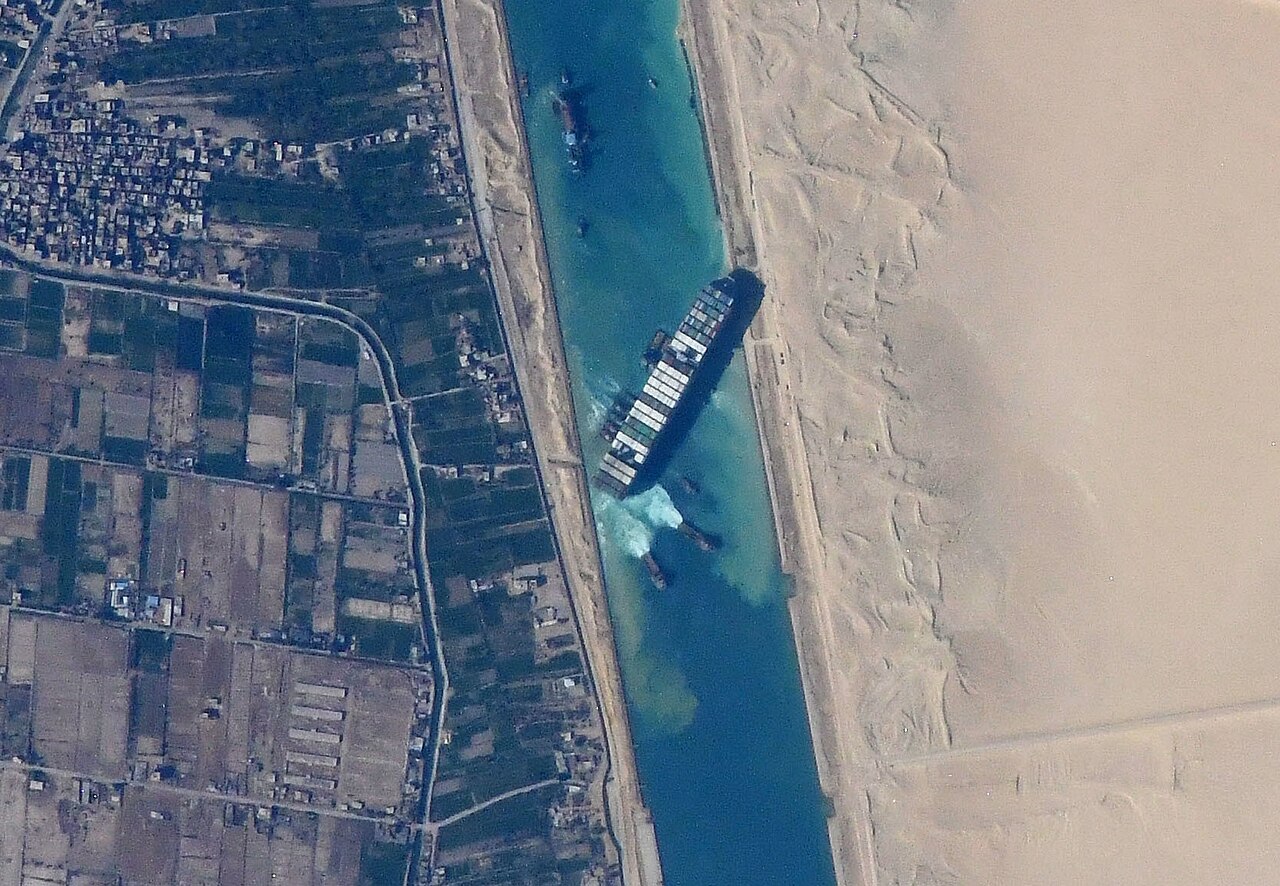
This system is efficient and fragile at the same time, and for the same reason: each link depends on the others. A missing part, a blocked port, a closed strait can be enough to stop an entire chain. In 2021, a single container ship stranded across the Suez Canal was enough to block one of the great routes of world trade for several days. This page returns to it below.2
A nuance is called for, however, since it is often said that everything has become dangerously dependent. An OECD analysis published in 2025 shows that only about 30% of exported products are highly concentrated on a few partners: most flows remain fairly diversified. But countries are increasingly buying from a small number of suppliers: this concentration has increased since the late 1990s, and that is what can create vulnerability.3
What is not new
It is often claimed that the world has only recently started trading. This is wrong, as several pages of this site show.
The networks of the Indian Ocean had been operating for centuries before 1492. In the sixteenth century, silver from the Andes flowed to China. The numerals we use for counting travelled from South Asia to Europe, and paper followed the same route.4
The world was already trading. What has changed is the speed, the quantity — and the fact that the chain has become invisible.
What is new fits in a box
On 26 April 1956, a crane loaded fifty-eight metal boxes onto a converted tanker.5
Until then, loading a tonne of goods by hand cost 5.83 dollars. In these boxes: less than 16 cents.6
The man who organised this did not invent the box — containers already existed. What he invented was the agreement between objects: a box, a lorry, a crane, a ship and a quay that agree in advance on dimensions.
This is the fourth time this site has encountered the same idea.
A standard weight makes it possible to compare goods from one town to another. A guaranteed coin makes it possible to trade with a stranger. A written rule allows two teams that have never met to play against each other. A box of agreed dimensions allows goods to circulate without anyone opening the doors.
A shared convention makes a relationship with a stranger possible. It is perhaps the most important idea in this encyclopedia.
The trap of the straits: when the flow freezes
Though globalisation seems fluid, it rests on an extremely fragile physical geography. Most world trade uses sea routes that narrow at a few chokepoints: the strategic straits and canals (Suez, Panama, Malacca, Hormuz).
In March 2021, a container ship four hundred metres long ran aground across the Suez Canal. For several days, the canal was completely blocked.7
The result: hundreds of ships held up at both entrances, billions of dollars’ worth of goods stopped every day according to estimates, and supply chains disrupted for months.8
A single technical incident, in a corridor a few hundred metres wide, is enough to disrupt the economies of dozens of countries on the other side of the Earth.
What a long chain produces
This interdependence has another side, and that side has faces.
On 24 April 2013, in Bangladesh, a building housing garment workshops collapsed. More than eleven hundred people died, the great majority of them female garment workers. Cracks had been noticed the day before, but the staff had been ordered back upstairs to work. The clothes made there were sold by international brands thousands of kilometres away.9
At the other end of the chain, at the end of the products’ lives, another, quieter tragedy unfolds. In a dump on the outskirts of Accra, in Ghana, as at other sites in South-East Asia, thousands of people dismantled by hand or burnt electronic waste from rich countries. They extracted copper and lead from it, at the cost of serious contamination of the soil and of their lungs. The Ghanaian site was razed in the early 2020s, and the workers dispersed.10
When a chain is long, each person sees only one link. That is what makes it efficient — and what allows everyone to claim that it was none of their business.
And what societies make of it
This page should not be read as if the world had merely submitted.
In Kenya, a service for sending money by telephone (M-Pesa) was launched in 2007 by Safaricom, part of the Vodafone group, with software developed by a British company. It was Kenyans who turned it into an everyday mass practice — to an extent that no one has reproduced elsewhere on the same scale.11
The lesson is the same as in several other pages of this site: the Indian weavers who buy industrial yarn and go on weaving, Japan choosing a school model and then changing it, the casters of Benin who make works of art from melted-down currency.
To receive is not to submit. One must say where a technique comes from, and also say where it became a practice. These are not always the same places.
A final word on digital technology
People talk about the “virtual”, the “cloud”, the “immaterial”.
None of this is immaterial. A message passes through undersea cables, antennas and buildings filled with servers. These machines contain rare metals that had to be extracted, they consume an immense amount of electricity to cool their circuits, and they end up as toxic waste.12
This is not a reason to go without it, but a reason to know what it really involves.
Note 1
Global value chains (GVCs) account for about 70% of international trade, as services, raw materials, parts, and components cross borders – often multiple times.
Organisation de coopération et de développement économiques, “Global Value and Supply Chains”, open access
Note 2
And while they may make up only a small portion of total product value, their function can be so critical that any shortage could halt production lines (the automobile sector being a case in point).
Igan, Deniz, Rungcharoenkitkul, Phurichai and Takahashi, Koji, “Global supply chain disruptions: evolution, impact, outlook”, BIS Bulletin, no. 61, Banque des règlements internationaux, 28 September 2022, open access
Note 3
Based on a broad assessment of supply chain structures and vulnerabilities, this report finds that most trade flows remain relatively diversified. Approximately 30% of exported products are subject to high levels of concentration in few trading partners.
Organisation de coopération et de développement économiques, OECD Supply Chain Resilience Review: Navigating Risks, Paris, OECD Publishing, 2 June 2025, open access
That said, import concentration is on the rise, as countries are increasingly sourcing products from fewer suppliers than is globally possible. The number of cases of suboptimal diversification is 50% higher in the 2020s than it was in the late 1990s. […] it is also a potential source of vulnerability to shocks.
Organisation de coopération et de développement économiques, OECD Supply Chain Resilience Review: Navigating Risks, Paris, OECD Publishing, 2 June 2025, open access
Note 4
When European nations such as Spain, Portugal, the Netherlands, England, and France were just setting out on voyages of exploration and beginning to forge maritime trade networks, a thriving oceangoing commerce was already being carried on in the Indian Ocean.
Kordas, Ann, Lynch, Ryan J., Nelson, Brooke and Tatlock, Julie, World History, Volume 2: from 1400, OpenStax, 2022, chapter 2, introduction
For the most part, these were trade diaspora communities, communities established by merchants from foreign lands who came to do business but often settled and married into the local population. The most significant of the trade diaspora communities in Gujarat were those founded by Muslims. Some of their inhabitants were the descendants of merchants who had arrived from Persia or the Arabian Peninsula as early as the eighth century […]
Kordas, Ann, Lynch, Ryan J., Nelson, Brooke and Tatlock, Julie, World History, Volume 2: from 1400, OpenStax, 2022, chapter 2, introduction and section 2.1 “India and International Connections”
China was the dominant buyer of silver. On the supply side, Spanish America erupted with unprecedented production of the white metal.
Flynn, Dennis O. and Giráldez, Arturo, “Born with a "Silver Spoon": The Origin of World Trade in 1571”, Journal of World History, vol. 6, 1995, p. 201-221
Note 5
[…] the 524-foot Ideal X cast off from Berth 24 at the foot of Marsh Street in Port Newark en route to Houston, Texas carrying 58 containers on its maiden voyage. […] The crane placed a container on the deck of the Ideal X every seven minutes. The ship was loaded in less than eight hours and set sail on her maiden voyage the same day, April 26, 1956.
Hamlett, Roz, “Port Newark: How Malcom McLean Changed the World”, PORTfolio, Port Authority of New York and New Jersey, 27 April 2016
In April 1956, a refitted oil tanker carried fifty-eight shipping containers from Newark to Houston.
Princeton University Press, description of Levinson, Marc, The Box: How the Shipping Container Made the World Smaller and the World Economy Bigger, 2nd ed., 2016
Note 6
McLean calculated that in 1956, loading a medium-sized ship the conventional way cost $5.83 a ton. By comparison, loading containers (using the Ideal-X as a frame of reference) would cost less than $0.16 per ton.
Rodrigue, Jean-Paul, “First Containership, Ideal-X, 1956”, The Geography of Transport Systems, 6th ed., Routledge, 2024, chap. 1, § 1.4
Note 7
On March 23, 2021, the containership Ever Given ran aground in the Suez Canal. […] The Ever Given measures 400m long with a beam of 59m and a capacity of over 20,000 TEU. […] However, the incident occurred in the southern section of the Suez Canal, which has only one navigation lane, resulting in the complete blockage of all transits. […] On March 29, the containership was refloated and towed away to the Great Bitter Lake.
Notteboom, Theo, Pallis, Athanasios and Rodrigue, Jean-Paul, “Blockage of the Suez Canal, March 2021”
Note 8
A traffic jam on both entries of the Canal (the Mediterranean and the Red Sea), where more than 430 ships were forced to wait. […] The blockage held up some USD 9 billion in global trade each day
Notteboom, Theo, Pallis, Athanasios and Rodrigue, Jean-Paul, “Blockage of the Suez Canal, March 2021”
Note 9
Over 1,100 people – mostly garment workers – lost their lives when the Rana Plaza factory collapsed in the outskirts of Dhaka, Bangladesh, on 24 April 2013.
Organisation internationale du travail, “The Rana Plaza Disaster Ten Years On: What Has Changed?”, Genève, 2023
Note 10
Global flows of e-waste from the Global North to the Global South continue to damage local environments and harm human health. […] The Agbogbloshie site alone provides livelihood opportunities of various sorts to approximately 4500–6000 workers and perhaps another 1500 indirectly [6]. […] After manually dismantling electronic devices, recyclers (see Table 1 for economic roles) will normally burn computer components in order to extract metals from plastic, metallic, and rubber coverings.
Daum, Kurt, Stoler, Justin and Grant, Richard J., “Toward a More Sustainable Trajectory for E-Waste Policy: A Review of a Decade of E-Waste Research in Accra, Ghana”, International Journal of Environmental Research and Public Health, vol. 14, no. 2, 2017, 135
Several studies conducted at the Agbogbloshie informal e-waste site have reported high concentrations of harmful compounds present in ambient air, soil sediments, water bodies and biological fluids (blood and urine) of e-waste workers [13,14,15]. […] Direct exposure of e-waste workers to PM predisposes to decline in lung function and risk for small airway diseases such as asthma and COPD.
Amoabeng Nti, Afua Asabea et al., “Effect of Particulate Matter Exposure on Respiratory Health of e-Waste Workers at Agbogbloshie, Accra, Ghana”, International Journal of Environmental Research and Public Health, vol. 17, no. 9, 2020, 3042
Around 5.1 billion kg of used EEE/e-waste are shipped from one country to another annually. Of that total, 3.3 billion kg (65 per cent) are uncontrolled transboundary movements of used EEE/e-waste from high- to middle- and low-income countries.
Baldé, Cornelis P. et al., Global E-waste Monitor 2024, Union internationale des télécommunications et UNITAR, Genève, 2024
Note 11
In March 2007, Kenya’s largest mobile network operator, Safaricom (part of the Vodafone Group) launched M-PESA, an innovative payment service for the unbanked. […] we tendered for an external software developer; and chose Sagentia, a British company specializing in "blue sky" strategic development. […] operated locally by Safaricom, but owned, hosted, and developed by Vodafone.
Hughes, Nick and Lonie, Susie, “M-PESA: Mobile Money for the "Unbanked": Turning Cellphones into 24-Hour Tellers in Kenya”, Innovations: Technology, Governance, Globalization, vol. 2, no. 1-2, 2007, p. 63-81
the country that has seen perhaps the most rapid and widespread growth of a mobile money product – known locally as M PESA – in the developing world. […] M‐PESA has grown rapidly, reaching approximately 65 percent of Kenyan households by the end of 2009
Jack, William and Suri, Tavneet, “Mobile Money: The Economics of M-PESA”, National Bureau of Economic Research, 2011
Note 12
After globally consuming an estimated 460 terawatt-hours (TWh) in 2022, data centres' total electricity consumption could reach more than 1 000 TWh in 2026.
Agence internationale de l’énergie, Electricity 2024, Paris, 2024
Notes and sources
- ↑
Passage According to the OECD, about 70% of international trade passes through these chains: services, raw materials, parts and components that cross borders — often several times.
Global value chains (GVCs) account for about 70% of international trade, as services, raw materials, parts, and components cross borders – often multiple times.
Source Organisation de coopération et de développement économiques, “Global Value and Supply Chains”, open access, overview page.
Open access open the source · checked on 24 October 2026
- ↑
Passage each link depends on the others. A missing part, a blocked port, a closed strait can be enough to stop an entire chain.
And while they may make up only a small portion of total product value, their function can be so critical that any shortage could halt production lines (the automobile sector being a case in point).
Source Igan, Deniz, Rungcharoenkitkul, Phurichai and Takahashi, Koji, “Global supply chain disruptions: evolution, impact, outlook”, BIS Bulletin, no. 61, Banque des règlements internationaux, 28 September 2022, open access, p. 3 (box on semiconductors); p. 1-2 for the ports: “Lockdowns in major hubs, such as Shanghai, in the spring of 2022 halted shipping and production of intermediate parts.”.
Open access open the source · checked on 24 October 2026
- ↑
Passage only about 30% of exported products are highly concentrated on a few partners: most flows remain fairly diversified
Based on a broad assessment of supply chain structures and vulnerabilities, this report finds that most trade flows remain relatively diversified. Approximately 30% of exported products are subject to high levels of concentration in few trading partners.
Source Organisation de coopération et de développement économiques, OECD Supply Chain Resilience Review: Navigating Risks, Paris, OECD Publishing, 2 June 2025, open access, executive summary, p. 11, “Most global trade remains diversified, but import concentration is on the rise”.
Open access open the source · checked on 24 October 2026
Passage countries are increasingly buying from a small number of suppliers: this concentration has increased since the late 1990s, and that is what can create vulnerability
That said, import concentration is on the rise, as countries are increasingly sourcing products from fewer suppliers than is globally possible. The number of cases of suboptimal diversification is 50% higher in the 2020s than it was in the late 1990s. […] it is also a potential source of vulnerability to shocks.
Source Organisation de coopération et de développement économiques, OECD Supply Chain Resilience Review: Navigating Risks, Paris, OECD Publishing, 2 June 2025, open access, executive summary, p. 11; chapter 1, section 1.2, p. 16 for the vulnerability.
Open access open the source · checked on 24 October 2026
- ↑
Passage The networks of the Indian Ocean had been operating […] before 1492.
When European nations such as Spain, Portugal, the Netherlands, England, and France were just setting out on voyages of exploration and beginning to forge maritime trade networks, a thriving oceangoing commerce was already being carried on in the Indian Ocean.
Source Kordas, Ann, Lynch, Ryan J., Nelson, Brooke and Tatlock, Julie, World History, Volume 2: from 1400, OpenStax, 2022, chapter 2, introduction, chapter 2 introduction, 2nd sentence.
Open access open the source · checked on 27 October 2026
Passage The networks of the Indian Ocean had been operating for centuries
For the most part, these were trade diaspora communities, communities established by merchants from foreign lands who came to do business but often settled and married into the local population. The most significant of the trade diaspora communities in Gujarat were those founded by Muslims. Some of their inhabitants were the descendants of merchants who had arrived from Persia or the Arabian Peninsula as early as the eighth century […]
Source Kordas, Ann, Lynch, Ryan J., Nelson, Brooke and Tatlock, Julie, World History, Volume 2: from 1400, OpenStax, 2022, chapter 2, introduction and section 2.1 “India and International Connections”, section 2.1, “Beyond the Book” box (“The Port of Surat”), paragraph on Gujarat’s merchant communities.
Open access open the source · checked on 27 October 2026
Passage In the sixteenth century, silver from the Andes flowed to China.
China was the dominant buyer of silver. On the supply side, Spanish America erupted with unprecedented production of the white metal.
Source Flynn, Dennis O. and Giráldez, Arturo, “Born with a "Silver Spoon": The Origin of World Trade in 1571”, Journal of World History, vol. 6, 1995, p. 201-221, beginning of the article (abstract of the Routledge reissue, 2022).
Paywalled · checked on 9 September 2026
- ↑
Passage On 26 April 1956, a crane loaded fifty-eight metal boxes
[…] the 524-foot Ideal X cast off from Berth 24 at the foot of Marsh Street in Port Newark en route to Houston, Texas carrying 58 containers on its maiden voyage. […] The crane placed a container on the deck of the Ideal X every seven minutes. The ship was loaded in less than eight hours and set sail on her maiden voyage the same day, April 26, 1956.
Source Hamlett, Roz, “Port Newark: How Malcom McLean Changed the World”, PORTfolio, Port Authority of New York and New Jersey, 27 April 2016, 1st paragraph, 1st sentence, and 3rd paragraph, 1st and 2nd sentences.
Open access open the source · checked on 27 October 2026
Passage fifty-eight metal boxes onto a converted tanker.
In April 1956, a refitted oil tanker carried fifty-eight shipping containers from Newark to Houston.
Source Princeton University Press, description of Levinson, Marc, The Box: How the Shipping Container Made the World Smaller and the World Economy Bigger, 2nd ed., 2016, publisher’s description (“Overview”), 1st paragraph, 1st sentence.
Open access open the source · checked on 27 October 2026
- ↑
Passage loading a tonne of goods by hand cost 5.83 dollars. In these boxes: less than 16 cents.
McLean calculated that in 1956, loading a medium-sized ship the conventional way cost $5.83 a ton. By comparison, loading containers (using the Ideal-X as a frame of reference) would cost less than $0.16 per ton.
Source Rodrigue, Jean-Paul, “First Containership, Ideal-X, 1956”, The Geography of Transport Systems, 6th ed., Routledge, 2024, chap. 1, § 1.4, chap. 1, § 1.4, box “First Containership, Ideal-X, 1956”.
Open access open the source · checked on 27 October 2026
- ↑
Passage In March 2021, a container ship four hundred metres long ran aground across the Suez Canal. For several days, the canal was completely blocked.
On March 23, 2021, the containership Ever Given ran aground in the Suez Canal. […] The Ever Given measures 400m long with a beam of 59m and a capacity of over 20,000 TEU. […] However, the incident occurred in the southern section of the Suez Canal, which has only one navigation lane, resulting in the complete blockage of all transits. […] On March 29, the containership was refloated and towed away to the Great Bitter Lake.
Source Notteboom, Theo, Pallis, Athanasios and Rodrigue, Jean-Paul, “Blockage of the Suez Canal, March 2021”, first and second paragraphs.
Open access open the source · checked on 9 September 2026
- ↑
Passage hundreds of ships held up at both entrances, billions of dollars’ worth of goods stopped every day according to estimates
A traffic jam on both entries of the Canal (the Mediterranean and the Red Sea), where more than 430 ships were forced to wait. […] The blockage held up some USD 9 billion in global trade each day
Source Notteboom, Theo, Pallis, Athanasios and Rodrigue, Jean-Paul, “Blockage of the Suez Canal, March 2021”, list of the main effects (“main impacts”), first two points.
Open access open the source · checked on 9 September 2026
- ↑
Passage On 24 April 2013, in Bangladesh, a building housing garment workshops collapsed. More than eleven hundred people died
Over 1,100 people – mostly garment workers – lost their lives when the Rana Plaza factory collapsed in the outskirts of Dhaka, Bangladesh, on 24 April 2013.
Source Organisation internationale du travail, “The Rana Plaza Disaster Ten Years On: What Has Changed?”, Genève, 2023, introduction to the page.
Open access open the source · checked on 24 October 2026
- ↑
Passage thousands of people dismantled by hand or burnt electronic waste from rich countries
Global flows of e-waste from the Global North to the Global South continue to damage local environments and harm human health. […] The Agbogbloshie site alone provides livelihood opportunities of various sorts to approximately 4500–6000 workers and perhaps another 1500 indirectly [6]. […] After manually dismantling electronic devices, recyclers (see Table 1 for economic roles) will normally burn computer components in order to extract metals from plastic, metallic, and rubber coverings.
Source Daum, Kurt, Stoler, Justin and Grant, Richard J., “Toward a More Sustainable Trajectory for E-Waste Policy: A Review of a Decade of E-Waste Research in Accra, Ghana”, International Journal of Environmental Research and Public Health, vol. 14, no. 2, 2017, 135, abstract, 1st sentence; § 1 (“Introduction”), 2nd paragraph; § 5.4 (“Rudimentary Recycling Practices”), 1st paragraph.
Open access open the source · checked on 27 October 2026
Passage at the cost of serious contamination of the soil and of their lungs
Several studies conducted at the Agbogbloshie informal e-waste site have reported high concentrations of harmful compounds present in ambient air, soil sediments, water bodies and biological fluids (blood and urine) of e-waste workers [13,14,15]. […] Direct exposure of e-waste workers to PM predisposes to decline in lung function and risk for small airway diseases such as asthma and COPD.
Source Amoabeng Nti, Afua Asabea et al., “Effect of Particulate Matter Exposure on Respiratory Health of e-Waste Workers at Agbogbloshie, Accra, Ghana”, International Journal of Environmental Research and Public Health, vol. 17, no. 9, 2020, 3042, § 1 (“Introduction”), 3rd paragraph; abstract, “Conclusions”.
Open access open the source · checked on 27 October 2026
Passage electronic waste from rich countries
Around 5.1 billion kg of used EEE/e-waste are shipped from one country to another annually. Of that total, 3.3 billion kg (65 per cent) are uncontrolled transboundary movements of used EEE/e-waste from high- to middle- and low-income countries.
Source Baldé, Cornelis P. et al., Global E-waste Monitor 2024, Union internationale des télécommunications et UNITAR, Genève, 2024, Chapter 4 “Transboundary Movements”, p. 40.
Open access open the source · checked on 24 October 2026
- ↑
Passage In Kenya, a service for sending money by telephone (M-Pesa) was launched in 2007 by Safaricom, part of the Vodafone group, with software developed by a British company.
In March 2007, Kenya’s largest mobile network operator, Safaricom (part of the Vodafone Group) launched M-PESA, an innovative payment service for the unbanked. […] we tendered for an external software developer; and chose Sagentia, a British company specializing in "blue sky" strategic development. […] operated locally by Safaricom, but owned, hosted, and developed by Vodafone.
Source Hughes, Nick and Lonie, Susie, “M-PESA: Mobile Money for the "Unbanked": Turning Cellphones into 24-Hour Tellers in Kenya”, Innovations: Technology, Governance, Globalization, vol. 2, no. 1-2, 2007, p. 63-81, p. 63, p. 70 and p. 79.
Open access open the source · checked on 25 October 2026
Passage It was Kenyans who turned it into an everyday mass practice
the country that has seen perhaps the most rapid and widespread growth of a mobile money product – known locally as M PESA – in the developing world. […] M‐PESA has grown rapidly, reaching approximately 65 percent of Kenyan households by the end of 2009
Source Jack, William and Suri, Tavneet, “Mobile Money: The Economics of M-PESA”, National Bureau of Economic Research, 2011, abstract and introduction.
Open access open the source · checked on 25 October 2026
- ↑
Passage buildings filled with servers […] they consume an immense amount of electricity
After globally consuming an estimated 460 terawatt-hours (TWh) in 2022, data centres' total electricity consumption could reach more than 1 000 TWh in 2026.
Source Agence internationale de l’énergie, Electricity 2024, Paris, 2024, executive summary (“Executive summary”).
Open access open the source · checked on 9 September 2026
Bibliography
20
- Abu-Lughod, Janet L., Before European Hegemony: The World System A.D. 1250-1350, Oxford University Press, 1989, in libraries (the networks of the Indian Ocean before 1492).
- Agence internationale de l’énergie, Electricity 2024, Paris, 2024, open access (the electricity consumption of data centres: about 460 TWh in 2022). https://www.iea.org/reports/electricity-2024/executive-summary
- Akese, Grace Abena and Little, Peter C., “Electronic Waste and the Environmental Justice Challenge in Agbogbloshie”, Environmental Justice, vol. 11, no. 2, 2018, p. 77-83, paywalled (the site, the salvage work and its health effects).
- Amoabeng Nti, Afua Asabea et al., “Effect of Particulate Matter Exposure on Respiratory Health of e-Waste Workers at Agbogbloshie, Accra, Ghana”, International Journal of Environmental Research and Public Health, vol. 17, no. 9, 2020, 3042, open access (the high concentrations of harmful compounds in the air, soil and bodies of Agbogbloshie workers; the decline in their lung function). https://doi.org/10.3390/ijerph17093042
- Baldé, Cornelis P. et al., Global E-waste Monitor 2024, Union internationale des télécommunications et UNITAR, Genève, 2024, open access (global flows of electronic waste and their informal processing).
- Daum, Kurt, Stoler, Justin and Grant, Richard J., “Toward a More Sustainable Trajectory for E-Waste Policy: A Review of a Decade of E-Waste Research in Accra, Ghana”, International Journal of Environmental Research and Public Health, vol. 14, no. 2, 2017, 135, open access (electronic waste from the Global North; the 4,500 to 6,000 workers at Agbogbloshie; dismantling by hand and burning). https://doi.org/10.3390/ijerph14020135
- Flynn, Dennis O. and Giráldez, Arturo, “Born with a "Silver Spoon": The Origin of World Trade in 1571”, Journal of World History, vol. 6, 1995, p. 201-221, paywalled (silver from the Andes to China).
- Hamlett, Roz, “Port Newark: How Malcom McLean Changed the World”, PORTfolio, Port Authority of New York and New Jersey, 27 April 2016, open access (the 58 containers loaded by crane onto the Ideal X, which left Port Newark on 26 April 1956). https://portfolio.panynj.gov/2016/04/27/port-newarkmalcom-mcleans-box-changes-the-world/
- Hughes, Nick and Lonie, Susie, “M-PESA: Mobile Money for the "Unbanked": Turning Cellphones into 24-Hour Tellers in Kenya”, Innovations: Technology, Governance, Globalization, vol. 2, no. 1-2, 2007, p. 63-81, open access (the service launched in Kenya in 2007 by Safaricom, part of the Vodafone group, which owns, hosts and develops it; the software entrusted to the British company Sagentia). https://files.ifi.uzh.ch/hilty/t/Literature_by_RQs/RQ%20304/2007_Hughes_Lonie_M-PESA-%20Mobile%20Money%20for%20the%20Unbanked%20Turning%20Cellphones%20into%2024-Hour%20Tellers%20in%20Kenya.pdf
- Igan, Deniz, Rungcharoenkitkul, Phurichai and Takahashi, Koji, “Global supply chain disruptions: evolution, impact, outlook”, BIS Bulletin, no. 61, Banque des règlements internationaux, 28 September 2022, open access (a single missing part can stop production chains; lockdowns of major ports halted shipping and the manufacture of parts). https://www.bis.org/publ/bisbull61.pdf
- Jack, William and Suri, Tavneet, “Mobile Money: The Economics of M-PESA”, National Bureau of Economic Research, 2011, open access (the rapid and massive adoption of money transfer by telephone in Kenya: about 65% of households at the end of 2009). https://doi.org/10.3386/w16721
- Kordas, Ann, Lynch, Ryan J., Nelson, Brooke and Tatlock, Julie, World History, Volume 2: from 1400, OpenStax, 2022, chapter 2, introduction and section 2.1 “India and International Connections”, open access (the thriving Indian Ocean commerce at the time Europeans set out to explore; the Persian and Arab merchant communities settled in Gujarat from the eighth century). https://openstax.org/books/world-history-volume-2/pages/2-introduction
- Levinson, Marc, The Box: How the Shipping Container Made the World Smaller and the World Economy Bigger, Princeton University Press, 2006, in libraries (the first voyage of 1956 and the cost of loading per tonne).
- Notteboom, Theo, Pallis, Athanasios and Rodrigue, Jean-Paul, “Blockage of the Suez Canal, March 2021”, Port Economics, Management and Policy, Routledge, site de l’ouvrage, open access (the grounding of the Ever Given, 400 metres long, from 23 to 29 March 2021; the complete blockage of the canal; the ships held up at both entrances and the trade stopped each day). https://porteconomicsmanagement.org/suez-canal-blockage-2021/
- Organisation de coopération et de développement économiques, “Global Value and Supply Chains”, open access (the 70% of international trade passing through value chains; goods crossing borders several times). https://www.oecd.org/en/topics/policy-issues/global-value-and-supply-chains.html
- Organisation de coopération et de développement économiques, OECD Supply Chain Resilience Review: Navigating Risks, Paris, OECD Publishing, 2 June 2025, open access (about 30% of exported products highly concentrated on a few partners, most flows remaining diversified; import concentration rising since the late 1990s, a possible source of vulnerability). https://doi.org/10.1787/94e3a8ea-en
- Organisation internationale du travail, “The Rana Plaza Disaster Ten Years On: What Has Changed?”, Genève, 2023, open access (the date, the death toll and the aftermath of the disaster). https://webapps.ilo.org/infostories/en-GB/Stories/Country-Focus/rana-plaza
- Pitron, Guillaume, L’Enfer numérique. Voyage au bout d’un like, Les Liens qui libèrent, 2021, in libraries.
- Princeton University Press, description of Levinson, Marc, The Box: How the Shipping Container Made the World Smaller and the World Economy Bigger, 2nd ed., 2016, open access (the refitted oil tanker that carried fifty-eight containers from Newark to Houston in April 1956). https://press.princeton.edu/books/paperback/9780691170817/the-box
- Rodrigue, Jean-Paul, “First Containership, Ideal-X, 1956”, The Geography of Transport Systems, 6th ed., Routledge, 2024, chap. 1, § 1.4, open access. https://transportgeography.org/contents/chapter1/the-setting-of-global-transportation-systems/idealx-first-containeriship-1956/
Spotted an error or have a doubt? Write to us.