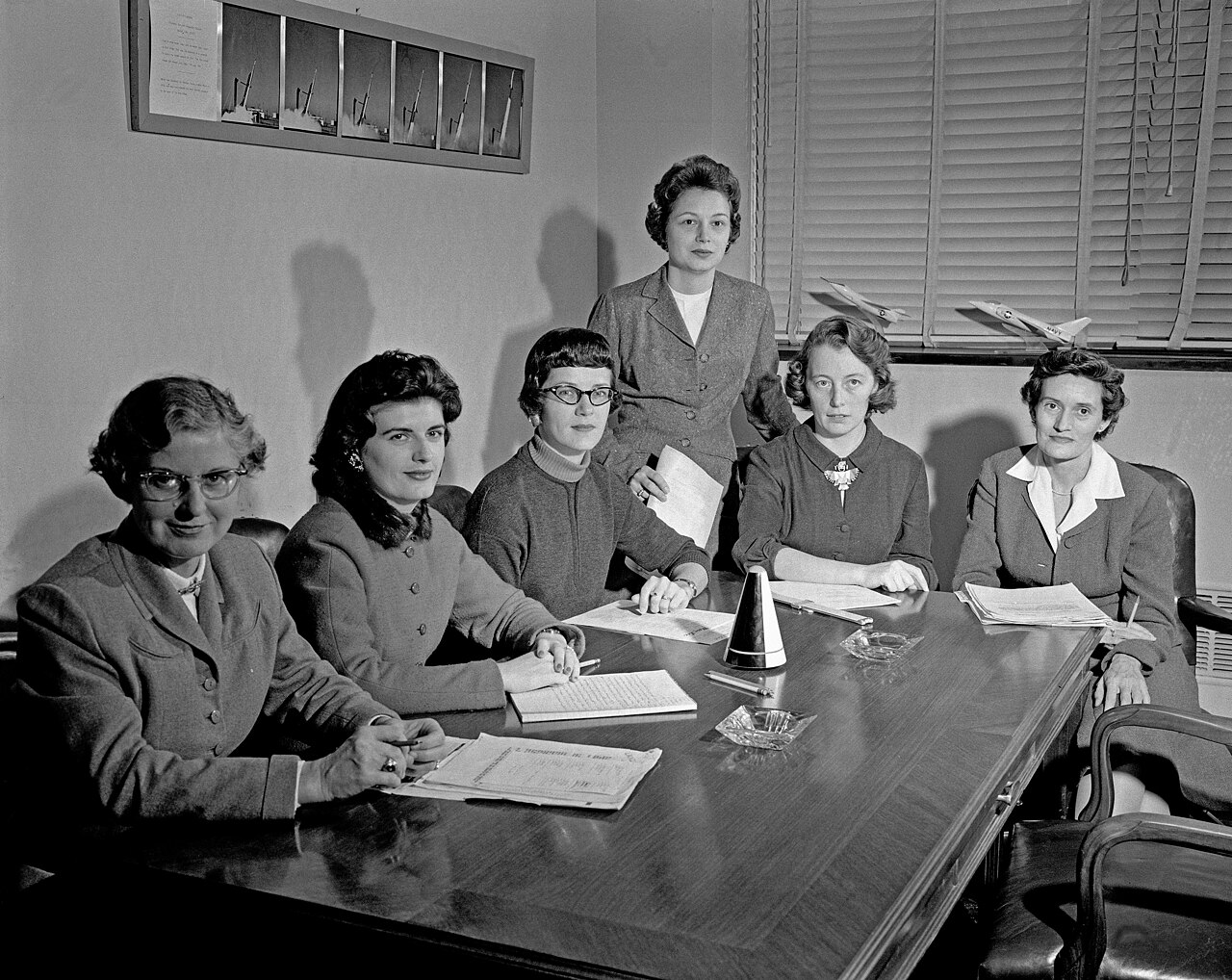

Before it was a machine, a computer was a person.
In English, the word computer referred to an occupation: someone whose job was to calculate, all day long, by hand. It was most often a woman.
Making a machine calculate
A calculating machine relies first of all on toothed wheels. A wheel advances one notch per unit; when it has made a full turn, it pushes its neighbour forward one notch. Carrying becomes mechanical.
The principle is easy to describe and hard to achieve. The whole difficulty lies precisely in the carry: at the moment when nine becomes ten, the neighbouring wheel must be pushed without jamming the machine.
In 1623, in Germany, Wilhelm Schickard described such a machine in two letters to the astronomer Kepler. It added, subtracted and helped with multiplication. But the copy ordered from a craftsman burned half-finished the following year, Schickard gave up, and he never spoke of it again. We know his calculating clock from these letters and from sketches found in 1935. Reconstructed, it works, but its carry remains fragile: a carry that runs through all the digits risks damaging the wheels.1
Twenty years later, in 1642, Blaise Pascal solved the carry problem and had about fifty machines built.2
So who invented the calculating machine? The question is wrongly framed. One had the idea and never made the object work; the other made the object work. Two different achievements, by two different people.
Telling the machine what to do
A machine that calculates is of little use if it has to be told what to do all over again each time. A second invention is needed, and it comes from elsewhere: from music, then from weaving.
In Lyon, around 1725, Basile Bouchon was a silk weaver. He knew the pinned cylinders that make musical automata play: the pins are the melody, the cylinder is merely a machine. He transferred the idea to the loom and controlled the threads with a strip of paper pierced with holes.3
Three years later, in 1728, Falcon’s loom replaced the strip with punched cards tied together in an endless chain. It was the first machine in the world, of any kind, to be controlled by punched cards. Jacques de Vaucanson then tried to automate the whole process. In 1804, Joseph-Marie Jacquard took up the three inventions, combined them, and at last produced a system that worked in real factories.4
The pattern is no longer in the weaver’s head or in the machine: it is on a separate medium, which can be changed. This is exactly the idea of the program.
In England, Charles Babbage seized on it. From 1837, he designed a mechanical machine that would calculate whatever it was asked, controlled by cards borrowed from the Jacquard loom. He never completed it.
In 1843, Ada Lovelace translated an article on this machine and added notes three times longer than the text. Historians disagree about what exactly she invented in them, and about what came from Babbage. But all agree on one point, and it is the most astonishing: she was the first to write that such a machine would not be limited to numbers. Since instructions can be coded on cards, it could be made to manipulate symbols — and, she wrote, to compose music.5
One hundred and eighteen years after Bouchon, the idea had returned to its starting point.
Counting a country
Punched cards then left the workshop for the administration.
In the United States, the 1880 census took eight to nine years to tabulate. With a growing population, the 1890 census risked not being finished before the next one was due. The Census Office held a competition in 1888: the contestants received the same files from St. Louis, and were timed.
The first two took one hundred and forty-four hours and one hundred hours to capture the data, then forty-five and fifty-five hours to sort it. Herman Hollerith captured the data in seventy-two and a half hours — and sorted it in five and a half hours.6
A story found everywhere must be corrected here: the 1890 census was not done in six weeks. Six weeks corresponds to the raw count of the population, and that count did not use the cards. The full tabulation took much longer: its results were published only a year and a half earlier than those of 1880 — and it cost almost twice as much. At the time, some wondered whether the machine was really worth its price.7
The company founded by Hollerith would later become IBM.
These machines were used everywhere, and for everything: counting inhabitants, managing payrolls, keeping inventories. In France, during the Occupation, the statistical services had them. But what states did with their counts did not depend on them: the lists that mattered, at that time, were kept by hand. This story is told in Entry 9.6.
The human computers
For a long time, truly lengthy calculations were done by people.
During the Second World War, the American army needed firing tables: for each gun angle, each wind, each distance, where the shell would land. That meant thousands of equations. A single one could take more than forty hours of work.
This work was entrusted to women. Such calculation was then considered too tedious for engineers. There were more than eighty of them at the University of Pennsylvania, and their job was called computer.
When an electronic machine was built to do this work faster, someone was needed to program it. Six of them were chosen: Kathleen McNulty, Frances Bilas, Betty Snyder, Marlyn Wescoff, Ruth Lichterman and Jean Jennings.8
No one could teach them: this job did not yet exist. They were handed a pile of wiring diagrams and told, in essence: understand how the machine works, then work out how to program it.
They succeeded. On 15 February 1946, the machine was presented to the press. The demonstration chosen was a trajectory calculation, developed by Jean Jennings and Betty Snyder.
Erased, then rediscovered
What followed is instructive.
The articles published about this demonstration spoke of the engineers who had built the machine. They did not mention the six programmers. In the evening, a dinner was held to celebrate the success. They were not invited.
The most troubling thing is that the archival photographs do show them. They are there, in front of the machine, in the pictures. It was the captions and the articles that made them disappear.9
It was not until the 1990s that women historians took an interest in these photographs and asked the question: who are these women? From then on, their work was recognised.
A source can remain in plain sight for fifty years and say nothing, as long as no one asks the right question.
How a machine calculates
Everything that follows rests on a disconcertingly simple idea: a machine can do only one thing: distinguish between two states. A switch open or closed, a current flowing or not. These two states are written 0 and 1, and they are called bits.10
With bits, numbers can be written — this is the binary system, which counts in powers of two instead of ten. Eight bits are enough to write all the numbers from 0 to 255. Since numbers can be written, anything can be written: all it takes is to decide that a number represents a letter, the colour of a pixel, a moment of sound. A text, an image and a piece of music are, inside a machine, exactly the same thing — sequences of bits, distinguished only by the rule used to read them back.
A calculating machine has three parts.
- The processor executes operations, one by one, but at a rate of several billion per second. It can only do additions and comparisons; everything else is built from them.
- The memory stores the data and instructions in use. A distinction is made between memory that is erased when the power is switched off and memory that persists.
- Inputs and outputs — keyboard, screen, sensor, loudspeaker — provide the link with the world.
A program, or software, is the list of instructions that the processor must execute. The algorithm, for its part, is the method itself, independent of the machine: a cooking recipe is an algorithm, and it stays the same whatever the stove.
None of this presupposes intelligence. A machine applies rules without understanding them, very fast and without making mistakes. It is this speed, and not any kind of understanding, that produces the results.
Ada Lovelace’s sentence, and the reply it received
Someone had already set this idea down in 1843 — the very person discussed at the beginning of this page.
In her notes, after imagining that a machine could manipulate symbols and compose music, Ada Lovelace sets a limit:
The Analytical Engine has no pretensions whatever to originate anything. It can do whatever we know how to order it to perform.11
The position is remarkable. The woman who saw furthest into what a machine might do is also the one who set the clearest boundary on what it would not do.
Yet the story does not end there. More than a century later, in 1950, a mathematician took up this sentence, named it “Lady Lovelace’s Objection”, and challenged it.12
His argument is subtle. He shifts the question: instead of asking whether a machine can originate, let us ask whether it can take us by surprise. And he observes that the objection rests on a false idea — the assumption that as soon as a fact is presented to a mind, all its consequences spring into the mind simultaneously with it.13
It is not true, he says, and it is even an error to which mathematicians are particularly prone.
This debate is still open. It has lasted for nearly two centuries, between two people who never met, and it concerns exactly the question that everyone asks when faced with the machines of their own time.
Smaller and smaller
What followed technically can be summed up in one word: miniaturisation. It can be told in three dates.
On 16 December 1947, in an American laboratory, John Bardeen and Walter Brattain placed two tiny gold contacts on a small slab of germanium, and obtained a device that amplified an electrical signal. This was the transistor. It replaced the vacuum tube: smaller and sturdier, it gave off almost no heat. A colleague came up with its name. With their team leader, William Shockley, the two men would receive the Nobel Prize nine years later.14
In 1958, then in 1959, two engineers who did not work together and did not know each other had the same idea: instead of making components one by one and connecting them by hand, etch them all together on a single wafer. Jack Kilby made the first, Robert Noyce the version that would lend itself to mass production. This is the integrated circuit.
In 1971, finally, Intel’s first microprocessor appeared, the 4004: a chip of twelve square millimetres, the size of a fingernail, which brought together everything needed to calculate — about two thousand three hundred transistors.15
It was not invented for a computer. It was a Japanese calculator company, Busicom, that ordered and paid for it, and one of its four designers, Masatoshi Shima, was that company’s engineer.
It is said everywhere that this chip was “as powerful as the ENIAC”. Caution is called for: this phrase comes from the manufacturer’s advertisement, in 1971, and has been copied ever since. The two machines are not so easily compared. What can safely be stated concerns the two objects: on one side a room of one hundred and sixty-seven square metres and thirty tonnes of equipment, on the other an object that fits on a fingertip.
In the 2020s, a chip contains several billion of them. It is this shrinking, more than any other new idea, that has put a computer in every pocket.
What it really weighs
It is often said that the digital world is “immaterial”. This is false, and it is worth knowing.
A phone contains dozens of different metals, extracted from real mines, by real people, sometimes in very harsh conditions. The services used every day run in buildings full of machines that must be powered and cooled continuously: data centres. In 2024, they consumed about one and a half per cent of the world’s electricity, and their consumption could more than double by 2030.16
The following must be added, or the figure will mislead. Over the same period, it is electric cars, factories and air conditioning that will drive most of the increase in global electricity consumption — not data centres.
Discarded devices, for their part, become waste. Sixty-two million tonnes in 2022. It is known that about twenty-two per cent is officially collected and recycled; for the rest, no one really knows, because a great deal of recovery takes place without being recorded anywhere.17
The cloud has an address, an electricity bill and a skip.
Two inventions, not one
| What is needed | What it is for | Where it comes from |
|---|---|---|
| A mechanism that calculates | carrying out the operations | toothed-wheel machines, then electronics |
| A medium for instructions | saying what to do, and being able to change it | punched strips and cards, from musical automata and then from weaving |
| People who know how to use it | translating a problem into a sequence of operations | the occupation of computer |
Note 1
On September 20, 1623, Schickard wrote to Kepler saying (in translation): […] These two letters, both of which were found in Kepler's papers […] it certainly works well on the reproductions constructed by von Freytag Loringhoff. […] This operation would require enough force that it might well do damage to the gears on the units digit.
Lee, J. A. N., “Wilhelm Schickard”, Computer Pioneers, IEEE Computer Society, 1995, mis à jour en 2013
I had placed an order with a local man, Johan Pfister, for the construction of a machine for you; but when half finished, this machine, together with some other things of mine, especially several metal plates, fell victim to a fire which broke out unseen during the night three days ago. […] Sketches of the calculator have been preserved in the manuscripts left by Schickard and Kepler. These however, were not rediscovered until 1935 when they were found during research into Kepler's life.
O’Connor, John J. and Robertson, Edmund F., “Wilhelm Schickard”, MacTutor History of Mathematics, University of St Andrews
Note 2
Arrivée à 9, la roue lève une masselotte qui stocke une certaine énergie. Au passage de 9 à 0, cette masselotte retombe et fait avancer d'une position la roue suivante. Si plusieurs roues sont simultanément à 9, le passage du poids faible de 9 à 0 déclenche la chute en cascade des masselottes et le report des retenues sur plusieurs rangs. La Pascaline, machine inventée par Blaise Pascal en 1642, est la première calculatrice mécanique dont la description ait été rendue publique en son temps.
On reaching 9, the wheel lifts a small weight that stores a certain amount of energy. On passing from 9 to 0, this weight falls back and advances the next wheel by one position. If several wheels are at 9 at the same time, the passage of the lowest-order wheel from 9 to 0 triggers the cascading fall of the weights and the carrying over several places. The Pascaline, a machine invented by Blaise Pascal in 1642, is the first mechanical calculator whose description was made public in its own time.
PATSTEC (Mission nationale de sauvegarde et de valorisation du patrimoine scientifique et technique contemporain), “Maquette de la calculatrice dite Pascaline”, fiche no. 7985
By 1652 fifty prototypes had been produced, but few machines were sold
O’Connor, John J. and Robertson, Edmund F., “Blaise Pascal”, MacTutor History of Mathematics, University of St Andrews
Note 3
De très nombreux tisseurs ont participé à l'évolution techniques de ces machines, dont les noms n'ont pas toujours été retenus par l'histoire. Ainsi, Basile Bouchon vers 1725, Louis Falcon en 1728, puis Jacques Vaucanson en 1750 et 1760 ont tous contribué à améliorer le fonctionnement des métiers à tisser et des divers outils nécessaires à leur fonctionnement.
A great many weavers took part in the technical development of these machines, and history has not always remembered their names. Thus Basile Bouchon around 1725, Louis Falcon in 1728, then Jacques Vaucanson in 1750 and 1760 all helped to improve the working of looms and of the various tools needed to operate them.
Four, Pierre-Alain (Aporss), “Lyon et la soie : une dynamique de la technique, un urbanisme original”, fiche no. 3, Grand Lyon, October 2007
Note 4
Model of Falcon's loom, 1728, with a jacquard type system. This loom was the first machine of any kind to be controlled by punch cards, following Frenchman Basile Bouchon's use of perforated paper rolls in 1725. Falcon's loom used perforated cards tied together in an endless chain.
Science Museum Group, Model of Falcon’s Loom, objet no. 1963-379
Note 5
She speculated that the Engine 'might act upon other things besides number... the Engine might compose elaborate and scientific pieces of music of any degree of complexity or extent'. The idea of a machine that could manipulate symbols in accordance with rules and that number could represent entities other than quantity mark the fundamental transition from calculation to computation. Ada was the first to explicitly articulate this notion and in this she appears to have seen further than Babbage.
Computer History Museum, “Ada Lovelace”, online exhibition The Babbage Engine, undated page
Note 6
The third contestant, a former Census Bureau employee named Herman Hollerith, completed the data capture process in 72.5 hours. […] Hollerith astounded Census Bureau officials by completing the task in just 5.5 hours!
U.S. Census Bureau, “The Hollerith Machine”, histoire du bureau
Note 7
Despite the greater amount of data collected, the Census Bureau completed publication of the 1890 data 18 months sooner than it published the 1880 Census.
U.S. Census Bureau, “Herman Hollerith and Mechanical Tabulation”, History and the Census, January 2016
Note 8
When it was operational, the machine was run by a team of six women. […] As modern engineers, we now celebrate the contributions of Kathleen McNulty Mauchly Antonelli, Jean Jennings Bartik, Frances (Betty) Snyder Holberton, Marlyn Wescoff Meltzer, Frances Bilas Spence, and Ruth Lichterman Teitelbaum.
University of Pennsylvania, School of Engineering and Applied Science, “Celebrating Penn Engineering History: ENIAC”
Note 9
Archival photos (such as the one at the top of this page) show both women and men working on the massive machine, but the articles and pictures published at the time feature only men.
University of Pennsylvania, School of Engineering and Applied Science, “Celebrating Penn Engineering History: ENIAC”
Note 10
If the base 2 is used the resulting units may be called binary digits, or more briefly bits, a word suggested by J. W. Tukey. A device with two stable positions, such as a relay or a flip-flop circuit, can store one bit of information.
Shannon, Claude E., “A Mathematical Theory of Communication”, Bell System Technical Journal, vol. 27, 1948, p. 379-423 et 623-656
Note 11
The Analytical Engine has no pretensions whatever to originate anything. It can do whatever we know how to order it to perform.
Lovelace, Ada, notes accompagnant sa traduction de Menabrea, Luigi F., “Sketch of the Analytical Engine Invented by Charles Babbage”, Scientific Memoirs, vol. 3, 1843
Note 12
Lady Lovelace's Objection […] In it she states, “The Analytical Engine has no pretensions to originate anything. It can do whatever we know how to order it to perform” (her italics).
Turing, Alan M., “Computing Machinery and Intelligence”, Mind, vol. 59, 1950, p. 433-460
Note 13
A better variant of the objection says that a machine can never ‘take us by surprise’. This statement is a more direct challenge and can be met directly.
Turing, Alan M., “Computing Machinery and Intelligence”, Mind, vol. 59, 1950, p. 433-460
This is the assumption that as soon as a fact is presented to a mind all consequences of that fact spring into the mind simultaneously with it. It is a very useful assumption under many circumstances, but one too easily forgets that it is false.
Turing, Alan M., “Computing Machinery and Intelligence”, Mind, vol. 59, 1950, p. 433-460
Note 14
On December 16, 1947, their research culminated in the first successful semiconductor amplifier. […] Named the "transistor" by electrical engineer John Pierce, Bell Labs publicly announced the revolutionary solid-state device at a press conference in New York on June 30, 1948.
Computer History Museum, “The Silicon Engine: A Timeline of Semiconductors in Computers”
Note 15
Ted Hoff and Stanley Mazor conceived Intel's first integrated CPU, the 4004 4-bit device, as a member of the MCS-4 Micro Computer Chip Set. In 1971, Federico Faggin, assisted by Masatoshi Shima, applied his experience in silicon-gate MOS technology (1968 Milestone) to squeeze the 2300 transistors of the 4004 into a low-cost 16-pin package.
Computer History Museum, “The Silicon Engine: A Timeline of Semiconductors in Computers”
Note 16
Data centres accounted for around 1.5% of the world’s electricity consumption in 2024, or 415 terawatt-hours (TWh). […] Data centre electricity consumption is set to more than double to around 945 TWh by 2030.
Agence internationale de l’énergie, Energy and AI, rapport spécial, Paris, April 2025, résumé exécutif, open access
Note 17
A record 62 million tonnes (Mt) of e-waste was produced in 2022 […] less than one quarter (22.3%) of the year's e-waste mass was documented as having been properly collected and recycled in 2022
UNITAR (programme SCYCLE) and Union internationale des télécommunications, Global E-waste Monitor 2024, 4e éd., 20 March 2024, par Cornelis P. Baldé, Ruediger Kuehr, Tales Yamamoto, Rosie McDonald et al.
Notes and sources
- ↑
Passage In 1623, in Germany, Wilhelm Schickard described such a machine in two letters to the astronomer Kepler […] Reconstructed, it works, but its carry remains fragile: a carry that runs through all the digits risks damaging the wheels.
On September 20, 1623, Schickard wrote to Kepler saying (in translation): […] These two letters, both of which were found in Kepler's papers […] it certainly works well on the reproductions constructed by von Freytag Loringhoff. […] This operation would require enough force that it might well do damage to the gears on the units digit.
Source Lee, J. A. N., “Wilhelm Schickard”, Computer Pioneers, IEEE Computer Society, 1995, mis à jour en 2013, “Wilhelm Schickard” entry in Computer Pioneers, paragraphs on the letters to Kepler and on the carry mechanism.
Open access open the source · checked on 25 October 2026
Passage But the copy ordered from a craftsman burned half-finished the following year […] We know his calculating clock from these letters and from sketches found in 1935.
I had placed an order with a local man, Johan Pfister, for the construction of a machine for you; but when half finished, this machine, together with some other things of mine, especially several metal plates, fell victim to a fire which broke out unseen during the night three days ago. […] Sketches of the calculator have been preserved in the manuscripts left by Schickard and Kepler. These however, were not rediscovered until 1935 when they were found during research into Kepler's life.
Source O’Connor, John J. and Robertson, Edmund F., “Wilhelm Schickard”, MacTutor History of Mathematics, University of St Andrews, MacTutor biography, letter to Kepler of 25 February 1624 quoted in translation, then paragraph on the sketches.
Open access open the source · checked on 25 October 2026
- ↑
Passage Twenty years later, in 1642, Blaise Pascal solved the carry problem
Arrivée à 9, la roue lève une masselotte qui stocke une certaine énergie. Au passage de 9 à 0, cette masselotte retombe et fait avancer d'une position la roue suivante. Si plusieurs roues sont simultanément à 9, le passage du poids faible de 9 à 0 déclenche la chute en cascade des masselottes et le report des retenues sur plusieurs rangs. La Pascaline, machine inventée par Blaise Pascal en 1642, est la première calculatrice mécanique dont la description ait été rendue publique en son temps.
Editors’ translation On reaching 9, the wheel lifts a small weight that stores a certain amount of energy. On passing from 9 to 0, this weight falls back and advances the next wheel by one position. If several wheels are at 9 at the same time, the passage of the lowest-order wheel from 9 to 0 triggers the cascading fall of the weights and the carrying over several places. The Pascaline, a machine invented by Blaise Pascal in 1642, is the first mechanical calculator whose description was made public in its own time.
Source PATSTEC (Mission nationale de sauvegarde et de valorisation du patrimoine scientifique et technique contemporain), “Maquette de la calculatrice dite Pascaline”, fiche no. 7985, PATSTEC record no. 7985, “Description” heading: how the small weights work, then the sentence on the invention of the Pascaline (which immediately follows).
Open access open the source · checked on 25 October 2026
Passage and had about fifty machines built
By 1652 fifty prototypes had been produced, but few machines were sold
Source O’Connor, John J. and Robertson, Edmund F., “Blaise Pascal”, MacTutor History of Mathematics, University of St Andrews, MacTutor biography, paragraph on the calculating machine.
Open access open the source · checked on 25 October 2026
- ↑
Passage In Lyon, around 1725, Basile Bouchon was a silk weaver.
De très nombreux tisseurs ont participé à l'évolution techniques de ces machines, dont les noms n'ont pas toujours été retenus par l'histoire. Ainsi, Basile Bouchon vers 1725, Louis Falcon en 1728, puis Jacques Vaucanson en 1750 et 1760 ont tous contribué à améliorer le fonctionnement des métiers à tisser et des divers outils nécessaires à leur fonctionnement.
Editors’ translation A great many weavers took part in the technical development of these machines, and history has not always remembered their names. Thus Basile Bouchon around 1725, Louis Falcon in 1728, then Jacques Vaucanson in 1750 and 1760 all helped to improve the working of looms and of the various tools needed to operate them.
Source Four, Pierre-Alain (Aporss), “Lyon et la soie : une dynamique de la technique, un urbanisme original”, fiche no. 3, Grand Lyon, October 2007, part A “Les innovations techniques, élément clé dans le décollage de l’activité soyeuse”, subsection “De nombreuses améliorations des métiers à tisser”.
Open access open the source · checked on 25 October 2026
- ↑
Passage Three years later, in 1728, Falcon’s loom replaced the strip with punched cards tied together in an endless chain.
Model of Falcon's loom, 1728, with a jacquard type system. This loom was the first machine of any kind to be controlled by punch cards, following Frenchman Basile Bouchon's use of perforated paper rolls in 1725. Falcon's loom used perforated cards tied together in an endless chain.
Source Science Museum Group, Model of Falcon’s Loom, objet no. 1963-379, object description (online record, object 1963-379), first three sentences.
Open access open the source · checked on 24 October 2026
Passage around 1725, Basile Bouchon […] controlled the threads with a strip of paper pierced with holes. […] in 1728, Falcon’s loom replaced the strip with punched cards tied together in an endless chain
Model of Falcon's loom, 1728, with a jacquard type system. This loom was the first machine of any kind to be controlled by punch cards, following Frenchman Basile Bouchon's use of perforated paper rolls in 1725. Falcon's loom used perforated cards tied together in an endless chain.
Source Science Museum Group, Model of Falcon’s Loom, objet no. 1963-379, object description (online record collection.sciencemuseumgroup.org.uk/objects/co44927, object 1963-379).
Open access open the source · checked on 25 October 2026
- ↑
Passage she was the first to write that such a machine would not be limited to numbers […] it could be made to manipulate symbols — and, she wrote, to compose music
She speculated that the Engine 'might act upon other things besides number... the Engine might compose elaborate and scientific pieces of music of any degree of complexity or extent'. The idea of a machine that could manipulate symbols in accordance with rules and that number could represent entities other than quantity mark the fundamental transition from calculation to computation. Ada was the first to explicitly articulate this notion and in this she appears to have seen further than Babbage.
Source Computer History Museum, “Ada Lovelace”, online exhibition The Babbage Engine, undated page, page “Ada Lovelace”, three consecutive sentences.
Open access open the source · checked on 27 October 2026
- ↑
Passage Herman Hollerith captured the data in seventy-two and a half hours — and sorted it in five and a half hours.
The third contestant, a former Census Bureau employee named Herman Hollerith, completed the data capture process in 72.5 hours. […] Hollerith astounded Census Bureau officials by completing the task in just 5.5 hours!
Source U.S. Census Bureau, “The Hollerith Machine”, histoire du bureau, section “1888 Competition”.
Open access open the source · checked on 24 October 2026
- ↑
Passage The full tabulation took much longer: its results were published only a year and a half earlier than those of 1880
Despite the greater amount of data collected, the Census Bureau completed publication of the 1890 data 18 months sooner than it published the 1880 Census.
Source U.S. Census Bureau, “Herman Hollerith and Mechanical Tabulation”, History and the Census, January 2016, article “January 2016: Herman Hollerith and Mechanical Tabulation”, main section.
Open access open the source · checked on 25 October 2026
- ↑
Passage Six of them were chosen: Kathleen McNulty, Frances Bilas, Betty Snyder, Marlyn Wescoff, Ruth Lichterman and Jean Jennings.
When it was operational, the machine was run by a team of six women. […] As modern engineers, we now celebrate the contributions of Kathleen McNulty Mauchly Antonelli, Jean Jennings Bartik, Frances (Betty) Snyder Holberton, Marlyn Wescoff Meltzer, Frances Bilas Spence, and Ruth Lichterman Teitelbaum.
Source University of Pennsylvania, School of Engineering and Applied Science, “Celebrating Penn Engineering History: ENIAC”, history page “Celebrating Penn Engineering History: ENIAC”.
Open access open the source · checked on 24 October 2026
- ↑
Passage the archival photographs do show them […] It was the captions and the articles that made them disappear.
Archival photos (such as the one at the top of this page) show both women and men working on the massive machine, but the articles and pictures published at the time feature only men.
Source University of Pennsylvania, School of Engineering and Applied Science, “Celebrating Penn Engineering History: ENIAC”, history page “Celebrating Penn Engineering History: ENIAC”.
Open access open the source · checked on 24 October 2026
- ↑
Passage These two states are written 0 and 1, and they are called bits.
If the base 2 is used the resulting units may be called binary digits, or more briefly bits, a word suggested by J. W. Tukey. A device with two stable positions, such as a relay or a flip-flop circuit, can store one bit of information.
Source Shannon, Claude E., “A Mathematical Theory of Communication”, Bell System Technical Journal, vol. 27, 1948, p. 379-423 et 623-656, Introduction (p. 379-380 of the 1948 edition; p. 1 of the offprint).
Open access open the source · checked on 24 October 2026
- ↑
Passage The Analytical Engine has no pretensions whatever to originate anything. It can do whatever we know how to order it to perform.
The Analytical Engine has no pretensions whatever to originate anything. It can do whatever we know how to order it to perform.
Source Lovelace, Ada, notes accompagnant sa traduction de Menabrea, Luigi F., “Sketch of the Analytical Engine Invented by Charles Babbage”, Scientific Memoirs, vol. 3, 1843, Note G.
Public domain · checked on 9 September 2026
- ↑
Passage a mathematician took up this sentence, named it “Lady Lovelace’s Objection”, and challenged it
Lady Lovelace's Objection […] In it she states, “The Analytical Engine has no pretensions to originate anything. It can do whatever we know how to order it to perform” (her italics).
Source Turing, Alan M., “Computing Machinery and Intelligence”, Mind, vol. 59, 1950, p. 433-460, section 6, “(6) Lady Lovelace’s Objection”.
Open access open the source · checked on 9 September 2026
- ↑
Passage instead of asking whether a machine can originate, let us ask whether it can take us by surprise
A better variant of the objection says that a machine can never ‘take us by surprise’. This statement is a more direct challenge and can be met directly.
Source Turing, Alan M., “Computing Machinery and Intelligence”, Mind, vol. 59, 1950, p. 433-460, section 6, “(6) Lady Lovelace’s Objection”.
Open access open the source · checked on 9 September 2026
Passage the assumption that as soon as a fact is presented to a mind, all its consequences spring into the mind simultaneously with it
This is the assumption that as soon as a fact is presented to a mind all consequences of that fact spring into the mind simultaneously with it. It is a very useful assumption under many circumstances, but one too easily forgets that it is false.
Source Turing, Alan M., “Computing Machinery and Intelligence”, Mind, vol. 59, 1950, p. 433-460, section of the 1950 article.
Open access open the source · checked on 9 September 2026
- ↑
Passage On 16 December 1947 […] This was the transistor.
On December 16, 1947, their research culminated in the first successful semiconductor amplifier. […] Named the "transistor" by electrical engineer John Pierce, Bell Labs publicly announced the revolutionary solid-state device at a press conference in New York on June 30, 1948.
Source Computer History Museum, “The Silicon Engine: A Timeline of Semiconductors in Computers”, entry “1947: Invention of the Point-Contact Transistor” (https://www.computerhistory.org/siliconengine/invention-of-the-point-contact-transistor/).
Open access open the source · checked on 24 October 2026
- ↑
Passage In 1971, finally, Intel’s first microprocessor appeared, the 4004 […] about two thousand three hundred transistors.
Ted Hoff and Stanley Mazor conceived Intel's first integrated CPU, the 4004 4-bit device, as a member of the MCS-4 Micro Computer Chip Set. In 1971, Federico Faggin, assisted by Masatoshi Shima, applied his experience in silicon-gate MOS technology (1968 Milestone) to squeeze the 2300 transistors of the 4004 into a low-cost 16-pin package.
Source Computer History Museum, “The Silicon Engine: A Timeline of Semiconductors in Computers”, entry “1971: Microprocessor Integrates CPU Function onto a Single Chip” (https://www.computerhistory.org/siliconengine/microprocessor-integrates-cpu-function-onto-a-single-chip/), 2nd paragraph.
Open access open the source · checked on 24 October 2026
- ↑
Passage In 2024, they consumed about one and a half per cent of the world’s electricity, and their consumption could more than double by 2030.
Data centres accounted for around 1.5% of the world’s electricity consumption in 2024, or 415 terawatt-hours (TWh). […] Data centre electricity consumption is set to more than double to around 945 TWh by 2030.
Source Agence internationale de l’énergie, Energy and AI, rapport spécial, Paris, April 2025, résumé exécutif, open access, executive summary, sections “Data centres account for a small share of global electricity consumption today…” and “Electricity demand for data centres more than doubles by 2030”.
Open access open the source · checked on 24 October 2026
- ↑
Passage Sixty-two million tonnes in 2022. It is known that about twenty-two per cent is officially collected and recycled
A record 62 million tonnes (Mt) of e-waste was produced in 2022 […] less than one quarter (22.3%) of the year's e-waste mass was documented as having been properly collected and recycled in 2022
Source UNITAR (programme SCYCLE) and Union internationale des télécommunications, Global E-waste Monitor 2024, 4e éd., 20 March 2024, par Cornelis P. Baldé, Ruediger Kuehr, Tales Yamamoto, Rosie McDonald et al., report presentation page (key points).
Open access open the source · checked on 24 October 2026
Bibliography
17
- Agence internationale de l’énergie, Energy and AI, rapport spécial, Paris, April 2025, résumé exécutif, open access (what data centres consume and how much that weighs compared with the rest: about 1.5% of global electricity consumption in 2024, or 415 TWh; consumption that would more than double, to around 945 TWh in 2030). https://www.iea.org/reports/energy-and-ai/executive-summary
- Computer History Museum, “Ada Lovelace”, online exhibition The Babbage Engine, undated page, open access (Ada Lovelace, the first to state that a machine could manipulate symbols and not only numbers, and compose music). https://www.computerhistory.org/babbage/adalovelace/
- Computer History Museum, “The Silicon Engine: A Timeline of Semiconductors in Computers” (the 1947 transistor, the integrated circuit and the first microprocessor, among fifty-five milestones ranging from the first documented semiconductor effect in 1833 to Bell Labs’ single-chip signal processor in 1979; accessed on 4 September 2026). https://www.computerhistory.org/siliconengine/
- Four, Pierre-Alain (Aporss), “Lyon et la soie : une dynamique de la technique, un urbanisme original”, fiche no. 3, Grand Lyon, October 2007, open access (the innovations of the Lyon weavers: Basile Bouchon around 1725, Louis Falcon in 1728, then Vaucanson, before the Jacquard mechanism; accessed on 24 October 2026). https://millenaire3.grandlyon.com/content/download/3175/53862
- Hollings, Christopher, Martin, Ursula and Rice, Adrian, Ada Lovelace: The Making of a Computer Scientist, Bodleian Library Publishing, Oxford, 2018, 114 p. (what her 1843 notes actually contain, based on the Lovelace Papers held at the Bodleian: the table for calculating the Bernoulli numbers, but also her remarks on the possibility of the machine composing music or thinking).
- Lee, J. A. N., “Wilhelm Schickard”, Computer Pioneers, IEEE Computer Society, 1995, mis à jour en 2013, open access (the two letters to Kepler found in his papers; the reconstruction by Bruno von Freytag-Löringhoff, on which the carry mechanism works well; its weakness: a carry that runs through all the digits, as in 999,999 + 1, would require enough force to damage the wheels). https://history.computer.org/pioneers/schickard.html
- Lovelace, Ada, notes accompagnant sa traduction de Menabrea, Luigi F., “Sketch of the Analytical Engine Invented by Charles Babbage”, Scientific Memoirs, vol. 3, 1843, public domain (Note G: the machine has no pretensions to originate anything, and can do whatever we know how to order it to perform; the idea that it could manipulate symbols and compose music).
- O’Connor, John J. and Robertson, Edmund F., “Wilhelm Schickard”, MacTutor History of Mathematics, University of St Andrews, open access (the letters to Kepler of 20 September 1623 and 25 February 1624, the copy ordered from Johan Pfister destroyed by fire when half finished, the sketches found in 1935 during research on Kepler, the 1957-1960 reconstruction). https://mathshistory.st-andrews.ac.uk/Biographies/Schickard/
- O’Connor, John J. and Robertson, Edmund F., “Blaise Pascal”, MacTutor History of Mathematics, University of St Andrews, open access (Pascal’s calculating machine: construction begun in 1642, about fifty prototypes by 1652, few sold). https://mathshistory.st-andrews.ac.uk/Biographies/Pascal/
- PATSTEC (Mission nationale de sauvegarde et de valorisation du patrimoine scientifique et technique contemporain), “Maquette de la calculatrice dite Pascaline”, fiche no. 7985, object held by ACONIT, Grenoble, open access (the Pascaline, invented by Pascal in 1642, and its carry mechanism with small weights, which fall in cascade when several wheels are at 9 and pass the carry on over several places). https://www.patstec.fr/pdfgen.php?id=27186
- Science Museum Group, Model of Falcon’s Loom, objet no. 1963-379 (the first machine in the world controlled by punched cards — with a qualification that the record itself makes: Basile Bouchon had used perforated paper rolls as early as 1725; Falcon, in 1728, was the first to use cards, tied in an endless chain; a drawboy was still needed to present the cards; accessed on 4 September 2026). https://collection.sciencemuseumgroup.org.uk/objects/co44927
- Shannon, Claude E., “A Mathematical Theory of Communication”, Bell System Technical Journal, vol. 27, 1948, p. 379-423 et 623-656 (the bit as the unit of information; the binary coding of any message). https://doi.org/10.1002/j.1538-7305.1948.tb01338.x
- Turing, Alan M., “Computing Machinery and Intelligence”, Mind, vol. 59, 1950, p. 433-460, open access (“Lady Lovelace’s Objection”, its shift to the question of surprise, and the refutation of the assumption that all the consequences of a fact would spring into the mind at once). https://academic.oup.com/mind/article/LIX/236/433/986238
- U.S. Census Bureau, “The Hollerith Machine”, histoire du bureau (the 1888 competition and what the machines really changed: on the St. Louis data, the first two contestants captured the data in 144.5 and 100.5 hours, Hollerith in 72.5; in sorting by categories, 44.5 and 55.5 hours against 5.5 for Hollerith; his technology remained in service until it was replaced by computers in the 1950s; accessed on 4 September 2026). https://www.census.gov/about/history/bureau-history/census-innovations/technology/hollerith-machine.html
- U.S. Census Bureau, “Herman Hollerith and Mechanical Tabulation”, History and the Census, January 2016, open access (Hollerith’s 1889 patent, the 1888 competition and the use of his machines for the 1890 census, published eighteen months earlier than that of 1880 despite more data; accessed on 24 October 2026). https://www.census.gov/about/history/stories/monthly/2016/january-2016.html
- UNITAR (programme SCYCLE) and Union internationale des télécommunications, Global E-waste Monitor 2024, 4e éd., 20 March 2024, par Cornelis P. Baldé, Ruediger Kuehr, Tales Yamamoto, Rosie McDonald et al. (e-waste and what is not known about it: 62 million tonnes produced in 2022, up 82% since 2010, of which only 22.3% was documented as properly collected and recycled; the report excludes from its scope batteries, automotive electronics and equipment related to national security, p. 22; accessed on 24 October 2026). https://ewastemonitor.info/the-global-e-waste-monitor-2024/
- University of Pennsylvania, School of Engineering and Applied Science, “Celebrating Penn Engineering History: ENIAC” (the occupation of computer, the six programmers and their erasure from the articles of the time: the archival photographs show women and men working on the machine, but the articles and pictures published then show only men — Kathleen McNulty Mauchly Antonelli, Jean Jennings Bartik, Frances “Betty” Snyder Holberton, Marlyn Wescoff Meltzer, Frances Bilas Spence and Ruth Lichterman Teitelbaum; accessed on 4 September 2026). https://www.engineering.upenn.edu/about/history-heritage/eniac/
Diagrams: generated images, checked element by element.
Spotted an error or have a doubt? Write to us.