
In the Andes, the frost at night and the sun by day make it possible to keep potatoes for years.
Preserving food was, for almost the whole of human history, the number one problem: it arrives all at once, at harvest time or after a hunt, and it does not last.
Removing water
The micro-organisms that make food rot need water. Take the water away from them, and the food keeps.
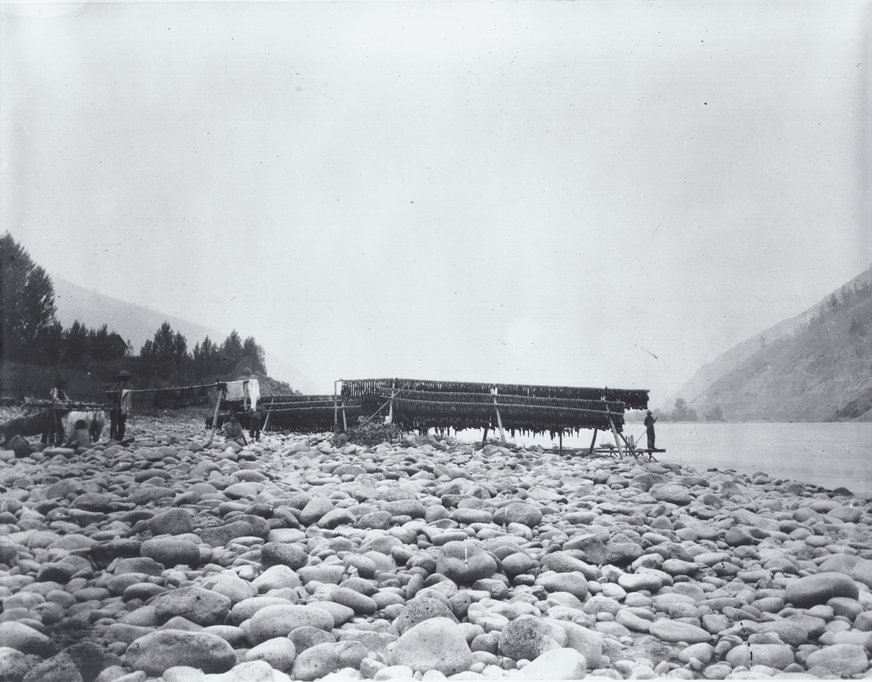
This is the simplest technique, and it is found everywhere: drying in the sun, in the wind, in smoke. Fish, meat, fruit and chillies are dried.
In the Andes, an even cleverer process was invented. At high altitude, temperatures drop below freezing at night and the sun blazes by day. Potatoes are spread out of doors: they freeze, which bursts their cells, then they thaw in the sun. They are then trampled by the family, on areas set aside for the purpose, which drives out the remaining water and removes the skin. The operation is repeated.
After several days, what remains is a hard, light, almost black product that keeps for years. This is chuño.
This is no makeshift expedient: it is exactly the principle of freeze-drying, the technique used today for astronauts’ food — invented in the Andes long before.
Chuño forms a reserve against famine on the scale of an empire. Archaeologists have found two chuños about five hundred years old in a jar set into the floor of an Inca site, on the desert coast of Peru. Yet chuño can only be made high in the mountains. These two pieces of potato are enough on their own to prove that this food was carried from one end of the empire to the other.1
Salt, and what it cost
Salt draws water out of food and stops microbes from settling in. Salted, a fish can last through a winter or cross an ocean.
That is why salt was, for centuries, one of the most precious commodities in the world. It was carried by camel across the Sahara, extracted from mines and salt marshes, and fought over.
That is also why states took an interest in it. Since no one can do without it, a salt tax is a sure source of revenue. Rome introduced one as early as 204 BCE. Comparable taxes existed in China, Japan and India.
A story best not repeated. You will read almost everywhere that Roman soldiers were paid in salt, and that our word “salary” comes from this. Half of it is true: salarium does derive from sal, salt. The other half has no basis. No ancient text attests that soldiers were paid in salt, or even that there was an allowance intended for buying it. The sentence from Pliny the Elder quoted in support — “the soldier’s pay was originally salt” — does not appear in this form in his text. What he actually writes is: salt is also related to magistracies and duty abroad, and that’s where we get the word “salaries”. He notes a link between two words; he does not say how soldiers were paid.
The researcher who took this story apart traces it back to the 1860s. The method is the same as for the legend of the diabolical zero: the birth of an invention can be dated by following who first wrote it down.
The story even has a happy ending. One of the greatest dictionaries of the English language has revised its entry and now cites this researcher in support of its caution. So a correction can travel up the chain, and not only down it.
Why a word for salt ended up meaning a payment remains unknown.2
In France, from the 1340s, the king taxed salt, then reserved its sale for himself. It could now be bought only in storehouses run by his agents, at the price he set, tax included. This tax was called the gabelle.3
The heaviest burden was not the tax itself. In some regions, every person was obliged to buy a minimum quantity of salt each year, whether they needed it or not. The price changed from one province to another: very expensive here, cheaper there, free in a few places. That is what made it the most hated tax in the kingdom.
It was abolished in 1790, reinstated in 1806, abolished again, reinstated again. It did not finally disappear until 1945.
Preserving one’s food was therefore expensive — not because of the technique, but because those in power had decided it should be so.
Letting the microbes work
The second strategy is the exact opposite of the first: instead of stopping micro-organisms from working, you let them get on with it — but you choose which ones.
This is fermentation. The good micro-organisms take up the space, transform the food, and stop the bad ones from settling in.
Almost every society has practised it, with whatever it had to hand. Bread and beer from cereals. Cheese and yoghurt from milk. Kimchi from vegetables, in Korea. Miso and soy sauce in East Asia. Sauces made from fermented fish, in South-East Asia as in the Roman world. Injera, in Ethiopia, from a tiny cereal called teff.
No one had ever seen a micro-organism, which stopped no one from using them.
Processing to make food edible
Some techniques go further than preservation: they make edible what is not.
Chuño already provides an example. There are two kinds. Black chuño is simply dried in the sun. White chuño, for its part, is made from bitter varieties of potato, toxic in their raw state, and it requires soaking in water for several weeks to remove the poison. Preserving and detoxifying, in a single operation.
Cassava is the clearest example. There are two kinds: sweet and bitter. Bitter cassava contains substances that release cyanide — the plant’s defence against those who would eat it.
To make it edible, it has to be peeled, grated, soaked at length, left to ferment, pressed, dried, then cooked for a long time. Each step removes part of the poison. Fermentation, together with pressing and washing the pulp, is the most effective step; drying in the sun or frying then removes part of the poison that remains.4
These steps are not mere habits but instructions, worked out in Amazonia, passed on for centuries, and followed today by hundreds of millions of people.
We must also mention what happens when they cannot be followed. Soaking cassava requires water, time, and something to eat while waiting. In times of drought, famine or war, families are forced to cut the soaking short. The poison remains, and a disease appears, konzo, which suddenly paralyses the legs and from which there is no recovery.5
A trap makes the situation far crueller.
When there is drought, the plant itself produces much more poison than usual. Cassava, stressed by the lack of water, increases its defence.6
In other words: at the very moment when there is not enough water to soak the roots, when people are hungry and cannot wait, the roots are more toxic. The three factors reinforce one another, and they arrive together.
A fourth factor adds to them. To neutralise cyanide, the body needs the sulphur in certain proteins. A person who eats little protein is therefore less well defended — and it is exactly the same circumstances that deprive people of protein and force them to cut the soaking short.7
It is not knowledge that is lacking. The knowledge is sound and it works. What is lacking is water, time, food and choice.
The doctor who gave this disease its name said so bluntly: one should not say that cassava causes konzo. Poverty, malnutrition, conflict, the absence of roads and markets are also needed. And he added the reason that matters here: if the true cause is not found, one does not act correctly.
A more encouraging note to finish: a quicker way of removing the poison from cassava flour has been developed, then taught to the women of affected villages. In one of them, the proportion of children exposed to the risk fell from more than half to less than a fifth.8
The most astonishing case is that of maize. In Mesoamerica, it is not simply cooked: it is soaked and cooked in water with lime added — further north, wood ash was used instead. This process is called nixtamalisation.9
This removes the skin of the grain, which is convenient. But above all, it releases a vitamin, niacin, which in raw maize remains locked up: it is indeed there, but the body cannot use it.10
The rest of the story is instructive. When maize travelled around the world, the plant travelled, but not the technique. In Europe and then in North America, poor populations ate untreated maize as their staple food. They developed a deficiency disease, pellagra, which damages the skin, the gut, then the mind, and which kills.
People died because the plant had been adopted without the know-how that went with it.
Cold
The last strategy: slow things down. In the cold, micro-organisms work slowly.
Long before electricity, ice houses were built. The most impressive is Iranian, and it bears a name meaning “ice pit”: the yakhchal.
One clarification is needed first, because it changes what goes into it. It is not a refrigerator. Food was not stored in it: ice was made and kept in it, and then distributed in the town during the summer. The ice, for its part, served many purposes — including sorbets.
The yakhchal is a great dome of earth set over a deep pit, with walls at least two metres thick, made of a special mortar mixing sand, clay, lime, egg white, goat hair and ashes. In winter, water is left to freeze in pools nearby — the water arrives through an underground channel, a qanat, like those described on the page on mastering water. The ice is piled into the pit. It lasts until the height of summer, when the temperature outside exceeds forty degrees.
How long has it existed? No one really knows, and that is interesting. Digging a pit to keep ice or snow is a very old practice: a Greek author relates that Alexander the Great had them dug during his campaign in India, more than two thousand three hundred years ago. But between that hole in the ground and the great brick dome, the whole story is missing: no text, no excavation tells how one led to the other. Many of the domes still standing are much more recent than people believe.
Yet one date is found everywhere, always the same, always phrased in the same way. That is precisely what should make us wary: when a sentence is copied word for word, it often has only one source.
A delightful detail to finish: in Persian, the word yakhchal still means refrigerator today.
At the end of the eighteenth century (the years 1700 to 1799), the French government promised a reward to whoever found a good way of preserving food. A confectioner, Nicolas Appert, set to work on it in 1795. He sealed food in carefully stoppered glass jars, then heated them in a water bath. He tried, failed, started again — for fifteen years.
The method worked. In 1810, he was given twelve thousand francs, on one condition: that he publish his method instead of keeping it to himself. He agreed, and his book was printed in a run of six thousand copies.11
But no one, not even he, knew why it worked. It would be another fifty years or so before the role of micro-organisms was understood. Throughout that time, food was preserved with a method that worked without anyone being able to explain it.12
Then came industrial refrigeration, and with it a new problem: between the farm and the plate, food passes through trains, warehouses, shops. If a single link is too warm or too dirty, everything is lost.
It was an American chemist, Mary Engle Pennington, who brought order to this field at the beginning of the twentieth century (the years 1900 to 1999). She measured the exact temperatures at which bacteria grow, set the rules for building refrigerated railway wagons, developed quick freezing, and wrote the first rules of what is today called the cold chain.13
One detail of her hiring deserves to be reported precisely. It was not she who had this idea. Her future director registered her under the name “M. E. Pennington”, so that no one would see that she was a woman.14
She came top in the examination.15
When the administration realised that she was a woman, some wanted to reverse her appointment; her director intervened, and she took up the post. In 1907 she became the first woman to head a laboratory of the United States government (some sources date her appointment to the end of 1906; the year 1907 is the one most generally accepted).16
Four ways to stop rotting
| Principle | Techniques | Examples |
|---|---|---|
| Removing water | Drying, frost and sun, smoking | Dried fish, Andean chuño |
| Making the environment uninhabitable | Salting, sugar, vinegar | Salted fish, confits |
| Choosing the micro-organisms | Fermentation | Kimchi, cheese, injera, miso |
| Slowing down | Cold, freezing | Cold chain |
Note 1
ALBERTA, CANADA—Two freeze-dried potatoes estimated to be 500 years old were discovered in a ceramic jar set into a floor at Tambo Viejo, a coastal Inca site in southern Peru’s arid Acarí Valley, according to a Phys.org report.
Saraceni, Jessica Esther, “Preserved Potatoes Discovered in Inca Site in Southern Peru”, Archaeology (Archaeological Institute of America), 16 June 2026
Note 2
There isn’t the tiniest scrap of evidence to suggest this. […] No ancient source ever actually uses salarium to mean ‘salt allowance’.
Gainsford, Peter, “Salt and Salary: Were Roman Soldiers Paid in Salt?”, Kiwi Hellenist: Modern Myths about the Ancient World, 11 January 2017
honoribus etiam militiaeque interponitur salariis inde dictis — (Salt) is also related to magistracies and duty abroad, and that's where we get the word 'salaries'
(Salt) is also related to magistracies and military service, salaries being named from it — (Salt) is also related to magistracies and duty abroad, and that’s where we get the word ’salaries’
Gainsford, Peter, “Salt and Salary: Were Roman Soldiers Paid in Salt?”, Kiwi Hellenist: Modern Myths about the Ancient World, 11 January 2017
I’ve done some searching around in Google Books with date constraints, and that seems to indicate that people first started writing about the idea around the 1860s
Gainsford, Peter, “Salt and Salary: Were Roman Soldiers Paid in Salt?”, Kiwi Hellenist: Modern Myths about the Ancient World, 11 January 2017
(Compare "Salt and salary: were Roman soldiers paid in salt?," blog post by New Zealand classicist Peter Gainsford, Kiwi Hellenist, January 11, 2017, available online 5/26/22.)
Merriam-Webster, “Salary”, Merriam-Webster.com Dictionary
Note 3
Mise au point par Philippe VI (ordonnances de 1341 et de 1343), elle ne cessa d'être perfectionnée jusqu'à la Révolution, qui l'abolit.
Developed by Philip VI (ordinances of 1341 and 1343), it was continually refined until the Revolution, which abolished it.
Moyen, Françoise, “Gabelle”, Encyclopædia Universalis
Par les lettres patentes du 4 janvier 1547 l’État se réserve le monopole de la vente dans des greniers à sel, mais s’en dessaisit au profit de marchands adjudicataires. […] il faudra finalement attendre la loi de finances du 31 décembre 1945 pour que la gabelle disparaisse définitivement.
By the letters patent of 4 January 1547 the State reserved to itself the monopoly of sale in salt storehouses, but relinquished it in favour of contracting merchants. […] it was ultimately necessary to wait for the finance law of 31 December 1945 for the gabelle to disappear for good.
Ministère de l’Économie et des Finances, Service des archives économiques et financières (SAEF), “La gabelle et les taxes sur le sel, une longue histoire”, document du mois
Note 4
In the detoxification of cassava products fermentation is most effective when accompanied by squeezing and washing of the acidic pulp. Residual cyanide can be reduced further by sun drying or frying.
Organisation des Nations unies pour l’alimentation et l’agriculture (FAO), Roots, Tubers, Plantains and Bananas in Human Nutrition, Rome, 1990
Note 5
Konzo is a distinct neurological entity […] characterized by an abrupt onset of an irreversible, non-progressive, and symmetrical spastic para/tetraparesis.
Nzwalo, Hipólito and Cliff, Julie, “Konzo: From Poverty, Cassava, and Cyanogen Intake to Toxico-Nutritional Neurological Disease”, PLOS Neglected Tropical Diseases, vol. 5, e1051, 2011
Note 6
In East Africa outbreaks occur during drought, when cassava plants produce much more cyanogens than normal.
Nhassico, Dulce, Bradbury, J. Howard, Cliff, Julie et al., “Use of the Wetting Method on Cassava Flour in Three Konzo Villages in Mozambique Reduces Cyanide Intake and May Prevent Konzo in Future Droughts”, Food Science & Nutrition, vol. 4, no. 4, 2016, p. 555-561
Note 7
Rhodanese is the enzyme responsible for most cyanide detoxification, transforming it to thiocyanate, […] The enzyme is located in all tissues, but mainly in the liver. This process requires sulphur donors, provided from dietary SAAs, which are deficient in cassava roots.
Nzwalo, Hipólito and Cliff, Julie, “Konzo: From Poverty, Cassava, and Cyanogen Intake to Toxico-Nutritional Neurological Disease”, PLOS Neglected Tropical Diseases, vol. 5, e1051, 2011
Note 8
The percentage of children with high (>350 μmol/L) urinary thiocyanate content and at risk of contracting konzo in Cava […] reduced from 52 […] to 17
Nhassico, Dulce, Bradbury, J. Howard, Cliff, Julie et al., “Use of the Wetting Method on Cassava Flour in Three Konzo Villages in Mozambique Reduces Cyanide Intake and May Prevent Konzo in Future Droughts”, Food Science & Nutrition, vol. 4, no. 4, 2016, p. 555-561
Note 9
Nixtamalization is a traditional maize preparation process in which dried kernels are cooked and steeped in an alkaline solution, usually water and food-grade lime (calcium hydroxide).
CIMMYT (Centre international d’amélioration du maïs et du blé), ressources techniques sur la nixtamalisation
In Mesoamerica, the widespread availability of limestone made slaked lime the predominant choice for the alkalizing agent, and nixtamalized maize was commonly ground into masa, the dough used to make tortillas and tamales […] In the American Southwest and Eastern Woodlands, however, lye strained from wood ash and other burned plant materials was most common (Beck, 2001; Briggs, 2015; Katz et al., 1974).
Johnson, Emily S. and Marston, John M., “The Experimental Identification of Nixtamalized Maize through Starch Spherulites”, Journal of Archaeological Science, vol. 113, 2020, article 105056
Note 10
The explanation seems to be the almost universal practice amongst the traditional American Indian corn-eaters of cooking their corn with alkali, either limewater or an extract of wood ash (Laguna & Carpenter, 1951; Katz, Hediger & Valleroy, 1974). This has the effect of releasing the niacin it contains from an otherwise unavailable complex (Kodicek, 1960).
Carpenter, K. J., “High-cereal diets for man”, Proceedings of the Nutrition Society, vol. 36, 1977, p. 149-158, open access
Note 11
j'ai en conséquence accueilli la proposition qui m'a été faite par mon bureau consultatif, de vous accorder un encouragement de douze mille francs. […] cette description que vous remettrez à mon bureau consultatif des Arts et manufactures, sera imprimée à vos frais, après qu'il l'aura examinée et revue. Vous m'en adresserez ensuite deux cents exemplaires. L'envoi de ces exemplaires étant la seule condition que je mette au paiement des douze mille francs qui vous ont été accordés, je ne doute point que vous ne vous empressiez de la remplir.
I have accordingly accepted the proposal made to me by my advisory board to grant you an award of twelve thousand francs. […] this description, which you will submit to my advisory board for Arts and Manufactures, will be printed at your expense, after the board has examined and revised it. You will then send me two hundred copies. The dispatch of these copies being the only condition I attach to the payment of the twelve thousand francs that have been granted to you, I have no doubt that you will hasten to fulfil it.
Appert, Nicolas, L’Art de conserver, pendant plusieurs années, toutes les substances animales et végétales, Paris, 1810
Note 12
But it was years before Louis Pasteur’s research would reveal the relationship between microorganisms and food going bad […] Appert knew that it worked, but he had no idea why, and neither did those, like Englishman Peter Durand, who refined his idea. Durand got the patent for the tin can in 1810. It would be more than 50 years before Pasteur would make the innovation that bears his name—pasteurization.
Smithsonian Magazine, “The Father of Canning Knew His Process Worked, But Not Why It Worked”, “Smart News” section, Smithsonian Institution, no date displayed
Note 13
she identified the exact temperatures at which bacteria grew, solving the mystery of why food went bad so quickly. […] Her research helped to establish national standards for ice-cooled refrigerator cars, set standards for construction and insulation, and solve the problem of humidity control in cold storage.
National Inventors Hall of Fame, notice biographique de Mary Engle Pennington
Note 14
Wiley disguised the fact that she was female […] submitting his hiring request under the name of M.E. Pennington
U.S. Food and Drug Administration, “Mary Engle Pennington: The "Cold Chain" of Food Safety”, FDA History Office, page à jour au 28 March 2018, open access
Significantly, Wiley registered her under the name “M. E. Pennington,” masking her gender.
Jones, Jacob, “Mary Engle Pennington”, Science History Institute, biographies scientifiques, 28 March 2025, open access
Note 15
Pennington achieved the top score on the Civil Service exam to enter federal service
U.S. Food and Drug Administration, “Mary Engle Pennington: The "Cold Chain" of Food Safety”, FDA History Office, page à jour au 28 March 2018, open access
Note 16
Later, when her sex was discovered, members of the Civil Service tried to rescind the offer. Wiley intervened to ensure that Pennington took the job.
Jones, Jacob, “Mary Engle Pennington”, Science History Institute, biographies scientifiques, 28 March 2025, open access
Notes and sources
- ↑
Passage Archaeologists have found two chuños about five hundred years old in a jar set into the floor of an Inca site, on the desert coast of Peru.
ALBERTA, CANADA—Two freeze-dried potatoes estimated to be 500 years old were discovered in a ceramic jar set into a floor at Tambo Viejo, a coastal Inca site in southern Peru’s arid Acarí Valley, according to a Phys.org report.
Source Saraceni, Jessica Esther, “Preserved Potatoes Discovered in Inca Site in Southern Peru”, Archaeology (Archaeological Institute of America), 16 June 2026, news item, 1st sentence.
Open access open the source · checked on 27 October 2026
- ↑
Passage No ancient text attests that soldiers were paid in salt, or even that there was an allowance intended for buying it.
There isn’t the tiniest scrap of evidence to suggest this. […] No ancient source ever actually uses salarium to mean ‘salt allowance’.
Source Gainsford, Peter, “Salt and Salary: Were Roman Soldiers Paid in Salt?”, Kiwi Hellenist: Modern Myths about the Ancient World, 11 January 2017, Beginning of the post (after the quotation of the myth “the Roman Legions were sometimes paid in salt”); then the section on dictionaries, paragraph “All these dictionaries are engaging in conjecture”.
Open access open the source · checked on 24 October 2026
Passage salt is also related to magistracies and duty abroad, and that’s where we get the word “salaries”
honoribus etiam militiaeque interponitur salariis inde dictis — (Salt) is also related to magistracies and duty abroad, and that's where we get the word 'salaries'
Editors’ translation (Salt) is also related to magistracies and military service, salaries being named from it — (Salt) is also related to magistracies and duty abroad, and that’s where we get the word ’salaries’
Source Gainsford, Peter, “Salt and Salary: Were Roman Soldiers Paid in Salt?”, Kiwi Hellenist: Modern Myths about the Ancient World, 11 January 2017, post of 11 January 2017 (quotation of Pliny, Natural History, 31, 89, and the author’s translation).
Open access open the source · checked on 9 September 2026
Passage The researcher who took this story apart traces it back to the 1860s.
I’ve done some searching around in Google Books with date constraints, and that seems to indicate that people first started writing about the idea around the 1860s
Source Gainsford, Peter, “Salt and Salary: Were Roman Soldiers Paid in Salt?”, Kiwi Hellenist: Modern Myths about the Ancient World, 11 January 2017, post of 11 January 2017, paragraph “‘Roman soldiers were paid in salt’ may be the simplest form of the myth”.
Open access open the source · checked on 9 September 2026
Passage One of the greatest dictionaries of the English language has revised its entry and now cites this researcher
(Compare "Salt and salary: were Roman soldiers paid in salt?," blog post by New Zealand classicist Peter Gainsford, Kiwi Hellenist, January 11, 2017, available online 5/26/22.)
Source Merriam-Webster, “Salary”, Merriam-Webster.com Dictionary, entry “salary”, etymology.
Open access open the source · checked on 9 September 2026
- ↑
Passage In France, from the 1340s, the king taxed salt, then reserved its sale for himself
Mise au point par Philippe VI (ordonnances de 1341 et de 1343), elle ne cessa d'être perfectionnée jusqu'à la Révolution, qui l'abolit.
Editors’ translation Developed by Philip VI (ordinances of 1341 and 1343), it was continually refined until the Revolution, which abolished it.
Source Moyen, Françoise, “Gabelle”, Encyclopædia Universalis, beginning of the article.
Paywalled open the source · checked on 24 October 2026
Passage the king taxed salt, then reserved its sale for himself […] It did not finally disappear until 1945.
Par les lettres patentes du 4 janvier 1547 l’État se réserve le monopole de la vente dans des greniers à sel, mais s’en dessaisit au profit de marchands adjudicataires. […] il faudra finalement attendre la loi de finances du 31 décembre 1945 pour que la gabelle disparaisse définitivement.
Editors’ translation By the letters patent of 4 January 1547 the State reserved to itself the monopoly of sale in salt storehouses, but relinquished it in favour of contracting merchants. […] it was ultimately necessary to wait for the finance law of 31 December 1945 for the gabelle to disappear for good.
Source Ministère de l’Économie et des Finances, Service des archives économiques et financières (SAEF), “La gabelle et les taxes sur le sel, une longue histoire”, document du mois, presentation text of the document of the month.
Open access open the source · checked on 24 October 2026
- ↑
Passage Fermentation, together with pressing and washing the pulp, is the most effective step; drying in the sun or frying then removes part of the poison that remains.
In the detoxification of cassava products fermentation is most effective when accompanied by squeezing and washing of the acidic pulp. Residual cyanide can be reduced further by sun drying or frying.
Source Organisation des Nations unies pour l’alimentation et l’agriculture (FAO), Roots, Tubers, Plantains and Bananas in Human Nutrition, Rome, 1990, chapter 7 “Toxic substances and antinutritional factors”, section on cassava, subheading “Production of low-cyanide foods”.
Open access open the source · checked on 24 October 2026
- ↑
Passage The poison remains, and a disease appears, konzo, which suddenly paralyses the legs and from which there is no recovery.
Konzo is a distinct neurological entity […] characterized by an abrupt onset of an irreversible, non-progressive, and symmetrical spastic para/tetraparesis.
Source Nzwalo, Hipólito and Cliff, Julie, “Konzo: From Poverty, Cassava, and Cyanogen Intake to Toxico-Nutritional Neurological Disease”, PLOS Neglected Tropical Diseases, vol. 5, e1051, 2011, abstract.
Open access open the source · checked on 9 September 2026
- ↑
Passage the plant itself produces much more poison than usual
In East Africa outbreaks occur during drought, when cassava plants produce much more cyanogens than normal.
Source Nhassico, Dulce, Bradbury, J. Howard, Cliff, Julie et al., “Use of the Wetting Method on Cassava Flour in Three Konzo Villages in Mozambique Reduces Cyanide Intake and May Prevent Konzo in Future Droughts”, Food Science & Nutrition, vol. 4, no. 4, 2016, p. 555-561, abstract.
Open access open the source · checked on 9 September 2026
- ↑
Passage To neutralise cyanide, the body needs the sulphur in certain proteins.
Rhodanese is the enzyme responsible for most cyanide detoxification, transforming it to thiocyanate, […] The enzyme is located in all tissues, but mainly in the liver. This process requires sulphur donors, provided from dietary SAAs, which are deficient in cassava roots.
Source Nzwalo, Hipólito and Cliff, Julie, “Konzo: From Poverty, Cassava, and Cyanogen Intake to Toxico-Nutritional Neurological Disease”, PLOS Neglected Tropical Diseases, vol. 5, e1051, 2011, “Cyanogen Toxicity and Konzo” section.
Open access open the source · checked on 9 September 2026
- ↑
Passage the proportion of children exposed to the risk fell from more than half to less than a fifth
The percentage of children with high (>350 μmol/L) urinary thiocyanate content and at risk of contracting konzo in Cava […] reduced from 52 […] to 17
Source Nhassico, Dulce, Bradbury, J. Howard, Cliff, Julie et al., “Use of the Wetting Method on Cassava Flour in Three Konzo Villages in Mozambique Reduces Cyanide Intake and May Prevent Konzo in Future Droughts”, Food Science & Nutrition, vol. 4, no. 4, 2016, p. 555-561, abstract.
Open access open the source · checked on 9 September 2026
- ↑
Passage it is soaked and cooked in water with lime added […] This process is called nixtamalisation.
Nixtamalization is a traditional maize preparation process in which dried kernels are cooked and steeped in an alkaline solution, usually water and food-grade lime (calcium hydroxide).
Source CIMMYT (Centre international d’amélioration du maïs et du blé), ressources techniques sur la nixtamalisation, page “What is nixtamalization?”, first sentence of the “What is nixtamalization?” section (after two introductory paragraphs).
Open access open the source · checked on 25 October 2026
Passage In Mesoamerica […] in water with lime added — further north, wood ash was used instead.
In Mesoamerica, the widespread availability of limestone made slaked lime the predominant choice for the alkalizing agent, and nixtamalized maize was commonly ground into masa, the dough used to make tortillas and tamales […] In the American Southwest and Eastern Woodlands, however, lye strained from wood ash and other burned plant materials was most common (Beck, 2001; Briggs, 2015; Katz et al., 1974).
Source Johnson, Emily S. and Marston, John M., “The Experimental Identification of Nixtamalized Maize through Starch Spherulites”, Journal of Archaeological Science, vol. 113, 2020, article 105056, p. 2 (accepted manuscript), “Regional differences” paragraph.
Paywalled (accepted manuscript open access) open the source · checked on 25 October 2026
- ↑
Passage it releases a vitamin, niacin, which in raw maize remains locked up
The explanation seems to be the almost universal practice amongst the traditional American Indian corn-eaters of cooking their corn with alkali, either limewater or an extract of wood ash (Laguna & Carpenter, 1951; Katz, Hediger & Valleroy, 1974). This has the effect of releasing the niacin it contains from an otherwise unavailable complex (Kodicek, 1960).
Source Carpenter, K. J., “High-cereal diets for man”, Proceedings of the Nutrition Society, vol. 36, 1977, p. 149-158, open access, p. 150.
Open access open the source · checked on 24 October 2026
- ↑
Passage In 1810, he was given twelve thousand francs, on one condition: that he publish his method
j'ai en conséquence accueilli la proposition qui m'a été faite par mon bureau consultatif, de vous accorder un encouragement de douze mille francs. […] cette description que vous remettrez à mon bureau consultatif des Arts et manufactures, sera imprimée à vos frais, après qu'il l'aura examinée et revue. Vous m'en adresserez ensuite deux cents exemplaires. L'envoi de ces exemplaires étant la seule condition que je mette au paiement des douze mille francs qui vous ont été accordés, je ne doute point que vous ne vous empressiez de la remplir.
Editors’ translation I have accordingly accepted the proposal made to me by my advisory board to grant you an award of twelve thousand francs. […] this description, which you will submit to my advisory board for Arts and Manufactures, will be printed at your expense, after the board has examined and revised it. You will then send me two hundred copies. The dispatch of these copies being the only condition I attach to the payment of the twelve thousand francs that have been granted to you, I have no doubt that you will hasten to fulfil it.
Source Appert, Nicolas, L’Art de conserver, pendant plusieurs années, toutes les substances animales et végétales, Paris, 1810, letter from the Minister of the Interior to Appert reproduced at the front of the book (preliminary pages, views 16 to 18 of the digitisation).
Public domain open the source · checked on 24 October 2026
- ↑
Passage It would be another fifty years or so before the role of micro-organisms was understood.
But it was years before Louis Pasteur’s research would reveal the relationship between microorganisms and food going bad […] Appert knew that it worked, but he had no idea why, and neither did those, like Englishman Peter Durand, who refined his idea. Durand got the patent for the tin can in 1810. It would be more than 50 years before Pasteur would make the innovation that bears his name—pasteurization.
Source Smithsonian Magazine, “The Father of Canning Knew His Process Worked, But Not Why It Worked”, “Smart News” section, Smithsonian Institution, no date displayed, body of the article, from the quotation of Brian A. Nummer to the last two sentences quoted.
Open access open the source · checked on 27 October 2026
- ↑
Passage She measured the exact temperatures at which bacteria grow, set the rules for building refrigerated railway wagons
she identified the exact temperatures at which bacteria grew, solving the mystery of why food went bad so quickly. […] Her research helped to establish national standards for ice-cooled refrigerator cars, set standards for construction and insulation, and solve the problem of humidity control in cold storage.
Source National Inventors Hall of Fame, notice biographique de Mary Engle Pennington, NIHF blog article “Defining Food Safety”; inductee notice, paragraph on the refrigerated wagons.
Open access open the source · checked on 24 October 2026
- ↑
Passage registered her under the name “M. E. Pennington”, so that no one would see that she was a woman
Wiley disguised the fact that she was female […] submitting his hiring request under the name of M.E. Pennington
Source U.S. Food and Drug Administration, “Mary Engle Pennington: The "Cold Chain" of Food Safety”, FDA History Office, page à jour au 28 March 2018, open access, historical feature, paragraph on her entry into the Bureau of Chemistry.
Open access open the source · checked on 24 October 2026
Passage Her future director registered her under the name “M. E. Pennington”
Significantly, Wiley registered her under the name “M. E. Pennington,” masking her gender.
Source Jones, Jacob, “Mary Engle Pennington”, Science History Institute, biographies scientifiques, 28 March 2025, open access, biography, paragraph on her hiring at the USDA.
Open access open the source · checked on 24 October 2026
- ↑
Passage She came top in the examination.
Pennington achieved the top score on the Civil Service exam to enter federal service
Source U.S. Food and Drug Administration, “Mary Engle Pennington: The "Cold Chain" of Food Safety”, FDA History Office, page à jour au 28 March 2018, open access, historical feature, paragraph on her entry into the Bureau of Chemistry.
Open access open the source · checked on 24 October 2026
- ↑
Passage When the administration realised that she was a woman, some wanted to reverse her appointment; her director intervened, and she took up the post
Later, when her sex was discovered, members of the Civil Service tried to rescind the offer. Wiley intervened to ensure that Pennington took the job.
Source Jones, Jacob, “Mary Engle Pennington”, Science History Institute, biographies scientifiques, 28 March 2025, open access, biography, paragraph on her hiring at the USDA.
Open access open the source · checked on 24 October 2026
Bibliography
18
- Appert, Nicolas, L’Art de conserver, pendant plusieurs années, toutes les substances animales et végétales, Paris, 1810 (the text published following the 12,000-franc prize).
- Barnett, James A., “A History of Research on Yeasts 1: Work by Chemists and Biologists 1789-1850”, Yeast, vol. 14, 1998, p. 1439-1451 (the context of fermentation before the discovery of micro-organisms).
- Carpenter, K. J., “High-cereal diets for man”, Proceedings of the Nutrition Society, vol. 36, 1977, p. 149-158, open access (cooking maize in limewater or with ash, which releases niacin from a complex that the body cannot use). https://doi.org/10.1079/PNS19770027
- CIMMYT (Centre international d’amélioration du maïs et du blé), ressources techniques sur la nixtamalisation.
- Gainsford, Peter, “Salt and Salary: Were Roman Soldiers Paid in Salt?”, Kiwi Hellenist: Modern Myths about the Ancient World, 11 January 2017, open access (the demonstration, with ancient sources in support, that no text attests either pay in salt or a salt allowance; the trail of the story traced back to the 1860s). https://kiwihellenist.blogspot.com/2017/01/salt-and-salary.html See also Wordorigins.org, entrée “salary” (the probably nineteenth-century origin of the story, and its spread through Lewis and Short’s Latin dictionary, 1879).
- Johnson, Emily S. and Marston, John M., “The Experimental Identification of Nixtamalized Maize through Starch Spherulites”, Journal of Archaeological Science, vol. 113, 2020, article 105056, paywalled (nixtamalisation: cooking maize in an alkaline solution; slaked lime, the predominant agent in Mesoamerica, and wood-ash lye, the most common in the American Southwest and the Eastern Woodlands; accepted manuscript read on the Boston University website, pp. 1-2). https://www.bu.edu/archaeology/files/2019/12/Johnson.Marston.JAS_.11.20.19.pdf
- Jones, Jacob, “Mary Engle Pennington”, Science History Institute, biographies scientifiques, 28 March 2025, open access (the registration under the name “M. E. Pennington”; the attempt to go back on her hiring and Wiley’s intervention; the headship of the Food Research Laboratory offered in 1907; the refrigerated railway wagons). https://www.sciencehistory.org/education/scientific-biographies/mary-engle-pennington/
- Merriam-Webster, “Salary”, Merriam-Webster.com Dictionary, open access (the etymological note that refers to Peter Gainsford’s blog post and judges the story of pay in salt to be unfounded). https://www.merriam-webster.com/dictionary/salary
- Ministère de l’Économie et des Finances, Service des archives économiques et financières (SAEF), “La gabelle et les taxes sur le sel, une longue histoire”, document du mois, open access (the royal monopoly on the sale of salt in the storehouses, the zones of 1680, the abolition of 1790, the reinstatement of 1806, the attempt of 1848 and the final abolition by the finance law of 31 December 1945). https://www.economie.gouv.fr/saef/document-du-mois/la-gabelle-et-les-taxes-sur-le-sel-une-longue-histoire
- Moyen, Françoise, “Gabelle”, Encyclopædia Universalis, paywalled, beginning of the article free to read (the gabelle developed by Philip VI, ordinances of 1341 and 1343). https://www.universalis.fr/encyclopedie/gabelle/
- National Inventors Hall of Fame, notice biographique de Mary Engle Pennington.
- Nhassico, Dulce, Bradbury, J. Howard, Cliff, Julie et al., “Use of the Wetting Method on Cassava Flour in Three Konzo Villages in Mozambique Reduces Cyanide Intake and May Prevent Konzo in Future Droughts”, Food Science & Nutrition, vol. 4, no. 4, 2016, p. 555-561, open access (the plant’s increased production of cyanogenic compounds in times of drought; the wetting method taught to village women and the fall in the proportion of children at risk). https://pmc.ncbi.nlm.nih.gov/articles/PMC4930499/
- Nzwalo, Hipólito and Cliff, Julie, “Konzo: From Poverty, Cassava, and Cyanogen Intake to Toxico-Nutritional Neurological Disease”, PLOS Neglected Tropical Diseases, vol. 5, e1051, 2011, open access (the sudden and irreversible paralysis; the combination of insufficiently processed bitter cassava and a protein-poor diet; the epidemics linked to severe food shortages). https://doi.org/10.1371/journal.pntd.0001051
- Organisation des Nations unies pour l’alimentation et l’agriculture (FAO), Roots, Tubers, Plantains and Bananas in Human Nutrition, Rome, 1990 (the toxicity of bitter cassava, konzo, detoxification methods).
- Saraceni, Jessica Esther, “Preserved Potatoes Discovered in Inca Site in Southern Peru”, Archaeology (Archaeological Institute of America), 16 June 2026, open access (the two chuños about 500 years old found in a jar set into the floor of Tambo Viejo, a coastal Inca site in the arid Acarí Valley). https://archaeology.org/news/2026/06/16/preserved-potatoes-discovered-in-inca-site-in-southern-peru/
- Smithsonian Magazine, “The Father of Canning Knew His Process Worked, But Not Why It Worked”, “Smart News” section, Smithsonian Institution, no date displayed, open access (Appert did not know why his method worked; more than fifty years before Pasteur established the role of micro-organisms). https://www.smithsonianmag.com/smart-news/father-canning-knew-his-process-worked-not-why-it-worked-180961960/
- U.S. Food and Drug Administration, “Mary Engle Pennington: The "Cold Chain" of Food Safety”, FDA History Office, page à jour au 28 March 2018, open access (the hiring request submitted by Harvey Wiley under the name “M.E. Pennington” to conceal that she was a woman; the top score in the civil service examination). https://www.fda.gov/about-fda/fda-history-exhibits/mary-engle-pennington-cold-chain-food-safety
- Valdez, Lidio M. and Bettcher, Katrina J., “Inka Freeze-Dried Potatoes from Tambo Viejo, Acarí Valley, Perú”, Journal of Field Archaeology, vol. 51, no. 5, 2026, p. 378-387 (the two chuños found at the site on the Peruvian coast). https://doi.org/10.1080/00934690.2026.2658319
Spotted an error or have a doubt? Write to us.