
A year lasts three hundred and sixty-five days. Except when it lasts three hundred and sixty-six.
This oddity is not a mistake, but the trace of a problem that every society in the world has encountered, and that none has completely solved.
Three clocks that do not agree
Nature offers us three ways of counting time.
The day: the Earth turns on its axis. The lunation: the Moon goes from one crescent to the next, in a little over twenty-nine days. The year: the Earth goes round the Sun, and the seasons return.
Yet these three durations do not divide into one another exactly. The year does not contain a whole number of days: almost six hours are left over. Nor does it contain a whole number of lunations.
Every calendar in the world is a solution to this problem. Every solution involves giving something up.
Following the Moon
The Hijri calendar, used in the Muslim world, follows the Moon. Twelve lunations make about three hundred and fifty-four days, eleven fewer than a solar year.1
The consequence: the months move. The month of Ramadan falls in summer for a few years, then in spring, then in winter. It goes round the seasons in about thirty years.
This is not a flaw, but a choice. This calendar gives priority to the Moon, which can be observed at a single glance, rather than to the seasons.
Catching up with an extra month
Other societies wanted to keep both: the lunar months, and the seasons in the right place.
Their solution: add a whole month from time to time. These calendars are called lunisolar. The Hebrew calendar works this way. So does the Chinese calendar, which explains why Chinese New Year does not fall on the same date each year in our calendar.2
It is a clever solution, but it requires knowing precisely when to add the extra month. So it takes observations, calculations, and people whose job this is.
Two counts at once
In Mesoamerica, the region’s peoples — among them the Maya — adopted another solution: using two calendars at once.
One counts two hundred and sixty days. The other counts three hundred and sixty-five. The two turn at the same time, like two gearwheels. A given combination of the two only comes round again after fifty-two years. This two-hundred-and-sixty-day count is, moreover, still used today, every day, by many Maya in Guatemala.3
That leaves the question of how these numbers were chosen. Why twenty and thirteen, rather than other numbers? Researchers put forward three explanations, and none is proven:
- Pregnancy: about two hundred and sixty-six days separate conception from birth. (Counted from the last menstrual period, as obstetric medicine does, a pregnancy lasts about two hundred and eighty days.) An ethnologist observed that K’iche’ midwives do indeed use this count to follow a pregnancy.
- The sky: at the latitude of certain very ancient sites, about fifteen degrees north, the Sun passes exactly overhead twice a year, and two hundred and sixty days separate these two passages. Other specialists find this explanation unconvincing.
- Maize growing: its agricultural cycle is said to be very close to this length.
What we do know, on the other hand, is what the carved dates tell us — and we have understood this only very recently. For a long time, specialists believed that the figures sculpted on the stelae were gods. In 1960, Tatiana Proskouriakoff showed that they were kings and queens: the dates mark their births, their accessions to power, their deaths. She thus reconstructed a sequence of seven rulers over two hundred years.4
How she got there
She was not an archaeologist. She was an architect, and she left for Guatemala in 1936 with a museum team for which she drew as a volunteer, unpaid.5
Her task: to draw the ruins. Then she produced reconstructions of the city — drawings showing the buildings as they must have stood. These drawings were noticed by a specialist, who hired her and sent her to draw other Maya cities.6
But the essential part is what she did next, and it is always left out of the story.
Before her 1960 discovery, she undertook a substantial piece of work: analysing around four hundred monuments to establish a dating method based on the style of the sculpture — the shape of the features, the way the figures are handled. Her method makes it possible to date a monument with no inscribed date to within twenty or thirty years.7
This is not an artist’s eye at work. It is a systematic comparison of four hundred objects.
It was by spending so many years looking at these stones one by one that she finally saw the pattern: the same signs, in the same places, in the same order, from one stela to the next.
One Mayanist summed up the effect of her article in a single sentence: at one blow, this short paper freed the study of Maya writing from a lengthy stagnation.8
Ten days erased
The calendar used in the Roman Empire, introduced by Julius Caesar in 46 BCE, counted a year of three hundred and sixty-five and a quarter days. It was almost right. Almost: it drifted by about one day every hundred and twenty-eight years.
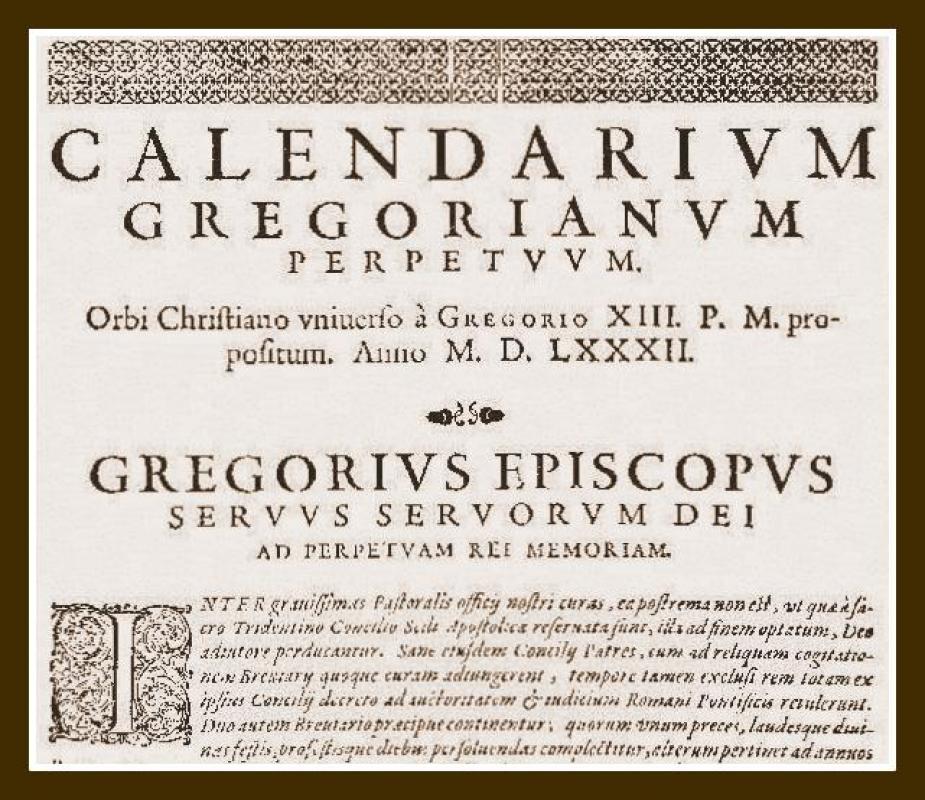
After sixteen centuries, the drift had become visible. In 1582, a reform decided to correct it in one go: ten days were removed from the calendar. People went to bed one evening and woke up ten days later.9
But not everyone followed at the same time. Great Britain and its colonies waited until 1752. Japan changed in 1873, China in 1912, Russia in 1918. Greece did not switch until 1923.10
A curious detail: the longer a country waited, the greater the lag, and so the more days had to be removed. Ten in 1582. Eleven in 1752. Thirteen in 1918.
For more than three centuries, two neighbouring countries could be on different dates on the same day.
From shadow to atom
To measure time within a day, other tools were needed.
The simplest is a stick planted in the ground. Its shadow turns and shortens: this is a gnomon. Then came water clocks, used in Egypt, in China, in the Greek and then the Arabic-speaking world. Water flows out at a steady rate, and its level indicates the hour.
For a clock to run regularly, it needs a mechanism that releases energy little by little, in regular jolts, instead of letting it run out all at once. This mechanism is called an escapement. It was developed in China in the eighth century, by a monk named Yi Xing and Liang Lingzan.11
Around 1090, still in China, the engineer Su Song completed a water-driven clock tower in Kaifeng, as tall as a building, which also displayed the positions of the heavenly bodies. It was dismantled by an army in 1127, and no one has ever managed to reassemble it.12
In Europe, more than five centuries after the Chinese escapement, weight-driven clocks were built in the thirteenth century (the years 1200 to 1299) and installed on town towers. Then, in 1656, Huygens applied the pendulum to the clock: precision took a leap forward.13
Today, the reference is the atomic clock. It uses the regular vibration of atoms and drifts by less than one second in several million years.
Who decides the time?
One last question: why does the time change when you travel?
For a long time, each town had its own time, set by the Sun. This posed no problem as long as people travelled slowly.
The railway changed everything. With trains crossing a country in a day, common timetables were needed, otherwise collisions would become inevitable. The railway companies of North America did not wait for governments: meeting in Chicago in 1883, they divided the continent into five time zones and applied them.
The following year, in 1884, an international conference met in Washington. It adopted the meridian passing through Greenwich, near London, as the starting point for longitudes. This choice was by no means obligatory: it prevailed because most navigation charts already used it.14
The conference did not, however, divide the world into time zones. This is often claimed, and it is wrong. One delegate proposed it; others replied that this was not the subject of the meeting, and the proposal was not even put to a vote. Time zones came afterwards, country by country, each choosing its own moment.15
Not everyone agreed. France abstained in the vote. It continued to print its maps with the Paris meridian until 1911. Its law eventually accepted Greenwich time without ever writing the word: it defined it as “Paris time retarded by nine minutes and twenty-one seconds”.16
Our calendars and our hours do not come from the sky. They are human decisions, taken on specific dates, by people who had their reasons.
Three families of calendars
| Family | What it is set by | What it loses | Examples |
|---|---|---|---|
| Observational lunar | The observed Moon | The seasons drift | Hijri |
| Lunisolar | The Moon, brought back into line with the Sun | Months have to be added | Hebrew, Chinese |
| Solar | The Sun alone | The months no longer follow the Moon | Julian, Gregorian, Ethiopian |
Note 1
Douze mois lunaires comportent 354 ou 355 jours, l'année solaire comporte 365 ou 366 jours, les calendriers lunaires se décalent donc en moyenne de 11 jours par rapport à un calendrier solaire.
Twelve lunar months comprise 354 or 355 days, the solar year comprises 365 or 366 days, so lunar calendars drift on average by 11 days relative to a solar calendar.
Rocher, Patrick, “Les calendriers”, Institut de mécanique céleste et de calcul des éphémérides, Observatoire de Paris, cours, s. d., open access
Note 2
Pour rattraper ce décalage et conserver un aspect solaire à un calendrier lunaire il suffit d'intercaler des années de 13 mois lunaires.
To make up this drift and give a lunar calendar a solar character, it is enough to intercalate years of 13 lunar months.
Rocher, Patrick, “Les calendriers”, Institut de mécanique céleste et de calcul des éphémérides, Observatoire de Paris, cours, s. d., open access
Note 3
In the Calendar Round, any given combination of a Tzolk’in day with a Haab day will not repeat itself, until 52 periods of 365 days have passed.
Smithsonian Institution, National Museum of the American Indian, Living Maya Time
The Maya sacred calendar is called Tzolk’in in Yucatec Mayan and Chol Q’ij in K’iche’ Mayan. […] The Chol Q’ij printed calendar is used daily by many people in the highlands of Guatemala.
Smithsonian Institution, National Museum of the American Indian, Living Maya Time
Note 4
The intervals between these dates are such that no single series exceeds the span of a reasonable lifetime, and it is suggested that the initial date represents something in the nature of a birth or name day of a ruler who accedes to power on the inaugural date, and that each set of monuments records the history of a reign. The representations on monuments are interpreted as portraits of rulers and their families.
Proskouriakoff, Tatiana, “Historical Implications of a Pattern of Dates at Piedras Negras, Guatemala”, American Antiquity, vol. 25, no. 4, 1960, p. 454-475
Note 5
She received a B.S. degree in Architecture from Penn State University in 1930, […] and volunteered to do archaeological drawings at the University Museum. Her work impressed Linton Satterthwaite, Assistant Curator of the American Section, who invited her to join his 1936 expedition to the Maya site of Piedras Negras in northwestern Guatemala.
Penn Museum Archives, “Tatiana Proskouriakoff Papers (PU-Mu. 1116)”, inventaire du fonds, notice biographique, open access
Note 6
Beginning with Piedras Negras, Proskouriakoff produced a series of reconstructive drawings depicting ancient Mayan cities. […] Silvanus Morley of the Carnegie Institution of Washington (CIW) sent Proskouriakoff to Copan, Honduras, and then Chichen Itza and other sites in Yucatan, Mexico to produce restoration architectural drawings of Mayan ruins.
Penn Museum Archives, “Tatiana Proskouriakoff Papers (PU-Mu. 1116)”, inventaire du fonds, notice biographique, open access
Tania’s stunning reconstructions of Piedras Negras were noticed by another pioneer of Maya archaeology, Sylvanus Morley of the Carnegie Institution in Washington DC. Morley sent Tania to the site of Copan in Honduras in 1939 and later to Chichen Itza in Mexico.
Archaeological Institute of America, notice biographique “Tatiana Avenirovna Proskouriakoff”
Note 7
Even before publishing the 1960 paper, Tania had begun to revolutionize Maya scholarship by establishing a method of dating Maya monuments that was based on morphology and sculptural style rather than on an examination of aesthetic values—the commonly used process at the time. Through a systematic and rigorous analysis of around 400 monuments that included inscriptions with dates, she put together a process to date any monument without an inscribed date to within 20 or 30 years.
Archaeological Institute of America, notice biographique “Tatiana Avenirovna Proskouriakoff”
Note 8
at one blow, this short paper freed the study of Maya writing from a lengthy stagnation
Archaeological Institute of America, notice biographique “Tatiana Avenirovna Proskouriakoff”
Note 9
The most surreal part of implementing the new calendar came in October 1582, when 10 days were dropped […] So, in countries that adopted the new calendar, the Feast of St. Francis of Assisi on October 4, 1582, was directly followed by October 15.
“Gregorian Calendar” et “Ten Days That Vanished”, Encyclopædia Britannica
Note 10
Britain adopted the New Style in 1752 and Sweden in 1753, although the Swedes, because they had in 1740 followed the German Protestants in using their astronomical methods for determining Easter, declined to adopt the Gregorian calendar rules until 1844. […] The now-defunct Soviet Union adopted the New Style in 1918, and Greece in 1923. In Britain and the British dominions, the change was made when the difference between the New and Old Style calendars amounted to 11 days: the lag was covered by naming the day after September 2, 1752, as September 14, 1752.
“Calendar”, section “The Gregorian calendar”, Encyclopædia Britannica
Note 11
One such example is the water-powered celestial globe (shuiyun huntian) developed by the monk I-Hsing (683–727 CE) and Liang Lingzan. […] Joseph Needham (1900–1995 CE) believed that this water-powered celestial globe was the predecessor of the earliest mechanical clock (Liu and Wang, 1959), and that it was equipped with a waterwheel steelyard clepsydra, which, according to historical records, functioned as the earliest known escapement regulator.
Hwang, Zeng-Hui, Lin, Tsung-Yi and Yan, Hong-Sen, “Reconstruction designs of an early Chinese astronomical clock with a waterwheel steelyard clepsydra”, Mechanical Sciences, vol. 12, no. 2, 2021
During the 8th century, ancient China began to use a steelyard clepsydra to control the waterwheel, giving it a time-keeping function for use in hydromechanical astronomical clocks. In the Tang Dynasty, the monk I-Hsing (683–723 CE) and Liang Lingzan jointly built a water-powered celestial globe (shuiyun huntian), which, according to historical records, was China's first hydromechanical astronomical clock with a waterwheel steelyard clepsydra.
Hwang, Zeng-Hui, Lin, Tsung-Yi and Yan, Hong-Sen, “Reconstruction designs of an early Chinese astronomical clock with a waterwheel steelyard clepsydra”, Mechanical Sciences, vol. 12, no. 2, 2021
Note 12
His astronomical clock, powered by a water wheel, was completed in around 1090.
“Su-sung”, Science and Its Times: Understanding the Social Significance of Scientific Discovery, Gale, online at Encyclopedia.com
Note 13
In 1656 he patented the first pendulum clock, which greatly increased the accuracy of time measurement.
O’Connor, John J. and Robertson, Edmund F., “Christiaan Huygens”, MacTutor History of Mathematics, University of St Andrews
Note 14
II. “Resolved, That the Conference proposes to the Governments here represented the adoption of the meridian passing through the centre of the transit instrument at the Observatory of Greenwich as the initial meridian, for longitude.”
“The Prime Meridian Conference”, Nature, vol. 31, no. 787, 27 November 1884, p. 82-83
The Delegates to the International Meridian Conference, who assembled in Washington upon invitation addressed by the Government of the United States to all nations holding diplomatic relations with it, […] held their first conference to-day, October 1, 1884, in the Diplomatic Hall of the Department of State.
International Conference Held at Washington for the Purpose of Fixing a Prime Meridian and a Universal Day, October 1884: Protocols of the Proceedings, Washington, 1884, public domain
Note 15
Mr. Allen here read a paper upon the needs and conveniences of the railroads and telegraphs, advocating local times differing whole hours from each other, and introduced a resolution that local time be held to mean that of the nearest meridian situated some whole number of hours from Greenwich ; but, after some discussion as to the competence of the conference to go so far into details, he withdrew it.
“The Meridian Conference”, Science, vol. 4, no. 90, 24 October 1884, p. 406
Note 16
The above resolution was adopted by the following vote : — […] In the negative— San Domingo. Abstaining from voting— Brazil, France. Ayes, 22 ; noes, 1 ; abstaining, 2.
“The Prime Meridian Conference”, Nature, vol. 31, no. 787, 27 November 1884, p. 82-83
Notes and sources
- ↑
Passage Twelve lunations make about three hundred and fifty-four days, eleven fewer than a solar year.
Douze mois lunaires comportent 354 ou 355 jours, l'année solaire comporte 365 ou 366 jours, les calendriers lunaires se décalent donc en moyenne de 11 jours par rapport à un calendrier solaire.
Editors’ translation Twelve lunar months comprise 354 or 355 days, the solar year comprises 365 or 366 days, so lunar calendars drift on average by 11 days relative to a solar calendar.
Source Rocher, Patrick, “Les calendriers”, Institut de mécanique céleste et de calcul des éphémérides, Observatoire de Paris, cours, s. d., open access, p. 13, part on lunar calendars (see also p. 6: “une année lunaire moyenne de 12Lm = 354,3670662 jours”).
Open access open the source · checked on 24 October 2026
- ↑
Passage Their solution: add a whole month from time to time. These calendars are called lunisolar.
Pour rattraper ce décalage et conserver un aspect solaire à un calendrier lunaire il suffit d'intercaler des années de 13 mois lunaires.
Editors’ translation To make up this drift and give a lunar calendar a solar character, it is enough to intercalate years of 13 lunar months.
Source Rocher, Patrick, “Les calendriers”, Institut de mécanique céleste et de calcul des éphémérides, Observatoire de Paris, cours, s. d., open access, p. 13, part on lunar calendars; the notion of a lunisolar calendar is defined in the introduction to the course.
Open access open the source · checked on 24 October 2026
- ↑
Passage A given combination of the two only comes round again after fifty-two years.
In the Calendar Round, any given combination of a Tzolk’in day with a Haab day will not repeat itself, until 52 periods of 365 days have passed.
Source Smithsonian Institution, National Museum of the American Indian, Living Maya Time, page “The Calendar System”, part on the “Calendar Round”.
Open access open the source · checked on 24 October 2026
Passage This two-hundred-and-sixty-day count is, moreover, still used today, every day, by many Maya in Guatemala.
The Maya sacred calendar is called Tzolk’in in Yucatec Mayan and Chol Q’ij in K’iche’ Mayan. […] The Chol Q’ij printed calendar is used daily by many people in the highlands of Guatemala.
Source Smithsonian Institution, National Museum of the American Indian, Living Maya Time, page “The Calendar System”, part on the Tzolk’in.
Open access open the source · checked on 24 October 2026
- ↑
Passage In 1960, Tatiana Proskouriakoff showed that they were kings and queens: the dates mark their births, their accessions to power […]
The intervals between these dates are such that no single series exceeds the span of a reasonable lifetime, and it is suggested that the initial date represents something in the nature of a birth or name day of a ruler who accedes to power on the inaugural date, and that each set of monuments records the history of a reign. The representations on monuments are interpreted as portraits of rulers and their families.
Source Proskouriakoff, Tatiana, “Historical Implications of a Pattern of Dates at Piedras Negras, Guatemala”, American Antiquity, vol. 25, no. 4, 1960, p. 454-475, abstract.
Paywalled · checked on 9 September 2026
- ↑
Passage She was an architect, and she left for Guatemala in 1936 with a museum team for which she drew as a volunteer, unpaid.
She received a B.S. degree in Architecture from Penn State University in 1930, […] and volunteered to do archaeological drawings at the University Museum. Her work impressed Linton Satterthwaite, Assistant Curator of the American Section, who invited her to join his 1936 expedition to the Maya site of Piedras Negras in northwestern Guatemala.
Source Penn Museum Archives, “Tatiana Proskouriakoff Papers (PU-Mu. 1116)”, inventaire du fonds, notice biographique, open access, biographical note in the finding aid.
Open access open the source · checked on 24 October 2026
- ↑
Passage she produced reconstructions of the city […] These drawings were noticed by a specialist, who hired her and sent her to draw other Maya cities.
Beginning with Piedras Negras, Proskouriakoff produced a series of reconstructive drawings depicting ancient Mayan cities. […] Silvanus Morley of the Carnegie Institution of Washington (CIW) sent Proskouriakoff to Copan, Honduras, and then Chichen Itza and other sites in Yucatan, Mexico to produce restoration architectural drawings of Mayan ruins.
Source Penn Museum Archives, “Tatiana Proskouriakoff Papers (PU-Mu. 1116)”, inventaire du fonds, notice biographique, open access, biographical note in the finding aid.
Open access open the source · checked on 24 October 2026
Passage she produced reconstructions of the city […] These drawings were noticed by a specialist, who hired her and sent her to draw other Maya cities.
Tania’s stunning reconstructions of Piedras Negras were noticed by another pioneer of Maya archaeology, Sylvanus Morley of the Carnegie Institution in Washington DC. Morley sent Tania to the site of Copan in Honduras in 1939 and later to Chichen Itza in Mexico.
Source Archaeological Institute of America, notice biographique “Tatiana Avenirovna Proskouriakoff”, body of the article.
Open access open the source · checked on 24 October 2026
- ↑
Passage analysing around four hundred monuments to establish a dating method based on the style of the sculpture […] to within twenty or thirty years
Even before publishing the 1960 paper, Tania had begun to revolutionize Maya scholarship by establishing a method of dating Maya monuments that was based on morphology and sculptural style rather than on an examination of aesthetic values—the commonly used process at the time. Through a systematic and rigorous analysis of around 400 monuments that included inscriptions with dates, she put together a process to date any monument without an inscribed date to within 20 or 30 years.
Source Archaeological Institute of America, notice biographique “Tatiana Avenirovna Proskouriakoff”, biographical note (interview with Ben Thomas).
Open access open the source · checked on 9 September 2026
- ↑
Passage at one blow, this short paper freed the study of Maya writing from a lengthy stagnation
at one blow, this short paper freed the study of Maya writing from a lengthy stagnation
Source Archaeological Institute of America, notice biographique “Tatiana Avenirovna Proskouriakoff”, quotation from Ian Graham.
Open access open the source · checked on 9 September 2026
- ↑
Passage In 1582, a reform decided to correct it in one go: ten days were removed from the calendar.
The most surreal part of implementing the new calendar came in October 1582, when 10 days were dropped […] So, in countries that adopted the new calendar, the Feast of St. Francis of Assisi on October 4, 1582, was directly followed by October 15.
Source “Gregorian Calendar” et “Ten Days That Vanished”, Encyclopædia Britannica, “Ten Days That Vanished: The Switch to the Gregorian Calendar”, fourth paragraph.
Open access · checked on 24 October 2026
- ↑
Passage Great Britain and its colonies waited until 1752 […] Greece did not switch until 1923.
Britain adopted the New Style in 1752 and Sweden in 1753, although the Swedes, because they had in 1740 followed the German Protestants in using their astronomical methods for determining Easter, declined to adopt the Gregorian calendar rules until 1844. […] The now-defunct Soviet Union adopted the New Style in 1918, and Greece in 1923. In Britain and the British dominions, the change was made when the difference between the New and Old Style calendars amounted to 11 days: the lag was covered by naming the day after September 2, 1752, as September 14, 1752.
Source “Calendar”, section “The Gregorian calendar”, Encyclopædia Britannica, article “Calendar”, section “The Gregorian calendar” (end of one paragraph and beginning of the next).
Open access open the source · checked on 25 October 2026
- ↑
Passage This mechanism is called an escapement. It was developed in China […] by a monk named Yi Xing and Liang Lingzan.
One such example is the water-powered celestial globe (shuiyun huntian) developed by the monk I-Hsing (683–727 CE) and Liang Lingzan. […] Joseph Needham (1900–1995 CE) believed that this water-powered celestial globe was the predecessor of the earliest mechanical clock (Liu and Wang, 1959), and that it was equipped with a waterwheel steelyard clepsydra, which, according to historical records, functioned as the earliest known escapement regulator.
Source Hwang, Zeng-Hui, Lin, Tsung-Yi and Yan, Hong-Sen, “Reconstruction designs of an early Chinese astronomical clock with a waterwheel steelyard clepsydra”, Mechanical Sciences, vol. 12, no. 2, 2021, § 1 (“Introduction”), 1st paragraph.
Open access open the source · checked on 27 October 2026
Passage It was developed in China in the eighth century
During the 8th century, ancient China began to use a steelyard clepsydra to control the waterwheel, giving it a time-keeping function for use in hydromechanical astronomical clocks. In the Tang Dynasty, the monk I-Hsing (683–723 CE) and Liang Lingzan jointly built a water-powered celestial globe (shuiyun huntian), which, according to historical records, was China's first hydromechanical astronomical clock with a waterwheel steelyard clepsydra.
Source Hwang, Zeng-Hui, Lin, Tsung-Yi and Yan, Hong-Sen, “Reconstruction designs of an early Chinese astronomical clock with a waterwheel steelyard clepsydra”, Mechanical Sciences, vol. 12, no. 2, 2021, abstract, 1st and 2nd sentences.
Open access open the source · checked on 27 October 2026
- ↑
Passage Around 1090, still in China, the engineer Su Song completed a water-driven clock tower in Kaifeng
His astronomical clock, powered by a water wheel, was completed in around 1090.
Source “Su-sung”, Science and Its Times: Understanding the Social Significance of Scientific Discovery, Gale, online at Encyclopedia.com, entry “Su-sung”.
Open access open the source · checked on 27 October 2026
- ↑
Passage in 1656, Huygens applied the pendulum to the clock
In 1656 he patented the first pendulum clock, which greatly increased the accuracy of time measurement.
Source O’Connor, John J. and Robertson, Edmund F., “Christiaan Huygens”, MacTutor History of Mathematics, University of St Andrews, biography, paragraph beginning “Work in astronomy required accurate timekeeping.”.
Open access open the source · checked on 24 October 2026
- ↑
Passage It adopted the meridian passing through Greenwich […] as the starting point for longitudes.
II. “Resolved, That the Conference proposes to the Governments here represented the adoption of the meridian passing through the centre of the transit instrument at the Observatory of Greenwich as the initial meridian, for longitude.”
Source “The Prime Meridian Conference”, Nature, vol. 31, no. 787, 27 November 1884, p. 82-83, p. 82 (Final Act, Resolution II).
Public domain open the source · checked on 27 October 2026
Passage in 1884, an international conference met in Washington
The Delegates to the International Meridian Conference, who assembled in Washington upon invitation addressed by the Government of the United States to all nations holding diplomatic relations with it, […] held their first conference to-day, October 1, 1884, in the Diplomatic Hall of the Department of State.
Source International Conference Held at Washington for the Purpose of Fixing a Prime Meridian and a Universal Day, October 1884: Protocols of the Proceedings, Washington, 1884, public domain, minutes of the first session (1 October 1884), first sentence.
Open access · checked on 24 October 2026
- ↑
Passage The conference did not, however, divide the world into time zones […] the proposal was not even put to a vote
Mr. Allen here read a paper upon the needs and conveniences of the railroads and telegraphs, advocating local times differing whole hours from each other, and introduced a resolution that local time be held to mean that of the nearest meridian situated some whole number of hours from Greenwich ; but, after some discussion as to the competence of the conference to go so far into details, he withdrew it.
Source “The Meridian Conference”, Science, vol. 4, no. 90, 24 October 1884, p. 406, p. 406, report of the session of Tuesday 14 October 1884.
Public domain open the source · checked on 27 October 2026
- ↑
Passage France abstained in the vote.
The above resolution was adopted by the following vote : — […] In the negative— San Domingo. Abstaining from voting— Brazil, France. Ayes, 22 ; noes, 1 ; abstaining, 2.
Source “The Prime Meridian Conference”, Nature, vol. 31, no. 787, 27 November 1884, p. 82-83, p. 82-83 (Final Act, vote on Resolution II; the abstention is at the top of p. 83).
Public domain open the source · checked on 27 October 2026
Bibliography
14
- Archaeological Institute of America, notice biographique “Tatiana Avenirovna Proskouriakoff”, open access (the analysis of around four hundred monuments and the method of dating by style, to within twenty or thirty years; Ian Graham’s judgement on the effect of the 1960 article; the reconstructions of Piedras Negras noticed by Sylvanus Morley, who sent her to Copán in 1939). https://www.archaeological.org/archaeologists-you-should-know-proskouriakoff/
- “Calendar”, section “The Gregorian calendar”, Encyclopædia Britannica, open access (the staggered adoption of the Gregorian calendar: Britain and its dominions in 1752, Japan in 1873, the Soviet Union in 1918, Greece in 1923; consulted on 24 October 2026). https://www.britannica.com/science/calendar/The-Gregorian-calendar
- “Gregorian Calendar” et “Ten Days That Vanished”, Encyclopædia Britannica, open access (the 1582 reform, the ten days removed, and the adoption spread over more than three centuries).
- Hwang, Zeng-Hui, Lin, Tsung-Yi and Yan, Hong-Sen, “Reconstruction designs of an early Chinese astronomical clock with a waterwheel steelyard clepsydra”, Mechanical Sciences, vol. 12, no. 2, 2021, open access. https://doi.org/10.5194/ms-12-891-2021
- International Conference Held at Washington for the Purpose of Fixing a Prime Meridian and a Universal Day, October 1884: Protocols of the Proceedings, Washington, 1884, public domain (the choice of the Greenwich meridian; the proposal for time zones set aside without a vote; France’s abstention).
- Needham, Joseph, with Wang Ling, Science and Civilisation in China, vol. IV, part 2, Cambridge University Press, 1965, in libraries (the escapement developed in the eighth century by Yi Xing and Liang Lingzan, and Su Song’s clock tower).
- O’Connor, John J. and Robertson, Edmund F., “Christiaan Huygens”, MacTutor History of Mathematics, University of St Andrews, open access (the pendulum applied to the clock in 1656). https://mathshistory.st-andrews.ac.uk/Biographies/Huygens/
- Penn Museum Archives, “Tatiana Proskouriakoff Papers (PU-Mu. 1116)”, inventaire du fonds, notice biographique, open access (the 1930 architecture degree; the volunteer drawing work at the University of Pennsylvania museum; the 1936 expedition to Piedras Negras; the reconstruction drawings; the post obtained with Sylvanus Morley). https://www.penn.museum/collections/archives/findingaid/552873
- Proskouriakoff, Tatiana, “Historical Implications of a Pattern of Dates at Piedras Negras, Guatemala”, American Antiquity, vol. 25, no. 4, 1960, p. 454-475, paywalled (the demonstration that the carved dates mark out reigns, and the sequence of seven rulers reconstructed).
- Rocher, Patrick, “Les calendriers”, Institut de mécanique céleste et de calcul des éphémérides, Observatoire de Paris, cours, s. d., open access (the families of calendars; the lunar year of 354 days and its 11-day drift against the solar year; the thirteen-month years of lunisolar calendars, including the Jewish calendar). https://perso.imcce.fr/jean-eudes-arlot/ecole-ete-aout-2017/cours/cours-les%20calendriers.pdf
- Smithsonian Institution, National Museum of the American Indian, Living Maya Time, open access (the two-hundred-and-sixty-day count, kept without interruption to this day).
- “Su-sung”, Science and Its Times: Understanding the Social Significance of Scientific Discovery, Gale, online at Encyclopedia.com, open access (the astronomical clock driven by a waterwheel, completed around 1090). https://encyclopedia.com/science/encyclopedias-almanacs-transcripts-and-maps/su-sung
- “The Meridian Conference”, Science, vol. 4, no. 90, 24 October 1884, p. 406, public domain (Allen’s proposal of local times differing by whole hours from Greenwich, withdrawn after a discussion of the conference’s competence). https://archive.org/details/jstor-1758379
- “The Prime Meridian Conference”, Nature, vol. 31, no. 787, 27 November 1884, p. 82-83, public domain (the Final Act of the Washington conference: the resolution adopting the Greenwich meridian and the record of the vote, 22 for, 1 against, Brazil and France abstaining). https://archive.org/details/paper-doi-10_1038_031082c0
Diagrams: generated images, checked element by element.
Spotted an error or have a doubt? Write to us.