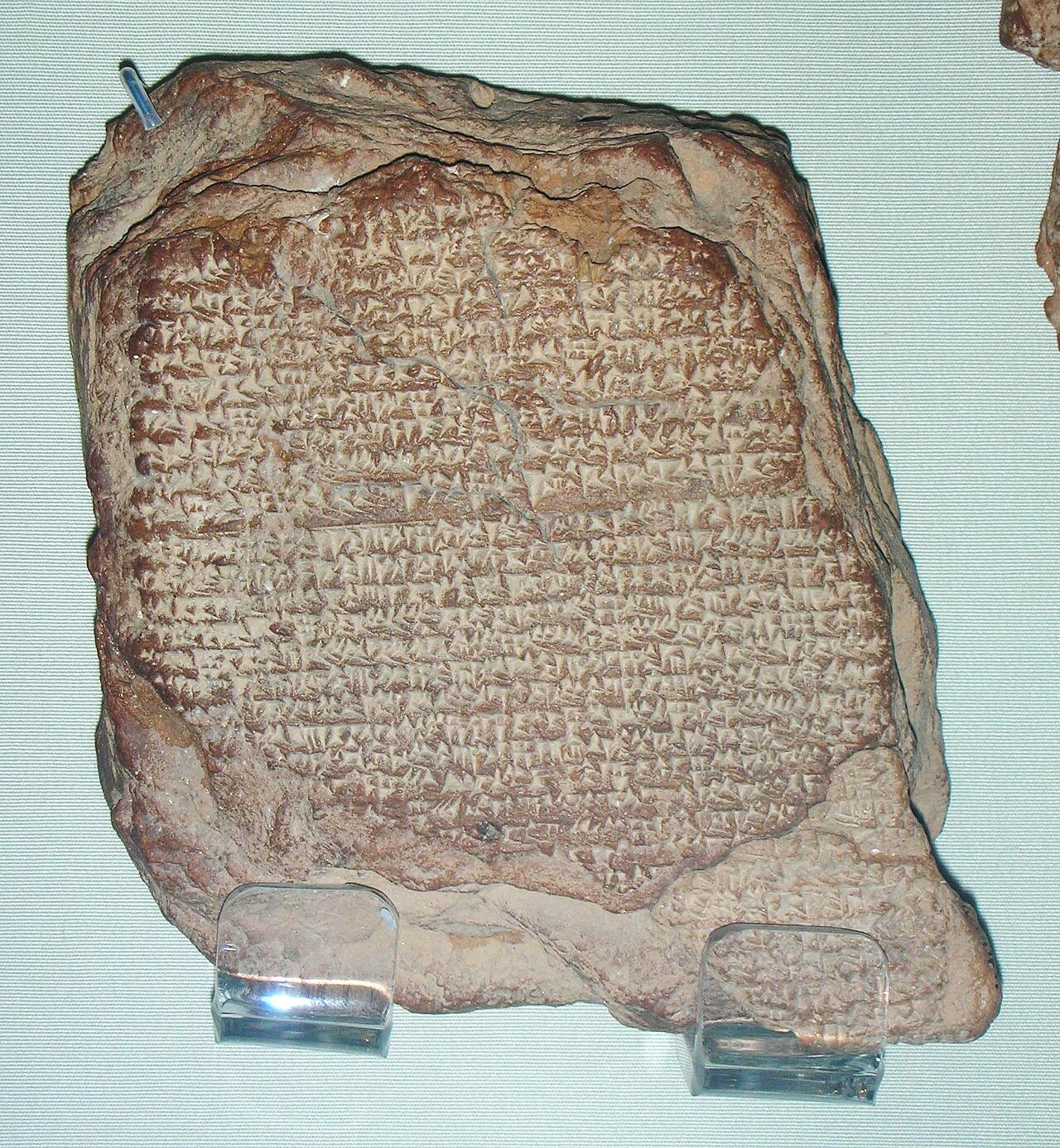

More than two thousand years ago, in Babylon, scribes recorded eclipses on clay tablets.
The oldest still in use date from 720 BCE.1
Today these records make possible a measurement that no other source allows.
The Earth is slowing down
Our planet is spinning a little more slowly than it used to. It is mainly the Moon that brakes it — through the tides, as our page on the Earth and the Moon explains.
The question is how much it is slowing down. The length of the day is increasing by an average of 1.8 milliseconds per century. That is a tiny amount. But it adds up century after century, and after twenty-seven centuries the accumulated offset runs to hours — enough to become observable.2
The result is intriguing: the tides alone predict a lengthening of 2.3 milliseconds per century. What is measured is 1.8. So the Earth is slowing down markedly less than expected. Something, inside the planet and at its surface, is working in the opposite direction — the rebound of land once crushed by ice, and exchanges between the core and the mantle.3
The method of measurement
A total eclipse of the Sun is visible only along a narrow band of the Earth. A text saying that it was total at a given place therefore fixes the orientation of the Earth at that moment, to within a few minutes.4
If the sky of the past is recalculated by computer on the assumption that the Earth has always turned at the same speed, the eclipse falls somewhere else. The gap between where the calculation places it and where someone actually saw it measures how much the Earth has slowed down since.
Babylonian tablets have preserved only two observations of a total solar eclipse. One of them, in 136 BCE, indisputably describes a total eclipse, and its date is written in black and white in the text: on its own, it provides an independent measurement.5
What this means
The real slowdown cannot be measured from modern data: over a few decades, it is drowned out by much larger fluctuations. Observations from the distant past are therefore needed — however crude they may be by our standards.6
Now, the most precise ones available before the invention of the telescope are accounts of eclipses. They go back to about 720 BCE.7
These observations come from everywhere: Babylon, China, Greece, the lands of Islam, Europe. Citing them is not a matter of courtesy but an acknowledgement of dependence: without these scribes, this value would remain unknown.8
For centuries, Babylonian astronomers systematically measured the beginning and end of eclipses. They wrote on clay tablets, in cuneiform script — which can now be read without difficulty. The British Museum holds some two thousand of them devoted to astronomy, and it is estimated that fewer than 10% of the original records survive.9
The critical assessment of ancient data
These texts are treated not as mere treasures, but as data — and all data call for critical assessment.
- The trap of circular reasoning. When a tablet is damaged and the date is missing, it would be tempting to recover it from the eclipse itself. But to do so, one would already need to know the very slowdown one is trying to measure. The researchers therefore deliberately set aside any observation whose date had been reconstructed in this way.
- Sorting by quality. Not all observations are of equal value: the oldest give the time only to within twenty minutes, sometimes forty. They are therefore given different weights, and the least reliable are set aside.
- Doubt openly acknowledged. Two ancient observations do not agree with the rest. Rather than twisting the curve to make them fit — which would require implausible variations in speed — the researchers flag them as exceptions to be studied.10
That is what respecting an ancient observation means: using it, and checking it — not marvelling at it.
The guest star of 1054
In the eleventh century, astronomers in East Asia recorded the appearance of a “guest star” in the constellation of Taurus, so bright that it was visible in broad daylight; it then slowly faded and disappeared.
It was an exploding star — a supernova. Its remains are now known as the Crab Nebula. Without these notes, we would know that the nebula exists, but we would not know when it was born.
Here again, the texts are debated: the translations have been revised several times. This in no way diminishes the value of these documents: it means treating them as historical sources in their own right.
What we see depends on the instrument
For millennia, the sky was observed with the naked eye, with the help of instruments for measuring angles. Then came refracting telescopes, reflecting telescopes, photography, and finally sensors for what is invisible to the human eye (infrared, X-rays, radio waves).
At each stage, we did not simply see further: we saw something else.
That is why the fundamental question is not only “what was seen?” but also: what was it observed with?
Instruments for seeing something else
Before the telescope, there were already observatories. In Jaipur, in India, a site built in the early eighteenth century brings together some twenty large fixed instruments in masonry, designed to measure the positions of the stars with the naked eye. Some are the largest ever built in their category.11
In 1610, Galileo published what he had seen by using, for the first time, a telescope as an instrument of science: the Moon covered with mountains and valleys, the stars of the Milky Way, moons around Jupiter.12
A refracting telescope gathers light with a lens, which disperses it and produces false colours. Isaac Newton replaced the lens with a concave mirror. His telescope is still kept by the Royal Society in London.13
The atmosphere gets in the way too: shifting pockets of air blur the view — this is what makes the stars twinkle — and it blocks part of the ultraviolet and the infrared. The Hubble Space Telescope, launched on 24 April 1990, was therefore placed in orbit above the atmosphere. Its mirror is 2.4 metres across.14
The James Webb Space Telescope, launched on 25 December 2021, has a mirror 6.5 metres across, made of 18 hexagonal segments coated with gold, which reflects infrared light better. Wider than the rocket, it was folded for launch.15
Finally, we do not observe only light. Tasked with understanding the source of interference to transatlantic telephone communications, the engineer Karl Jansky traced it to the centre of the Milky Way. His discovery of 1933 laid the foundations of radio astronomy.16
A compass that exists only in a body
The task is to cross the Pacific without instruments, without a map and without a compass: not once by luck, but regularly, over thousands of kilometres.
A traditional navigator uses the rising points of the stars as a compass. This compass exists nowhere physically: it is entirely contained in his memory.17
The method
The navigator steers towards a known star; when it climbs too high, another takes over. But the stars are only one marker among others: the Sun, the Moon, the swell and the flight of birds are read too. Even after several days of completely overcast sky, a great navigator was able to keep in mind an accurate picture of his canoe’s progress.18
The demonstration
In 1976, the master navigator Mau Piailug guided the canoe Hōkūleʻa from Hawaii to Tahiti — about 4,000 kilometres, without a map or instruments. Having set out on 1 May, it arrived on 4 June.19
On the approach, it was birds that announced land: small white terns skimming the sea, a sign that a still-invisible atoll was very close. Soon, the atoll appeared.20
This voyage weakened the hypothesis that the Pacific was settled by chance: these were not castaways, but navigators.21
The cost of knowledge
Mau Piailug came from Satawal, in Micronesia. This knowledge was passed on according to strict rules: he himself had been chosen by his grandfather, a master navigator. By sharing it, he broke the taboos surrounding this teaching — to save an art that was in danger of disappearing.22
A sky divided up differently
In Australia, the constellation of the Emu is not made of stars: it is drawn by the dark areas of the Milky Way, the clouds of dust that hide the stars behind them. The eye is drawn to the emptiness between the stars rather than to the stars themselves.
Nothing obliges us to divide up the sky the way we do. A constellation is not in the sky: it is a figure that a culture traces there.
An essential caveat: these traditions most often reach us through old transcriptions, made by people who did not know the sky. The weak link in the chain is not the oral tradition but the way it was written down.
What images really show
To the question “Do nebulae really look like the photos?”, the answer is almost always no.
A telescope takes a series of black-and-white images, each through a filter that lets through only one wavelength. A colour is then assigned to each before they are superimposed.
- Not a trick, a translation: the image shifts light that the eye does not perceive into the visible range. The colours represent real differences — but they are chosen colours.
- The relevant question is the one from our page on the giant planets: not “is it real?”, but “what had to be translated?”
Note 1
Useful records of eclipses extend back to about 720 BC.
Stephenson, F. Richard, Morrison, Leslie V. and Hohenkerk, Catherine Y., “Measurement of the Earth’s Rotation: 720 BC to AD 2015”, Proceedings of the Royal Society A, vol. 472, 20160404, 2016
Note 2
the change in the length of the mean solar day (lod) increases at an average rate of +1.8 ms per century
Stephenson, F. Richard, Morrison, Leslie V. and Hohenkerk, Catherine Y., “Measurement of the Earth’s Rotation: 720 BC to AD 2015”, Proceedings of the Royal Society A, vol. 472, 20160404, 2016
Note 3
This is significantly less than the rate predicted on the basis of tidal friction, which is +2.3 ms per century.
Stephenson, F. Richard, Morrison, Leslie V. and Hohenkerk, Catherine Y., “Measurement of the Earth’s Rotation: 720 BC to AD 2015”, Proceedings of the Royal Society A, vol. 472, 20160404, 2016
post-glacial rebound and core–mantle coupling which are invoked to explain the departures from tidal friction
Stephenson, F. Richard, Morrison, Leslie V. and Hohenkerk, Catherine Y., “Measurement of the Earth’s Rotation: 720 BC to AD 2015”, Proceedings of the Royal Society A, vol. 472, 20160404, 2016
Note 4
Owing to the narrowness of the path of totality on the Earth's surface, a report that an eclipse was total or near-total at a known place fixes the rotational frame of the Earth to within the projected width of the band of totality
Stephenson, F. Richard, Morrison, Leslie V. and Hohenkerk, Catherine Y., “Measurement of the Earth’s Rotation: 720 BC to AD 2015”, Proceedings of the Royal Society A, vol. 472, 20160404, 2016
Note 5
Only two observations of a total solar eclipse have come down to us from Babylon: those of 136 BC (−135) and 10 BC (−9). The date of the former observation, which incontestably describes a total solar eclipse, is clearly specified in the text
Stephenson, F. Richard, Morrison, Leslie V. and Hohenkerk, Catherine Y., “Measurement of the Earth’s Rotation: 720 BC to AD 2015”, Proceedings of the Royal Society A, vol. 472, 20160404, 2016
Note 6
the actual long-term acceleration […] cannot be measured directly from modern data because it is masked by the relatively large decade fluctuations
Stephenson, F. Richard, Morrison, Leslie V. and Hohenkerk, Catherine Y., “Measurement of the Earth’s Rotation: 720 BC to AD 2015”, Proceedings of the Royal Society A, vol. 472, 20160404, 2016
Note 7
By far the most accurate data for measuring the Earth's rotation before the advent of telescopic observations (ca AD 1620) are records of eclipses.
Stephenson, F. Richard, Morrison, Leslie V. and Hohenkerk, Catherine Y., “Measurement of the Earth’s Rotation: 720 BC to AD 2015”, Proceedings of the Royal Society A, vol. 472, 20160404, 2016
Note 8
An exhaustive search of historical records of eclipses of the Sun and Moon extant from Babylonia, China, Greece, the Arab Dominions and Europe
Stephenson, F. Richard, Morrison, Leslie V. and Hohenkerk, Catherine Y., “Measurement of the Earth’s Rotation: 720 BC to AD 2015”, Proceedings of the Royal Society A, vol. 472, 20160404, 2016
Note 9
Babylonian astronomers systematically measured the times of the beginning, end and often maximum of eclipses […] The Babylonian scribes wrote on clay tablets, using a cuneiform script, which is now well understood.
Stephenson, F. Richard, Morrison, Leslie V. and Hohenkerk, Catherine Y., “Measurement of the Earth’s Rotation: 720 BC to AD 2015”, Proceedings of the Royal Society A, vol. 472, 20160404, 2016
some 2000 texts devoted to astronomy are now carefully preserved there. It is estimated that fewer than 10% of the original records are now extant.
Stephenson, F. Richard, Morrison, Leslie V. and Hohenkerk, Catherine Y., “Measurement of the Earth’s Rotation: 720 BC to AD 2015”, Proceedings of the Royal Society A, vol. 472, 20160404, 2016
Note 10
we have specifically avoided using any isolated observations of eclipses in which a damaged or missing date has been restored on the basis of the eclipse record itself. Because a preliminary value of ΔT needs to be assumed as an aid to dating, this amounts to circular reasoning.
Stephenson, F. Richard, Morrison, Leslie V. and Hohenkerk, Catherine Y., “Measurement of the Earth’s Rotation: 720 BC to AD 2015”, Proceedings of the Royal Society A, vol. 472, 20160404, 2016
After about 560 BC, all time intervals were quoted to the nearest US (‘degree’, equal to 4 min). However, in earlier years, time intervals were usually expressed only to the nearest 5° or even 10°. […] We have used this variance to weight the observations. […] The two observations in brackets around −200 were treated as outliers.
Stephenson, F. Richard, Morrison, Leslie V. and Hohenkerk, Catherine Y., “Measurement of the Earth’s Rotation: 720 BC to AD 2015”, Proceedings of the Royal Society A, vol. 472, 20160404, 2016
These two exceptions (−600 and −382) require further investigation […] To accommodate the result from −600, along with those of −708 and −694, requires a large variation in the lod, which is geophysically implausible. This is also the case with the −382 eclipse in the Almagest.
Stephenson, F. Richard, Morrison, Leslie V. and Hohenkerk, Catherine Y., “Measurement of the Earth’s Rotation: 720 BC to AD 2015”, Proceedings of the Royal Society A, vol. 472, 20160404, 2016
Note 11
an astronomical observation site built in the early 18th century. It includes a set of some twenty main fixed instruments. […] Designed for the observation of astronomical positions with the naked eye
UNESCO, World Heritage Committee, decision 34 COM 8B.17, “The Jantar Mantar, Jaipur (India)”, 2010
some of them are the largest ever built in their categories
UNESCO, World Heritage Committee, decision 34 COM 8B.17, “The Jantar Mantar, Jaipur (India)”, 2010
Note 12
Using a telescope for the first time as an instrument of science, Galileo recorded his observations in 1610. […] the physical nature of the moon, the star formations of the Milky Way and the discovery of the moons of Jupiter […] the lunar surface was much like the surface of the earth, punctuated with mountains and valleys
De Simone, Dan, “A ‘Messenger’ of Our Own: Library Acquires Galileo Astronomy Volume”, Library of Congress Information Bulletin, vol. 69, no. 12, December 2010
Note 13
In Newton's telescope he used a concave mirror to gather light instead of a simple lens that produces false colour due to the dispersion of light. […] a faithful copy of the original that still resides with Royal Society
Science Museum Group, “Isaac Newton’s Reflecting Telescope (replica)”, collection record
Note 14
they seem to twinkle. That's because shifting pockets of air in Earth's atmosphere distort your view, even on the clearest nights. […] Hubble is designed to view some ultraviolet and infrared wavelengths, which are blocked or partially blocked by the atmosphere.
NASA Science, “Why Have a Telescope in Space?”
Launched on April 24, 1990, aboard the Space Shuttle Discovery […] at 94.5 inches (2.4 m) in diameter […] High above the blurring effects of Earth's atmosphere
NASA Science, “Hubble Space Telescope – An Overview”, fact sheet
Note 15
Webb launched on Dec. 25th 2021.
NASA Science, “James Webb Space Telescope”
Webb's primary mirror is 6.5 meters (21 feet 4 inches) across. […] 18 hexagonal-shaped mirror segments […] Gold improves the mirror's reflection of infrared light. […] the mirror is segmented and designed to fold for launch
NASA Science, “Webb’s Mirrors”
Note 16
Jansky was assigned the task of understanding the source of interference to transatlantic telephone communications […] Jansky meticulously traced the origin of the noise to the center of the Milky Way. […] Karl Jansky’s 1933 discovery of cosmic radio emission laid the foundation for the many subsequent discoveries
Koberlein, Brian, “Jansky @90: The Origins of a New Window on the Universe”, National Radio Astronomy Observatory, 27 April 2023
Note 17
Navigator Mau Piailug used the rising points of the stars […] as a natural compass to guide the canoe.
PBS, “Wayfinders: Polynesian History and Origin”
Note 18
supplemented by observations of the sun, moon, and ocean swells […] small, white fairy terns skimming over the sea, told Mau that […] the atoll of Mataiva, just to the north-northwest of Tahiti, was near before it could actually be seen.
PBS, “Wayfinders: Polynesian History and Origin”
Even when days of solid cloud cover hid the stars, sun, and moon from sight, Mau was able to keep the canoe on course and keep in his mind an accurate picture of the canoe's progress toward Tahiti.
PBS, “Wayfinders: Polynesian History and Origin”
Note 19
the navigational feat of guiding the canoe to Tahiti without instruments
Finney, Ben, “1976 Hawai‘i to Tahiti and Back”, Polynesian Voyaging Society, archives
Hokule‘a left from Honolua Bay, Maui, on May 1, 1976. […] arriving on June 4, thirty-four days after departing from Maui.
Finney, Ben, “1976 Hawai‘i to Tahiti and Back”, Polynesian Voyaging Society, archives
Hokule'a's first voyage in 1976 was from Honolua Bay, Maui, to Papeete, Tahiti-a distance of twenty-five hundred miles.
Polynesian Voyaging Society, “Nainoa Thompson: Searching for a Way (1976-1978)”, archives
Note 20
And, obligingly, small, white terns skimming over the sea provided Mau with a sign that Matahiva was near before we could actually see this low island.
Finney, Ben, “1976 Hawai‘i to Tahiti and Back”, extrait de “Voyaging into Polynesia’s Past”, dans From Sea to Space, 1992, page publiée par la Polynesian Voyaging Society, open access
Note 21
effectively demonstrated how Polynesian canoes and traditional navigational methods were up to the task of planned, long-distance voyaging, effectively turning the tide against Sharp and his revival of the Lang accidental settlement hypothesis.
Finney, Ben, “1976 Hawai‘i to Tahiti and Back”, extrait de “Voyaging into Polynesia’s Past”, dans From Sea to Space, 1992, page publiée par la Polynesian Voyaging Society, open access
Note 22
He was picked by his grandfather, the master navigator for his people, […] Mau was a visionary man with great conviction in his knowledge, tremendous physical and mental strength, and unwavering courage to break the taboos of the teaching of navigation in order to preserve the precious "talk of the sea."
Polynesian Voyaging Society, “Pius "Mau" Piailug (1932-2010)”, notice biographique (textes de Chad Kalepa Baybayan, Tom Raffipiy et Nainoa Thompson, 2010), open access
Notes and sources
- ↑
Passage The oldest still in use date from 720 BCE.
Useful records of eclipses extend back to about 720 BC.
Source Stephenson, F. Richard, Morrison, Leslie V. and Hohenkerk, Catherine Y., “Measurement of the Earth’s Rotation: 720 BC to AD 2015”, Proceedings of the Royal Society A, vol. 472, 20160404, 2016, § 1(b).
Open access open the source · checked on 9 September 2026
- ↑
Passage The length of the day is increasing by an average of 1.8 milliseconds per century.
the change in the length of the mean solar day (lod) increases at an average rate of +1.8 ms per century
Source Stephenson, F. Richard, Morrison, Leslie V. and Hohenkerk, Catherine Y., “Measurement of the Earth’s Rotation: 720 BC to AD 2015”, Proceedings of the Royal Society A, vol. 472, 20160404, 2016, abstract.
Open access open the source · checked on 9 September 2026
- ↑
Passage the tides alone predict a lengthening of 2.3 milliseconds per century. What is measured is 1.8. So the Earth is slowing down markedly less than expected.
This is significantly less than the rate predicted on the basis of tidal friction, which is +2.3 ms per century.
Source Stephenson, F. Richard, Morrison, Leslie V. and Hohenkerk, Catherine Y., “Measurement of the Earth’s Rotation: 720 BC to AD 2015”, Proceedings of the Royal Society A, vol. 472, 20160404, 2016, abstract.
Open access open the source · checked on 9 September 2026
Passage the rebound of land once crushed by ice, and exchanges between the core and the mantle
post-glacial rebound and core–mantle coupling which are invoked to explain the departures from tidal friction
Source Stephenson, F. Richard, Morrison, Leslie V. and Hohenkerk, Catherine Y., “Measurement of the Earth’s Rotation: 720 BC to AD 2015”, Proceedings of the Royal Society A, vol. 472, 20160404, 2016, abstract.
Open access open the source · checked on 9 September 2026
- ↑
Passage A total eclipse of the Sun is visible only along a narrow band of the Earth. A text saying that it was total at a given place therefore fixes the orientation of the Earth at that moment
Owing to the narrowness of the path of totality on the Earth's surface, a report that an eclipse was total or near-total at a known place fixes the rotational frame of the Earth to within the projected width of the band of totality
Source Stephenson, F. Richard, Morrison, Leslie V. and Hohenkerk, Catherine Y., “Measurement of the Earth’s Rotation: 720 BC to AD 2015”, Proceedings of the Royal Society A, vol. 472, 20160404, 2016, § 2(b).
Open access open the source · checked on 9 September 2026
- ↑
Passage Babylonian tablets have preserved only two observations of a total solar eclipse. One of them, in 136 BCE, indisputably describes a total eclipse, and its date is written in black and white in the text
Only two observations of a total solar eclipse have come down to us from Babylon: those of 136 BC (−135) and 10 BC (−9). The date of the former observation, which incontestably describes a total solar eclipse, is clearly specified in the text
Source Stephenson, F. Richard, Morrison, Leslie V. and Hohenkerk, Catherine Y., “Measurement of the Earth’s Rotation: 720 BC to AD 2015”, Proceedings of the Royal Society A, vol. 472, 20160404, 2016, § 2(b)(i).
Open access open the source · checked on 9 September 2026
- ↑
Passage The real slowdown cannot be measured from modern data: over a few decades, it is drowned out by much larger fluctuations.
the actual long-term acceleration […] cannot be measured directly from modern data because it is masked by the relatively large decade fluctuations
Source Stephenson, F. Richard, Morrison, Leslie V. and Hohenkerk, Catherine Y., “Measurement of the Earth’s Rotation: 720 BC to AD 2015”, Proceedings of the Royal Society A, vol. 472, 20160404, 2016, § 1(b).
Open access open the source · checked on 9 September 2026
- ↑
Passage the most precise ones available before the invention of the telescope are accounts of eclipses
By far the most accurate data for measuring the Earth's rotation before the advent of telescopic observations (ca AD 1620) are records of eclipses.
Source Stephenson, F. Richard, Morrison, Leslie V. and Hohenkerk, Catherine Y., “Measurement of the Earth’s Rotation: 720 BC to AD 2015”, Proceedings of the Royal Society A, vol. 472, 20160404, 2016, § 1(b).
Open access open the source · checked on 9 September 2026
- ↑
Passage These observations come from everywhere: Babylon, China, Greece, the lands of Islam, Europe.
An exhaustive search of historical records of eclipses of the Sun and Moon extant from Babylonia, China, Greece, the Arab Dominions and Europe
Source Stephenson, F. Richard, Morrison, Leslie V. and Hohenkerk, Catherine Y., “Measurement of the Earth’s Rotation: 720 BC to AD 2015”, Proceedings of the Royal Society A, vol. 472, 20160404, 2016, § 7, conclusion.
Open access open the source · checked on 9 September 2026
- ↑
Passage For centuries, Babylonian astronomers systematically measured the beginning and end of eclipses. They wrote on clay tablets, in cuneiform script
Babylonian astronomers systematically measured the times of the beginning, end and often maximum of eclipses […] The Babylonian scribes wrote on clay tablets, using a cuneiform script, which is now well understood.
Source Stephenson, F. Richard, Morrison, Leslie V. and Hohenkerk, Catherine Y., “Measurement of the Earth’s Rotation: 720 BC to AD 2015”, Proceedings of the Royal Society A, vol. 472, 20160404, 2016, § 2(a)(i).
Open access open the source · checked on 9 September 2026
Passage The British Museum holds some two thousand of them devoted to astronomy, and it is estimated that fewer than 10% of the original records survive.
some 2000 texts devoted to astronomy are now carefully preserved there. It is estimated that fewer than 10% of the original records are now extant.
Source Stephenson, F. Richard, Morrison, Leslie V. and Hohenkerk, Catherine Y., “Measurement of the Earth’s Rotation: 720 BC to AD 2015”, Proceedings of the Royal Society A, vol. 472, 20160404, 2016, § 2(a)(i).
Open access open the source · checked on 9 September 2026
- ↑
Passage When a tablet is damaged and the date is missing […] one would already need to know the very slowdown one is trying to measure. The researchers therefore deliberately set aside any observation whose date had been reconstructed in this way.
we have specifically avoided using any isolated observations of eclipses in which a damaged or missing date has been restored on the basis of the eclipse record itself. Because a preliminary value of ΔT needs to be assumed as an aid to dating, this amounts to circular reasoning.
Source Stephenson, F. Richard, Morrison, Leslie V. and Hohenkerk, Catherine Y., “Measurement of the Earth’s Rotation: 720 BC to AD 2015”, Proceedings of the Royal Society A, vol. 472, 20160404, 2016, § 2(a)(i).
Open access open the source · checked on 9 September 2026
Passage the oldest give the time only to within twenty minutes, sometimes forty. They are therefore given different weights, and the least reliable are set aside.
After about 560 BC, all time intervals were quoted to the nearest US (‘degree’, equal to 4 min). However, in earlier years, time intervals were usually expressed only to the nearest 5° or even 10°. […] We have used this variance to weight the observations. […] The two observations in brackets around −200 were treated as outliers.
Source Stephenson, F. Richard, Morrison, Leslie V. and Hohenkerk, Catherine Y., “Measurement of the Earth’s Rotation: 720 BC to AD 2015”, Proceedings of the Royal Society A, vol. 472, 20160404, 2016, § 2(a)(i), § 3(b)(i) and caption of figure 3.
Open access open the source · checked on 9 September 2026
Passage Two ancient observations do not agree with the rest. Rather than twisting the curve to make them fit — which would require implausible variations in speed — the researchers flag them as exceptions to be studied.
These two exceptions (−600 and −382) require further investigation […] To accommodate the result from −600, along with those of −708 and −694, requires a large variation in the lod, which is geophysically implausible. This is also the case with the −382 eclipse in the Almagest.
Source Stephenson, F. Richard, Morrison, Leslie V. and Hohenkerk, Catherine Y., “Measurement of the Earth’s Rotation: 720 BC to AD 2015”, Proceedings of the Royal Society A, vol. 472, 20160404, 2016, § 4(b) “Fitting a curve by cubic splines”.
Open access open the source · checked on 9 September 2026
- ↑
Passage Before the telescope, there were already observatories. In Jaipur, in India, a site built in the early eighteenth century brings together some twenty large fixed instruments in masonry, designed to measure the positions of the stars with the naked eye.
an astronomical observation site built in the early 18th century. It includes a set of some twenty main fixed instruments. […] Designed for the observation of astronomical positions with the naked eye
Source UNESCO, World Heritage Committee, decision 34 COM 8B.17, “The Jantar Mantar, Jaipur (India)”, 2010.
Open access open the source · checked on 26 October 2026
Passage Some are the largest ever built in their category.
some of them are the largest ever built in their categories
Source UNESCO, World Heritage Committee, decision 34 COM 8B.17, “The Jantar Mantar, Jaipur (India)”, 2010.
Open access open the source · checked on 26 October 2026
- ↑
Passage In 1610, Galileo published what he had seen by using, for the first time, a telescope as an instrument of science: the Moon covered with mountains and valleys, the stars of the Milky Way, moons around Jupiter.
Using a telescope for the first time as an instrument of science, Galileo recorded his observations in 1610. […] the physical nature of the moon, the star formations of the Milky Way and the discovery of the moons of Jupiter […] the lunar surface was much like the surface of the earth, punctuated with mountains and valleys
Source De Simone, Dan, “A ‘Messenger’ of Our Own: Library Acquires Galileo Astronomy Volume”, Library of Congress Information Bulletin, vol. 69, no. 12, December 2010, whole article.
Open access open the source · checked on 26 October 2026
- ↑
Passage A refracting telescope gathers light with a lens, which disperses it and produces false colours. Isaac Newton replaced the lens with a concave mirror. His telescope is still kept by the Royal Society in London.
In Newton's telescope he used a concave mirror to gather light instead of a simple lens that produces false colour due to the dispersion of light. […] a faithful copy of the original that still resides with Royal Society
Source Science Museum Group, “Isaac Newton’s Reflecting Telescope (replica)”, collection record, object record.
Open access open the source · checked on 26 October 2026
- ↑
Passage shifting pockets of air blur the view — this is what makes the stars twinkle — and it blocks part of the ultraviolet and the infrared
they seem to twinkle. That's because shifting pockets of air in Earth's atmosphere distort your view, even on the clearest nights. […] Hubble is designed to view some ultraviolet and infrared wavelengths, which are blocked or partially blocked by the atmosphere.
Source NASA Science, “Why Have a Telescope in Space?”, whole page.
Open access open the source · checked on 26 October 2026
Passage The Hubble Space Telescope, launched on 24 April 1990, was therefore placed in orbit above the atmosphere. Its mirror is 2.4 metres across.
Launched on April 24, 1990, aboard the Space Shuttle Discovery […] at 94.5 inches (2.4 m) in diameter […] High above the blurring effects of Earth's atmosphere
Source NASA Science, “Hubble Space Telescope – An Overview”, fact sheet.
Open access open the source · checked on 26 October 2026
- ↑
Passage The James Webb Space Telescope, launched on 25 December 2021
Webb launched on Dec. 25th 2021.
Source NASA Science, “James Webb Space Telescope”, mission page.
Open access open the source · checked on 26 October 2026
Passage has a mirror 6.5 metres across, made of 18 hexagonal segments coated with gold, which reflects infrared light better. Wider than the rocket, it was folded for launch.
Webb's primary mirror is 6.5 meters (21 feet 4 inches) across. […] 18 hexagonal-shaped mirror segments […] Gold improves the mirror's reflection of infrared light. […] the mirror is segmented and designed to fold for launch
Source NASA Science, “Webb’s Mirrors”, whole page.
Open access open the source · checked on 26 October 2026
- ↑
Passage Tasked with understanding the source of interference to transatlantic telephone communications, the engineer Karl Jansky traced it to the centre of the Milky Way. His discovery of 1933 laid the foundations of radio astronomy.
Jansky was assigned the task of understanding the source of interference to transatlantic telephone communications […] Jansky meticulously traced the origin of the noise to the center of the Milky Way. […] Karl Jansky’s 1933 discovery of cosmic radio emission laid the foundation for the many subsequent discoveries
Source Koberlein, Brian, “Jansky @90: The Origins of a New Window on the Universe”, National Radio Astronomy Observatory, 27 April 2023, whole article.
Open access open the source · checked on 26 October 2026
- ↑
Passage A traditional navigator uses the rising points of the stars as a compass.
Navigator Mau Piailug used the rising points of the stars […] as a natural compass to guide the canoe.
Source PBS, “Wayfinders: Polynesian History and Origin”, “Wayfinders” page.
Open access open the source · checked on 9 September 2026
- ↑
Passage the Sun, the Moon, the swell and the flight of birds are read too
supplemented by observations of the sun, moon, and ocean swells […] small, white fairy terns skimming over the sea, told Mau that […] the atoll of Mataiva, just to the north-northwest of Tahiti, was near before it could actually be seen.
Source PBS, “Wayfinders: Polynesian History and Origin”, “Wayfinders” page.
Open access open the source · checked on 9 September 2026
Passage Even after several days of completely overcast sky, a great navigator was able to keep in mind an accurate picture of his canoe’s progress.
Even when days of solid cloud cover hid the stars, sun, and moon from sight, Mau was able to keep the canoe on course and keep in his mind an accurate picture of the canoe's progress toward Tahiti.
Source PBS, “Wayfinders: Polynesian History and Origin”, “Wayfinders” page.
Open access open the source · checked on 9 September 2026
- ↑
Passage In 1976, the master navigator Mau Piailug guided the canoe Hōkūleʻa from Hawaii to Tahiti […] without a map or instruments.
the navigational feat of guiding the canoe to Tahiti without instruments
Source Finney, Ben, “1976 Hawai‘i to Tahiti and Back”, Polynesian Voyaging Society, archives, account of the crossing.
Open access open the source · checked on 24 October 2026
Passage Having set out on 1 May, it arrived on 4 June.
Hokule‘a left from Honolua Bay, Maui, on May 1, 1976. […] arriving on June 4, thirty-four days after departing from Maui.
Source Finney, Ben, “1976 Hawai‘i to Tahiti and Back”, Polynesian Voyaging Society, archives, account of the crossing.
Open access open the source · checked on 24 October 2026
Passage about 4,000 kilometres
Hokule'a's first voyage in 1976 was from Honolua Bay, Maui, to Papeete, Tahiti-a distance of twenty-five hundred miles.
Source Polynesian Voyaging Society, “Nainoa Thompson: Searching for a Way (1976-1978)”, archives, first sentence, under the heading “Nainoa Thompson: Searching for a Way (1976-1978)”.
Open access open the source · checked on 9 September 2026
- ↑
Passage it was birds that announced land: small white terns skimming the sea, a sign that a still-invisible atoll was very close. Soon, the atoll appeared.
And, obligingly, small, white terns skimming over the sea provided Mau with a sign that Matahiva was near before we could actually see this low island.
Source Finney, Ben, “1976 Hawai‘i to Tahiti and Back”, extrait de “Voyaging into Polynesia’s Past”, dans From Sea to Space, 1992, page publiée par la Polynesian Voyaging Society, open access, Ben Finney’s account, paragraph on the outward voyage (“The voyage went as planned”).
Open access open the source · checked on 24 October 2026
- ↑
Passage This voyage weakened the hypothesis that the Pacific was settled by chance
effectively demonstrated how Polynesian canoes and traditional navigational methods were up to the task of planned, long-distance voyaging, effectively turning the tide against Sharp and his revival of the Lang accidental settlement hypothesis.
Source Finney, Ben, “1976 Hawai‘i to Tahiti and Back”, extrait de “Voyaging into Polynesia’s Past”, dans From Sea to Space, 1992, page publiée par la Polynesian Voyaging Society, open access, Ben Finney’s account, paragraph on the return to Hawaii.
Open access open the source · checked on 24 October 2026
- ↑
Passage This knowledge was passed on according to strict rules: he himself had been chosen by his grandfather, a master navigator. By sharing it, he broke the taboos surrounding this teaching — to save an art that was in danger of disappearing.
He was picked by his grandfather, the master navigator for his people, […] Mau was a visionary man with great conviction in his knowledge, tremendous physical and mental strength, and unwavering courage to break the taboos of the teaching of navigation in order to preserve the precious "talk of the sea."
Source Polynesian Voyaging Society, “Pius "Mau" Piailug (1932-2010)”, notice biographique (textes de Chad Kalepa Baybayan, Tom Raffipiy et Nainoa Thompson, 2010), open access, biographical notice: speech by Nainoa Thompson (Polynesian Union, 1997) for the grandfather; section “More about Mau, from his nephew, Tom Raffipiy” for the taboos.
Open access open the source · checked on 24 October 2026
Bibliography
14
- De Simone, Dan, “A ‘Messenger’ of Our Own: Library Acquires Galileo Astronomy Volume”, Library of Congress Information Bulletin, vol. 69, no. 12, December 2010, open access (Galileo’s observations published in 1610). https://loc.gov/loc/lcib/1012/galileo.html
- Finney, Ben, “1976 Hawai‘i to Tahiti and Back”, Polynesian Voyaging Society, archives, open access (departure from Maui on 1 May 1976, arrival in Tahiti on 4 June, without instruments). https://archive.hokulea.com/holokai/1976/ben_finney.html
- Finney, Ben, “1976 Hawai‘i to Tahiti and Back”, extrait de “Voyaging into Polynesia’s Past”, dans From Sea to Space, 1992, page publiée par la Polynesian Voyaging Society, open access (the small white terns skimming the sea, a sign that the atoll of Matahiva was near before it could be seen; the voyage that pushed back the hypothesis of accidental settlement). https://archive.hokulea.com/holokai/1976/ben_finney.html
- Koberlein, Brian, “Jansky @90: The Origins of a New Window on the Universe”, National Radio Astronomy Observatory, 27 April 2023, open access (the interference to transatlantic communications; the source at the centre of the Milky Way; the 1933 discovery). https://public.nrao.edu/news/jansky-90-the-origins-of-a-new-window-on-the-universe
- NASA Science, “Hubble Space Telescope – An Overview”, fact sheet, open access (the launch on 24 April 1990; the 2.4 m mirror). https://science.nasa.gov/wp-content/uploads/2023/04/hst_overview_fact_sheet.pdf
- NASA Science, “Why Have a Telescope in Space?”, open access (the pockets of air that blur the view; the ultraviolet and infrared blocked by the atmosphere). https://science.nasa.gov/mission/hubble/overview/why-have-a-telescope-in-space/
- NASA Science, “James Webb Space Telescope”, mission page, open access (the launch on 25 December 2021). https://science.nasa.gov/mission/webb/
- NASA Science, “Webb’s Mirrors”, open access (the 6.5 m mirror, its 18 gold-coated segments, folded for launch). https://science.nasa.gov/mission/webb/webbs-mirrors/
- PBS, “Wayfinders: Polynesian History and Origin”, open access (the rising points of the stars as a compass, the reading of the Sun, the swell and the birds, the course held under an overcast sky, the significance of the demonstration). https://www.pbs.org/wayfinders/polynesian8.html
- Polynesian Voyaging Society, “Nainoa Thompson: Searching for a Way (1976-1978)”, archives, open access (the distance of the 1976 crossing: 2,500 miles, or about 4,000 kilometres). https://archive.hokulea.com/rapanui/1976.html
- Polynesian Voyaging Society, “Pius "Mau" Piailug (1932-2010)”, notice biographique (textes de Chad Kalepa Baybayan, Tom Raffipiy et Nainoa Thompson, 2010), open access (Mau Piailug chosen by his grandfather, a master navigator; the teaching of Hawaiians; the taboos broken to preserve navigation without instruments). https://archive.hokulea.com/index/founder_and_teachers/mau.html
- Science Museum Group, “Isaac Newton’s Reflecting Telescope (replica)”, collection record, open access (the concave mirror in place of the lens; the original kept by the Royal Society). https://collection.sciencemuseumgroup.org.uk/objects/co56834/isaac-newtons-reflecting-telescope-replica
- Stephenson, F. Richard, Morrison, Leslie V. and Hohenkerk, Catherine Y., “Measurement of the Earth’s Rotation: 720 BC to AD 2015”, Proceedings of the Royal Society A, vol. 472, 20160404, 2016, open access (1.8 versus 2.3 milliseconds per century, the 720 BCE starting point, the cultures from which the observations come, the British Museum tablets, the rejection of circular reasoning, the weighting of observations, the two exceptions flagged, the total eclipse of 136 BCE). https://doi.org/10.1098/rspa.2016.0404
- UNESCO, World Heritage Committee, decision 34 COM 8B.17, “The Jantar Mantar, Jaipur (India)”, 2010, open access (the early eighteenth-century site; the twenty or so fixed instruments; naked-eye observation). https://whc.unesco.org/en/decisions/3996
Spotted an error or have a doubt? Write to us.