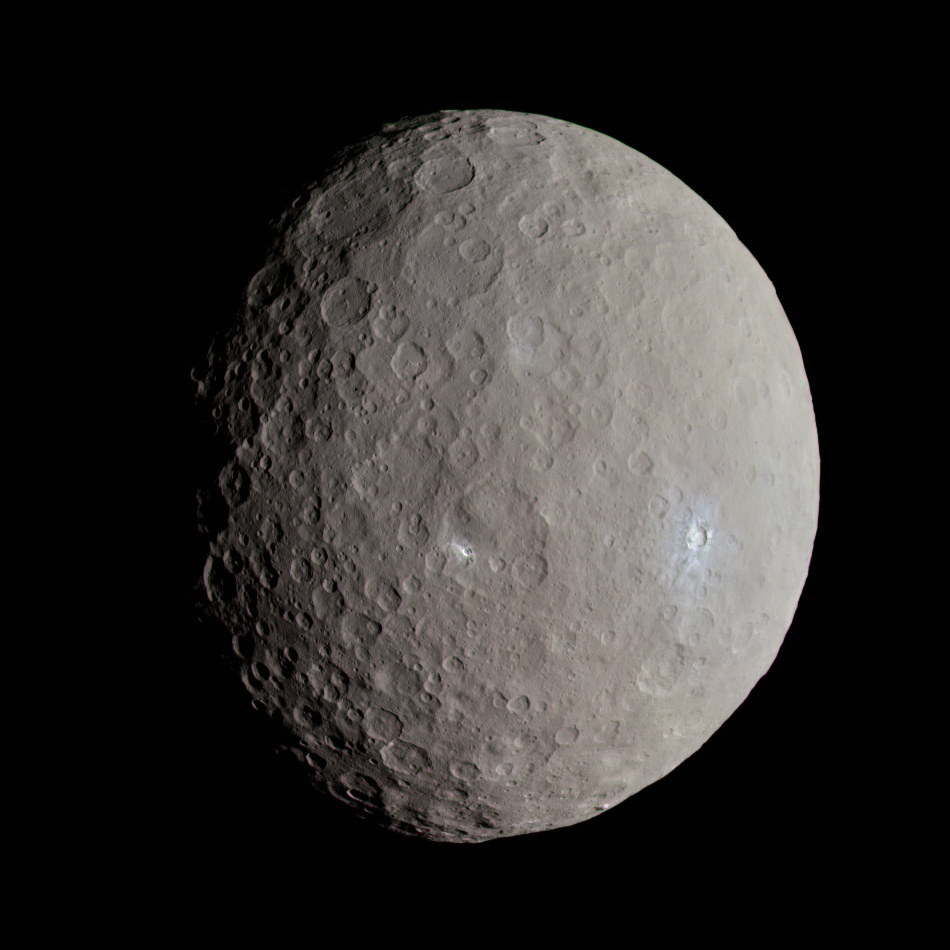

There is an object in the solar system that has changed category twice without ever moving a metre.1
It is Ceres. Its story closes a question that we opened elsewhere on this site.
The small bodies of the Solar System
The eight planets are not alone in circling the Sun: a host of smaller objects also orbit it, and they fall into three families.
Asteroids are rocky bodies, without an atmosphere, most often irregular in shape. The great majority occupy a region lying between Mars and Jupiter, the main belt. Contrary to what films show, there is no need to zigzag your way through it: the objects there are separated by millions of kilometres on average.2
Comets are made of ices and dust. Far from the Sun, a comet is nothing more than a dark nucleus a few kilometres across. As it approaches, its ices turn directly into gas and form a luminous envelope, the coma, then two tails that behave differently.
- The ionised gas tail is thin, bluish, and points away from the Sun: it is swept along by the solar wind.
- The dust tail is broader and brighter; the grains, much larger, remain partly on the comet’s path, so that it generally appears curved and not pointing strictly away from the Sun.3
A counter-intuitive consequence: these tails are not behind the comet. When it moves away from the Sun after its passage, it travels tail first. Comets come from the outer reaches: the Kuiper belt, beyond Neptune, and much farther still the Oort cloud, which surrounds the whole Solar System.
Dwarf planets are massive enough for their own gravity to have made them nearly round, but they have not cleared the neighbourhood around their orbit, and they are not satellites. Pluto and Ceres are among them.4
It is this last criterion that cost Pluto its status as a planet in 2006. Bear it in mind, because this whole page examines what it is worth: the question is not what Ceres really is, but who decides on the boxes, and by what criteria.5
1 January 1801
An Italian priest, a mathematician and astronomer, is observing the sky from Palermo. He is looking for a known star, and he notices next to it a point that was not there before.6
The next day, he observes it again: the point has moved.
He first thinks it is a comet. Then he observes it twenty-four times over the following month, and its motion convinces him that it might be a planet.7
He sends his observations to Paris in April; they are published in September. But the object is by then too close to the Sun to be seen again: it is not until December that someone else confirms it.8
It is named Ceres, after the Roman goddess of the harvest.9
Status number one: planet, for fifty years
For half a century, astronomy textbooks list Ceres among the planets.10
Between 1800 and 1806, other similar objects are discovered in its neighbourhood. Astronomers begin to wonder whether they have stumbled upon a whole family of objects whose existence no one had suspected.11
Status number two: asteroid, for a hundred and forty years
The word “asteroid” is adopted as early as 1802 by the astronomer William Herschel, who borrows it from a classical scholar, Charles Burney Jr.12
It becomes untenable to call them all planets. In the 1860s, when it is understood that Ceres has several hundred similar neighbours, the distinction between planets and asteroids is widely accepted — even if what exactly a planet is remains unclear.13
Ceres was thus demoted, and this status lasted about a hundred and forty years.
Status number three: the reversal
In 2006, the International Astronomical Union adopts a definition of the word “planet”. Our page on the Solar System tells how this was decided: yellow ballot cards raised in the air, on the last day of a congress, and Pluto ceasing to be a planet.
Yet the same text creates a new category: dwarf planet. Pluto becomes its first member. Ceres is the second — and remains to this day the only dwarf planet in the asteroid belt.14
The same day, the same text, the same decision demoted Pluto and promoted Ceres.
Neither had moved.
In March 2015, the Dawn probe went into orbit around Ceres: the first visit to a dwarf planet.15
What to conclude from this, and it is not what one might think
One might conclude that these people change their minds all the time and that their categories are worthless.
The conclusion is tempting, but wrong, as a closer look shows.
A summary by the American Astronomical Society puts it in a way that we find very apt: astronomers have reclassified Ceres twice, and each time it found itself among the very first members of a wholly new category.16
The same summary adds the essential point: the way an object is classified is linked to the advancement of knowledge. Things are not reclassified on a whim; they are reclassified because enough has just been learned to need a new box.17
In the 1860s, it was not “demoted” out of pettiness: it had just been realised that there was a whole family of objects whose existence no one had suspected in 1801. A word was needed for them.18
In 2006, it was not “promoted” out of kindness: a whole population of round objects that do not dominate their orbit had just been discovered. A word was needed for them too.
Ceres is not the victim of a capricious administration. It is a marker. Each time it changes boxes, it is because enough has just been learned to need a new box.
Three boxes, the same question
Our page on the Solar System already presented two of these three cases. Let us bring them together one last time, because Ceres sheds a different light on them.
A shop category invented at a meeting in London, on 29 June 1987, because people in the record business did not know where to shelve certain records — and the minutes of their meeting exist.19
A word that the United Nations deliberately refuses to define, so that each people may decide for itself who it is.
A decision taken by a show of hands, one day in August, at the end of a congress.
A small ball of rock and ice that has been a planet, then an asteroid, then a dwarf planet, without ever doing anything other than circling the Sun.
Categories are not in nature. They are made by people, at a given moment, to solve a problem they had.
That does not make them arbitrary. It means that the same question must always be asked: who made this box, when, and to solve what?
The comet of 1910, and how a fear is manufactured
Words and categories shape our view of the sky, but hasty interpretations of science can also manufacture real panics.
In 1910, Halley’s comet passed close to the Earth. People bought gas masks. Others sealed up their windows.
This story is a textbook case, because each of its stages can be reconstructed.
Stage 1. In February 1910, an observatory publicly announces that the light from the comet’s tail shows the presence of cyanogen, a toxic gas. This fact is accurate.20
Stage 2. A very prominent French astronomer suggests that this gas could snuff out all life on the planet. He presents it as a theoretical possibility.21
Stage 3. Other astronomers, quoted in the same newspaper article, reject the idea: a comet’s tail is extremely rarefied, and there is nothing in it to poison anyone.22
Stage 4. The newspaper’s headline, however, keeps only the poison. The other newspapers pick up the sensational part without the contradiction.
The contradiction was there. In the same article. It did not travel.
Hence the maxim: corrections never travel as far as headlines.
What people did, and why we should not laugh at it
The newspapers of the time report that gas masks, “anti-comet pills” and anti-comet umbrellas were sold.
Some people, it is said, made costly decisions: not sowing, not repaying debts, since they were going to die before then.
These decisions would be perfectly reasonable if the premise were true.
These people were not foolish. They had been misinformed by a source they had good reason to believe: a famous astronomer, relayed by the newspapers.
The question to ask, then, is not “how could anyone believe that?”, but rather: how, today, can we tell an alarming headline from an established fact for ourselves?
And a caveat, which compounds all the rest
The wording of the previous paragraph deserves attention: “the newspapers report that”, “it is said”. This is not caution for the sake of style.
We know the newspapers’ panic very well. We know much less about the panic of the people. Almost all our sources on this alarm are… the newspapers that produced it.
The source that documents the panic is the one that manufactured it. That is the trap within the trap.
Halley’s comet will come back. Most people see it only once in their lifetime.
Note 1
As we have learned more about the objects in our solar system and beyond, astronomers have re-classified Ceres twice, each time being one of the first of a wholly new category
Wilson, Teresa, “This Month in Astronomical History: The Discovery of Ceres”, American Astronomical Society, Historical Astronomy Division, 5 January 2018
Note 2
Their average spacing is several million kilometers.
Morrison, David, réponse à “In science fiction movies, the "asteroid belt" is always pictured as a very crowded place…”, Scientific American
Note 3
The solar wind then blows these gases and dust particles away from the direction of the Sun causing two tails to form. These tails always point away from the Sun as the comet travels around it. One tail is called the ion tail and is made up of gases which have been broken apart into charged molecules and ions by the radiation from the Sun. […] this ion tail often appears blue.
Las Cumbres Observatory, “Comets, the Kuiper Belt and the Oort Cloud”
The dust in this tail is less strongly affected by the solar wind since the particles of dust are much larger than the ions in the ion tail. That is why the dust tail is usually curved rather than straight, and does not point directly away from the Sun, because it is also influenced by the motion of the comet.
Las Cumbres Observatory, “Comets, the Kuiper Belt and the Oort Cloud”
Note 4
A "dwarf planet" is a celestial body that (a) is in orbit around the Sun, (b) has sufficient mass for its self-gravity to overcome rigid body forces so that it assumes a hydrostatic equilibrium (nearly round) shape, (c) has not cleared the neighbourhood around its orbit, and (d) is not a satellite.
Union astronomique internationale, “The Final IAU Resolution on the definition of "planet" ready for voting”, communiqué iau0602 du 24 August 2006
Note 5
(2) A "dwarf planet" is a celestial body that […] (c) has not cleared the neighbourhood around its orbit, and (d) is not a satellite. […] Pluto is a "dwarf planet" by the above definition and is recognized as the prototype of a new category of trans-Neptunian objects.
Union astronomique internationale, “The Final IAU Resolution on the definition of "planet" ready for voting”, communiqué iau0602 du 24 August 2006, open access
Note 6
On 1 January 1801, with his invitation to join the Celestial Police still in the mail, Giuseppe Piazzi, an Italian priest, mathematician, and astronomer, was looking for a well-known star when he discovered another star-like object moving across the field of his target.
Wilson, Teresa, “This Month in Astronomical History: The Discovery of Ceres”, American Astronomical Society, Historical Astronomy Division, 5 January 2018
Note 7
Initially thinking it a comet, Piazzi observed it 24 times over the next month and determined from its motion that it might be a planet.
Wilson, Teresa, “This Month in Astronomical History: The Discovery of Ceres”, American Astronomical Society, Historical Astronomy Division, 5 January 2018
Note 8
In April, he sent his complete observations to Paris and they were published in September. However, due to the object's position in relation to the Sun, his observations were not verified until December.
Wilson, Teresa, “This Month in Astronomical History: The Discovery of Ceres”, American Astronomical Society, Historical Astronomy Division, 5 January 2018
Note 9
It was named Ceres, after the Roman goddess of grain.
Wilson, Teresa, “This Month in Astronomical History: The Discovery of Ceres”, American Astronomical Society, Historical Astronomy Division, 5 January 2018
Note 10
Astronomy textbooks listed it as a planet for the next 50 years.
Wilson, Teresa, “This Month in Astronomical History: The Discovery of Ceres”, American Astronomical Society, Historical Astronomy Division, 5 January 2018
Note 11
From 1800 to 1806, other similar objects were discovered in Ceres' neighborhood. Astronomers began to wonder if they had, in fact, stumbled across a whole new category of objects.
Wilson, Teresa, “This Month in Astronomical History: The Discovery of Ceres”, American Astronomical Society, Historical Astronomy Division, 5 January 2018
Note 12
In 1802, William Herschel chose the term "asteroid", coined by the Greek scholar Charles Burney Jr., to describe them.
Wilson, Teresa, “This Month in Astronomical History: The Discovery of Ceres”, American Astronomical Society, Historical Astronomy Division, 5 January 2018
Note 13
By the 1860's, with the realization that Ceres had several hundred similar neighbors, the distinction between planets and asteroids was widely accepted, although what constitutes a planet was still unclear.
Wilson, Teresa, “This Month in Astronomical History: The Discovery of Ceres”, American Astronomical Society, Historical Astronomy Division, 5 January 2018
Note 14
Because Pluto did not make the cut, it became the first of the new category, dwarf-planets. Ceres was the second object relegated to dwarf-planet status and remains the only dwarf-planet in the asteroid belt.
Wilson, Teresa, “This Month in Astronomical History: The Discovery of Ceres”, American Astronomical Society, Historical Astronomy Division, 5 January 2018
Note 15
In March 2015, the Dawn spacecraft arrived at Ceres to make NASA's first visit to a dwarf-planet.
Wilson, Teresa, “This Month in Astronomical History: The Discovery of Ceres”, American Astronomical Society, Historical Astronomy Division, 5 January 2018
Note 16
astronomers have re-classified Ceres twice, each time being one of the first of a wholly new category
Wilson, Teresa, “This Month in Astronomical History: The Discovery of Ceres”, American Astronomical Society, Historical Astronomy Division, 5 January 2018
Note 17
the manner of an object's classification is linked to scientific advancement and our understanding of the universe
Wilson, Teresa, “This Month in Astronomical History: The Discovery of Ceres”, American Astronomical Society, Historical Astronomy Division, 5 January 2018
Note 18
On 1 January 1801, with his invitation to join the Celestial Police still in the mail, Giuseppe Piazzi, an Italian priest, mathematician, and astronomer, was looking for a well-known star when he discovered another star-like object moving across the field of his target. […] By the 1860’s, with the realization that Ceres had several hundred similar neighbors, the distinction between planets and asteroids was widely accepted, although what constitutes a planet was still unclear.
Wilson, Teresa, “This Month in Astronomical History: The Discovery of Ceres”, American Astronomical Society, Historical Astronomy Division, 5 January 2018
Note 19
But where the hell did you look in your High Street record shop for all this varied music that now had a burgeoning would-be buyer base but no obvious rack to browse? […] At 7.00pm on Monday June 29th, 1987, what was initially described as an ‘International Pop Label Meeting’ was convened at the Empress Of Russia in St. John Street, Islington […] ‘World Music’ seemed to include the most and omit the least, and got it on a show of hands.
Anderson, Ian, “World Music History”, fRoots, no. 201, March 2000
Note 20
On February 7, the Yerkes scientists announced a modest discovery: using spectrograph analysis, they had detected cyanogen gas in Halley’s tail. […] it has a pungent almond odor and kills by preventing cells from utilizing oxygen.
Kean, Sam, “The Comet Panic of 1910, Revisited”, Distillations, Science History Institute, 16 January 2025
Note 21
astronomer Camille Flammarion, the Carl Sagan of his day. […] The Frenchman again showed an astonishing lack of awareness. Without saying it was likely, Flammarion mused that the cyanogen could theoretically “impregnate the atmosphere and possibly snuff out all life on the planet.”
Kean, Sam, “The Comet Panic of 1910, Revisited”, Distillations, Science History Institute, 16 January 2025
Note 22
To be sure, other astronomers quoted in the story threw cold water on the idea.
Kean, Sam, “The Comet Panic of 1910, Revisited”, Distillations, Science History Institute, 16 January 2025
Notes and sources
- ↑
Passage There is an object in the solar system that has changed category twice without ever moving a metre.
As we have learned more about the objects in our solar system and beyond, astronomers have re-classified Ceres twice, each time being one of the first of a wholly new category
Source Wilson, Teresa, “This Month in Astronomical History: The Discovery of Ceres”, American Astronomical Society, Historical Astronomy Division, 5 January 2018, paragraph 6 (last paragraph).
Open access open the source · checked on 9 September 2026
- ↑
Passage the objects there are separated by millions of kilometres on average
Their average spacing is several million kilometers.
Source Morrison, David, réponse à “In science fiction movies, the "asteroid belt" is always pictured as a very crowded place…”, Scientific American, David Morrison’s answer.
Open access open the source · checked on 9 September 2026
- ↑
Passage The ionised gas tail is […] bluish, and points away from the Sun: it is swept along by the solar wind.
The solar wind then blows these gases and dust particles away from the direction of the Sun causing two tails to form. These tails always point away from the Sun as the comet travels around it. One tail is called the ion tail and is made up of gases which have been broken apart into charged molecules and ions by the radiation from the Sun. […] this ion tail often appears blue.
Source Las Cumbres Observatory, “Comets, the Kuiper Belt and the Oort Cloud”, page “Comets, the Kuiper Belt and the Oort Cloud”, paragraph on the tails.
Open access open the source · checked on 9 September 2026
Passage The dust tail […]; the grains, much larger, remain partly on the comet’s path, so that it generally appears curved and not pointing strictly away from the Sun
The dust in this tail is less strongly affected by the solar wind since the particles of dust are much larger than the ions in the ion tail. That is why the dust tail is usually curved rather than straight, and does not point directly away from the Sun, because it is also influenced by the motion of the comet.
Source Las Cumbres Observatory, “Comets, the Kuiper Belt and the Oort Cloud”, page “Comets, the Kuiper Belt and the Oort Cloud”, paragraph on the tails.
Open access open the source · checked on 9 September 2026
- ↑
Passage Dwarf planets are massive enough for their own gravity to have made them nearly round, but they have not cleared the neighbourhood around their orbit, and they are not satellites.
A "dwarf planet" is a celestial body that (a) is in orbit around the Sun, (b) has sufficient mass for its self-gravity to overcome rigid body forces so that it assumes a hydrostatic equilibrium (nearly round) shape, (c) has not cleared the neighbourhood around its orbit, and (d) is not a satellite.
Source Union astronomique internationale, “The Final IAU Resolution on the definition of "planet" ready for voting”, communiqué iau0602 du 24 August 2006, Resolution 5A, point (2).
Open access open the source · checked on 9 September 2026
- ↑
Passage It is this last criterion that cost Pluto its status as a planet in 2006
(2) A "dwarf planet" is a celestial body that […] (c) has not cleared the neighbourhood around its orbit, and (d) is not a satellite. […] Pluto is a "dwarf planet" by the above definition and is recognized as the prototype of a new category of trans-Neptunian objects.
Source Union astronomique internationale, “The Final IAU Resolution on the definition of "planet" ready for voting”, communiqué iau0602 du 24 August 2006, open access, press release iau0602 of 24 August 2006 (text put to the vote): Resolution 5A, point (2), and Resolution 6A “Pluto”.
Open access open the source · checked on 24 October 2026
- ↑
Passage An Italian priest, a mathematician and astronomer, is observing the sky […] He is looking for a known star, and he notices next to it a point that was not there before.
On 1 January 1801, with his invitation to join the Celestial Police still in the mail, Giuseppe Piazzi, an Italian priest, mathematician, and astronomer, was looking for a well-known star when he discovered another star-like object moving across the field of his target.
Source Wilson, Teresa, “This Month in Astronomical History: The Discovery of Ceres”, American Astronomical Society, Historical Astronomy Division, 5 January 2018, paragraph 3.
Open access open the source · checked on 9 September 2026
- ↑
Passage He first thinks it is a comet. Then he observes it twenty-four times over the following month, and its motion convinces him that it might be a planet.
Initially thinking it a comet, Piazzi observed it 24 times over the next month and determined from its motion that it might be a planet.
Source Wilson, Teresa, “This Month in Astronomical History: The Discovery of Ceres”, American Astronomical Society, Historical Astronomy Division, 5 January 2018, paragraph 3.
Open access open the source · checked on 9 September 2026
- ↑
Passage He sends his observations to Paris in April; they are published in September. But the object is by then too close to the Sun […] it is not until December that someone else confirms it.
In April, he sent his complete observations to Paris and they were published in September. However, due to the object's position in relation to the Sun, his observations were not verified until December.
Source Wilson, Teresa, “This Month in Astronomical History: The Discovery of Ceres”, American Astronomical Society, Historical Astronomy Division, 5 January 2018, paragraph 3.
Open access open the source · checked on 9 September 2026
- ↑
Passage It is named Ceres, after the Roman goddess of the harvest.
It was named Ceres, after the Roman goddess of grain.
Source Wilson, Teresa, “This Month in Astronomical History: The Discovery of Ceres”, American Astronomical Society, Historical Astronomy Division, 5 January 2018, paragraph 3.
Open access open the source · checked on 9 September 2026
- ↑
Passage astronomy textbooks list Ceres among the planets
Astronomy textbooks listed it as a planet for the next 50 years.
Source Wilson, Teresa, “This Month in Astronomical History: The Discovery of Ceres”, American Astronomical Society, Historical Astronomy Division, 5 January 2018, paragraph 3.
Open access open the source · checked on 9 September 2026
- ↑
Passage Between 1800 and 1806, other similar objects are discovered in its neighbourhood. Astronomers begin to wonder whether they have stumbled upon a whole family of objects
From 1800 to 1806, other similar objects were discovered in Ceres' neighborhood. Astronomers began to wonder if they had, in fact, stumbled across a whole new category of objects.
Source Wilson, Teresa, “This Month in Astronomical History: The Discovery of Ceres”, American Astronomical Society, Historical Astronomy Division, 5 January 2018, paragraph 4.
Open access open the source · checked on 9 September 2026
- ↑
Passage The word “asteroid” is adopted as early as 1802 by the astronomer William Herschel, who borrows it from a classical scholar, Charles Burney Jr.
In 1802, William Herschel chose the term "asteroid", coined by the Greek scholar Charles Burney Jr., to describe them.
Source Wilson, Teresa, “This Month in Astronomical History: The Discovery of Ceres”, American Astronomical Society, Historical Astronomy Division, 5 January 2018, paragraph 4.
Open access open the source · checked on 9 September 2026
- ↑
Passage In the 1860s, when it is understood that Ceres has several hundred similar neighbours, the distinction between planets and asteroids is widely accepted — even if what exactly a planet is remains unclear.
By the 1860's, with the realization that Ceres had several hundred similar neighbors, the distinction between planets and asteroids was widely accepted, although what constitutes a planet was still unclear.
Source Wilson, Teresa, “This Month in Astronomical History: The Discovery of Ceres”, American Astronomical Society, Historical Astronomy Division, 5 January 2018, paragraph 4.
Open access open the source · checked on 9 September 2026
- ↑
Passage Pluto becomes its first member. Ceres is the second — and remains to this day the only dwarf planet in the asteroid belt.
Because Pluto did not make the cut, it became the first of the new category, dwarf-planets. Ceres was the second object relegated to dwarf-planet status and remains the only dwarf-planet in the asteroid belt.
Source Wilson, Teresa, “This Month in Astronomical History: The Discovery of Ceres”, American Astronomical Society, Historical Astronomy Division, 5 January 2018, paragraph 5.
Open access open the source · checked on 9 September 2026
- ↑
Passage In March 2015, the Dawn probe went into orbit around Ceres: the first visit to a dwarf planet.
In March 2015, the Dawn spacecraft arrived at Ceres to make NASA's first visit to a dwarf-planet.
Source Wilson, Teresa, “This Month in Astronomical History: The Discovery of Ceres”, American Astronomical Society, Historical Astronomy Division, 5 January 2018, paragraph 5.
Open access open the source · checked on 9 September 2026
- ↑
Passage astronomers have reclassified Ceres twice, and each time it found itself among the very first members of a wholly new category
astronomers have re-classified Ceres twice, each time being one of the first of a wholly new category
Source Wilson, Teresa, “This Month in Astronomical History: The Discovery of Ceres”, American Astronomical Society, Historical Astronomy Division, 5 January 2018, last paragraph.
Open access open the source · checked on 9 September 2026
- ↑
Passage the way an object is classified is linked to the advancement of knowledge
the manner of an object's classification is linked to scientific advancement and our understanding of the universe
Source Wilson, Teresa, “This Month in Astronomical History: The Discovery of Ceres”, American Astronomical Society, Historical Astronomy Division, 5 January 2018, last paragraph.
Open access open the source · checked on 9 September 2026
- ↑
Passage In the 1860s, it was not “demoted” out of pettiness: it had just been realised that there was a whole family of objects whose existence no one had suspected in 1801
On 1 January 1801, with his invitation to join the Celestial Police still in the mail, Giuseppe Piazzi, an Italian priest, mathematician, and astronomer, was looking for a well-known star when he discovered another star-like object moving across the field of his target. […] By the 1860’s, with the realization that Ceres had several hundred similar neighbors, the distinction between planets and asteroids was widely accepted, although what constitutes a planet was still unclear.
Source Wilson, Teresa, “This Month in Astronomical History: The Discovery of Ceres”, American Astronomical Society, Historical Astronomy Division, 5 January 2018, account of the discovery (beginning of the article); then fourth paragraph of the body of the article.
Open access open the source · checked on 24 October 2026
- ↑
Passage A shop category invented at a meeting in London, on 29 June 1987
But where the hell did you look in your High Street record shop for all this varied music that now had a burgeoning would-be buyer base but no obvious rack to browse? […] At 7.00pm on Monday June 29th, 1987, what was initially described as an ‘International Pop Label Meeting’ was convened at the Empress Of Russia in St. John Street, Islington […] ‘World Music’ seemed to include the most and omit the least, and got it on a show of hands.
Source Anderson, Ian, “World Music History”, fRoots, no. 201, March 2000, article, paragraphs on the 1987 meeting.
Open access open the source · checked on 9 September 2026
- ↑
Passage In February 1910, an observatory publicly announces that the light from the comet’s tail shows the presence of cyanogen, a toxic gas.
On February 7, the Yerkes scientists announced a modest discovery: using spectrograph analysis, they had detected cyanogen gas in Halley’s tail. […] it has a pungent almond odor and kills by preventing cells from utilizing oxygen.
Source Kean, Sam, “The Comet Panic of 1910, Revisited”, Distillations, Science History Institute, 16 January 2025, body of the article.
Open access open the source · checked on 9 September 2026
- ↑
Passage A very prominent French astronomer suggests that this gas could snuff out all life on the planet.
astronomer Camille Flammarion, the Carl Sagan of his day. […] The Frenchman again showed an astonishing lack of awareness. Without saying it was likely, Flammarion mused that the cyanogen could theoretically “impregnate the atmosphere and possibly snuff out all life on the planet.”
Source Kean, Sam, “The Comet Panic of 1910, Revisited”, Distillations, Science History Institute, 16 January 2025, body of the article.
Open access open the source · checked on 9 September 2026
- ↑
Passage Other astronomers, quoted in the same newspaper article, reject the idea
To be sure, other astronomers quoted in the story threw cold water on the idea.
Source Kean, Sam, “The Comet Panic of 1910, Revisited”, Distillations, Science History Institute, 16 January 2025, body of the article.
Open access open the source · checked on 9 September 2026
Bibliography
6
- Anderson, Ian, “World Music History”, fRoots, no. 201, March 2000, open access (the meeting of 29 June 1987 at the Empress of Russia, in the London district of Islington, the problem of shelving records in shops and the choice of the name “World Music” by a show of hands; the minutes of the meetings are published on the same site; see Entry 1.5). https://frootsmag.com/world-music-history
- Kean, Sam, “The Comet Panic of 1910, Revisited”, Distillations, Science History Institute, 16 January 2025, open access (the announcement of cyanogen by the Yerkes Observatory, Camille Flammarion’s hypothesis and the astronomers who contradicted it in the same New York Times article). https://www.sciencehistory.org/stories/magazine/the-comet-panic-of-1910-revisited/
- Las Cumbres Observatory, “Comets, the Kuiper Belt and the Oort Cloud”, open access (the two tails of comets and their distinct behaviour; the two reservoirs). https://lco.global/spacebook/solar-system/comets-kuiper-belt-and-oort-cloud/
- Morrison, David, réponse à “In science fiction movies, the "asteroid belt" is always pictured as a very crowded place…”, Scientific American, open access (the spacing of several million kilometres between asteroids). https://www.scientificamerican.com/article/in-science-fiction-movies
- Union astronomique internationale, “The Final IAU Resolution on the definition of "planet" ready for voting”, communiqué iau0602 du 24 August 2006, open access (the definition of a dwarf planet). https://iauarchive.eso.org/public_press/news/detail/iau0602
- Wilson, Teresa, “This Month in Astronomical History: The Discovery of Ceres”, American Astronomical Society, Historical Astronomy Division, 5 January 2018, open access (the discovery, the twenty-four observations, the fifty years of planet status, the word “asteroid” in 1802, the 1860s, Ceres’s place among the dwarf planets, the Dawn mission, and the reading of the two reclassifications). https://aas.org/posts/story/2018/01/month-astronomical-history-discovery-ceres
Spotted an error or have a doubt? Write to us.