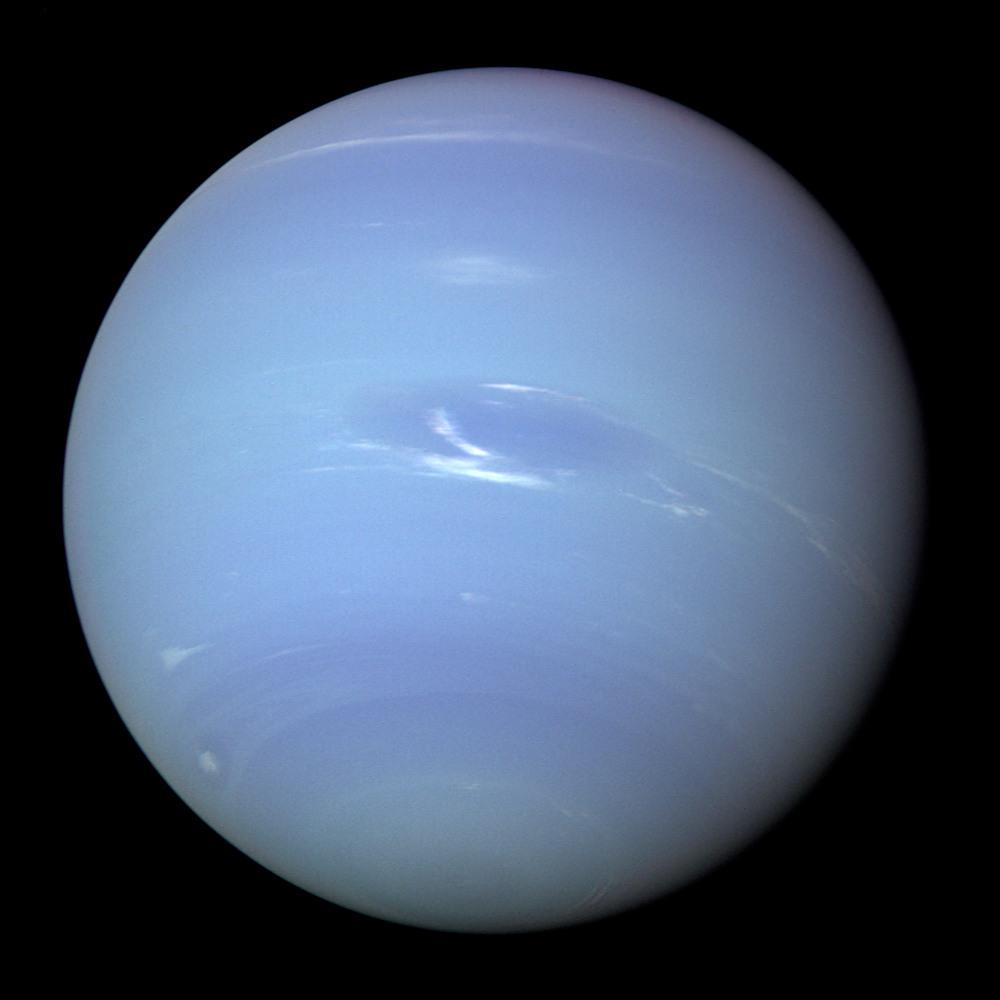

Neptune, the most distant of the planets, is known as a deep-blue ball.1
It is not that colour.
The story of this error is one of the most instructive on this site, because at no point did anyone lie.
The 1989 image
The Voyager 2 probe is the only human-made craft to have flown past Uranus and Neptune, in the 1980s.2
Its camera did not produce colour photographs directly, as a phone does. It photographed through separate filters — each shot recording only a single colour. These images were then recombined to obtain a colour view.3
The images of Uranus were published in a form close to true colour.4
Those of Neptune, on the other hand, were not. In this composite image, the contrast was strongly enhanced to bring out the clouds, bands and winds — which made Neptune artificially too blue. The researcher who reopened the case puts it this way: the images of Neptune were “stretched and enhanced”.5
No one lied
This is the crux of the story.
Planetary scientists at the time knew this perfectly well. It was not a secret, nor an error, nor a manipulation: it was a deliberate technical choice, intended to bring out details that would otherwise have been invisible.
What is more, the images were released with captions that explained it.
So what happened?
The caption got lost along the way.
The researcher is precise on this point: the artificially saturated colour was known among planetary scientists, the images were released with captions explaining it, and that distinction had become lost over time.6
The image, meanwhile, went on its way: into newspapers, textbooks, posters, children’s books, onto screens. After a few years, all that remained was the blue ball.
In 2024, a team led from the University of Oxford used instruments in which each point of the image contains a complete spectrum of colours. It rebalanced the Voyager 2 images and those of the Hubble telescope.7
The result: Uranus and Neptune are a similar shade, a greenish blue. Neptune leans only slightly more towards blue — because of a thinner haze layer — and it is much paler than in the image that stuck in people’s minds.89
What to take away
This story lends itself easily to misuse.
It is not “we were lied to”. The processing was documented, announced, explained. Those who present it as proof that space images are faked have left out half the story.
What happened is more interesting, and much more common.
An image travels without its caption.
This holds for all images, everywhere. A photograph is easily copied, shared and reused. The text that goes with it, by contrast, is cumbersome: it gets shortened, moved, forgotten.
This mechanism appears elsewhere on this site, in other forms: a history book from 1960, refuted by historians from the 1970s onwards and still cited today outside its discipline; a figure on biodiversity, copied for twenty years without its original nuance; an archaeological discovery corrected by those who led the excavations, while the old version carried on its way.
Each time, it is not the fact that gets lost. It is the precision that went with it.
What this changes for us
We draw a rule from this for our own work, and would rather state it openly.
It is not enough to write an accurate caption under each image. An accurate caption offers no protection, since it becomes detached.
The information must therefore travel with the image, and not alongside it: which instrument, which date, which processing.
On this page, the header image is the Voyager 2 one, with its date and its credit. The version rebalanced in 2024 can be seen in the University of Oxford press release listed in the bibliography.
A planet found with a pencil
In 1846, a man calculated where a planet that no one had ever seen ought to be. A telescope was pointed at the spot indicated. It was there.10
It was Neptune, the only planet in the solar system discovered by calculation before being discovered by observation.
It all started with unexplained irregularities in the orbit of Uranus. Something was pulling on it.
The French astronomer Urbain Le Verrier calculated where this something must be, and sent its position to Berlin. As soon as he received the letter, Johann Galle pointed his telescope and quickly found the planet.11
What the usual account leaves out
It is often said that another mathematician, the Englishman John Couch Adams, had reached the same result at the same time, and that he was unjustly forgotten.
The historians who reopened the case present things differently. Adams had not given one position, but several, which kept shifting — enough to launch a search, not to point a telescope.12
On one side of the Channel, an observer was told: point here. On the other: search over there.
That is not the same thing.
A dispute, an admission, and a theft
After the discovery, the Franco-British rivalry nearly turned into an incident. A compromise eventually granted joint credit to the two men.
What followed reads like a novel.
The Greenwich Observatory’s archival papers on this affair had disappeared. They remained untraceable for decades, before resurfacing at the end of the twentieth century.13
After examining them, historians concluded that Adams does not deserve the same credit as Le Verrier.14
Three caveats
This case is too good to be told without reservations.
One. The doubt about Adams does not date from the recovered archives: researchers had already raised it earlier. The documents confirmed an old question; they did not give rise to it.
Two. Le Verrier is not a spotless hero. His calculations, too, rested on bold assumptions. He was right, and he was also lucky; to write the one without the other would be to manufacture a legend.
Three, and most important. Science does not only correct what it says about the facts of nature. It also corrects its own history — and much more slowly. It took a very long time for this case to be reopened.
What the giant planets are
Jupiter, Saturn, Uranus and Neptune have no solid surface: beneath their clouds, gases swirl above a core.15
Jupiter and Saturn are gas giants, made mostly of hydrogen and helium. Jupiter, eleven times wider than the Earth, is more than twice as massive as all the other planets combined. Saturn is the only planet whose average density is lower than that of water.16
Uranus and Neptune are ice giants. At least 80% of their mass is a hot, dense fluid of so-called “icy” materials — water, methane and ammonia — above a small rocky core. Uranus’s axis is so tilted that it seems to spin lying on its side. Neptune takes about 165 years to go round the Sun.17
All of them have rings. Saturn’s, made of billions of small chunks of ice and rock, are by far the most spectacular. Jupiter has only a faint system of dusty rings; Uranus has 13, Neptune at least five main ones.18
Note 1
both worlds are in fact a similar shade of greenish blue, despite the commonly-held belief that Neptune is a deep azure
Université d’Oxford, “New images reveal what Neptune and Uranus really look like”, communiqué du 5 January 2024
Note 2
NASA's Voyager 2 mission, the only spacecraft to fly past these worlds
Université d’Oxford, “New images reveal what Neptune and Uranus really look like”, communiqué du 5 January 2024
Note 3
recorded images in separate colours. The single-colour images were later recombined to create composite colour images
Université d’Oxford, “New images reveal what Neptune and Uranus really look like”, communiqué du 5 January 2024
Note 4
the familiar Voyager 2 images of Uranus were published in a form closer to 'true' colour
Université d’Oxford, “New images reveal what Neptune and Uranus really look like”, communiqué du 5 January 2024
Note 5
the early Neptune images from Voyager 2 were strongly contrast enhanced to better reveal the clouds, bands, and winds
Université d’Oxford, “New images reveal what Neptune and Uranus really look like”, communiqué du 5 January 2024
those of Neptune were, in fact, stretched and enhanced, and therefore made artificially too blue
Université d’Oxford, “New images reveal what Neptune and Uranus really look like”, communiqué du 5 January 2024
Note 6
Even though the artificially-saturated colour was known at the time amongst planetary scientists – and the images were released with captions explaining it – that distinction had become lost over time.
Université d’Oxford, “New images reveal what Neptune and Uranus really look like”, communiqué du 5 January 2024
Note 7
In the new study, the researchers used data from Hubble Space Telescope's Space Telescope Imaging Spectrograph (STIS) and the Multi Unit Spectroscopic Explorer (MUSE) on the European Southern Observatory's Very Large Telescope. In both instruments, each pixel is a continuous spectrum of colours.
Université d’Oxford, “New images reveal what Neptune and Uranus really look like”, communiqué du 5 January 2024
The researchers used these data to re-balance the composite colour images recorded by the Voyager 2 camera, and also by the Hubble Space Telescope's Wide Field Camera 3
Université d’Oxford, “New images reveal what Neptune and Uranus really look like”, communiqué du 5 January 2024
Note 8
Uranus and Neptune are actually a rather similar shade of greenish blue. The main difference is that Neptune has a slight hint of additional blue, which the model reveals to be due to a thinner haze layer on that planet.
Université d’Oxford, “New images reveal what Neptune and Uranus really look like”, communiqué du 5 January 2024
Note 9
Finally, we find that although the visible colour of Uranus is less blue than Neptune, due to the increased aerosol thickness on Uranus, and this difference is greatest at Uranus’s solstices, it is much less significant than is commonly believed due to a long-standing misperception of Neptune’s ‘true’ colour.
Irwin, Patrick G. J. et al., “Modelling the Seasonal Cycle of Uranus’s Colour and Magnitude, and Comparison with Neptune”, Monthly Notices of the Royal Astronomical Society, vol. 527, no. 4, February 2024, p. 11521-11538
Note 10
[…] Le Verrier lance le 31 août 1846, du haut de la tribune de l’Académie des sciences, un vibrant appel aux astronomes de France. Il les exhorte à braquer leurs lunettes vers un lieu précis du ciel où devrait se trouver l’hypothétique planète responsable des troubles constatés dans l’orbite d’Uranus.
[…] on 31 August 1846, from the rostrum of the Académie des sciences, Le Verrier launches a stirring appeal to the astronomers of France. He urges them to train their telescopes on a precise place in the sky where the hypothetical planet responsible for the disturbances observed in the orbit of Uranus should be found.
Descamps, Pascal, “Pourquoi Neptune n’a-t-elle pas été découverte à l’Observatoire de Paris ?”, IMCCE – Observatoire de Paris, lettre d’information, December 2011
Note 11
Le 18 septembre 1846, Le Verrier décide alors de s’adresser à Johann Galle de l’Observatoire de Berlin. […] Dès réception du courrier de Le Verrier, le 23 septembre 1846, Galle se met en chasse du nouvel astre avec l’aide de son jeune assistant Heinrich d’Arrest (1822-1875). […] Il leur faut ensuite peu de temps pour se rendre compte qu’un nouvel objet, vu à l’oculaire non loin de l’endroit indiqué par Le Verrier, ne figure pas sur la carte de Bremiker qui rassemble pourtant toutes les étoiles jusqu’à la neuvième grandeur.
On 18 September 1846, Le Verrier then decides to write to Johann Galle of the Berlin Observatory. […] As soon as he receives Le Verrier’s letter, on 23 September 1846, Galle sets off in pursuit of the new body with the help of his young assistant Heinrich d’Arrest (1822-1875). […] It then takes them little time to realise that a new object, seen in the eyepiece not far from the place indicated by Le Verrier, does not appear on Bremiker’s chart, which nevertheless gathers all the stars down to the ninth magnitude.
Descamps, Pascal, “Pourquoi Neptune n’a-t-elle pas été découverte à l’Observatoire de Paris ?”, IMCCE – Observatoire de Paris, lettre d’information, December 2011
Note 12
Adams's successive predictions
Sheehan, William, Kollerstrom, Nicholas and Waff, Craig B., “The Case of the Pilfered Planet: Did the British Steal Neptune?”, Scientific American, vol. 291, no. 6, December 2004, p. 92-99
Note 13
[…] the "Neptune file," the record at Greenwich Observatory of the events and documents involving Adams, Challis, and Airy, had long ago gone missing. But in 1999, it turned up, in – of all places – Chile, stolen and taken there by a miscreant astronomer.
Ashworth, William B., Jr., “John Couch Adams”, Scientist of the Day, Linda Hall Library, 5 June 2025
Note 14
The file revealed that Adams had not given just one prediction in 1845 for the position of a new planet – he had given quite a few of them, each one in a different location, making it virtually impossible for anyone to look for it. […] So Adams was not a co-discoverer of Neptune after all.
Ashworth, William B., Jr., “John Couch Adams”, Scientist of the Day, Linda Hall Library, 5 June 2025
Note 15
The giant planets in the outer solar system don't have hard surfaces. Instead, they have swirling gases above a core.
NASA Science, “About the Planets”
Note 16
Like fellow gas giant Jupiter, Saturn is a massive ball made mostly of hydrogen and helium.
NASA Science, “Saturn: Facts”
Jupiter is more than twice as massive as all other Solar System planets combined. […] 142 984 km (11 times that of Earth)
European Space Agency (ESA), “Facts about Jupiter”
Saturn is the only planet in our solar system with an average density that is less than water.
NASA Science, “Saturn: Facts”
Note 17
Neptune is one of two ice giants in the outer solar system. […] Most (80% or more) of the planet's mass is made up of a hot dense fluid of "icy" materials – water, methane, and ammonia – above a small, rocky core.
NASA Science, “Neptune: Facts”
Most (80% or more) of the planet's mass is made up of a hot dense fluid of "icy" materials – water, methane, and ammonia
NASA Science, “Uranus: Facts”
This unique tilt makes Uranus appear to spin sideways, orbiting the Sun like a rolling ball.
NASA Science, “Uranus: Facts”
And Neptune makes a complete orbit around the Sun (a year in Neptunian time) in about 165 Earth years
NASA Science, “Neptune: Facts”
Note 18
They are made of billions of small chunks of ice and rock coated with other materials such as dust. […] Saturn is not the only planet to have rings, but none are as spectacular or as complex as Saturn's.
NASA Science, “Saturn: Facts”
Jupiter has a faint four-part system of dusty rings
European Space Agency (ESA), “Facts about Jupiter”
The ice giant is surrounded by 13 faint rings and 28 small moons.
NASA Science, “Uranus: Facts”
Neptune has at least five main rings and four prominent ring arcs that we know of so far.
NASA Science, “Neptune: Facts”
Notes and sources
- ↑
Passage Neptune, the most distant of the planets, is known as a deep-blue ball. It is not that colour.
both worlds are in fact a similar shade of greenish blue, despite the commonly-held belief that Neptune is a deep azure
Source Université d’Oxford, “New images reveal what Neptune and Uranus really look like”, communiqué du 5 January 2024, paragraph 3.
Open access open the source · checked on 9 September 2026
- ↑
Passage The Voyager 2 probe is the only human-made craft to have flown past Uranus and Neptune, in the 1980s.
NASA's Voyager 2 mission, the only spacecraft to fly past these worlds
Source Université d’Oxford, “New images reveal what Neptune and Uranus really look like”, communiqué du 5 January 2024, paragraph 5.
Open access open the source · checked on 9 September 2026
- ↑
Passage It photographed through separate filters […] These images were then recombined to obtain a colour view.
recorded images in separate colours. The single-colour images were later recombined to create composite colour images
Source Université d’Oxford, “New images reveal what Neptune and Uranus really look like”, communiqué du 5 January 2024, paragraphs 5-6.
Open access open the source · checked on 9 September 2026
- ↑
Passage The images of Uranus were published in a form close to true colour.
the familiar Voyager 2 images of Uranus were published in a form closer to 'true' colour
Source Université d’Oxford, “New images reveal what Neptune and Uranus really look like”, communiqué du 5 January 2024, quotation from Patrick Irwin.
Open access open the source · checked on 9 September 2026
- ↑
Passage the contrast was strongly enhanced to bring out the clouds, bands and winds
the early Neptune images from Voyager 2 were strongly contrast enhanced to better reveal the clouds, bands, and winds
Source Université d’Oxford, “New images reveal what Neptune and Uranus really look like”, communiqué du 5 January 2024, paragraph 7.
Open access open the source · checked on 9 September 2026
Passage which made Neptune artificially too blue […] the images of Neptune were “stretched and enhanced”
those of Neptune were, in fact, stretched and enhanced, and therefore made artificially too blue
Source Université d’Oxford, “New images reveal what Neptune and Uranus really look like”, communiqué du 5 January 2024, quotation from Patrick Irwin.
Open access open the source · checked on 9 September 2026
- ↑
Passage the artificially saturated colour was known among planetary scientists, the images were released with captions explaining it, and that distinction had become lost over time
Even though the artificially-saturated colour was known at the time amongst planetary scientists – and the images were released with captions explaining it – that distinction had become lost over time.
Source Université d’Oxford, “New images reveal what Neptune and Uranus really look like”, communiqué du 5 January 2024, quotation from Patrick Irwin.
Open access open the source · checked on 9 September 2026
- ↑
Passage In 2024, a team led from the University of Oxford used instruments in which each point of the image contains a complete spectrum of colours.
In the new study, the researchers used data from Hubble Space Telescope's Space Telescope Imaging Spectrograph (STIS) and the Multi Unit Spectroscopic Explorer (MUSE) on the European Southern Observatory's Very Large Telescope. In both instruments, each pixel is a continuous spectrum of colours.
Source Université d’Oxford, “New images reveal what Neptune and Uranus really look like”, communiqué du 5 January 2024, paragraph 11.
Open access open the source · checked on 9 September 2026
Passage It rebalanced the Voyager 2 images and those of the Hubble telescope.
The researchers used these data to re-balance the composite colour images recorded by the Voyager 2 camera, and also by the Hubble Space Telescope's Wide Field Camera 3
Source Université d’Oxford, “New images reveal what Neptune and Uranus really look like”, communiqué du 5 January 2024, paragraph 13.
Open access open the source · checked on 9 September 2026
- ↑
Passage Uranus and Neptune are a similar shade, a greenish blue. Neptune leans only slightly more towards blue — because of a thinner haze layer
Uranus and Neptune are actually a rather similar shade of greenish blue. The main difference is that Neptune has a slight hint of additional blue, which the model reveals to be due to a thinner haze layer on that planet.
Source Université d’Oxford, “New images reveal what Neptune and Uranus really look like”, communiqué du 5 January 2024, paragraph 14.
Open access open the source · checked on 9 September 2026
- ↑
For this whole section
Passage a new study
Finally, we find that although the visible colour of Uranus is less blue than Neptune, due to the increased aerosol thickness on Uranus, and this difference is greatest at Uranus’s solstices, it is much less significant than is commonly believed due to a long-standing misperception of Neptune’s ‘true’ colour.
Source Irwin, Patrick G. J. et al., “Modelling the Seasonal Cycle of Uranus’s Colour and Magnitude, and Comparison with Neptune”, Monthly Notices of the Royal Astronomical Society, vol. 527, no. 4, February 2024, p. 11521-11538, abstract, penultimate sentence.
Open access open the source · checked on 24 October 2026
- ↑
Passage In 1846, a man calculated where a planet that no one had ever seen ought to be
[…] Le Verrier lance le 31 août 1846, du haut de la tribune de l’Académie des sciences, un vibrant appel aux astronomes de France. Il les exhorte à braquer leurs lunettes vers un lieu précis du ciel où devrait se trouver l’hypothétique planète responsable des troubles constatés dans l’orbite d’Uranus.
Editors’ translation […] on 31 August 1846, from the rostrum of the Académie des sciences, Le Verrier launches a stirring appeal to the astronomers of France. He urges them to train their telescopes on a precise place in the sky where the hypothetical planet responsible for the disturbances observed in the orbit of Uranus should be found.
Source Descamps, Pascal, “Pourquoi Neptune n’a-t-elle pas été découverte à l’Observatoire de Paris ?”, IMCCE – Observatoire de Paris, lettre d’information, December 2011, account of the discovery.
Open access open the source · checked on 9 September 2026
- ↑
Passage The French astronomer Urbain Le Verrier calculated where this something must be, and sent its position to Berlin. As soon as he received the letter, Johann Galle pointed his telescope and quickly found the planet.
Le 18 septembre 1846, Le Verrier décide alors de s’adresser à Johann Galle de l’Observatoire de Berlin. […] Dès réception du courrier de Le Verrier, le 23 septembre 1846, Galle se met en chasse du nouvel astre avec l’aide de son jeune assistant Heinrich d’Arrest (1822-1875). […] Il leur faut ensuite peu de temps pour se rendre compte qu’un nouvel objet, vu à l’oculaire non loin de l’endroit indiqué par Le Verrier, ne figure pas sur la carte de Bremiker qui rassemble pourtant toutes les étoiles jusqu’à la neuvième grandeur.
Editors’ translation On 18 September 1846, Le Verrier then decides to write to Johann Galle of the Berlin Observatory. […] As soon as he receives Le Verrier’s letter, on 23 September 1846, Galle sets off in pursuit of the new body with the help of his young assistant Heinrich d’Arrest (1822-1875). […] It then takes them little time to realise that a new object, seen in the eyepiece not far from the place indicated by Le Verrier, does not appear on Bremiker’s chart, which nevertheless gathers all the stars down to the ninth magnitude.
Source Descamps, Pascal, “Pourquoi Neptune n’a-t-elle pas été découverte à l’Observatoire de Paris ?”, IMCCE – Observatoire de Paris, lettre d’information, December 2011, account of the discovery.
Open access open the source · checked on 9 September 2026
- ↑
Passage Adams had not given one position, but several, which kept shifting
Adams's successive predictions
Source Sheehan, William, Kollerstrom, Nicholas and Waff, Craig B., “The Case of the Pilfered Planet: Did the British Steal Neptune?”, Scientific American, vol. 291, no. 6, December 2004, p. 92-99, analysis of Adams’s predictions, p. 92-99.
Paywalled · checked on 9 September 2026
- ↑
Passage The Greenwich Observatory’s archival papers on this affair had disappeared. They remained untraceable for decades, before resurfacing at the end of the twentieth century.
[…] the "Neptune file," the record at Greenwich Observatory of the events and documents involving Adams, Challis, and Airy, had long ago gone missing. But in 1999, it turned up, in – of all places – Chile, stolen and taken there by a miscreant astronomer.
Source Ashworth, William B., Jr., “John Couch Adams”, Scientist of the Day, Linda Hall Library, 5 June 2025, paragraph on the “Neptune file”.
Open access open the source · checked on 9 September 2026
- ↑
Passage After examining them, historians concluded that Adams does not deserve the same credit as Le Verrier.
The file revealed that Adams had not given just one prediction in 1845 for the position of a new planet – he had given quite a few of them, each one in a different location, making it virtually impossible for anyone to look for it. […] So Adams was not a co-discoverer of Neptune after all.
Source Ashworth, William B., Jr., “John Couch Adams”, Scientist of the Day, Linda Hall Library, 5 June 2025, paragraph on the “Neptune file” and conclusion.
Open access open the source · checked on 9 September 2026
- ↑
Passage Jupiter, Saturn, Uranus and Neptune have no solid surface: beneath their clouds, gases swirl above a core.
The giant planets in the outer solar system don't have hard surfaces. Instead, they have swirling gases above a core.
Source NASA Science, “About the Planets”, whole page.
Open access open the source · checked on 26 October 2026
- ↑
Passage Jupiter and Saturn are gas giants, made mostly of hydrogen and helium.
Like fellow gas giant Jupiter, Saturn is a massive ball made mostly of hydrogen and helium.
Source NASA Science, “Saturn: Facts”, whole page.
Open access open the source · checked on 26 October 2026
Passage Jupiter, eleven times wider than the Earth, is more than twice as massive as all the other planets combined.
Jupiter is more than twice as massive as all other Solar System planets combined. […] 142 984 km (11 times that of Earth)
Source European Space Agency (ESA), “Facts about Jupiter”, whole page.
Open access open the source · checked on 26 October 2026
Passage Saturn is the only planet whose average density is lower than that of water.
Saturn is the only planet in our solar system with an average density that is less than water.
Source NASA Science, “Saturn: Facts”, whole page.
Open access open the source · checked on 26 October 2026
- ↑
Passage Uranus and Neptune are ice giants. At least 80% of their mass is a hot, dense fluid of so-called “icy” materials — water, methane and ammonia — above a small rocky core.
Neptune is one of two ice giants in the outer solar system. […] Most (80% or more) of the planet's mass is made up of a hot dense fluid of "icy" materials – water, methane, and ammonia – above a small, rocky core.
Source NASA Science, “Neptune: Facts”, whole page.
Open access open the source · checked on 26 October 2026
Passage Uranus and Neptune are ice giants. At least 80% of their mass is a hot, dense fluid of so-called “icy” materials — water, methane and ammonia
Most (80% or more) of the planet's mass is made up of a hot dense fluid of "icy" materials – water, methane, and ammonia
Source NASA Science, “Uranus: Facts”, whole page.
Open access open the source · checked on 26 October 2026
Passage Uranus’s axis is so tilted that it seems to spin lying on its side.
This unique tilt makes Uranus appear to spin sideways, orbiting the Sun like a rolling ball.
Source NASA Science, “Uranus: Facts”, whole page.
Open access open the source · checked on 26 October 2026
Passage Neptune takes about 165 years to go round the Sun.
And Neptune makes a complete orbit around the Sun (a year in Neptunian time) in about 165 Earth years
Source NASA Science, “Neptune: Facts”, whole page.
Open access open the source · checked on 26 October 2026
- ↑
Passage All of them have rings. Saturn’s, made of billions of small chunks of ice and rock, are by far the most spectacular.
They are made of billions of small chunks of ice and rock coated with other materials such as dust. […] Saturn is not the only planet to have rings, but none are as spectacular or as complex as Saturn's.
Source NASA Science, “Saturn: Facts”, whole page.
Open access open the source · checked on 26 October 2026
Passage Jupiter has only a faint system of dusty rings
Jupiter has a faint four-part system of dusty rings
Source European Space Agency (ESA), “Facts about Jupiter”, whole page.
Open access open the source · checked on 26 October 2026
Passage Uranus has 13
The ice giant is surrounded by 13 faint rings and 28 small moons.
Source NASA Science, “Uranus: Facts”, whole page.
Open access open the source · checked on 26 October 2026
Passage Neptune at least five main ones
Neptune has at least five main rings and four prominent ring arcs that we know of so far.
Source NASA Science, “Neptune: Facts”, whole page.
Open access open the source · checked on 26 October 2026
Bibliography
10
- Ashworth, William B., Jr., “John Couch Adams”, Scientist of the Day, Linda Hall Library, 5 June 2025, open access (the Greenwich “Neptune” file, lost and then found again in 1999; Adams’s multiple predictions; Adams was not a co-discoverer). https://www.lindahall.org/about/news/scientist-of-the-day/john-couch-adams/
- Descamps, Pascal, “Pourquoi Neptune n’a-t-elle pas été découverte à l’Observatoire de Paris ?”, IMCCE – Observatoire de Paris, lettre d’information, December 2011, open access (Le Verrier’s appeal in 1846; his letter to Galle; the discovery in Berlin). https://www.imcce.fr/newsletter/docs/NeptuneLeVerrier_NewsLetterDecembre2011.pdf
- European Space Agency (ESA), “Facts about Jupiter”, open access (the diameter, eleven times that of the Earth; a mass more than twice that of the other planets combined; the dusty rings). https://www.esa.int/Science_Exploration/Space_Science/Juice/Facts_about_Jupiter
- Irwin, Patrick G. J. et al., “Modelling the Seasonal Cycle of Uranus’s Colour and Magnitude, and Comparison with Neptune”, Monthly Notices of the Royal Astronomical Society, vol. 527, no. 4, February 2024, p. 11521-11538, open access (the study itself). https://doi.org/10.1093/mnras/stad3761
- NASA Science, “About the Planets”, open access (the giant planets with no solid surface; gas giants and ice giants). https://science.nasa.gov/solar-system/planets/
- NASA Science, “Saturn: Facts”, open access (hydrogen and helium; an average density lower than that of water; the rings of ice and rock). https://science.nasa.gov/saturn/facts/
- NASA Science, “Uranus: Facts”, open access (the fluid of “icy” materials; the tilted axis; the 13 rings). https://science.nasa.gov/uranus/facts/
- NASA Science, “Neptune: Facts”, open access (the fluid of “icy” materials above a rocky core; the 165-year year; the rings). https://science.nasa.gov/neptune/facts/
- Sheehan, William, Kollerstrom, Nicholas and Waff, Craig B., “The Case of the Pilfered Planet: Did the British Steal Neptune?”, Scientific American, vol. 291, no. 6, December 2004, p. 92-99, paywalled (the Greenwich archives, lost and then found again; Adams’s successive positions).
- Université d’Oxford, “New images reveal what Neptune and Uranus really look like”, communiqué du 5 January 2024, open access (Voyager 2 as the only flyby, the separate filters, the enhanced contrast, the lost caption, the shared greenish blue, the thinner haze). https://www.ox.ac.uk/news/2024-01-05-new-images-reveal-what-neptune-and-uranus-really-look-1
Spotted an error or have a doubt? Write to us.