
The plural in the title is deliberate: there was not one revolution.
There is a story that gets told, then its opposite, then the opposite of the opposite. All three in less than thirty years.
Nothing better shows how research works.
First, what is solid
Growing crops and raising animals were invented at least eleven times, separately, by people who did not know one another. Wheat in the Near East, rice in China, maize in Mesoamerica, potatoes in the Andes, yams in Africa, taro in New Guinea.1
So there is no single cradle of agriculture. The Near East is the most thoroughly excavated centre, which is not the same thing.
This change was not simple progress: in many regions, the first farmers were shorter and less well nourished than the hunter-gatherers who preceded them. This story is told in detail in our page on agriculture.
A misleading word
It is called the “Neolithic Revolution”. The expression was popularised by the Australian archaeologist Vere Gordon Childe, notably in Man Makes Himself (1936), which compares this shift with the Industrial Revolution of the eighteenth century.2
The problem is that a revolution suggests something rapid. Yet this change stretched over thousands of years; it advanced and retreated, and it did not look like the same process from one region to another.
In Japan, for example (the Jōmon period), populations lived in large permanent villages for millennia while remaining exclusively hunter-gatherers. Elsewhere, people cultivated before settling down.3
The word can be kept, since it is convenient, provided one bears in mind that it describes something slow and plural.
The three stories
First story: the one that used to be told.
First, humans farm. Then, forced to stay near their fields, they build villages. Finally, once they produce more than they need, they erect large monuments.
In that order: the economy first, religion and art afterwards, like a luxury people treat themselves to once they are sure of having enough to eat.
Second story: the one that overturned the first.
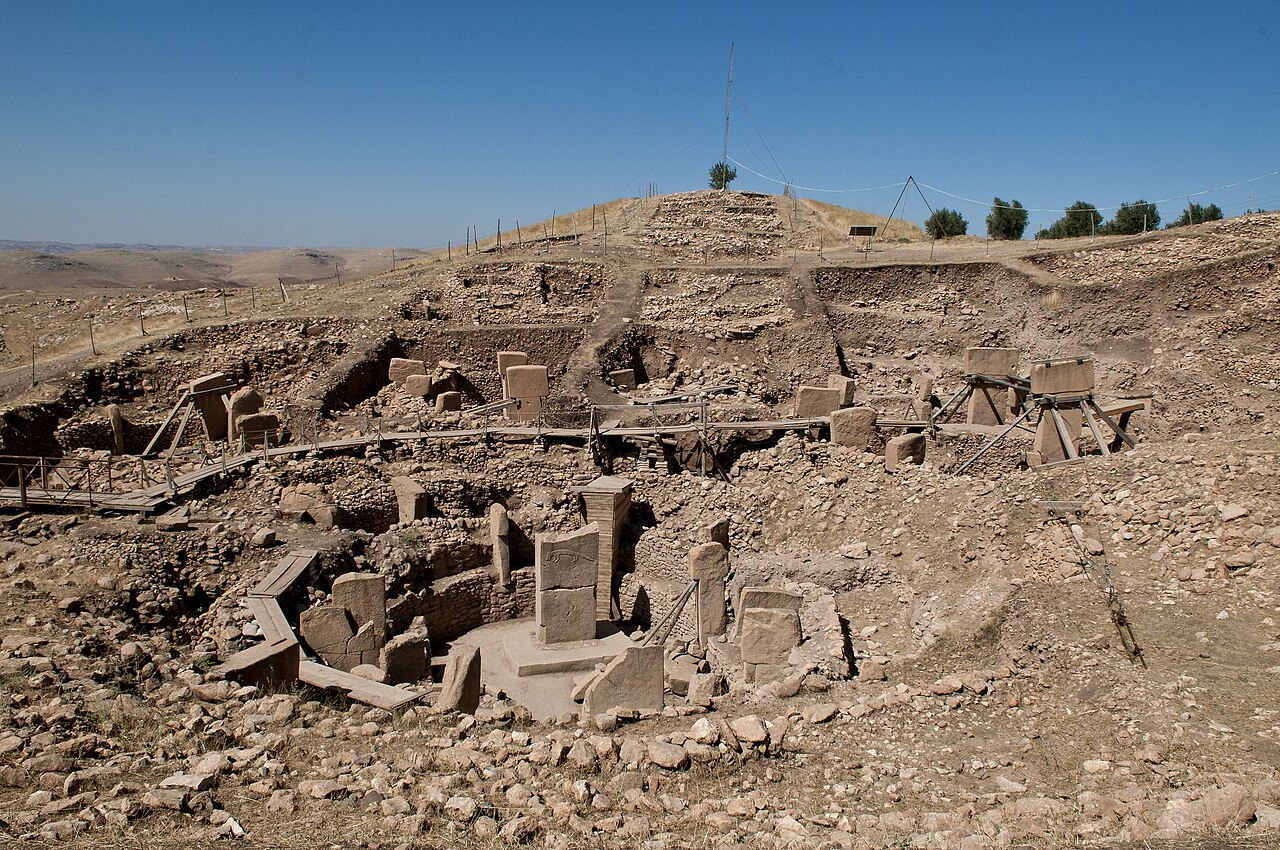
In south-eastern Turkey, on a hill called Göbekli Tepe, huge T-shaped carved stone pillars were uncovered, set up in circles. The site was occupied from about 9500 BCE — that is, several thousand years before the pyramids.4
This is the period when, in this region, people were moving from hunting and gathering to agriculture. But they were not yet farmers.5
The German archaeologist who excavated the site from 1995 onwards, Klaus Schmidt, concluded that it was a place of gathering and ritual, to which hunter-gatherers came from far away. He took the title of his book from this: “They built the first temples.” On this view, monumentality came before agriculture.6
He summed up his thesis in a short phrase, and that is what people remembered: “First the temple, then the city.”7
This idea went around the world: it was spectacular, it turned everything upside down, and it has been repeated everywhere ever since.
Third story: the one being written now.
The excavations continued, and the current team did two things: dig new test trenches, and reread twenty years of excavation records.8
These brought to light houses — round, then rectangular buildings, set against one another, on the slope of the hill — as well as cisterns dug into the rock to collect rainwater, and thousands of tools for grinding grain.9
In other words: people lived there.
The current head of research puts it bluntly: this work is leading to a revision of former interpretations, the very ones that still fuel the image of the site as home to the “World’s First Temples”.10
What to take from it, and it is not what one might think
It would be wrong to conclude: “we were mistaken, it was only a village”.
The pillars are there. No one disputes that they are extraordinary, nor that it took many people working together to raise them. What changes is that it is no longer seen as a place without inhabitants.
The way the correction came about also deserves attention: not by finding something spectacular elsewhere, but by rereading the excavation notebooks of the previous twenty years. Part of the answer was already there, written down, and no one had read it that way.11
The main lesson lies elsewhere, and it is more useful.
A sound correction can in turn become the official story — and be corrected.
The second story was a real discovery. It corrected an account that was too simple. It left the archaeology journals and entered books, documentaries and conversations. While it travelled, those working on the site kept on digging.
Note 1
At least 11 regions of the Old and New World were involved as independent centers of origin, encompassing geographically isolated regions on most continents, but several more have been suggested (Fig. 1) (3, 7, 11, 15, 16).
Larson, Greger et al., “Current Perspectives and the Future of Domestication Studies”, Proceedings of the National Academy of Sciences, vol. 111, 2014, p. 6139-6146
In the Near East it was grains like wheat and barley. […] In Mesoamerica it was squash and later maize, or corn, and in China millet and rice. […] Farther south, in the Andean region, around five thousand years ago people began to grow potatoes. […] The cultivation of taro in New Guinea may have begun as early as 7000 BCE. And in central Africa, farming of white Guinea yams began around 5000 BCE, later including crops like millet and sorghum.
Kordas, Ann, Lynch, Ryan J., Nelson, Brooke and Tatlock, Julie, World History, Volume 1: to 1500, OpenStax, 2023, section 2.3 “The Neolithic Revolution”
Note 2
Childe introduced the idea of prehistoric revolutions in 1934. […] Two years later, his widely read book Man Makes Himself brought prehistoric revolutions to a popular audience. […] ushered in by an economic revolution of the same kind and having the same effect as the ‘Industrial Revolution’ of the eighteenth century.
Frieman, Catherine J., “‘Revolutions So Remote’: Revolutionary Thinking and Archaeological Inquiry”, Age of Revolutions, 1 June 2020
Note 3
Over a period of more than 10,000 years, the Jomon people continued hunter-fisher-gatherer lifeways without changing to an agrarian culture, adapting to environmental changes such as climate warming and cooling and the corresponding marine transgression and regression. […] The Jomon people initiated a sedentary way of life about 15,000 years ago, as indicated tentatively at first by the use of pottery, and later by the construction of more permanent dwellings and ritual sites, and the year-round exploitation of nearby resources.
UNESCO, “Jomon Prehistoric Sites in Northern Japan”, World Heritage List
This component part is an archaeological site of a large hub settlement that dates mainly from the second half of the development stage of sedentism. It is an important archaeological site that attests to a livelihood of an inland bay area, large hub settlements, and the diversity of rituals and ceremonies.
Secretariat for the Promotion of the World Heritage Inscription of Jomon Prehistoric Sites (Aomori Prefectural Government), “Sannai Maruyama Site”, official website World Heritage Jomon Prehistoric Sites in Northern Japan
Note 4
Göbekli Tepe (~9.500–8.000 calBC) is a prehistoric site in Southeast Turkey
Clare, Lee, “Göbekli Tepe, Turkey. A Brief Summary of Research at a New World Heritage Site (2015-2019)”, e-Forschungsberichte des DAI, 2020, p. 81-88
Note 5
dates back to an early stage in the transition from hunter-gathering to farming economies in the Near East
Clare, Lee, “Göbekli Tepe, Turkey. A Brief Summary of Research at a New World Heritage Site (2015-2019)”, e-Forschungsberichte des DAI, 2020, p. 81-88
Note 6
Als der deutsche Archäologe Klaus Schmidt an einem Oktobernachmittag des Jahres 1994 […] Schmidt war sofort klar, dass dies keine natürliche Anhöhe war: »Das, was wir sahen, konnte ohne Zweifel nur Menschenwerk sein«, schrieb er in seinem Buch »Sie bauten die ersten Tempel«. […] Seine ersten Geheimnisse gab der Hügel im Jahr 1995 preis. Damals begann Klaus Schmidt zusammen mit türkischen Kolleginnen und Kollegen zu graben, gefördert vom Deutschen Archäologischen Institut (DAI). […] Da er den Göbekli Tepe als Bergheiligtum deutete, wo Menschen zusammenkamen, um ihre Religion auszuüben, goss er seine Überzeugungen in folgende Formel: »Erst kam der Tempel, dann die Stadt.«
Schediwy, Dagmar, “Göbekli Tepe: Das Dorf, in dem Jäger und Sammler wohnten”, Spektrum der Wissenschaft (spektrum.de), 25 December 2023
Göbekli Tepe is one of the most important archaeological discoveries of modern times, pushing back the origins of monumentality beyond the emergence of agriculture.
Dietrich, Oliver et al., “The Role of Cult and Feasting in the Emergence of Neolithic Communities: New Evidence from Göbekli Tepe, South-eastern Turkey”, Antiquity, vol. 86, 2012, p. 674-695
Note 7
First the temple, then the city
Symmes, Patrick, “Turkey: Archeological Dig Reshaping Human History”, Newsweek, 19 February 2010, open access
Note 8
Research undertaken in the period 2015–2019 has included the excavation of deep-soundings and the re-evaluation of some two decades of excavation records.
Clare, Lee, “Göbekli Tepe, Turkey. A Brief Summary of Research at a New World Heritage Site (2015-2019)”, e-Forschungsberichte des DAI, 2020, p. 81-88
C'est pourquoi un nouveau projet de recherches a été lancé en 2021. Intitulé Şanlıurfa Neolithic Research Project-Taş Tepeler, il se veut une approche multidisciplinaire visant à enrichir notre compréhension de l'environnement néolithique sous tous ses aspects. […] les résultats des recherches menées sur Karahantepe, l'un des sites étudiés dans le cadre du projet Taş Tepeler.
That is why a new research project was launched in 2021. Entitled Şanlıurfa Neolithic Research Project-Taş Tepeler, it aims to be a multidisciplinary approach seeking to enrich our understanding of the Neolithic environment in all its aspects. […] the results of the research carried out at Karahantepe, one of the sites studied as part of the Taş Tepeler project.
Musée du Louvre, “Karahantepe. Les premières sociétés sédentaires, il y a 12 000 ans, dans le Taurus oriental”, présentation de la conférence de Necmi Karul (Université d’Istanbul), 25 October 2023
Note 9
the remains of several further agglutinated round house structures appeared on the nearby western slope […] the gradual appearance of more rectangular-shaped structures […] the number of agglutinating rectangular structures discovered on the slopes and knolls of Göbekli Tepe
Clare, Lee, “Göbekli Tepe, Turkey. A Brief Summary of Research at a New World Heritage Site (2015-2019)”, e-Forschungsberichte des DAI, 2020, p. 81-88
given the evidence of prehistoric »rainwater-harvesting« from the adjacent plateau, including carved channels and »cisterns« in the natural bedrock, its interpretation as a component in an on-site water-acquisition system is a distinct possibility
Clare, Lee, “Göbekli Tepe, Turkey. A Brief Summary of Research at a New World Heritage Site (2015-2019)”, e-Forschungsberichte des DAI, 2020, p. 81-88
Especially striking is the number of tools related to food processing, including grinding slabs/bowls, handstones, pestles, and mortars, which have not been studied before. […] Almost 3400 handstones of coarse and middle-coarse basalt were found
Dietrich, Laura et al., “Cereal Processing at Early Neolithic Göbekli Tepe, Southeastern Turkey”, PLOS ONE, vol. 14, e0215214, 2019
Note 10
This work is leading to a revision of former interpretations of the prehistoric site which still fuel the popular media image of Göbekli Tepe as home to the »World's First Temples«.
Clare, Lee, “Göbekli Tepe, Turkey. A Brief Summary of Research at a New World Heritage Site (2015-2019)”, e-Forschungsberichte des DAI, 2020, p. 81-88
Note 11
the re-evaluation of some two decades of excavation records
Clare, Lee, “Göbekli Tepe, Turkey. A Brief Summary of Research at a New World Heritage Site (2015-2019)”, e-Forschungsberichte des DAI, 2020, p. 81-88
Notes and sources
- ↑
Passage Growing crops and raising animals were invented at least eleven times, separately, by people who did not know one another.
At least 11 regions of the Old and New World were involved as independent centers of origin, encompassing geographically isolated regions on most continents, but several more have been suggested (Fig. 1) (3, 7, 11, 15, 16).
Source Larson, Greger et al., “Current Perspectives and the Future of Domestication Studies”, Proceedings of the National Academy of Sciences, vol. 111, 2014, p. 6139-6146, section “Spatial and Temporal Patterns of Domestication”, 3rd paragraph (beginning “An increasingly rich and diverse corpus of data…”).
Open access open the source · checked on 24 October 2026
Passage Wheat in the Near East, rice in China, maize in Mesoamerica, potatoes in the Andes, yams in Africa, taro in New Guinea.
In the Near East it was grains like wheat and barley. […] In Mesoamerica it was squash and later maize, or corn, and in China millet and rice. […] Farther south, in the Andean region, around five thousand years ago people began to grow potatoes. […] The cultivation of taro in New Guinea may have begun as early as 7000 BCE. And in central Africa, farming of white Guinea yams began around 5000 BCE, later including crops like millet and sorghum.
Source Kordas, Ann, Lynch, Ryan J., Nelson, Brooke and Tatlock, Julie, World History, Volume 1: to 1500, OpenStax, 2023, section 2.3 “The Neolithic Revolution”, § 2.3 (“The Neolithic Revolution”), parts “The Development of Agriculture” and “Neolithic Peoples”.
Open access open the source · checked on 27 October 2026
- ↑
Passage The expression was popularised by the Australian archaeologist Vere Gordon Childe, notably in Man Makes Himself (1936), which compares this shift with the Industrial Revolution of the eighteenth century.
Childe introduced the idea of prehistoric revolutions in 1934. […] Two years later, his widely read book Man Makes Himself brought prehistoric revolutions to a popular audience. […] ushered in by an economic revolution of the same kind and having the same effect as the ‘Industrial Revolution’ of the eighteenth century.
Source Frieman, Catherine J., “‘Revolutions So Remote’: Revolutionary Thinking and Archaeological Inquiry”, Age of Revolutions, 1 June 2020, 2nd paragraph, then 5th paragraph (quotation from Man Makes Himself, p. 35).
Open access open the source · checked on 28 October 2026
- ↑
Passage In Japan, for example (the Jōmon period), populations lived […] for millennia while remaining exclusively hunter-gatherers.
Over a period of more than 10,000 years, the Jomon people continued hunter-fisher-gatherer lifeways without changing to an agrarian culture, adapting to environmental changes such as climate warming and cooling and the corresponding marine transgression and regression. […] The Jomon people initiated a sedentary way of life about 15,000 years ago, as indicated tentatively at first by the use of pottery, and later by the construction of more permanent dwellings and ritual sites, and the year-round exploitation of nearby resources.
Source UNESCO, “Jomon Prehistoric Sites in Northern Japan”, World Heritage List, “Brief synthesis”, 2nd paragraph, 2nd sentence, and 3rd paragraph, 1st sentence.
Open access open the source · checked on 27 October 2026
Passage populations lived in large permanent villages
This component part is an archaeological site of a large hub settlement that dates mainly from the second half of the development stage of sedentism. It is an important archaeological site that attests to a livelihood of an inland bay area, large hub settlements, and the diversity of rituals and ceremonies.
Source Secretariat for the Promotion of the World Heritage Inscription of Jomon Prehistoric Sites (Aomori Prefectural Government), “Sannai Maruyama Site”, official website World Heritage Jomon Prehistoric Sites in Northern Japan, page “Sannai Maruyama Site”, 6th paragraph (last before “Site tours”), two consecutive sentences; page header: Special Historic Site, ca. 3,900 BCE – 2,200 BCE.
Open access open the source · checked on 27 October 2026
- ↑
Passage The site was occupied from about 9500 BCE
Göbekli Tepe (~9.500–8.000 calBC) is a prehistoric site in Southeast Turkey
Source Clare, Lee, “Göbekli Tepe, Turkey. A Brief Summary of Research at a New World Heritage Site (2015-2019)”, e-Forschungsberichte des DAI, 2020, p. 81-88, abstract.
Open access open the source · checked on 9 September 2026
- ↑
Passage This is the period when, in this region, people were moving from hunting and gathering to agriculture. But they were not yet farmers.
dates back to an early stage in the transition from hunter-gathering to farming economies in the Near East
Source Clare, Lee, “Göbekli Tepe, Turkey. A Brief Summary of Research at a New World Heritage Site (2015-2019)”, e-Forschungsberichte des DAI, 2020, p. 81-88, abstract.
Open access open the source · checked on 9 September 2026
- ↑
Passage The German archaeologist who excavated the site from 1995 onwards, Klaus Schmidt, concluded that it was a place of gathering and ritual […] He took the title of his book from this: “They built the first temples.”
Als der deutsche Archäologe Klaus Schmidt an einem Oktobernachmittag des Jahres 1994 […] Schmidt war sofort klar, dass dies keine natürliche Anhöhe war: »Das, was wir sahen, konnte ohne Zweifel nur Menschenwerk sein«, schrieb er in seinem Buch »Sie bauten die ersten Tempel«. […] Seine ersten Geheimnisse gab der Hügel im Jahr 1995 preis. Damals begann Klaus Schmidt zusammen mit türkischen Kolleginnen und Kollegen zu graben, gefördert vom Deutschen Archäologischen Institut (DAI). […] Da er den Göbekli Tepe als Bergheiligtum deutete, wo Menschen zusammenkamen, um ihre Religion auszuüben, goss er seine Überzeugungen in folgende Formel: »Erst kam der Tempel, dann die Stadt.«
Source Schediwy, Dagmar, “Göbekli Tepe: Das Dorf, in dem Jäger und Sammler wohnten”, Spektrum der Wissenschaft (spektrum.de), 25 December 2023, 3rd paragraph (opening); 4th paragraph; section “Fast 6 Meter hoch und 20 Tonnen schwer”, 1st paragraph; section “Wie entstand unsere Zivilisation?”, 3rd paragraph.
Open access open the source · checked on 27 October 2026
Passage On this view, monumentality came before agriculture
Göbekli Tepe is one of the most important archaeological discoveries of modern times, pushing back the origins of monumentality beyond the emergence of agriculture.
Source Dietrich, Oliver et al., “The Role of Cult and Feasting in the Emergence of Neolithic Communities: New Evidence from Göbekli Tepe, South-eastern Turkey”, Antiquity, vol. 86, 2012, p. 674-695, abstract, p. 674.
Paywalled · checked on 25 October 2026
- ↑
Passage He summed up his thesis in a short phrase, and that is what people remembered: “First the temple, then the city.”
First the temple, then the city
Source Symmes, Patrick, “Turkey: Archeological Dig Reshaping Human History”, Newsweek, 19 February 2010, open access, Newsweek article, passage on Schmidt’s thesis (“Schmidt concludes that man’s first house was a house of worship: "First the temple, then the city," he insists.”).
Open access open the source · checked on 24 October 2026
- ↑
Passage the current team did two things: dig new test trenches, and reread twenty years of excavation records
Research undertaken in the period 2015–2019 has included the excavation of deep-soundings and the re-evaluation of some two decades of excavation records.
Source Clare, Lee, “Göbekli Tepe, Turkey. A Brief Summary of Research at a New World Heritage Site (2015-2019)”, e-Forschungsberichte des DAI, 2020, p. 81-88, abstract.
Open access open the source · checked on 9 September 2026
Passage The excavations continued
C'est pourquoi un nouveau projet de recherches a été lancé en 2021. Intitulé Şanlıurfa Neolithic Research Project-Taş Tepeler, il se veut une approche multidisciplinaire visant à enrichir notre compréhension de l'environnement néolithique sous tous ses aspects. […] les résultats des recherches menées sur Karahantepe, l'un des sites étudiés dans le cadre du projet Taş Tepeler.
Editors’ translation That is why a new research project was launched in 2021. Entitled Şanlıurfa Neolithic Research Project-Taş Tepeler, it aims to be a multidisciplinary approach seeking to enrich our understanding of the Neolithic environment in all its aspects. […] the results of the research carried out at Karahantepe, one of the sites studied as part of the Taş Tepeler project.
Source Musée du Louvre, “Karahantepe. Les premières sociétés sédentaires, il y a 12 000 ans, dans le Taurus oriental”, présentation de la conférence de Necmi Karul (Université d’Istanbul), 25 October 2023, text presenting the lecture.
Open access open the source · checked on 24 October 2026
- ↑
Passage houses — round, then rectangular buildings, set against one another, on the slope of the hill
the remains of several further agglutinated round house structures appeared on the nearby western slope […] the gradual appearance of more rectangular-shaped structures […] the number of agglutinating rectangular structures discovered on the slopes and knolls of Göbekli Tepe
Source Clare, Lee, “Göbekli Tepe, Turkey. A Brief Summary of Research at a New World Heritage Site (2015-2019)”, e-Forschungsberichte des DAI, 2020, p. 81-88, p. 83-84.
Open access open the source · checked on 9 September 2026
Passage cisterns dug into the rock to collect rainwater
given the evidence of prehistoric »rainwater-harvesting« from the adjacent plateau, including carved channels and »cisterns« in the natural bedrock, its interpretation as a component in an on-site water-acquisition system is a distinct possibility
Source Clare, Lee, “Göbekli Tepe, Turkey. A Brief Summary of Research at a New World Heritage Site (2015-2019)”, e-Forschungsberichte des DAI, 2020, p. 81-88, p. 85, section “Rainwater-harvesting”.
Open access open the source · checked on 9 September 2026
Passage thousands of tools for grinding grain
Especially striking is the number of tools related to food processing, including grinding slabs/bowls, handstones, pestles, and mortars, which have not been studied before. […] Almost 3400 handstones of coarse and middle-coarse basalt were found
Source Dietrich, Laura et al., “Cereal Processing at Early Neolithic Göbekli Tepe, Southeastern Turkey”, PLOS ONE, vol. 14, e0215214, 2019, abstract; section “Functional analysis of grinding stones”.
Open access open the source · checked on 24 October 2026
- ↑
Passage The current head of research puts it bluntly: this work is leading to a revision of former interpretations, the very ones that still fuel the image of the site as home to the “World’s First Temples”.
This work is leading to a revision of former interpretations of the prehistoric site which still fuel the popular media image of Göbekli Tepe as home to the »World's First Temples«.
Source Clare, Lee, “Göbekli Tepe, Turkey. A Brief Summary of Research at a New World Heritage Site (2015-2019)”, e-Forschungsberichte des DAI, 2020, p. 81-88, abstract.
Open access open the source · checked on 9 September 2026
- ↑
Passage the correction came about […] by rereading the excavation notebooks of the previous twenty years
the re-evaluation of some two decades of excavation records
Source Clare, Lee, “Göbekli Tepe, Turkey. A Brief Summary of Research at a New World Heritage Site (2015-2019)”, e-Forschungsberichte des DAI, 2020, p. 81-88, abstract.
Open access open the source · checked on 9 September 2026
Bibliography
14
- Childe, Vere Gordon, Man Makes Himself, Watts & Co., London, 1936, in libraries (the expression “Neolithic Revolution”, and the comparison with the Industrial Revolution of the eighteenth century). French translation: La Naissance de la civilisation, Gonthier, 1964.
- Clare, Lee, “Göbekli Tepe, Turkey. A Brief Summary of Research at a New World Heritage Site (2015-2019)”, e-Forschungsberichte des DAI, 2020, p. 81-88, open access (the dating of the site; the soundings and the rereading of twenty years of records; the round, then rectangular houses; the cisterns cut into the rock; the revision of the image of the “World’s First Temples”). https://doi.org/10.34780/efb.v0i2.1012
- Dietrich, Laura et al., “Cereal Processing at Early Neolithic Göbekli Tepe, Southeastern Turkey”, PLOS ONE, vol. 14, e0215214, 2019, open access (the thousands of tools for grinding grain). https://doi.org/10.1371/journal.pone.0215214
- Dietrich, Oliver et al., “The Role of Cult and Feasting in the Emergence of Neolithic Communities: New Evidence from Göbekli Tepe, South-eastern Turkey”, Antiquity, vol. 86, 2012, p. 674-695, paywalled (the ritual interpretation of the site).
- Frieman, Catherine J., “‘Revolutions So Remote’: Revolutionary Thinking and Archaeological Inquiry”, Age of Revolutions, 1 June 2020, open access (Childe’s idea of prehistoric revolutions from 1934; the comparison with the Industrial Revolution in Man Makes Himself). https://ageofrevolutions.com/2020/06/01/revolutions-so-remote-revolutionary-thinking-and-archaeological-inquiry/
- Habu, Junko, Ancient Jomon of Japan, Cambridge University Press, 2004, in libraries (sedentary hunter-gatherer villages over millennia).
- Kordas, Ann, Lynch, Ryan J., Nelson, Brooke and Tatlock, Julie, World History, Volume 1: to 1500, OpenStax, 2023, section 2.3 “The Neolithic Revolution”, open access (the plants and animals domesticated in each centre: Near East, China, Mesoamerica, Andes, Africa, New Guinea). https://openstax.org/books/world-history-volume-1/pages/2-3-the-neolithic-revolution
- Larson, Greger et al., “Current Perspectives and the Future of Domestication Studies”, Proceedings of the National Academy of Sciences, vol. 111, 2014, p. 6139-6146, open access (the eleven independent centres of domestication and the species involved). https://doi.org/10.1073/pnas.1323964111
- Musée du Louvre, “Karahantepe. Les premières sociétés sédentaires, il y a 12 000 ans, dans le Taurus oriental”, présentation de la conférence de Necmi Karul (Université d’Istanbul), 25 October 2023, open access (the Taş Tepeler regional project, launched in 2021 and coordinated by Necmi Karul, and the research on sites neighbouring Göbekli Tepe, including Karahantepe). https://api-www.louvre.fr/sites/default/files/2023-10/20231025_ARA_KARAHANTEPE_BAT.pdf
- Schediwy, Dagmar, “Göbekli Tepe: Das Dorf, in dem Jäger und Sammler wohnten”, Spektrum der Wissenschaft (spektrum.de), 25 December 2023, open access. https://www.spektrum.de/news/goebekli-tepe-das-dorf-in-dem-jaeger-und-sammler-wohnten/2159868
- Schmidt, Klaus, Sie bauten die ersten Tempel. Das rätselhafte Heiligtum der Steinzeitjäger, C. H. Beck, 2006, in libraries (the second story: the hunter-gatherers’ sanctuary, and the title that went around the world). French translation by Thérèse Houdart: Le Premier Temple. Göbekli Tepe, CNRS Éditions.
- Secretariat for the Promotion of the World Heritage Inscription of Jomon Prehistoric Sites (Aomori Prefectural Government), “Sannai Maruyama Site”, official website World Heritage Jomon Prehistoric Sites in Northern Japan, open access. https://jomon-japan.jp/en/jomon-sites/sannai-maruyama/
- Symmes, Patrick, “Turkey: Archeological Dig Reshaping Human History”, Newsweek, 19 February 2010, open access (Klaus Schmidt’s formula: “First the temple, then the city”). https://newsweek.com/turkey-archeological-dig-reshaping-human-history-75101
- UNESCO, “Jomon Prehistoric Sites in Northern Japan”, World Heritage List, open access. https://whc.unesco.org/en/list/1632/
Spotted an error or have a doubt? Write to us.