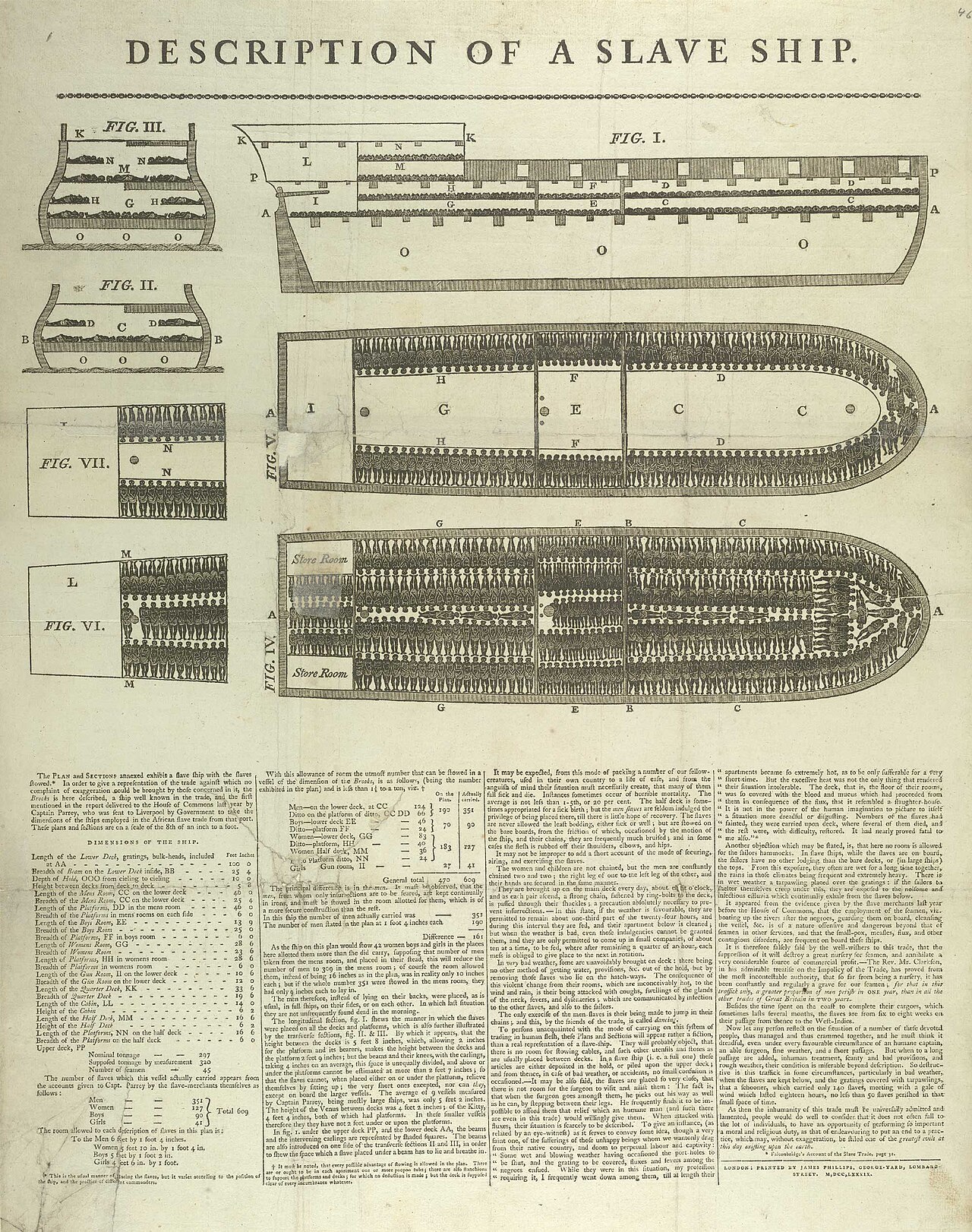

Over three hundred and sixty-six years, about 12.5 million people were forcibly embarked from Africa to the Americas.1
About 10.7 million were landed.
More than 1.8 million people did not arrive.2
This figure was not established separately: it is the gap between two counts, that of the people who went on board and that of the people who came off. A figure always counts something specific; here, the difference between two pieces of data is the historical fact itself.
The system these figures come from
These deportations were no accident of history: they fed an economic system built for this purpose, which lasted nearly four centuries.
A colonial empire is a set of territories conquered and administered by a distant state, for its own profit. Between the sixteenth and the nineteenth centuries, Portugal, Spain, England, France and the Netherlands thus divided up the Americas, then parts of Africa and Asia. A colony is not governed for its own sake: it supplies the metropole with what the metropole does not produce.
A plantation is the tool of this supply. It is a large agricultural estate devoted to a single crop intended for export — sugar first, then tobacco, rice, indigo, coffee. What it produces is not meant to feed those who work there, but to be sold far away.3
This model was not invented in America. It had first been set up on islands off the coast of Africa, where the Portuguese were already having sugar cane grown by enslaved Africans. The Americas did not give birth to the system: they gave it scale.4
This model requires a large workforce, available all year round and unable to leave. The colonists first exploited the indigenous populations, decimated by epidemics, then indentured European workers. It was in particular the inadequacy of these two solutions that led to the mass deportation of enslaved Africans — a hereditary status, defined by law as property.5
The resulting circuit is often called the triangular trade: goods from Europe to Africa, people from Africa to the Americas, colonial produce from the Americas to Europe. The phrase is convenient but simplifying: the real trade was more complex, and part of the slave trade took place within the Americas themselves.6
Sugar is at the heart of the system. A luxury commodity that became an everyday consumer product in Europe, it requires exhausting cultivation and immediate processing on the spot. It was the crop that required the most labour, and it was to the sugar colonies — Saint-Domingue, Jamaica, Barbados, Brazil — that the majority of the deportees were sent.7
Against this system, resistance never ceased: it took the forms examined below, from everyday slowdowns to marronage and armed revolt.
Why these numbers are known
How are these figures known so precisely, when estimates of the population of the Americas before 1492 still vary by several tens of millions?8
Because it was a trade.
A trade keeps accounts: logbooks, insurance papers, port registers, shipowners’ ledgers. They record what is bought, what is carried, what is sold, and what is lost along the way.
Researchers brought together decades of archival work in two major databases:
- 36,000 transatlantic crossings recorded;
- 10,000 journeys within the Americas — for the trade continued after landing.9
For each voyage, the team sought to establish the dates, the owners, the ship, the captain, the African ports of call, the American destination, the number of people embarked and the number landed.10
The team found most of this information for about 80% of the transatlantic slave trade. The rest was estimated by calculation.11
The key point: these data are known because those responsible kept precise accounts of them.
Breakdown by flag
Breakdown of the people embarked by the flag of the ships (estimates):
| Flag | People embarked |
|---|---|
| Portugal | about 5,850,000 |
| Great Britain | about 3,260,000 |
| France | about 1,380,000 |
| Spain | about 1,060,000 |
| Netherlands | about 550,000 |
| United States | about 305,000 |
| Denmark | about 111,000 |
Sources for the table12
The scientific approach and margins of error
The historians of this project write “about”, state their coverage — four voyages in five — and say how they reconstructed the rest. Their work builds on the first overall census, published by the historian Philip Curtin.13
Far from weakening the argument, this approach strengthens it. A team that specifies its margin of error distinguishes what it knows from what it infers. It is the approach of the scientists who date a fossil to 315,000 years “give or take 34,000 years”, as reported on our page on the origins of Homo sapiens.
More than ninety thousand names
A third database records the names of more than ninety thousand people, with the place of embarkation, sex and origin.14
But the reason why these particular names were preserved is significant. These people appear in the archives only because their ship was intercepted by patrols, after the trade had been legally banned, and they were then registered one by one.15
So it was not their story that caused their name to be preserved: it was the boarding of the ship. And these names represent only a tiny fraction of the twelve and a half million people embarked.
Forms of resistance
The history of the slave trade cannot be reduced to what was endured. It was opposed at every stage, individually and collectively.
- Shipboard insurrections: Mutinies broke out during the crossings; historians have recorded these uprisings and study their causes.
- Marronage and autonomous communities: Fleeing the plantation gave rise to lasting communities — quilombos in Brazil, palenques in the Hispanic world, marronage in the Caribbean. They developed their own cultures, their own agriculture and their own systems of defence.
- Plantation revolts: Strikes, sabotage and armed insurrections regularly disrupted the system, such as the Jamaican revolt of 1760 or the La Escalera conspiracy in Cuba.
- The Haitian Revolution (1791-1804): In Saint-Domingue, the insurrection launched by the captives defeated the colonial armies. It led to the abolition of slavery and to the independence of Haiti.
- Other slave-trade circuits: Alongside the transatlantic slave trade, the trans-Saharan and Indian Ocean slave trades also deported millions of captives over several centuries. Although less documented by centralised accounting archives, they too gave rise to resistance, from go-slows to flight and sabotage.16
Note 1
in 366 years, slaving vessels embarked about 12.5 million captives in Africa, and landed 10.7 million in the New World
Slave Voyages: The Trans-Atlantic and Intra-American Slave Trade Databases, Rice University et consortium d’universités
Note 2
a careful estimate that the Middle Passage took a toll of more than 1.8 million African lives
Slave Voyages: The Trans-Atlantic and Intra-American Slave Trade Databases, Rice University et consortium d’universités
Note 3
to produce sugar, rice, indigo, tobacco, and, by the eighteenth century, coffee in the Americas.
OpenStax, World History, vol. 2, chapitre “The Atlantic Slave Trade”
Note 4
The Portuguese, already using enslaved Africans to grow sugar on islands off the coast of Africa,
OpenStax, World History, vol. 2, chapitre “The Atlantic Slave Trade”
Note 5
Indigenous people died in large numbers from infectious diseases, leaving too few to labor in the fields.
OpenStax, World History, vol. 2, chapitre “The Atlantic Slave Trade”
Thus, Europeans eager to extract a profit looked to Africa as the solution, and to slavery instead of indentured servitude.
OpenStax, World History, vol. 2, chapitre “The Atlantic Slave Trade”
in all the European colonies in the Americas, the child of an enslaved woman was born enslaved.
OpenStax, World History, vol. 2, chapitre “The Atlantic Slave Trade”
Note 6
was a complex one, for purposes of simplification, it is often characterized as the triangular trade
OpenStax, World History, vol. 2, chapitre “The Atlantic Slave Trade”
The three databases below provide details of 36,000 trans-Atlantic slave voyages, 10,000 intra-American ventures, names and personal information.
Slave Voyages: The Trans-Atlantic and Intra-American Slave Trade Databases, Rice University et consortium d’universités
Note 7
Sugar, the most valuable crop grown by enslaved people, also required the most labor,
OpenStax, World History, vol. 2, chapitre “The Atlantic Slave Trade”
The majority of Africans brought across the Atlantic were destined to labor on sugar plantations in the Caribbean and Brazil.
OpenStax, World History, vol. 2, chapitre “The Atlantic Slave Trade”
Note 8
60.5 million (interquartile range, IQR 44.8–78.2 million)
Koch, Alexander, Brierley, Chris, Maslin, Mark M. and Lewis, Simon L., “Earth System Impacts of the European Arrival and Great Dying in the Americas after 1492”, Quaternary Science Reviews, vol. 207, 2019, p. 13-36
Note 9
The three databases below provide details of 36,000 trans-Atlantic slave voyages, 10,000 intra-American ventures, names and personal information.
Slave Voyages: The Trans-Atlantic and Intra-American Slave Trade Databases, Rice University et consortium d’universités
Note 10
For each voyage they sought to establish dates, owners, vessels, captains, African visits, American destinations, numbers of slaves embarked, and numbers landed.
Slave Voyages: The Trans-Atlantic and Intra-American Slave Trade Databases, Rice University et consortium d’universités
Note 11
They have been able to find much of this material for an estimated 80 percent of the entire transatlantic African slave trade. With corrections for missing voyages, the Project has estimated the entire size of the transatlantic slave trade
Slave Voyages: The Trans-Atlantic and Intra-American Slave Trade Databases, Rice University et consortium d’universités
Note 12
Portugal 5,848,266 | Great Britain 3,259,441 | France 1,381,404
Slave Voyages: The Trans-Atlantic and Intra-American Slave Trade Databases, Rice University et consortium d’universités
Spain 1,061,524 | Netherlands 554,336 | United States 305,326 | Denmark 111,040
Slave Voyages: The Trans-Atlantic and Intra-American Slave Trade Databases, Rice University et consortium d’universités
Note 13
Beginning with works such as Philip Curtin’s The Atlantic Slave Trade: A Census(1969), a widely disbursed group of scholars has spent almost half a century collecting and coding the records of the transatlantic slave voyages that brought tens of millions of Africans to the New World. David Eltis, Stephen Behrendt and David Richardson played leading roles in amalgamating this data, and then producing software that would make it accessible to students and researchers across the world.
Newman, Simon P., “Mapping the Transatlantic Slave Trade”, review of Eltis and Richardson’s Atlas of the Transatlantic Slave Trade, Commonplace: The Journal of Early American Life
Using the patterns that have emerged in the huge amount of surviving data, the project authors have inferred places and imputed numbers, filling in the gaps in the records. […] The authors believe that the 34,934 voyages covered in this volume constitute “just over 80 percent of all the slave ventures that ever set out for Africa to obtain slaves from all locations around the Atlantic” (xxv). […] Absolute precision is an impossible goal […]
Newman, Simon P., “Mapping the Transatlantic Slave Trade”, review of Eltis and Richardson’s Atlas of the Transatlantic Slave Trade, Commonplace: The Journal of Early American Life
Note 14
contains information on 92,230 individuals including African names for almost all of them
Domingues da Silva, Daniel, Eltis, David, Misevich, Philip and Ojo, Olatunji, “The Diaspora of Africans Liberated from Slave Ships in the Nineteenth Century”, The Journal of African History, vol. 55, no. 3, 2014, p. 347-369
These records are sortable by name, gender origin, and place of embarkation.
African Origins / African Names Database, dans Slave Voyages
Based on the assessment of extant data for more than 92,000 Liberated Africans whose information was copied in at times duplicate and triplicate form in both London- and Freetown-based registers, this essay explores the pitfalls and possibilities associated with using the Registers for Liberated Africans as sources for historical analysis of the slave trade.
Anderson, Richard et al., “Using African Names to Identify the Origins of Captives in the Transatlantic Slave Trade: Crowd-Sourcing and the Registers of Liberated Africans, 1808–1862”, History in Africa, vol. 40, 2013, p. 165-191
Note 15
Africans, bound for slavery in North and South America, but liberated after their ships were stopped
African Origins / African Names Database, dans Slave Voyages
Note 16
Historical insights—unlike moralizing rhetorical gestures, however valid and necessary—come from the close study of more modest quanta: fluctuations and cycles in traffic volumes, regional differences in captive gender ratios, or the frequency of African resistance aboard ship, for example. […] Richardson, for example, has explored the conditions under which slave rebellions were likely to occur on board ship.
Williford, James, “Gross Injustice: The Slave Trade by the Numbers”, Humanities, National Endowment for the Humanities, vol. 31, no. 5, September-October 2010
Usually called palenques in the Spanish colonies and mocambos or quilombos in Brazil, they ranged from tiny bands that survived less than a year to powerful states encompassing thousands of members and enduring for generations or even centuries. […] In Brazil, Colombia, Cuba, Ecuador, Hispaniola, Jamaica, Mexico, Panama, Peru, Suriname, and Venezuela, for example, the whites reluctantly offered treaties granting Maroon communities their freedom […]
Price, Richard, “Maroons in the Americas: Heroic Pasts, Ambiguous Presents, Uncertain Futures”, Cultural Survival Quarterly, vol. 25, no. 4, December 2001
In 1760, some fifteen hundred enslaved black men and women […] to stage a massive uprising in Jamaica […]
Brown, Vincent (ed.), Slave Revolt in Jamaica, 1760-1761: A Cartographic Narrative, Harvard University and Axis Maps, online cartographic narrative
At dawn on June 29, 1844, a firing squad in Havana executed ten accused ringleaders of the Conspiracy of La Escalera, an alleged plot to abolish slavery and colonial rule in Cuba. […] Scholars have debated the existence of the Conspiracy of La Escalera for over a century, yet little is known about how those targeted by the violence responded.
Reid-Vazquez, Michele, The Year of the Lash: Free People of Color in Cuba and the Nineteenth-Century Atlantic World, University of Georgia Press, 2011, publisher’s description
In 1791, freed and enslaved Africans and other islanders of African descent rebelled under the leadership of Toussaint Louverture and Jean-Jacques Dessalines, both of whom had been born enslaved on local plantations. […] By January 1804, through successful guerrilla tactics, Black revolutionaries had decimated the French army, already suffering an outbreak of yellow fever, to create the Haitian nation.
Kordas, Ann, Lynch, Ryan J., Nelson, Brooke and Tatlock, Julie, World History, Volume 2: from 1400, OpenStax, 2022, section 8.1 “Revolution for Whom?”
The British withdrew from Haiti in 1798, having been been defeated by the revolutionary army of formerly enslaved people led by Toussaint Louverture.
Royal Museums Greenwich, Pechon, J., Plan de la baye et du Mole St. Nicolas partie du Nord de St. Domingue, manuscript chart, 1794, National Maritime Museum, G245:8/4, collection record
The most authoritative estimates by leading scholars in the field suggest that around 5 million people were trafficked from Sub-Saharan Africa during the period from the 16th to the 19th century.
Rönnbäck, Klas, “The Slave Trades out of Africa”, in The History of African Development, online textbook, African Economic History Network
This book provides a series of pioneering studies, by experts in the field, on resistance to forms of bondage in Africa, Asia and the Indian Ocean world. It analyses the causes, duration and structure of resistance, from go-slows to flight, and theft to sabotage.
Routledge, description of Alpers, Edward A., Campbell, Gwyn and Salman, Michael (ed.), Slavery and Resistance in Africa and Asia: Bonds of Resistance, 2005
A series of revolutionary uprisings in Saint Domigue (Haiti) between 1791 and 1804 led to Haiti achieving independence on 1st January 1804, and becoming the first country to permanently ban slavery.
Royal Museums Greenwich, Pechon, J., Plan de la baye et du Mole St. Nicolas partie du Nord de St. Domingue, manuscript chart, 1794, National Maritime Museum, G245:8/4, collection record
Notes and sources
- ↑
Passage Over three hundred and sixty-six years, about 12.5 million people were forcibly embarked […] About 10.7 million were landed.
in 366 years, slaving vessels embarked about 12.5 million captives in Africa, and landed 10.7 million in the New World
Source Slave Voyages: The Trans-Atlantic and Intra-American Slave Trade Databases, Rice University et consortium d’universités, presentation of the estimates.
Open access open the source · checked on 9 September 2026
- ↑
Passage More than 1.8 million people did not arrive.
a careful estimate that the Middle Passage took a toll of more than 1.8 million African lives
Source Slave Voyages: The Trans-Atlantic and Intra-American Slave Trade Databases, Rice University et consortium d’universités, presentation of the estimates.
Open access open the source · checked on 9 September 2026
- ↑
Passage a single crop intended for export — sugar first, then tobacco, rice, indigo, coffee
to produce sugar, rice, indigo, tobacco, and, by the eighteenth century, coffee in the Americas.
Source OpenStax, World History, vol. 2, chapitre “The Atlantic Slave Trade”, section on export crops.
Open access open the source · checked on 24 October 2026
- ↑
Passage It had first been set up on islands off the coast of Africa, where the Portuguese were already having sugar cane grown by enslaved Africans. […] The Americas did not give birth to the system: they gave it scale.
The Portuguese, already using enslaved Africans to grow sugar on islands off the coast of Africa,
Source OpenStax, World History, vol. 2, chapitre “The Atlantic Slave Trade”, passage on the beginnings of the slave trade to Brazil.
Open access open the source · checked on 24 October 2026
- ↑
Passage The colonists first exploited the indigenous populations, decimated by epidemics
Indigenous people died in large numbers from infectious diseases, leaving too few to labor in the fields.
Source OpenStax, World History, vol. 2, chapitre “The Atlantic Slave Trade”, passage on indigenous labour.
Open access open the source · checked on 24 October 2026
Passage It was in particular the inadequacy of these two solutions that led to the mass deportation of enslaved Africans
Thus, Europeans eager to extract a profit looked to Africa as the solution, and to slavery instead of indentured servitude.
Source OpenStax, World History, vol. 2, chapitre “The Atlantic Slave Trade”, passage on indentured European workers.
Open access open the source · checked on 24 October 2026
Passage a hereditary status, defined by law as property
in all the European colonies in the Americas, the child of an enslaved woman was born enslaved.
Source OpenStax, World History, vol. 2, chapitre “The Atlantic Slave Trade”, passage on chattel slavery.
Open access open the source · checked on 24 October 2026
- ↑
Passage The phrase is convenient but simplifying: the real trade was more complex
was a complex one, for purposes of simplification, it is often characterized as the triangular trade
Source OpenStax, World History, vol. 2, chapitre “The Atlantic Slave Trade”, discussion of the expression “triangular trade”.
Open access open the source · checked on 24 October 2026
Passage part of the slave trade took place within the Americas themselves
The three databases below provide details of 36,000 trans-Atlantic slave voyages, 10,000 intra-American ventures, names and personal information.
Source Slave Voyages: The Trans-Atlantic and Intra-American Slave Trade Databases, Rice University et consortium d’universités, home page of the databases.
Open access open the source · checked on 24 October 2026
- ↑
Passage It was the crop that required the most labour
Sugar, the most valuable crop grown by enslaved people, also required the most labor,
Source OpenStax, World History, vol. 2, chapitre “The Atlantic Slave Trade”, passage on sugar.
Open access open the source · checked on 24 October 2026
Passage it was to the sugar colonies — Saint-Domingue, Jamaica, Barbados, Brazil — that the majority of the deportees were sent
The majority of Africans brought across the Atlantic were destined to labor on sugar plantations in the Caribbean and Brazil.
Source OpenStax, World History, vol. 2, chapitre “The Atlantic Slave Trade”, passage on the destinations of the captives.
Open access open the source · checked on 24 October 2026
- ↑
Passage estimates of the population of the Americas before 1492 still vary by several tens of millions
60.5 million (interquartile range, IQR 44.8–78.2 million)
Source Koch, Alexander, Brierley, Chris, Maslin, Mark M. and Lewis, Simon L., “Earth System Impacts of the European Arrival and Great Dying in the Americas after 1492”, Quaternary Science Reviews, vol. 207, 2019, p. 13-36, abstract.
Open access open the source · checked on 24 October 2026
- ↑
Passage 36,000 transatlantic crossings recorded […] 10,000 journeys within the Americas
The three databases below provide details of 36,000 trans-Atlantic slave voyages, 10,000 intra-American ventures, names and personal information.
Source Slave Voyages: The Trans-Atlantic and Intra-American Slave Trade Databases, Rice University et consortium d’universités, home page of the databases.
Open access open the source · checked on 9 September 2026
- ↑
Passage For each voyage, the team sought to establish the dates, the owners, the ship, the captain, the African ports of call, the American destination, the number of people embarked and the number landed.
For each voyage they sought to establish dates, owners, vessels, captains, African visits, American destinations, numbers of slaves embarked, and numbers landed.
Source Slave Voyages: The Trans-Atlantic and Intra-American Slave Trade Databases, Rice University et consortium d’universités, presentation of the project.
Open access open the source · checked on 9 September 2026
- ↑
Passage The team found most of this information for about 80% of the transatlantic slave trade. The rest was estimated by calculation.
They have been able to find much of this material for an estimated 80 percent of the entire transatlantic African slave trade. With corrections for missing voyages, the Project has estimated the entire size of the transatlantic slave trade
Source Slave Voyages: The Trans-Atlantic and Intra-American Slave Trade Databases, Rice University et consortium d’universités, presentation of the project.
Open access open the source · checked on 9 September 2026
- ↑
Passage Portugal […] about 5,850,000 […] Great Britain […] about 3,260,000 […] France […] about 1,380,000
Portugal 5,848,266 | Great Britain 3,259,441 | France 1,381,404
Source Slave Voyages: The Trans-Atlantic and Intra-American Slave Trade Databases, Rice University et consortium d’universités, table of the breakdown by flag.
Open access open the source · checked on 9 September 2026
Passage Spain […] about 1,060,000 […] Netherlands […] about 550,000 […] United States […] about 305,000 […] Denmark […] about 111,000
Spain 1,061,524 | Netherlands 554,336 | United States 305,326 | Denmark 111,040
Source Slave Voyages: The Trans-Atlantic and Intra-American Slave Trade Databases, Rice University et consortium d’universités, table of the breakdown by flag.
Open access open the source · checked on 9 September 2026
- ↑
Passage Their work builds on the first overall census, published by the historian Philip Curtin.
Beginning with works such as Philip Curtin’s The Atlantic Slave Trade: A Census(1969), a widely disbursed group of scholars has spent almost half a century collecting and coding the records of the transatlantic slave voyages that brought tens of millions of Africans to the New World. David Eltis, Stephen Behrendt and David Richardson played leading roles in amalgamating this data, and then producing software that would make it accessible to students and researchers across the world.
Source Newman, Simon P., “Mapping the Transatlantic Slave Trade”, review of Eltis and Richardson’s Atlas of the Transatlantic Slave Trade, Commonplace: The Journal of Early American Life, 2nd paragraph of the review.
Open access open the source · checked on 27 October 2026
Passage The historians of this project write “about”, state their coverage — four voyages in five — and say how they reconstructed the rest.
Using the patterns that have emerged in the huge amount of surviving data, the project authors have inferred places and imputed numbers, filling in the gaps in the records. […] The authors believe that the 34,934 voyages covered in this volume constitute “just over 80 percent of all the slave ventures that ever set out for Africa to obtain slaves from all locations around the Atlantic” (xxv). […] Absolute precision is an impossible goal […]
Source Newman, Simon P., “Mapping the Transatlantic Slave Trade”, review of Eltis and Richardson’s Atlas of the Transatlantic Slave Trade, Commonplace: The Journal of Early American Life, paragraphs beginning “The maps and the calculations”, “As new datasets appear” and “The maps in this volume are therefore” (quoting the Atlas, p. xxv).
Open access open the source · checked on 27 October 2026
- ↑
Passage More than ninety thousand names
contains information on 92,230 individuals including African names for almost all of them
Source Domingues da Silva, Daniel, Eltis, David, Misevich, Philip and Ojo, Olatunji, “The Diaspora of Africans Liberated from Slave Ships in the Nineteenth Century”, The Journal of African History, vol. 55, no. 3, 2014, p. 347-369, section “Size and Distribution”.
Paywalled open the source · checked on 24 October 2026
Passage with the place of embarkation, sex and origin
These records are sortable by name, gender origin, and place of embarkation.
Source African Origins / African Names Database, dans Slave Voyages, presentation of the names database.
Open access open the source · checked on 24 October 2026
Passage the building of this database and its limits
Based on the assessment of extant data for more than 92,000 Liberated Africans whose information was copied in at times duplicate and triplicate form in both London- and Freetown-based registers, this essay explores the pitfalls and possibilities associated with using the Registers for Liberated Africans as sources for historical analysis of the slave trade.
Source Anderson, Richard et al., “Using African Names to Identify the Origins of Captives in the Transatlantic Slave Trade: Crowd-Sourcing and the Registers of Liberated Africans, 1808–1862”, History in Africa, vol. 40, 2013, p. 165-191, abstract.
Paywalled open the source · checked on 25 October 2026
- ↑
Passage These people appear in the archives only because their ship was intercepted by patrols, after the trade had been legally banned
Africans, bound for slavery in North and South America, but liberated after their ships were stopped
Source African Origins / African Names Database, dans Slave Voyages, presentation of the names database.
Open access open the source · checked on 9 September 2026
- ↑
Passage Mutinies broke out during the crossings; historians have recorded these uprisings and study their causes.
Historical insights—unlike moralizing rhetorical gestures, however valid and necessary—come from the close study of more modest quanta: fluctuations and cycles in traffic volumes, regional differences in captive gender ratios, or the frequency of African resistance aboard ship, for example. […] Richardson, for example, has explored the conditions under which slave rebellions were likely to occur on board ship.
Source Williford, James, “Gross Injustice: The Slave Trade by the Numbers”, Humanities, National Endowment for the Humanities, vol. 31, no. 5, September-October 2010, body of the article, paragraph beginning “The slave trade was not” (3rd paragraph) and paragraph beginning “A quick survey of” (David Richardson’s research).
Open access open the source · checked on 27 October 2026
Passage Fleeing the plantation gave rise to lasting communities — quilombos in Brazil, palenques in the Hispanic world, marronage in the Caribbean.
Usually called palenques in the Spanish colonies and mocambos or quilombos in Brazil, they ranged from tiny bands that survived less than a year to powerful states encompassing thousands of members and enduring for generations or even centuries. […] In Brazil, Colombia, Cuba, Ecuador, Hispaniola, Jamaica, Mexico, Panama, Peru, Suriname, and Venezuela, for example, the whites reluctantly offered treaties granting Maroon communities their freedom […]
Source Price, Richard, “Maroons in the Americas: Heroic Pasts, Ambiguous Presents, Uncertain Futures”, Cultural Survival Quarterly, vol. 25, no. 4, December 2001, 3rd paragraph, 2nd sentence, and 5th paragraph (“In many cases…”, peace treaties).
Open access open the source · checked on 27 October 2026
Passage the Jamaican revolt
In 1760, some fifteen hundred enslaved black men and women […] to stage a massive uprising in Jamaica […]
Source Brown, Vincent (ed.), Slave Revolt in Jamaica, 1760-1761: A Cartographic Narrative, Harvard University and Axis Maps, online cartographic narrative, home page, “Project Description”, 1st sentence.
Open access open the source · checked on 27 October 2026
Passage the La Escalera conspiracy in Cuba
At dawn on June 29, 1844, a firing squad in Havana executed ten accused ringleaders of the Conspiracy of La Escalera, an alleged plot to abolish slavery and colonial rule in Cuba. […] Scholars have debated the existence of the Conspiracy of La Escalera for over a century, yet little is known about how those targeted by the violence responded.
Source Reid-Vazquez, Michele, The Year of the Lash: Free People of Color in Cuba and the Nineteenth-Century Atlantic World, University of Georgia Press, 2011, publisher’s description, publisher’s description, 2nd and 3rd paragraphs.
Open access open the source · checked on 27 October 2026
Passage In Saint-Domingue, the insurrection launched by the captives defeated the colonial armies.
In 1791, freed and enslaved Africans and other islanders of African descent rebelled under the leadership of Toussaint Louverture and Jean-Jacques Dessalines, both of whom had been born enslaved on local plantations. […] By January 1804, through successful guerrilla tactics, Black revolutionaries had decimated the French army, already suffering an outbreak of yellow fever, to create the Haitian nation.
Source Kordas, Ann, Lynch, Ryan J., Nelson, Brooke and Tatlock, Julie, World History, Volume 2: from 1400, OpenStax, 2022, section 8.1 “Revolution for Whom?”, section 8.1, subsection “The Napoleonic Era”, paragraphs on Saint-Domingue.
Open access open the source · checked on 27 October 2026
Passage the insurrection launched by the captives defeated the colonial armies
The British withdrew from Haiti in 1798, having been been defeated by the revolutionary army of formerly enslaved people led by Toussaint Louverture.
Source Royal Museums Greenwich, Pechon, J., Plan de la baye et du Mole St. Nicolas partie du Nord de St. Domingue, manuscript chart, 1794, National Maritime Museum, G245:8/4, collection record, object record G245:8/4, description, last paragraph.
Open access open the source · checked on 27 October 2026
Passage the trans-Saharan and Indian Ocean slave trades also deported millions of captives over several centuries
The most authoritative estimates by leading scholars in the field suggest that around 5 million people were trafficked from Sub-Saharan Africa during the period from the 16th to the 19th century.
Source Rönnbäck, Klas, “The Slave Trades out of Africa”, in The History of African Development, online textbook, African Economic History Network, p. 2, section 2 (“The Trans-Saharan, Red Sea and Indian Ocean slave trades”).
Open access open the source · checked on 27 October 2026
Passage they too gave rise to resistance, from go-slows to flight and sabotage
This book provides a series of pioneering studies, by experts in the field, on resistance to forms of bondage in Africa, Asia and the Indian Ocean world. It analyses the causes, duration and structure of resistance, from go-slows to flight, and theft to sabotage.
Source Routledge, description of Alpers, Edward A., Campbell, Gwyn and Salman, Michael (ed.), Slavery and Resistance in Africa and Asia: Bonds of Resistance, 2005, publisher’s description, 1st and 2nd sentences.
Open access open the source · checked on 27 October 2026
Passage It led to the abolition of slavery and to the independence of Haiti.
A series of revolutionary uprisings in Saint Domigue (Haiti) between 1791 and 1804 led to Haiti achieving independence on 1st January 1804, and becoming the first country to permanently ban slavery.
Source Royal Museums Greenwich, Pechon, J., Plan de la baye et du Mole St. Nicolas partie du Nord de St. Domingue, manuscript chart, 1794, National Maritime Museum, G245:8/4, collection record, object record G245:8/4, “Contents Note”, 3rd sentence.
Open access open the source · checked on 27 October 2026
Bibliography
23
- African Origins / African Names Database, dans Slave Voyages, open access (the names of people freed from intercepted ships, with place of embarkation, sex and origin). https://www.slavevoyages.org/past/database
- Anderson, Richard et al., “Using African Names to Identify the Origins of Captives in the Transatlantic Slave Trade: Crowd-Sourcing and the Registers of Liberated Africans, 1808–1862”, History in Africa, vol. 40, 2013, p. 165-191, paywalled (the building of this database and its limits). https://doi.org/10.1017/hia.2013.3
- Brown, Vincent (ed.), Slave Revolt in Jamaica, 1760-1761: A Cartographic Narrative, Harvard University and Axis Maps, online cartographic narrative, open access (the uprising of some fifteen hundred enslaved people in Jamaica, from April 1760 to October 1761). https://revolt.axismaps.com/
- Brown, Vincent, Tacky’s Revolt: The Story of an Atlantic Slave War, Harvard University Press, 2020, in libraries (the Jamaican revolt in the eighteenth century).
- Curtin, Philip D., The Atlantic Slave Trade: A Census, University of Wisconsin Press, 1969, in libraries (the first systematic count, the starting point of the project).
- Domingues da Silva, Daniel, Eltis, David, Misevich, Philip and Ojo, Olatunji, “The Diaspora of Africans Liberated from Slave Ships in the Nineteenth Century”, The Journal of African History, vol. 55, no. 3, 2014, p. 347-369, paywalled (the number of people recorded in the Liberated Africans database, almost all with their African name). https://doi.org/10.1017/S0021853714000371
- Dubois, Laurent, Avengers of the New World: The Story of the Haitian Revolution, Harvard University Press, 2004, in libraries (the Haitian Revolution). French translation: Les Vengeurs du Nouveau Monde, Les Perséides, 2005.
- Eltis, David and Richardson, David, Atlas of the Transatlantic Slave Trade, Yale University Press, 2010, in libraries (cartographic synthesis, orders of magnitude, margins of error).
- Koch, Alexander, Brierley, Chris, Maslin, Mark M. and Lewis, Simon L., “Earth System Impacts of the European Arrival and Great Dying in the Americas after 1492”, Quaternary Science Reviews, vol. 207, 2019, p. 13-36, open access (the population of the Americas before 1492 and the gap between published estimates). https://doi.org/10.1016/j.quascirev.2018.12.004
- Kordas, Ann, Lynch, Ryan J., Nelson, Brooke and Tatlock, Julie, World History, Volume 2: from 1400, OpenStax, 2022, section 8.1 “Revolution for Whom?”, open access (the 1791 uprising in Saint-Domingue and the defeat of the French army in 1804). https://openstax.org/books/world-history-volume-2/pages/8-1-revolution-for-whom
- Lovejoy, Paul E., Transformations in Slavery: A History of Slavery in Africa, Cambridge University Press, 2012, in libraries (the trans-Saharan and Indian Ocean slave trades).
- Newman, Simon P., “Mapping the Transatlantic Slave Trade”, review of Eltis and Richardson’s Atlas of the Transatlantic Slave Trade, Commonplace: The Journal of Early American Life, open access (Philip Curtin’s 1969 census as the starting point of the data-gathering continued by Eltis, Behrendt and Richardson). https://commonplace.online/article/mapping-transatlantic-slave-trade/
- OpenStax, World History, vol. 2, chapitre “The Atlantic Slave Trade”, open access (the successive export crops; the simplifying nature of the expression “triangular trade”). https://openstax.org/books/world-history-volume-2/pages/5-4-the-atlantic-slave-trade
- Paquette, Robert L., Sugar Is Made with Blood: The Conspiracy of La Escalera and the Conflict between Empires over Slavery in Cuba, Wesleyan University Press, 1988, in libraries (the La Escalera conspiracy).
- Price, Richard (ed.), Maroon Societies: Rebel Slave Communities in the Americas, Johns Hopkins University Press, 1996, in libraries (quilombos, palenques, marronage).
- Price, Richard, “Maroons in the Americas: Heroic Pasts, Ambiguous Presents, Uncertain Futures”, Cultural Survival Quarterly, vol. 25, no. 4, December 2001, open access (maroon communities, palenques and quilombos, some of which lasted for generations or even centuries, from Brazil to Jamaica). https://www.culturalsurvival.org/publications/cultural-survival-quarterly/maroons-americas-heroic-pasts-ambiguous-presents-uncertain
- Reid-Vazquez, Michele, The Year of the Lash: Free People of Color in Cuba and the Nineteenth-Century Atlantic World, University of Georgia Press, 2011, publisher’s description, open access. https://ugapress.org/book/9780820335759/the-year-of-the-lash
- Richardson, David, “Shipboard Revolts, African Authority, and the Atlantic Slave Trade”, William and Mary Quarterly, vol. 58, no. 1, 2001, p. 69-92, paywalled (shipboard insurrections).
- Rönnbäck, Klas, “The Slave Trades out of Africa”, in The History of African Development, online textbook, African Economic History Network, open access (some 5 million captives deported by the trans-Saharan, Red Sea and Indian Ocean trades from the sixteenth to the nineteenth century). https://www.aehnetwork.org/wp-content/uploads/2020/05/Ronnback_Slave_Trades_out_of_Africa.pdf
- Routledge, description of Alpers, Edward A., Campbell, Gwyn and Salman, Michael (ed.), Slavery and Resistance in Africa and Asia: Bonds of Resistance, 2005, open access (resistance to bondage in Africa, Asia and the Indian Ocean world, from go-slows to flight and sabotage). https://www.routledge.com/Slavery-and-Resistance-in-Africa-and-Asia-Bonds-of-Resistance/Alpers-Campbell-Salman/p/book/9780415875813
- Royal Museums Greenwich, Pechon, J., Plan de la baye et du Mole St. Nicolas partie du Nord de St. Domingue, manuscript chart, 1794, National Maritime Museum, G245:8/4, collection record, open access (Toussaint Louverture’s army of formerly enslaved people defeating the British, who withdrew in 1798; Haitian independence in 1804 and the permanent ban on slavery). https://www.rmg.co.uk/collections/objects/rmgc-object-540528
- Slave Voyages: The Trans-Atlantic and Intra-American Slave Trade Databases, Rice University et consortium d’universités, open access (36,000 transatlantic crossings and 10,000 intra-American journeys; the data sought for each voyage; the 80% coverage and the estimation of the rest; 12.5 million embarked, 10.7 million landed, more than 1.8 million dead; the breakdown by flag). https://www.slavevoyages.org
- Williford, James, “Gross Injustice: The Slave Trade by the Numbers”, Humanities, National Endowment for the Humanities, vol. 31, no. 5, September-October 2010, open access (the slave-voyages database and the research it makes possible, including the frequency of shipboard revolts and their conditions, studied by David Richardson). https://www.neh.gov/humanities/2010/septemberoctober/feature/gross-injustice
Spotted an error or have a doubt? Write to us.