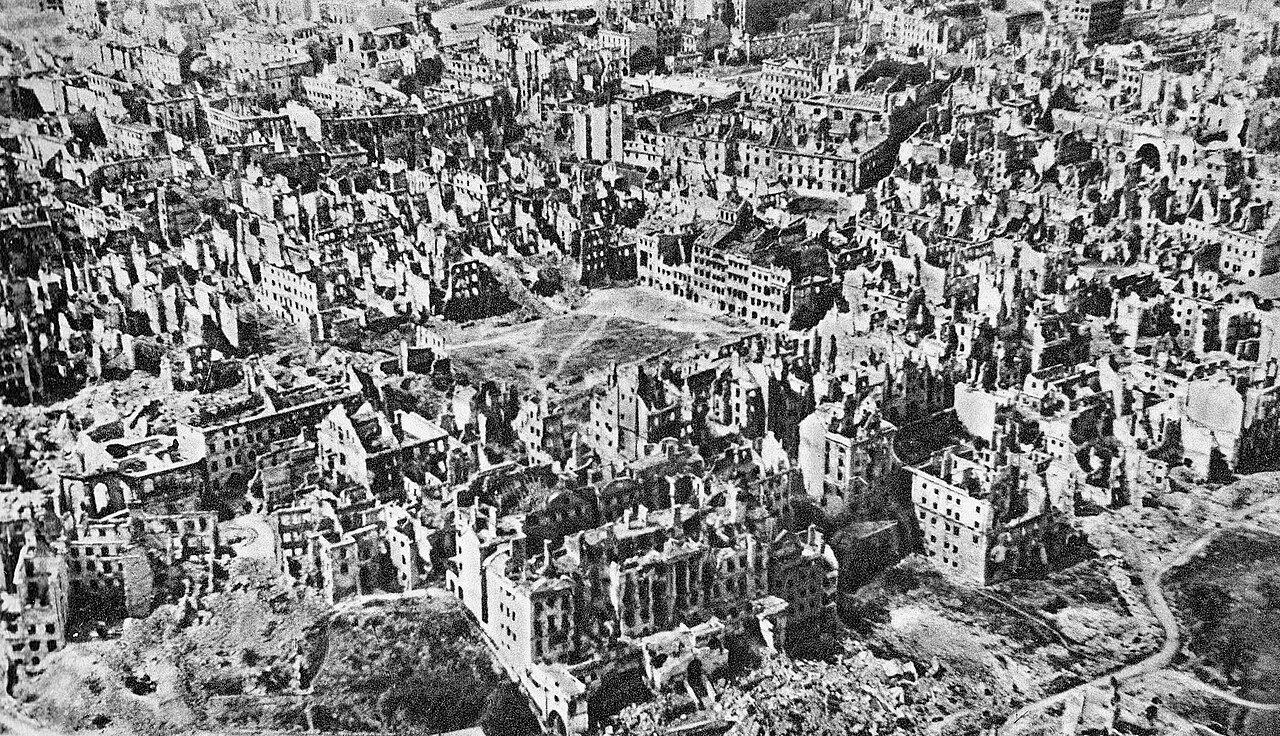

Common estimates put the death toll of the Second World War at between 55 and 70 million people.1
That is 2 to 3% of humanity at the time. This toll came after the 20 million or so dead of the First World War (1914-1918), the century’s first conflict on a global scale.2
The two wars in brief
The First World War (1914-1918) mainly pitted Germany and Austria-Hungary against France, the United Kingdom and Russia, which were joined by Italy and then by the United States. It was triggered by an assassination in Sarajevo, but that was only the spark: for decades, the great European powers had bound themselves by alliances that obliged each of them to go to war if its ally did.
It was expected to be short. It lasted four years and invented an unprecedented form of combat: trench warfare, in which two fortified lines faced each other for years over a few kilometres. It was the first industrial war — machine guns, heavy artillery, poison gas, aircraft — and the first in which the factories on the home front counted as much as the armies.
The Second World War (1939-1945) arose largely from the first. In Germany, defeated and heavily penalised by the treaty of 1919, a Nazi regime came to power in 1933 and built its project on revenge and on a racist ideology. The war began in Europe with the invasion of Poland in September 1939; it had already begun in Asia, where Japan had been invading China since 1937.
It pitted the Allies — the United Kingdom, the Soviet Union, the United States, China, Free France and the resistance movements of the occupied countries — against the Axis powers: Germany, Italy, Japan. It ended in May 1945 in Europe and in August-September 1945 in Asia, after the two atomic bombings of Hiroshima and Nagasaki.
What makes the second one different
It did not merely cause more deaths: it killed differently. In the Second, civilian victims were two to three times as numerous as military ones — through the bombing of cities, organised famines and massacres.3
It also encompasses an event that is not a consequence of the war but a programme carried out during it: the Holocaust, the deliberate extermination of the Jews of Europe by Nazi Germany, which cost the lives of about six million people. Hundreds of thousands of Roma, disabled people, political opponents and members of other designated groups were killed according to the same logic.4
It is this distinction — dying in a war, being killed by a programme — that the rest of this page examines. It explains why the two are not counted in the same way, and why adding them together without saying so obscures something essential.
Where?
One fact is often relegated to the background, when it should come first:
Nearly half of the deaths of the Second World War, if not more, occurred in China and the Soviet Union.
- Soviet Union: in the order of twenty-six to twenty-seven million dead, a figure established by a demographic audit commissioned under Gorbachev.
- China: fourteen to twenty million dead, as a result of the Japanese invasion begun as early as 1937 and of the famines that followed.
- Poland: the highest proportion of population lost among independent countries — in the order of one person in six.5
This conflict reversed what had been taken for granted about modern wars: far more civilians than soldiers died in it. This disproportion is explained in particular by the war in Asia, by the effort imposed on colonial populations — such as the Bengal famine, in 1943, which caused between one and a half and three million deaths — and by the exterminatory nature of the occupations.6
Why such a wide range?
55 to 70 million: where does this gap of 15 million come from?
- The nature of the records Military deaths are archived (enlistment registers, combat records, lists of the missing). Civilian losses can only be estimated, mainly in China, the USSR and the occupied territories.
- Destruction and displacement Archives were destroyed and borders altered. More than 60 million displaced people add to this. From one census to the next, the territory counted is therefore no longer the same: in Ukraine, for example, the steep population growth between 1939 and 1959 is merely apparent, as it stems mainly from changes to the borders.
- Political bias Some figures may have been understated during the war, or overstated after it, depending on the interests of states.7
The figure depends on who is counting, when, and for what purpose.
The essential distinction
This observation could lead to a mistaken conclusion, which should be set aside: the fact that a total is uncertain does not make what it is made of uncertain.
- The world total shows a wide range because it aggregates uneven data across several continents and nearly a decade.
- Certain parts of this total are established precisely thanks to decades of targeted studies.
The case of the genocide of the Jews of Europe
About 6 million people were murdered by Nazi Germany and its collaborators, that is, two thirds of the pre-war European Jewish population. The regime also murdered millions of other civilians it had singled out — Roma, disabled people, Soviet prisoners of war, Polish elites — without an equally solid total being available for them: the figure of “11 million” that is often cited has no precise documentary basis, and historians of the genocide advise against using it.8
We even know where it comes from. It breaks down into six million Jewish victims and five million others. These five million are based on no count at all. The historian Yehuda Bauer, who knew the man who put the figure into circulation in the 1970s, reports having told him so — and being told in reply that sometimes you had to do that to achieve what you considered essential.9
The intention was to make the Holocaust resonate with those it did not directly concern. The result, according to these historians today, is the opposite: an invented figure weakens what it was meant to serve, because it can be refuted.10
The essential point is this: a figure does not become true because it serves a just cause.
The figure of six million comes from comparing pre-war and post-war censuses and from contemporary documents. In parallel, the identification of victims name by name began in the 1950s and has continued ever since.11
In November 2025, the database of the Yad Vashem memorial contained about five million names — more than four victims in five. They come from three kinds of sources: forms filled in mainly by survivors, relatives or friends; archival documents, such as deportation lists; and local commemoration projects.12
The institution itself makes two noteworthy remarks. The first: there will never be a complete list, because the Nazis did not seek to document their crimes and even tried to erase them. The second: children’s names are the hardest to find, because they were often not recorded when they were killed with their families.13
📌 Principle:
A disputed order of magnitude is not a disputed fact. An imprecise total does not make its parts imprecise.
The figures are still moving
- The opening of the Soviet archives, from the late 1980s onwards, has led to revised estimates for the USSR.
- National institutes regularly publish revised data.
- Ongoing: the name-by-name identification of the victims of the genocide adds new names every year — about forty thousand in 2022 alone.14
A figure that changes is not a wrong figure: it is the sign of research that is still going on.
Note 1
World War II resulted in an estimated 55 million deaths worldwide.
United States Holocaust Memorial Museum, “World War II: In Depth”, Holocaust Encyclopedia
Mit insgesamt 60-70 Millionen Toten steht der Zweite Weltkrieg für die Tragödie des 20. Jahrhunderts.
With 60-70 million dead in all, the Second World War stands for the tragedy of the 20th century.
Bundeszentrale für politische Bildung, “Der Zweite Weltkrieg”
Note 2
some 8,500,000 soldiers died as a result of wounds and/or disease. […] the number of civilian deaths attributable to the war was higher than the military casualties, or around 13,000,000.
Encyclopaedia Britannica, “World War I”, section “Killed, wounded, and missing”
Note 3
Battle Deaths 15,000,000 […] Civilian Deaths 45,000,000 […] *Worldwide casualty estimates vary widely in several sources.
The National WWII Museum, New Orleans, “Research Starters: Worldwide Deaths in World War II”
Note 4
close to six million were murdered in a variety of ways
Yad Vashem, “Central Database of Shoah Victims’ Names” et foire aux questions
Note 5
On existing knowledge, the Soviet war dead were 26-27 million. […] Not until the time of Gorbachev was a full audit commissioned from the Soviet national statistical agency.
Harrison, Mark, “Counting the Soviet Union’s War Dead: Still 26-27 Million”, CAGE Working Paper no. 332, université de Warwick, May 2017
As Rana Mitter points out these eight years of fighting caused some 14 million deaths, vast flows of refugees, misery, famine […] China […] 20,000,000
Cortazzi, Hugh, review of Mitter, Rana, China’s War with Japan, 1937-1945: The Struggle for Survival, The Japan Society, London, online ; et The National WWII Museum, New Orleans, “Research Starters: Worldwide Deaths in World War II”, online
W czasie II wojny światowej Polska poniosła relatywnie największe straty i szkody demograficzne spośród wszystkich państw walczących i okupowanych. Do dzisiaj rozmiar tych strat oraz zakres represji nie jest dokładnie znany. W 2009 r. w 70. rocznicę wybuchu II wojny światowej IPN przedstawił publikację, zgodnie z którą w latach 1939-1945 zginęło od 5,6 do 5,8 mln polskich obywateli, w tym także Żydów, Ukraińców, Białorusinów, Litwinów, Czechów i Niemców, którzy byli obywatelami polskimi.
During the Second World War, Poland suffered proportionally the greatest demographic losses and damage of all the belligerent and occupied states. To this day the scale of these losses and the extent of the repression are not precisely known. In 2009, on the 70th anniversary of the outbreak of the Second World War, the IPN presented a publication according to which between 5.6 and 5.8 million Polish citizens died in 1939-1945, including Jews, Ukrainians, Belarusians, Lithuanians, Czechs and Germans who were Polish citizens.
Nowotnik, Norbert (PAP), “Są pieniądze na program "Straty osobowe i ofiary represji pod okupacją niemiecką"”, dzieje.pl, Muzeum Historii Polski, 9 June 2011
Note 6
Churchill's Secret War: The British Empire and the Ravaging of India during World War II
Mukerjee, Madhusree, Churchill’s Secret War, Basic Books, 2010 ; et Sen, Amartya, Poverty and Famines, Oxford University Press, 1981
Note 7
One of the war’s lesser-known aspects is that of displacement – over 60 million people were displaced in Europe alone, including many to Wales.
Senedd Cymru / Centre for the Movement of People (Aberystwyth University), “Unsettled Lives: War and Displacement in Wales”, exhibition, 7 November 2025 - 22 January 2026
In 20 years, from one census to the next, the population of Ukraine went from 30.9 million inhabitants in 1939 (RAN 1992 ) to 41.9 million in 1959 (TsSU 1962 ). However, this steep population growth is merely apparent, since it resulted essentially from major changes to the borders of the Republic of Ukraine.
Vallin, Jacques, Meslé, France, Adamets, Sergei and Pyrozhkov, Serhii, “The Consequences of the Second World War and the Stalinist Repression”, in Meslé, France and Vallin, Jacques, Mortality and Causes of Death in 20th-Century Ukraine, Demographic Research Monographs, Springer, 2012, chap. 3
Note 8
The Holocaust was the murder of approximately six million Jews by the Nazis and their collaborators.
Yad Vashem, “Central Database of Shoah Victims’ Names” et foire aux questions
It is, however, a number without any scholarly basis. […] Yehuda Bauer, an Israeli Holocaust scholar who chairs the International Holocaust Remembrance Alliance, said he warned his friend Wiesenthal, who died in 2005, about spreading the false notion that the Holocaust claimed 11 million victims – 6 million Jews and 5 million non-Jews. […] When I explain that this number is simply inaccurate, in fact made up, […]
Kampeas, Ron, “’Remember the 11 million’? Why an inflated victims tally irks Holocaust historians”, Jewish Telegraphic Agency, 31 January 2017
Note 9
the false notion that the Holocaust claimed 11 million victims – 6 million Jews and 5 million non-Jews
Jewish Telegraphic Agency, “Remember the 11 Million? Why an Inflated Victims Tally Irks Holocaust Historians”, 31 January 2017, entretien avec Yehuda Bauer
It is, however, a number without any scholarly basis.
Jewish Telegraphic Agency, “Remember the 11 Million? Why an Inflated Victims Tally Irks Holocaust Historians”, 31 January 2017, entretien avec Yehuda Bauer
"I said to him, 'Simon, you are telling a lie,'" Bauer recalled […] "He said, 'Sometimes you need to do that to get the results for things you think are essential.'"
Jewish Telegraphic Agency, “Remember the 11 Million? Why an Inflated Victims Tally Irks Holocaust Historians”, 31 January 2017, entretien avec Yehuda Bauer
Note 10
He wanted a number large enough to attract the attention of non-Jews who might not otherwise care about Jewish suffering
Jewish Telegraphic Agency, “Remember the 11 Million? Why an Inflated Victims Tally Irks Holocaust Historians”, 31 January 2017, entretien avec Yehuda Bauer
Note 11
The main sources for these statistics are comparisons of prewar censuses with postwar censuses and population estimates, as well as contemporary documentation […] The first 800,000 pages were collected in the 1950s, and the rest since.
Yad Vashem, “Central Database of Shoah Victims’ Names” et foire aux questions
In total, six million Jews died in the Holocaust. This number is calculated based on Nazi German documents and prewar and postwar demographic data.
United States Holocaust Memorial Museum, “How Many People did the Nazis Murder?”, Holocaust Encyclopedia
Note 12
Yad Vashem has successfully documented 5 million names of Holocaust victims in its central database, more than 80%.
Eichner, Itamar, “Yad Vashem succeeds in documenting names of 5 million Holocaust victims”, Ynetnews, 3 November 2025
Currently the Database is comprised of three types of sources: […] These are one-page forms, submitted to Yad Vashem primarily by survivors, remaining family members or friends, […] Historical documentation from archives […] lists detailing confiscation of assets, deportation lists or lists of victims; […] There are dozens of local initiatives to record the names of Jews from a specific region, country or camp.
Yad Vashem, “Central Database of Shoah Victims’ Names” et foire aux questions
Note 13
We will never have a complete record of all the names, because the Nazis were deliberately not interested in documenting their crimes and even tried to cover them up.
Yad Vashem, “The President of the State of Israel Isaac Herzog and his wife, Michal, looking for names of their family murdered during the Holocaust”, page du 28 March 2023
From the beginning of our collection efforts, we realized that locating the names of children would be particularly challenging, since in many cases they were not recorded when they were murdered with their families.
Yad Vashem, “The President of the State of Israel Isaac Herzog and his wife, Michal, looking for names of their family murdered during the Holocaust”, page du 28 March 2023
Note 14
Last year, Yad Vashem managed to collect and locate about 40,000 new names.
Yad Vashem, “The President of the State of Israel Isaac Herzog and his wife, Michal, looking for names of their family murdered during the Holocaust”, page du 28 March 2023
Soviet secretiveness meant that the necessary historical documents remained locked away until the end of the 1980s.
Harrison, Mark, “Counting the Soviet Union’s War Dead: Still 26-27 Million”, CAGE Working Paper no. 332, université de Warwick, May 2017
The largest archive on victims and survivors of Nazi persecution. […] Our online archive contains over 40 million documents.
Arolsen Archives, Bad Arolsen
Notes and sources
- ↑
Passage Common estimates put the death toll of the Second World War at between 55 and 70 million people.
World War II resulted in an estimated 55 million deaths worldwide.
Source United States Holocaust Memorial Museum, “World War II: In Depth”, Holocaust Encyclopedia, section “Deaths during World War II”.
Open access open the source · checked on 27 October 2026
Passage Common estimates put the death toll of the Second World War at between 55 and 70 million people.
Mit insgesamt 60-70 Millionen Toten steht der Zweite Weltkrieg für die Tragödie des 20. Jahrhunderts.
Editors’ translation With 60-70 million dead in all, the Second World War stands for the tragedy of the 20th century.
Source Bundeszentrale für politische Bildung, “Der Zweite Weltkrieg”, introduction to the dossier.
Open access open the source · checked on 27 October 2026
- ↑
Passage the 20 million or so dead of the First World War
some 8,500,000 soldiers died as a result of wounds and/or disease. […] the number of civilian deaths attributable to the war was higher than the military casualties, or around 13,000,000.
Source Encyclopaedia Britannica, “World War I”, section “Killed, wounded, and missing”, section “Killed, wounded, and missing” (total of about 21.5 million calculated by the editors).
Open access open the source · checked on 27 October 2026
- ↑
Passage In the Second, civilian victims were two to three times as numerous as military ones
Battle Deaths 15,000,000 […] Civilian Deaths 45,000,000 […] *Worldwide casualty estimates vary widely in several sources.
Source The National WWII Museum, New Orleans, “Research Starters: Worldwide Deaths in World War II”, “Worldwide Casualties*” table (“Battle Deaths” and “Civilian Deaths” rows) and note below the table.
Open access open the source · checked on 27 October 2026
- ↑
Passage the Holocaust […] cost the lives of about six million people
close to six million were murdered in a variety of ways
Source Yad Vashem, “Central Database of Shoah Victims’ Names” et foire aux questions, frequently asked questions.
Open access open the source · checked on 9 September 2026
- ↑
Passage Soviet Union: in the order of twenty-six to twenty-seven million dead, a figure established by a demographic audit commissioned under Gorbachev
On existing knowledge, the Soviet war dead were 26-27 million. […] Not until the time of Gorbachev was a full audit commissioned from the Soviet national statistical agency.
Source Harrison, Mark, “Counting the Soviet Union’s War Dead: Still 26-27 Million”, CAGE Working Paper no. 332, université de Warwick, May 2017, abstract and introduction.
Open access open the source · checked on 24 October 2026
Passage China: fourteen to twenty million dead, as a result of the Japanese invasion begun as early as 1937 and of the famines that followed
As Rana Mitter points out these eight years of fighting caused some 14 million deaths, vast flows of refugees, misery, famine […] China […] 20,000,000
Source Cortazzi, Hugh, review of Mitter, Rana, China’s War with Japan, 1937-1945: The Struggle for Survival, The Japan Society, London, online ; et The National WWII Museum, New Orleans, “Research Starters: Worldwide Deaths in World War II”, online, review, 1st paragraph (Japan Society) ; table “Deaths by Country”, China row: 3-4,000,000 military deaths, 20,000,000 total deaths (National WWII Museum).
Open access open the source 1 open the source 2 · checked on 27 October 2026
Passage Poland: the highest proportion of population lost among independent countries
W czasie II wojny światowej Polska poniosła relatywnie największe straty i szkody demograficzne spośród wszystkich państw walczących i okupowanych. Do dzisiaj rozmiar tych strat oraz zakres represji nie jest dokładnie znany. W 2009 r. w 70. rocznicę wybuchu II wojny światowej IPN przedstawił publikację, zgodnie z którą w latach 1939-1945 zginęło od 5,6 do 5,8 mln polskich obywateli, w tym także Żydów, Ukraińców, Białorusinów, Litwinów, Czechów i Niemców, którzy byli obywatelami polskimi.
Editors’ translation During the Second World War, Poland suffered proportionally the greatest demographic losses and damage of all the belligerent and occupied states. To this day the scale of these losses and the extent of the repression are not precisely known. In 2009, on the 70th anniversary of the outbreak of the Second World War, the IPN presented a publication according to which between 5.6 and 5.8 million Polish citizens died in 1939-1945, including Jews, Ukrainians, Belarusians, Lithuanians, Czechs and Germans who were Polish citizens.
Source Nowotnik, Norbert (PAP), “Są pieniądze na program "Straty osobowe i ofiary represji pod okupacją niemiecką"”, dzieje.pl, Muzeum Historii Polski, 9 June 2011, paragraph beginning “W czasie II wojny światowej Polska poniosła”, near the end of the dispatch.
Open access open the source · checked on 27 October 2026
- ↑
Passage the Bengal famine, in 1943, which caused between one and a half and three million deaths
Churchill's Secret War: The British Empire and the Ravaging of India during World War II
Source Mukerjee, Madhusree, Churchill’s Secret War, Basic Books, 2010 ; et Sen, Amartya, Poverty and Famines, Oxford University Press, 1981, assessment of the famine deaths.
In libraries · checked on 9 September 2026
- ↑
Passage More than 60 million displaced people
One of the war’s lesser-known aspects is that of displacement – over 60 million people were displaced in Europe alone, including many to Wales.
Source Senedd Cymru / Centre for the Movement of People (Aberystwyth University), “Unsettled Lives: War and Displacement in Wales”, exhibition, 7 November 2025 - 22 January 2026, exhibition description, 2nd paragraph.
Open access open the source · checked on 27 October 2026
Passage From one census to the next, the territory counted is therefore no longer the same: in Ukraine, for example, the steep population growth between 1939 and 1959 is merely apparent, as it stems mainly from changes to the borders.
In 20 years, from one census to the next, the population of Ukraine went from 30.9 million inhabitants in 1939 (RAN 1992 ) to 41.9 million in 1959 (TsSU 1962 ). However, this steep population growth is merely apparent, since it resulted essentially from major changes to the borders of the Republic of Ukraine.
Source Vallin, Jacques, Meslé, France, Adamets, Sergei and Pyrozhkov, Serhii, “The Consequences of the Second World War and the Stalinist Repression”, in Meslé, France and Vallin, Jacques, Mortality and Causes of Death in 20th-Century Ukraine, Demographic Research Monographs, Springer, 2012, chap. 3, chapter 3, p. 39, 1st paragraph (before § 3.1), 1st and 2nd sentences.
Open access open the source · checked on 27 October 2026
- ↑
Passage About 6 million people were murdered by Nazi Germany and its collaborators
The Holocaust was the murder of approximately six million Jews by the Nazis and their collaborators.
Source Yad Vashem, “Central Database of Shoah Victims’ Names” et foire aux questions, frequently asked questions, “Historical Questions”.
Open access open the source · checked on 9 September 2026
Passage the figure of “11 million” that is often cited has no precise documentary basis, and historians of the genocide advise against using it
It is, however, a number without any scholarly basis. […] Yehuda Bauer, an Israeli Holocaust scholar who chairs the International Holocaust Remembrance Alliance, said he warned his friend Wiesenthal, who died in 2005, about spreading the false notion that the Holocaust claimed 11 million victims – 6 million Jews and 5 million non-Jews. […] When I explain that this number is simply inaccurate, in fact made up, […]
Source Kampeas, Ron, “’Remember the 11 million’? Why an inflated victims tally irks Holocaust historians”, Jewish Telegraphic Agency, 31 January 2017, 4th, 12th and 17th paragraphs.
Open access open the source · checked on 27 October 2026
- ↑
Passage It breaks down into six million Jewish victims and five million others.
the false notion that the Holocaust claimed 11 million victims – 6 million Jews and 5 million non-Jews
Source Jewish Telegraphic Agency, “Remember the 11 Million? Why an Inflated Victims Tally Irks Holocaust Historians”, 31 January 2017, entretien avec Yehuda Bauer, interview of 31 January 2017.
Open access open the source · checked on 9 September 2026
Passage These five million are based on no count at all.
It is, however, a number without any scholarly basis.
Source Jewish Telegraphic Agency, “Remember the 11 Million? Why an Inflated Victims Tally Irks Holocaust Historians”, 31 January 2017, entretien avec Yehuda Bauer, interview of 31 January 2017.
Open access open the source · checked on 9 September 2026
Passage The historian Yehuda Bauer […] reports having told him so — and being told in reply that sometimes you had to do that to achieve what you considered essential.
"I said to him, 'Simon, you are telling a lie,'" Bauer recalled […] "He said, 'Sometimes you need to do that to get the results for things you think are essential.'"
Source Jewish Telegraphic Agency, “Remember the 11 Million? Why an Inflated Victims Tally Irks Holocaust Historians”, 31 January 2017, entretien avec Yehuda Bauer, interview of 31 January 2017.
Open access open the source · checked on 9 September 2026
- ↑
Passage The intention was to make the Holocaust resonate with those it did not directly concern.
He wanted a number large enough to attract the attention of non-Jews who might not otherwise care about Jewish suffering
Source Jewish Telegraphic Agency, “Remember the 11 Million? Why an Inflated Victims Tally Irks Holocaust Historians”, 31 January 2017, entretien avec Yehuda Bauer, interview of 31 January 2017.
Open access open the source · checked on 9 September 2026
- ↑
Passage The figure of six million comes from comparing pre-war and post-war censuses and from contemporary documents. In parallel, the identification of victims name by name began in the 1950s
The main sources for these statistics are comparisons of prewar censuses with postwar censuses and population estimates, as well as contemporary documentation […] The first 800,000 pages were collected in the 1950s, and the rest since.
Source Yad Vashem, “Central Database of Shoah Victims’ Names” et foire aux questions, frequently asked questions, “Historical Questions” and “Questions about the Database”.
Open access open the source · checked on 9 September 2026
Passage The figure of six million comes from comparing pre-war and post-war censuses and from contemporary documents
In total, six million Jews died in the Holocaust. This number is calculated based on Nazi German documents and prewar and postwar demographic data.
Source United States Holocaust Memorial Museum, “How Many People did the Nazis Murder?”, Holocaust Encyclopedia, section “How many Jewish people died in the Holocaust?”.
Open access open the source · checked on 27 October 2026
- ↑
Passage In November 2025, the database of the Yad Vashem memorial contained about five million names — more than four victims in five.
Yad Vashem has successfully documented 5 million names of Holocaust victims in its central database, more than 80%.
Source Eichner, Itamar, “Yad Vashem succeeds in documenting names of 5 million Holocaust victims”, Ynetnews, 3 November 2025, article.
Open access open the source · checked on 9 September 2026
Passage They come from three kinds of sources: forms filled in mainly by survivors, relatives or friends; archival documents, such as deportation lists; and local commemoration projects
Currently the Database is comprised of three types of sources: […] These are one-page forms, submitted to Yad Vashem primarily by survivors, remaining family members or friends, […] Historical documentation from archives […] lists detailing confiscation of assets, deportation lists or lists of victims; […] There are dozens of local initiatives to record the names of Jews from a specific region, country or camp.
Source Yad Vashem, “Central Database of Shoah Victims’ Names” et foire aux questions, frequently asked questions, “Questions about the Database”.
Open access open the source · checked on 9 September 2026
- ↑
Passage there will never be a complete list, because the Nazis did not seek to document their crimes and even tried to erase them
We will never have a complete record of all the names, because the Nazis were deliberately not interested in documenting their crimes and even tried to cover them up.
Source Yad Vashem, “The President of the State of Israel Isaac Herzog and his wife, Michal, looking for names of their family murdered during the Holocaust”, page du 28 March 2023, statement by Alexander Avram, director of the Hall of Names.
Open access open the source · checked on 9 September 2026
Passage children’s names are the hardest to find, because they were often not recorded when they were killed with their families
From the beginning of our collection efforts, we realized that locating the names of children would be particularly challenging, since in many cases they were not recorded when they were murdered with their families.
Source Yad Vashem, “The President of the State of Israel Isaac Herzog and his wife, Michal, looking for names of their family murdered during the Holocaust”, page du 28 March 2023, statement by Alexander Avram, director of the Hall of Names.
Open access open the source · checked on 9 September 2026
- ↑
Passage the name-by-name identification of the victims of the genocide adds new names every year — about forty thousand in 2022 alone
Last year, Yad Vashem managed to collect and locate about 40,000 new names.
Source Yad Vashem, “The President of the State of Israel Isaac Herzog and his wife, Michal, looking for names of their family murdered during the Holocaust”, page du 28 March 2023, page of 28 March 2023 (“last year”: 2022).
Open access open the source · checked on 24 October 2026
Passage The opening of the Soviet archives, from the late 1980s onwards, has led to revised estimates for the USSR.
Soviet secretiveness meant that the necessary historical documents remained locked away until the end of the 1980s.
Source Harrison, Mark, “Counting the Soviet Union’s War Dead: Still 26-27 Million”, CAGE Working Paper no. 332, université de Warwick, May 2017, p. 3.
Open access open the source · checked on 24 October 2026
Passage the name-based archives of Nazi persecution
The largest archive on victims and survivors of Nazi persecution. […] Our online archive contains over 40 million documents.
Source Arolsen Archives, Bad Arolsen, home page (English version), under the heading “Arolsen Archives” and in the list “Our projects and initiatives”.
Open access open the source · checked on 24 October 2026
Bibliography
24
- Arolsen Archives, Bad Arolsen, open access (the name-based archives of Nazi persecution). https://arolsen-archives.org/
- Bauer, Yehuda, Rethinking the Holocaust, Yale University Press, 2001, in libraries (why the figure of “11 million” has no documentary basis).
- Bundeszentrale für politische Bildung, “Der Zweite Weltkrieg”, online dossier, 10 November 2025, open access (60 to 70 million dead). https://www.bpb.de/themen/nationalsozialismus-zweiter-weltkrieg/der-zweite-weltkrieg/
- Cortazzi, Hugh, review of Mitter, Rana, China’s War with Japan, 1937-1945: The Struggle for Survival, The Japan Society, London, open access (some 14 million deaths in eight years of war). https://www.japansociety.org.uk/review?review=436
- Eichner, Itamar, “Yad Vashem succeeds in documenting names of 5 million Holocaust victims”, Ynetnews, 3 November 2025, open access (about five million names in the database, more than four victims in five). https://www.ynetnews.com/article/puxnbefk6
- Encyclopaedia Britannica, “World War I”, section “Killed, wounded, and missing”, open access (some 8.5 million soldiers and around 13 million civilians dead). https://www.britannica.com/event/World-War-I/Killed-wounded-and-missing
- Harrison, Mark, “Counting the Soviet Union’s War Dead: Still 26-27 Million”, CAGE Working Paper no. 332, université de Warwick, May 2017, open access (the twenty-six to twenty-seven million Soviet dead, established by demographers after a full audit commissioned under Gorbachev; the archives that remained closed until the late 1980s). https://warwick.ac.uk/fac/soc/economics/research/centres/cage/manage/publications/332-2017_harrison.pdf
- Hilberg, Raul, The Destruction of the European Jews, Yale University Press, 2003, in libraries (the six-million figure and how it was constructed). French translation: La Destruction des Juifs d’Europe, Gallimard, 2006.
- Jewish Telegraphic Agency, “Remember the 11 Million? Why an Inflated Victims Tally Irks Holocaust Historians”, 31 January 2017, open access (the interview in which Yehuda Bauer sets out the origin of the figure: five million non-Jewish victims with no scholarly basis, put forward in the 1970s to broaden the attention paid to the Holocaust). https://www.jta.org/2017/01/31/united-states/remember-the-11-million-why-an-inflated-victims-tally-irks-holocaust-historians
- Judt, Tony, Postwar: A History of Europe since 1945, Penguin, 2005, chap. 1, in libraries (the displaced persons of the post-war period and the difficulty of censuses). French translation: Après-guerre, Armand Colin, 2007.
- Kampeas, Ron, “’Remember the 11 million’? Why an inflated victims tally irks Holocaust historians”, Jewish Telegraphic Agency, 31 January 2017, open access. https://www.jta.org/2017/01/31/united-states/remember-the-11-million-why-an-inflated-victims-tally-irks-holocaust-historians
- Materski, Wojciech and Szarota, Tomasz (ed.), Polska 1939-1945. Straty osobowe i ofiary represji pod dwiema okupacjami, Instytut Pamięci Narodowej, Varsovie, 2009, in libraries (the revised Polish losses).
- Mitter, Rana, China’s War with Japan, 1937-1945: The Struggle for Survival, Allen Lane, 2013, in libraries (the estimates of fourteen to twenty million Chinese dead, from war and famines).
- Mukerjee, Madhusree, Churchill’s Secret War, Basic Books, 2010 ; et Sen, Amartya, Poverty and Famines, Oxford University Press, 1981, in libraries (the Bengal famine of 1943).
- Nowotnik, Norbert (PAP), “Są pieniądze na program "Straty osobowe i ofiary represji pod okupacją niemiecką"”, dzieje.pl, Muzeum Historii Polski, 9 June 2011, open access. https://dzieje.pl/node/7953
- Overy, Richard (ed.), The Oxford Illustrated History of World War II, Oxford University Press, 2015, in libraries (the respective shares of civilians and military personnel).
- Senedd Cymru / Centre for the Movement of People (Aberystwyth University), “Unsettled Lives: War and Displacement in Wales”, exhibition, 7 November 2025 - 22 January 2026, open access. https://senedd.wales/visit/exhibitions/past-exhibitions/unsettled-lives-war-and-displacement-in-wales/
- The National WWII Museum, New Orleans, “Research Starters: Worldwide Deaths in World War II”, open access (the table of deaths by country: 20 million for China). https://www.nationalww2museum.org/students-teachers/student-resources/research-starters/research-starters-worldwide-deaths-world-war
- United States Holocaust Memorial Museum, “How Many People did the Nazis Murder?”, Holocaust Encyclopedia, Washington, open access (the six million Jewish victims, calculated from German documents and pre-war and post-war demographic data). https://encyclopedia.ushmm.org/content/en/article/documenting-numbers-of-victims-of-the-holocaust-and-nazi-persecution
- United States Holocaust Memorial Museum, “World War II: In Depth”, Holocaust Encyclopedia, Washington, open access (an estimated 55 million deaths worldwide). https://encyclopedia.ushmm.org/content/en/article/world-war-ii-in-depth
- Vallin, Jacques, Meslé, France, Adamets, Sergei and Pyrozhkov, Serhii, “The Consequences of the Second World War and the Stalinist Repression”, in Meslé, France and Vallin, Jacques, Mortality and Causes of Death in 20th-Century Ukraine, Demographic Research Monographs, Springer, 2012, chap. 3, open access (text online on the website of the Max Planck Institute for Demographic Research; the apparent growth of Ukraine’s population between the 1939 and 1959 censuses, caused by border changes). https://www.demogr.mpg.de/books/drm/009/3.pdf
- Winter, Jay, The Great War and the British People, Macmillan, 1985 ; et Prost, Antoine, “Compter les vivants et les morts : l’évaluation des pertes françaises de 1914-1918”, Le Mouvement social, no. 222, 2008, p. 41-60, in libraries (the method of counting national losses).
- Yad Vashem, “Central Database of Shoah Victims’ Names” et foire aux questions, open access (the six-million figure and how it was established; the name-by-name identification since the 1950s; the three kinds of sources of the names). https://www.yadvashem.org/archive/hall-of-names/database.html
- Yad Vashem, “The President of the State of Israel Isaac Herzog and his wife, Michal, looking for names of their family murdered during the Holocaust”, page du 28 March 2023, open access (about forty thousand new names found in 2022; the impossibility of a complete list; the particular difficulty of children’s names). https://www.yadvashem.org/events/28-march-2023
Spotted an error or have a doubt? Write to us.