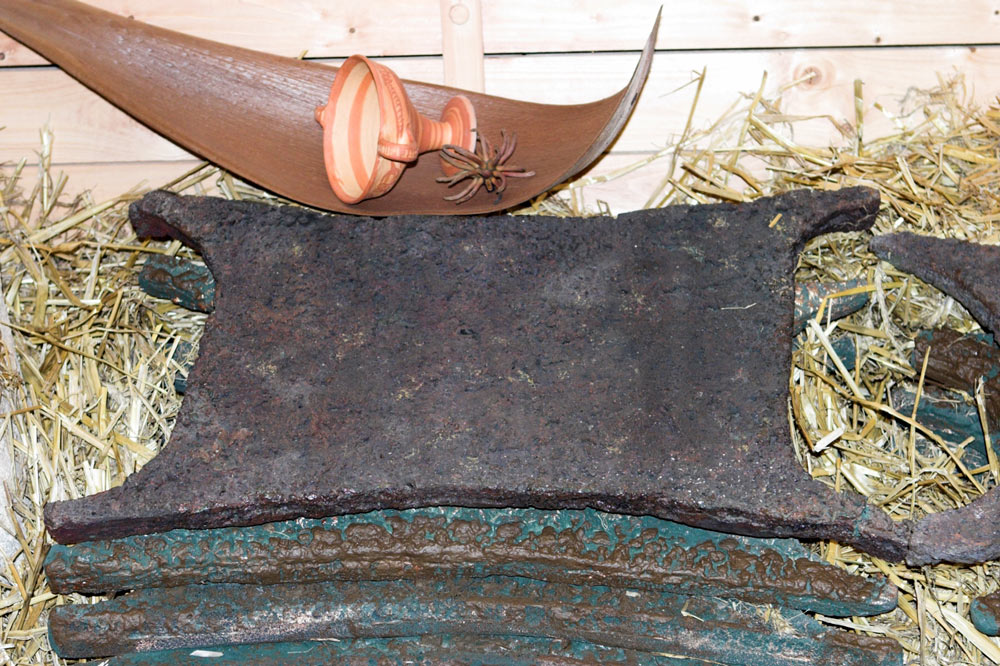

Was iron metallurgy invented in sub-Saharan Africa, or did it arrive there from the north? Nobody can yet say for certain.
That is precisely what makes the question so fascinating.
What is certain
Very ancient traces of iron smelting do indeed exist in West Africa and Central Africa.
- In the Termit Massif, in Niger, excavations have yielded very early dates for iron metallurgy — this is where the oldest dates in the whole case come from.
- In Nigeria, the site of Taruga has yielded iron and smelting furnaces.
- Elsewhere in West Africa and Central Africa, similar installations have been excavated.1
Iron production in sub-Saharan Africa goes back more than two thousand five hundred years, and these material facts are not in dispute.2
What is debated
Did African craftsmen develop this technique independently, or did they receive it through networks coming from the north?
The history of this debate is even more instructive than the answer itself — and it does not unfold the way one might expect.
The idea of an independent African invention is more than a century old. It can already be found in the work of a nineteenth-century German scholar, the author of a five-volume history of iron, who wrote that everywhere among the peoples of Africa he saw an art of producing iron that was not imported but original.3
Then the mainstream archaeology of the mid-twentieth century reversed this position: the technique must necessarily have come from the North.
Then came radiocarbon dating. It yielded sub-Saharan dates as early as, if not earlier than, those of the supposed “donor” regions, and the hypothesis of an independent beginning of iron metallurgy resurfaced.4
Where does research stand?
Researchers from several countries — African, European, American — now regard local invention as the most plausible scenario. The standard synthesis on the subject notes this from the outset: judging from recent publications, the long-running debate over the origins of iron smelting in sub-Saharan Africa has been resolved in favour of independent invention.5
This sentence nevertheless deserves a careful reading, for it contains a typographical trap. Here is exactly what the author writes: the debate “has been resolved… in favor of those advocating independent invention”.6
The three dots are no accident. They suspend the sentence in the middle, just before the conclusion — and the rest of the article, over fifty pages, methodically dismantles this supposed resolution.
The title, moreover, says the same thing: “Did They or Didn’t They Invent It?” A question, not an answer.
The wording of Hamady Bocoum, who directed the UNESCO synthesis on the subject, deserves close examination:7
In the present state of knowledge, the debate is closed for want of conclusive proof accrediting any of the proposed transmission channels from the north.8
A second reading is called for. It does not say that African invention has been proved. It says that the opposite has not been proved. That is not the same thing, and it is an essential methodological nuance.
Another researcher puts it just as cautiously: the hypothesis of independent invention is, to date, the most viable among all the hypotheses in contention — which is not a demonstration either.9
As for the earliest dates sometimes put forward, they remain hotly contested.10
Metal does not travel alone: the flows of raw materials
The question of origins often masks a concrete reality: a metallurgical technique never exists in isolation.
The adoption or development of metalworking always forms part of wider circuits of exchange. Even before iron, human societies had built long-distance exchange networks for other strategic resources:
- Salt: a mineral essential to life and to food preservation, exchanged for gold or foodstuffs across the Sahara and the river basins.
- Copper: worked before iron in some areas (as at Akjoujt in Mauritania from the first millennium BCE), circulating in the form of ingots or tools.
- Obsidian: a volcanic glass whose chemical signature makes it possible to trace trade routes over thousands of kilometres from the Neolithic onwards (in the Mediterranean and in East Africa).
- Amber: a fossil resin circulating from the Baltic to southern Europe, proving the existence of interconnected networks long before the historical trade routes.11
Whether invented locally or imported, iron immediately slots into these pre-existing circuits. Mastery of the metal in turn changes the value of the other goods exchanged: whoever produces iron controls the farming tool and the weapon, reshuffling the cards of regional trade.
Why this nuance is crucial
If this text refuses to settle the question arbitrarily, it is for reasons of scientific ethics.
The idea of iron systematically coming from elsewhere stemmed from a colonial prejudice: the supposed inability of local societies to develop a complex technique without outside input. Correcting this bias is essential.
But replacing one preconceived idea with the opposite dogma does not constitute proof.
To assert categorically that “iron was invented in Africa” would flatter our convictions, but would run ahead of what science demonstrates. If a discovery were one day to qualify this assertion, the whole historical narrative would be weakened.
Checking a fact one likes is not betraying a cause: it is protecting it.
A second safeguard: the precedent of bronze in Southeast Asia
This risk of ideological over-interpretation is not peculiar to Africa. It can also be found in the history of archaeology in Southeast Asia.
In the 1970s, excavations at the site of Ban Chiang, in Thailand, yielded bronze objects associated with very early dates. Some researchers immediately concluded that Southeast Asia had invented bronze metallurgy before Mesopotamia and China, overturning the traditional view.12
It took systematic re-dating, decades later, to expose a methodological error: the first dates came from pieces of pottery, a material that is difficult to date reliably. The best-supported chronology now places this metallurgy much later — another team defends an intermediate date, but no one now upholds the original date.13
The lesson of this regional detour: correcting historical contempt towards a region must never lead to premature acceptance of exceptional dates. Methodical doubt protects local history from devastating swings of the pendulum.
The plurality of centres of invention
An underlying question runs through this encyclopaedia: is a major technique invented only once in human history?
Comparison with other fields sheds useful light:
| Innovation | Number of independent inventions identified | Examples |
|---|---|---|
| Struck coinage | 3 times | Lydia (stamping), China (casting), Northern India (punch) |
| Agriculture | At least 11 times | Fertile Crescent, Mesoamerica, China, New Guinea... |
| Writing | 3 to 4 times | Mesopotamia, Egypt, China, Mesoamerica |
A clarification, in the spirit of this page. The figure of eleven for agriculture comes from a reference map published in 2014, the result of a meeting of twenty-five researchers from five different disciplines. It identifies eleven widely accepted centres of independent domestication — and the authors write “at least 11”, specifying that others have been suggested. But the evidence is not equally solid everywhere: in some regions, domestication is inferred only from plants or animals found far from their region of origin. Those centres remain less well established than the others.14
These parallels prove nothing for iron, but they invalidate the idea that a complex technique could emerge at only a single point on the globe. And the argument holds even if a few centres remain uncertain: it is the plurality that counts, not the exact tally.
The social and environmental impact of metal
Beyond the question of origins, metallurgy entails major social and ecological costs:
- Pressure on forests: smelting ore requires extremely high temperatures, which consume massive quantities of charcoal.
- Human cost: extraction and work in the mines have often relied on coerced labour for arduous and dangerous tasks.
Every metal object stands as much for a retreating forest and forced labour as for a technical advance.
Note 1
For Gérard Quéchon, the French archeologist to whom we owe very early dates for iron metallurgy from the Termit Massif in Niger, “indisputably, in the present state of knowledge, the hypothesis of an autochthonous invention is convincing.”
Alpern, Stanley B., “Did They or Didn’t They Invent It? Iron in Sub-Saharan Africa”, History in Africa, vol. 32, 2005, p. 41-94
Quéchon reviews the research carried out at both Termit and Egaro and rightly notes the high recurrence of dates, which dispels any doubt as to the cultural contexts associated with the earliest iron objects in those regions. Copper and iron objects first appeared in 1500 B.C. in this region, where technical installations (forges) have been dated to 800 B.C.
Bocoum, Hamady (ed.), The Origins of Iron Metallurgy in Africa: New Light on Its Antiquity. West and Central Africa, UNESCO Publishing, Paris, 2004
This happened in 1960 with the excavations at Taruga and the finding of iron, Nok terracottas and domestic debris in good association, dated to the late first millennium B.C. (Fagg, 1969). […] These early dates undoubtedly make the Taruga iron-smelting furnaces the earliest ones known in West Africa […]
Jemkur, Joseph Fazing, “The Beginnings of Iron Metallurgy in West Africa”, in Bocoum, Hamady (ed.), The Origins of Iron Metallurgy in Africa: New Light on Its Antiquity. West and Central Africa, UNESCO Publishing, Paris, 2004
Note 2
Iron production has played a part in the history of Africa for more than 2,500 years.
Robion-Brunner, Caroline, “What Is the Meaning of the Extreme Variability of Ancient Ironworking in West Africa? A Comparison between Four Case Studies”, dans Duckworth, C. N., Cuénod, A. et Mattingly, D. J. (dir.), Mobile Technologies in the Ancient Sahara and Beyond, Cambridge University Press, 2020, p. 290-314
Note 3
The idea that sub-Saharan Africans independently invented iron is more than a century old. It goes back at least to a German scholar, Ludwig Beck, who published a five-volume history of iron between 1884 and 1903.
Alpern, Stanley B., “Did They or Didn’t They Invent It? Iron in Sub-Saharan Africa”, History in Africa, vol. 32, 2005, p. 41-94
we see everywhere an original art of producing iron among the numerous native tribes of Africa, which is in its entire essence not imported but original
Alpern, Stanley B., “Did They or Didn’t They Invent It? Iron in Sub-Saharan Africa”, History in Africa, vol. 32, 2005, p. 41-94
Note 4
It is now becoming increasingly apparent that the diffusionist theory, as summarized above, tends to be simplistic and mostly lacks hard evidence to support it. In the light of recent archaeological work on the subject in Africa south of the Sahara, there is an emerging school of thought that argues for possible independent beginnings of ironworking technology for West Africa (and indeed in other centres of Africa south of the Sahara). […] The few dates available for ironworking in some parts of Africa south of the Sahara are as early as, if not earlier than, those obtained for the 'donor' areas. For example, apart from the Nok culture area where ironworking is known to have been established at least by the fourth or fifth century B.C., other early dates, of about the fifth century B.C., have come from Ethiopia at Matara, while radiocarbon dates point to the existence of ironworking in the Bahaya area of Lake Victoria by 500 B.C. (Schmidt and Avery, 1978).
Jemkur, Joseph Fazing, “The Beginnings of Iron Metallurgy in West Africa”, in Bocoum, Hamady (ed.), The Origins of Iron Metallurgy in Africa: New Light on Its Antiquity. West and Central Africa, UNESCO Publishing, Paris, 2004, p. 38
Note 5
the long-running debate over the origins of iron smelting in sub-Saharan Africa has been resolved… in favor of those advocating independent invention
Alpern, Stanley B., “Did They or Didn’t They Invent It? Iron in Sub-Saharan Africa”, History in Africa, vol. 32, 2005, p. 41-94
Note 6
Judging from a number of recent publications, the long-running debate over the origins of iron smelting in sub-Saharan Africa has been resolved… in favor of those advocating independent invention.
Alpern, Stanley B., “Did They or Didn’t They Invent It? Iron in Sub-Saharan Africa”, History in Africa, vol. 32, 2005, p. 41-94
Note 7
Edited by Hamady Bocoum
Bocoum, Hamady (ed.), The Origins of Iron Metallurgy in Africa: New Light on Its Antiquity. West and Central Africa, UNESCO Publishing, Paris, 2004
Note 8
in the present state of knowledge, the debate [over diffusion vs. independent invention] is closed for want of conclusive proof accrediting any of the proposed transmission channels [from the north]
Alpern, Stanley B., “Did They or Didn’t They Invent It? Iron in Sub-Saharan Africa”, History in Africa, vol. 32, 2005, p. 41-94
Note 9
the hypothesis for independent invention is currently the most viable among the multitude of diffusionist hypotheses
Alpern, Stanley B., “Did They or Didn’t They Invent It? Iron in Sub-Saharan Africa”, History in Africa, vol. 32, 2005, p. 41-94
Note 10
Challenging data, that may be accurate or not, are usually ignored or dismissed without serious consideration. […] Iron production activities are documented to have taken place as early as 3000–2500 BC.
Zangato, Étienne and Holl, Augustin F. C., “On the Iron Front: New Evidence from North-Central Africa”, Journal of African Archaeology, vol. 8, no. 1, 2010, p. 7-23
Note 11
It is already known from Lambert's work in the south-west Sahara that copper was being mined and worked around Akjoujt in Mauritania by the middle of the first millennium B.C., or even earlier (Lambert, 1971, pp. 9–12). Evidence is now coming up from other parts of West Africa, especially Niger, pointing to the appearance of copper before iron.
Jemkur, Joseph Fazing, “The Beginnings of Iron Metallurgy in West Africa”, in Bocoum, Hamady (ed.), The Origins of Iron Metallurgy in Africa: New Light on Its Antiquity. West and Central Africa, UNESCO Publishing, Paris, 2004
Note 12
From the 1974 sequence of 18 Carbon-14 determinations the oldest material from these basal phases dates back to 3600 B.C. […] In 1975, in direct association with a low-lying flexed burial, we recovered a well-made, cast and hammered bronze spearhead.
Gorman, Chester F. and Charoenwongsa, Pisit, “Ban Chiang: A Mosaic of Impressions from the First Two Years”, Expedition, vol. 18, no. 4, 1976, p. 14-26
Note 13
Two conflicting theories put the introduction of bronze into Southeast Asia 1000 years apart, one (before China) at 2000 BC, the other at 1000 BC. Both were drawn from radiocarbon dates, the first of pottery, the second of bone. The authors cut the Gordian Knot by showing the earlier dates to be unreliable
Higham, Charles, Higham, Thomas and Kijngam, Amphan, “Cutting a Gordian Knot: The Bronze Age of Southeast Asia: Origins, Timing and Impact”, Antiquity, vol. 85, 2011, p. 583-598
It will be proposed on both chronological and technological grounds that the first bronze metallurgy in Southeast Asia was derived from pre-Andronovo late third millennium BC Eurasian forest-steppe metals technology, and not from the second millennium, technologically distinctive, élite-sponsored bronze metallurgy of the Chinese Erlitou or Erligang Periods.
White, Joyce C. and Hamilton, Elizabeth G., “The Transmission of Early Bronze Technology to Thailand: New Perspectives”, Journal of World Prehistory, vol. 22, 2009, p. 357-397
Note 14
At least 11 regions of the Old and New World were involved as independent centers of origin, encompassing geographically isolated regions on most continents, but several more have been suggested (Fig. 1) […] Brown regions represent areas where, at present, the evidence for domestication is interpreted based upon the presence of domestic forms indigenous to these regions found outside of their native distributions.
Larson, Greger et al., “Current Perspectives and the Future of Domestication Studies”, Proceedings of the National Academy of Sciences, vol. 111, 2014, p. 6139-6146
At least 11 regions of the Old and New World were involved as independent centers of origin […] but several more have been suggested
Larson, Greger et al., “Current Perspectives and the Future of Domestication Studies”, Proceedings of the National Academy of Sciences, vol. 111, 2014, p. 6139-6146
In the spring of 2011, 25 scholars with a central interest in domestication representing the fields of genetics, archaeobotany, zooarchaeology, geoarchaeology, and archaeology met
Larson, Greger et al., “Current Perspectives and the Future of Domestication Studies”, Proceedings of the National Academy of Sciences, vol. 111, 2014, p. 6139-6146
Notes and sources
- ↑
Passage In the Termit Massif, in Niger, excavations have yielded very early dates for iron metallurgy
For Gérard Quéchon, the French archeologist to whom we owe very early dates for iron metallurgy from the Termit Massif in Niger, “indisputably, in the present state of knowledge, the hypothesis of an autochthonous invention is convincing.”
Source Alpern, Stanley B., “Did They or Didn’t They Invent It? Iron in Sub-Saharan Africa”, History in Africa, vol. 32, 2005, p. 41-94, opening of the article (excerpt visible on Cambridge Core).
Paywalled open the source · checked on 9 September 2026
Passage In the Termit Massif, in Niger, excavations have yielded very early dates for iron metallurgy
Quéchon reviews the research carried out at both Termit and Egaro and rightly notes the high recurrence of dates, which dispels any doubt as to the cultural contexts associated with the earliest iron objects in those regions. Copper and iron objects first appeared in 1500 B.C. in this region, where technical installations (forges) have been dated to 800 B.C.
Source Bocoum, Hamady (ed.), The Origins of Iron Metallurgy in Africa: New Light on Its Antiquity. West and Central Africa, UNESCO Publishing, Paris, 2004, introduction by H. Bocoum, p. 25 (presenting G. Quéchon’s chapter, “Iron Metallurgy Datings from Termit (Niger): Their Reliability and Significance”, pp. 109-118, and A. Person and G. Quéchon’s chapter, pp. 119-126).
Open access open the source · checked on 27 October 2026
Passage In Nigeria, the site of Taruga has yielded iron and smelting furnaces.
This happened in 1960 with the excavations at Taruga and the finding of iron, Nok terracottas and domestic debris in good association, dated to the late first millennium B.C. (Fagg, 1969). […] These early dates undoubtedly make the Taruga iron-smelting furnaces the earliest ones known in West Africa […]
Source Jemkur, Joseph Fazing, “The Beginnings of Iron Metallurgy in West Africa”, in Bocoum, Hamady (ed.), The Origins of Iron Metallurgy in Africa: New Light on Its Antiquity. West and Central Africa, UNESCO Publishing, Paris, 2004, p. 33 (chapter by J. F. Jemkur).
Open access open the source · checked on 27 October 2026
- ↑
Passage Iron production in sub-Saharan Africa goes back more than two thousand five hundred years
Iron production has played a part in the history of Africa for more than 2,500 years.
Source Robion-Brunner, Caroline, “What Is the Meaning of the Extreme Variability of Ancient Ironworking in West Africa? A Comparison between Four Case Studies”, dans Duckworth, C. N., Cuénod, A. et Mattingly, D. J. (dir.), Mobile Technologies in the Ancient Sahara and Beyond, Cambridge University Press, 2020, p. 290-314, chapter abstract.
Paywalled open the source · checked on 9 September 2026
- ↑
Passage The idea of an independent African invention is more than a century old. It can already be found in the work of a nineteenth-century German scholar, the author of a five-volume history of iron
The idea that sub-Saharan Africans independently invented iron is more than a century old. It goes back at least to a German scholar, Ludwig Beck, who published a five-volume history of iron between 1884 and 1903.
Source Alpern, Stanley B., “Did They or Didn’t They Invent It? Iron in Sub-Saharan Africa”, History in Africa, vol. 32, 2005, p. 41-94, § II.
Paywalled open the source · checked on 9 September 2026
Passage who wrote that everywhere among the peoples of Africa he saw an art of producing iron that was not imported but original
we see everywhere an original art of producing iron among the numerous native tribes of Africa, which is in its entire essence not imported but original
Source Alpern, Stanley B., “Did They or Didn’t They Invent It? Iron in Sub-Saharan Africa”, History in Africa, vol. 32, 2005, p. 41-94, § II, quotation from Beck.
Paywalled open the source · checked on 9 September 2026
- ↑
Passage Then came radiocarbon dating. It yielded sub-Saharan dates as early as, if not earlier than, those of the supposed “donor” regions, and the hypothesis of an independent beginning of iron metallurgy resurfaced.
It is now becoming increasingly apparent that the diffusionist theory, as summarized above, tends to be simplistic and mostly lacks hard evidence to support it. In the light of recent archaeological work on the subject in Africa south of the Sahara, there is an emerging school of thought that argues for possible independent beginnings of ironworking technology for West Africa (and indeed in other centres of Africa south of the Sahara). […] The few dates available for ironworking in some parts of Africa south of the Sahara are as early as, if not earlier than, those obtained for the 'donor' areas. For example, apart from the Nok culture area where ironworking is known to have been established at least by the fourth or fifth century B.C., other early dates, of about the fifth century B.C., have come from Ethiopia at Matara, while radiocarbon dates point to the existence of ironworking in the Bahaya area of Lake Victoria by 500 B.C. (Schmidt and Avery, 1978).
Source Jemkur, Joseph Fazing, “The Beginnings of Iron Metallurgy in West Africa”, in Bocoum, Hamady (ed.), The Origins of Iron Metallurgy in Africa: New Light on Its Antiquity. West and Central Africa, UNESCO Publishing, Paris, 2004, p. 38, J. F. Jemkur’s chapter, section “The local connection”, p. 38, 1st paragraph (opening sentences, then last sentence and start of the next paragraph).
Open access open the source · checked on 27 October 2026
- ↑
Passage the long-running debate over the origins of iron smelting in sub-Saharan Africa has been resolved in favour of independent invention
the long-running debate over the origins of iron smelting in sub-Saharan Africa has been resolved… in favor of those advocating independent invention
Source Alpern, Stanley B., “Did They or Didn’t They Invent It? Iron in Sub-Saharan Africa”, History in Africa, vol. 32, 2005, p. 41-94, opening of the article.
Paywalled open the source · checked on 9 September 2026
- ↑
Passage the debate “has been resolved… in favor of those advocating independent invention” […] They suspend the sentence in the middle
Judging from a number of recent publications, the long-running debate over the origins of iron smelting in sub-Saharan Africa has been resolved… in favor of those advocating independent invention.
Source Alpern, Stanley B., “Did They or Didn’t They Invent It? Iron in Sub-Saharan Africa”, History in Africa, vol. 32, 2005, p. 41-94, p. 41, first sentence.
Paywalled open the source · checked on 9 September 2026
- ↑
Passage Hamady Bocoum, who directed the UNESCO synthesis on the subject
Edited by Hamady Bocoum
Source Bocoum, Hamady (ed.), The Origins of Iron Metallurgy in Africa: New Light on Its Antiquity. West and Central Africa, UNESCO Publishing, Paris, 2004, title page of the English edition (p. 3 of the UNESDOC document).
Open access open the source · checked on 27 October 2026
- ↑
Passage In the present state of knowledge, the debate is closed for want of conclusive proof accrediting any of the proposed transmission channels from the north.
in the present state of knowledge, the debate [over diffusion vs. independent invention] is closed for want of conclusive proof accrediting any of the proposed transmission channels [from the north]
Source Alpern, Stanley B., “Did They or Didn’t They Invent It? Iron in Sub-Saharan Africa”, History in Africa, vol. 32, 2005, p. 41-94, quotation from Hamady Bocoum.
Paywalled open the source · checked on 9 September 2026
- ↑
Passage the hypothesis of independent invention is, to date, the most viable among all the hypotheses in contention
the hypothesis for independent invention is currently the most viable among the multitude of diffusionist hypotheses
Source Alpern, Stanley B., “Did They or Didn’t They Invent It? Iron in Sub-Saharan Africa”, History in Africa, vol. 32, 2005, p. 41-94, quotation from Peter R. Schmidt.
Paywalled open the source · checked on 9 September 2026
- ↑
Passage the earliest dates sometimes put forward […] remain hotly contested
Challenging data, that may be accurate or not, are usually ignored or dismissed without serious consideration. […] Iron production activities are documented to have taken place as early as 3000–2500 BC.
Source Zangato, Étienne and Holl, Augustin F. C., “On the Iron Front: New Evidence from North-Central Africa”, Journal of African Archaeology, vol. 8, no. 1, 2010, p. 7-23, abstract.
Paywalled · checked on 25 October 2026
- ↑
Passage Copper: worked before iron in some areas
It is already known from Lambert's work in the south-west Sahara that copper was being mined and worked around Akjoujt in Mauritania by the middle of the first millennium B.C., or even earlier (Lambert, 1971, pp. 9–12). Evidence is now coming up from other parts of West Africa, especially Niger, pointing to the appearance of copper before iron.
Source Jemkur, Joseph Fazing, “The Beginnings of Iron Metallurgy in West Africa”, in Bocoum, Hamady (ed.), The Origins of Iron Metallurgy in Africa: New Light on Its Antiquity. West and Central Africa, UNESCO Publishing, Paris, 2004, p. 37 (J. F. Jemkur’s chapter).
Open access open the source · checked on 27 October 2026
- ↑
Passage excavations at the site of Ban Chiang, in Thailand, yielded bronze objects associated with very early dates
From the 1974 sequence of 18 Carbon-14 determinations the oldest material from these basal phases dates back to 3600 B.C. […] In 1975, in direct association with a low-lying flexed burial, we recovered a well-made, cast and hammered bronze spearhead.
Source Gorman, Chester F. and Charoenwongsa, Pisit, “Ban Chiang: A Mosaic of Impressions from the First Two Years”, Expedition, vol. 18, no. 4, 1976, p. 14-26, paragraph beginning “The lowest levels of Ban Chiang, Phases I and II”.
Open access open the source · checked on 24 October 2026
- ↑
Passage the first dates came from pieces of pottery, a material that is difficult to date reliably. […] The best-supported chronology now places this metallurgy much later
Two conflicting theories put the introduction of bronze into Southeast Asia 1000 years apart, one (before China) at 2000 BC, the other at 1000 BC. Both were drawn from radiocarbon dates, the first of pottery, the second of bone. The authors cut the Gordian Knot by showing the earlier dates to be unreliable
Source Higham, Charles, Higham, Thomas and Kijngam, Amphan, “Cutting a Gordian Knot: The Bronze Age of Southeast Asia: Origins, Timing and Impact”, Antiquity, vol. 85, 2011, p. 583-598, abstract.
Paywalled · checked on 25 October 2026
Passage another team defends an intermediate date
It will be proposed on both chronological and technological grounds that the first bronze metallurgy in Southeast Asia was derived from pre-Andronovo late third millennium BC Eurasian forest-steppe metals technology, and not from the second millennium, technologically distinctive, élite-sponsored bronze metallurgy of the Chinese Erlitou or Erligang Periods.
Source White, Joyce C. and Hamilton, Elizabeth G., “The Transmission of Early Bronze Technology to Thailand: New Perspectives”, Journal of World Prehistory, vol. 22, 2009, p. 357-397, abstract.
Paywalled · checked on 9 September 2026
- ↑
Passage The figure of eleven for agriculture comes from a reference map […] But the evidence is not equally solid everywhere: in some regions, domestication is inferred only from plants or animals found far from their region of origin.
At least 11 regions of the Old and New World were involved as independent centers of origin, encompassing geographically isolated regions on most continents, but several more have been suggested (Fig. 1) […] Brown regions represent areas where, at present, the evidence for domestication is interpreted based upon the presence of domestic forms indigenous to these regions found outside of their native distributions.
Source Larson, Greger et al., “Current Perspectives and the Future of Domestication Studies”, Proceedings of the National Academy of Sciences, vol. 111, 2014, p. 6139-6146, section “Spatial and Temporal Patterns of Domestication” and caption of Figure 1.
Open access open the source · checked on 24 October 2026
Passage the authors write “at least 11”, specifying that others have been suggested
At least 11 regions of the Old and New World were involved as independent centers of origin […] but several more have been suggested
Source Larson, Greger et al., “Current Perspectives and the Future of Domestication Studies”, Proceedings of the National Academy of Sciences, vol. 111, 2014, p. 6139-6146, pp. 6139-6146.
Open access open the source · checked on 9 September 2026
Passage the result of a meeting of twenty-five researchers from five different disciplines
In the spring of 2011, 25 scholars with a central interest in domestication representing the fields of genetics, archaeobotany, zooarchaeology, geoarchaeology, and archaeology met
Source Larson, Greger et al., “Current Perspectives and the Future of Domestication Studies”, Proceedings of the National Academy of Sciences, vol. 111, 2014, p. 6139-6146, pp. 6139-6146.
Open access open the source · checked on 9 September 2026
Bibliography
13
- Alpern, Stanley B., “Did They or Didn’t They Invent It? Iron in Sub-Saharan Africa”, History in Africa, vol. 32, 2005, p. 41-94, paywalled (the synthesis of the debate; the observation that the question seems settled, immediately followed by doubt; the positions of Bocoum, Schmidt and others; the age of the hypothesis of an African invention). https://doi.org/10.1353/hia.2005.0003
- Bocoum, Hamady (ed.), Aux origines de la métallurgie du fer en Afrique. Une ancienneté méconnue : Afrique de l’Ouest et Afrique centrale, Éditions UNESCO, Paris, 2002, in libraries (the African synthesis of the case).
- Bocoum, Hamady (ed.), The Origins of Iron Metallurgy in Africa: New Light on Its Antiquity. West and Central Africa, UNESCO Publishing, Paris, 2004, open access (the research and dates of Gérard Quéchon and Alain Person in the Termit Massif, pp. 109-126). https://unesdoc.unesco.org/ark:/48223/pf0000133909
- Gorman, Chester F. and Charoenwongsa, Pisit, “Ban Chiang: A Mosaic of Impressions from the First Two Years”, Expedition, vol. 18, no. 4, 1976, p. 14-26, open access (the original early dates).
- Higham, Charles, Higham, Thomas and Kijngam, Amphan, “Cutting a Gordian Knot: The Bronze Age of Southeast Asia: Origins, Timing and Impact”, Antiquity, vol. 85, 2011, p. 583-598, paywalled (the revised chronology and the original methodological error).
- Jemkur, Joseph Fazing, “The Beginnings of Iron Metallurgy in West Africa”, in Bocoum, Hamady (ed.), The Origins of Iron Metallurgy in Africa: New Light on Its Antiquity. West and Central Africa, UNESCO Publishing, Paris, 2004, open access (copper mined and worked at Akjoujt, in Mauritania, by the middle of the first millennium BC, after Nicole Lambert’s work, and appearing before iron elsewhere in West Africa, especially Niger; the iron and smelting furnaces of Taruga, in Nigeria). https://unesdoc.unesco.org/ark:/48223/pf0000133909
- Killick, David, “What Do We Know about African Iron Working?”, Journal of African Archaeology, vol. 2, no. 1, 2004, p. 97-112, paywalled (the critical examination of the oldest dates).
- Lambert, Nicole, “Les industries sur cuivre dans l’Ouest saharien”, West African Journal of Archaeology, vol. 1, 1971, p. 9-21, in libraries (copper working before iron working).
- Larson, Greger et al., “Current Perspectives and the Future of Domestication Studies”, Proceedings of the National Academy of Sciences, vol. 111, 2014, p. 6139-6146, open access (the eleven centres of domestication and the uneven solidity of their dating). https://doi.org/10.1073/pnas.1323964111
- Robion-Brunner, Caroline, “What Is the Meaning of the Extreme Variability of Ancient Ironworking in West Africa? A Comparison between Four Case Studies”, dans Duckworth, C. N., Cuénod, A. et Mattingly, D. J. (dir.), Mobile Technologies in the Ancient Sahara and Beyond, Cambridge University Press, 2020, p. 290-314, paywalled (iron production in Africa for more than 2,500 years). https://doi.org/10.1017/9781108908047.010
- Tylecote, Ronald F., “Iron Smelting at Taruga, Nigeria”, Journal of the Historical Metallurgy Society, vol. 9, 1975, p. 49-56, in libraries (the Taruga furnaces).
- White, Joyce C. and Hamilton, Elizabeth G., “The Transmission of Early Bronze Technology to Thailand: New Perspectives”, Journal of World Prehistory, vol. 22, 2009, p. 357-397, paywalled (the opposing position on the Ban Chiang chronology).
- Zangato, Étienne and Holl, Augustin F. C., “On the Iron Front: New Evidence from North-Central Africa”, Journal of African Archaeology, vol. 8, no. 1, 2010, p. 7-23, paywalled (the earliest, contested dates).
Spotted an error or have a doubt? Write to us.