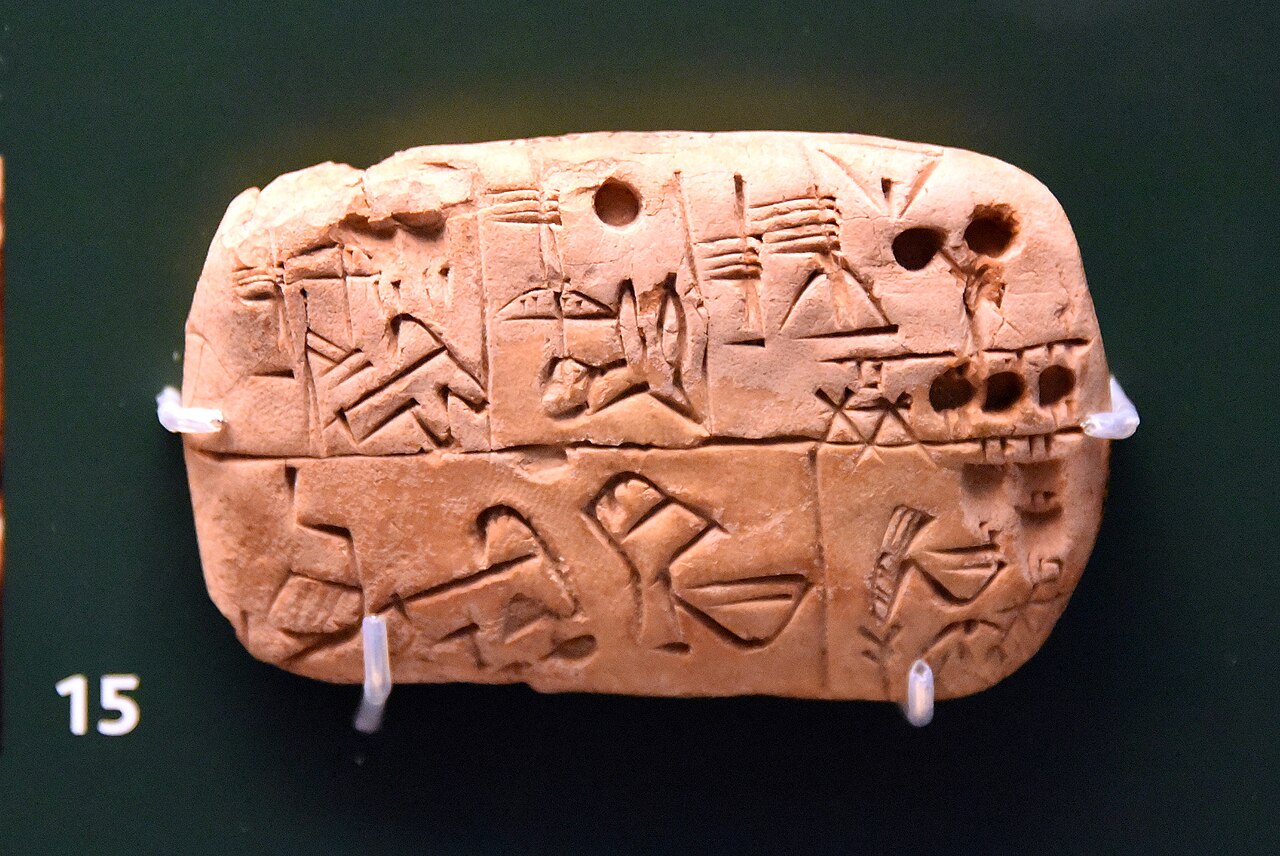

The oldest written text we know of is neither a poem, nor a prayer, nor a law.1
It is an account. Someone recorded quantities of barley and head of cattle on a clay tablet, with the name of the person who owed or received them.
Writing began as counting
In Mesopotamia, around 3200 BCE, cuneiform was invented. It is the only writing system in the world whose entire history, back to its material origins, we believe we can trace — a reconstruction that is widely accepted, even though its details are debated.
Before signs, there were clay tokens. Small shapes that were enclosed in sealed clay envelopes to represent goods: so many tokens, so many sheep. Marks representing the contents were then impressed on the outside, along with the seals of those with an interest in the transaction — so that it could be checked without breaking the envelope.2
Then these shapes were drawn directly, and the drawings became stylised into signs.
So writing does not descend from storytelling. It descends from accounting.3
One reservation is called for, however. This line of descent is widely accepted, but it is debated. At a site in Upper Mesopotamia, more than a thousand small clay objects of this kind have been unearthed: their detailed study concludes that they were indeed used for counting in certain specific places, but that this single role cannot be attributed to them everywhere.4
This story is told in detail in our page on number systems.
From tokens to the first cities
Why did this need to count arise at that particular moment? Because humans were then inventing the city.
Older sites such as Çatalhöyük, in Anatolia, already brought together thousands of people, but without centralised institutions or administration. With Uruk or Susa, around 3500-3200 BCE, a threshold was crossed: the concentration of inhabitants transformed the social structure and gave rise to the first city-state.
For the first time, the majority of people did not produce their own food: craftsmen, builders and administrators had to be fed. An administrative city cannot function on human memory alone. Harvests have to be centralised, rations redistributed, and a record kept of who has paid their share and who still owes labour.
Writing did not create the city: it was the city, grown too large for human memory, that made writing indispensable.
Three times, or four
How many times was writing invented from scratch, without anyone copying anyone?
Three cases may have been independent inventions: Mesopotamia, China and Mesoamerica. Three regions of the world far apart from one another, where societies seem to have had the same idea independently — although, for China, the hypothesis that the idea came from the west is sometimes put forward.5
The fourth case, Egypt, is debated. This debate is illuminating.
Egyptian writing appeared at roughly the same time as Mesopotamian cuneiform — the oldest labels from Abydos date to about 3300 BCE — but it works very differently. Some researchers see it as a 100% independent invention. Others think the Egyptians learned, through trade routes, that it was possible to fix speech and accounts on a medium — and that they then devised their own system.6
This second possibility has a name: stimulus diffusion.7
One can borrow the idea of a technique without copying its form. Knowing that something is feasible is enough to set about achieving it in one’s own way.
Other pages on this site already show this mechanism at work among Indian weavers or in the choice of the Japanese school model. Here, it goes a step further: one does not even receive the object, only the news that it exists.
What we will never read
Not all ancient writing systems can be deciphered.
Linear A from Crete, Proto-Elamite from Iran, Meroitic from Sudan (whose signs we have known how to pronounce since the early twentieth century, without understanding the language), rongorongo from Easter Island, and the Indus script (used in present-day Pakistan and north-western India) keep their secrets.8
In the case of the Indus script, the problem is revealing: on a single surface, the longest known inscription has only seventeen signs, and the average is under five. (One sometimes reads twenty-six signs — by adding up the faces of a single object — or thirty-four, based on a copper plate published in 2019 whose authenticity is disputed. Whatever figure is adopted, it is the brevity that stands in the way.)9
This leads some researchers to ask a troubling question: is it really a writing system capable of transcribing sentences? Or mere merchants’ marks, family emblems or religious symbols?10
There is, however, a way of trying to settle the matter without reading a single sign.
The method is to measure how far each sign makes it possible to predict the next. In a language, the sequence of signs is neither completely predictable nor completely random: there are rules, but also an element of choice. In 2009, a team argued that the sequence of Indus signs behaves, from this point of view, like a language.11
The response was immediate: this test, other researchers objected, does not separate true writing systems from symbol systems that are not writing.12
The debate has lasted twenty years, between people who all work from the same four thousand inscriptions and the same four hundred signs. What separates them is not what they see, but what they accept as proof.13
As with the number of languages in the world or the threshold at which a village becomes a town: the number of writing systems recorded depends strictly on how one defines the word “writing”.14
And what was destroyed
There is another reason why texts are missing: systematic destruction.
In Mesoamerica, a whole series of distinct writing systems dating from before the arrival of the Europeans has been identified. Several are known only from a single inscription on stone.15
The vast majority of books — the codices — were destroyed during the Spanish conquest. In the sixteenth century, in Yucatán, Maya codices were burned on the orders of a Spanish cleric, who himself described the scene in writing. Only three original Maya codices have survived, four if one includes a long-contested manuscript.16
We do not know how many libraries disappeared in this way.
What we call a state
The word keeps coming up on this page, and it refers to something precise. A state is an organisation that exercises lasting power over a territory and over those who live there, beyond ties of kinship. It is this last point that makes the difference: in a village, one obeys relatives; in a state, one obeys people one does not know and will never meet.
Four features recur wherever states are seen to emerge, from the Nile to the Indus Valley.
- A levy. The state takes a share of what is produced — grain, livestock, labour. This is what feeds it, and it is the reason it must count.
- A hierarchy of specialists. Those who levy, those who record, those who command, those who officiate. None of them farms: they live off the levy.
- A force. A capacity for coercion — guards, soldiers — without which the levy would cease to be accepted.
- A written record, or an equivalent. A memory must be kept of what has been taken, what is owed, what has been promised — and one man’s memory is not enough when the levy concerns thousands of households.
The word “equivalent” matters. The Inca state administered millions of people without writing, by means of knotted cords, the quipus, which recorded quantities and accounts. This is not writing in the strict sense, since they do not transcribe any language — but it fulfils the same function: preserving information beyond what an individual memory can retain.
Each of these four features calls for the others. A regular levy requires knowing who has paid; knowing requires writing; writing requires people whose job it is; supporting them requires levying more. The state, writing and the city did not appear one after another: they appeared together, because none of the three can stand without the other two.
This is exactly what the object at the start of this page shows. The oldest known text is not a poem: it is an account — the trace of a levy.
What the state writes
When a state forms, its first reaction is to lay down written rules: tax registers, standards of measurement, debt cancellations.
In China, the emperor Qin Shi Huang unified the country in the third century BCE. His most far-reaching founding act was not a battle: it was to have unified the measures, the axle width of carts and the signs of writing throughout the empire.17
The axle width deserves a moment’s attention. Fixing this measurement means ensuring that all carts run in the same ruts — and therefore that the empire’s roads are usable everywhere. It is the same idea as the box of agreed dimensions discussed on our page on transport, twenty-two centuries earlier.
In Mesopotamia, debts recorded on clay ended up stifling the peasants. On his accession, a king would regularly proclaim an “amnesty” (andurāru): debts were cancelled and those who had sold themselves into service to repay their debts were freed.18
An important clarification: these edicts did not abolish slavery. They freed those who had been sold or pledged for debt, but a slave born in the household was excluded from this release. The details are on our page devoted to ancient social structures.19
Note 1
The development from tokens to script reveals that writing emerged from counting and accounting. Writing was used exclusively for accounting until the third millennium BC, when the Sumerian concern for the afterlife paved the way to literature by using writing for funerary inscriptions.
Schmandt-Besserat, Denise, “The Evolution of Writing”, in Wright, James (ed.), International Encyclopedia of Social and Behavioral Sciences, Elsevier, 2014
Note 2
The direct antecedent of the Mesopotamian script was a recording device consisting of clay tokens of multiple shapes (Schmandt-Besserat 1996).
Schmandt-Besserat, Denise, “The Evolution of Writing”, in Wright, James (ed.), International Encyclopedia of Social and Behavioral Sciences, Elsevier, 2014
sealed clay envelopes were used to contain the tokens, inscribed on the outside with marks representing the contents, and seals identifying those with a direct interest
Yeo, Geoffrey, Record-Making and Record-Keeping in Early Societies, Routledge, 2021, chapitres 2 et 3
Note 3
The earliest written records in Mesopotamia were made for much the same purposes as their unwritten predecessors; they served to account for the administration of commodities and economic resources.
Yeo, Geoffrey, Record-Making and Record-Keeping in Early Societies, Routledge, 2021, chapitres 2 et 3
Note 4
Though likely used as counting tools in certain specific occupational areas and levels, the evidence does not suggest a singular universal role of geometric clay objects as mnemonic accounting devices. […] A filtered search of the Sabi Abyad finds database returns over 1,535 records fitting the definition (table 2).
Bennison-Chapman, Lucy E., “Clay Objects as "Tokens"? Evidence for Early Counting and Administration at Late Neolithic Tell Sabi Abyad, Mesopotamia”, Levant, vol. 50, no. 3, 2018, p. 305-337, open access (version auteur, dépôt de l’université de Leyde)
Note 5
Writing may have been invented independently three times in different parts of the world: in the Near East, China and Mesoamerica.
Schmandt-Besserat, Denise, “The Evolution of Writing”, in Wright, James (ed.), International Encyclopedia of Social and Behavioral Sciences, Elsevier, 2014
Writing may have been invented independently three times in different parts of the world: in the Near East, China and Mesoamerica
Schmandt-Besserat, Denise, “The Evolution of Writing”, in Wright, James (ed.), International Encyclopedia of Social and Behavioral Sciences, Elsevier, 2014
Bottéro also suggests that the idea of writing, although none of the actual details, is likely to have come to China from further West (259).
Wright, Roger, review of Houston, Stephen D. (ed.), The First Writing: Script Invention as History and Process, Bryn Mawr Classical Review, 2005.07.12
Note 6
Of particular importance is tomb U-j with 12 chambers, archaeologically dated to Naqada IIIa2, which contained bone and ivory labels and pottery with inscriptions, so far the earliest evidence of hieroglyphic writing from Egypt. […] Using our measurements we can date Naqada IIIa2 to the middle of the 34th century BC […]
Görsdorf, Jochen, Dreyer, Günter and Hartung, Ulrich, “New 14C Dating of the Archaic Royal Necropolis Umm el-Qaab at Abydos (Egypt)”, Radiocarbon, vol. 40, no. 2, 1998, p. 641-647
In fact, scholars still debate whether the invention of writing in Egypt may have been inspired by people from Mesopotamia making their way to Egypt. […] Historians and archaeologists used to believe that writing originated in Mesopotamia and spread to Egypt through trade and sustained cultural contact.
ISAC Museum (Institute for the Study of Ancient Cultures, University of Chicago), “Visible Language (Part II)”, Google Arts & Culture, adapted from Woods, Christopher (ed.), Visible Language: Inventions of Writing in the Ancient Middle East and Beyond, Oriental Institute Museum Publications 32, 2010
Note 7
In this case it is the idea of the complex or system which is accepted, but it remains for the receiving culture to develop a new content. This somewhat special process might therefore be called "idea-diffusion" or "stimulus-diffusion."
Kroeber, Alfred L., “Stimulus Diffusion”, American Anthropologist, vol. 42, 1940, p. 1-20
Note 8
L'écriture a été déchiffrée en 1911, mais la langue résiste encore à la traduction après un siècle d'investigations.
The script was deciphered in 1911, but the language still resists translation after a century of investigation.
Rilly, Claude, “Ressusciter les mots. La patiente traduction des textes méroïtiques”, colloquium “Déchiffrement(s) : des hiéroglyphes à l’ADN”, Collège de France, 20 October 2022
Note 9
One of many obvious pieces of evidence against the ''Indus script'' model has to do with the extreme brevity of all known 4-5000 Indus inscriptions. The longest is only 17 symbols long, and the average length of all inscriptions is under 4.6 signs long.
Farmer, Steve, Sproat, Richard and Witzel, Michael, “The Collapse of the Indus-Script Thesis”, Electronic Journal of Vedic Studies, vol. 11, no. 2, 2004, p. 19-57
Note 10
A comparison of Indus sign frequencies with those in ancient scripts confirms a deeper suggestion of this evidence: that the Indus system was neither able to (nor apparently meant to) record speech, contradicting 130 years of claims that Indus symbols were part of a true ‘script’.
Farmer, Steve, Sproat, Richard and Witzel, Michael, “The Collapse of the Indus-Script Thesis”, Electronic Journal of Vedic Studies, vol. 11, no. 2, 2004, p. 19-57
Note 11
Here, we present evidence for the linguistic hypothesis by showing that the script's conditional entropy is closer to those of natural languages than various types of nonlinguistic systems.
Rao, Rajesh P. N. et al., “Entropic Evidence for Linguistic Structure in the Indus Script”, Science, vol. 324, 2009, p. 1165, paywalled
Note 12
Are statistical methods useful in distinguishing written language from nonlinguistic symbol systems? Some recent articles (Rao et al. 2009a, Lee et al. 2010a) have claimed so. […] Using a larger set of nonlinguistic and comparison linguistic corpora than were used in these and other studies, I show that none of the previously proposed methods are useful as published.
Sproat, Richard, “A Statistical Comparison of Written Language and Nonlinguistic Symbol Systems”, Language, vol. 90, no. 2, 2014, p. 457-481
Note 13
The Indus script refers to the approximately 4,000 inscriptions […] The number of different symbols in the script is estimated to be about 400.
Rao, Rajesh P. N., Yadav, Nisha, Vahia, Mayank N. et al., “Entropy, the Indus Script, and Language: A Reply to R. Sproat”, Computational Linguistics, vol. 36, no. 4, 2010, p. 795-805
Note 14
We assumed that what we had was a word/syllable script based on a Dravidian language. […] In my book Deciphering the Indus script, which was released in 1994, I developed the ideas from those early years further.
Parpola, Asko, “Solving the riddles of the Indus Civilization”, 375 Humanists, Faculty of Arts, University of Helsinki, 2014
Note 15
From the earliest attestations of this intellectual feat in the Late Preclassic period (c. 900 bc-ad 150), writing spread throughout Mesoamerica, developing and diversifying into a series of distinct and independent scripts. With the exception of the celebrated phonetic decipherments of Maya and Aztec writing, which are now well-documented and can be fully read, most Mesoamerican writing systems remain little studied and undeciphered.
Clemmensen, Mikkel Bøg and Helmke, Christophe (ed.), Western Mesoamerican Calendars and Writing Systems: Proceedings of the Copenhagen Roundtable, Archaeopress, 2023
Note 16
Hallamosles grande numero de libros destas sus letras, y porque no tenian cosa en que no uviesse superstición y falsedades del demonio se les quemamos todos, lo qual a maravilla sentían, y les dava pena.
We found a great number of books in these letters of theirs, and because they contained nothing in which there was not superstition and falsehoods of the devil, we burned them all, which they felt deeply and which caused them grief.
Landa, Diego de, Relation des choses de Yucatan de Diego de Landa, texte espagnol et traduction française en regard, ed. and trans. Brasseur de Bourbourg, Bertrand, Paris, 1864
The Grolier Codex, an ancient document that is among the rarest books in the world, has been regarded with skepticism since it was reportedly unearthed by looters from a cave in Chiapas, Mexico, in the 1960s. […] Those codices, the Dresden, Madrid and Paris, all named for the cities in which they are now housed, were regarded from the start as genuine, the authors note. […] “A reasoned weighing of evidence leaves only one possible conclusion: four intact Mayan codices survive from the Precolumbian period, and one of them,” Houston and his colleagues wrote, “is the Grolier.”
Brown University, “13th century Maya codex, long shrouded in controversy, proves genuine”, press release, 7 September 2016
Note 17
il unifia les lois et les règles, les mesures de pesanteur et les mesures de longueur ; les chars eurent des essieux de dimensions identiques ; dans les écrits on se servit de caractères uniformes
he unified the laws and the rules, the measures of weight and the measures of length; the chariots had axles of identical dimensions; in writings, uniform characters were used
Sima Qian, Shiji [Mémoires historiques], chap. 6, vers 90 av. J.-C., trad. Édouard Chavannes, Leroux, 1897
Note 18
L'avènement des rois, en Babylonie, s'accompagnait traditionnellement de la proclamation d'un édit décrit par le terme de mîšarum. […] Contrairement à ce qu'ont écrit certains assyriologues, le roi intervenait ainsi au-delà de son domaine propre : il annulait en effet les créances des particuliers.
In Babylonia, the accession of kings was traditionally accompanied by the proclamation of an edict described by the term mîšarum. […] Contrary to what some Assyriologists have written, the king thus intervened beyond his own domain: he in fact cancelled the debts owed to private individuals.
Charpin, Dominique, “L’avènement de Samsu-iluna”, lecture course “La Mésopotamie sous les successeurs de Hammu-rabi”, Collège de France, 22 October 2018, summary
L'un des instruments de la justice était l'andurârum, qu'il faut comprendre comme le « retour au statut d'origine » : cette mesure royale annulait les dettes, permettait aux vendeurs de récupérer leurs terres, etc.
One of the instruments of justice was the andurârum, which should be understood as the ‘return to the original status’: this royal measure cancelled debts, allowed sellers to recover their land, etc.
Charpin, Dominique, “La justice : l’andurârum, retour à la situation d’origine”, lecture series « Depuis ce jour, plus rien n’a été inventé ». Aux origines de la civilisation en Mésopotamie, Collège de France, 21 February 2022
Note 19
Note also that those pledged, as well as those sold for debt, qualified for release. Paragraph 21 provided an exception to the foregoing rule: […] A house-born slave was apparently not sufficiently a member of the family to qualify for the privileges of the release.
Westbrook, Raymond, “Slave and Master in Ancient Near Eastern Law”, Chicago-Kent Law Review, vol. 70, no. 4, 1995, p. 1631 ff.
Notes and sources
- ↑
Passage The oldest written text we know of […] It is an account.
The development from tokens to script reveals that writing emerged from counting and accounting. Writing was used exclusively for accounting until the third millennium BC, when the Sumerian concern for the afterlife paved the way to literature by using writing for funerary inscriptions.
Source Schmandt-Besserat, Denise, “The Evolution of Writing”, in Wright, James (ed.), International Encyclopedia of Social and Behavioral Sciences, Elsevier, 2014, introduction, 1st paragraph, consecutive sentences.
Open access, text posted by the author (University of Texas at Austin) open the source · checked on 27 October 2026
- ↑
Passage Before signs, there were clay tokens.
The direct antecedent of the Mesopotamian script was a recording device consisting of clay tokens of multiple shapes (Schmandt-Besserat 1996).
Source Schmandt-Besserat, Denise, “The Evolution of Writing”, in Wright, James (ed.), International Encyclopedia of Social and Behavioral Sciences, Elsevier, 2014, § 1 (“Tokens as Precursor of Writing”), 1st sentence.
Open access, text posted by the author (University of Texas at Austin) open the source · checked on 27 October 2026
Passage Small shapes that were enclosed in sealed clay envelopes […] Marks representing the contents were then impressed on the outside, along with the seals of those with an interest in the transaction — so that it could be checked without breaking the envelope.
sealed clay envelopes were used to contain the tokens, inscribed on the outside with marks representing the contents, and seals identifying those with a direct interest
Source Yeo, Geoffrey, Record-Making and Record-Keeping in Early Societies, Routledge, 2021, chapitres 2 et 3, chapter 2, “Marks of Ownership and Sealing”.
Open access open the source · checked on 9 September 2026
- ↑
Passage So writing does not descend from storytelling. It descends from accounting.
The earliest written records in Mesopotamia were made for much the same purposes as their unwritten predecessors; they served to account for the administration of commodities and economic resources.
Source Yeo, Geoffrey, Record-Making and Record-Keeping in Early Societies, Routledge, 2021, chapitres 2 et 3, chapter 3, “Records, accounting, and the emergence of writing in ancient Mesopotamia”, chapter abstract.
Open access open the source · checked on 9 September 2026
- ↑
Passage At a site in Upper Mesopotamia, more than a thousand small clay objects of this kind have been unearthed: their detailed study concludes that they were indeed used for counting in certain specific places, but that this single role cannot be attributed to them everywhere.
Though likely used as counting tools in certain specific occupational areas and levels, the evidence does not suggest a singular universal role of geometric clay objects as mnemonic accounting devices. […] A filtered search of the Sabi Abyad finds database returns over 1,535 records fitting the definition (table 2).
Source Bennison-Chapman, Lucy E., “Clay Objects as "Tokens"? Evidence for Early Counting and Administration at Late Neolithic Tell Sabi Abyad, Mesopotamia”, Levant, vol. 50, no. 3, 2018, p. 305-337, open access (version auteur, dépôt de l’université de Leyde), abstract; body of the article (table 2).
Open access open the source · checked on 9 September 2026
- ↑
Passage Three cases may have been independent inventions: Mesopotamia, China and Mesoamerica.
Writing may have been invented independently three times in different parts of the world: in the Near East, China and Mesoamerica.
Source Schmandt-Besserat, Denise, “The Evolution of Writing”, in Wright, James (ed.), International Encyclopedia of Social and Behavioral Sciences, Elsevier, 2014, introduction.
Open access, text posted by the author (University of Texas at Austin) open the source · checked on 27 October 2026
Passage Three cases may have been independent inventions: […] Three regions of the world far apart from one another, where societies seem to have had the same idea independently
Writing may have been invented independently three times in different parts of the world: in the Near East, China and Mesoamerica
Source Schmandt-Besserat, Denise, “The Evolution of Writing”, in Wright, James (ed.), International Encyclopedia of Social and Behavioral Sciences, Elsevier, 2014, text of the article, passage on independent inventions.
Open access, text posted by the author (University of Texas at Austin) open the source · checked on 27 October 2026
Passage for China, the hypothesis that the idea came from the west is sometimes put forward
Bottéro also suggests that the idea of writing, although none of the actual details, is likely to have come to China from further West (259).
Source Wright, Roger, review of Houston, Stephen D. (ed.), The First Writing: Script Invention as History and Process, Bryn Mawr Classical Review, 2005.07.12, review, paragraph on the chapters by Robert Bagley and Françoise Bottéro.
Open access open the source · checked on 27 October 2026
- ↑
Passage the oldest labels from Abydos date to about 3300 BCE
Of particular importance is tomb U-j with 12 chambers, archaeologically dated to Naqada IIIa2, which contained bone and ivory labels and pottery with inscriptions, so far the earliest evidence of hieroglyphic writing from Egypt. […] Using our measurements we can date Naqada IIIa2 to the middle of the 34th century BC […]
Source Görsdorf, Jochen, Dreyer, Günter and Hartung, Ulrich, “New 14C Dating of the Archaic Royal Necropolis Umm el-Qaab at Abydos (Egypt)”, Radiocarbon, vol. 40, no. 2, 1998, p. 641-647, p. 641 (“Introduction”, tomb U-j) and p. 644 (“Conclusion”).
Open access open the source · checked on 27 October 2026
Passage The fourth case, Egypt, is debated […] Others think the Egyptians learned, through trade routes, that it was possible to fix speech
In fact, scholars still debate whether the invention of writing in Egypt may have been inspired by people from Mesopotamia making their way to Egypt. […] Historians and archaeologists used to believe that writing originated in Mesopotamia and spread to Egypt through trade and sustained cultural contact.
Source ISAC Museum (Institute for the Study of Ancient Cultures, University of Chicago), “Visible Language (Part II)”, Google Arts & Culture, adapted from Woods, Christopher (ed.), Visible Language: Inventions of Writing in the Ancient Middle East and Beyond, Oriental Institute Museum Publications 32, 2010, section “The Invention of Writing in Egypt”, 1st paragraph; […] section “Why Did the Egyptians Invent Writing?”.
Open access open the source · checked on 27 October 2026
- ↑
Passage This second possibility has a name: stimulus diffusion.
In this case it is the idea of the complex or system which is accepted, but it remains for the receiving culture to develop a new content. This somewhat special process might therefore be called "idea-diffusion" or "stimulus-diffusion."
Source Kroeber, Alfred L., “Stimulus Diffusion”, American Anthropologist, vol. 42, 1940, p. 1-20.
Open access open the source · checked on 9 September 2026
- ↑
Passage Meroitic from Sudan (whose signs we have known how to pronounce since the early twentieth century, without understanding the language)
L'écriture a été déchiffrée en 1911, mais la langue résiste encore à la traduction après un siècle d'investigations.
Editors’ translation The script was deciphered in 1911, but the language still resists translation after a century of investigation.
Source Rilly, Claude, “Ressusciter les mots. La patiente traduction des textes méroïtiques”, colloquium “Déchiffrement(s) : des hiéroglyphes à l’ADN”, Collège de France, 20 October 2022, summary of the talk.
Open access open the source · checked on 27 October 2026
- ↑
Passage on a single surface, the longest known inscription has only seventeen signs, and the average is under five
One of many obvious pieces of evidence against the ''Indus script'' model has to do with the extreme brevity of all known 4-5000 Indus inscriptions. The longest is only 17 symbols long, and the average length of all inscriptions is under 4.6 signs long.
Source Farmer, Steve, Sproat, Richard and Witzel, Michael, “The Collapse of the Indus-Script Thesis”, Electronic Journal of Vedic Studies, vol. 11, no. 2, 2004, p. 19-57, abstract of the article (ETANA record).
Open access · checked on 9 September 2026
- ↑
Passage is it really a writing system capable of transcribing sentences? Or mere merchants’ marks, family emblems or religious symbols?
A comparison of Indus sign frequencies with those in ancient scripts confirms a deeper suggestion of this evidence: that the Indus system was neither able to (nor apparently meant to) record speech, contradicting 130 years of claims that Indus symbols were part of a true ‘script’.
Source Farmer, Steve, Sproat, Richard and Witzel, Michael, “The Collapse of the Indus-Script Thesis”, Electronic Journal of Vedic Studies, vol. 11, no. 2, 2004, p. 19-57, p. 26.
Open access · checked on 24 October 2026
- ↑
Passage In 2009, a team argued that the sequence of Indus signs behaves, from this point of view, like a language.
Here, we present evidence for the linguistic hypothesis by showing that the script's conditional entropy is closer to those of natural languages than various types of nonlinguistic systems.
Source Rao, Rajesh P. N. et al., “Entropic Evidence for Linguistic Structure in the Indus Script”, Science, vol. 324, 2009, p. 1165, paywalled, abstract of the article.
Open access and paywalled open the source · checked on 9 September 2026
- ↑
Passage this test, other researchers objected, does not separate true writing systems from symbol systems that are not writing
Are statistical methods useful in distinguishing written language from nonlinguistic symbol systems? Some recent articles (Rao et al. 2009a, Lee et al. 2010a) have claimed so. […] Using a larger set of nonlinguistic and comparison linguistic corpora than were used in these and other studies, I show that none of the previously proposed methods are useful as published.
Source Sproat, Richard, “A Statistical Comparison of Written Language and Nonlinguistic Symbol Systems”, Language, vol. 90, no. 2, 2014, p. 457-481, abstract of the article.
Paywalled open the source · checked on 9 September 2026
- ↑
Passage people who all work from the same four thousand inscriptions and the same four hundred signs
The Indus script refers to the approximately 4,000 inscriptions […] The number of different symbols in the script is estimated to be about 400.
Source Rao, Rajesh P. N., Yadav, Nisha, Vahia, Mayank N. et al., “Entropy, the Indus Script, and Language: A Reply to R. Sproat”, Computational Linguistics, vol. 36, no. 4, 2010, p. 795-805, section 2 “The Indus Script Debate”, p. 795.
Open access open the source · checked on 9 September 2026
- ↑
For this whole section
Passage the opposing position
We assumed that what we had was a word/syllable script based on a Dravidian language. […] In my book Deciphering the Indus script, which was released in 1994, I developed the ideas from those early years further.
Source Parpola, Asko, “Solving the riddles of the Indus Civilization”, 375 Humanists, Faculty of Arts, University of Helsinki, 2014, 2nd paragraph (“My brother, the Assyriologist Simo Parpola…”); 3rd paragraph (after the first photo caption).
Open access open the source · checked on 27 October 2026
- ↑
Passage a whole series of distinct writing systems dating from before the arrival of the Europeans has been identified
From the earliest attestations of this intellectual feat in the Late Preclassic period (c. 900 bc-ad 150), writing spread throughout Mesoamerica, developing and diversifying into a series of distinct and independent scripts. With the exception of the celebrated phonetic decipherments of Maya and Aztec writing, which are now well-documented and can be fully read, most Mesoamerican writing systems remain little studied and undeciphered.
Source Clemmensen, Mikkel Bøg and Helmke, Christophe (ed.), Western Mesoamerican Calendars and Writing Systems: Proceedings of the Copenhagen Roundtable, Archaeopress, 2023, publisher’s page, book description, 2nd paragraph.
Open access open the source · checked on 27 October 2026
- ↑
Passage Maya codices were burned on the orders of a Spanish cleric, who himself described the scene in writing
Hallamosles grande numero de libros destas sus letras, y porque no tenian cosa en que no uviesse superstición y falsedades del demonio se les quemamos todos, lo qual a maravilla sentían, y les dava pena.
Editors’ translation We found a great number of books in these letters of theirs, and because they contained nothing in which there was not superstition and falsehoods of the devil, we burned them all, which they felt deeply and which caused them grief.
Source Landa, Diego de, Relation des choses de Yucatan de Diego de Landa, texte espagnol et traduction française en regard, ed. and trans. Brasseur de Bourbourg, Bertrand, Paris, 1864, Spanish text, p. 316 (page given by the editor in his foreword, p. IX: “ce qu’il avoue lui-même ingénument (page 316)”).
Public domain open the source · checked on 27 October 2026
Passage Only three original Maya codices have survived, four if one includes a long-contested manuscript.
The Grolier Codex, an ancient document that is among the rarest books in the world, has been regarded with skepticism since it was reportedly unearthed by looters from a cave in Chiapas, Mexico, in the 1960s. […] Those codices, the Dresden, Madrid and Paris, all named for the cities in which they are now housed, were regarded from the start as genuine, the authors note. […] “A reasoned weighing of evidence leaves only one possible conclusion: four intact Mayan codices survive from the Precolumbian period, and one of them,” Houston and his colleagues wrote, “is the Grolier.”
Source Brown University, “13th century Maya codex, long shrouded in controversy, proves genuine”, press release, 7 September 2016, 1st paragraph; […] 13th paragraph; […] 24th paragraph.
Open access open the source · checked on 27 October 2026
- ↑
Passage His most far-reaching founding act was not a battle: it was to have unified the measures, the axle width of carts and the signs of writing throughout the empire.
il unifia les lois et les règles, les mesures de pesanteur et les mesures de longueur ; les chars eurent des essieux de dimensions identiques ; dans les écrits on se servit de caractères uniformes
Editors’ translation he unified the laws and the rules, the measures of weight and the measures of length; the chariots had axles of identical dimensions; in writings, uniform characters were used
Source Sima Qian, Shiji [Mémoires historiques], chap. 6, vers 90 av. J.-C., trad. Édouard Chavannes, Leroux, 1897, vol. II, chap. VI, after the gathering of weapons at the imperial palace (Wikisource, Page:Sima_qian_chavannes_memoires_historiques_v2.djvu/150).
Public domain open the source · checked on 9 September 2026
- ↑
Passage On his accession, a king would regularly proclaim an “amnesty”
L'avènement des rois, en Babylonie, s'accompagnait traditionnellement de la proclamation d'un édit décrit par le terme de mîšarum. […] Contrairement à ce qu'ont écrit certains assyriologues, le roi intervenait ainsi au-delà de son domaine propre : il annulait en effet les créances des particuliers.
Editors’ translation In Babylonia, the accession of kings was traditionally accompanied by the proclamation of an edict described by the term mîšarum. […] Contrary to what some Assyriologists have written, the king thus intervened beyond his own domain: he in fact cancelled the debts owed to private individuals.
Source Charpin, Dominique, “L’avènement de Samsu-iluna”, lecture course “La Mésopotamie sous les successeurs de Hammu-rabi”, Collège de France, 22 October 2018, summary, lecture summary, 3rd paragraph.
Open access open the source · checked on 27 October 2026
Passage (andurāru): debts were cancelled
L'un des instruments de la justice était l'andurârum, qu'il faut comprendre comme le « retour au statut d'origine » : cette mesure royale annulait les dettes, permettait aux vendeurs de récupérer leurs terres, etc.
Editors’ translation One of the instruments of justice was the andurârum, which should be understood as the ‘return to the original status’: this royal measure cancelled debts, allowed sellers to recover their land, etc.
Source Charpin, Dominique, “La justice : l’andurârum, retour à la situation d’origine”, lecture series « Depuis ce jour, plus rien n’a été inventé ». Aux origines de la civilisation en Mésopotamie, Collège de France, 21 February 2022, lecture description, 1st sentence.
Open access open the source · checked on 27 October 2026
- ↑
Passage these edicts did not abolish slavery. They freed those who had been sold or pledged for debt, but a slave born in the household was excluded from this release
Note also that those pledged, as well as those sold for debt, qualified for release. Paragraph 21 provided an exception to the foregoing rule: […] A house-born slave was apparently not sufficiently a member of the family to qualify for the privileges of the release.
Source Westbrook, Raymond, “Slave and Master in Ancient Near Eastern Law”, Chicago-Kent Law Review, vol. 70, no. 4, 1995, p. 1631 ff., part V (“Termination”), section C (“By Debt-Release”), commentary on §§ 20-21 of the edict of Ammi-ṣaduqa.
Open access open the source · checked on 27 October 2026
Bibliography
30
- Bennison-Chapman, Lucy E., “Clay Objects as "Tokens"? Evidence for Early Counting and Administration at Late Neolithic Tell Sabi Abyad, Mesopotamia”, Levant, vol. 50, no. 3, 2018, p. 305-337, open access, author’s version (more than a thousand “tokens” whose study concludes they were used for local counting, with no universal role). https://doi.org/10.1080/00758914.2019.1658501
- Brown University, “13th century Maya codex, long shrouded in controversy, proves genuine”, press release, 7 September 2016, open access (the three Maya codices of Dresden, Madrid and Paris, and the long-contested Grolier Codex, shown to be genuine by Coe, Houston, Miller and Taube). https://www.brown.edu/news/2016-09-07/mayacodex
- Charpin, Dominique, “L’avènement de Samsu-iluna”, lecture course “La Mésopotamie sous les successeurs de Hammu-rabi”, Collège de France, 22 October 2018, summary, open access (the mîšarum edict proclaimed at the accession of the kings of Babylon and the cancellation of debts). https://www.college-de-france.fr/fr/agenda/cours/la-mesopotamie-sous-les-successeurs-de-hammu-rabi/avenement-de-samsu-iluna
- Charpin, Dominique, “La justice : l’andurârum, retour à la situation d’origine”, lecture series « Depuis ce jour, plus rien n’a été inventé ». Aux origines de la civilisation en Mésopotamie, Collège de France, 21 February 2022, open access (andurārum, the royal measure that cancelled debts). https://www.college-de-france.fr/agenda/cours/depuis-ce-jour-plus-rien-ete-invente-aux-origines-de-la-civilisation-en-mesopotamie/la-justice-andurarum-retour-la-situation-origine
- Charpin, Dominique, “Les édits de "restauration" des rois babyloniens et leur application”, dans Nicolet, Claude (dir.), Du pouvoir dans l’Antiquité, Droz, 1990, p. 13-24, in libraries (the debt amnesties and what they did not cover).
- Clemmensen, Mikkel Bøg and Helmke, Christophe (ed.), Western Mesoamerican Calendars and Writing Systems: Proceedings of the Copenhagen Roundtable, Archaeopress, 2023, open access (the diversification of Mesoamerican writing into a series of distinct scripts, most of them undeciphered). https://bcp.archaeopress.com/Archaeopress/Products/9781803274850
- Coe, Michael D., Breaking the Maya Code, Thames & Hudson, 2012, in libraries (the Mesoamerican writing systems and the surviving codices).
- Dreyer, Günter, Umm el-Qaab I. Das prädynastische Königsgrab U-j und seine frühen Schriftzeugnisse, Philipp von Zabern, 1998, in libraries (the oldest inscribed labels from Abydos).
- Farmer, Steve, Sproat, Richard and Witzel, Michael, “The Collapse of the Indus-Script Thesis”, Electronic Journal of Vedic Studies, vol. 11, no. 2, 2004, p. 19-57, open access (is the Indus script a writing system? the brevity of the inscriptions).
- Görsdorf, Jochen, Dreyer, Günter and Hartung, Ulrich, “New 14C Dating of the Archaic Royal Necropolis Umm el-Qaab at Abydos (Egypt)”, Radiocarbon, vol. 40, no. 2, 1998, p. 641-647, open access. https://journals.uair.arizona.edu/index.php/radiocarbon/article/download/3738/3163
- Houston, Stephen D. (ed.), The First Writing: Script Invention as History and Process, Cambridge University Press, 2004, in libraries (the independent inventions; the Egyptian case and stimulus diffusion).
- ISAC Museum (Institute for the Study of Ancient Cultures, University of Chicago), “Visible Language (Part II)”, Google Arts & Culture, adapted from Woods, Christopher (ed.), Visible Language: Inventions of Writing in the Ancient Middle East and Beyond, Oriental Institute Museum Publications 32, 2010, open access (the debate on the origin of Egyptian writing: autonomous invention or an idea from Mesopotamia via trade). https://artsandculture.google.com/story/4AXR09XM5lg0hw
- Keightley, David N., Sources of Shang History: The Oracle-Bone Inscriptions of Bronze Age China, University of California Press, 1978, in libraries (the Chinese invention of writing).
- Kroeber, Alfred L., “Stimulus Diffusion”, American Anthropologist, vol. 42, 1940, p. 1-20, open access (the origin of the concept). https://escholarship.org/uc/item/0qn3s0z7
- Landa, Diego de, Relación de las cosas de Yucatán, éd. et trad. Tozzer, Peabody Museum, 1941, in libraries (the destruction of the Maya books, told by the man who ordered it).
- Landa, Diego de, Relation des choses de Yucatan de Diego de Landa, texte espagnol et traduction française en regard, ed. and trans. Brasseur de Bourbourg, Bertrand, Paris, 1864, public domain (Landa’s own account of the burning of the Maya books). https://archive.org/details/relationdeschose00land
- Nissen, Hans J., Damerow, Peter and Englund, Robert K., Archaic Bookkeeping: Early Writing and Techniques of Economic Administration in the Ancient Near East, University of Chicago Press, 1993, in libraries (the Uruk tablets: accounts of rations, barley and livestock).
- Parpola, Asko, Deciphering the Indus Script, Cambridge University Press, 1994, in libraries (the opposing position on the Indus script).
- Parpola, Asko, “Solving the riddles of the Indus Civilization”, 375 Humanists, Faculty of Arts, University of Helsinki, 2014, open access (the author of Deciphering the Indus Script takes the Indus signs to be a word/syllable script recording a Dravidian language). https://375humanistia.helsinki.fi/en/asko-parpola/solving-the-riddles-of-the-indus-civilization
- Rao, Rajesh P. N. et al., “Entropic Evidence for Linguistic Structure in the Indus Script”, Science, vol. 324, 2009, p. 1165, paywalled (the conditional entropy test) ; Farmer, Steve, Sproat, Richard et Witzel, Michael, “The Collapse of the Indus-Script Thesis”, Electronic Journal of Vedic Studies, vol. 11, 2004, open access (the thesis of a non-linguistic system, based on the brevity of the inscriptions). https://doi.org/10.1126/science.1170391
- Rao, Rajesh P. N., Yadav, Nisha, Vahia, Mayank N. et al., “Entropy, the Indus Script, and Language: A Reply to R. Sproat”, Computational Linguistics, vol. 36, no. 4, 2010, p. 795-805, open access (about 4,000 inscriptions and about 400 different signs). https://aclanthology.org/J10-4016.pdf
- Rilly, Claude, La Langue du royaume de Méroé, Champion, 2007, in libraries (Meroitic: signs that can be pronounced without the language being understood).
- Rilly, Claude, “Ressusciter les mots. La patiente traduction des textes méroïtiques”, colloquium “Déchiffrement(s) : des hiéroglyphes à l’ADN”, Collège de France, 20 October 2022, open access (Meroitic script deciphered, the language still untranslated). https://www.college-de-france.fr/fr/agenda/grand-evenement/dechiffrements-des-hieroglyphes-adn/ressusciter-les-mots-la-patiente-traduction-des-textes-meroitiques
- Schmandt-Besserat, Denise, Before Writing, University of Texas Press, 1992, in libraries (the line of descent from counting tokens to the first tablets).
- Schmandt-Besserat, Denise, “The Evolution of Writing”, in Wright, James (ed.), International Encyclopedia of Social and Behavioral Sciences, Elsevier, 2014, open access, text posted by the author (writing perhaps invented independently three times: Near East, China, Mesoamerica). https://sites.utexas.edu/dsb/tokens/the-evolution-of-writing/
- Sima Qian, Shiji [Mémoires historiques], chap. 6, vers 90 av. J.-C., trad. Édouard Chavannes, Leroux, 1897, public domain (Qin Shi Huang’s unification of writing, axles and measures).
- Sproat, Richard, “A Statistical Comparison of Written Language and Nonlinguistic Symbol Systems”, Language, vol. 90, no. 2, 2014, p. 457-481, paywalled, open-access abstract (the refutation of the entropy test). https://research.google/pubs/a-statistical-comparison-of-written-language-and-nonlinguistic-symbol-systems/
- Westbrook, Raymond, “Slave and Master in Ancient Near Eastern Law”, Chicago-Kent Law Review, vol. 70, no. 4, 1995, p. 1631 ff., open access. https://scholarship.kentlaw.iit.edu/cklawreview/vol70/iss4/12
- Wright, Roger, review of Houston, Stephen D. (ed.), The First Writing: Script Invention as History and Process, Bryn Mawr Classical Review, 2005.07.12, open access (Baines on Egypt; Bottéro on the idea of writing perhaps reaching China from the west). https://bmcr.brynmawr.edu/2005/2005.07.12/
- Yeo, Geoffrey, Record-Making and Record-Keeping in Early Societies, Routledge, 2021, open access (the sealed clay envelopes, the marks and the seals that made it possible to check without breaking; the emergence of writing from accounting; the regions where it appeared independently). https://doi.org/10.4324/9780429054686
Spotted an error or have a doubt? Write to us.