
In the third century, a prophet of the Persian Empire named Mani drew up a list of the four greatest powers in the world.1
Here it is, as handed down in the Kephalaia:
“There are four great kingdoms in the world. The first is the kingdom of the land of Babylon and Persia, the second is the kingdom of the Romans. The third is the kingdom of the Aksumites, the fourth is the kingdom of Silis; there is none that surpasses them.”2
Three of these names immediately call famous empires to mind. The fourth, Silis, is less certain: many researchers recognise China in it, but its identification is debated.3
It is the third that concerns us here. It was long absent from the historical narratives taught in Europe.
The forgotten kingdom: the power of Aksum
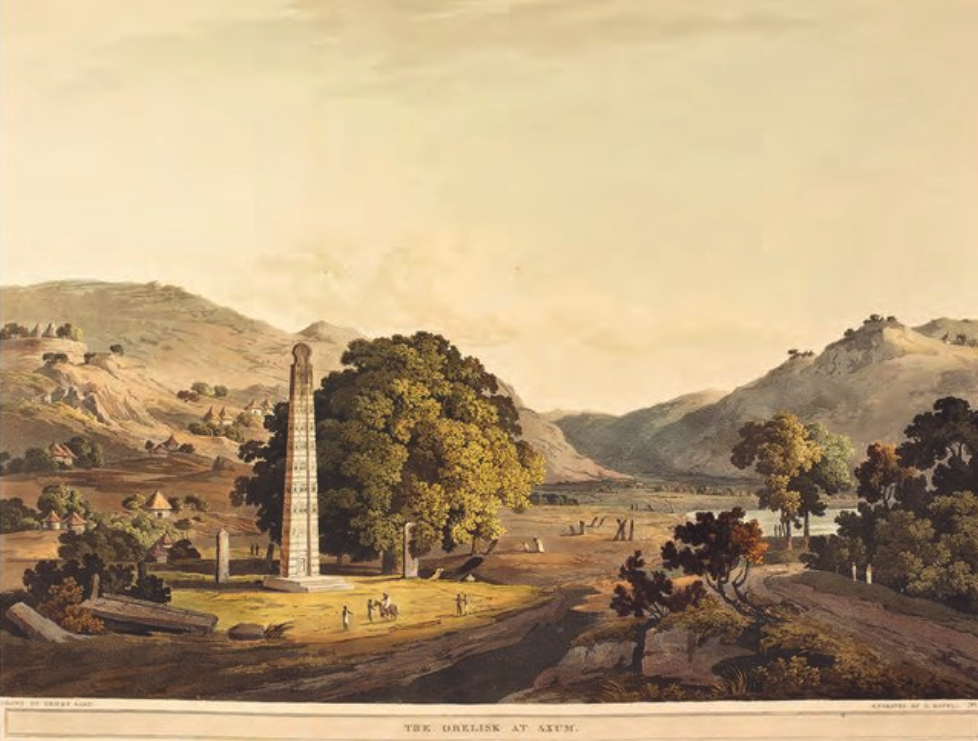
Aksum flourished from the first century AD in the Horn of Africa (present-day Ethiopia and Eritrea).4
- A rare monetary sovereignty: Aksum struck its own coinage in gold, silver and bronze — a privilege reserved for the very greatest powers of Antiquity. Some of these coins have been found very far from where they were minted.
- A commercial crossroads: its port of Adulis, on the Red Sea, linked the maritime routes of the Mediterranean and the Indian Ocean.
- An early conversion: in the fourth century, under King Ezana, Aksum adopted Christianity as its state religion — among the very first kingdoms in the world to do so, and before the Roman Empire made it its official religion, in 380.5
That does not mean it should be turned into a dream kingdom. Aksum was a conquering empire: it waged campaigns of expansion, as far as South Arabia, on the other side of the Red Sea. Its mercantile economy rested partly on the slave trade, and its society was stratified.6
Repairing an omission does not mean replacing one flattering narrative with another.
The historiographical method: decentring through the sources
This passage illustrates a fundamental rule of method:
Instead of declaring a posteriori that we must “rebalance the historical narrative”, we rely directly on a third-century witness.
Mani was neither European nor African. He lived in the Persian Empire, and he had no modern political motive for rebalancing. He described the world as it looked from where he stood.7
What remains is what his list implies: if he places Aksum on the same footing as Rome and Persia, it is because the kingdom was then powerful enough to be counted among the foremost, as seen from Iran.
It is not the contemporary gaze that decentres history: it is the original source.
A testimony from the period, written without apologetic intent, carries more evidential weight than later theoretical constructions.
From supposition to evidence: the bias of external attribution
The history of research on Aksum offers a critical lesson in epistemology.
For several decades, a persistent hypothesis held that Aksum had been founded by a people from Arabia, on the other side of the Red Sea. Archaeology has refuted this thesis: the local populations already possessed a complex organisation, and the outside contribution was a minor one.8
This case recalls a similar bias identified in the study of metallurgy (see Entry 3.4):
- The prior supposition: Faced with an innovation or a complex political structure in sub-Saharan Africa, an external origin was assumed by default (diffusionism from the North or the East).
- Correction by the data: Radiocarbon dating and stratigraphic excavations have shown that these developments were endogenous.
Rule of analysis: Faced with the claim that a technique or an institution derives from an external centre, one must always examine how much is material evidence and how much is unverified postulate.
From contemporary empires to world views
In the third century, monumental political entities coexisted across the globe:
- The West and the Eastern Mediterranean: The Roman Empire.
- East Asia: The Han dynasty (then the Three Kingdoms period).
- Central and South Asia: the declining Kushan Empire, the nascent Sasanian Empire — and, in the following century, the Gupta Empire.
- The Horn of Africa: The kingdom of Aksum.
- The Americas: Teotihuacan and the Maya city-states of the Classic period.
The question of interconnections
How did societies so far apart simultaneously develop complex state structures without direct contact?
Rome and China barely knew each other. Their exchanges took place step by step along the Silk Roads and the sea routes, through a complex chain of Sasanian, Indian and Aksumite intermediaries. Their images of each other owed more to geopolitical myth than to accurate knowledge.
Conceiving the world: the "Axial Age" and philosophies
The term “philosophies” reminds us that this political plurality is matched by a plurality of systems of thought:
- Moving beyond the myth of Greek exclusivity: Rational and ethical thought developed simultaneously in several centres (Greece, India, China, Persia).
- A historiographical nuance: the notion of an “Axial Age”, coined by the philosopher Karl Jaspers in the mid-twentieth century to designate a simultaneous spiritual awakening in several regions of the world, is now the subject of debate. It is criticised for confining to one period and a few regions traits that appeared centuries earlier across Afro-Eurasia.9
Note 1
The forefathers of Mani's father are said to have been from Hamadan and so perhaps of Iranian origin […] But he did win his favor to such a degree that he was authorized to propagate the new faith in the Iranian empire […] But Mani was also a man who underwent supernatural experiences from his early youth on and a prophet in the proper sense and in the Oriental tradition.
Encyclopædia Iranica, “Mani”, Encyclopædia Iranica Foundation, online edition
Note 2
There are four great kingdoms in the world. The first is the kingdom of the land of Babylon and Persia, the second is the kingdom of the Romans. The third is the kingdom of the Aksumites, the fourth is the kingdom of Silis; there is none that surpasses them.
Gardner, Iain (trad.), The Kephalaia of the Teacher: The Edited Coptic Manichaean Texts in Translation with Commentary, Brill, 1995
Note 3
Gardner, Iain (trad.), The Kephalaia of the Teacher: The Edited Coptic Manichaean Texts in Translation with Commentary, Brill, 1995
Note 4
Situé dans les montagnes du nord de l'Ethiopie, Axoum symbolise la richesse et l'importance de la civilisation de l'ancien royaume d’Axoum, qui a duré du Ier au VIIIe siècles après J.-C. Le royaume était au carrefour de trois continents, l'Afrique, l'Arabie et le monde gréco-romain, et il était l'Etat le plus puissant entre l'Empire romain d'orient et la Perse.
Located in the highlands of northern Ethiopia, Aksum symbolises the wealth and importance of the civilisation of the ancient kingdom of Aksum, which lasted from the 1st to the 8th centuries AD. The kingdom stood at the crossroads of three continents, Africa, Arabia and the Graeco-Roman world, and was the most powerful state between the Eastern Roman Empire and Persia.
UNESCO, World Heritage Centre, “Aksum”, World Heritage List, property no. 15, statement of Outstanding Universal Value
Note 5
secured an additional 18 gold, silver, and bronze Aksumite coins for Princeton's collection. […] The bronze coin is partially gilded—a feature unique to Aksumite coins—
Princeton University, Department of Art and Archaeology, “Graduate Student Jenica Brown Helps Princeton Grow its Aksumite Coin Collection”, 14 December 2023
In August 2018 a Saudi Arabian source provided us with photographs and some data about a small hoard of 16 late Roman solidi and 7 Aksumite gold coins, found on 29 July 2018 at an undetermined location in the Abyan Governorate of Yemen, northeast of the city of Aden.
Martínez Chico, David and González García, Alberto, “The Abyan Governorate Hoard of Late Roman Solidi and Aksumite Gold Coins”, Numismatic Chronicle, vol. 179, 2019, p. 373-380
Adulis was the port town for the Aksumite Empire and one of the most prominent Red Sea ports during the Roman and Byzantine periods. […] Like the Egyptian ports of Berenike and Myos Hormos, Adulis was one of the most important ports in the Red Sea for trade between the Mediterranean and the Indian Ocean.
Zazzaro, Chiara and Manzo, Andrea, “A preliminary assessment of the pottery assemblage from the port town of Adulis (Eritrea)”, British Museum Studies in Ancient Egypt and Sudan, vol. 18, 2012, p. 233-246
Following his conversion, King Ezana (r. 320–350) had the crescent-and-disk of South Arabian polytheism removed from his coins and replaced with the Christian cross.
The Metropolitan Museum of Art, New York, Department of the Arts of Africa, Oceania, and the Americas, “Foundations of Aksumite Civilization and Its Christian Legacy (1st–8th Century)”, Heilbrunn Timeline of Art History, October 2000
might it not be more accurate to start in AD 380 when the Emperor Theodosius (d. AD 395) presented himself […] issued the Edict of Thessalonica, Cunctos Populos, […] now making Catholic Christianity the official religion of the the Roman Empire.
Meconi, David Vincent, “Introduction”, in Meconi, David Vincent (ed.), The Cambridge Companion to Augustine’s City of God, Cambridge University Press, 2021, pp. 1-18
Note 6
The Himyarite invasion of 525 CE by Kaleb of Aksum was a definitive war in the narrative of global religion and politics. […] Ethiopia from Ezana and his predecessors embarked on a regional expansion policy (cf. Bowersock 2013). These were imperialist ambitions; […]
Rukuni, Rugare, “Religious statecraft: Constantinianism in the figure of Nagashi Kaleb”, HTS Teologiese Studies / Theological Studies, vol. 76, no. 4, 2020
The kingdom of Aksum, in modern Ethiopia and Eritrea, was a trading nation and naval power in the first millennium AD (Fattovich 2019). According to the mid-first century merchant’s handbook, the Periplus Maris Erythraei (§6) and the Christian Topography of Cosmas Indicopleustes (§2.49) of c. AD 540/550 (Casson 1989; Wolska-Conus 1968), it exported ivory, rhinoceros horn, hippopotamus hides, turtle shell, monkeys and slaves to the Roman Empire and India in the first to seventh centuries.
Then-Obłuska, Joanna, Phillips, Jacke and Tucker, Katie, “Imported ornaments of a Late Antiquity community in Christian Ethiopia”, Azania: Archaeological Research in Africa, vol. 57, no. 2, 2022, pp. 280-296
The custom was followed at several levels of Aksumite society, the elaborate (probably royal) examples described above being contrasted with shaft or simple pit-graves marked with plain or undressed smaller stelae. This funerary evidence for socio-economic stratification is paralleled by the domestic architecture.
Phillipson, David W., “Aksum: An African Civilisation in its World Contexts”, Proceedings of the British Academy, vol. 111, 2001, p. 23-59
Note 7
A trustworthy Parthian hagiographic fragment makes it clear that Mani did not succeed in converting the king. But he did win his favor to such a degree that he was authorized to propagate the new faith in the Iranian empire (Sundermann, 1986a, p. 58, sub 11.2; cf. Sundermann, 1981, pp. 106-7).
Encyclopædia Iranica, “Mani”, Encyclopædia Iranica Foundation, online edition
Note 8
The last millennium BC is seen as a time when northern Ethiopia and parts of Eritrea were inhabited by farming peoples whose ancestry may be traced far back into the local 'Late Stone Age'. Colonisation from southern Arabia, to which defining importance has been attached by earlier researchers, is now seen to have been brief in duration and small in scale, its effects largely restricted to élite sections of the community.
Phillipson, David W., Foundations of an African Civilisation: Aksum and the Northern Horn, 1000 BC – AD 1300, James Currey, 2012, publisher’s description
Beginning in the 3rd millennium BC, complex societies and states arose in the northern Horn of Africa. This process culminated with the development of the Kingdom of Aksum in northern Ethiopia and Eritrea in the 1st millennium AD.
Fattovich, Rodolfo, “The Development of Ancient States in the Northern Horn of Africa, c. 3000 BC – AD 1000: An Archaeological Outline”, Journal of World Prehistory, vol. 23, 2010, p. 145-175
Note 9
Et c'est pourquoi, comme toute la suite de l'ouvrage va s'efforcer de le confirmer, cet axe doit être pensé non à partir de l'avènement d'une réalité unique, mais bien d'une conjonction de « choses extraordinaires »6 qui, en survenant toutes en une période relativement condensée de l'histoire de l'humanité, ont si fondamentalement pesé sur son devenir qu'elles en ont irrémédiablement déterminé le cours autant que l'enjeu. Plus que d'un axe, il s'agit bien dès lors de prendre acte d'une « période axiale [Achsenzeit] » : celle, située « entre 800 et 200 avant notre ère ». […] Bref, « la nouveauté de cette époque est que, dans les trois mondes, l'homme prend conscience de l'être dans sa totalité, de lui-même et de ses limites »7. C'est à cette époque, comme l'écrit à la suite Jaspers, que « furent engendrées les catégories fondamentales, selon lesquelles nous pensons encore aujourd'hui, ainsi que les grandes religions dont vivent les hommes jusqu'à aujourd'hui. En tous sens, le pas vers l'universel fut accompli »8.
And that is why, as the rest of the book will strive to confirm, this axis must be conceived not on the basis of the advent of a single reality, but of a conjunction of “extraordinary things”6 which, all occurring within a relatively condensed period of human history, weighed so fundamentally on its development that they irrevocably determined its course as much as its stakes. More than an axis, then, what must be acknowledged is an “axial period [Achsenzeit]”: the one situated “between 800 and 200 before our era”. […] In short, “what is new about this age is that, in all three worlds, man becomes aware of being as a whole, of himself and of his limits”7. It was in this age, as Jaspers goes on to write, that “the fundamental categories were engendered, according to which we still think today, as well as the great religions by which men still live today. In every sense, the step towards the universal was taken”8.
Grosos, Philippe, “Trois penseurs de l’histoire au regard de la préhistoire”, Revue de théologie et de philosophie, vol. 154, 2022, pp. 157-169
Proponents of the Axial Age contend that parallel cultural developments between 800 and 200 BCE in what is today China, Greece, India, Iran, and Israel-Palestine constitute the global historical turning point towards modernity. While the Axial Age concept is well-known and influential, deficiencies in the historical evidence and sociological analysis available have thwarted efforts to evaluate the Axial Age concept's major global contentions. As a result, the Axial Age concept remains controversial.
Mullins, D., Hoyer, D., Collins, C., et al., “A Systematic Assessment of ‘Axial Age’ Proposals Using Global Comparative Historical Evidence”, American Sociological Review, vol. 83, 2018, pp. 596-626
Our systematic investigation undercuts the notion of a specific 'age' of axiality limited to a specific geo-temporal localization. Critical traits offered as evidence of an axial transformation by proponents of the Axial Age concept are shown to have appeared across Afro-Eurasia hundreds and in some cases thousands of years prior to the proposed Axial Age.
Mullins, D., Hoyer, D., Collins, C., et al., “A Systematic Assessment of ‘Axial Age’ Proposals Using Global Comparative Historical Evidence”, American Sociological Review, vol. 83, 2018, pp. 596-626
Notes and sources
- ↑
Passage a prophet of the Persian Empire named Mani
The forefathers of Mani's father are said to have been from Hamadan and so perhaps of Iranian origin […] But he did win his favor to such a degree that he was authorized to propagate the new faith in the Iranian empire […] But Mani was also a man who underwent supernatural experiences from his early youth on and a prophet in the proper sense and in the Oriental tradition.
Source Encyclopædia Iranica, “Mani”, Encyclopædia Iranica Foundation, online edition, sections “Childhood and youth”, “The founding of the Manichean Church” and “Mani’s personality”.
Open access open the source · checked on 27 October 2026
- ↑
Passage There are four great kingdoms in the world. The first is the kingdom of the land of Babylon and Persia, the second is the kingdom of the Romans. The third is the kingdom of the Aksumites, the fourth is the kingdom of Silis; there is none that surpasses them.
There are four great kingdoms in the world. The first is the kingdom of the land of Babylon and Persia, the second is the kingdom of the Romans. The third is the kingdom of the Aksumites, the fourth is the kingdom of Silis; there is none that surpasses them.
Source Gardner, Iain (trad.), The Kephalaia of the Teacher: The Edited Coptic Manichaean Texts in Translation with Commentary, Brill, 1995, chapter 77.
In libraries · checked on 9 September 2026
- ↑
Passage The fourth, Silis, is less certain: many researchers recognise China in it, but its identification is debated.
Source Gardner, Iain (trad.), The Kephalaia of the Teacher: The Edited Coptic Manichaean Texts in Translation with Commentary, Brill, 1995, editor’s commentary on the identification of the fourth kingdom.
In libraries · checked on 9 September 2026
- ↑
Passage Aksum flourished from the first century AD in the Horn of Africa
Situé dans les montagnes du nord de l'Ethiopie, Axoum symbolise la richesse et l'importance de la civilisation de l'ancien royaume d’Axoum, qui a duré du Ier au VIIIe siècles après J.-C. Le royaume était au carrefour de trois continents, l'Afrique, l'Arabie et le monde gréco-romain, et il était l'Etat le plus puissant entre l'Empire romain d'orient et la Perse.
Editors’ translation Located in the highlands of northern Ethiopia, Aksum symbolises the wealth and importance of the civilisation of the ancient kingdom of Aksum, which lasted from the 1st to the 8th centuries AD. The kingdom stood at the crossroads of three continents, Africa, Arabia and the Graeco-Roman world, and was the most powerful state between the Eastern Roman Empire and Persia.
Source UNESCO, World Heritage Centre, “Aksum”, World Heritage List, property no. 15, statement of Outstanding Universal Value, “Outstanding Universal Value”, “Brief synthesis”, 1st paragraph, first two sentences (French version of the page).
Open access open the source · checked on 27 October 2026
- ↑
Passage Aksum struck its own coinage in gold, silver and bronze
secured an additional 18 gold, silver, and bronze Aksumite coins for Princeton's collection. […] The bronze coin is partially gilded—a feature unique to Aksumite coins—
Source Princeton University, Department of Art and Archaeology, “Graduate Student Jenica Brown Helps Princeton Grow its Aksumite Coin Collection”, 14 December 2023, news article, paragraph beginning “With the help of funds from the Seeger Center”, then paragraph on the gilded bronze coin.
Open access open the source · checked on 28 October 2026
Passage Some of these coins have been found very far from where they were minted.
In August 2018 a Saudi Arabian source provided us with photographs and some data about a small hoard of 16 late Roman solidi and 7 Aksumite gold coins, found on 29 July 2018 at an undetermined location in the Abyan Governorate of Yemen, northeast of the city of Aden.
Source Martínez Chico, David and González García, Alberto, “The Abyan Governorate Hoard of Late Roman Solidi and Aksumite Gold Coins”, Numismatic Chronicle, vol. 179, 2019, p. 373-380, abstract.
Open access open the source · checked on 27 October 2026
Passage its port of Adulis, on the Red Sea, linked the maritime routes of the Mediterranean and the Indian Ocean
Adulis was the port town for the Aksumite Empire and one of the most prominent Red Sea ports during the Roman and Byzantine periods. […] Like the Egyptian ports of Berenike and Myos Hormos, Adulis was one of the most important ports in the Red Sea for trade between the Mediterranean and the Indian Ocean.
Source Zazzaro, Chiara and Manzo, Andrea, “A preliminary assessment of the pottery assemblage from the port town of Adulis (Eritrea)”, British Museum Studies in Ancient Egypt and Sudan, vol. 18, 2012, p. 233-246, p. 234, opening of the 1st and 2nd paragraphs.
Open access open the source · checked on 27 October 2026
Passage in the fourth century, under King Ezana, Aksum adopted Christianity
Following his conversion, King Ezana (r. 320–350) had the crescent-and-disk of South Arabian polytheism removed from his coins and replaced with the Christian cross.
Source The Metropolitan Museum of Art, New York, Department of the Arts of Africa, Oceania, and the Americas, “Foundations of Aksumite Civilization and Its Christian Legacy (1st–8th Century)”, Heilbrunn Timeline of Art History, October 2000, essay, passage on Frumentius and Ezana’s conversion.
Open access open the source · checked on 27 October 2026
Passage before the Roman Empire made it its official religion, in 380
might it not be more accurate to start in AD 380 when the Emperor Theodosius (d. AD 395) presented himself […] issued the Edict of Thessalonica, Cunctos Populos, […] now making Catholic Christianity the official religion of the the Roman Empire.
Source Meconi, David Vincent, “Introduction”, in Meconi, David Vincent (ed.), The Cambridge Companion to Augustine’s City of God, Cambridge University Press, 2021, pp. 1-18, summary shown in open access on the chapter page.
Paywalled, summary open access open the source · checked on 27 October 2026
- ↑
Passage Aksum was a conquering empire: it waged campaigns of expansion, as far as South Arabia
The Himyarite invasion of 525 CE by Kaleb of Aksum was a definitive war in the narrative of global religion and politics. […] Ethiopia from Ezana and his predecessors embarked on a regional expansion policy (cf. Bowersock 2013). These were imperialist ambitions; […]
Source Rukuni, Rugare, “Religious statecraft: Constantinianism in the figure of Nagashi Kaleb”, HTS Teologiese Studies / Theological Studies, vol. 76, no. 4, 2020, abstract, 1st sentence; section “Constantinianism and Ethiopianism themes”, 5th paragraph.
Open access open the source · checked on 27 October 2026
Passage Its mercantile economy rested partly on the slave trade
The kingdom of Aksum, in modern Ethiopia and Eritrea, was a trading nation and naval power in the first millennium AD (Fattovich 2019). According to the mid-first century merchant’s handbook, the Periplus Maris Erythraei (§6) and the Christian Topography of Cosmas Indicopleustes (§2.49) of c. AD 540/550 (Casson 1989; Wolska-Conus 1968), it exported ivory, rhinoceros horn, hippopotamus hides, turtle shell, monkeys and slaves to the Roman Empire and India in the first to seventh centuries.
Source Then-Obłuska, Joanna, Phillips, Jacke and Tucker, Katie, “Imported ornaments of a Late Antiquity community in Christian Ethiopia”, Azania: Archaeological Research in Africa, vol. 57, no. 2, 2022, pp. 280-296, p. 281, introduction, 1st paragraph, 1st and 2nd sentences.
Open access open the source · checked on 27 October 2026
Passage and its society was stratified
The custom was followed at several levels of Aksumite society, the elaborate (probably royal) examples described above being contrasted with shaft or simple pit-graves marked with plain or undressed smaller stelae. This funerary evidence for socio-economic stratification is paralleled by the domestic architecture.
Source Phillipson, David W., “Aksum: An African Civilisation in its World Contexts”, Proceedings of the British Academy, vol. 111, 2001, p. 23-59, p. 48, end of the paragraph beginning “Use of upright stones as grave-markers” and first sentence of the next paragraph.
Open access open the source · checked on 27 October 2026
- ↑
Passage Mani […] lived in the Persian Empire
A trustworthy Parthian hagiographic fragment makes it clear that Mani did not succeed in converting the king. But he did win his favor to such a degree that he was authorized to propagate the new faith in the Iranian empire (Sundermann, 1986a, p. 58, sub 11.2; cf. Sundermann, 1981, pp. 106-7).
Source Encyclopædia Iranica, “Mani”, Encyclopædia Iranica Foundation, online edition, section “The founding of the Manichean Church”, passage on Mani’s presentation at the court of Šābuhr I.
Open access open the source · checked on 27 October 2026
- ↑
Passage a persistent hypothesis held that Aksum had been founded by a people from Arabia […] Archaeology has refuted this thesis
The last millennium BC is seen as a time when northern Ethiopia and parts of Eritrea were inhabited by farming peoples whose ancestry may be traced far back into the local 'Late Stone Age'. Colonisation from southern Arabia, to which defining importance has been attached by earlier researchers, is now seen to have been brief in duration and small in scale, its effects largely restricted to élite sections of the community.
Source Phillipson, David W., Foundations of an African Civilisation: Aksum and the Northern Horn, 1000 BC – AD 1300, James Currey, 2012, publisher’s description, publisher’s description of the book (Cambridge Core), 2nd paragraph.
Open access open the source · checked on 27 October 2026
Passage the local populations already possessed a complex organisation
Beginning in the 3rd millennium BC, complex societies and states arose in the northern Horn of Africa. This process culminated with the development of the Kingdom of Aksum in northern Ethiopia and Eritrea in the 1st millennium AD.
Source Fattovich, Rodolfo, “The Development of Ancient States in the Northern Horn of Africa, c. 3000 BC – AD 1000: An Archaeological Outline”, Journal of World Prehistory, vol. 23, 2010, p. 145-175, abstract.
Paywalled · checked on 25 October 2026
- ↑
Passage the notion of an “Axial Age”, coined by the philosopher Karl Jaspers […] to designate a simultaneous spiritual awakening in several regions of the world
Et c'est pourquoi, comme toute la suite de l'ouvrage va s'efforcer de le confirmer, cet axe doit être pensé non à partir de l'avènement d'une réalité unique, mais bien d'une conjonction de « choses extraordinaires »6 qui, en survenant toutes en une période relativement condensée de l'histoire de l'humanité, ont si fondamentalement pesé sur son devenir qu'elles en ont irrémédiablement déterminé le cours autant que l'enjeu. Plus que d'un axe, il s'agit bien dès lors de prendre acte d'une « période axiale [Achsenzeit] » : celle, située « entre 800 et 200 avant notre ère ». […] Bref, « la nouveauté de cette époque est que, dans les trois mondes, l'homme prend conscience de l'être dans sa totalité, de lui-même et de ses limites »7. C'est à cette époque, comme l'écrit à la suite Jaspers, que « furent engendrées les catégories fondamentales, selon lesquelles nous pensons encore aujourd'hui, ainsi que les grandes religions dont vivent les hommes jusqu'à aujourd'hui. En tous sens, le pas vers l'universel fut accompli »8.
Editors’ translation And that is why, as the rest of the book will strive to confirm, this axis must be conceived not on the basis of the advent of a single reality, but of a conjunction of “extraordinary things”6 which, all occurring within a relatively condensed period of human history, weighed so fundamentally on its development that they irrevocably determined its course as much as its stakes. More than an axis, then, what must be acknowledged is an “axial period [Achsenzeit]”: the one situated “between 800 and 200 before our era”. […] In short, “what is new about this age is that, in all three worlds, man becomes aware of being as a whole, of himself and of his limits”7. It was in this age, as Jaspers goes on to write, that “the fundamental categories were engendered, according to which we still think today, as well as the great religions by which men still live today. In every sense, the step towards the universal was taken”8.
Source Grosos, Philippe, “Trois penseurs de l’histoire au regard de la préhistoire”, Revue de théologie et de philosophie, vol. 154, 2022, pp. 157-169, p. 159, 1st and 2nd paragraphs.
Open access open the source · checked on 27 October 2026
Passage is now the subject of debate.
Proponents of the Axial Age contend that parallel cultural developments between 800 and 200 BCE in what is today China, Greece, India, Iran, and Israel-Palestine constitute the global historical turning point towards modernity. While the Axial Age concept is well-known and influential, deficiencies in the historical evidence and sociological analysis available have thwarted efforts to evaluate the Axial Age concept's major global contentions. As a result, the Axial Age concept remains controversial.
Source Mullins, D., Hoyer, D., Collins, C., et al., “A Systematic Assessment of ‘Axial Age’ Proposals Using Global Comparative Historical Evidence”, American Sociological Review, vol. 83, 2018, pp. 596-626, abstract, 1st to 3rd sentences.
Open access open the source · checked on 27 October 2026
Passage It is criticised for confining to one period and a few regions traits that appeared centuries earlier across Afro-Eurasia.
Our systematic investigation undercuts the notion of a specific 'age' of axiality limited to a specific geo-temporal localization. Critical traits offered as evidence of an axial transformation by proponents of the Axial Age concept are shown to have appeared across Afro-Eurasia hundreds and in some cases thousands of years prior to the proposed Axial Age.
Source Mullins, D., Hoyer, D., Collins, C., et al., “A Systematic Assessment of ‘Axial Age’ Proposals Using Global Comparative Historical Evidence”, American Sociological Review, vol. 83, 2018, pp. 596-626, abstract, 5th and 6th sentences.
Open access open the source · checked on 27 October 2026
Bibliography
22
- Bellah, Robert N. and Joas, Hans (ed.), The Axial Age and Its Consequences, Harvard University Press, 2012, in libraries (current debates on the notion of the Axial Age).
- Bowersock, Glen W., The Throne of Adulis: Red Sea Wars on the Eve of Islam, Oxford University Press, 2013, in libraries (Adulis and the wars in South Arabia).
- Encyclopædia Iranica, “Mani”, Encyclopædia Iranica Foundation, online edition, open access (Mani, a prophet “in the Oriental tradition”, perhaps of Iranian descent, authorised to preach in the Iranian empire). https://www.iranicaonline.org/articles/mani-founder-manicheism
- Fattovich, Rodolfo, “The Development of Ancient States in the Northern Horn of Africa, c. 3000 BC – AD 1000: An Archaeological Outline”, Journal of World Prehistory, vol. 23, 2010, p. 145-175, paywalled (state formation in the Horn of Africa).
- Gardner, Iain (trad.), The Kephalaia of the Teacher: The Edited Coptic Manichaean Texts in Translation with Commentary, Brill, 1995, in libraries (the text of the four great kingdoms, the fourth of which is named Silis).
- Grosos, Philippe, “Trois penseurs de l’histoire au regard de la préhistoire”, Revue de théologie et de philosophie, vol. 154, 2022, pp. 157-169, open access (Jaspers’s “axial period”, between 800 and 200 BCE). https://doi.org/10.47421/rthph154_2_157-169
- Jaspers, Karl, Vom Ursprung und Ziel der Geschichte, Piper, 1949, in libraries (the notion of the “Axial Age”). French translation: Origine et sens de l’histoire, Plon, 1954.
- “Mani”, Encyclopædia Iranica, online edition, open access (Mani’s life in the Sasanian Empire). https://www.iranicaonline.org/articles/mani-founder-manicheism
- Martínez Chico, David and González García, Alberto, “The Abyan Governorate Hoard of Late Roman Solidi and Aksumite Gold Coins”, Numismatic Chronicle, vol. 179, 2019, p. 373-380, open access, University of Valencia repository (a hoard of Aksumite and Roman gold coins found in Yemen, near Aden). https://hdl.handle.net/10550/76805
- Meconi, David Vincent, “Introduction”, in Meconi, David Vincent (ed.), The Cambridge Companion to Augustine’s City of God, Cambridge University Press, 2021, pp. 1-18, paywalled, summary open access (the Edict of Thessalonica of 380, which made Christianity the official religion of the Roman Empire). https://www.cambridge.org/core/books/cambridge-companion-to-augustines-city-of-god/introduction/870EDB333A22E683E01978FB97FD96C3
- Mullins, D., Hoyer, D., Collins, C., et al., “A Systematic Assessment of ‘Axial Age’ Proposals Using Global Comparative Historical Evidence”, American Sociological Review, vol. 83, 2018, pp. 596-626, open access (a “controversial” notion of the Axial Age, tested against the Seshat databank). https://doi.org/10.1177/0003122418772567
- Munro-Hay, Stuart, Aksum: An African Civilisation of Late Antiquity, Edinburgh University Press, 1991, in libraries (coinage, Adulis, Ezana, the military campaigns, the place of slaves in trade).
- Munro-Hay, Stuart and Juel-Jensen, Bent, Aksumite Coinage, Spink, London, 1995, in libraries (the striking of gold, silver and bronze).
- Phillipson, David W., Foundations of an African Civilisation: Aksum and the Northern Horn, 1000 BC – AD 1300, James Currey, 2012, in libraries (the refutation of the thesis of a foundation from Arabia; the earlier settlement).
- Phillipson, David W., “Aksum: An African Civilisation in its World Contexts”, Proceedings of the British Academy, vol. 111, 2001, p. 23-59 (Albert Reckitt Archaeological Lecture, 2000), open access (the socio-economic stratification of Aksumite society, visible in its graves and domestic architecture). https://www.thebritishacademy.ac.uk/documents/2486/111p023.pdf
- Princeton University, Department of Art and Archaeology, “Graduate Student Jenica Brown Helps Princeton Grow its Aksumite Coin Collection”, 14 December 2023, open access (Aksumite coins in gold, silver and bronze, including a partially gilded bronze coin). https://artandarchaeology.princeton.edu/whats/news/graduate-student-jenica-brown-helps-princeton-grow-its-aksumite-coin-collection
- Rukuni, Rugare, “Religious statecraft: Constantinianism in the figure of Nagashi Kaleb”, HTS Teologiese Studies / Theological Studies, vol. 76, no. 4, 2020, open access (Aksum’s policy of expansion from Ezana onwards and Kaleb’s invasion of Himyar, in South Arabia, in 525). https://doi.org/10.4102/hts.v76i4.5885
- Tardieu, Michel, Le Manichéisme, PUF, “Que sais-je ?”, 1997, in libraries (Mani, his life in the Persian Empire, and the context of his writings).
- The Metropolitan Museum of Art, New York, Department of the Arts of Africa, Oceania, and the Americas, “Foundations of Aksumite Civilization and Its Christian Legacy (1st–8th Century)”, Heilbrunn Timeline of Art History, October 2000, open access (Ezana’s reign, 320-350, his conversion and the cross on his coins). https://www.metmuseum.org/essays/foundations-of-aksumite-civilization-and-its-christian-legacy-1st-7th-century
- Then-Obłuska, Joanna, Phillips, Jacke and Tucker, Katie, “Imported ornaments of a Late Antiquity community in Christian Ethiopia”, Azania: Archaeological Research in Africa, vol. 57, no. 2, 2022, pp. 280-296, open access (Aksum’s exports, slaves among them, according to the Periplus and Cosmas). https://doi.org/10.1080/0067270X.2022.2078575
- UNESCO, World Heritage Centre, “Aksum”, World Heritage List, property no. 15, statement of Outstanding Universal Value, open access (the kingdom of Aksum, 1st to 8th centuries AD, in northern Ethiopia; the port of Adulis and the Red Sea trade). https://whc.unesco.org/en/list/15/
- Zazzaro, Chiara and Manzo, Andrea, “A preliminary assessment of the pottery assemblage from the port town of Adulis (Eritrea)”, British Museum Studies in Ancient Egypt and Sudan, vol. 18, 2012, p. 233-246, open access, repository of the University of Naples “L’Orientale” (Adulis, port of the Aksumite Empire and a hub of trade between the Mediterranean and the Indian Ocean). https://unora.unior.it/retrieve/dfd1bedc-f91f-d55a-e053-3705fe0af723/Zazzaro_Manzo.pdf
Spotted an error or have a doubt? Write to us.