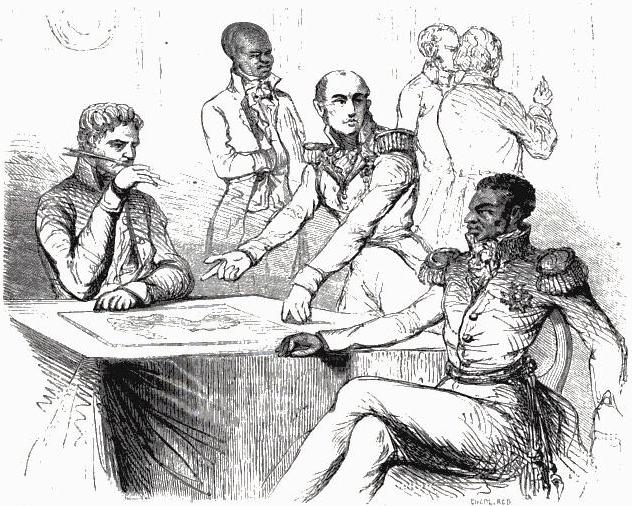

In 1804, after thirteen years of war, Haiti became the first country in the world born of a successful uprising of enslaved people.1
Twenty-one years later, France made it pay 150 million gold francs as the price of its recognition.
The indemnity went to the former colonists, for the income that their plantations and the labour of enslaved people had brought them. Meanwhile, Europe was entering the age of steam and coal, transforming work and trade on a global scale.
1825: the decision by force
On 17 April 1825, King Charles X signed an ordinance. A squadron of French warships delivered it off Port-au-Prince. The choice left to the country came down to a few words: money or war.2
Under duress, Haiti agreed to pay France 150 million francs, payable in five annual instalments of 30 million.3
The terms of the transaction
- What Haiti obtains: official recognition of its independence (an indispensable condition for trading internationally and for warding off the threat of a French invasion).
- What is compensated: the former colonists, for the loss of income from their plantations — income derived from the labour of enslaved people.4
“France forced the winners of Haiti’s independence – the former slaves – to compensate the losers, their former masters.”
— Monique Clesca, journalist and activist of Haitian origin, at the United Nations Permanent Forum on People of African Descent, on 17 April 2025 — two hundred years to the day after the ordinance.5
The mechanics of the “double debt”
Haiti did not have the necessary funds. As the investigators who reconstructed this history put it, the sum was far beyond its means.6
To grasp the order of magnitude, it helps to find a point of comparison. Caution is needed here, because the ratios put forward do not agree. One organisation puts it at sixteen times Haiti’s gross domestic product at the time. Another settles on five years of GDP. Other studies compare it not with GDP but with state revenue.7
Three figures, three denominators. Comparing with GDP and comparing with tax revenue do not measure the same thing. But the gap between five and sixteen years of GDP is a genuine disagreement: it stems from how the GDP of a country in 1826 is reconstructed, an exercise for which data are lacking.
Faced with two figures that contradict each other, the first question is not “which one is true?” but “what does each one count?”
The financial spiral
- The ordinance demands 150 million francs, payable in five annual instalments.
- The forced loan: to settle the first instalment, Haiti has to borrow from French banks.
- The fees: these banks deduct commissions and fees. The country therefore does not receive the sum it borrows, but it owes all of it.
- The double debt: Haiti goes into debt with banks in order to pay the French state’s claim. Two debts, for a single event.8
In 1838, the remaining sum was negotiated and reduced: a treaty brought the total down from 150 to 90 million gold francs. But repayment stifled the country’s finances for several generations: the investigators calculated that for a decade after 1915, under the American occupation, a quarter of the country’s revenue was still going on repayments.9
Historical note: two “final payments”
Two final payment dates that should not be confused:
| Due date | Recipient | Nature of the payment |
|---|---|---|
| 1888 | France | Final instalment of the indemnity, paid in tranches. |
| 1947 | The lending banks | Balance of the loan taken out to finance this indemnity. |
Sources for the table10
Overall: more than a hundred and twenty years of repayments. The last payment was made nearly a century and a half after independence.
Analysis of the financial data: a gap of 1 to 40, or even 200
| Type of calculation | Amount | What the sum measures |
|---|---|---|
| Payments actually made | about 112 million francs (roughly 560 million dollars in 2022 money) | The money taken out of the coffers of the Haitian state, payment after payment. |
| Forgone gains | 21 to 115 billion dollars | What this money would have produced had it remained in the country. |
Sources for the table11
Why such a gap between the two rows?
Because they do not answer the same question.
The first is a cash record: the investigators followed each payment, one by one.
The second is a calculation of what did not happen. And its range has an explanation: the low estimate assumes only that the money would have remained in the Haitian economy; the high estimate further assumes that Haiti would have experienced the growth of its Latin American neighbours. Two different assumptions, two results separated by a factor of five.12
Key point: before comparing two complex figures, one must always check what each one measures.
Technical upheavals: industrial growth (eighteenth–nineteenth centuries)
While political and colonial sovereignties were clashing, the world was undergoing an unprecedented material transformation: the Industrial Revolution.
The three engines of technical change
- The mechanisation of power (steam): the steam engine frees production from dependence on human, animal or water power.
- Coal-based metallurgy (pit coal): the switch to coke allows the mass production of cast iron, then of steel, the basic materials of factories and infrastructure.
- The transport revolution: the arrival of the railway and of steam shipping speeds up the movement of raw materials and goods on a global scale.13
From the domestic system to the factory: the reorganisation of work
The shift from the putting-out system (home-based textile work) to the factory system (centralised factory) profoundly alters social structures.14
| Dimension | Before industrialisation | After industrialisation |
|---|---|---|
| Workplace | Home, craft workshop | Centralised factory, mine |
| Pace | Set by the seasons and the daylight | Dictated by the clock and the machine |
| Social structure | Peasantry, artisans | Urban proletariat, industrial bourgeoisie |
| Energy used | Human, animal, wood, water | Coal, steam, then electricity |
Sources for the table15
Interconnection: political and technical revolutions
These two movements are not separate: they feed each other over the course of the nineteenth century.
- The need for raw materials: the British textile industry processes cotton that comes from far away, through global supply chains.
- The rise of financial capitalism: European banks lend to states, Haiti included; a Parisian bank, Crédit Industriel et Commercial, even lies behind the creation of the National Bank of Haiti.
- Control of the seas: in 1825, it was a squadron of warships that imposed the ordinance off Port-au-Prince; naval power also serves financial pressure.16
The present-day situation
- 2015: in a speech in Guadeloupe, President François Hollande spoke of “the ransom of independence”; his aides immediately made clear that it was a moral debt and not a financial one.
- 2022: a press investigation reconstructed the payments one by one, from the archives, and popularised the word “ransom”.
- 17 April 2025, bicentenary: President Emmanuel Macron acknowledged that the indemnity confronted Haiti with “the unjust force of History” and announced a joint commission of historians from France and Haiti; no financial reparation was mentioned.
- Haitian and international position: in 2025, the Transitional Presidential Council called for the restitution of the sums paid; Amnesty International and other organisations support a demand for reparations; the debate remains open.17
The positions presented here are those of each actor; the debate on reparations remains open.
Note 1
The first country ever to free itself from slavery through a successful uprising
ONU Info, “How Haiti paid for its freedom – twice over”, April 2025
the modern world's first nation born of a slave revolt
Nagourney, Eric, “The root of Haiti’s misery: reparations to enslavers”, The New York Times, 21 May 2022, repris par The Philadelphia Tribune
Note 2
Le 17 avril 1825, le roi Charles X signe l’ordonnance reconnaissant l’indépendance d’Haïti
On 17 April 1825, King Charles X signed the ordinance recognising Haiti’s independence
Fondation pour la mémoire de l’esclavage, “L’ordonnance de Charles X sur l’indemnité d’Haïti”
a squadron of warships returned with an ultimatum from King Charles X. The choice: money or war.
Porter, Catherine, Méheut, Constant, Gebrekidan, Selam and Apuzzo, Matt, “The Ransom”, The New York Times, 20 May 2022
Note 3
France demanded that Haitians pay their former masters 150 million francs […] in five annual payments of 30 million
Porter, Catherine, Méheut, Constant, Gebrekidan, Selam and Apuzzo, Matt, “The Ransom”, The New York Times, 20 May 2022
Note 4
destinée à dédommager les anciens colons
intended to compensate the former colonists
Fondation pour la mémoire de l’esclavage, “L’ordonnance de Charles X sur l’indemnité d’Haïti”
couvrir les pertes de revenus coloniaux issus de l'exploitation de la main-d'œuvre réduite en esclavage
to cover the losses of colonial income derived from the exploitation of enslaved labour
Amnesty International France, “Haïti : La France doit fournir les réparations pour remédier à son passé colonial”, 17 April 2025
Note 5
France forced the winners of Haiti's independence – the former slaves – to compensate the losers, their former masters
Clesca, Monique, intervention au Forum permanent des Nations unies sur les personnes d’ascendance africaine, 17 April 2025
Note 6
a staggering amount, far beyond their means
Porter, Catherine, Méheut, Constant, Gebrekidan, Selam and Apuzzo, Matt, “The Ransom”, The New York Times, 20 May 2022
Note 7
Le montant de la dette imposée, de 150 millions de francs, représentait 16 fois le PIB d'Haïti en 1826.
The amount of the debt imposed, 150 million francs, represented 16 times Haiti’s GDP in 1826.
Amnesty International France, “Haïti : La France doit fournir les réparations pour remédier à son passé colonial”, 17 April 2025
le versement de 150 MF (5 années du PIB d'Haïti) à la Caisse des Dépôts et Consignations
the payment of 150 MF (5 years of Haiti’s GDP) to the Caisse des Dépôts et Consignations
Fondation pour la mémoire de l’esclavage, “L’ordonnance de Charles X sur l’indemnité d’Haïti”
For a decade, a quarter of Haiti's total revenue went to paying debts controlled by National City Bank and its affiliate.
Nagourney, Eric, “The root of Haiti’s misery: reparations to enslavers”, The New York Times, 21 May 2022, repris par The Philadelphia Tribune
Note 8
Après la signature de l’ordonnance de 1825, Haïti, sous pression pour effectuer sans délai le paiement de la première annuité de l’indemnité, contracte un emprunt massif auprès de banques françaises. L’opération, orchestrée par Jacques Laffitte [encadré n°2], le baron Mallet et Denis-Charles Delessert, s’élève à 30 millions de francs, à 6% d’intérêt, dont l’État haïtien ne percevra que 24 millions, 6 millions étant absorbés par les banques à titre de frais financiers.
After the signing of the 1825 ordinance, Haiti, under pressure to pay the first annual instalment of the indemnity without delay, took out a massive loan from French banks. The operation, orchestrated by Jacques Laffitte [box no. 2], Baron Mallet and Denis-Charles Delessert, amounted to 30 million francs at 6% interest, of which the Haitian state would receive only 24 million, 6 million being absorbed by the banks as financial charges.
Fondation pour la mémoire de l’esclavage, La double dette d’Haïti (1825-2025), FME Note no. 4, March 2025
Après la signature de l’ordonnance de 1825, Haïti, sous pression pour effectuer sans délai le paiement de la première annuité de l’indemnité, contracte un emprunt massif auprès de banques françaises. […] L’État haïtien aura donc désormais deux sommes à rembourser à la CDC : celle liée à l’indemnité instituée par l’ordonnance du 17 avril, et celle liée à l’emprunt souscrit à Paris, qui forment ensemble ce qui sera connu plus tard comme la « double dette » d’Haïti, d’un montant total de 156 millions de francs, en incluant les frais de l’emprunt.
After the signing of the 1825 ordinance, Haiti, under pressure to pay the first instalment of the indemnity without delay, took out a massive loan from French banks. […] The Haitian state would therefore henceforth have two sums to repay to the CDC: the one linked to the indemnity established by the ordinance of 17 April, and the one linked to the loan taken out in Paris, which together form what would later be known as Haiti’s “double debt”, amounting in total to 156 million francs, including the costs of the loan.
Fondation pour la mémoire de l’esclavage, La double dette d’Haïti (1825-2025), FME Note no. 4, March 2025
Note 9
The indemnity was renegotiated on 12 February 1838, with the remainder of the indemnity reduced from 120 to 60 million francs.
Oosterlinck, Kim, Panizza, Ugo, Weidemaier, Mark and Gulati, Mitu, “The Odious Haitian Independence Debt”, CEPR Discussion Paper DP16413, 2021
For a decade, a quarter of Haiti's total revenue went to paying debts controlled by National City Bank and its affiliate.
Nagourney, Eric, “The root of Haiti’s misery: reparations to enslavers”, The New York Times, 21 May 2022, repris par The Philadelphia Tribune
Haïti obtiendra la réduction de l’indemnité de 150 MF à 90 MF par un traité bilatéral en 1838
Haiti would obtain the reduction of the indemnity from 150 MF to 90 MF through a bilateral treaty in 1838
Fondation pour la mémoire de l’esclavage, “L’ordonnance de Charles X sur l’indemnité d’Haïti”
Note 10
Haïti allait acquitter l'indemnité par échéances jusqu'en 1888
Haiti would pay off the indemnity in instalments until 1888
Dignat, Alban, “17 April 1825. La France impose une indemnité à Haïti”, Herodote.net, mis à jour le 8 May 2025
Face à l’ampleur de la dette, Haïti a ensuite été forcée à contracter des emprunts auprès de divers banques dont des banques françaises à des taux d’intérêt exorbitants. L’essentiel de l’activité économique haïtienne est assujetti au remboursement de la dette d’indépendance, jusqu’à son remboursement total au bout de 122 ans. […] 1947 : Remboursement total de la dette d’indépendance par Haïti
Faced with the scale of the debt, Haiti was then forced to take out loans from various banks, including French banks, at exorbitant interest rates. Most of Haiti’s economic activity was subordinated to repaying the independence debt, until it was fully repaid after 122 years. […] 1947: Full repayment of the independence debt by Haiti
Amnesty International France, “Haïti : La France doit fournir les réparations pour remédier à son passé colonial”, 17 April 2025
1947 : Remboursement total de la dette d'indépendance par Haïti
1947: Full repayment of the independence debt by Haiti
Amnesty International France, “Haïti : La France doit fournir les réparations pour remédier à son passé colonial”, 17 April 2025
Note 11
Haiti made payments totaling 112 million francs over the course of seven decades, or about $560 million in today's dollars
Porter, Catherine, Méheut, Constant, Gebrekidan, Selam and Apuzzo, Matt, “The Ransom”, The New York Times, 20 May 2022
Note 12
If that money had remained in Haiti, rather than being shipped off to France it would have added $21 billion to Haiti's economy over the last two centuries.
Porter, Catherine, Méheut, Constant, Gebrekidan, Selam and Apuzzo, Matt, “The Ransom”, The New York Times, 20 May 2022
Modeling based on the growth rate of Haiti's Latin American neighbors suggests the payments diverted to France cost Haiti as much as $115 billion.
Porter, Catherine, Méheut, Constant, Gebrekidan, Selam and Apuzzo, Matt, “The Ransom”, The New York Times, 20 May 2022
Note 13
In the late 1700s, western European nations began to adopt mechanization, the use of machines to replace the labor of animals and humans. […] During the Industrial Revolution, factories increasingly relied on machine power, most importantly the steam engine. […] Locomotives and boats powered by steam engines soon delivered raw materials to the factories and transported finished goods to consumers.
Kordas, Ann, Lynch, Ryan J., Nelson, Brooke and Tatlock, Julie, World History, Volume 2: from 1400, OpenStax, 2022, section 6.3 “Capitalism and the First Industrial Revolution”
The Industrial Revolution precipitated a pivotal shift from waterpower to coal-fueled steam power in British textile mills.
Jonell, Tara N., Jones, Peter, Lucas, Adam and Naylor, Simon, “Limited Waterpower Contributed to Rise of Steam Power in British ‘Cottonopolis’”, PNAS Nexus, vol. 3, no. 7, 2024, pgae251
Note 14
These entrepreneurs provided farm families with raw materials and asked them to produce finished goods in their cottages, a system that became known as cottage labor. […] In time, entrepreneurs began to gather laborers together in one location, a factory. […] The production of goods shifted from the handiwork of highly skilled middle-class artisans to mechanized production done by low-paid unskilled laborers.
Kordas, Ann, Lynch, Ryan J., Nelson, Brooke and Tatlock, Julie, World History, Volume 2: from 1400, OpenStax, 2022, section 6.3 “Capitalism and the First Industrial Revolution”
Note 15
While people in rural areas had adjusted their working hours to the seasons, since there were no artificial light sources, workers in the factory could work with artificial lighting at any time. They were forced to adjust their life and work rhythms to the clock. […] Steam engines provided the energy needed for all machines in the factory. […] They predefined the work cycle.
DASA Arbeitswelt Ausstellung (Federal Institute for Occupational Safety and Health), “Following the rhythm of the machine: How industrialization changed the working world”, Google Arts & Culture
Note 16
Between the years 1820 and 1860, approximately 80 percent of the global cotton supply was produced in the United States. Nearly all the exported cotton was shipped to Great Britain, fueling its burgeoning textile industry and making the powerful British Empire increasingly dependent on American cotton and southern slavery.
Corbett, P. Scott, Janssen, Volker, Lund, John M., Pfannestiel, Todd, Waskiewicz, Sylvie and Vickery, Paul, U.S. History, OpenStax, 2014, section 12.1 “The Economics of Cotton”
But the National Bank of Haiti was Haitian in name only. It was a creation of Crédit Industriel et Commercial, a Paris-based bank commonly known as CIC, and its investors.
Nagourney, Eric, “The root of Haiti’s misery: reparations to enslavers”, The New York Times, 21 May 2022, repris par The Philadelphia Tribune
French warships returned to a people who had paid for their freedom with blood, issuing an ultimatum:
Nagourney, Eric, “The root of Haiti’s misery: reparations to enslavers”, The New York Times, 21 May 2022, repris par The Philadelphia Tribune
Note 17
Then-president François Hollande acknowledged the payments as "the ransom of independence" in a 2015 speech, but the government quickly walked back his vow […] saying he meant only a moral debt and not a financial one.
Porter, Catherine, Méheut, Constant, Gebrekidan, Selam and Apuzzo, Matt, “The Ransom”, The New York Times, 20 May 2022
l'entourage de François Hollande a précisé qu'il s'agissait d'un acquittement moral de la dette et non financier
François Hollande’s entourage made clear that he meant a moral discharge of the debt and not a financial one
AFP, “Hollande en Haïti sur fond de polémique sur l’acquittement de la dette”, RTBF Actus, 12 May 2015
à la force injuste de l'Histoire […] j'entends qu'il soit institué une commission mixte franco-haïtienne chargée d'examiner notre passé commun
to the unjust force of History […] I intend that a joint Franco-Haitian commission be set up, tasked with examining our shared past
Présidence de la République française, “Déclaration du Président de la République sur la relation entre la France et Haïti”, 17 April 2025
la restitution de la dette de l'Indépendance et la réparation des torts causés au pays
the restitution of the Independence debt and reparation for the wrongs done to the country
Le Quotidien 509, “Dette de l’indépendance : le CPT réclame réparation… sous le regard du drapeau de la CARICOM”, 17 April 2025
appeler la France à réparer les conséquences néfastes persistantes
to call on France to repair the persisting harmful consequences
Amnesty International France, “Haïti : La France doit fournir les réparations pour remédier à son passé colonial”, 17 April 2025
restitution of the financial sums extracted through this cost arrangement
ONU Info, “How Haiti paid for its freedom – twice over”, April 2025
Notes and sources
- ↑
Passage Haiti became the first country in the world born of a successful uprising of enslaved people
The first country ever to free itself from slavery through a successful uprising
Source ONU Info, “How Haiti paid for its freedom – twice over”, April 2025, introduction of the article.
Open access open the source · checked on 24 October 2026
Passage Haiti became the first country in the world born of a successful uprising of enslaved people
the modern world's first nation born of a slave revolt
Source Nagourney, Eric, “The root of Haiti’s misery: reparations to enslavers”, The New York Times, 21 May 2022, repris par The Philadelphia Tribune, introduction of the article.
Open access open the source · checked on 24 October 2026
- ↑
Passage On 17 April 1825, King Charles X signed an ordinance.
Le 17 avril 1825, le roi Charles X signe l’ordonnance reconnaissant l’indépendance d’Haïti
Editors’ translation On 17 April 1825, King Charles X signed the ordinance recognising Haiti’s independence
Source Fondation pour la mémoire de l’esclavage, “L’ordonnance de Charles X sur l’indemnité d’Haïti”, standfirst, below the page title.
Open access open the source · checked on 24 October 2026
Passage A squadron of French warships delivered it off Port-au-Prince. The choice left to the country came down to a few words: money or war.
a squadron of warships returned with an ultimatum from King Charles X. The choice: money or war.
Source Porter, Catherine, Méheut, Constant, Gebrekidan, Selam and Apuzzo, Matt, “The Ransom”, The New York Times, 20 May 2022, introduction of the investigation.
Paywalled open the source · checked on 9 September 2026
- ↑
Passage 150 million francs, payable in five annual instalments of 30 million
France demanded that Haitians pay their former masters 150 million francs […] in five annual payments of 30 million
Source Porter, Catherine, Méheut, Constant, Gebrekidan, Selam and Apuzzo, Matt, “The Ransom”, The New York Times, 20 May 2022, body of the investigation.
Paywalled open the source · checked on 9 September 2026
- ↑
Passage What is compensated: the former colonists, for the loss of income from their plantations
destinée à dédommager les anciens colons
Editors’ translation intended to compensate the former colonists
Source Fondation pour la mémoire de l’esclavage, “L’ordonnance de Charles X sur l’indemnité d’Haïti”, presentation of the ordinance; the amount is calculated on the income of colonial properties in 1789.
Open access open the source · checked on 24 October 2026
Passage income derived from the labour of enslaved people
couvrir les pertes de revenus coloniaux issus de l'exploitation de la main-d'œuvre réduite en esclavage
Editors’ translation to cover the losses of colonial income derived from the exploitation of enslaved labour
Source Amnesty International France, “Haïti : La France doit fournir les réparations pour remédier à son passé colonial”, 17 April 2025, presentation of the independence debt.
Open access open the source · checked on 24 October 2026
- ↑
Passage France forced the winners of Haiti’s independence – the former slaves – to compensate the losers, their former masters.
France forced the winners of Haiti's independence – the former slaves – to compensate the losers, their former masters
Source Clesca, Monique, intervention au Forum permanent des Nations unies sur les personnes d’ascendance africaine, 17 April 2025, remarks reported by UN News.
Open access open the source · checked on 24 October 2026
- ↑
Passage The sum […] was far beyond its means.
a staggering amount, far beyond their means
Source Porter, Catherine, Méheut, Constant, Gebrekidan, Selam and Apuzzo, Matt, “The Ransom”, The New York Times, 20 May 2022, introduction of the investigation.
Paywalled open the source · checked on 9 September 2026
- ↑
Passage One organisation puts it at sixteen times Haiti’s gross domestic product at the time.
Le montant de la dette imposée, de 150 millions de francs, représentait 16 fois le PIB d'Haïti en 1826.
Editors’ translation The amount of the debt imposed, 150 million francs, represented 16 times Haiti’s GDP in 1826.
Source Amnesty International France, “Haïti : La France doit fournir les réparations pour remédier à son passé colonial”, 17 April 2025, body of the article.
Open access open the source · checked on 24 October 2026
Passage Another settles on five years of GDP.
le versement de 150 MF (5 années du PIB d'Haïti) à la Caisse des Dépôts et Consignations
Editors’ translation the payment of 150 MF (5 years of Haiti’s GDP) to the Caisse des Dépôts et Consignations
Source Fondation pour la mémoire de l’esclavage, “L’ordonnance de Charles X sur l’indemnité d’Haïti”, presentation, paragraph on Article 2 of the ordinance (before “Texte de l’ordonnance”).
Open access open the source · checked on 24 October 2026
Passage Other studies compare it not with GDP but with state revenue.
For a decade, a quarter of Haiti's total revenue went to paying debts controlled by National City Bank and its affiliate.
Source Nagourney, Eric, “The root of Haiti’s misery: reparations to enslavers”, The New York Times, 21 May 2022, repris par The Philadelphia Tribune, section on the American occupation.
Open access open the source · checked on 24 October 2026
- ↑
Passage to settle the first instalment, Haiti has to borrow from French banks […] these banks deduct commissions and fees
Après la signature de l’ordonnance de 1825, Haïti, sous pression pour effectuer sans délai le paiement de la première annuité de l’indemnité, contracte un emprunt massif auprès de banques françaises. L’opération, orchestrée par Jacques Laffitte [encadré n°2], le baron Mallet et Denis-Charles Delessert, s’élève à 30 millions de francs, à 6% d’intérêt, dont l’État haïtien ne percevra que 24 millions, 6 millions étant absorbés par les banques à titre de frais financiers.
Editors’ translation After the signing of the 1825 ordinance, Haiti, under pressure to pay the first annual instalment of the indemnity without delay, took out a massive loan from French banks. The operation, orchestrated by Jacques Laffitte [box no. 2], Baron Mallet and Denis-Charles Delessert, amounted to 30 million francs at 6% interest, of which the Haitian state would receive only 24 million, 6 million being absorbed by the banks as financial charges.
Source Fondation pour la mémoire de l’esclavage, La double dette d’Haïti (1825-2025), FME Note no. 4, March 2025, p. 7.
Open access open the source · checked on 27 October 2026
Passage The double debt: Haiti goes into debt with banks in order to pay the French state’s claim. Two debts, for a single event.
Après la signature de l’ordonnance de 1825, Haïti, sous pression pour effectuer sans délai le paiement de la première annuité de l’indemnité, contracte un emprunt massif auprès de banques françaises. […] L’État haïtien aura donc désormais deux sommes à rembourser à la CDC : celle liée à l’indemnité instituée par l’ordonnance du 17 avril, et celle liée à l’emprunt souscrit à Paris, qui forment ensemble ce qui sera connu plus tard comme la « double dette » d’Haïti, d’un montant total de 156 millions de francs, en incluant les frais de l’emprunt.
Editors’ translation After the signing of the 1825 ordinance, Haiti, under pressure to pay the first instalment of the indemnity without delay, took out a massive loan from French banks. […] The Haitian state would therefore henceforth have two sums to repay to the CDC: the one linked to the indemnity established by the ordinance of 17 April, and the one linked to the loan taken out in Paris, which together form what would later be known as Haiti’s “double debt”, amounting in total to 156 million francs, including the costs of the loan.
Source Fondation pour la mémoire de l’esclavage, La double dette d’Haïti (1825-2025), FME Note no. 4, March 2025, p. 7, subheading “Les conséquences de l’indemnité de 1825 : un fardeau économique et diplomatique”, paragraph on the 1825 loan.
Open access open the source · checked on 27 October 2026
- ↑
Passage In 1838, the remaining sum was negotiated and reduced
The indemnity was renegotiated on 12 February 1838, with the remainder of the indemnity reduced from 120 to 60 million francs.
Source Oosterlinck, Kim, Panizza, Ugo, Weidemaier, Mark and Gulati, Mitu, “The Odious Haitian Independence Debt”, CEPR Discussion Paper DP16413, 2021, p. 17.
Open access open the source · checked on 27 October 2026
Passage the investigators calculated that for a decade after 1915, under the American occupation, a quarter of the country’s revenue was still going on repayments
For a decade, a quarter of Haiti's total revenue went to paying debts controlled by National City Bank and its affiliate.
Source Nagourney, Eric, “The root of Haiti’s misery: reparations to enslavers”, The New York Times, 21 May 2022, repris par The Philadelphia Tribune, section on the American occupation (from 1915 onwards).
Open access open the source · checked on 24 October 2026
Passage a treaty brought the total down from 150 to 90 million gold francs
Haïti obtiendra la réduction de l’indemnité de 150 MF à 90 MF par un traité bilatéral en 1838
Editors’ translation Haiti would obtain the reduction of the indemnity from 150 MF to 90 MF through a bilateral treaty in 1838
Source Fondation pour la mémoire de l’esclavage, “L’ordonnance de Charles X sur l’indemnité d’Haïti”, presentation, paragraph following the discussion of Article 3 (before “Texte de l’ordonnance”).
Open access open the source · checked on 24 October 2026
- ↑
Passage Final instalment of the indemnity, paid in tranches
Haïti allait acquitter l'indemnité par échéances jusqu'en 1888
Editors’ translation Haiti would pay off the indemnity in instalments until 1888
Source Dignat, Alban, “17 April 1825. La France impose une indemnité à Haïti”, Herodote.net, mis à jour le 8 May 2025, body of the article.
Open access open the source · checked on 24 October 2026
Passage Balance of the loan taken out to finance this indemnity […] more than a hundred and twenty years of repayments
Face à l’ampleur de la dette, Haïti a ensuite été forcée à contracter des emprunts auprès de divers banques dont des banques françaises à des taux d’intérêt exorbitants. L’essentiel de l’activité économique haïtienne est assujetti au remboursement de la dette d’indépendance, jusqu’à son remboursement total au bout de 122 ans. […] 1947 : Remboursement total de la dette d’indépendance par Haïti
Editors’ translation Faced with the scale of the debt, Haiti was then forced to take out loans from various banks, including French banks, at exorbitant interest rates. Most of Haiti’s economic activity was subordinated to repaying the independence debt, until it was fully repaid after 122 years. […] 1947: Full repayment of the independence debt by Haiti
Source Amnesty International France, “Haïti : La France doit fournir les réparations pour remédier à son passé colonial”, 17 April 2025, section “Une dette imposée par la violence” (two consecutive paragraphs); “Repères chronologiques”.
Open access open the source · checked on 24 October 2026
Passage Balance of the loan taken out to finance this indemnity
1947 : Remboursement total de la dette d'indépendance par Haïti
Editors’ translation 1947: Full repayment of the independence debt by Haiti
Source Amnesty International France, “Haïti : La France doit fournir les réparations pour remédier à son passé colonial”, 17 April 2025, the article’s chronological landmarks.
Open access open the source · checked on 24 October 2026
- ↑
Passage about 112 million francs […] roughly 560 million dollars in 2022 money
Haiti made payments totaling 112 million francs over the course of seven decades, or about $560 million in today's dollars
Source Porter, Catherine, Méheut, Constant, Gebrekidan, Selam and Apuzzo, Matt, “The Ransom”, The New York Times, 20 May 2022, findings of the investigation.
Paywalled open the source · checked on 9 September 2026
- ↑
Passage the low estimate assumes only that the money would have remained in the Haitian economy
If that money had remained in Haiti, rather than being shipped off to France it would have added $21 billion to Haiti's economy over the last two centuries.
Source Porter, Catherine, Méheut, Constant, Gebrekidan, Selam and Apuzzo, Matt, “The Ransom”, The New York Times, 20 May 2022, findings of the investigation.
Paywalled open the source · checked on 9 September 2026
Passage the high estimate further assumes that Haiti would have experienced the growth of its Latin American neighbours
Modeling based on the growth rate of Haiti's Latin American neighbors suggests the payments diverted to France cost Haiti as much as $115 billion.
Source Porter, Catherine, Méheut, Constant, Gebrekidan, Selam and Apuzzo, Matt, “The Ransom”, The New York Times, 20 May 2022, findings of the investigation.
Paywalled open the source · checked on 9 September 2026
- ↑
Passage the steam engine frees production from dependence on human, animal […] the arrival of the railway and of steam shipping
In the late 1700s, western European nations began to adopt mechanization, the use of machines to replace the labor of animals and humans. […] During the Industrial Revolution, factories increasingly relied on machine power, most importantly the steam engine. […] Locomotives and boats powered by steam engines soon delivered raw materials to the factories and transported finished goods to consumers.
Source Kordas, Ann, Lynch, Ryan J., Nelson, Brooke and Tatlock, Julie, World History, Volume 2: from 1400, OpenStax, 2022, section 6.3 “Capitalism and the First Industrial Revolution”, section 6.3, subsection “Mechanization”, 1st paragraph and paragraphs on the steam engine and on locomotives.
Open access open the source · checked on 27 October 2026
Passage the steam engine frees production from dependence on […] water power
The Industrial Revolution precipitated a pivotal shift from waterpower to coal-fueled steam power in British textile mills.
Source Jonell, Tara N., Jones, Peter, Lucas, Adam and Naylor, Simon, “Limited Waterpower Contributed to Rise of Steam Power in British ‘Cottonopolis’”, PNAS Nexus, vol. 3, no. 7, 2024, pgae251, abstract, 1st sentence.
Open access open the source · checked on 27 October 2026
- ↑
Passage The shift from the putting-out system (home-based textile work) to the factory system (centralised factory) profoundly alters social structures.
These entrepreneurs provided farm families with raw materials and asked them to produce finished goods in their cottages, a system that became known as cottage labor. […] In time, entrepreneurs began to gather laborers together in one location, a factory. […] The production of goods shifted from the handiwork of highly skilled middle-class artisans to mechanized production done by low-paid unskilled laborers.
Source Kordas, Ann, Lynch, Ryan J., Nelson, Brooke and Tatlock, Julie, World History, Volume 2: from 1400, OpenStax, 2022, section 6.3 “Capitalism and the First Industrial Revolution”, section 6.3, subsection “Mechanization”, paragraphs on cottage labour, on the factory and on the cost of industrialisation to workers.
Open access open the source · checked on 27 October 2026
- ↑
Passage Dictated by the clock and the machine
While people in rural areas had adjusted their working hours to the seasons, since there were no artificial light sources, workers in the factory could work with artificial lighting at any time. They were forced to adjust their life and work rhythms to the clock. […] Steam engines provided the energy needed for all machines in the factory. […] They predefined the work cycle.
Source DASA Arbeitswelt Ausstellung (Federal Institute for Occupational Safety and Health), “Following the rhythm of the machine: How industrialization changed the working world”, Google Arts & Culture, sections “Time is Money” (time clock, 1900) and “New Machines, new Risks” (steam engine, 1898).
Open access open the source · checked on 27 October 2026
- ↑
Passage the British textile industry processes cotton that comes from far away, through global supply chains
Between the years 1820 and 1860, approximately 80 percent of the global cotton supply was produced in the United States. Nearly all the exported cotton was shipped to Great Britain, fueling its burgeoning textile industry and making the powerful British Empire increasingly dependent on American cotton and southern slavery.
Source Corbett, P. Scott, Janssen, Volker, Lund, John M., Pfannestiel, Todd, Waskiewicz, Sylvie and Vickery, Paul, U.S. History, OpenStax, 2014, section 12.1 “The Economics of Cotton”, section 12.1, subsection “The South in the American and World Markets”.
Open access open the source · checked on 27 October 2026
Passage a Parisian bank, Crédit Industriel et Commercial, even lies behind the creation of the National Bank of Haiti
But the National Bank of Haiti was Haitian in name only. It was a creation of Crédit Industriel et Commercial, a Paris-based bank commonly known as CIC, and its investors.
Source Nagourney, Eric, “The root of Haiti’s misery: reparations to enslavers”, The New York Times, 21 May 2022, repris par The Philadelphia Tribune, section on the National Bank of Haiti.
Open access open the source · checked on 24 October 2026
Passage in 1825, it was a squadron of warships that imposed the ordinance off Port-au-Prince
French warships returned to a people who had paid for their freedom with blood, issuing an ultimatum:
Source Nagourney, Eric, “The root of Haiti’s misery: reparations to enslavers”, The New York Times, 21 May 2022, repris par The Philadelphia Tribune, introduction of the article.
Open access open the source · checked on 24 October 2026
- ↑
Passage President François Hollande spoke of “the ransom of independence”; his aides immediately made clear that it was a moral debt and not a financial one
Then-president François Hollande acknowledged the payments as "the ransom of independence" in a 2015 speech, but the government quickly walked back his vow […] saying he meant only a moral debt and not a financial one.
Source Porter, Catherine, Méheut, Constant, Gebrekidan, Selam and Apuzzo, Matt, “The Ransom”, The New York Times, 20 May 2022, body of the investigation.
Paywalled open the source · checked on 9 September 2026
Passage in a speech in Guadeloupe […] his aides immediately made clear that it was a moral debt and not a financial one
l'entourage de François Hollande a précisé qu'il s'agissait d'un acquittement moral de la dette et non financier
Editors’ translation François Hollande’s entourage made clear that he meant a moral discharge of the debt and not a financial one
Source AFP, “Hollande en Haïti sur fond de polémique sur l’acquittement de la dette”, RTBF Actus, 12 May 2015, body of the dispatch (stop in Guadeloupe before the trip to Haiti).
Open access open the source · checked on 24 October 2026
Passage President Emmanuel Macron acknowledged that the indemnity confronted Haiti with “the unjust force of History” and announced a joint commission of historians
à la force injuste de l'Histoire […] j'entends qu'il soit institué une commission mixte franco-haïtienne chargée d'examiner notre passé commun
Editors’ translation to the unjust force of History […] I intend that a joint Franco-Haitian commission be set up, tasked with examining our shared past
Source Présidence de la République française, “Déclaration du Président de la République sur la relation entre la France et Haïti”, 17 April 2025, text of the declaration; the commission is to be “made up of historians, from our two States”.
Open access open the source · checked on 24 October 2026
Passage in 2025, the Transitional Presidential Council called for the restitution of the sums paid
la restitution de la dette de l'Indépendance et la réparation des torts causés au pays
Editors’ translation the restitution of the Independence debt and reparation for the wrongs done to the country
Source Le Quotidien 509, “Dette de l’indépendance : le CPT réclame réparation… sous le regard du drapeau de la CARICOM”, 17 April 2025, note from the Transitional Presidential Council quoted in the article.
Open access open the source · checked on 24 October 2026
Passage Amnesty International and other organisations support a demand for reparations
appeler la France à réparer les conséquences néfastes persistantes
Editors’ translation to call on France to repair the persisting harmful consequences
Source Amnesty International France, “Haïti : La France doit fournir les réparations pour remédier à son passé colonial”, 17 April 2025, standfirst of the article.
Open access open the source · checked on 24 October 2026
Passage Amnesty International and other organisations support a demand for reparations
restitution of the financial sums extracted through this cost arrangement
Source ONU Info, “How Haiti paid for its freedom – twice over”, April 2025, remarks by Martin Kimani, member of the Permanent Forum.
Open access open the source · checked on 24 October 2026
Bibliography
23
- AFP, “Hollande en Haïti sur fond de polémique sur l’acquittement de la dette”, RTBF Actus, 12 May 2015, open access (François Hollande’s stop in Guadeloupe and his entourage’s clarification that the discharge of the debt was “moral”). https://www.rtbf.be/article/hollande-en-haiti-sur-fond-de-polemique-sur-l-acquittement-de-la-dette-8979231
- Allen, Robert C., The British Industrial Revolution in Global Perspective, Cambridge University Press, 2009, in libraries (from home-based work to the factory).
- Amnesty International France, “Haïti : La France doit fournir les réparations pour remédier à son passé colonial”, 17 April 2025, open access (the estimate of the debt at sixteen times Haiti’s GDP in 1826; the chronology up to the repayment of 1947; support for the demands for reparations). https://www.amnesty.fr/actualites/haiti-la-france-doit-fournir-les-reparations-pour-remedier-a-son-passe-colonial/
- Bairoch, Paul, Victoires et déboires. Histoire économique et sociale du monde du XVIᵉ siècle à nos jours, Gallimard, 1997, in libraries (the Industrial Revolution: steam, coal, transport).
- Blancpain, François, Un siècle de relations financières entre Haïti et la France (1825-1922), L’Harmattan, 2001, in libraries.
- Brière, Jean-François, Haïti et la France, 1804-1848. Le rêve brisé, Karthala, 2008, in libraries (the naval expedition of 1825, the loan, the reduction of 1838).
- Clesca, Monique, intervention au Forum permanent des Nations unies sur les personnes d’ascendance africaine, 17 April 2025, rapportée par ONU Info, “How Haiti paid for its freedom – twice over”, open access (the remark about the victors forced to compensate the losers). https://news.un.org/en/story/2025/04/1162406
- Corbett, P. Scott, Janssen, Volker, Lund, John M., Pfannestiel, Todd, Waskiewicz, Sylvie and Vickery, Paul, U.S. History, OpenStax, 2014, section 12.1 “The Economics of Cotton”, open access (cotton from the American South, 80 per cent of world supply between 1820 and 1860, exported almost entirely to the British textile industry). https://openstax.org/books/us-history/pages/12-1-the-economics-of-cotton
- DASA Arbeitswelt Ausstellung (Federal Institute for Occupational Safety and Health), “Following the rhythm of the machine: How industrialization changed the working world”, Google Arts & Culture, open access. https://artsandculture.google.com/story/RgURl_SPFBzAIQ
- Dignat, Alban, “17 April 1825. La France impose une indemnité à Haïti”, Herodote.net, mis à jour le 8 May 2025, open access (the indemnity paid in instalments until 1888). https://www.herodote.net/17_avril_1825-evenement-18250703.php
- Fondation pour la mémoire de l’esclavage, La double dette d’Haïti (1825-2025), FME Note no. 4, March 2025, open access (the 1825 loan from French banks and its charges, the “double debt” and its amount, the instalments and later loans up to 1947). https://memoire-esclavage.org/double-dette-dhaiti
- Fondation pour la mémoire de l’esclavage, “L’ordonnance de Charles X sur l’indemnité d’Haïti”, open access (the text of the ordinance, the method used to assess the amount, the estimate at five years of GDP). https://memoire-esclavage.org/lordonnance-de-charles-x-sur-lindemnite-dhaiti
- Gaillard, Gusti-Klara, L’Expérience haïtienne de la dette extérieure, Henri Deschamps, 1990, in libraries.
- Jonell, Tara N., Jones, Peter, Lucas, Adam and Naylor, Simon, “Limited Waterpower Contributed to Rise of Steam Power in British ‘Cottonopolis’”, PNAS Nexus, vol. 3, no. 7, 2024, pgae251, open access (the shift from water power to steam in British textile mills). https://doi.org/10.1093/pnasnexus/pgae251
- Kordas, Ann, Lynch, Ryan J., Nelson, Brooke and Tatlock, Julie, World History, Volume 2: from 1400, OpenStax, 2022, section 6.3 “Capitalism and the First Industrial Revolution”, open access (mechanisation replacing human and animal labour, the steam engine in factories, steam locomotives and boats; the shift from home-based work to the factory). https://openstax.org/books/world-history-volume-2/pages/6-3-capitalism-and-the-first-industrial-revolution
- Le Quotidien 509, “Dette de l’indépendance : le CPT réclame réparation… sous le regard du drapeau de la CARICOM”, 17 April 2025, open access (the demand for restitution and reparation made by the Transitional Presidential Council). https://lequotidien509.com/dette-de-lindependance-le-cpt-reclame-reparation-sous-le-regard-du-drapeau-de-la-caricom
- Nagourney, Eric, “The root of Haiti’s misery: reparations to enslavers”, The New York Times, 21 May 2022, repris par The Philadelphia Tribune, open access (the National Bank of Haiti created by Crédit Industriel et Commercial; the quarter of revenue devoted, for a decade after 1915, to debts controlled by National City Bank; the first country born of a slave revolt; the squadron of 1825). https://www.phillytrib.com/nyt/the-root-of-haitis-misery-reparations-to-enslavers/article_85f63dfa-e659-52af-8859-abf54870940f.html
- ONU Info, “How Haiti paid for its freedom – twice over”, April 2025, open access (Haiti, the first country to have freed itself from slavery through a successful uprising; the calls for restitution at the Permanent Forum). https://news.un.org/en/story/2025/04/1162406
- Oosterlinck, Kim, Panizza, Ugo, Weidemaier, Mark and Gulati, Mitu, “The Odious Haitian Independence Debt”, CEPR Discussion Paper DP16413, 2021, open access (the renegotiation of 12 February 1838, which cut the remainder of the indemnity from 120 to 60 million francs). https://repec.cepr.org/repec/cpr/ceprdp/DP16413.pdf
- Piketty, Thomas, Capital et idéologie, Seuil, 2019, chap. 6, in libraries (the “double debt” and its orders of magnitude).
- Porter, Catherine, Méheut, Constant, Gebrekidan, Selam and Apuzzo, Matt, “The Ransom”, The New York Times, 20 May 2022, paywalled (the “money or war” ultimatum; the 150 million in five annual instalments; the 112 million actually paid, or about 560 million dollars; the quarter of the country’s revenue devoted to servicing the debt; the final payment of 1947; the estimates of 21 to 115 billion and their distinct assumptions; François Hollande’s remarks in 2015). https://www.nytimes.com/spotlight/haiti
- Présidence de la République française, “Déclaration du Président de la République sur la relation entre la France et Haïti”, 17 April 2025, open access (“the unjust force of History” and the announcement of a joint commission of historians). https://www.elysee.fr/emmanuel-macron/2025/04/17/declaration-du-president-de-la-republique-sur-la-relation-entre-la-france-et-haiti
- Thompson, E. P., “Time, Work-Discipline, and Industrial Capitalism”, Past & Present, no. 38, 1967, p. 56-97, paywalled (the pace of work dictated by the clock).
Spotted an error or have a doubt? Write to us.