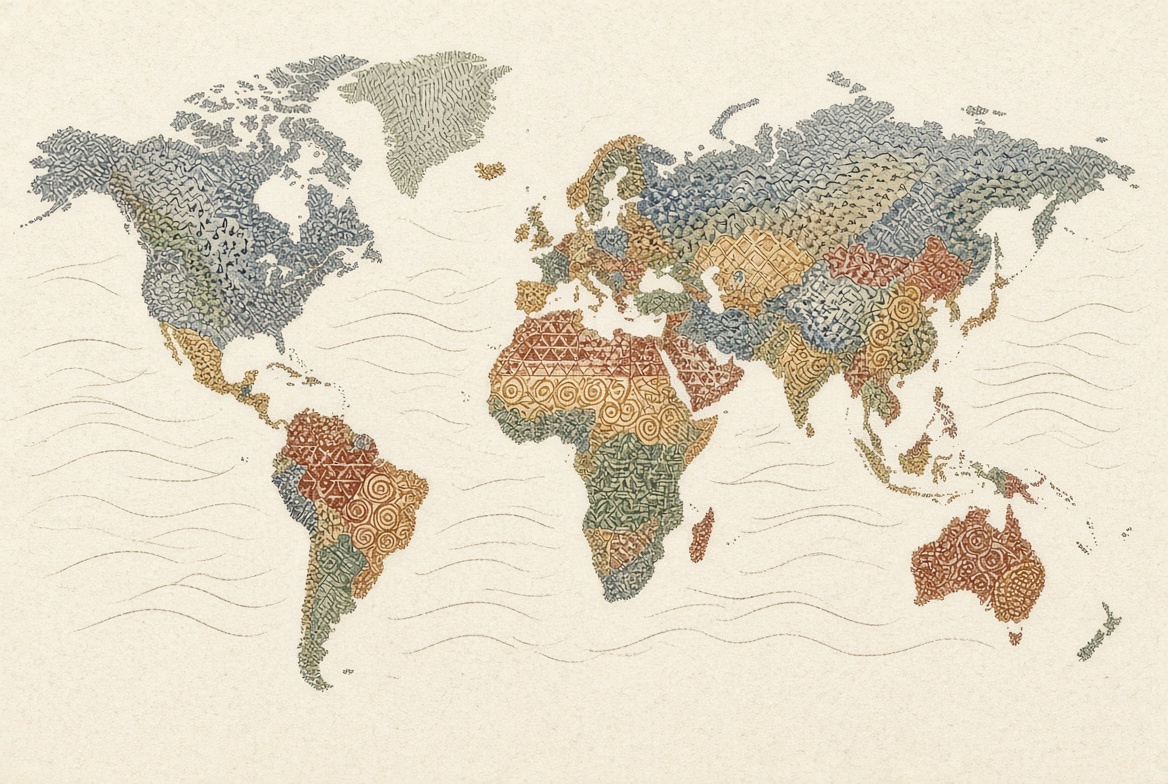
A synthesis entry: it points elsewhere more than it demonstrates, and that is its role.
How many peoples are there on Earth?
This question calls for a surprising answer: nobody wants to answer it, and that is deliberate.
A figure without a definition
The United Nations estimates that there are about 476 million indigenous people in the world, spread across some 90 countries, and representing about 5,000 different cultures. They speak the great majority of the world’s seven thousand languages, and account for less than 5% of the population — but for 15% of the poorest.1
Yet one point is truly remarkable.
There is no official definition of the word “indigenous”. Given the diversity of these peoples, no body of the United Nations system has adopted one.2
Instead, a set of criteria is used, the first of which is this: a person declares themselves indigenous, and the community accepts them as one of its own. Then come historical continuity with the societies that preceded colonisation, a strong link to territory, distinct institutions, language and beliefs, and the will to pass all this on.3
The official United Nations formula comes down to two verbs: it is better to identify than to define.4
A chosen, protective vagueness
Other pages on this site show that the number of the world’s languages depends on the rule one chooses, and that the same goes for the number of people who live in cities.
In those other cases, the vagueness is endured: it arises because each country built its statistics on its own. Nobody wanted it.
Here, the situation is different: the vagueness is chosen, and it protects. To define would amount to deciding for people who they are.
Faced with a vague category, then, it is better not to conclude straight away that the work has been badly done, but to ask instead: is this vagueness endured or chosen — and by whom?
A concrete example: in some countries, groups that international organisations count among indigenous peoples are not recognised as such by their own government. The same world, two ways of describing it, and the figures do not match.
What a culture is
A culture is everything that a human group passes on to those who come after it, without this passing through the genes. Language, ways of eating, of building, of dressing, of counting time, of naming kinship, of treating the dead, of telling the story of the world. None of this is inherited biologically: everything is learned, and everything can therefore change.
The oldest definition still in use dates from 1871. The British anthropologist Edward Tylor defined culture as that complex whole which includes knowledge, belief, art, morals, law, custom — and any other capabilities and habits acquired by man as a member of society. The decisive word is acquired.5
It is this mode of transmission that distinguishes a culture from a population. A population is defined by ancestry, a culture by learning — and the two do not coincide. A child born in one place and raised elsewhere will speak the language of the place where it grows up, not that of its ancestors.
And this transmission does not come only from parents. It also passes through peers of the same age and through adults who are not family — teachers, neighbours and, today, screens. That is why a culture can change quickly: all it takes is for one generation to learn more from its peers than from its parents.6
What is passed on can be grouped into a few domains, which recur everywhere.
- Ways of doing: techniques, working gestures, cooking, care.
- Ways of saying: language, stories, songs, memorised knowledge.
- Ways of living together: kinship rules, forms of authority, ways of settling a conflict.
- Ways of explaining: beliefs, rituals, representations of the world and of the afterlife.
No society invents all this alone, and none keeps it intact. A culture constantly receives elements from elsewhere, adapts them, abandons others. This is its normal state, not a sign of weakness or loss.
That is precisely why counting them is so difficult: what one would like to count has no fixed boundaries.
What a culture is not
A convenient but false image pictures cultures as closed boxes, each with its contents, lined up on a shelf. This encyclopaedia constantly shows the opposite:
- Pasta with tomato sauce: The most “national” Italian dish is Arab through its pasta, American through its tomato, and was put together in a city then governed by Spaniards.
- The Scottish kilt: According to a famous thesis, the short kilt was supposedly devised around 1727 by an English industrialist, so that his Highland workers could work more conveniently.7
This thesis is disputed, and what it rests on deserves to be known. It rests on an article, published in an Edinburgh magazine in 1785 — more than half a century after the events. It is the earliest trace of this story.8
It has, moreover, always irritated the Scots. According to a Scottish historian, the Highlanders of the time considered the story too ridiculous to answer.9
An invented tradition, or an invented invention? The case is not closed.
- The Indian weavers of the nineteenth century: They did not disappear in the face of machine-spun yarn: they bought it and went on weaving.
- The Japanese school model: In 1872, Japan acquired a new school system. It borrowed from two countries at the same time: the organisation — elementary school, secondary school, university — came from France; the pedagogy — the methods, the training of teachers — came from the United States.10
A specialist adds a nuance that applies to all the examples on this page: these were influences, not a model imported or copied as it stood.11
Borrowing is not copying. One takes a piece here, another there, to make something that existed nowhere.
- The Benin Bronzes: They were cast with brass that came from Germany.12
A culture is not a box. It is what a group makes of what happens to it.
What genetics shows
A word is needed about a notion that inevitably comes up. For a long time humans were sorted into large groups defined by appearance, and the word “race” was used for this. This word refers to a classification that people manufactured, at times that can be dated, and that served to dominate others. This is a matter of history, and is not disputed.
In 1972, the geneticist Richard Lewontin compared the genetic variation of humans at three levels: between people within the same population, between closely related populations, and between the large groups that were then called races.13
The result: about 85% of the variation is found between people within the same population. Less than 15% corresponds to the differences between the large groups. Other researchers have since redone the calculation and have arrived at the same result.14
The conclusion that follows is solid: what can be seen — skin colour, the shape of the face — is a very poor guide for guessing the rest. Two people who look alike can differ greatly elsewhere in their genes; two people who do not look alike can be very close.
A note on intellectual honesty: The statement “85% of the variation lies within groups” is correct. However, specialists debate the exact conclusions to be drawn from it, because of the way genes vary together rather than separately. This debate over scientific method does not call the general observation into question.15
Inequality and statistical invisibility
We need to return to the two figures from the beginning: less than 5% of the world’s population, but 15% of the poorest. Placed side by side, they show that the second is three times the first.
This ratio is the important fact, and it is more reliable than any of its decimal places: depending on which institution publishes it, the share varies, but the gap remains.16
What is more, it is not always known how many of them there are. In several countries, censuses do not ask the question, or ask it in a way that gives results very far from the estimates of indigenous organisations.
Not being counted is no mere detail: when people do not appear in public data, it is impossible either to measure the inequalities that affect them or to build policies to remedy them.17
The origins of the erasure
Let us return to the question from the beginning: is the vagueness endured or chosen? While chosen vagueness protects, statistical erasure can result from past policies.
For more than a century, Norway pursued a policy of assimilating the Sámi and other minorities. Children were placed in boarding schools, where they were forbidden to speak their language.
The Norwegian Parliament eventually set up a commission of inquiry. It worked for five years, gathered more than seven hundred testimonies, and on 1 June 2023 delivered a report of nearly seven hundred pages.18
What was done with it was out of the ordinary. On the day it was delivered, the report was read aloud, in full, over more than thirty-five hours, live on the national channel.19
A year and a half later, in November 2024, the Parliament issued an official apology to the Sámi, the Kvens and the Forest Finns — acknowledging the active role it had itself played in this policy.20
One effect of this policy remains visible today: many descendants of these minorities do not know that they belong to them, because the name of their people was for a long time a word to be ashamed of.
The fog over the figures is sometimes the result of a policy that silenced, then made people forget.
Note 1
There are an estimated 476 million indigenous peoples in the world living across 90 countries.
Nations unies, “Journée internationale des peuples autochtones — contexte”
represent 5,000 different cultures
Nations unies, “Journée internationale des peuples autochtones — contexte”
They speak an overwhelming majority of the world's estimated 7,000 languages
Nations unies, “Journée internationale des peuples autochtones — contexte”
They make up less than 5 per cent of the world's population, but account for 15 per cent of the poorest.
Nations unies, “Journée internationale des peuples autochtones — contexte”
Note 2
Considering the diversity of indigenous peoples, an official definition of "indigenous" has not been adopted by any UN-system body.
Instance permanente des Nations unies sur les questions autochtones, “Who are indigenous peoples?”, fiche d’information
Note 3
Self-identification as indigenous peoples at the individual level and accepted by the community as their member.
Instance permanente des Nations unies sur les questions autochtones, “Who are indigenous peoples?”, fiche d’information
Historical continuity with pre-colonial and/or pre-settler societies • Strong link to territories and surrounding natural resources • Distinct social, economic or political systems • Distinct language, culture and beliefs […] Resolve to maintain and reproduce their ancestral environments and systems
Instance permanente des Nations unies sur les questions autochtones, “Who are indigenous peoples?”, fiche d’information
Note 4
According to the UN the most fruitful approach is to identify, rather than define indigenous peoples.
Instance permanente des Nations unies sur les questions autochtones, “Who are indigenous peoples?”, fiche d’information
Note 5
Culture or Civilization, taken in its wide ethnographic sense, is that complex whole which includes knowledge, belief, art, morals, law, custom, and any other capabilities and habits acquired by man as a member of society.
Tylor, Edward Burnett, Primitive Culture, John Murray, Londres, 1871, chapitre I, p. 1
Culture or Civilization, taken in its wide ethnographic sense, is that complex whole which includes knowledge, belief, art, morals, law, custom, and any other capabilities and habits acquired by man as a member of society.
Tylor, Edward Burnett, Primitive Culture, John Murray, Londres, 1871, chapitre I, p. 1, public domain
Note 6
Cavalli-Sforza & Feldman [6] focused on three key pathways of cultural transmission: vertical (from parents to children), horizontal (among peers), and oblique (from unrelated adults, such as teachers).
Tamariz, Monica, Walker, Bradley, Bennett, Matthew, Segovia-Martín, José and Fay, Nicolas, “Cultural Transmission of Attitudes and Behaviours from Parents, Peers and Grandparents”, PLOS ONE, vol. 21, no. 1, e0341433, 2026
Note 7
The story was that, previous to 1728, the kilt as a separate garment did not exist, […] An Englishman named Rawlinson, manager of the iron works at Glengarry, Inverness-shire, it was said, finding his Highland labourers so much encumbered by a garment measuring eight yards of double cloth, had taught them to divide it down the middle and sew it in single width into its present shape.
Mackay, J. G., The Romantic Story of the Highland Garb and the Tartan, Stirling, Eneas Mackay, 1924
Note 8
This story first saw the light of day in an article which appeared in the Scots Magazine, published in Edinburgh in 1785.
Mackay, J. G., The Romantic Story of the Highland Garb and the Tartan, Stirling, Eneas Mackay, 1924
Note 9
To Highlanders, at the time, the tale seemed too ridiculous to merit notice, but it offered too good an opportunity for a taunt at Highland prestige to allow it to be forgotten.
Mackay, J. G., The Romantic Story of the Highland Garb and the Tartan, Stirling, Eneas Mackay, 1924
Note 10
À l’origine en 1872, le modèle institutionnel – école élémentaire, école secondaire, université –, est français. Le modèle pédagogique, lui, vient des États-Unis, en particulier de l’école normale d’Oswego (New York).
Originally, in 1872, the institutional model – elementary school, secondary school, university – was French. The pedagogical model, for its part, came from the United States, in particular from the Oswego normal school (New York).
Galan, Christian, “Christian Galan | Le système éducatif n’a été pensé que pour les enfants japonais”, entretien avec Serge Rived, lepetitjournal.com (Tokyo), 23 June 2023
Note 11
Il s’agit d’influences, il n’y a pas eu de modèle importé ou copié in extenso.
These were influences; there was no model imported or copied in extenso.
Galan, Christian, “Christian Galan | Le système éducatif n’a été pensé que pour les enfants japonais”, entretien avec Serge Rived, lepetitjournal.com (Tokyo), 23 June 2023
Note 12
Comparing trace elements and lead isotope ratios of manillas and Benin Bronzes identifies Germany as the principal source of the manillas used in the West African trade between the 15th and 18th centuries […] Millions of these artifacts were sent to West Africa where they likely provided the major, virtually the only, source of brass for West African casters between the 15th and the 18th centuries, including serving as the principal metal source of the Benin Bronzes.
Skowronek, Tobias B. et al., “German Brass for Benin Bronzes: Geochemical Analysis Insights into the Early Atlantic Trade”, PLOS ONE, vol. 18, e0283415, 2023
Note 13
With the table set, Lewontin serves the main dish, estimating that at an average genetic locus, 85.4% of the total diversity of the human species is within populations, 8.3% is among populations but within races and 6.3% is among races.
Edge, Michael D., Ramachandran, Sohini and Rosenberg, Noah A., “Celebrating 50 years since Lewontin’s apportionment of human diversity”, Philosophical Transactions of the Royal Society B, vol. 377, no. 1852, 2022, article 20200405
Note 14
With the table set, Lewontin serves the main dish, estimating that at an average genetic locus, 85.4% of the total diversity of the human species is within populations, 8.3% is among populations but within races and 6.3% is among races.
Edge, Michael D., Ramachandran, Sohini and Rosenberg, Noah A., “Celebrating 50 years since Lewontin’s apportionment of human diversity”, Philosophical Transactions of the Royal Society B, vol. 377, no. 1852, 2022, article 20200405
Within-population differences among individuals account for 93 to 95% of genetic variation; differences among major groups constitute only 3 to 5%.
Rosenberg, Noah A. et al., “Genetic Structure of Human Populations”, Science, vol. 298, 2002, p. 2381-2385
Note 15
This conclusion, due to R.C. Lewontin in 1972, is unwarranted because the argument ignores the fact that most of the information that distinguishes populations is hidden in the correlation structure of the data and not simply in the variation of the individual factors.
Edwards, A. W. F., “Human Genetic Diversity: Lewontin’s Fallacy”, BioEssays, vol. 25, 2003, p. 798-801
Note 16
They make up only 6.2 percent of the global population, yet account for 18.2 percent of those living in extreme poverty worldwide.
Banque mondiale, “Indigenous Peoples: Overview”
Note 17
The report emphasizes the critical need for reliable data to understand and address the challenges faced by IP communities in the Philippines. It highlights the dearth of data in areas that matter to IP communities, such as population and demography, poverty and inequality, the status of Ancestral Domains (ADs), and the interactions between poverty, land, and conflict.
Banque mondiale, “No Data, No Story: Indigenous Peoples in the Philippines (Report Highlights)”, 4 April 2025
Note 18
au cours de ses cinq années de travail […] Le 1er juin à midi, le président de la Commission vérité et réconciliation (CVR) norvégienne, Dagfinn Høybråten, remet son rapport final […] qui compte près de 700 pages […] en s'appuyant sur des entretiens avec plus de 700 personnes
over its five years of work […] On 1 June at noon, the chair of the Norwegian Truth and Reconciliation Commission (TRC), Dagfinn Høybråten, delivers his final report […] which runs to nearly 700 pages […] drawing on interviews with more than 700 people
Andersen, Astrid Nonbo, Dankertsen, Astri and Kortekangas, Otso, “Le processus de vérité et de réconciliation en Norvège va-t-il changer les choses ?”, JusticeInfo.net, 29 August 2023
Note 19
Une heure plus tard […] une première lecture à haute voix du rapport intégral de la CVR, qui compte près de 700 pages. La lecture dure plus de 35 heures et peut être suivie en direct sur la chaîne nationale NRK et des stations dans tout le pays.
An hour later […] a first reading aloud of the full TRC report, which runs to nearly 700 pages. The reading lasts more than 35 hours and can be followed live on the national channel NRK and on stations throughout the country.
Andersen, Astrid Nonbo, Dankertsen, Astri and Kortekangas, Otso, “Le processus de vérité et de réconciliation en Norvège va-t-il changer les choses ?”, JusticeInfo.net, 29 August 2023
Note 20
Le 12 novembre, le Parlement norvégien a présenté ses excuses aux Samis […] le Storting présente des excuses officielles aux Samis, aux Kvens, aux Finlandais norvégiens et aux Finlandais de la Forêt : […] Le Storting présente ses excuses pour le rôle actif que les précédents Storting ont joué dans la politique de norvégianisation et reconnaît sa responsabilité dans les conséquences que ces politiques ont eues pour les groupes et les individus
On 12 November, the Norwegian Parliament apologised to the Sámi […] the Storting offers an official apology to the Sámi, the Kvens, the Norwegian Finns and the Forest Finns: […] The Storting apologises for the active role that previous Stortings played in the Norwegianisation policy and acknowledges its responsibility for the consequences these policies have had for groups and individuals
Andersen, Astrid Nonbo, Habbestad, Amalie Drage and Dankertsen, Astri, “La Norvège s’ouvre à la réconciliation”, JusticeInfo.net, 28 November 2024
Notes and sources
- ↑
Passage about 476 million indigenous people in the world, spread across some 90 countries
There are an estimated 476 million indigenous peoples in the world living across 90 countries.
Source Nations unies, “Journée internationale des peuples autochtones — contexte”, introductory paragraph.
Open access open the source · checked on 9 September 2026
Passage representing about 5,000 different cultures
represent 5,000 different cultures
Source Nations unies, “Journée internationale des peuples autochtones — contexte”, introductory paragraph.
Open access open the source · checked on 9 September 2026
Passage They speak the great majority of the world’s seven thousand languages
They speak an overwhelming majority of the world's estimated 7,000 languages
Source Nations unies, “Journée internationale des peuples autochtones — contexte”, introductory paragraph.
Open access open the source · checked on 9 September 2026
Passage account for less than 5% of the population — but for 15% of the poorest
They make up less than 5 per cent of the world's population, but account for 15 per cent of the poorest.
Source Nations unies, “Journée internationale des peuples autochtones — contexte”, introductory paragraph.
Open access open the source · checked on 9 September 2026
- ↑
Passage Given the diversity of these peoples, no body of the United Nations system has adopted one.
Considering the diversity of indigenous peoples, an official definition of "indigenous" has not been adopted by any UN-system body.
Source Instance permanente des Nations unies sur les questions autochtones, “Who are indigenous peoples?”, fiche d’information, section “Understanding the term "indigenous"”.
Open access open the source · checked on 9 September 2026
- ↑
Passage a person declares themselves indigenous, and the community accepts them as one of its own
Self-identification as indigenous peoples at the individual level and accepted by the community as their member.
Source Instance permanente des Nations unies sur les questions autochtones, “Who are indigenous peoples?”, fiche d’information, first criterion in the list.
Open access open the source · checked on 9 September 2026
Passage historical continuity with the societies that preceded colonisation, a strong link to territory, distinct institutions, language and beliefs, and the will to pass all this on
Historical continuity with pre-colonial and/or pre-settler societies • Strong link to territories and surrounding natural resources • Distinct social, economic or political systems • Distinct language, culture and beliefs […] Resolve to maintain and reproduce their ancestral environments and systems
Source Instance permanente des Nations unies sur les questions autochtones, “Who are indigenous peoples?”, fiche d’information, list of criteria.
Open access open the source · checked on 9 September 2026
- ↑
Passage it is better to identify than to define
According to the UN the most fruitful approach is to identify, rather than define indigenous peoples.
Source Instance permanente des Nations unies sur les questions autochtones, “Who are indigenous peoples?”, fiche d’information, section “A question of identity”.
Open access open the source · checked on 9 September 2026
- ↑
Passage The British anthropologist Edward Tylor defined culture as that complex whole which includes knowledge, belief, art, morals, law, custom — and any other capabilities and habits acquired by man as a member of society
Culture or Civilization, taken in its wide ethnographic sense, is that complex whole which includes knowledge, belief, art, morals, law, custom, and any other capabilities and habits acquired by man as a member of society.
Source Tylor, Edward Burnett, Primitive Culture, John Murray, Londres, 1871, chapitre I, p. 1, chapter I, first sentence, p. 1.
Public domain open the source · checked on 9 September 2026
Passage The oldest definition still in use dates from 1871
Culture or Civilization, taken in its wide ethnographic sense, is that complex whole which includes knowledge, belief, art, morals, law, custom, and any other capabilities and habits acquired by man as a member of society.
Source Tylor, Edward Burnett, Primitive Culture, John Murray, Londres, 1871, chapitre I, p. 1, public domain, chapter I, “The Science of Culture”, first sentence (p. 1); the editions page states “First edition, April, 1871”.
Open access open the source · checked on 24 October 2026
- ↑
Passage this transmission does not come only from parents. It also passes through peers of the same age and through adults who are not family
Cavalli-Sforza & Feldman [6] focused on three key pathways of cultural transmission: vertical (from parents to children), horizontal (among peers), and oblique (from unrelated adults, such as teachers).
Source Tamariz, Monica, Walker, Bradley, Bennett, Matthew, Segovia-Martín, José and Fay, Nicolas, “Cultural Transmission of Attitudes and Behaviours from Parents, Peers and Grandparents”, PLOS ONE, vol. 21, no. 1, e0341433, 2026, Introduction, sentence preceding the “Cultural transmission pathways” subsections.
Open access open the source · checked on 27 October 2026
- ↑
Passage the short kilt was supposedly devised around 1727 by an English industrialist, so that his Highland workers could work more conveniently
The story was that, previous to 1728, the kilt as a separate garment did not exist, […] An Englishman named Rawlinson, manager of the iron works at Glengarry, Inverness-shire, it was said, finding his Highland labourers so much encumbered by a garment measuring eight yards of double cloth, had taught them to divide it down the middle and sew it in single width into its present shape.
Source Mackay, J. G., The Romantic Story of the Highland Garb and the Tartan, Stirling, Eneas Mackay, 1924, Introduction, p. 27.
Open access open the source · checked on 24 October 2026
- ↑
Passage It rests on an article, published in an Edinburgh magazine in 1785 — more than half a century after the events. It is the earliest trace of this story.
This story first saw the light of day in an article which appeared in the Scots Magazine, published in Edinburgh in 1785.
Source Mackay, J. G., The Romantic Story of the Highland Garb and the Tartan, Stirling, Eneas Mackay, 1924, Introduction, p. 27.
Open access open the source · checked on 24 October 2026
- ↑
Passage According to a Scottish historian, the Highlanders of the time considered the story too ridiculous to answer.
To Highlanders, at the time, the tale seemed too ridiculous to merit notice, but it offered too good an opportunity for a taunt at Highland prestige to allow it to be forgotten.
Source Mackay, J. G., The Romantic Story of the Highland Garb and the Tartan, Stirling, Eneas Mackay, 1924, Introduction, p. 27.
Open access open the source · checked on 24 October 2026
- ↑
Passage In 1872, Japan acquired a new school system. […] the organisation — elementary school, secondary school, university — came from France; the pedagogy — the methods, the training of teachers — came from the United States
À l’origine en 1872, le modèle institutionnel – école élémentaire, école secondaire, université –, est français. Le modèle pédagogique, lui, vient des États-Unis, en particulier de l’école normale d’Oswego (New York).
Editors’ translation Originally, in 1872, the institutional model – elementary school, secondary school, university – was French. The pedagogical model, for its part, came from the United States, in particular from the Oswego normal school (New York).
Source Galan, Christian, “Christian Galan | Le système éducatif n’a été pensé que pour les enfants japonais”, entretien avec Serge Rived, lepetitjournal.com (Tokyo), 23 June 2023, interview, answer on foreign models.
Open access open the source · checked on 9 September 2026
- ↑
Passage these were influences, not a model imported or copied as it stood
Il s’agit d’influences, il n’y a pas eu de modèle importé ou copié in extenso.
Editors’ translation These were influences; there was no model imported or copied in extenso.
Source Galan, Christian, “Christian Galan | Le système éducatif n’a été pensé que pour les enfants japonais”, entretien avec Serge Rived, lepetitjournal.com (Tokyo), 23 June 2023, interview, answer on foreign models.
Open access open the source · checked on 9 September 2026
- ↑
Passage The Benin Bronzes: They were cast with brass that came from Germany.
Comparing trace elements and lead isotope ratios of manillas and Benin Bronzes identifies Germany as the principal source of the manillas used in the West African trade between the 15th and 18th centuries […] Millions of these artifacts were sent to West Africa where they likely provided the major, virtually the only, source of brass for West African casters between the 15th and the 18th centuries, including serving as the principal metal source of the Benin Bronzes.
Source Skowronek, Tobias B. et al., “German Brass for Benin Bronzes: Geochemical Analysis Insights into the Early Atlantic Trade”, PLOS ONE, vol. 18, e0283415, 2023, abstract and conclusion.
Open access open the source · checked on 24 October 2026
- ↑
Passage In 1972, the geneticist Richard Lewontin compared the genetic variation of humans at three levels
With the table set, Lewontin serves the main dish, estimating that at an average genetic locus, 85.4% of the total diversity of the human species is within populations, 8.3% is among populations but within races and 6.3% is among races.
Source Edge, Michael D., Ramachandran, Sohini and Rosenberg, Noah A., “Celebrating 50 years since Lewontin’s apportionment of human diversity”, Philosophical Transactions of the Royal Society B, vol. 377, no. 1852, 2022, article 20200405, section 2 “Lewontin’s 1972 paper”, 5th paragraph.
Open access open the source · checked on 9 September 2026
- ↑
Passage about 85% of the variation is found between people within the same population
With the table set, Lewontin serves the main dish, estimating that at an average genetic locus, 85.4% of the total diversity of the human species is within populations, 8.3% is among populations but within races and 6.3% is among races.
Source Edge, Michael D., Ramachandran, Sohini and Rosenberg, Noah A., “Celebrating 50 years since Lewontin’s apportionment of human diversity”, Philosophical Transactions of the Royal Society B, vol. 377, no. 1852, 2022, article 20200405, section 2 “Lewontin’s 1972 paper”, 5th paragraph.
Open access open the source · checked on 9 September 2026
Passage Other researchers have since redone the calculation and have arrived at the same result.
Within-population differences among individuals account for 93 to 95% of genetic variation; differences among major groups constitute only 3 to 5%.
Source Rosenberg, Noah A. et al., “Genetic Structure of Human Populations”, Science, vol. 298, 2002, p. 2381-2385, abstract.
Paywalled · checked on 25 October 2026
- ↑
Passage specialists debate the exact conclusions to be drawn from it, because of the way genes vary together rather than separately
This conclusion, due to R.C. Lewontin in 1972, is unwarranted because the argument ignores the fact that most of the information that distinguishes populations is hidden in the correlation structure of the data and not simply in the variation of the individual factors.
Source Edwards, A. W. F., “Human Genetic Diversity: Lewontin’s Fallacy”, BioEssays, vol. 25, 2003, p. 798-801, abstract.
Paywalled · checked on 25 October 2026
- ↑
Passage depending on which institution publishes it, the share varies, but the gap remains
They make up only 6.2 percent of the global population, yet account for 18.2 percent of those living in extreme poverty worldwide.
Source Banque mondiale, “Indigenous Peoples: Overview”, section “Our Approach to Indigenous Peoples”, subsection “Context”.
Open access open the source · checked on 24 October 2026
- ↑
Passage when people do not appear in public data, it is impossible either to measure the inequalities that affect them or to build policies to remedy them
The report emphasizes the critical need for reliable data to understand and address the challenges faced by IP communities in the Philippines. It highlights the dearth of data in areas that matter to IP communities, such as population and demography, poverty and inequality, the status of Ancestral Domains (ADs), and the interactions between poverty, land, and conflict.
Source Banque mondiale, “No Data, No Story: Indigenous Peoples in the Philippines (Report Highlights)”, 4 April 2025, body of the page, point “Importance of Data”.
Open access open the source · checked on 9 September 2026
- ↑
Passage It worked for five years, gathered more than seven hundred testimonies, and on 1 June 2023 delivered a report of nearly seven hundred pages
au cours de ses cinq années de travail […] Le 1er juin à midi, le président de la Commission vérité et réconciliation (CVR) norvégienne, Dagfinn Høybråten, remet son rapport final […] qui compte près de 700 pages […] en s'appuyant sur des entretiens avec plus de 700 personnes
Editors’ translation over its five years of work […] On 1 June at noon, the chair of the Norwegian Truth and Reconciliation Commission (TRC), Dagfinn Høybråten, delivers his final report […] which runs to nearly 700 pages […] drawing on interviews with more than 700 people
Source Andersen, Astrid Nonbo, Dankertsen, Astri and Kortekangas, Otso, “Le processus de vérité et de réconciliation en Norvège va-t-il changer les choses ?”, JusticeInfo.net, 29 August 2023, body of the article.
Open access open the source · checked on 9 September 2026
- ↑
Passage the report was read aloud, in full, over more than thirty-five hours, live on the national channel
Une heure plus tard […] une première lecture à haute voix du rapport intégral de la CVR, qui compte près de 700 pages. La lecture dure plus de 35 heures et peut être suivie en direct sur la chaîne nationale NRK et des stations dans tout le pays.
Editors’ translation An hour later […] a first reading aloud of the full TRC report, which runs to nearly 700 pages. The reading lasts more than 35 hours and can be followed live on the national channel NRK and on stations throughout the country.
Source Andersen, Astrid Nonbo, Dankertsen, Astri and Kortekangas, Otso, “Le processus de vérité et de réconciliation en Norvège va-t-il changer les choses ?”, JusticeInfo.net, 29 August 2023, body of the article.
Open access open the source · checked on 9 September 2026
- ↑
Passage in November 2024, the Parliament issued an official apology to the Sámi, the Kvens and the Forest Finns
Le 12 novembre, le Parlement norvégien a présenté ses excuses aux Samis […] le Storting présente des excuses officielles aux Samis, aux Kvens, aux Finlandais norvégiens et aux Finlandais de la Forêt : […] Le Storting présente ses excuses pour le rôle actif que les précédents Storting ont joué dans la politique de norvégianisation et reconnaît sa responsabilité dans les conséquences que ces politiques ont eues pour les groupes et les individus
Editors’ translation On 12 November, the Norwegian Parliament apologised to the Sámi […] the Storting offers an official apology to the Sámi, the Kvens, the Norwegian Finns and the Forest Finns: […] The Storting apologises for the active role that previous Stortings played in the Norwegianisation policy and acknowledges its responsibility for the consequences these policies have had for groups and individuals
Source Andersen, Astrid Nonbo, Habbestad, Amalie Drage and Dankertsen, Astri, “La Norvège s’ouvre à la réconciliation”, JusticeInfo.net, 28 November 2024, subtitle and body of the article.
Open access open the source · checked on 9 September 2026
Bibliography
16
- Andersen, Astrid Nonbo, Dankertsen, Astri and Kortekangas, Otso, “Le processus de vérité et de réconciliation en Norvège va-t-il changer les choses ?”, JusticeInfo.net, 29 August 2023, open access (the Norwegian commission’s five years of work, the more than 700 people heard, the report of nearly 700 pages delivered on 1 June 2023 and its public reading of more than 35 hours). https://www.justiceinfo.net/fr/120811-processus-verite-reconciliation-norvege-changer-choses.html
- Andersen, Astrid Nonbo, Habbestad, Amalie Drage and Dankertsen, Astri, “La Norvège s’ouvre à la réconciliation”, JusticeInfo.net, 28 November 2024, open access (the Norwegian Parliament’s official apology of 12 November 2024). https://www.justiceinfo.net/fr/138875-norvege-ouvre-reconciliation.html
- Banque mondiale, “Indigenous Peoples: Overview”, open access (the share of the world’s population and that of people in extreme poverty). https://www.worldbank.org/en/topic/indigenouspeoples
- Banque mondiale, “No Data, No Story: Indigenous Peoples in the Philippines (Report Highlights)”, 4 April 2025, open access (without reliable data on indigenous peoples, their poverty and the inequalities that affect them can be neither understood nor addressed). https://www.worldbank.org/en/country/philippines/publication/no-data-no-story-indigenous-peoples-in-the-philippines-report-highlights
- Cavalli-Sforza, Luigi Luca and Feldman, Marcus W., Cultural Transmission and Evolution: A Quantitative Approach, Princeton University Press, 1981, in libraries (the modes of cultural transmission — parents, peers, teachers — and their effects on the speed of cultural change).
- Edge, Michael D., Ramachandran, Sohini and Rosenberg, Noah A., “Celebrating 50 years since Lewontin’s apportionment of human diversity”, Philosophical Transactions of the Royal Society B, vol. 377, no. 1852, 2022, article 20200405, open access (Lewontin’s 1972 calculation at three levels and its result: 85.4% of the diversity within populations). https://doi.org/10.1098/rstb.2020.0405
- Edwards, A. W. F., “Human Genetic Diversity: Lewontin’s Fallacy”, BioEssays, vol. 25, 2003, p. 798-801, paywalled (the debate over method concerning genes that vary together).
- Galan, Christian, “Christian Galan | Le système éducatif n’a été pensé que pour les enfants japonais”, entretien avec Serge Rived, lepetitjournal.com (Tokyo), 23 June 2023, open access (the French institutional model and the American pedagogical model adopted in 1872; the warning against the idea of a model imported as it stood). https://lepetitjournal.com/tokyo/christian-galan
- Instance permanente des Nations unies sur les questions autochtones, “Who are indigenous peoples?”, fiche d’information, open access (no official definition adopted; the criteria used, starting with self-identification accepted by the community). https://www.un.org/esa/socdev/unpfii/documents/5session_factsheet1.pdf
- Lewontin, Richard C., “The Apportionment of Human Diversity”, Evolutionary Biology, vol. 6, 1972, p. 381-398, paywalled.
- Mackay, J. G., The Romantic Story of the Highland Garb and the Tartan, Stirling, Eneas Mackay, 1924, open access (the account of the invention of the short kilt by Rawlinson, before 1728; its first appearance in an article in the Scots Magazine published in Edinburgh in 1785; the reception the Highlanders gave it). https://archive.org/details/romanticstoryofh00mack
- Nations unies, “Journée internationale des peuples autochtones — contexte”, open access (476 million people, 90 countries, 5,000 cultures, the majority of the seven thousand languages, less than 5% of the population but 15% of the poorest). https://www.un.org/en/observances/indigenous-day/background
- Rosenberg, Noah A. et al., “Genetic Structure of Human Populations”, Science, vol. 298, 2002, p. 2381-2385, paywalled (the result found again with modern data).
- Skowronek, Tobias B. et al., “German Brass for Benin Bronzes: Geochemical Analysis Insights into the Early Atlantic Trade”, PLOS ONE, vol. 18, e0283415, 2023, open access (the European brass of the Benin Bronzes). https://doi.org/10.1371/journal.pone.0283415
- Tamariz, Monica, Walker, Bradley, Bennett, Matthew, Segovia-Martín, José and Fay, Nicolas, “Cultural Transmission of Attitudes and Behaviours from Parents, Peers and Grandparents”, PLOS ONE, vol. 21, no. 1, e0341433, 2026, open access (Cavalli-Sforza and Feldman’s three pathways of transmission: from parents, from peers, from unrelated adults). https://doi.org/10.1371/journal.pone.0341433
- Tylor, Edward Burnett, Primitive Culture, John Murray, Londres, 1871, chapitre I, p. 1, public domain (the definition of culture as a whole of capabilities acquired as a member of a society). https://archive.org/details/primitiveculture0171tylo
Spotted an error or have a doubt? Write to us.