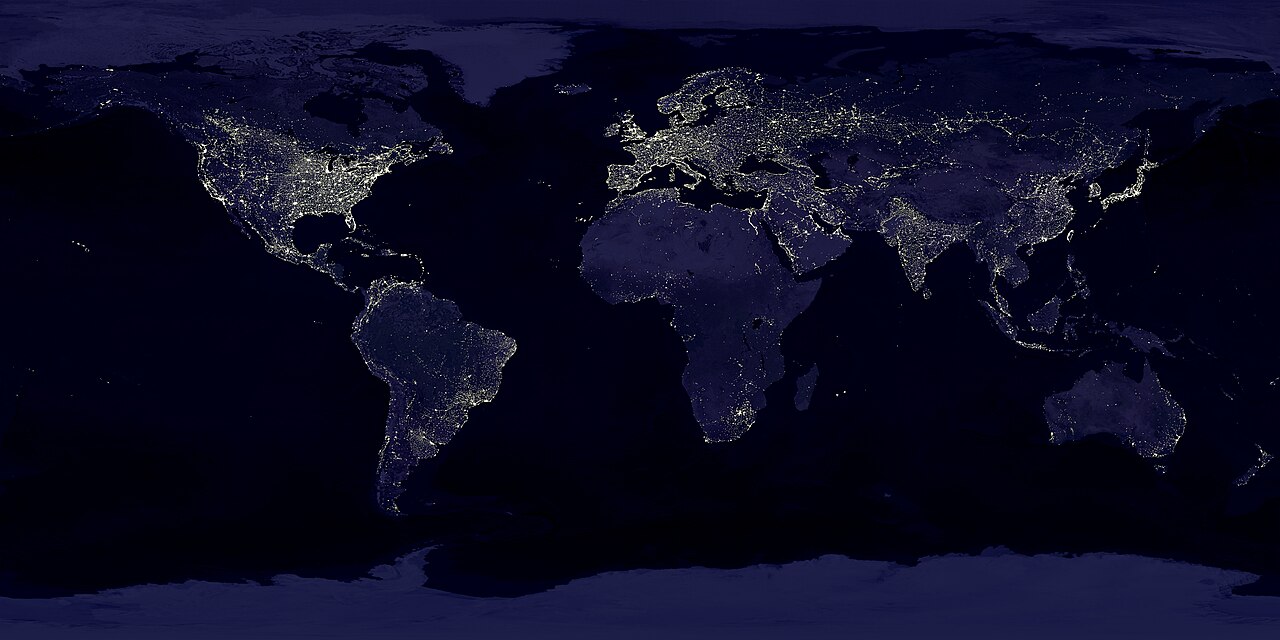

A seemingly simple question: exactly what share of humanity lives in cities today?
Put the question to a search engine, a geography book or an international institution, and the answer seems immediately obvious, backed by precise figures. Yet as soon as one compares the work of experts on a global scale, the verdict is unequivocal: nobody agrees on the answer.
This vagueness is not due to a lack of data or to calculation errors. The reason is far deeper and more interesting: we do not know how to define, universally, what a “city” is.
Three official answers, three different truths
Measuring a global phenomenon requires a method. Depending on the rule applied, the urban face of the planet changes completely. For the year 2015 alone, two major reference methods put forward radically different assessments:
- The national-definitions method. The UN long compiled the official reports submitted by each country, without questioning their criteria. That is where the most famous figure comes from, the one found in the media and in textbooks: a little over half of humanity is said to be urban.
- The density method. Developed by the European Commission and its partners to compare territories with one and the same rule, it looks not at the administrative status of a place but at the number of people living on each square kilometre. It divides territory into three: cities, towns and suburbs, and rural areas.1
The decisive result is as follows. With the harmonised rule, the urban share is roughly the same as with national definitions in the Americas, Europe and Oceania — but considerably higher in Africa and Asia.2
Why? Because towns, that intermediate category, are counted as rural in Africa and Asia, and as urban elsewhere. The disagreement does not come from the big cities or from the countryside: it comes from what is done with the middle.3
None of these institutions got its sums wrong. They are two distinct ways of deciding where the city ends.
The origins of the wide gap: inconsistent national criteria
The reason there is no single figure at the UN is that there is no definition of the word “city” that all countries apply. Each government has drawn up its own (in France, at least 2,000 inhabitants), according to its geography, its history or its domestic politics.4
The gap between national rules is sometimes spectacular:
Some countries set a very low threshold: a few hundred inhabitants are enough to constitute an urban area. Others require tens of thousands of people, concentrated in a dense core where people do not make their living from farming.
Between the two, the ratio runs into the hundreds. Each country has set the threshold wherever its history and geography led it.5
Take a town of three thousand inhabitants. In a country with a low threshold, it is urban beyond dispute. Transposed to a country with a high threshold, it becomes rural. The town has not changed; the rule has.
Since then, the United Nations has changed its method
This page long set two camps against each other: the United Nations compiling national definitions on one side, the advocates of a harmonised density rule on the other.
That opposition no longer exists. The United Nations Statistical Commission has adopted the density method, and the new edition of the World Urbanization Prospects uses it.6
Here is the result for 2025: of the 8.2 billion human beings, 45% live in cities, 36% in towns, 19% in rural areas.7
These numbers are worth putting into perspective. In 1950, the share of cities was only 20%: it has more than doubled. The share of towns has fallen from 40 to 36%. And that of the countryside has halved.8
The United Nations’ first conclusion fits into one sentence: there are now more people in cities than in towns or in the countryside.9
What is worth remembering is not the new figure. It is that a disagreement over definitions, presented here as a lasting difficulty, was settled within a few years — because a method proved itself and the most widely cited institution took it up. Disputes over measurement do not always last.
The end of the disagreement: consensus on the metropolises
There is, however, one geographical level at which everyone agrees. As soon as one leaves the world of small built-up areas to look only at the great metropolises, the disputes over definition vanish.
Nobody hesitates to call a megacity such as Tokyo, São Paulo or Cairo a city. Nobody disputes the rural character of an isolated farm or a mountain hamlet. For large agglomerations, the two methods broadly agree.10
The global disagreement is not about the extremes. It is about the whole intermediate zone.
Incidentally, one category keeps growing: that of megacities, cities of ten million inhabitants or more. In 2025, more than half of them were in Asia.11
The world is not a border, it is a continuum
The classic mistake is to imagine the world cut in two by a sharp border: on one side the city with its concrete and its lights, on the other the countryside with its fields and its forests.
On the ground, reality looks more like a continuous gradient, a gentle slope along which spaces follow one another without any abrupt break:
Isolated farm ⟶ Hamlet ⟶ Village ⟶ Market town ⟶ Small town ⟶ Suburb ⟶ Dense centre
Wherever one decides to place an arbitrary barrier along this chain, one obtains a figure. That figure tells us less about the reality on the ground than about the exact point at which the observer chose to draw the line.
That is why repeating the striking phrase “more than half of humanity now lives in cities” conveys very little real information, unless one has checked who counted what, and by what rule.
Deconstructing the universal myth of the rural exodus
Beyond the mere question of counting, the way we imagine the growth of cities is also coloured by received ideas.
The traditional account of urbanisation is well known: modern industry arrives, factories need labour, the countryside mechanises and empties, bringing about a massive rural exodus towards the factories of the cities. This theoretical model, formalised by the economist Arthur Lewis in 1954, was devised by observing the industrial history of Europe and North America.12
Yet when researchers set out to check whether this model applied to the rest of the planet, they found that it did not hold up everywhere:
- Urbanisation without factories. Cities have grown a great deal in countries with almost no factories, which live mainly from selling their natural resources. Industry can feed a city; it is not the condition for its expansion.
- The surge of births within cities. In low- and middle-income countries, most new city dwellers are no longer rural people who have just arrived: they are children born in the city. Natural increase has overtaken migration as the main driver of urban growth.
- Rentier and service cities. A large study covering more than a hundred countries revealed another path. In countries whose economy rests on the extraction of natural resources, cities grow not around assembly lines but around the services and consumption that this rent makes possible.13
So there is not one single, universal road to urbanisation, but a variety of trajectories that shape extremely different types of city around the world.
A trap: “rate” and “volume” do not mean the same thing
Even at the highest level of political decision-making, a common confusion of terms distorts our understanding of urban dynamics. It is crucial to distinguish two notions that are often lumped together:
- The urbanisation rate: This is a percentage. It indicates the relative share of city dwellers in the total population of a country.
- Urban population growth: This is an absolute number. It measures the raw quantity of additional people living in cities.
The same country can see its urbanisation rate rise at an ordinary pace while taking into its cities, every year, an unprecedented number of people — simply because its total population is growing strongly.
Confusing the speed at which the proportion rises with the raw quantity of inhabitants arriving leads to serious errors in planning housing, schools and transport.
The United Nations, moreover, projects that two-thirds of world population growth between now and 2050 will take place in cities, and most of the remainder in towns.14
Note 1
The Degree of Urbanisation is a new definition of cities, towns and semi-dense areas, and rural areas
Dijkstra, Lewis et al., “Applying the Degree of Urbanisation to the Globe: A New Harmonised Definition Reveals a Different Picture of Global Urbanisation”, Journal of Urban Economics, vol. 125, 103312, 2021
Note 2
The urban population share according to the Degree of Urbanisation is similar to the one based on national definitions in the Americas, Europe and Oceania, but considerably higher in Africa and Asia.
Dijkstra, Lewis et al., “Applying the Degree of Urbanisation to the Globe: A New Harmonised Definition Reveals a Different Picture of Global Urbanisation”, Journal of Urban Economics, vol. 125, 103312, 2021
Note 3
towns are likely to be classified as rural areas in Africa and Asia and as urban areas in other parts of the world
Dijkstra, Lewis et al., “Applying the Degree of Urbanisation to the Globe: A New Harmonised Definition Reveals a Different Picture of Global Urbanisation”, Journal of Urban Economics, vol. 125, 103312, 2021
Note 4
Les unités urbaines sont construites en France métropolitaine et dans les DOM d’après la définition suivante : une commune ou un ensemble de communes présentant une zone de bâti continu (pas de coupure de plus de 200 mètres entre deux constructions) qui compte au moins 2 000 habitants.
Urban units are constructed in metropolitan France and in the overseas departments (DOM) according to the following definition: a municipality or group of municipalities with a zone of continuous building (no gap of more than 200 metres between two buildings) that has at least 2,000 inhabitants.
INSEE, “Unité urbaine : définition”
Because of national differences in the characteristics that distinguish urban from rural areas, the distinction between the urban and the rural population is not yet amenable to a single definition that would be applicable to all countries or, for the most part, even to the countries within a region.
Nations unies, Division de statistique (UNSD), “Population density and urbanization”, Demographic and Social Statistics, section “B. Urban and rural”
Note 5
In general, national definitions in Europe and the Americas tend to classify towns as urban, while in Africa and Asia they tend to classify them as rural.
ONU-Habitat, World Cities Report 2022: Envisaging the Future of Cities, Nairobi, 2022, chap. 2, open access
Note 6
The Degree of Urbanisation is a new definition […] endorsed by the UN Statistical Commission.
Dijkstra, Lewis et al., “Applying the Degree of Urbanisation to the Globe: A New Harmonised Definition Reveals a Different Picture of Global Urbanisation”, Journal of Urban Economics, vol. 125, 103312, 2021
Note 7
In 2025, cities are home to 45 per cent of the world's 8.2 billion people […] the share of the global population living in towns declined from 40 to 36 per cent, and the share in rural communities fell by half, to just 19 per cent.
Nations unies, Département des affaires économiques et sociales, World Urbanization Prospects 2025: Summary of Results, November 2025
Note 8
more than double the 20 per cent share in 1950
Nations unies, Département des affaires économiques et sociales, World Urbanization Prospects 2025: Summary of Results, November 2025
Note 9
The world has become increasingly urban; more people live in cities today than in towns or rural areas.
Nations unies, Département des affaires économiques et sociales, World Urbanization Prospects 2025: Summary of Results, November 2025
Note 10
Studies indicate a general alignment between the Degree of Urbanization methodology and national definitions for cities and rural areas, respectively. However, differences arise in the categorization of towns as urban or rural. […] Indeed, studies comparing the Degree of Urbanization classifications with national systems in specific countries have found general agreement at the extremes of the urban-rural continuum but noted significant divergence in these intermediate "middle ranges" encompassing towns, semi-dense areas and dense rural settlements (Balk and others, 2021).
Nations unies, Département des affaires économiques et sociales, World Urbanization Prospects 2025: Methodology of the United Nations Urbanization Estimates and Projections, 2025
Note 11
The number of "megacities" (10 million inhabitants or more) continues to grow; over half are in Asia.
Nations unies, Département des affaires économiques et sociales, World Urbanization Prospects 2025: Summary of Results, November 2025
Note 12
His fundamental works from the middle of the fifties – Economic Development with Unlimited Supplies of Labour (1954), and Theory of Economic Growth (1955) – have been followed by a series of other important works. […] The driving force in the economy stems from the latter sector, which expands with the support of unlimited supplies of labour by migration from the agricultural sector, […]
Royal Swedish Academy of Sciences, “This Year’s Economics Prize Awarded to Developing-Country Research”, press release for the 1979 economics prize, 16 October 1979
Note 13
We document a strong positive relationship between natural resource exports and urbanization in a sample of 116 developing nations over the period 1960–2010. In countries that are heavily dependent on resource exports, urbanization appears to be concentrated in “consumption cities” where the economies consist primarily of non-tradable services. […] We note that although the development literature often assumes that urbanization is synonymous with industrialization, patterns differ markedly across developing countries.
Gollin, Douglas, Jedwab, Remi and Vollrath, Dietrich, “Urbanization with and without Industrialization”, Journal of Economic Growth, vol. 21, 2016, p. 35-70
we find that differences in natural increase between the rural and urban sectors explain most of the urbanization over the 30‐year period examined. […] we confirm that it is misleading to view migration as fueling urbanization in low‐ and middle‐income countries.
Menashe-Oren, Ashira and Bocquier, Philippe, “Urbanization Is No Longer Driven by Migration in Low- and Middle-Income Countries (1985-2015)”, Population and Development Review, vol. 47, no. 3, 2021, p. 639-663
In countries that are heavily dependent on resource exports, urbanization appears to be concentrated in “consumption cities” where the economies consist primarily of non-tradable services. These contrast with “production cities” that are more dependent on manufacturing in countries that have industrialized.
Gollin, Douglas, Jedwab, Remi and Vollrath, Dietrich, “Urbanization with and without Industrialization”, Journal of Economic Growth, vol. 21, 2016, p. 35-70
Note 14
Projections indicate that two-thirds of the world's population growth between now and 2050 will occur in cities, with most of the remainder in towns
Nations unies, Département des affaires économiques et sociales, World Urbanization Prospects 2025: Summary of Results, November 2025
Notes and sources
- ↑
Passage It divides territory into three: cities, towns and suburbs, and rural areas.
The Degree of Urbanisation is a new definition of cities, towns and semi-dense areas, and rural areas
Source Dijkstra, Lewis et al., “Applying the Degree of Urbanisation to the Globe: A New Harmonised Definition Reveals a Different Picture of Global Urbanisation”, Journal of Urban Economics, vol. 125, 103312, 2021, article abstract.
Open access open the source · checked on 9 September 2026
- ↑
Passage the urban share is roughly the same as with national definitions in the Americas, Europe and Oceania — but considerably higher in Africa and Asia
The urban population share according to the Degree of Urbanisation is similar to the one based on national definitions in the Americas, Europe and Oceania, but considerably higher in Africa and Asia.
Source Dijkstra, Lewis et al., “Applying the Degree of Urbanisation to the Globe: A New Harmonised Definition Reveals a Different Picture of Global Urbanisation”, Journal of Urban Economics, vol. 125, 103312, 2021, article abstract.
Open access open the source · checked on 9 September 2026
- ↑
Passage towns […] are counted as rural in Africa and Asia, and as urban elsewhere
towns are likely to be classified as rural areas in Africa and Asia and as urban areas in other parts of the world
Source Dijkstra, Lewis et al., “Applying the Degree of Urbanisation to the Globe: A New Harmonised Definition Reveals a Different Picture of Global Urbanisation”, Journal of Urban Economics, vol. 125, 103312, 2021, article abstract.
Open access open the source · checked on 9 September 2026
- ↑
Passage […] (in France, at least 2,000 inhabitants)
Les unités urbaines sont construites en France métropolitaine et dans les DOM d’après la définition suivante : une commune ou un ensemble de communes présentant une zone de bâti continu (pas de coupure de plus de 200 mètres entre deux constructions) qui compte au moins 2 000 habitants.
Editors’ translation Urban units are constructed in metropolitan France and in the overseas departments (DOM) according to the following definition: a municipality or group of municipalities with a zone of continuous building (no gap of more than 200 metres between two buildings) that has at least 2,000 inhabitants.
Source INSEE, “Unité urbaine : définition”, “Définition” section, first paragraph.
Open access open the source · checked on 24 October 2026
Passage there is no definition of the word “city” that all countries apply. Each government has drawn up its own
Because of national differences in the characteristics that distinguish urban from rural areas, the distinction between the urban and the rural population is not yet amenable to a single definition that would be applicable to all countries or, for the most part, even to the countries within a region.
Source Nations unies, Division de statistique (UNSD), “Population density and urbanization”, Demographic and Social Statistics, section “B. Urban and rural”.
Open access open the source · checked on 25 October 2026
- ↑
Passage the gap between the measurements and its origins
In general, national definitions in Europe and the Americas tend to classify towns as urban, while in Africa and Asia they tend to classify them as rural.
Source ONU-Habitat, World Cities Report 2022: Envisaging the Future of Cities, Nairobi, 2022, chap. 2, open access, chap. 2, section 2.1, p. 33 (same section, p. 34: “the disagreement with regard to the middle of the urban-rural continuum”).
Open access open the source · checked on 24 October 2026
- ↑
Passage The United Nations Statistical Commission has adopted the density method
The Degree of Urbanisation is a new definition […] endorsed by the UN Statistical Commission.
Source Dijkstra, Lewis et al., “Applying the Degree of Urbanisation to the Globe: A New Harmonised Definition Reveals a Different Picture of Global Urbanisation”, Journal of Urban Economics, vol. 125, 103312, 2021, article abstract.
Open access open the source · checked on 9 September 2026
- ↑
Passage of the 8.2 billion human beings, 45% live in cities, 36% in towns, 19% in rural areas
In 2025, cities are home to 45 per cent of the world's 8.2 billion people […] the share of the global population living in towns declined from 40 to 36 per cent, and the share in rural communities fell by half, to just 19 per cent.
Source Nations unies, Département des affaires économiques et sociales, World Urbanization Prospects 2025: Summary of Results, November 2025, key message no. 1.
Open access open the source · checked on 9 September 2026
- ↑
Passage In 1950, the share of cities was only 20%: it has more than doubled.
more than double the 20 per cent share in 1950
Source Nations unies, Département des affaires économiques et sociales, World Urbanization Prospects 2025: Summary of Results, November 2025, key message no. 1.
Open access open the source · checked on 9 September 2026
- ↑
Passage there are now more people in cities than in towns or in the countryside
The world has become increasingly urban; more people live in cities today than in towns or rural areas.
Source Nations unies, Département des affaires économiques et sociales, World Urbanization Prospects 2025: Summary of Results, November 2025, key message no. 1.
Open access open the source · checked on 9 September 2026
- ↑
Passage For large agglomerations, the two methods broadly agree.
Studies indicate a general alignment between the Degree of Urbanization methodology and national definitions for cities and rural areas, respectively. However, differences arise in the categorization of towns as urban or rural. […] Indeed, studies comparing the Degree of Urbanization classifications with national systems in specific countries have found general agreement at the extremes of the urban-rural continuum but noted significant divergence in these intermediate "middle ranges" encompassing towns, semi-dense areas and dense rural settlements (Balk and others, 2021).
Source Nations unies, Département des affaires économiques et sociales, World Urbanization Prospects 2025: Methodology of the United Nations Urbanization Estimates and Projections, 2025, § II.A, p. 11.
Open access open the source · checked on 27 October 2026
- ↑
Passage one category keeps growing: that of megacities, cities of ten million inhabitants or more. In 2025, more than half of them were in Asia.
The number of "megacities" (10 million inhabitants or more) continues to grow; over half are in Asia.
Source Nations unies, Département des affaires économiques et sociales, World Urbanization Prospects 2025: Summary of Results, November 2025, key message no. 2.
Open access open the source · checked on 9 September 2026
- ↑
Passage This theoretical model, formalised by the economist Arthur Lewis in 1954
His fundamental works from the middle of the fifties – Economic Development with Unlimited Supplies of Labour (1954), and Theory of Economic Growth (1955) – have been followed by a series of other important works. […] The driving force in the economy stems from the latter sector, which expands with the support of unlimited supplies of labour by migration from the agricultural sector, […]
Source Royal Swedish Academy of Sciences, “This Year’s Economics Prize Awarded to Developing-Country Research”, press release for the 1979 economics prize, 16 October 1979, press release, paragraphs on Arthur Lewis (major works, then “The first model”).
Open access open the source · checked on 27 October 2026
- ↑
Passage Cities have grown a great deal in countries with almost no factories, which live mainly from selling their natural resources.
We document a strong positive relationship between natural resource exports and urbanization in a sample of 116 developing nations over the period 1960–2010. In countries that are heavily dependent on resource exports, urbanization appears to be concentrated in “consumption cities” where the economies consist primarily of non-tradable services. […] We note that although the development literature often assumes that urbanization is synonymous with industrialization, patterns differ markedly across developing countries.
Source Gollin, Douglas, Jedwab, Remi and Vollrath, Dietrich, “Urbanization with and without Industrialization”, Journal of Economic Growth, vol. 21, 2016, p. 35-70, abstract.
Paywalled · checked on 9 September 2026
Passage In low- and middle-income countries, most new city dwellers are no longer rural people who have just arrived: they are children born in the city.
we find that differences in natural increase between the rural and urban sectors explain most of the urbanization over the 30‐year period examined. […] we confirm that it is misleading to view migration as fueling urbanization in low‐ and middle‐income countries.
Source Menashe-Oren, Ashira and Bocquier, Philippe, “Urbanization Is No Longer Driven by Migration in Low- and Middle-Income Countries (1985-2015)”, Population and Development Review, vol. 47, no. 3, 2021, p. 639-663, abstract.
Paywalled · checked on 25 October 2026
Passage In countries whose economy rests on the extraction of natural resources, cities grow not around assembly lines but around the services
In countries that are heavily dependent on resource exports, urbanization appears to be concentrated in “consumption cities” where the economies consist primarily of non-tradable services. These contrast with “production cities” that are more dependent on manufacturing in countries that have industrialized.
Source Gollin, Douglas, Jedwab, Remi and Vollrath, Dietrich, “Urbanization with and without Industrialization”, Journal of Economic Growth, vol. 21, 2016, p. 35-70, abstract.
Paywalled · checked on 25 October 2026
- ↑
Passage two-thirds of world population growth between now and 2050 will take place in cities, and most of the remainder in towns
Projections indicate that two-thirds of the world's population growth between now and 2050 will occur in cities, with most of the remainder in towns
Source Nations unies, Département des affaires économiques et sociales, World Urbanization Prospects 2025: Summary of Results, November 2025, key message no. 1.
Open access open the source · checked on 9 September 2026
Bibliography
10
- Dijkstra, Lewis et al., “Applying the Degree of Urbanisation to the Globe: A New Harmonised Definition Reveals a Different Picture of Global Urbanisation”, Journal of Urban Economics, vol. 125, 103312, 2021, open access (the density method, its adoption by the United Nations Statistical Commission, the gap by continent and the treatment of towns). https://doi.org/10.1016/j.jue.2020.103312
- Gollin, Douglas, Jedwab, Remi and Vollrath, Dietrich, “Urbanization with and without Industrialization”, Journal of Economic Growth, vol. 21, 2016, p. 35-70, paywalled (urbanisation without factories and rentier cities).
- INSEE, “Unité urbaine : définition”, open access (an example of a national threshold). https://www.insee.fr/fr/metadonnees/definition/c1501
- Lewis, W. Arthur, “Economic Development with Unlimited Supplies of Labour”, The Manchester School, vol. 22, no. 2, 1954, p. 139-191, paywalled (the classic model of the rural exodus towards industry).
- Menashe-Oren, Ashira and Bocquier, Philippe, “Urbanization Is No Longer Driven by Migration in Low- and Middle-Income Countries (1985-2015)”, Population and Development Review, vol. 47, no. 3, 2021, p. 639-663, paywalled (natural increase as the main driver of urban growth).
- Nations unies, Département des affaires économiques et sociales, World Urbanization Prospects 2025: Methodology of the United Nations Urbanization Estimates and Projections, 2025, open access (the agreement between the density method and national definitions for cities and rural areas, the divergence over towns). https://www.un.org/development/desa/pd/sites/www.un.org.development.desa.pd/files/undesa_pd_2025_wup2025_methodological_report.pdf
- Nations unies, Département des affaires économiques et sociales, World Urbanization Prospects 2025: Summary of Results, November 2025, open access (45% in cities, 36% in towns, 19% in rural areas out of 8.2 billion inhabitants; the share of cities doubled since 1950; megacities; the two-thirds of future growth). https://www.un.org/development/desa/pd/sites/www.un.org.development.desa.pd/files/undesa_pd_2024_key_messages_wup_2025.pdf
- Nations unies, Division de statistique (UNSD), “Population density and urbanization”, Demographic and Social Statistics, section “B. Urban and rural” (d’après les Principles and Recommendations for Population and Housing Censuses, par. 2.78-2.88), open access (there is no definition of urban applicable to all countries). https://unstats.un.org/unsd/demographic/sconcerns/densurb/densurbmethods.htm
- ONU-Habitat, World Cities Report 2022: Envisaging the Future of Cities, Nairobi, 2022, chap. 2, open access (the gap between the measurements and its origins: the absence of a unified definition of urban, national thresholds, towns counted as urban in Europe and the Americas but as rural in Africa and Asia). https://unhabitat.org/world-cities-report-2022-envisaging-the-future-of-cities
- Royal Swedish Academy of Sciences, “This Year’s Economics Prize Awarded to Developing-Country Research”, press release for the 1979 economics prize, 16 October 1979, open access (Arthur Lewis’s 1954 article and his model of an industry that grows on labour drawn from the countryside). https://www.nobelprize.org/prizes/economic-sciences/1979/press-release/
Spotted an error or have a doubt? Write to us.