
In a record shop or a music app, there is a “world music” section.
In it you find Bulgarian, Malian, Cuban, Indian and Mongolian music, filed together.
The question is what these kinds of music have in common.
Nothing. Absolutely nothing, except one thing: they do not come from a small group of countries.
The arts: what is sorted, and under what names
Before examining how things are sorted, we need to know what is being sorted.
The word “arts” refers to the activities through which humans make objects, sounds, gestures or images intended to be seen, heard or experienced by others. Every known society practises them, without exception — but no two divide them up in the same way, and that is where the difficulties begin.
The usual European division distinguishes the visual arts, music, dance, theatre, architecture and literature. This list seems natural. Yet it has a date, and we know who drew it up. In 1746, the French abbé Charles Batteux published Les Beaux-Arts réduits à un même principe and proposed grouping under this name music, poetry, painting, sculpture and dance — on the grounds that they imitate nature and aim at pleasure, whereas the mechanical arts serve a useful purpose. It is this book that fixed the category.1
Two and a half centuries later, we still use his classification without knowing that it has an author.
This particular idea is not universal. In much of the world, a mask, a carpet, a piece of pottery or a song is not separated from its use: the mask serves in a ceremony, the song accompanies work or a birth. Displaying them under glass in a silent gallery amounts to stripping them of precisely what gave them their meaning.
Music, and what it brings together
All music combines three elements, in proportions that vary enormously from one culture to another.
- Pitch: whether a sound is low or high, and the way the interval between the two is divided up. Europe uses twelve steps per octave; Indian music distinguishes more, and Arabic music uses intervals that the piano cannot play.
- Duration: rhythm, that is, the organisation of sounds in time. Some traditions build it on cycles of seven, nine or sixteen beats where Europe favours three and four.
- Timbre: what makes the same note sound different on a flute and on a violin.
Instruments are classified according to what vibrates: a string, a column of air, a stretched skin, or the very body of the object. This criterion comes from the Belgian Victor-Charles Mahillon, curator of the museum of the Brussels Conservatoire, who divided instruments into four groups in an attempt at classification published in 1880 — but his classification was based mainly on European instruments.2
In 1914, two researchers, the Austrian Erich von Hornbostel and the German Curt Sachs, took it up and extended it so that it could classify the instruments of every culture in the world. It is their version that is still in use.3
These classifications are tools, not discoveries. None is written into the nature of the works themselves; each was made by someone, somewhere, for a purpose. The rest of this page examines what happens when we fail to say so.
A box invented on a Monday in June
This category has a date of birth: 29 June 1987, at the Empress of Russia, in the Islington district of London.4
Record company executives, record retailers and producers met there to create a new commercial category. We even have the minutes of the meeting: someone had kept a copy.
Their problem was a very practical one, and there was nothing malicious about it. Music from Bulgaria, Mali, Senegal or Zimbabwe was finding more and more buyers. But shops did not know which section to put it in. So a section was created.5
A clarification is needed, because it is often said that the term was invented that day. It was not: it had existed since the early 1960s, used by an American academic, Robert E. Brown, who wanted to introduce his students to the musics of the world. What the 1987 meeting created was not the term. It was its commercial use.6
What this teaches us
“World music” describes no music at all.
It is all the music on the planet, minus that of a few countries, filed together. It is a category defined by what it is not.
Once created, the box takes on a life of its own. There are world music charts, displays, festivals, awards. A Malian musician and a Mongolian musician end up as neighbours on the shelf even though they share neither language nor instruments nor audience.
The mechanism is not confined to music: when faced with a category, we must ask who made it, when, and to solve what problem. The answer is often surprising, and is sometimes found in the minutes of a meeting.
Now, an object
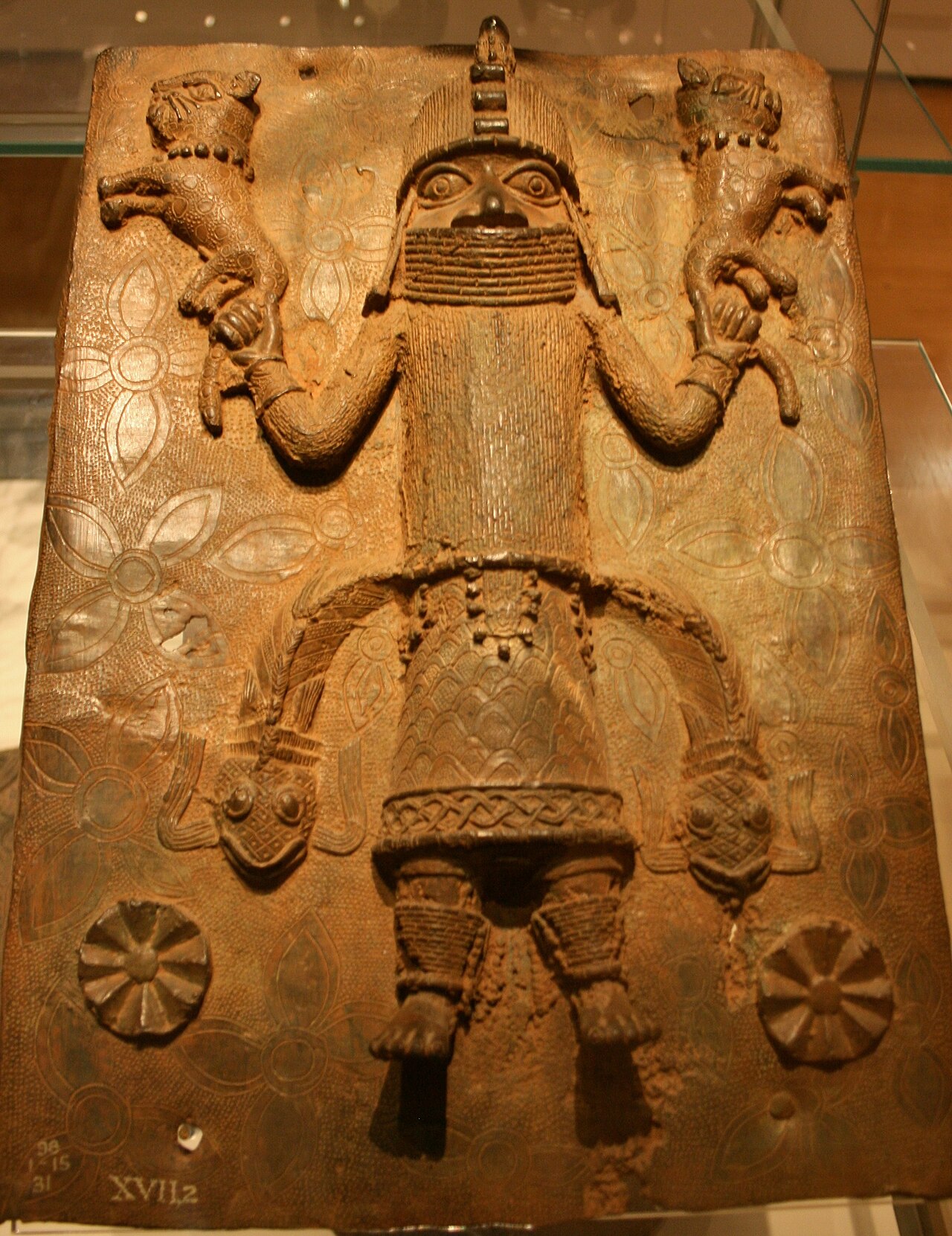
In Nigeria, the Kingdom of Benin — which has nothing to do with the country that bears that name today — for centuries produced metal plaques, heads and figures of extraordinary refinement. They are called the Benin Bronzes. They are in museums all over the world.
Twenty-first-century research has established two facts, and neither is what you would expect.
They are not bronzes. They are, for the most part, made of brass, a different alloy — copper and zinc, instead of copper and tin.7
This brass came from Germany. It was already thought to have come from European metal rings, without anyone being able to prove it. In 2023, a team analysed sixty-seven manillas — those horseshoe-shaped metal rings — recovered from five Atlantic shipwrecks and from three sites on land. By comparing their trace elements and lead isotopes with those of the Benin works and with those of European ores, they identified the origin: the Rhineland, between Cologne and Aachen, where both the zinc ore and the lead needed were available.8
The researcher who led the study puts it simply: this brass was thought to be British or Flemish; it was mined in the Rhine region, between Germany and Belgium, then shipped more than six thousand kilometres.9
Yet these rings were not mere raw material. They were money, the currency of the Atlantic trade — and that trade was the slave trade. Like the shells whose story is told elsewhere on this site, manillas were used to pay for human beings.10
In other words, the metal of these works is melted-down money.
What not to conclude from this
Two conclusions spring to mind at once, and both are wrong.
It is not a European art. These objects were cast in Benin, by the kingdom’s casters — the Edo people — with their technique and their expertise. The metal does not make the work, any more than the paper makes the book.11
But it was an open art. These casters worked with what trade brought them, as craftspeople the world over always have.
The right statement is a third one: they took the metal that arrived, and they made something else of it.
This is not the first time this encyclopaedia has encountered this situation. Indian weavers buy machine-made yarn and go on weaving; Kenya turns a British service into a practice that no one else has reproduced; Japan chooses a model of school, then changes it. Each time, the observation is the same: receiving is not the same as submitting.
How these objects ended up in museums
This point must be made, because it is the part that is often passed over in silence.
Most of the pieces held today in the museums of Europe and the United States come from a British military expedition carried out in 1897 against the Kingdom of Benin.12
They were not bought. They were taken.
This is now one of the great debates in museums: what should be done with these objects, and to whom do they belong? Several museums have already returned some, and Germany has transferred ownership of a large number of pieces to Nigeria.
One detail speaks volumes about the way the debate is conducted: the researcher who established the German origin of the metal pointed out that the debate on restitution had, until then, simply ignored this part of the story.13
Note 1
Les autres ont pour objet le plaisir. […] on les appelle les beaux Arts par excellence. Tels sont la Musique, la Poësie, la Peinture, la Sculpture, & l'Art du geste ou la Danse.
The others have pleasure as their object. […] they are called the fine Arts par excellence. Such are Music, Poetry, Painting, Sculpture, & the Art of gesture, or Dance.
Batteux, Charles, Les Beaux-Arts réduits à un même principe, Durand, Paris, 1746
Les uns ont pour objet les besoins de l'homme […] C'est de là que sont sortis les Arts mécaniques. Les autres ont pour objet le plaisir. […] Les lois du goût n'ont pour objet que l'imitation de la belle nature
Some have the needs of man as their object […] It is from there that the mechanical Arts arose. The others have pleasure as their object. […] The laws of taste have as their object only the imitation of beautiful nature
Batteux, Charles, Les Beaux-Arts réduits à un même principe, Durand, Paris, 1746
Note 2
Le Catalogue du Musée instrumental du Conservatoire de Bruxelles, paru en 1880, a été épuisé en très peu de temps […] Tous les appareils sonores qui ont occupé le génie inventif de l'homme, se rangent en quatre classes : La première, où le son est entretenu par l'élasticité des corps eux-mêmes, est celle des instruments authophones. La deuxième, où le son est dû à la vibration de membranes devenues élastiques par tension, est celle des instruments à membranes. La troisième est celle des instruments à vent. […] Enfin, la quatrième, basée sur la vibration des cordes, corps filiformes qui, de même que les membranes, ne deviennent élastiques que par tension, est celle des instruments à cordes.
The Catalogue of the Instrument Museum of the Brussels Conservatoire, published in 1880, sold out in a very short time […] All the sound-producing devices that have occupied man’s inventive genius fall into four classes: The first, in which the sound is sustained by the elasticity of the bodies themselves, is that of autophonic instruments. The second, in which the sound is due to the vibration of membranes made elastic by tension, is that of membrane instruments. The third is that of wind instruments. […] Finally, the fourth, based on the vibration of strings, filiform bodies which, like membranes, become elastic only through tension, is that of stringed instruments.
Mahillon, Victor-Charles, Catalogue descriptif & analytique du Musée instrumental du Conservatoire royal de musique de Bruxelles, vol. 1, 2nd ed., Gand, A. Hoste, 1893
Note 3
Hornbostel- Sachs uses and expands Mahillon’s classification from thirty years earlier (Kartomi 1990), therefore perpetuating the radical changes of Mahillon’s scheme. […] Hornbostel-Sachs was developed in the early twentieth century by Austrian and German music theorists and scholars, Erich von Hornbostel and Curt Sachs (Katz 2001, Brown 2001). The scheme was first published in German in 1914 with the title of the scheme given as “Systematik der Musikinstrumente” (Hornbostel and Sachs 1914). […] The scheme drew upon developments in instrument classification, such as Mahillon’s division into four categories, while purposefully designing a scheme which moves away from single-culture, Western-centric structures of instrument classification.
Lee, Deborah, “Hornbostel-Sachs Classification of Musical Instruments”, Knowledge Organization, vol. 47, no. 1, 2020, p. 72-91, accepted version
Note 4
For some reason I've kept all the minutes. At 7.00pm on Monday June 29th, 1987, what was initially described as an 'International Pop Label Meeting' was convened at the Empress Of Russia in St. John Street, Islington
Anderson, Ian, “World Music History”, fRoots, 2000
Note 5
the far more hip indie label 4AD had a mammoth seller with Les Mysteres De Voix Bulgares. But where the hell did you look in your High Street record shop for all this varied music that now had a burgeoning would-be buyer base but no obvious rack to browse?
Anderson, Ian, “World Music History”, fRoots, 2000
Note 6
To my knowledge, the origin of the term world music dates to the early 1960s at Wesleyan University, when I thought it up in order to distinguish a new Ph.D. program there from ethnomusicology programs already in existence.
Brown, Robert E., “World Music — Past, Present, and Future”, College Music Symposium, vol. 29, forum “World Music and Ethnomusicology”
It wasn’t a new name, just one of many that had floated around in the preceding decades. But the logic set out by Roger Armstrong was that an established, unified generic name would give retailers a place where they could confidently rack otherwise unstockable releases […]
Anderson, Ian, “World Music History”, fRoots, 2000
Note 7
Over 700 available chemical analyses of Benin Bronzes indicate that the majority are either brass or leaded brass, sometimes with small amounts of tin. […] Brass, as an alloy of copper and zinc frequently carries some lead that originates from the calamine ores, which generally are not lead-free.
Skowronek, Tobias B. et al., “German Brass for Benin Bronzes: Geochemical Analysis Insights into the Early Atlantic Trade”, PLOS ONE, vol. 18, no. 4, e0283415, 2023
Note 8
It is commonly believed that distinctive brass rings known as “manillas”, used as currency in the European trade in West Africa, also served as a metal source for the making of the Bronzes. However, prior to the current study, no research had conclusively connected the Benin artworks and the European manillas.
Skowronek, Tobias B. et al., “German Brass for Benin Bronzes: Geochemical Analysis Insights into the Early Atlantic Trade”, PLOS ONE, vol. 18, no. 4, e0283415, 2023
we present the lead isotope ratios and trace element compositions of 67 manillas from five Atlantic shipwrecks and three terrestrial sites
Skowronek, Tobias B. et al., “German Brass for Benin Bronzes: Geochemical Analysis Insights into the Early Atlantic Trade”, PLOS ONE, vol. 18, no. 4, e0283415, 2023
These data are then compared with those of relevant European ores and to those of the Benin Bronzes.
Skowronek, Tobias B. et al., “German Brass for Benin Bronzes: Geochemical Analysis Insights into the Early Atlantic Trade”, PLOS ONE, vol. 18, no. 4, e0283415, 2023
large quantities of manillas were produced in the German Rhineland industries between Cologne and Aachen that relied on the rich occurrences of calamine (the zinc-ore necessary to produce brass) and nearby lead sources
Skowronek, Tobias B. et al., “German Brass for Benin Bronzes: Geochemical Analysis Insights into the Early Atlantic Trade”, PLOS ONE, vol. 18, no. 4, e0283415, 2023
Note 9
Finally, we can prove that the brass used for the Benin masterpieces, long thought to come from Britain or Flanders, was mined in the Rhine region between the borders of Germany and Belgium […] The Rhineland manillas were then shipped more than [3,900 miles] to Benin.
Kingsley, Sean, “What Shipwrecks Reveal About the Origins of the Benin Bronzes”, Smithsonian Magazine, 5 April 2023
Note 10
distinctive brass rings known as “manillas”, used as currency in the European trade in West Africa […] It is astonishing that early 16th century slave traders apparently recognized African needs for manillas of specific composition.
Skowronek, Tobias B. et al., “German Brass for Benin Bronzes: Geochemical Analysis Insights into the Early Atlantic Trade”, PLOS ONE, vol. 18, no. 4, e0283415, 2023
During the Transatlantic slave trade manillas were a frequent medium of exchange for slaves.
The British Museum, London, Manilla; currency, no. 2009,4092.1
Note 11
the renowned Benin Bronzes, produced by the Edo people of Nigeria
Skowronek, Tobias B. et al., “German Brass for Benin Bronzes: Geochemical Analysis Insights into the Early Atlantic Trade”, PLOS ONE, vol. 18, no. 4, e0283415, 2023
Reflecting this prominence, the brass casters are the highest-ranking guild of visual artists in Benin's palace societies. Casters use the lost-wax method, in which a precisely detailed wax model is formed over a clay core.
The Art Institute of Chicago, “Video: Lost Wax Brass Casting, Benin City, 2003, 2006”, website of the exhibition Benin—Kings and Rituals
Note 12
Central to the consideration of the 5246 Benin objects currently dispersed across the 131 museums brought together here is the question of their ties to the British colonial military campaign on Benin City, or the ‘punitive expedition’ of 1897[1]. […] Using provenance research to document the trajectories and ownership histories of the pieces contributes to identifying the royal treasures that were taken by members of the expedition. These make up most of the Benin objects presently in public collections.
Digital Benin, “Provenance”, project documentation, 7 November 2022
Note 13
However, the extensive discussion surrounding the restitution of the stolen artworks completely ignored the historical data that explained the presence of German metals in the Bronzes.
Skowronek, Tobias, “New Publication Echoes from Benin by Associate Researcher Dr. Tobias Skowronek”, Global Heritage Lab, Université de Bonn, 17 February 2025
Notes and sources
- ↑
Passage In 1746, the French abbé Charles Batteux published Les Beaux-Arts réduits à un même principe and proposed grouping under this name music, poetry, painting, sculpture and dance
Les autres ont pour objet le plaisir. […] on les appelle les beaux Arts par excellence. Tels sont la Musique, la Poësie, la Peinture, la Sculpture, & l'Art du geste ou la Danse.
Editors’ translation The others have pleasure as their object. […] they are called the fine Arts par excellence. Such are Music, Poetry, Painting, Sculpture, & the Art of gesture, or Dance.
Source Batteux, Charles, Les Beaux-Arts réduits à un même principe, Durand, Paris, 1746, part one, chapter I, “Division & origine des Arts”.
Public domain open the source · checked on 24 October 2026
Passage on the grounds that they imitate nature and aim at pleasure, whereas the mechanical arts serve a useful purpose
Les uns ont pour objet les besoins de l'homme […] C'est de là que sont sortis les Arts mécaniques. Les autres ont pour objet le plaisir. […] Les lois du goût n'ont pour objet que l'imitation de la belle nature
Editors’ translation Some have the needs of man as their object […] It is from there that the mechanical Arts arose. The others have pleasure as their object. […] The laws of taste have as their object only the imitation of beautiful nature
Source Batteux, Charles, Les Beaux-Arts réduits à un même principe, Durand, Paris, 1746, part one, chapter I, “Division & origine des Arts”; title of a chapter in part two.
Public domain open the source · checked on 24 October 2026
- ↑
Passage This criterion comes from the Belgian Victor-Charles Mahillon […] who divided instruments into four groups in an attempt at classification published in 1880
Le Catalogue du Musée instrumental du Conservatoire de Bruxelles, paru en 1880, a été épuisé en très peu de temps […] Tous les appareils sonores qui ont occupé le génie inventif de l'homme, se rangent en quatre classes : La première, où le son est entretenu par l'élasticité des corps eux-mêmes, est celle des instruments authophones. La deuxième, où le son est dû à la vibration de membranes devenues élastiques par tension, est celle des instruments à membranes. La troisième est celle des instruments à vent. […] Enfin, la quatrième, basée sur la vibration des cordes, corps filiformes qui, de même que les membranes, ne deviennent élastiques que par tension, est celle des instruments à cordes.
Editors’ translation The Catalogue of the Instrument Museum of the Brussels Conservatoire, published in 1880, sold out in a very short time […] All the sound-producing devices that have occupied man’s inventive genius fall into four classes: The first, in which the sound is sustained by the elasticity of the bodies themselves, is that of autophonic instruments. The second, in which the sound is due to the vibration of membranes made elastic by tension, is that of membrane instruments. The third is that of wind instruments. […] Finally, the fourth, based on the vibration of strings, filiform bodies which, like membranes, become elastic only through tension, is that of stringed instruments.
Source Mahillon, Victor-Charles, Catalogue descriptif & analytique du Musée instrumental du Conservatoire royal de musique de Bruxelles, vol. 1, 2nd ed., Gand, A. Hoste, 1893, preface to the 2nd edition, p. [XII] (first page, unnumbered); then “Essai de classification méthodique de tous les instruments anciens et modernes”, p. 3.
Public domain open the source · checked on 27 October 2026
- ↑
Passage In 1914, two researchers, the Austrian Erich von Hornbostel and the German Curt Sachs, took it up and extended it so that it could classify the instruments of every culture in the world.
Hornbostel- Sachs uses and expands Mahillon’s classification from thirty years earlier (Kartomi 1990), therefore perpetuating the radical changes of Mahillon’s scheme. […] Hornbostel-Sachs was developed in the early twentieth century by Austrian and German music theorists and scholars, Erich von Hornbostel and Curt Sachs (Katz 2001, Brown 2001). The scheme was first published in German in 1914 with the title of the scheme given as “Systematik der Musikinstrumente” (Hornbostel and Sachs 1914). […] The scheme drew upon developments in instrument classification, such as Mahillon’s division into four categories, while purposefully designing a scheme which moves away from single-culture, Western-centric structures of instrument classification.
Source Lee, Deborah, “Hornbostel-Sachs Classification of Musical Instruments”, Knowledge Organization, vol. 47, no. 1, 2020, p. 72-91, accepted version, § 2.2 (“Mahillon and the road to Hornbostel-Sachs”), § 2.3 (“The germination of Hornbostel-Sachs”), 1st and 2nd sentences, and § 6 (“Conclusion”).
Open access open the source · checked on 27 October 2026
- ↑
Passage 29 June 1987, at the Empress of Russia, in the Islington district of London […] We even have the minutes of the meeting
For some reason I've kept all the minutes. At 7.00pm on Monday June 29th, 1987, what was initially described as an 'International Pop Label Meeting' was convened at the Empress Of Russia in St. John Street, Islington
Source Anderson, Ian, “World Music History”, fRoots, 2000, account of the first meeting (29 June 1987), at the start of the minutes of the meetings.
Open access open the source · checked on 24 October 2026
- ↑
Passage Music from Bulgaria, Mali, Senegal or Zimbabwe was finding more and more buyers […] But shops did not know which section to put it in.
the far more hip indie label 4AD had a mammoth seller with Les Mysteres De Voix Bulgares. But where the hell did you look in your High Street record shop for all this varied music that now had a burgeoning would-be buyer base but no obvious rack to browse?
Source Anderson, Ian, “World Music History”, fRoots, 2000, passage on the commercial context before the 1987 meetings.
Open access open the source · checked on 24 October 2026
- ↑
Passage it had existed since the early 1960s, used by an American academic, Robert E. Brown
To my knowledge, the origin of the term world music dates to the early 1960s at Wesleyan University, when I thought it up in order to distinguish a new Ph.D. program there from ethnomusicology programs already in existence.
Source Brown, Robert E., “World Music — Past, Present, and Future”, College Music Symposium, vol. 29, forum “World Music and Ethnomusicology”, section “Origin and Background of the Terminology”, 1st paragraph.
Open access open the source · checked on 27 October 2026
Passage What the 1987 meeting created was not the term. It was its commercial use.
It wasn’t a new name, just one of many that had floated around in the preceding decades. But the logic set out by Roger Armstrong was that an established, unified generic name would give retailers a place where they could confidently rack otherwise unstockable releases […]
Source Anderson, Ian, “World Music History”, fRoots, 2000, paragraph following the list of participants, 1st and 2nd sentences.
Open access open the source · checked on 27 October 2026
- ↑
Passage They are, for the most part, made of brass, a different alloy — copper and zinc, instead of copper and tin.
Over 700 available chemical analyses of Benin Bronzes indicate that the majority are either brass or leaded brass, sometimes with small amounts of tin. […] Brass, as an alloy of copper and zinc frequently carries some lead that originates from the calamine ores, which generally are not lead-free.
Source Skowronek, Tobias B. et al., “German Brass for Benin Bronzes: Geochemical Analysis Insights into the Early Atlantic Trade”, PLOS ONE, vol. 18, no. 4, e0283415, 2023, Introduction.
Open access open the source · checked on 9 September 2026
- ↑
Passage It was already thought to have come from European metal rings, without anyone being able to prove it.
It is commonly believed that distinctive brass rings known as “manillas”, used as currency in the European trade in West Africa, also served as a metal source for the making of the Bronzes. However, prior to the current study, no research had conclusively connected the Benin artworks and the European manillas.
Source Skowronek, Tobias B. et al., “German Brass for Benin Bronzes: Geochemical Analysis Insights into the Early Atlantic Trade”, PLOS ONE, vol. 18, no. 4, e0283415, 2023, abstract of the article.
Open access open the source · checked on 9 September 2026
Passage In 2023, a team analysed sixty-seven manillas […] recovered from five Atlantic shipwrecks and from three sites on land.
we present the lead isotope ratios and trace element compositions of 67 manillas from five Atlantic shipwrecks and three terrestrial sites
Source Skowronek, Tobias B. et al., “German Brass for Benin Bronzes: Geochemical Analysis Insights into the Early Atlantic Trade”, PLOS ONE, vol. 18, no. 4, e0283415, 2023, body of the article.
Open access open the source · checked on 9 September 2026
Passage By comparing their trace elements and lead isotopes with those of the Benin works and with those of European ores
These data are then compared with those of relevant European ores and to those of the Benin Bronzes.
Source Skowronek, Tobias B. et al., “German Brass for Benin Bronzes: Geochemical Analysis Insights into the Early Atlantic Trade”, PLOS ONE, vol. 18, no. 4, e0283415, 2023, body of the article.
Open access open the source · checked on 9 September 2026
Passage the Rhineland, between Cologne and Aachen, where both the zinc ore and the lead needed were available
large quantities of manillas were produced in the German Rhineland industries between Cologne and Aachen that relied on the rich occurrences of calamine (the zinc-ore necessary to produce brass) and nearby lead sources
Source Skowronek, Tobias B. et al., “German Brass for Benin Bronzes: Geochemical Analysis Insights into the Early Atlantic Trade”, PLOS ONE, vol. 18, no. 4, e0283415, 2023, body of the article.
Open access open the source · checked on 9 September 2026
- ↑
Passage this brass was thought to be British or Flemish; it was mined in the Rhine region, between Germany and Belgium, then shipped more than six thousand kilometres
Finally, we can prove that the brass used for the Benin masterpieces, long thought to come from Britain or Flanders, was mined in the Rhine region between the borders of Germany and Belgium […] The Rhineland manillas were then shipped more than [3,900 miles] to Benin.
Source Kingsley, Sean, “What Shipwrecks Reveal About the Origins of the Benin Bronzes”, Smithsonian Magazine, 5 April 2023, statement by T. Skowronek quoted in the article.
Open access open the source · checked on 9 September 2026
- ↑
Passage They were money, the currency of the Atlantic trade — and that trade was the slave trade.
distinctive brass rings known as “manillas”, used as currency in the European trade in West Africa […] It is astonishing that early 16th century slave traders apparently recognized African needs for manillas of specific composition.
Source Skowronek, Tobias B. et al., “German Brass for Benin Bronzes: Geochemical Analysis Insights into the Early Atlantic Trade”, PLOS ONE, vol. 18, no. 4, e0283415, 2023, abstract of the article; Discussion.
Open access open the source · checked on 9 September 2026
Passage manillas were used to pay for human beings
During the Transatlantic slave trade manillas were a frequent medium of exchange for slaves.
Source The British Museum, London, Manilla; currency, no. 2009,4092.1, online catalogue entry for the object, curator’s comments.
Open access open the source · checked on 27 October 2026
- ↑
Passage These objects were cast in Benin, by the kingdom’s casters — the Edo people — with their technique and their expertise.
the renowned Benin Bronzes, produced by the Edo people of Nigeria
Source Skowronek, Tobias B. et al., “German Brass for Benin Bronzes: Geochemical Analysis Insights into the Early Atlantic Trade”, PLOS ONE, vol. 18, no. 4, e0283415, 2023, abstract of the article.
Open access open the source · checked on 9 September 2026
Passage their technique and their expertise
Reflecting this prominence, the brass casters are the highest-ranking guild of visual artists in Benin's palace societies. Casters use the lost-wax method, in which a precisely detailed wax model is formed over a clay core.
Source The Art Institute of Chicago, “Video: Lost Wax Brass Casting, Benin City, 2003, 2006”, website of the exhibition Benin—Kings and Rituals, page “Video: Lost Wax Brass Casting, Benin City, 2003, 2006”, heading “Brass Casters (Igun Eronmwon)”, 2nd and 3rd sentences.
Open access open the source · checked on 27 October 2026
- ↑
Passage Most of the pieces […] come from a British military expedition carried out in 1897 […] They were not bought. They were taken.
Central to the consideration of the 5246 Benin objects currently dispersed across the 131 museums brought together here is the question of their ties to the British colonial military campaign on Benin City, or the ‘punitive expedition’ of 1897[1]. […] Using provenance research to document the trajectories and ownership histories of the pieces contributes to identifying the royal treasures that were taken by members of the expedition. These make up most of the Benin objects presently in public collections.
Source Digital Benin, “Provenance”, project documentation, 7 November 2022, 1st paragraph, 1st sentence, and 2nd paragraph, first two sentences.
Open access open the source · checked on 27 October 2026
- ↑
Passage the debate on restitution had, until then, simply ignored this part of the story
However, the extensive discussion surrounding the restitution of the stolen artworks completely ignored the historical data that explained the presence of German metals in the Bronzes.
Source Skowronek, Tobias, “New Publication Echoes from Benin by Associate Researcher Dr. Tobias Skowronek”, Global Heritage Lab, Université de Bonn, 17 February 2025, presentation text, 1st paragraph.
Open access open the source · checked on 9 September 2026
Bibliography
17
- Anderson, Ian, “World Music History”, fRoots, 2000, open access (the minutes of the June–July 1987 meetings in London and the creation of the commercial category). https://frootsmag.com/world-music-history
- Batteux, Charles, Les Beaux-Arts réduits à un même principe, Durand, Paris, 1746, public domain (the treatise that fixed the category of the fine arts, as opposed to the mechanical arts). https://fr.wikisource.org/wiki/Les_Beaux-Arts_r%C3%A9duits_%C3%A0_un_m%C3%AAme_principe
- Brown, Robert E., “World Music — Past, Present, and Future”, College Music Symposium, vol. 29, forum “World Music and Ethnomusicology”, open access (the academic origin of the term “world music”, at Wesleyan, in the early 1960s). https://symposium.music.org/volume-29/forum-essays-1752877059/world-music-past-present-and-future
- Digital Benin, “Provenance”, project documentation, 7 November 2022, open access. https://digitalbenin.org/documentation/provenance
- Feld, Steven, “A Sweet Lullaby for World Music”, Public Culture, vol. 12, no. 1, 2000, p. 145-171, paywalled (the history of the category and its earlier use by an American ethnomusicologist).
- Hogendorn, Jan and Johnson, Marion, The Shell Money of the Slave Trade, Cambridge University Press, 1986, in libraries (cowries, a currency of the Atlantic slave trade, to which the entry compares manillas).
- Hornbostel, Erich Moritz von and Sachs, Curt, “Systematik der Musikinstrumente. Ein Versuch”, Zeitschrift für Ethnologie, vol. 46, 1914, p. 553-590, in libraries (the extension of the classification of instruments to every culture in the world).
- Kingsley, Sean, “What Shipwrecks Reveal About the Origins of the Benin Bronzes”, Smithsonian Magazine, 5 April 2023, open access (the statement by Tobias Skowronek, lead author of the study: brass thought to be British or Flemish, mined in the Rhine region and shipped more than 3,900 miles, i.e. more than 6,000 km, to Benin). https://www.smithsonianmag.com/history/what-shipwrecks-reveal-about-the-origins-of-the-benin-bronzes-180981925/
- Lee, Deborah, “Hornbostel-Sachs Classification of Musical Instruments”, Knowledge Organization, vol. 47, no. 1, 2020, p. 72-91, open-access accepted version. https://openaccess.city.ac.uk/id/eprint/22554/
- Mahillon, Victor-Charles, Catalogue descriptif & analytique du Musée instrumental du Conservatoire royal de musique de Bruxelles, vol. 1, 2nd ed., Gand, A. Hoste, 1893, public domain (the preface recalling the first edition of 1880 and the “Essai de classification méthodique” in four classes according to what vibrates). https://archive.org/details/cataloguedescrip00cons
- Mahillon, Victor-Charles, Catalogue descriptif et analytique du musée instrumental du Conservatoire royal de Bruxelles, Gand, 1880, public domain (the four groups of instruments according to what vibrates). https://gallica.bnf.fr/ark:/12148/bpt6k64205770.texteImage
- Phillips, Barnaby, Loot: Britain and the Benin Bronzes, Oneworld, 2021, in libraries (the 1897 expedition, the dispersal of the objects, the debate on restitution).
- Plankensteiner, Barbara (ed.), Benin: Kings and Rituals. Court Arts from Nigeria, Snoeck, 2007, in libraries (the kingdom’s casters and their technique).
- Skowronek, Tobias B. et al., “German Brass for Benin Bronzes: Geochemical Analysis Insights into the Early Atlantic Trade”, PLOS ONE, vol. 18, no. 4, e0283415, 2023, open access (the sixty-seven manillas analysed, the shipwrecks and sites, the Rhineland origin of the brass, the link with the slave trade). https://doi.org/10.1371/journal.pone.0283415
- Skowronek, Tobias, “New Publication Echoes from Benin by Associate Researcher Dr. Tobias Skowronek”, Global Heritage Lab, Université de Bonn, 17 February 2025, open access (the observation that the debate on restitution ignored the German origin of the metal). https://globalheritagelab.org/2025/02/17/new-publication-echoes-from-benin-by-guest-researcher-dr-tobias-skowronek/
- The Art Institute of Chicago, “Video: Lost Wax Brass Casting, Benin City, 2003, 2006”, website of the exhibition Benin—Kings and Rituals, open access. https://archive.artic.edu/benin/659
- The British Museum, London, Manilla; currency, no. 2009,4092.1, open access (manillas as a frequent medium of exchange for enslaved people during the Atlantic slave trade). https://www.britishmuseum.org/collection/object/C_2009-4092-1
Spotted an error or have a doubt? Write to us.