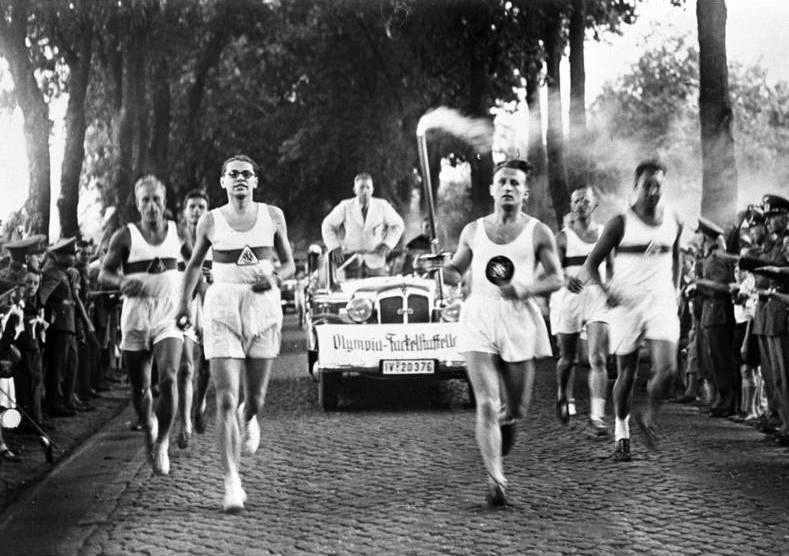

In sport, nothing seems older than the Olympic flame, lit at Olympia and carried by runners all the way to the stadium.
It seems certain to come from the Greeks and to go back two thousand five hundred years.
That is false.
Why humans come together
Every known society organises moments when the group gathers and interrupts the ordinary course of everyday life. These moments take three forms, which are often combined.
Ritual is a sequence of acts fixed in advance, performed in an agreed order because that is how things are done. Its form matters as much as its result: a birthday without candles or a wedding without an exchange of words seems incomplete, even if nothing material is missing.
Many rituals mark a passage — birth, entry into adulthood, marriage, death. Their purpose is to make a change of status public: the person is no longer quite the same afterwards, and the whole group bears witness to it.
The researcher Arnold van Gennep showed in 1909 that many of these rites follow the same three-stage structure.1
- Separation: the person is removed from their previous state, often by being physically set apart from the group.
- The margin: an in-between in which they are no longer what they were and not yet what they will become. This is where what matters most happens, and it is often the most testing phase.
- Incorporation: they rejoin the group, with their new status recognised by all.
A graduation ceremony, a wedding or a baptism includes all three stages. This explains why these ceremonies are so resistant to change — their setting can be altered, but not their structure.
The festival interrupts working time and brings people together on a wide scale. It is almost always pegged to an external marker: a moment in the agricultural year, a solstice, a religious date, a collective anniversary. By marking these points, festivals divide up the year and give it a shape — a point this page returns to further on.
Games and sport are voluntary activities, set apart from everything else by accepted rules and a clear end. In them we accept constraints that we would refuse elsewhere — running without going anywhere, not picking up the ball with our hands — and it is precisely this shared consent that makes the game possible. A game exists only because everyone accepts the same rules at the same moment.
These three forms are not mutually exclusive. A sporting competition includes rituals — the anthem, the flame, the medal ceremony — and is a festive occasion. It is in fact this mixture that gives these events their weight, and that explains why people instinctively believe them to be very old.
Yet many are not. A tradition may have been invented by someone, on a date that can be traced — and that is the subject of this whole page.2
A tradition less than a hundred years old
The Greeks did tend fires, and they held torch races — but at festivals in honour of certain gods. At the Olympic Games, there was never a relay.3
The chronology speaks for itself. The modern Games began in 1896, and no flame was lit. It was not until 1928, in Amsterdam, that a fire burned at the top of one of the stadium’s towers, and then 1932 in Los Angeles. But those fires were lit on site, not at Olympia, and no one carried them.4
The relay from Olympia was invented for the 1936 Games. Seven countries were crossed, from Greece to Germany: more than 3,000 kilometres, covered by 3,075 runners — roughly one per kilometre — in a dozen or so days.5
One organisational detail is delightful: the organisers had at first considered, to make it look ancient, keeping the flame in bundles of stalks of a slow-burning Mediterranean plant. They gave this up for practical reasons and had torches made — none of those available on the market was suitable.6
Those Games were the Games of Nazi Germany. The relay was meant to present the regime as the heir to ancient Greece. The ritual has remained; what it represents today no longer has anything to do with that.
The man who had the idea
This episode is almost never told.
The idea of the relay came from an archaeologist and sports official named Alfred Schiff. He knew the ancient texts and the images of torchbearers painted on vases: that is where he found his idea.7
Alfred Schiff was Jewish. He was driven from his post at a major German sports college because of his origins, a few years before the Games.
His idea was carried out in 1936. His name, however, was erased. It was the secretary-general of the organising committee who took over the idea, and it is to him that it is still most often attributed today.8
A note in the interest of honesty: the attribution to Schiff rests on the work of historians and on German archives. Others have claimed this idea, starting with the organiser of the Games himself.
Elsewhere, this site tells the story of six women programmers missing from the newspapers that wrote about their machine (page 9.14), or that of a woman chemist who sat a competitive examination under her initials so that no one would know she was a woman (page 9.11). The mechanism is the same, for a different reason. The question to ask of any invention is always this one: who was removed from the story, and why them?
What the nineteenth century invented, and it is not the game
Let us turn to sports.
Ball games have been played everywhere and for a very long time. In China, with cuju — “kicking the ball with the foot”. In Japan, with kemari. In Greece, in Rome. In medieval Europe, with matches involving entire villages, and extremely rough ones.
In Mesoamerica, long before all that. Archaeologists have uncovered ballcourts several thousand years old: two long banks of compacted earth framing a playing alley. Not stone — earth.
The ball itself is a technical feat. Marshy ground at El Manatí has preserved solid rubber balls more than three thousand five hundred years old, made of latex mixed with the juice of a vine to make it elastic. This game does not need to be the ancestor of anything: it has its own courts, its own ball and its own history.9
What nineteenth-century England brought was not the game. It was the written rule — the game is then said to be codified.
Cambridge rules around 1848. Sheffield rules in 1858. Then, in December 1863, in London, the laws of the game of the brand-new English football association — including the decision that matters most: the ban on carrying the ball in the hands. This is what separates this game from rugby.10
These rules were not one man’s idea: they are the result of decades of trial and error in schools, clubs and towns.
Why write them down? For a simple reason: each school had its own. Here you could pick up the ball and there you could not, here you could collide and there you could not, here you scored high and there low. So two schools could hardly play against each other.11
That is what writing the rules was for: making a match possible between people who do not know one another.
Historical note: the museum of the international football federation points out that Chinese cuju is the oldest attested form, while writing that no case can be made that this game influenced any of the ball games codified in the nineteenth century. Neither “football comes from China” nor “football was invented in England” — parallel games, and an English codification.
And yet. In 2004, the president of that same federation publicly declared that China was the home of football, and a certificate was presented to the city of Linzi, recognised as the “cradle of the earliest forms of football”.
The museum writes one thing, the presidency declares another. The contradiction lies within the institution itself.
The difference is essential: an institution can certify whatever it likes; this reflects its policy, not what historians have established.12
The same invention, for the fourth time
Other pages of this encyclopaedia reveal the same recurring logic.
⚖️ A standard weight makes it possible to compare goods from one town to another.
🪙 A guaranteed coin makes it possible to trade with a stranger without weighing its metal.
📦 A box of agreed dimensions (the container) allows a lorry and a ship that have never met to hand a load over to each other.
📜 A written rule allows two teams that have never seen each other to play against each other.
Four different worlds, a single idea: agreeing in advance on a measure, in order to be able to deal with a stranger.
A festival organises time
This is what connects everything else.
A festival is not just a pleasant moment: it is a way of fixing when everyone stops together.
Among the Igbo, in south-eastern Nigeria, the week has four days that bear the names of the markets — Eke, Orie, Afọ, Nkwọ. Seven of these weeks make a month of twenty-eight days, and thirteen of these months make a year. In some Maya communities in Guatemala, a 260-day count is still kept today. The Olympic Games come round every four years, and this particular interval really is ancient: the Greeks already kept it — then the Games ceased for a very long time, until the moderns revived them in 1896.13
In an annual calendar, the days without school are not distributed at random. Someone, at some point, decided which ones — and it is often possible to find out when.
What the festival costs
The Olympic Games transform a city. They must also be discussed from the point of view of those who live there.
An organisation specialising in the right to housing studied several host cities and concluded that around two million people had been displaced over twenty years because of the development works — often among the poorest residents.14
One detail shows how to read these figures.
For one and the same host city, the authorities announced a few thousand displaced households, whereas the report counted more than a million people.15
They are not counting the same thing. One side counts the people who lived on the exact site of the stadiums. The other counts everyone who had to leave because of works linked to the Games: beautification of the city, roads, hotels — going back several years, sometimes to before the city had even been chosen.
One last point changes the significance of the figure. Almost all of this total comes from just two cities, Seoul and Beijing. Elsewhere, displaced people number in the hundreds or thousands, not in the millions.16
So the figure does not say “the Games displace two million people”. It says: when a state can evict without oversight, the Games give it the opportunity and the pretext. It is not the same claim, and the second is better supported than the first.
Note 1
L'expression « rites de passage » remonte à l'ouvrage d' Arnold Van Gennep qui, paru en 1909, porte ce titre. […] Dans la diversité des faits qui l'intéressaient, Van Gennep a repéré l'existence d'une structure tripartite et de fonctions communes. Il a montré, en effet, que tous s'organisent selon une séquence constante en trois temps, qui distingue à l'intérieur d'un même rituel : une phase de séparation vis-à-vis du groupe ; une phase de mise en marge (ou « liminale ») ; une phase de réintégration ( ou « agrégation ») au sein du groupe, dans une nouvelle situation sociale.
The expression “rites of passage” goes back to the book by Arnold Van Gennep which, published in 1909, bears that title. […] Within the diversity of the facts that interested him, Van Gennep identified the existence of a tripartite structure and of common functions. He showed, indeed, that they are all organised according to a constant three-stage sequence, which distinguishes within one and the same ritual: a phase of separation from the group; a phase of being set at the margin (or “liminal” phase); a phase of reintegration (or “aggregation”) into the group, in a new social situation.
Encyclopædia Universalis, “Rites de passage”, article en ligne
Note 2
‘Traditions’ which appear or claim to be old are often quite recent in origin and sometimes invented. […] It includes both ‘traditions’ actually invented, constructed and formally instituted and those emerging in a less easily traceable manner within a brief and dateable period – a matter of a few years perhaps – and establishing themselves with great rapidity.
Hobsbawm, Eric, “Introduction: Inventing Traditions”, in Hobsbawm, Eric and Ranger, Terence (ed.), The Invention of Tradition, Cambridge University Press, 1983 (reissued 2012), p. 1-14, publisher’s summary
Note 3
Il n'y a jamais eu de relais lors des Jeux Olympiques de l'Antiquité ou des Jeux Panhelléniques (organisés à Nemée, Delphes et à l'Isthme de Corinthe). […] Néanmoins, il existait à Athènes des courses aux flambeaux (lampadédromies) organisées en l'honneur de certains dieux, entre autres Prométhée.
There was never a relay at the Olympic Games of Antiquity or at the Panhellenic Games (held at Nemea, Delphi and the Isthmus of Corinth). […] Nevertheless, there were torch races in Athens (lampadedromies) organised in honour of certain gods, Prometheus among others.
Le Musée Olympique (CIO), “La flamme olympique et le relais”, Lausanne, 3e édition, 2013, open access
Note 4
The Olympic flame made its first appearance of the modern era at Amsterdam 1928, where it was lit atop a tower overlooking the Olympic Stadium, the venue for the athletics events. It also presided over the scene at Los Angeles’s Olympic Stadium four years later, this time at the top of the gateway to the arena, which resembled the Arc de Triomphe. […] It was not until Berlin 1936, however, that the Olympic torch relay – the brainchild of the university lecturer and sports theorist Carl Diem – was first staged. As continues to be the custom today, the flame was lit in Olympia, Greece,
Comité international olympique, “The amazing story of the Olympic flame”, olympics.com, sans date, open access
Note 5
Insgesamt trugen 3075 Läufer die Fackel durch sieben Länder: Griechenland, Bulgarien, Jugoslawien, Ungarn, Österreich, Tschechoslowakei und Deutschland.
In all, 3,075 runners carried the torch through seven countries: Greece, Bulgaria, Yugoslavia, Hungary, Austria, Czechoslovakia and Germany.
Bundesarchiv, “Der Olympische Fackellauf bei den Sommerspielen in Berlin 1936”, sans date, open access
Start date: July 20, 1936, Olympia, Greece […] End date: August 1, 1936, Olympic Stadium, Berlin, Germany […] Number of torchbearers: 3,075 […] Relay length: 1910.7 miles
USOPC (comité olympique et paralympique des États-Unis), archives, “Olympic Torches”, sans date, open access
Contrairement à ce que l'on peut imaginer, cette tradition ne remonte pas aux Jeux Olympiques de l'Antiquité. Invention moderne (le premier relais remonte à 1936 et le Mouvement olympique reconnaît sa grande valeur symbolique en 1948), le relais de la flamme s'inspire toutefois de plusieurs pratiques antiques:
Contrary to what one might imagine, this tradition does not go back to the Olympic Games of Antiquity. A modern invention (the first relay dates back to 1936 and the Olympic Movement recognised its great symbolic value in 1948), the flame relay is nevertheless inspired by several ancient practices:
Le Musée Olympique (CIO), “La flamme olympique et le relais”, Lausanne, 3e édition, 2013, open access
Note 6
Taking inspiration from ancient ways, the Organising Committee of the Berlin Games had initially planned to convey the flame by means of a bundle of slow-burning fennel stalks. For practical reasons, however, it was finally decided to use a torch for the job, with the Organising Committee requesting the creation of a specific design, given that there were no torches on the market capable of meeting their criteria.
Comité international olympique, “The amazing story of the Olympic flame”, olympics.com, sans date, open access
Note 7
Der erste Olympische Fackellauf der Geschichte ging auf eine Idee des Archäologen Alfred Schiff zurück und startete am 20. Juli 1936 im antiken Heiligtum von Olympia in Griechenland. […] Alfred Schiff hatte nicht nur an archäologischen Ausgrabungen in Athen und Olympia mitgewirkt, er war auch Schiedsrichter (u. a. im Fechten) und Mannschaftsbetreuer bei den ersten Olympischen Spielen der Neuzeit 1896 in Athen gewesen. […] Basierend auf antiken Schriftquellen und Darstellungen von Fackelläufern in Relief- und Vasenbildern, entwickelte Schiff die Idee eines Olympischen Fackellaufs.
The first Olympic torch relay in history went back to an idea of the archaeologist Alfred Schiff and started on 20 July 1936 in the ancient sanctuary of Olympia in Greece. […] Alfred Schiff had not only taken part in archaeological excavations in Athens and Olympia, he had also been a referee (in fencing, among other sports) and a team official at the first Olympic Games of the modern era in 1896 in Athens. […] Drawing on ancient written sources and on depictions of torch runners in reliefs and vase paintings, Schiff developed the idea of an Olympic torch relay.
Bundesarchiv, “Der Olympische Fackellauf bei den Sommerspielen in Berlin 1936”, sans date, open access
Zuletzt schrieb der Archäologe Stefan Lehmann, die Idee stamme von dem vergessenen jüdischen Archäologen Alfred Schiff (1863–1939), einst mit Diem befreundet. […] Seinen Olympianachlass übernahm Diem, der Schiff im Kontext des Fackellaufs nie erwähnte. […] Alfred Schiff aber blieb lange vergessen.
Most recently, the archaeologist Stefan Lehmann wrote that the idea came from the forgotten Jewish archaeologist Alfred Schiff (1863–1939), once a friend of Diem’s. […] His Olympic papers were taken over by Diem, who never mentioned Schiff in connection with the torch relay. […] But Alfred Schiff long remained forgotten.
Schäfer, Ralf, “Gestohlenes Feuer”, Jüdische Allgemeine, 23 July 2012, open access
Note 8
Der Olympische Fackellauf hat seinen Ursprung nicht im antiken Griechenland: Er geht auf eine Idee des Archäologen Alfred Schiff zurück, des persönlichen Beraters von Carl Diem. […] Diem war Generalsekretär des Organisationskomitees der Sommerspiele 1936 in Berlin.
The Olympic torch relay does not have its origin in ancient Greece: it goes back to an idea of the archaeologist Alfred Schiff, Carl Diem’s personal adviser. […] Diem was secretary-general of the organising committee of the 1936 Summer Games in Berlin.
Bundesarchiv, “Der Olympische Fackellauf bei den Sommerspielen in Berlin 1936”, sans date, open access
Zum ersten Mal fand er 1936 statt: der Olympische Fackellauf. Als sein Erfinder gilt Carl Diem (1882–1962), Organisator der Berliner Spiele. Doch auch das NS-Propagandaministerium beanspruchte die Urheberschaft.
It took place for the first time in 1936: the Olympic torch relay. Its inventor is held to be Carl Diem (1882–1962), organiser of the Berlin Games. But the Nazi Propaganda Ministry also claimed authorship.
Schäfer, Ralf, “Gestohlenes Feuer”, Jüdische Allgemeine, 23 July 2012, open access
Note 9
Additional evidence that may point to the early ballgame comes from the Gulf Coast of Mexico, where Ponciano Ortíz and María del Carmen Rodríguez discovered rubber balls at El Manatí dating to approximately 1600 B.C. […] The game was played with solid rubber balls ( 2005.91.1 ), which were manufactured from native rubber-producing plants.
Earley, Caitlin C., “The Mesoamerican Ballgame”, The Metropolitan Museum of Art, 1 June 2017
The researchers' most significant finding is that the Mesoamerican civilization, which flourished from at least 2000 BC to the Spanish invasion in 1521 in what is now parts of Mexico and Central America, engineered the properties of latex from the native Castilla elastica tree. These ancient people enhanced the elasticity of this otherwise brittle material by mixing it with juice from the morning glory species Ipomoea alba. […] to sample two ancient Mexican rubber balls dredged from Manati, an archaeological site in a swamp in Veracruz.
Halber, Deborah, “Rubber processed in ancient Mesoamerica, MIT researchers find”, MIT News, 14 July 1999
Note 10
The 'Cambridge Rules' were a code of football rules first drawn up at Cambridge University in 1848.
Cambridge City Council, “Cambridge Rules Public Art Commission – Concept Approval”, report to the Community Services Scrutiny Committee, 15 January 2015
Creswick and Prest were responsible for drawing up the club’s rules of play, which were decided upon at the club’s AGM on 21 October 1858, and published the following year.
Sheffield FC, “History”, official club website
9. No player shall carry the ball
The Football Association, Laws of the Game, Londres, 1863
Note 11
The creators sought to formulate a game that was acceptable to students who had played various codes of public school football, each with different rules.
Cambridge City Council, “Cambridge Rules Public Art Commission – Concept Approval”, report to the Community Services Scrutiny Committee, 15 January 2015
In England, schools and local areas all had their own approaches and rules to the game, which meant that it was almost impossible to play one another.
Austin, Liam, “The ‘Cambridge Rules’ of football, 1863”, Cambridge University Library, Special Collections, 26 October 2013
Note 12
While no case can be made that cuju influenced any of the modern ball games codified in the 19th century, its adaptability and enduring appeal show an innate desire within humans to play
FIFA Museum, Zurich, “Origins — Cuju in China”
the FIFA president Mr. Blatter solemnly declared to the world, “China is the home of football.” […] Subsequently, Veerapan issued a certificate to Linzi, Zibo city.
Liu, Xiaoxue, Zhang, Yanfen et al., “Historical Study on the Relation between Ancient Chinese Cuju and Modern Football”, 2018 4th International Conference on Innovative Development of E-commerce and Logistics (ICIDEL 2018), Clausius Scientific Press, 2018
Note 13
Ces Jeux ont lieu tous les quatre ans. Cette période de quatre années prend le nom d'«Olympiade» et sert de système de datation: le temps ne se compte pas en années, mais en Olympiades.
These Games take place every four years. This four-year period is called the “Olympiad” and serves as a dating system: time is not counted in years, but in Olympiads.
Le Musée Olympique (CIO), Service éducatif et culturel, “Les Jeux Olympiques de l’Antiquité”, Lausanne, 3e édition, 2013, open access
Every 260 days, the Ajq’ijab’ in the highlands areas of Guatemala, celebrate a new year ceremony called Wajxaqib’, B’atz, and welcome another cycle in the sacred Chol Q’ij or Tzolk’in Maya calendar.
Smithsonian Institution, National Museum of the American Indian, Living Maya Time, “The Calendar System”, open access
The calendar has 13 months in a year (Afọ), 7 weeks in a month (Ọnwa), and 4 days of Igbo market days (Eke, Orie, Afọ, and Nkwọ) in a week (Izu)
Onwuejeogwu, M. Angulu, An Igbo Civilization: Nri Kingdom and Hegemony, Ethnographica, 1981
On sait que les Jeux sont encore organisés au 4e siècle de notre ère. C’est un décret de l’empereur chrétien Théodose en 393 après J.-C. qui interdit la pratique des cultes païens et par là l’organisation des Jeux.
We know that the Games were still being held in the 4th century AD. It was a decree of the Christian emperor Theodosius in 393 AD that banned the practice of pagan cults and thereby the holding of the Games.
Le Musée Olympique (CIO), Service éducatif et culturel, “Les Jeux Olympiques de l’Antiquité”, Lausanne, 3e édition, 2013, open access
La première édition des Jeux d’été de l’ère moderne se déroule en 1896 à Athènes (Grèce)
The first edition of the Summer Games of the modern era took place in 1896 in Athens (Greece)
Le Musée Olympique (CIO), Service éducatif et culturel, “Les Jeux Olympiques modernes”, Lausanne, 3e édition, 2013, open access
Note 14
Poor and homeless people, marginalised ethnic minorities, or simply those in the way of development related to the mega-event, have been forced from their homes or living spaces – or even forced from the city. […] In Seoul, 720,000 people were forcibly evicted from their homes in preparation for the Olympic Games in 1988. […] approximately 30,000 people were displaced bij Olympics-related gentrification and development’. […] In the lead up to the 2008 Olympic Games in Beijing, COHRE estinates that over 1.25 million people already have been displaced due to Olympics-related urban redevelopment
Centre on Housing Rights and Evictions, Fair Play for Housing Rights: Mega-Events, Olympic Games and Housing Rights, Genève, 2007
Note 15
Foreign Ministry spokeswoman Jiang Yu yesterday denied a Geneva-based rights group's report saying about 1.5 million people would be displaced in Beijing because of the 2008 Olympic Games. "The figure is groundless," Jiang said. A total of 6,037 households have been shifted since 2002 for the construction of nine Olympic projects.
“Allegation denied”, China Daily, 6 June 2007, p. 2
Note 16
In Seoul, 720,000 people were forcibly evicted from their homes in preparation for the Olympic Games in 1988. […] In Athens, hundreds of Roma were displaced under the pretext of Olympics-related preparations. In the lead up to the 2008 Olympic Games in Beijing, COHRE estinates that over 1.25 million people already have been displaced
Centre on Housing Rights and Evictions, Fair Play for Housing Rights: Mega-Events, Olympic Games and Housing Rights, Genève, 2007
Notes and sources
- ↑
Passage The researcher Arnold van Gennep showed in 1909 that many of these rites follow the same three-stage structure.
L'expression « rites de passage » remonte à l'ouvrage d' Arnold Van Gennep qui, paru en 1909, porte ce titre. […] Dans la diversité des faits qui l'intéressaient, Van Gennep a repéré l'existence d'une structure tripartite et de fonctions communes. Il a montré, en effet, que tous s'organisent selon une séquence constante en trois temps, qui distingue à l'intérieur d'un même rituel : une phase de séparation vis-à-vis du groupe ; une phase de mise en marge (ou « liminale ») ; une phase de réintégration ( ou « agrégation ») au sein du groupe, dans une nouvelle situation sociale.
Editors’ translation The expression “rites of passage” goes back to the book by Arnold Van Gennep which, published in 1909, bears that title. […] Within the diversity of the facts that interested him, Van Gennep identified the existence of a tripartite structure and of common functions. He showed, indeed, that they are all organised according to a constant three-stage sequence, which distinguishes within one and the same ritual: a phase of separation from the group; a phase of being set at the margin (or “liminal” phase); a phase of reintegration (or “aggregation”) into the group, in a new social situation.
Source Encyclopædia Universalis, “Rites de passage”, article en ligne, beginning of the article (open-access part), introduction then section “Le schéma tripartite des rites de passage”.
Open access open the source · checked on 25 October 2026
- ↑
Passage A tradition may have been invented by someone, on a date that can be traced
‘Traditions’ which appear or claim to be old are often quite recent in origin and sometimes invented. […] It includes both ‘traditions’ actually invented, constructed and formally instituted and those emerging in a less easily traceable manner within a brief and dateable period – a matter of a few years perhaps – and establishing themselves with great rapidity.
Source Hobsbawm, Eric, “Introduction: Inventing Traditions”, in Hobsbawm, Eric and Ranger, Terence (ed.), The Invention of Tradition, Cambridge University Press, 1983 (reissued 2012), p. 1-14, publisher’s summary, chapter summary (Cambridge Core), 1st and 2nd paragraphs.
Open access open the source · checked on 27 October 2026
- ↑
Passage The Greeks did tend fires, and they held torch races — but at festivals in honour of certain gods. At the Olympic Games, there was never a relay.
Il n'y a jamais eu de relais lors des Jeux Olympiques de l'Antiquité ou des Jeux Panhelléniques (organisés à Nemée, Delphes et à l'Isthme de Corinthe). […] Néanmoins, il existait à Athènes des courses aux flambeaux (lampadédromies) organisées en l'honneur de certains dieux, entre autres Prométhée.
Editors’ translation There was never a relay at the Olympic Games of Antiquity or at the Panhellenic Games (held at Nemea, Delphi and the Isthmus of Corinth). […] Nevertheless, there were torch races in Athens (lampadedromies) organised in honour of certain gods, Prometheus among others.
Source Le Musée Olympique (CIO), “La flamme olympique et le relais”, Lausanne, 3e édition, 2013, open access, p. 7, box “Les courses aux flambeaux à Athènes” (see also p. 4: the permanent fire on the altar of Hestia in the Prytaneion at Olympia).
Open access open the source · checked on 24 October 2026
- ↑
Passage It was not until 1928, in Amsterdam, that a fire burned at the top of one of the stadium’s towers, and then 1932 in Los Angeles. But those fires were lit on site, not at Olympia
The Olympic flame made its first appearance of the modern era at Amsterdam 1928, where it was lit atop a tower overlooking the Olympic Stadium, the venue for the athletics events. It also presided over the scene at Los Angeles’s Olympic Stadium four years later, this time at the top of the gateway to the arena, which resembled the Arc de Triomphe. […] It was not until Berlin 1936, however, that the Olympic torch relay – the brainchild of the university lecturer and sports theorist Carl Diem – was first staged. As continues to be the custom today, the flame was lit in Olympia, Greece,
Source Comité international olympique, “The amazing story of the Olympic flame”, olympics.com, sans date, open access, beginning of the article, paragraphs on Amsterdam 1928, Los Angeles 1932 and Berlin 1936.
Open access open the source · checked on 24 October 2026
- ↑
Passage Seven countries were crossed, from Greece to Germany: more than 3,000 kilometres, covered by 3,075 runners — roughly one per kilometre — in a dozen or so days.
Insgesamt trugen 3075 Läufer die Fackel durch sieben Länder: Griechenland, Bulgarien, Jugoslawien, Ungarn, Österreich, Tschechoslowakei und Deutschland.
Editors’ translation In all, 3,075 runners carried the torch through seven countries: Greece, Bulgaria, Yugoslavia, Hungary, Austria, Czechoslovakia and Germany.
Source Bundesarchiv, “Der Olympische Fackellauf bei den Sommerspielen in Berlin 1936”, sans date, open access, body of the page, before the table of stages (departure on 20 July 1936 at Olympia, arrival on 1 August 1936 in Berlin).
Open access open the source · checked on 24 October 2026
Passage Seven countries were crossed, from Greece to Germany: more than 3,000 kilometres, covered by 3,075 runners — roughly one per kilometre — in a dozen or so days.
Start date: July 20, 1936, Olympia, Greece […] End date: August 1, 1936, Olympic Stadium, Berlin, Germany […] Number of torchbearers: 3,075 […] Relay length: 1910.7 miles
Source USOPC (comité olympique et paralympique des États-Unis), archives, “Olympic Torches”, sans date, open access, “Berlin 1936” section, “Torch relay” box.
Open access open the source · checked on 24 October 2026
Passage The relay from Olympia was invented for the 1936 Games
Contrairement à ce que l'on peut imaginer, cette tradition ne remonte pas aux Jeux Olympiques de l'Antiquité. Invention moderne (le premier relais remonte à 1936 et le Mouvement olympique reconnaît sa grande valeur symbolique en 1948), le relais de la flamme s'inspire toutefois de plusieurs pratiques antiques:
Editors’ translation Contrary to what one might imagine, this tradition does not go back to the Olympic Games of Antiquity. A modern invention (the first relay dates back to 1936 and the Olympic Movement recognised its great symbolic value in 1948), the flame relay is nevertheless inspired by several ancient practices:
Source Le Musée Olympique (CIO), “La flamme olympique et le relais”, Lausanne, 3e édition, 2013, open access, p. 6.
Open access open the source · checked on 24 October 2026
- ↑
Passage the organisers had at first considered […] keeping the flame in bundles of stalks of a slow-burning Mediterranean plant. They gave this up for practical reasons and had torches made
Taking inspiration from ancient ways, the Organising Committee of the Berlin Games had initially planned to convey the flame by means of a bundle of slow-burning fennel stalks. For practical reasons, however, it was finally decided to use a torch for the job, with the Organising Committee requesting the creation of a specific design, given that there were no torches on the market capable of meeting their criteria.
Source Comité international olympique, “The amazing story of the Olympic flame”, olympics.com, sans date, open access, paragraph on the Berlin 1936 relay.
Open access open the source · checked on 24 October 2026
- ↑
Passage The idea of the relay came from an archaeologist and sports official named Alfred Schiff […] His name, however, was erased.
Der erste Olympische Fackellauf der Geschichte ging auf eine Idee des Archäologen Alfred Schiff zurück und startete am 20. Juli 1936 im antiken Heiligtum von Olympia in Griechenland. […] Alfred Schiff hatte nicht nur an archäologischen Ausgrabungen in Athen und Olympia mitgewirkt, er war auch Schiedsrichter (u. a. im Fechten) und Mannschaftsbetreuer bei den ersten Olympischen Spielen der Neuzeit 1896 in Athen gewesen. […] Basierend auf antiken Schriftquellen und Darstellungen von Fackelläufern in Relief- und Vasenbildern, entwickelte Schiff die Idee eines Olympischen Fackellaufs.
Editors’ translation The first Olympic torch relay in history went back to an idea of the archaeologist Alfred Schiff and started on 20 July 1936 in the ancient sanctuary of Olympia in Greece. […] Alfred Schiff had not only taken part in archaeological excavations in Athens and Olympia, he had also been a referee (in fencing, among other sports) and a team official at the first Olympic Games of the modern era in 1896 in Athens. […] Drawing on ancient written sources and on depictions of torch runners in reliefs and vase paintings, Schiff developed the idea of an Olympic torch relay.
Source Bundesarchiv, “Der Olympische Fackellauf bei den Sommerspielen in Berlin 1936”, sans date, open access, body of the page, part on the origin of the relay.
Open access open the source · checked on 24 October 2026
Passage The idea of the relay came from an archaeologist and sports official named Alfred Schiff […] His name, however, was erased.
Zuletzt schrieb der Archäologe Stefan Lehmann, die Idee stamme von dem vergessenen jüdischen Archäologen Alfred Schiff (1863–1939), einst mit Diem befreundet. […] Seinen Olympianachlass übernahm Diem, der Schiff im Kontext des Fackellaufs nie erwähnte. […] Alfred Schiff aber blieb lange vergessen.
Editors’ translation Most recently, the archaeologist Stefan Lehmann wrote that the idea came from the forgotten Jewish archaeologist Alfred Schiff (1863–1939), once a friend of Diem’s. […] His Olympic papers were taken over by Diem, who never mentioned Schiff in connection with the torch relay. […] But Alfred Schiff long remained forgotten.
Source Schäfer, Ralf, “Gestohlenes Feuer”, Jüdische Allgemeine, 23 July 2012, open access, body of the article.
Open access open the source · checked on 24 October 2026
- ↑
Passage It was the secretary-general of the organising committee who took over the idea, and it is to him that it is still most often attributed today.
Der Olympische Fackellauf hat seinen Ursprung nicht im antiken Griechenland: Er geht auf eine Idee des Archäologen Alfred Schiff zurück, des persönlichen Beraters von Carl Diem. […] Diem war Generalsekretär des Organisationskomitees der Sommerspiele 1936 in Berlin.
Editors’ translation The Olympic torch relay does not have its origin in ancient Greece: it goes back to an idea of the archaeologist Alfred Schiff, Carl Diem’s personal adviser. […] Diem was secretary-general of the organising committee of the 1936 Summer Games in Berlin.
Source Bundesarchiv, “Der Olympische Fackellauf bei den Sommerspielen in Berlin 1936”, sans date, open access, body of the page.
Open access open the source · checked on 24 October 2026
Passage It was the secretary-general of the organising committee who took over the idea, and it is to him that it is still most often attributed today.
Zum ersten Mal fand er 1936 statt: der Olympische Fackellauf. Als sein Erfinder gilt Carl Diem (1882–1962), Organisator der Berliner Spiele. Doch auch das NS-Propagandaministerium beanspruchte die Urheberschaft.
Editors’ translation It took place for the first time in 1936: the Olympic torch relay. Its inventor is held to be Carl Diem (1882–1962), organiser of the Berlin Games. But the Nazi Propaganda Ministry also claimed authorship.
Source Schäfer, Ralf, “Gestohlenes Feuer”, Jüdische Allgemeine, 23 July 2012, open access, beginning of the article.
Open access open the source · checked on 24 October 2026
- ↑
Passage at El Manatí has preserved solid rubber balls more than three thousand five hundred years old
Additional evidence that may point to the early ballgame comes from the Gulf Coast of Mexico, where Ponciano Ortíz and María del Carmen Rodríguez discovered rubber balls at El Manatí dating to approximately 1600 B.C. […] The game was played with solid rubber balls ( 2005.91.1 ), which were manufactured from native rubber-producing plants.
Source Earley, Caitlin C., “The Mesoamerican Ballgame”, The Metropolitan Museum of Art, 1 June 2017, 2nd and 5th paragraphs of the essay.
Open access open the source · checked on 27 October 2026
Passage Marshy ground at El Manatí […] made of latex mixed with the juice of a vine
The researchers' most significant finding is that the Mesoamerican civilization, which flourished from at least 2000 BC to the Spanish invasion in 1521 in what is now parts of Mexico and Central America, engineered the properties of latex from the native Castilla elastica tree. These ancient people enhanced the elasticity of this otherwise brittle material by mixing it with juice from the morning glory species Ipomoea alba. […] to sample two ancient Mexican rubber balls dredged from Manati, an archaeological site in a swamp in Veracruz.
Source Halber, Deborah, “Rubber processed in ancient Mesoamerica, MIT researchers find”, MIT News, 14 July 1999, 3rd and 22nd paragraphs of the press release.
Open access open the source · checked on 27 October 2026
- ↑
Passage Cambridge rules around 1848.
The 'Cambridge Rules' were a code of football rules first drawn up at Cambridge University in 1848.
Source Cambridge City Council, “Cambridge Rules Public Art Commission – Concept Approval”, report to the Community Services Scrutiny Committee, 15 January 2015, § 3.1, p. 2, 1st sentence.
Open access open the source · checked on 27 October 2026
Passage Sheffield rules in 1858.
Creswick and Prest were responsible for drawing up the club’s rules of play, which were decided upon at the club’s AGM on 21 October 1858, and published the following year.
Source Sheffield FC, “History”, official club website, “History” page, passage on Nathaniel Creswick and William Prest.
Open access open the source · checked on 27 October 2026
Passage in December 1863, in London, the laws of the game of the brand-new English football association — including the decision that matters most: the ban on carrying the ball in the hands
9. No player shall carry the ball
Source The Football Association, Laws of the Game, Londres, 1863, law no. 9 of the thirteen laws of 1863 (text reproduced on the National Football Museum’s object page, which states: “At a meeting in December 1863, 13 laws were drafted by Ebenezer Morley, the first secretary of The Football Association, creating one single set of laws.”).
Public domain open the source · checked on 24 October 2026
- ↑
Passage each school had its own
The creators sought to formulate a game that was acceptable to students who had played various codes of public school football, each with different rules.
Source Cambridge City Council, “Cambridge Rules Public Art Commission – Concept Approval”, report to the Community Services Scrutiny Committee, 15 January 2015, § 3.1, p. 2, 2nd sentence.
Open access open the source · checked on 27 October 2026
Passage So two schools could hardly play against each other.
In England, schools and local areas all had their own approaches and rules to the game, which meant that it was almost impossible to play one another.
Source Austin, Liam, “The ‘Cambridge Rules’ of football, 1863”, Cambridge University Library, Special Collections, 26 October 2013, 2nd paragraph, 2nd sentence.
Open access open the source · checked on 27 October 2026
- ↑
Passage no case can be made that this game influenced any of the ball games codified in the nineteenth century
While no case can be made that cuju influenced any of the modern ball games codified in the 19th century, its adaptability and enduring appeal show an innate desire within humans to play
Source FIFA Museum, Zurich, “Origins — Cuju in China”, article “Origins — Cuju in China”.
Open access open the source · checked on 9 September 2026
Passage In 2004, the president of that same federation publicly declared that China was the home of football, and a certificate was presented to the city of Linzi
the FIFA president Mr. Blatter solemnly declared to the world, “China is the home of football.” […] Subsequently, Veerapan issued a certificate to Linzi, Zibo city.
Source Liu, Xiaoxue, Zhang, Yanfen et al., “Historical Study on the Relation between Ancient Chinese Cuju and Modern Football”, 2018 4th International Conference on Innovative Development of E-commerce and Logistics (ICIDEL 2018), Clausius Scientific Press, 2018, p. 607.
Open access open the source · checked on 9 September 2026
- ↑
Passage The Olympic Games come round every four years, and this particular interval really is ancient: the Greeks already kept it
Ces Jeux ont lieu tous les quatre ans. Cette période de quatre années prend le nom d'«Olympiade» et sert de système de datation: le temps ne se compte pas en années, mais en Olympiades.
Editors’ translation These Games take place every four years. This four-year period is called the “Olympiad” and serves as a dating system: time is not counted in years, but in Olympiads.
Source Le Musée Olympique (CIO), Service éducatif et culturel, “Les Jeux Olympiques de l’Antiquité”, Lausanne, 3e édition, 2013, open access, p. 3, introduction.
Open access open the source · checked on 24 October 2026
Passage In some Maya communities in Guatemala, a 260-day count is still kept today
Every 260 days, the Ajq’ijab’ in the highlands areas of Guatemala, celebrate a new year ceremony called Wajxaqib’, B’atz, and welcome another cycle in the sacred Chol Q’ij or Tzolk’in Maya calendar.
Source Smithsonian Institution, National Museum of the American Indian, Living Maya Time, “The Calendar System”, open access, “The Calendar System” page.
Open access open the source · checked on 24 October 2026
Passage the week has four days that bear the names of the markets — Eke, Orie, Afọ, Nkwọ. Seven of these weeks make a month of twenty-eight days, and thirteen of these months make a year
The calendar has 13 months in a year (Afọ), 7 weeks in a month (Ọnwa), and 4 days of Igbo market days (Eke, Orie, Afọ, and Nkwọ) in a week (Izu)
Source Onwuejeogwu, M. Angulu, An Igbo Civilization: Nri Kingdom and Hegemony, Ethnographica, 1981, description of the Igbo calendar.
In libraries · checked on 9 September 2026
Passage then the Games ceased for a very long time, until the moderns revived them in 1896
On sait que les Jeux sont encore organisés au 4e siècle de notre ère. C’est un décret de l’empereur chrétien Théodose en 393 après J.-C. qui interdit la pratique des cultes païens et par là l’organisation des Jeux.
Editors’ translation We know that the Games were still being held in the 4th century AD. It was a decree of the Christian emperor Theodosius in 393 AD that banned the practice of pagan cults and thereby the holding of the Games.
Source Le Musée Olympique (CIO), Service éducatif et culturel, “Les Jeux Olympiques de l’Antiquité”, Lausanne, 3e édition, 2013, open access, p. 13.
Open access open the source · checked on 24 October 2026
Passage then the Games ceased for a very long time, until the moderns revived them in 1896
La première édition des Jeux d’été de l’ère moderne se déroule en 1896 à Athènes (Grèce)
Editors’ translation The first edition of the Summer Games of the modern era took place in 1896 in Athens (Greece)
Source Le Musée Olympique (CIO), Service éducatif et culturel, “Les Jeux Olympiques modernes”, Lausanne, 3e édition, 2013, open access, p. 3.
Open access open the source · checked on 24 October 2026
- ↑
Passage around two million people had been displaced over twenty years because of the development works — often among the poorest residents
Poor and homeless people, marginalised ethnic minorities, or simply those in the way of development related to the mega-event, have been forced from their homes or living spaces – or even forced from the city. […] In Seoul, 720,000 people were forcibly evicted from their homes in preparation for the Olympic Games in 1988. […] approximately 30,000 people were displaced bij Olympics-related gentrification and development’. […] In the lead up to the 2008 Olympic Games in Beijing, COHRE estinates that over 1.25 million people already have been displaced due to Olympics-related urban redevelopment
Source Centre on Housing Rights and Evictions, Fair Play for Housing Rights: Mega-Events, Olympic Games and Housing Rights, Genève, 2007, Executive Summary, p. 11 (Seoul, Atlanta, Beijing).
Open access open the source · checked on 24 October 2026
- ↑
Passage the authorities announced a few thousand displaced households, whereas the report counted more than a million people
Foreign Ministry spokeswoman Jiang Yu yesterday denied a Geneva-based rights group's report saying about 1.5 million people would be displaced in Beijing because of the 2008 Olympic Games. "The figure is groundless," Jiang said. A total of 6,037 households have been shifted since 2002 for the construction of nine Olympic projects.
Source “Allegation denied”, China Daily, 6 June 2007, p. 2, 1st and 2nd paragraphs.
Open access open the source · checked on 27 October 2026
- ↑
Passage Almost all of this total comes from just two cities, Seoul and Beijing. Elsewhere, displaced people number in the hundreds or thousands, not in the millions.
In Seoul, 720,000 people were forcibly evicted from their homes in preparation for the Olympic Games in 1988. […] In Athens, hundreds of Roma were displaced under the pretext of Olympics-related preparations. In the lead up to the 2008 Olympic Games in Beijing, COHRE estinates that over 1.25 million people already have been displaced
Source Centre on Housing Rights and Evictions, Fair Play for Housing Rights: Mega-Events, Olympic Games and Housing Rights, Genève, 2007, Executive Summary, p. 11.
Open access open the source · checked on 24 October 2026
Bibliography
25
- “Allegation denied”, China Daily, 6 June 2007, p. 2, open access (the Chinese Foreign Ministry’s denial and its official figure: 6,037 households moved since 2002 for nine Olympic projects). https://www.chinadaily.com.cn/china/2007-06/06/content_887862.htm
- Austin, Liam, “The ‘Cambridge Rules’ of football, 1863”, Cambridge University Library, Special Collections, 26 October 2013, open access (schools and local areas with their own rules, so that it was almost impossible to play one another; the Cambridge rules of 1848). https://specialcollections-blog.lib.cam.ac.uk/?p=5891
- Bundesarchiv, “Der Olympische Fackellauf bei den Sommerspielen in Berlin 1936”, sans date, open access (the idea of the relay owed to the archaeologist Alfred Schiff, drawn from ancient texts and from the torchbearers painted on vases; his sporting roles; the 3,075 runners and the seven countries crossed from 20 July to 1 August 1936; Carl Diem, secretary-general of the organising committee). https://www.bundesarchiv.de/themen-entdecken/online-entdecken/themenbeitraege/der-olympische-fackellauf-bei-den-sommerspielen-in-berlin-1936/
- Cambridge City Council, “Cambridge Rules Public Art Commission – Concept Approval”, report to the Community Services Scrutiny Committee, 15 January 2015, open access (the Cambridge rules of 1848, drawn up for students from schools with different rules). https://democracy.cambridge.gov.uk/documents/s27578/Cambridge%20Rules%20Artwork%20Project%20-%20Report.pdf
- Centre on Housing Rights and Evictions, Fair Play for Housing Rights: Mega-Events, Olympic Games and Housing Rights, Genève, 2007, open access (the people displaced by Olympic development works and the concentration in two cities).
- Comité international olympique, “The amazing story of the Olympic flame”, olympics.com, sans date, open access (the 1928 fire at the top of a tower of the Amsterdam stadium, the 1932 one in Los Angeles, the first relay in 1936; the abandoned plan for fennel stalks and the making of a purpose-designed torch). https://olympics.com/en/news/the-amazing-story-of-the-olympic-flame
- Earley, Caitlin C., “The Mesoamerican Ballgame”, The Metropolitan Museum of Art, 1 June 2017, open access (the El Manatí rubber balls, c. 1600 BC). https://www.metmuseum.org/essays/the-mesoamerican-ballgame
- Encyclopædia Universalis, “Rites de passage”, article en ligne (auteur non indiqué sur la page), beginning of the article open access, the rest reserved for subscribers (Arnold Van Gennep’s book published in 1909; the constant three-stage sequence — separation, margin, incorporation — identified across the diversity of rites). https://www.universalis.fr/encyclopedie/rites-de-passage/
- FIFA Museum, Zurich, “Origins — Cuju in China”, open access (cuju as the oldest form attested by documents, and the observation that no case can be made that it influenced the ball games codified in the nineteenth century). https://editorial.fifamuseum.com/en/read/origins-cuju-in-china/
- The Football Association, Laws of the Game, Londres, 1863, public domain (the original text, including the ban on carrying the ball in the hands).
- Halber, Deborah, “Rubber processed in ancient Mesoamerica, MIT researchers find”, MIT News, 14 July 1999, open access (D. Hosler’s work on Mesoamerican rubber: latex and vine juice, the El Manatí balls). https://news.mit.edu/1999/rubber-0714
- Harvey, Adrian, Football: The First Hundred Years. The Untold Story, Routledge, 2005, in libraries (Cambridge 1848, Sheffield 1858, the founding of the English football association and the adoption of the laws of the game).
- Hobsbawm, Eric, “Introduction: Inventing Traditions”, in Hobsbawm, Eric and Ranger, Terence (ed.), The Invention of Tradition, Cambridge University Press, 1983 (reissued 2012), p. 1-14, open-access publisher’s summary (the definition of invented traditions, emerging within a brief and dateable period). https://doi.org/10.1017/CBO9781107295636.001
- Hobsbawm, Eric and Ranger, Terence (ed.), The Invention of Tradition, Cambridge University Press, 1983, in libraries (invented traditions that can be dated). French translation: L’Invention de la tradition, Éditions Amsterdam, 2006.
- Hosler, Dorothy, Burkett, Sandra L. and Tarkanian, Michael J., “Prehistoric Polymers: Rubber Processing in Ancient Mesoamerica”, Science, vol. 284, 1999, p. 1988-1991, paywalled (the El Manatí balls and the latex mixed with vine juice).
- Le Musée Olympique (CIO), Service éducatif et culturel, “Les Jeux Olympiques de l’Antiquité”, Lausanne, 3e édition, 2013, open access (the end of the ancient Games, banned by a decree of Theodosius in 393); copy posted online by the French National Olympic and Sports Committee. https://generation2030.franceolympique.com/sites/default/files/2025-06/Les-Jeux-Olympiques-de-l-Antiquite.pdf
- Le Musée Olympique (CIO), Service éducatif et culturel, “Les Jeux Olympiques modernes”, Lausanne, 3e édition, 2013, open access (the first Games of the modern era, in Athens in 1896). https://stillmed.olympics.com/media/Document%20Library/OlympicOrg/Documents/Document-Set-Teachers-The-Main-Olympic-Topics/Les-Jeux-Olympiques-modernes.pdf
- Le Musée Olympique (CIO), “La flamme olympique et le relais”, Lausanne, 3e édition, 2013, open access (the relay, a modern invention: the first dates back to 1936; no relay at the Games of Antiquity, but torch races in Athens in honour of certain gods, including Prometheus). https://edge.sitecorecloud.io/internation5b29-iwe-production-106c/media/files/resource-library/olympic-flame/the-olympic-flame-and-the-torch-relay-fr.pdf
- Le Musée Olympique (CIO), Service éducatif et culturel, “Les Jeux Olympiques de l’Antiquité”, Lausanne, 3e édition, 2013, open access (the Games every four years, the Olympiad as a dating system; the end of the ancient Games, banned by a decree of Theodosius in 393); copy posted online by the French National Olympic and Sports Committee. https://generation2030.franceolympique.com/sites/default/files/2025-06/Les-Jeux-Olympiques-de-l-Antiquite.pdf
- Liu, Xiaoxue, Zhang, Yanfen et al., “Historical Study on the Relation between Ancient Chinese Cuju and Modern Football”, 2018 4th International Conference on Innovative Development of E-commerce and Logistics (ICIDEL 2018), Clausius Scientific Press, 2018, open access (the account of the July 2004 ceremony: the federation president’s declaration and the presentation of the certificate to Linzi). https://doi.org/10.23977/icidel.2018.079
- Onwuejeogwu, M. Angulu, An Igbo Civilization: Nri Kingdom and Hegemony, Ethnographica, 1981, in libraries (the Igbo calendar: the week of four market days, the seven weeks of the month and the thirteen months of the year).
- Schäfer, Ralf, “Gestohlenes Feuer”, Jüdische Allgemeine, 23 July 2012, open access (Carl Diem regarded as the inventor of the relay; Alfred Schiff, long forgotten, never mentioned by Diem). https://juedische-allgemeine.de/juedische-welt/gestohlenes-feuer
- Sheffield FC, “History”, official club website, open access (the club’s rules adopted on 21 October 1858). https://sheffieldfc.com/the-worlds-first/history
- Smithsonian Institution, National Museum of the American Indian, Living Maya Time, “The Calendar System”, open access (the 260-day sacred calendar, Chol Q’ij or Tzolk’in, each new cycle of which is still celebrated in the highlands of Guatemala, where its printed calendar is used every day). https://maya.nmai.si.edu/calendar/calendar-system
- USOPC (comité olympique et paralympique des États-Unis), archives, “Olympic Torches”, sans date, open access (the 1936 relay: 3,075 torchbearers, 1,910.7 miles, i.e. about 3,075 km, from 20 July to 1 August). https://www.usopc.org/archives/olympic-torches
Spotted an error or have a doubt? Write to us.