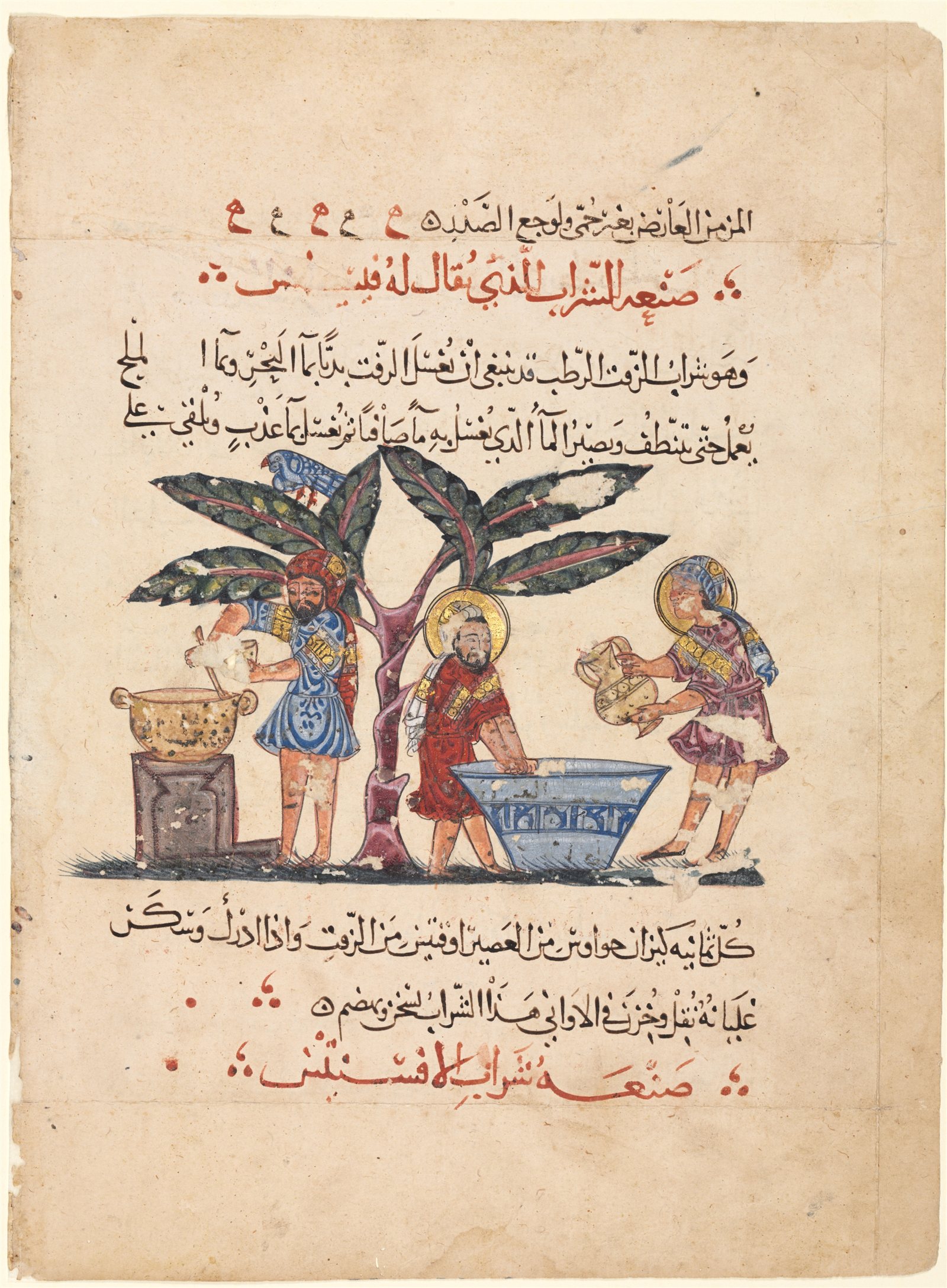
The House of Wisdom in Baghdad, the academy where scholars supposedly translated Greek books together, never existed in that form.
The translation movement, on the other hand, really did take place, and it goes far beyond the legend. Both statements come from the same researcher.
What is told
In Baghdad, in the eighth and ninth centuries, there supposedly existed the House of Wisdom: a great academy where scholars from everywhere translated Greek books together, worked side by side and advanced mathematics, astronomy and medicine.
It is a fine image. It can be found in books, documentaries and museums.
What research establishes
The Arabic term is bayt al-hikma. What the documents allow us to state is that it was a library, most likely established as a bureau of the administration, modelled on an earlier Persian practice. Its primary function: to house both the activity and the results of translations from Persian into Arabic. Translators were employed there for this purpose, and bookbinders to preserve the books.1
The researcher who has carried out the most thorough investigation, Dimitri Gutas, puts it bluntly: much ink has been spilt needlessly describing this place, mostly by projecting modern institutions and research projects onto it. The fact is that we have exceedingly little historical information about it.2
He adds the decisive argument:
Among the dozens of reports about the translation of Greek works into Arabic that we have, there is not even a single one that mentions the bayt al-hikma.3
Yet the few reports on translations from Persian do mention it. The silence is therefore selective, and that is what makes it telling.4
The most striking point is yet to come. The great translator Hunayn ibn Ishaq left a first-hand account of this work. In it he describes the efforts he made to go in search of Greek manuscripts. He never says that he looked for them in the bayt al-hikma — which was nonetheless right under his nose, in Baghdad.56
Where the legend comes from
How the myth was made is clear enough:
- Words translated too hastily: Arabic terms denoting a book depository were rendered with notions that evoked a modern academy.
- The power of storytelling: a scientific academy makes a better story than an archive depository.
- The desire to repair an omission: the legend grew because it answered a real injustice — the West long told the history of science by jumping straight from ancient Greece to the Renaissance.
Gutas is categorical on one point: the bayt al-hikma was certainly not an academy where the ancient sciences were taught as they were being translated. This idea, he writes, did not even occur to the ancient authors who did, however, fabricate other dubious accounts of the transmission of this knowledge.7
As with the Mesopotamian debt-cancellation edicts or the place name Coober Pedy, a mistranslated word ended up manufacturing a fact.
A word used as evidence must be read in its context before it is translated.
The real event
This is where the heart of the matter lies.
The translation movement, on the other hand, really did take place, and it was gigantic.
The publisher’s presentation of his book sums up its scale as follows: from the middle of the eighth century to the tenth century, almost all non-literary and non-historical secular Greek books available in the eastern Byzantine Empire and the Near East were translated into Arabic — astrology, alchemy, physics, botany, medicine, and the rest.8
This work was carried out by translators of diverse origins and faiths — Nestorian Christians, Sabians, Persians, Hindus, Muslims — funded by caliphs, viziers and wealthy merchants.9
Without this movement, a large part of Greek science would have disappeared. What was translated was not merely preserved: it was corrected, discussed and enriched.10
The key detail:
Dimitri Gutas, the researcher who deconstructed the myth of the building, is the same one who established the scale of this translation movement. His book remains the standard reference on the subject.
He did not erase the movement. He simply put the building back in its proper place.
Invoking this story to claim that “the Islamic golden age is a legend” is therefore a misuse of it. The doubt concerns an administrative institution, not scientific activity itself.
What really circulated
This period is better understood through what circulated than through a simple list of cities:
- Numerals: born in South Asia, they passed through the Islamic world before slowly establishing themselves in Europe. A manuscript copied in 976, the Codex Vigilanus, contains them — it is the oldest known document of the Christian West in which they appear.
- Paper: its manufacturing technique followed the same route, from east to west, carried by trade.
- Money without travel: in China, coins were deposited in exchange for certificates; in the Muslim world, instruments for payment at a distance heralded the bill of exchange; in India, equivalent bills of exchange developed.
- Teaching institutions: in Fez, al-Qarawiyyin was founded in the ninth century; it is now regarded as the oldest institution of higher education still in operation.11
One last point, so as not to idealise these centres. They were not open to all: learning remained the preserve of a very small minority — senior officials, scholars, princes and great merchants. A medieval centre of learning produces and preserves knowledge. It does not democratise it.
Note 1
It was a library, most likely established as a 'bureau' under al-Mansur, part of the 'Abbasid administration modeled on that of the Sasanians.
Gutas, Dimitri, Greek Thought, Arabic Culture: The Graeco-Arabic Translation Movement in Baghdad and Early ʿAbbāsid Society, Routledge, 1998, p. 53-60
Its primary function was to house both the activity and the results of translations from Persian into Arabic […] there were hired translators capable to perform this function as well as book binders for the preservation of books.
Gutas, Dimitri, Greek Thought, Arabic Culture: The Graeco-Arabic Translation Movement in Baghdad and Early ʿAbbāsid Society, Routledge, 1998, p. 53-60
Note 2
Much ink has been used unnecessarily on description of the bayt al-hikma, mostly in fanciful and sometimes wishful projections of modern institutions and research projects back into the eighth century. The fact is that we have exceedingly little historical information about the bayt al-hikma.
Gutas, Dimitri, Greek Thought, Arabic Culture: The Graeco-Arabic Translation Movement in Baghdad and Early ʿAbbāsid Society, Routledge, 1998, p. 53-60
Note 3
Among the dozens of reports about the translation of Greek works into Arabic that we have, there is not even a single one that mentions the bayt-al-hikma.
Gutas, Dimitri, Greek Thought, Arabic Culture: The Graeco-Arabic Translation Movement in Baghdad and Early ʿAbbāsid Society, Routledge, 1998, p. 53-60
Note 4
This is to be contrasted with the references to translations from the Persian; we have few such references and yet two of them […] do mention the bayt-al-hikma.
Gutas, Dimitri, Greek Thought, Arabic Culture: The Graeco-Arabic Translation Movement in Baghdad and Early ʿAbbāsid Society, Routledge, 1998, p. 53-60
Note 5
Hunayn mentions the efforts he expended in search of Greek manuscripts and again he never mentions that he looked for them right under his nose in the bayt al-hikma in Baghdad.
Gutas, Dimitri, Greek Thought, Arabic Culture: The Graeco-Arabic Translation Movement in Baghdad and Early ʿAbbāsid Society, Routledge, 1998, p. 53-60
Note 6
Stories explicitly said to have been told by mansa Müsä himself are recorded by al-Umarï, […] None of them mentions silent trade.
Moraes Farias, Paulo F. de, “Silent Trade: Myth and Historical Evidence”, History in Africa, vol. 1, 1974, p. 9-24
Note 7
The bayt-al-hikma was certainly also not an 'academy' for teaching the 'ancient' sciences as they were being translated; such a preposterous idea did not even occur to the authors of the spurious reports about the transmission of the teaching of these sciences that we do have.
Gutas, Dimitri, Greek Thought, Arabic Culture: The Graeco-Arabic Translation Movement in Baghdad and Early ʿAbbāsid Society, Routledge, 1998, p. 53-60
Note 8
From the middle of the eighth century to the tenth century, almost all non-literary and non-historical secular Greek books, including such diverse topics as astrology, alchemy, physics, botany and medicine […] were translated into Arabic.
Gutas, Dimitri, Greek Thought, Arabic Culture: The Graeco-Arabic Translation Movement in Baghdad and Early ʿAbbāsid Society, Routledge, 1998
Note 9
Hunayn and his coworkers, like a significant number of translators, were Nestorian Christians. […] At the same time, translators also included non-Muslim Sabians, Persians, and Hindus.
Montgomery, Scott L., “Mobilities of Science: The Era of Translation into Arabic”, Isis, vol. 109, no. 2, 2018, pp. 313-319
At the same time, translators also included non-Muslim Sabians, Persians, and Hindus. There were, of course, many important Muslim scholars involved in the movement—for example, Al-Kindi (801–873), around whom a group of scholars and students formed […]
Montgomery, Scott L., “Mobilities of Science: The Era of Translation into Arabic”, Isis, vol. 109, no. 2, 2018, pp. 313-319
Note 10
Returning to the Islamic reception of the Greek scientific tradition I hope the reader can now see how this Greek tradition was indeed deeply questioned and dissected, and its constituent parts were first critiqued, modified, and then reconstructed, added to, mathematical rescued, and fully overhauled in order to fit a new cultural framework and a better perception of the inner consistency of science.
Saliba, George, “Islamic reception of Greek astronomy”, Proceedings of the International Astronomical Union, vol. 5, Symposium S260, 2009 (published online 2011), pp. 149-165
Note 11
códice Vigilanus (976), el primer documento conocido del Occidente cristiano en el que aparecen estos guarismos
the Vigilanus codex (976), the first known document of the Christian West in which these numerals appear
Ramírez Martínez, Ángel and Usón Villalba, Carlos, “Unos siglos que cambiaron el mundo (y II)”, Suma (revue de la Federación Española de Sociedades de Profesores de Matemáticas), rubrique “Desde la historia”, no. 35, November 2000, p. 109-112, open access
Most scholars today think the technology, which was not very complex, could have moved out of China into western Iran before 751, though no examples of early, non-Chinese paper survive. Embracing the new technology, the founders of the Abbasid caliphate (750-1258) sponsored a papermaking factory in Baghdad in 796. Soon all scholars in the Islamic world were copying manuscripts onto paper, which was transmitted to Europe via Sicily and Spain by the 12th century (Bloom 2001).
Hansen, Valerie, “Paper”, in the Smithsonian Folklife Festival programme, Smithsonian Institution, 2002, pp. 52-53
During the Tang dynasty (618-907 CE), “Flying Money,” (or Bian Qian) evolved for convenience. More like a receipt, “Flying Money” was issued to merchants after they deposited cash with the government, army or other reliable institution. This receipt was redeemed at other official offices around the empire.
American Numismatic Association, Money Museum, “An Experiment in Paper”, virtual exhibit
By the middle of the eighth century CE the Arabs established their dominion from the Atlantic Ocean to west of the Persian Gulf. […] It was observed that the business practices and instruments that had developed throughout those lands during that period heralded the bill of exchange, both as a mechanism for the transmission of funds and as a negotiable instrument.
Geva, Benjamin, “The Medieval Hawale: The Legal Nature of the Suftaj and Other Islamic Payment Instruments”, Global Hauser Program, New York University School of Law, 2009, abstract
The most important class of credit Instruments that evolved in India were termed Hundis. […] Their use was most widespread in the twelfth century, and has continued till today.
Reserve Bank of India, Evolution of Payment Systems in India, 1998
Fathma bâtit la mosquée El-Kairaouyn, et Meriem la mosquée El-Andalous
Fathma built the El-Kairaouyn mosque, and Meriem the El-Andalous mosque
Ibn Abi Zar’, Rawd al-Qirtas, chronique de Fès (XIVᵉ siècle), traduction française d’Auguste Beaumier : Roudh el-Kartas. Histoire des souverains du Maghreb (Espagne et Maroc) et annales de la ville de Fès, Paris, Imprimerie impériale, 1860, public domain
Notes and sources
- ↑
Passage it was a library, most likely established as a bureau of the administration, modelled on an earlier Persian practice
It was a library, most likely established as a 'bureau' under al-Mansur, part of the 'Abbasid administration modeled on that of the Sasanians.
Source Gutas, Dimitri, Greek Thought, Arabic Culture: The Graeco-Arabic Translation Movement in Baghdad and Early ʿAbbāsid Society, Routledge, 1998, p. 53-60, pp. 58-60.
In libraries · checked on 9 September 2026
Passage to house both the activity and the results of translations from Persian into Arabic. Translators were employed there for this purpose, and bookbinders to preserve the books.
Its primary function was to house both the activity and the results of translations from Persian into Arabic […] there were hired translators capable to perform this function as well as book binders for the preservation of books.
Source Gutas, Dimitri, Greek Thought, Arabic Culture: The Graeco-Arabic Translation Movement in Baghdad and Early ʿAbbāsid Society, Routledge, 1998, p. 53-60, pp. 58-60.
In libraries · checked on 9 September 2026
- ↑
Passage much ink has been spilt needlessly describing this place, mostly by projecting modern institutions and research projects onto it. The fact is that we have exceedingly little historical information about it.
Much ink has been used unnecessarily on description of the bayt al-hikma, mostly in fanciful and sometimes wishful projections of modern institutions and research projects back into the eighth century. The fact is that we have exceedingly little historical information about the bayt al-hikma.
Source Gutas, Dimitri, Greek Thought, Arabic Culture: The Graeco-Arabic Translation Movement in Baghdad and Early ʿAbbāsid Society, Routledge, 1998, p. 53-60, p. 54.
In libraries · checked on 9 September 2026
- ↑
Passage Among the dozens of reports about the translation of Greek works into Arabic that we have, there is not even a single one that mentions the bayt al-hikma.
Among the dozens of reports about the translation of Greek works into Arabic that we have, there is not even a single one that mentions the bayt-al-hikma.
Source Gutas, Dimitri, Greek Thought, Arabic Culture: The Graeco-Arabic Translation Movement in Baghdad and Early ʿAbbāsid Society, Routledge, 1998, p. 53-60, pp. 58-60.
In libraries · checked on 9 September 2026
- ↑
Passage the few reports on translations from Persian do mention it
This is to be contrasted with the references to translations from the Persian; we have few such references and yet two of them […] do mention the bayt-al-hikma.
Source Gutas, Dimitri, Greek Thought, Arabic Culture: The Graeco-Arabic Translation Movement in Baghdad and Early ʿAbbāsid Society, Routledge, 1998, p. 53-60, pp. 58-60.
In libraries · checked on 9 September 2026
- ↑
Passage The great translator Hunayn ibn Ishaq left a first-hand account […] He never says that he looked for them in the bayt al-hikma — which was nonetheless right under his nose, in Baghdad.
Hunayn mentions the efforts he expended in search of Greek manuscripts and again he never mentions that he looked for them right under his nose in the bayt al-hikma in Baghdad.
Source Gutas, Dimitri, Greek Thought, Arabic Culture: The Graeco-Arabic Translation Movement in Baghdad and Early ʿAbbāsid Society, Routledge, 1998, p. 53-60, pp. 58-60.
In libraries · checked on 9 September 2026
- ↑
For this whole section
Passage the parallel with “silent trade”
Stories explicitly said to have been told by mansa Müsä himself are recorded by al-Umarï, […] None of them mentions silent trade.
Source Moraes Farias, Paulo F. de, “Silent Trade: Myth and Historical Evidence”, History in Africa, vol. 1, 1974, p. 9-24, note 19.
Paywalled · checked on 25 October 2026
- ↑
Passage the bayt al-hikma was certainly not an academy where the ancient sciences were taught as they were being translated. This idea […] did not even occur to the ancient authors
The bayt-al-hikma was certainly also not an 'academy' for teaching the 'ancient' sciences as they were being translated; such a preposterous idea did not even occur to the authors of the spurious reports about the transmission of the teaching of these sciences that we do have.
Source Gutas, Dimitri, Greek Thought, Arabic Culture: The Graeco-Arabic Translation Movement in Baghdad and Early ʿAbbāsid Society, Routledge, 1998, p. 53-60, p. 59.
In libraries · checked on 9 September 2026
- ↑
Passage from the middle of the eighth century to the tenth century, almost all non-literary and non-historical secular Greek books […] were translated into Arabic — astrology, alchemy, physics, botany, medicine
From the middle of the eighth century to the tenth century, almost all non-literary and non-historical secular Greek books, including such diverse topics as astrology, alchemy, physics, botany and medicine […] were translated into Arabic.
Source Gutas, Dimitri, Greek Thought, Arabic Culture: The Graeco-Arabic Translation Movement in Baghdad and Early ʿAbbāsid Society, Routledge, 1998, publisher’s description of the book.
Publisher’s description open access open the source · checked on 27 October 2026
- ↑
Passage translators of diverse origins and faiths — Nestorian Christians, Sabians
Hunayn and his coworkers, like a significant number of translators, were Nestorian Christians. […] At the same time, translators also included non-Muslim Sabians, Persians, and Hindus.
Source Montgomery, Scott L., “Mobilities of Science: The Era of Translation into Arabic”, Isis, vol. 109, no. 2, 2018, pp. 313-319, section “Who Were the Translators and What Did They Translate?”, 1st paragraph.
Open access open the source · checked on 27 October 2026
Passage Persians, Hindus, Muslims
At the same time, translators also included non-Muslim Sabians, Persians, and Hindus. There were, of course, many important Muslim scholars involved in the movement—for example, Al-Kindi (801–873), around whom a group of scholars and students formed […]
Source Montgomery, Scott L., “Mobilities of Science: The Era of Translation into Arabic”, Isis, vol. 109, no. 2, 2018, pp. 313-319, section “Who Were the Translators and What Did They Translate?”, 1st paragraph.
Open access open the source · checked on 27 October 2026
- ↑
Passage What was translated was not merely preserved: it was corrected, discussed and enriched.
Returning to the Islamic reception of the Greek scientific tradition I hope the reader can now see how this Greek tradition was indeed deeply questioned and dissected, and its constituent parts were first critiqued, modified, and then reconstructed, added to, mathematical rescued, and fully overhauled in order to fit a new cultural framework and a better perception of the inner consistency of science.
Source Saliba, George, “Islamic reception of Greek astronomy”, Proceedings of the International Astronomical Union, vol. 5, Symposium S260, 2009 (published online 2011), pp. 149-165, p. 165, § 3 (“Conclusion”), last paragraph; see also the abstract, p. 149 (“such old myths as Islamic science being a preservation of Greek science”).
Open access open the source · checked on 27 October 2026
- ↑
Passage A manuscript copied in 976, the Codex Vigilanus, contains them — it is the oldest known document of the Christian West in which they appear.
códice Vigilanus (976), el primer documento conocido del Occidente cristiano en el que aparecen estos guarismos
Editors’ translation the Vigilanus codex (976), the first known document of the Christian West in which these numerals appear
Source Ramírez Martínez, Ángel and Usón Villalba, Carlos, “Unos siglos que cambiaron el mundo (y II)”, Suma (revue de la Federación Española de Sociedades de Profesores de Matemáticas), rubrique “Desde la historia”, no. 35, November 2000, p. 109-112, open access, p. 109 (note call 2 after “Vigilanus” omitted).
Open access open the source · checked on 24 October 2026
Passage Paper: its manufacturing technique followed the same route, from east to west
Most scholars today think the technology, which was not very complex, could have moved out of China into western Iran before 751, though no examples of early, non-Chinese paper survive. Embracing the new technology, the founders of the Abbasid caliphate (750-1258) sponsored a papermaking factory in Baghdad in 796. Soon all scholars in the Islamic world were copying manuscripts onto paper, which was transmitted to Europe via Sicily and Spain by the 12th century (Bloom 2001).
Source Hansen, Valerie, “Paper”, in the Smithsonian Folklife Festival programme, Smithsonian Institution, 2002, pp. 52-53, p. 53, paragraph beginning “Legend has it that the secret of papermaking”.
Open access open the source · checked on 27 October 2026
Passage in China, coins were deposited in exchange for certificates
During the Tang dynasty (618-907 CE), “Flying Money,” (or Bian Qian) evolved for convenience. More like a receipt, “Flying Money” was issued to merchants after they deposited cash with the government, army or other reliable institution. This receipt was redeemed at other official offices around the empire.
Source American Numismatic Association, Money Museum, “An Experiment in Paper”, virtual exhibit, exhibit page, paragraph on Tang “Flying Money”.
Open access open the source · checked on 27 October 2026
Passage in the Muslim world, instruments for payment at a distance heralded the bill of exchange
By the middle of the eighth century CE the Arabs established their dominion from the Atlantic Ocean to west of the Persian Gulf. […] It was observed that the business practices and instruments that had developed throughout those lands during that period heralded the bill of exchange, both as a mechanism for the transmission of funds and as a negotiable instrument.
Source Geva, Benjamin, “The Medieval Hawale: The Legal Nature of the Suftaj and Other Islamic Payment Instruments”, Global Hauser Program, New York University School of Law, 2009, abstract, abstract, 1st and 6th sentences.
Open access open the source · checked on 27 October 2026
Passage in India, equivalent bills of exchange developed
The most important class of credit Instruments that evolved in India were termed Hundis. […] Their use was most widespread in the twelfth century, and has continued till today.
Source Reserve Bank of India, Evolution of Payment Systems in India, 1998, chapter II, passage on hundis.
Open access open the source · checked on 27 October 2026
Passage in Fez, al-Qarawiyyin was founded in the ninth century
Fathma bâtit la mosquée El-Kairaouyn, et Meriem la mosquée El-Andalous
Editors’ translation Fathma built the El-Kairaouyn mosque, and Meriem the El-Andalous mosque
Source Ibn Abi Zar’, Rawd al-Qirtas, chronique de Fès (XIVᵉ siècle), traduction française d’Auguste Beaumier : Roudh el-Kartas. Histoire des souverains du Maghreb (Espagne et Maroc) et annales de la ville de Fès, Paris, Imprimerie impériale, 1860, public domain, pp. 88-89 of the Beaumier translation (1860); p. 88: “the site of the El-Kairaouyn mosque, whose first foundations she laid on Saturday […] of the month of Ramadan the great”, followed by a date in the Hijri and Christian eras in the ninth century (read as “an 266 (869 J. G.)” by the OCR, to be checked against the page image).
Public domain open the source · checked on 24 October 2026
Bibliography
16
- American Numismatic Association, Money Museum, “An Experiment in Paper”, virtual exhibit, open access (Tang “flying money”, a receipt issued against a deposit of cash). https://www.money.org/money-museum-virtual-exhibits-silk-case4/
- Balty-Guesdon, Marie-Geneviève, “Le Bayt al-ḥikma de Baghdad”, Arabica, vol. 39, 1992, p. 131-150, paywalled.
- Bloom, Jonathan M., Paper Before Print: The History and Impact of Paper in the Islamic World, Yale University Press, 2001, in libraries (the route of paper from east to west).
- Brentjes, Sonja and Morrison, Robert G., “The Sciences in Islamic Societies (750-1800)”, dans The New Cambridge History of Islam, vol. 4, Cambridge University Press, 2010, p. 564-639, in libraries (the translation movement and the diversity of its participants).
- Geva, Benjamin, “The Medieval Hawale: The Legal Nature of the Suftaj and Other Islamic Payment Instruments”, Global Hauser Program, New York University School of Law, 2009, Osgoode Digital Commons repository (York University), open access (the suftaja, an order to pay at a place other than that of issue, and the Islamic instruments that heralded the bill of exchange). https://digitalcommons.osgoode.yorku.ca/scholarly_works/2616/
- Goitein, Shelomo Dov, A Mediterranean Society, vol. 1, Economic Foundations, University of California Press, 1967, in libraries (bills of exchange in the Mediterranean world).
- Gutas, Dimitri, Greek Thought, Arabic Culture: The Graeco-Arabic Translation Movement in Baghdad and Early ʿAbbāsid Society, Routledge, 1998, p. 53-60, in libraries (the nature of the bayt al-hikma: library and bureau, translations from Persian; the silence of the reports on translations from Greek; Hunayn’s account; the rejection of the academy idea; the real scale of the translation movement). French translation: Pensée grecque, culture arabe, Aubier, 2005.
- Hansen, Valerie, “Paper”, in the Smithsonian Folklife Festival programme, Smithsonian Institution, 2002, pp. 52-53, open access (papermaking, from China to Baghdad and then to Europe). https://folklife-media.si.edu/docs/festival/program-book-articles/FESTBK2002_13.pdf
- Ibn Abi Zar’, Rawd al-Qirtas, chronique de Fès (XIVᵉ siècle), traduction française d’Auguste Beaumier : Roudh el-Kartas. Histoire des souverains du Maghreb (Espagne et Maroc) et annales de la ville de Fès, Paris, Imprimerie impériale, 1860, public domain (the founding of al-Qarawiyyin by Fathma, daughter of Mohammed el-Fehery, in the ninth century: pp. 87-89). https://archive.org/details/roudhelkartashis00ibnauoft
- Montgomery, Scott L., “Mobilities of Science: The Era of Translation into Arabic”, Isis, vol. 109, no. 2, 2018, pp. 313-319, open access (Nestorian, Sabian, Persian and Hindu translators). https://doi.org/10.1086/698236
- Moraes Farias, Paulo F. de, “Silent Trade: Myth and Historical Evidence”, History in Africa, vol. 1, 1974, p. 9-24, paywalled (the parallel with “silent trade”).
- Ramírez Martínez, Ángel and Usón Villalba, Carlos, “Unos siglos que cambiaron el mundo (y II)”, Suma (revue de la Federación Española de Sociedades de Profesores de Matemáticas), rubrique “Desde la historia”, no. 35, November 2000, p. 109-112, open access (the Codex Vigilanus, dated 976, the first known document of the Christian West in which these numerals appear). https://revistasuma.fespm.es/sites/revistasuma.fespm.es/IMG/pdf/35/109-112.pdf
- Reserve Bank of India, Evolution of Payment Systems in India, 1998, chap. II, open access (hundis, Indian bills of exchange, widespread from the twelfth century). https://rbi.org.in/Scripts/PublicationsView.aspx?id=155
- Saliba, George, Islamic Science and the Making of the European Renaissance, MIT Press, 2007, in libraries (what was corrected and enriched, not merely preserved).
- Saliba, George, “Islamic reception of Greek astronomy”, Proceedings of the International Astronomical Union, vol. 5, Symposium S260, 2009 (published online 2011), pp. 149-165, open access (Greek astronomy criticised, corrected and overhauled, not merely preserved). https://doi.org/10.1017/S1743921311002237
- Von Glahn, Richard, Fountain of Fortune: Money and Monetary Policy in China, 1000-1700, University of California Press, 1996, in libraries (certificates in exchange for deposited coins in China).
Spotted an error or have a doubt? Write to us.