
In 1324, a West African king crosses Egypt on his way to Mecca. He hands out so much gold there that the price of the metal falls in Cairo.1
The fact is attested. Its duration, however, is less well attested than is often repeated — and this is the starting point of one of the most persistent myths in popular history.
How people crossed
Before steamships and aeroplanes, linking two worlds separated by a desert, a steppe or an ocean demanded a great deal of organisation. Three great systems of routes operated for centuries.
The trans-Saharan routes, linking West Africa to the Mediterranean. They rested on an animal and on an exchange. The animal was the dromedary, introduced into North Africa in the first centuries of the Common Era: it can go several days without drinking and carries heavy loads, which no horse can do in the Sahara. The exchange was that of gold from the South for salt from the North — salt being, in hot regions, essential for preserving food and for health, and scarce south of the desert. The caravans — sometimes thousands of animals — moved from oasis to oasis, the only possible watering points, which fixed the itineraries for centuries. The crossing took forty to fifty days.2
The Silk Roads, between China and the Mediterranean, across the steppes and deserts of Central Asia. The name is misleading: it was coined in the nineteenth century by the German geographer Ferdinand von Richthofen, and it was neither a single road nor a trade limited to silk. Almost no one made the whole journey: goods passed from hand to hand, each merchant covering only one segment.3
This relay principle applies to all three networks. On the Saharan routes too, merchants from North Africa and the Sahara and those from West Africa met in the staging towns of the Sahel: that is where goods changed hands. The great trading networks of the ancient world were not journeys, but chains.4
The maritime routes of the Indian Ocean, the busiest of all before the modern era. They rested on a natural phenomenon: the monsoon, a wind that blows for six months in one direction and six months in the other. A ship set out with one wind and returned with the other — which made crossings predictable, but sometimes meant waiting months in a foreign port. This is how merchant communities settled far from home took shape, from East Africa to Indonesia.
It was not only goods that travelled these routes. Techniques — paper, the compass, Indian numerals — religions, scholars, books, and diseases too: the Black Death followed the same paths as silk.
One point outweighs all the rest: these circuits existed before Europe took an interest in them, and they were not waiting for anyone. The kingdom discussed here was one of their major crossroads, and that is where its gold came from.5
What is established
Mansa Musa ruled the Mali Empire from about 1312 to 1337.
His empire had access to the Bure goldfields, left to quasi-independent vassals, and controlled the trans-Saharan trade. Mali’s gold crossed the desert on camelback and fed the economy of the Mediterranean world.6
In 1324, Mansa Musa made his pilgrimage to Mecca. During his stop in Cairo, he and his retinue gave, bought and sold so much gold, writes a witness, that they depressed its value in Egypt.7
The same witness gives a figure: before Musa’s arrival, a gold coin was worth at least twenty-five silver coins; afterwards, twenty-two at most — and this low rate is said to have lasted about twelve years.8
This figure, however, calls for caution.
That the rate fell is well founded. That it stayed low for twelve years is much less so. Only one witness says so: al-Umari, who arrived in Cairo a decade after the events and was busy writing an encyclopaedia intended to impress.9
The historian Warren Schultz, a specialist in the coinage of Egypt in this period, went back over all the available exchange rates. His finding: far from being the sole cause of a fall in the value of gold, the Mansa Musa episode was but one of many short-term fluctuations recorded in the same period. He cites others — dignitaries dumping their valuables, a looted palace pouring its gold onto the market.10
Finally, he makes a methodological remark of wider relevance: these accounts all have in common that they explain a phenomenon by a single cause alone, which is very convenient for storytelling, and hardly credible for a market in which coins of different origins, fineness and ages circulated together.11
The figure that survived is the one that made the best story.
What this event reveals: a private sumptuary decision capable of destabilising the financial market of a regional power.
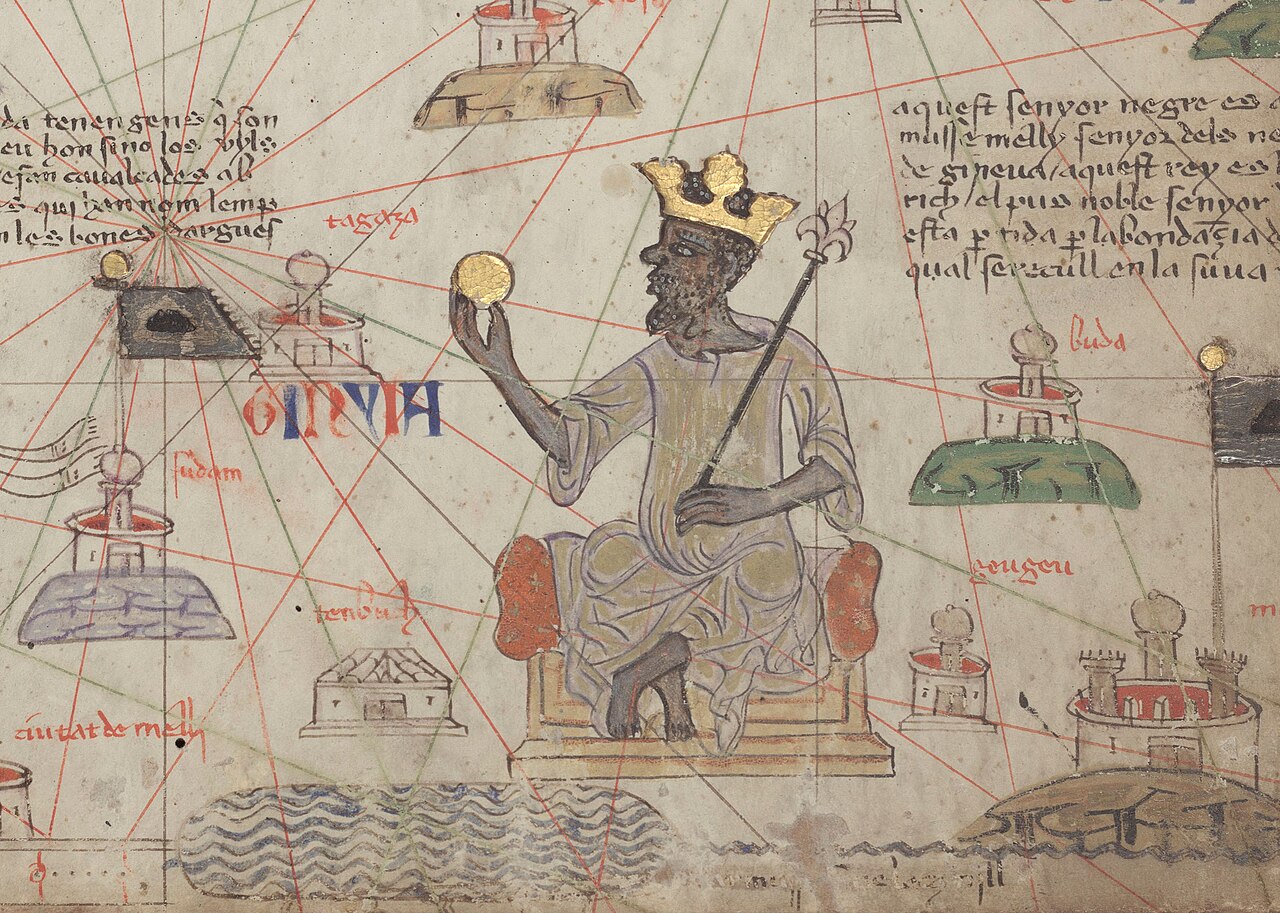
On his return, the emperor attracted architects, poets and scholars. Timbuktu became a major intellectual centre, and Mali’s fame reached Europe: an atlas drawn in Majorca at the end of the fourteenth century depicts Mansa Musa enthroned, a golden orb in his hand.12
What belongs to myth
One claim comes up again and again: Mansa Musa is said to have been “the richest human being in all of history”, with a fortune estimated at 400 billion dollars in today’s money.13
The origin of this number is known. It was published in 2012 by a website devoted to celebrities’ fortunes, in a ranking of the greatest fortunes of all time. Picked up by the press, it has circulated everywhere since.14
A magazine figure turned into a historical fact.
Economic historians reject this quantification for three reasons:15
- No common standard: No monetary conversion between the fourteenth century and today makes sense.
- Nature of wealth: Mansa Musa did not own a personal fortune in the modern sense, but held sovereign control over mines, tributes and trade flows.
- Incommensurability: Royal wealth was described by contemporaries as surpassing understanding, which reflected the absence of suitable measuring tools, not a precise figure.
Why this nuance is essential
The circulation of this figure reflects a legitimate aim: to correct a European historiography that long ignored the power of African empires. Recalling that a ruler of Mali surpassed the European monarchs of his time restores a historical fact.
However, the figure remains scientifically unfounded.
Principle of method: Correcting a received idea with an invented figure weakens the cause one seeks to defend. Removing this spurious figure takes nothing away from the reality of Mali’s power.
A world already interconnected before 1492
Global history often takes 1492 as the starting point of globalisation. In reality, the Afro-Eurasian continents were already trading freely:
- Financial instruments: China used paper money, while the Islamic world and India had mastered the long-distance transfer of debts (suftaja / hawala).
- Currencies of exchange: Cowries, shells thought to have come mainly from the Maldives, served as everyday currency as far as West Africa.
- Knowledge and technologies: Arabic numerals (originating in India) and papermaking travelled these same trade routes to Europe.16
Likewise, in the early fifteenth century, the Chinese maritime expeditions of Zheng He across the Indian Ocean bear witness to the power of these pre-existing networks — although the exact size of his ships is still debated among historians.17
The break after 1492 is therefore not the invention of transcontinental exchange, but the integration of the American continent into an already existing network.
(Note: The question of the trans-Saharan slave trades and of the movement of captives along these routes is dealt with specifically in Entry 3.10).18
Note 1
Corpus of Early Arabic Sources for West African History
Levtzion, Nehemia, Ancient Ghana and Mali, Methuen, 1973, in libraries
Note 2
Helping facilitate contact in the desert extremes were small settlements of seminomadic peoples at a fragile line of oases forging a point-to-point trading system. Thus, early trade in the Sahara was a matter not of transporting goods across the vast desert expanse but rather of passing them from oasis to oasis. A principal commodity exchanged during this early stage of trade was salt, which was carried to the south and acted as a sort of currency. […] Only gradually were highly valuable trading goods introduced, such as gold and copper, which were then brought across the desert from tropical West Africa to the far reaches of the North African coast. […] The camel enabled desert nomads to reach more distant oases than ever before and so open entirely new routes across the desert.
Kordas, Ann, Lynch, Ryan J., Nelson, Brooke and Tatlock, Julie, World History, Volume 1: to 1500, OpenStax, 2023, section 9.4 “North Africa’s Mediterranean and Trans-Saharan Connections”
Note 3
Mansa Musa's journey captured the attention of people from Spain to Syria, including the Muslim geographer Ibn Battuta, who, after years traveling throughout Asia, visited Mali during the reign of Mansa Musa's brother Mansa Suleyman. Ibn Battuta's account has become a major source of our knowledge about fourteenth-century Mali.
Kordas, Ann, Lynch, Ryan J., Nelson, Brooke and Tatlock, Julie, World History, Volume 1: to 1500, OpenStax, 2023, section 15.2 “Medieval Sub-Saharan Africa”
Note 4
The immediate destinations for Trans-Saharan camel caravans coming from North Africa were the market towns which developed on the southern fringes of the Sahara, in the most arid zones of the Sahel (Sahel meaning 'shore' in Arabic; see Fig. 17.1). These centres became the principal locations for the Trans-Saharan commercial exchange, meeting points between traders from North Africa and the Sahara and those coming from further south in West Africa.
Nixon, Sam, “The Early Islamic Trans-Saharan Market Towns of West Africa”, in Sterry, Martin and Mattingly, David J. (ed.), Urbanisation and State Formation in the Ancient Sahara and Beyond, Cambridge University Press, 2020, pp. 621-666
Note 5
When European nations such as Spain, Portugal, the Netherlands, England, and France were just setting out on voyages of exploration and beginning to forge maritime trade networks, a thriving oceangoing commerce was already being carried on in the Indian Ocean.
Kordas, Ann, Lynch, Ryan J., Nelson, Brooke and Tatlock, Julie, World History, Volume 2: from 1400, OpenStax, 2022, chapter 2, introduction
Note 6
The kings of Mali were less interested in conquering the various small kingdoms and chiefdoms of the grasslands than in taking the Sahelian trading towns that linked the regional economy to the vast trans-Saharan trade. […] Control of the towns and the trade routes they connected was one of several components in Mali's diverse economy, which included access to the Bure goldfields and the agriculturally rich rural areas, particularly those around Niani in the south of the country. […] Mansa Musa, the most famous of the Malian kings […] arrived in Cairo
Kordas, Ann, Lynch, Ryan J., Nelson, Brooke and Tatlock, Julie, World History, Volume 1: to 1500, OpenStax, 2023, section 15.2 “Medieval Sub-Saharan Africa”
Control of the towns and the trade routes they connected was one of several components in Mali's diverse economy, which included access to the Bure goldfields and the agriculturally rich rural areas, particularly those around Niani in the south of the country. […] This posed a serious risk to the imperial economy, so Malian rulers allowed gold areas to remain quasi-independent vassal states.
Kordas, Ann, Lynch, Ryan J., Nelson, Brooke and Tatlock, Julie, World History, Volume 1: to 1500, OpenStax, 2023, section 15.2 “Medieval Sub-Saharan Africa”
Note 7
The Cairenes made incalculable profits out of him and his suite in buying and selling and giving and taking. They exchanged gold until they depressed its value in Egypt and caused its price to fall.
Schultz, Warren C., “Mansa Musa’s Gold in Mamluk Cairo: A Reappraisal of a World Civilizations Anecdote”, dans Post-Mongol Central Asia and the Middle East, 2006
Note 8
The mithqāl did not go below 25 dirhams and was generally above, but from that time its value fell and it cheapened in price and has remained cheap till now. The mithqāl does not exceed 22 dirhams or less. This has been the state of affairs for about twelve years until this day
Schultz, Warren C., “Mansa Musa’s Gold in Mamluk Cairo: A Reappraisal of a World Civilizations Anecdote”, dans Post-Mongol Central Asia and the Middle East, 2006
Note 9
as far as I have been able to determine, only one Mamluk source mentions that Mansa Musa's gold was the cause of long-term drop in value of gold
Schultz, Warren C., “Mansa Musa’s Gold in Mamluk Cairo: A Reappraisal of a World Civilizations Anecdote”, dans Post-Mongol Central Asia and the Middle East, 2006
Note 10
Far from being a unique cause of a drop in the value of gold, a review of exchange-rates provided for Mamluk Cairo reveals the Mansa Musa episode was but one of many short-term fluctuations recorded
Schultz, Warren C., “Mansa Musa’s Gold in Mamluk Cairo: A Reappraisal of a World Civilizations Anecdote”, dans Post-Mongol Central Asia and the Middle East, 2006
the rapid sell-off ornamental wealth by Mamluk amirs […] and the enormous amount of gold which was apparently taken from the sacking of a high-ranking amir's palace
Schultz, Warren C., “Mansa Musa’s Gold in Mamluk Cairo: A Reappraisal of a World Civilizations Anecdote”, dans Post-Mongol Central Asia and the Middle East, 2006
Note 11
these two accounts, like the main account of Mansa Musa, have a reliance on single causation explanation that is troubling to the modern historian
Schultz, Warren C., “Mansa Musa’s Gold in Mamluk Cairo: A Reappraisal of a World Civilizations Anecdote”, dans Post-Mongol Central Asia and the Middle East, 2006
The available coinage could and often did include coins of multiple origins, purity, and age circulating together at multiple and varying exchange rates.
Schultz, Warren C., “Mansa Musa’s Gold in Mamluk Cairo: A Reappraisal of a World Civilizations Anecdote”, dans Post-Mongol Central Asia and the Middle East, 2006
Note 12
It was completed in 1375. […] Mansa Musa, the emperor of Mali, is prominently depicted on the second panel seated on a throne and holding a golden orb in one hand.
Northwestern University, “Abraham Cresques (?). Atlas of Maritime Charts (The Catalan Atlas)”, Caravans of Gold, Fragments in Time, projet numérique, 2019
Note 13
Step aside, Bill Gates. Meet Mansa Musa I of Mali, a 14th century African king whose estimated $400 billion fortune makes him the richest human being in all of history, according to the website Celebrity Net Worth. The website released a list last week of the wealthiest people who ever lived, claiming it had adjusted for inflation to bring the fortunes into 2012 dollars.
Fox News, “Website Names Obscure 14th Century African King the Richest Person in History”, 2012
Note 14
Meet Mansa Musa I of Mali […] whose estimated $400 billion fortune makes him the richest human being in all of history, according to the website Celebrity Net Worth. The website released a list last week of the wealthiest people who ever lived.
Fox News, “Website Names Obscure 14th Century African King the Richest Person in History”, 2012
Note 15
Gomez, Michael A., African Dominion: A New History of Empire in Early and Medieval West Africa, Princeton University Press, 2018
Note 16
the hawale, as the legal doctrine underlying the transfer of debts under the various schools of Islamic law […] A payment instrument to be further discussed is the suftaj; it contains an obligation of a paymaster or his correspondent to pay at a place other than that of the issue of the document.
Geva, Benjamin, “The Medieval Hawale: The Legal Nature of the Suftaj and Other Islamic Payment Instruments”, Global Hauser Program, New York University School of Law, 2009
The most important class of credit Instruments that evolved in India were termed Hundis. Their use was most widespread in the twelfth century, and has continued till today. In a sense, they represent the oldest surviving form of credit instrument. Hundis were used […] as remittance instruments (to transfer funds from one place to another)
Reserve Bank of India, Evolution of Payment Systems in India, 1998
The Maldives are often assumed to have been a main source of these shells; this has never been archaeologically tested. […] by the 14th century, cowries are described as currency, and an import on which vast profits were made (al Umari, in Hopkins and Levtzion 2000: 260, 269). In the 14th century, ibn Battuta saw 1150 cowries sold for one gold dinar in Mali. […] Although cowries occur throughout the Indo-Pacific, it is the Maldives specifically which have been described as main exporters of these shells
Haour, Anne, Christie, Annalisa and Jaufar, Shiura, “Tracking the Cowrie Shell: Excavations in the Maldives, 2016”, Nyame Akuma, no. 85, 2016, pp. 69-77
The main sources for the medieval history of West Africa are to be found in Arabic writings. […] Here, in 372 pages of clear English translations, is the sum of what Islamic scholars wrote about West Africa between the ninth and the fifteenth centuries, together with the notes necessary to its evaluation and the detailed indexes and glossaries which facilitate comparative use
Markus Wiener Publishers, “Corpus of Early Arabic Sources for West African History”, publisher’s description of the reprint
Note 17
The article presents a comprehensive study of the problem concerning the real dimensions of the “treasure ships” – the largest sailing vessels of medieval China that formed the core of admiral Zheng He’s fleet during his seven maritime expeditions (1405-1433). It has been traced that the contradictory nature of extant written evidence, the difficulties in interpreting traditional Chinese units of measurement and the lack of archeological data have led to long-standing debates about the real parameters of these ships.
Dolyk, O. and Kozlovskyi, S., “Admiral Zheng He’s ‘Treasure Ships’ (1405-1433): Problems of Dimensional Interpretation and Scholarly Assessments”, Problems of World History, no. 33, 2026, pp. 10-21
Note 18
Here, then, is Fauvelle's African Middle Ages, and the key to unlocking its secrets: we must limit ourselves to asking only the questions to which our sources permit answer, or be prepared to deal only in possibilities.
“Fauvelle, The Golden Rhinoceros”, review, The Medieval Review, 19.11.07, 2019
Notes and sources
- ↑
Passage In 1324, a West African king crosses Egypt on his way to Mecca […] Mansa Musa ruled the Mali Empire from about 1312 to 1337
Corpus of Early Arabic Sources for West African History
Source Levtzion, Nehemia, Ancient Ghana and Mali, Methuen, 1973, in libraries, accounts of the pilgrimage and of the chronology of the reign.
In libraries · checked on 9 September 2026
- ↑
Passage The exchange was that of gold from the South for salt from the North […] The caravans […] moved from oasis to oasis, the only possible watering points, which fixed the itineraries
Helping facilitate contact in the desert extremes were small settlements of seminomadic peoples at a fragile line of oases forging a point-to-point trading system. Thus, early trade in the Sahara was a matter not of transporting goods across the vast desert expanse but rather of passing them from oasis to oasis. A principal commodity exchanged during this early stage of trade was salt, which was carried to the south and acted as a sort of currency. […] Only gradually were highly valuable trading goods introduced, such as gold and copper, which were then brought across the desert from tropical West Africa to the far reaches of the North African coast. […] The camel enabled desert nomads to reach more distant oases than ever before and so open entirely new routes across the desert.
Source Kordas, Ann, Lynch, Ryan J., Nelson, Brooke and Tatlock, Julie, World History, Volume 1: to 1500, OpenStax, 2023, section 9.4 “North Africa’s Mediterranean and Trans-Saharan Connections”, section 9.4, subsection “North African and Trans-Saharan Trade”, paragraph beginning “Indigenous peoples of North Africa” and paragraph beginning “The camel enabled desert nomads”.
Open access open the source · checked on 27 October 2026
- ↑
Passage the journey to Mali
Mansa Musa's journey captured the attention of people from Spain to Syria, including the Muslim geographer Ibn Battuta, who, after years traveling throughout Asia, visited Mali during the reign of Mansa Musa's brother Mansa Suleyman. Ibn Battuta's account has become a major source of our knowledge about fourteenth-century Mali.
Source Kordas, Ann, Lynch, Ryan J., Nelson, Brooke and Tatlock, Julie, World History, Volume 1: to 1500, OpenStax, 2023, section 15.2 “Medieval Sub-Saharan Africa”, section 15.2, subsection “The Mali Empire”, paragraph following the “Link to Learning” box.
Open access open the source · checked on 27 October 2026
- ↑
Passage merchants from North Africa and the Sahara and those from West Africa met in the staging towns of the Sahel: that is where goods changed hands
The immediate destinations for Trans-Saharan camel caravans coming from North Africa were the market towns which developed on the southern fringes of the Sahara, in the most arid zones of the Sahel (Sahel meaning 'shore' in Arabic; see Fig. 17.1). These centres became the principal locations for the Trans-Saharan commercial exchange, meeting points between traders from North Africa and the Sahara and those coming from further south in West Africa.
Source Nixon, Sam, “The Early Islamic Trans-Saharan Market Towns of West Africa”, in Sterry, Martin and Mattingly, David J. (ed.), Urbanisation and State Formation in the Ancient Sahara and Beyond, Cambridge University Press, 2020, pp. 621-666, chapter summary, 2nd and 3rd sentences.
Paywalled, summary open access open the source · checked on 27 October 2026
- ↑
Passage these circuits existed before Europe took an interest in them
When European nations such as Spain, Portugal, the Netherlands, England, and France were just setting out on voyages of exploration and beginning to forge maritime trade networks, a thriving oceangoing commerce was already being carried on in the Indian Ocean.
Source Kordas, Ann, Lynch, Ryan J., Nelson, Brooke and Tatlock, Julie, World History, Volume 2: from 1400, OpenStax, 2022, chapter 2, introduction, chapter 2 introduction, 1st paragraph, 2nd sentence.
Open access open the source · checked on 27 October 2026
- ↑
Passage Mansa Musa ruled the Mali Empire […] His empire […] controlled the trans-Saharan trade.
The kings of Mali were less interested in conquering the various small kingdoms and chiefdoms of the grasslands than in taking the Sahelian trading towns that linked the regional economy to the vast trans-Saharan trade. […] Control of the towns and the trade routes they connected was one of several components in Mali's diverse economy, which included access to the Bure goldfields and the agriculturally rich rural areas, particularly those around Niani in the south of the country. […] Mansa Musa, the most famous of the Malian kings […] arrived in Cairo
Source Kordas, Ann, Lynch, Ryan J., Nelson, Brooke and Tatlock, Julie, World History, Volume 1: to 1500, OpenStax, 2023, section 15.2 “Medieval Sub-Saharan Africa”, section 15.2, subsection “The Mali Empire”, 5th and 6th paragraphs; paragraph following the “Dueling Voices” box.
Open access open the source · checked on 27 October 2026
Passage His empire had access to the Bure goldfields, left to quasi-independent vassals
Control of the towns and the trade routes they connected was one of several components in Mali's diverse economy, which included access to the Bure goldfields and the agriculturally rich rural areas, particularly those around Niani in the south of the country. […] This posed a serious risk to the imperial economy, so Malian rulers allowed gold areas to remain quasi-independent vassal states.
Source Kordas, Ann, Lynch, Ryan J., Nelson, Brooke and Tatlock, Julie, World History, Volume 1: to 1500, OpenStax, 2023, section 15.2 “Medieval Sub-Saharan Africa”, section 15.2, subsection “The Mali Empire”, paragraph on Mali’s economy and 7th paragraph (gold areas left as vassal states).
Open access open the source · checked on 27 October 2026
- ↑
Passage he and his retinue gave, bought and sold so much gold […] that they depressed its value in Egypt
The Cairenes made incalculable profits out of him and his suite in buying and selling and giving and taking. They exchanged gold until they depressed its value in Egypt and caused its price to fall.
Source Schultz, Warren C., “Mansa Musa’s Gold in Mamluk Cairo: A Reappraisal of a World Civilizations Anecdote”, dans Post-Mongol Central Asia and the Middle East, 2006, quotation from al-Umari (trans. Hopkins, Corpus, pp. 269-270) in the body of the article.
Open access open the source · checked on 9 September 2026
- ↑
Passage before Musa’s arrival, a gold coin was worth at least twenty-five silver coins; afterwards, twenty-two at most — and this low rate is said to have lasted about twelve years
The mithqāl did not go below 25 dirhams and was generally above, but from that time its value fell and it cheapened in price and has remained cheap till now. The mithqāl does not exceed 22 dirhams or less. This has been the state of affairs for about twelve years until this day
Source Schultz, Warren C., “Mansa Musa’s Gold in Mamluk Cairo: A Reappraisal of a World Civilizations Anecdote”, dans Post-Mongol Central Asia and the Middle East, 2006, quotation from al-Umari (trans. Hopkins, Corpus, pp. 269-270) in the body of the article.
Open access open the source · checked on 9 September 2026
- ↑
Passage Only one witness says so: al-Umari
as far as I have been able to determine, only one Mamluk source mentions that Mansa Musa's gold was the cause of long-term drop in value of gold
Source Schultz, Warren C., “Mansa Musa’s Gold in Mamluk Cairo: A Reappraisal of a World Civilizations Anecdote”, dans Post-Mongol Central Asia and the Middle East, 2006, body of the article.
Open access open the source · checked on 9 September 2026
- ↑
Passage the Mansa Musa episode was but one of many short-term fluctuations recorded in the same period
Far from being a unique cause of a drop in the value of gold, a review of exchange-rates provided for Mamluk Cairo reveals the Mansa Musa episode was but one of many short-term fluctuations recorded
Source Schultz, Warren C., “Mansa Musa’s Gold in Mamluk Cairo: A Reappraisal of a World Civilizations Anecdote”, dans Post-Mongol Central Asia and the Middle East, 2006, body of the article.
Open access open the source · checked on 9 September 2026
Passage dignitaries dumping their valuables, a looted palace pouring its gold onto the market
the rapid sell-off ornamental wealth by Mamluk amirs […] and the enormous amount of gold which was apparently taken from the sacking of a high-ranking amir's palace
Source Schultz, Warren C., “Mansa Musa’s Gold in Mamluk Cairo: A Reappraisal of a World Civilizations Anecdote”, dans Post-Mongol Central Asia and the Middle East, 2006, body of the article.
Open access open the source · checked on 9 September 2026
- ↑
Passage these accounts all have in common that they explain a phenomenon by a single cause alone
these two accounts, like the main account of Mansa Musa, have a reliance on single causation explanation that is troubling to the modern historian
Source Schultz, Warren C., “Mansa Musa’s Gold in Mamluk Cairo: A Reappraisal of a World Civilizations Anecdote”, dans Post-Mongol Central Asia and the Middle East, 2006, body of the article.
Open access open the source · checked on 9 September 2026
Passage a market in which coins of different origins, fineness and ages circulated together
The available coinage could and often did include coins of multiple origins, purity, and age circulating together at multiple and varying exchange rates.
Source Schultz, Warren C., “Mansa Musa’s Gold in Mamluk Cairo: A Reappraisal of a World Civilizations Anecdote”, dans Post-Mongol Central Asia and the Middle East, 2006, body of the article.
Open access open the source · checked on 9 September 2026
- ↑
Passage an atlas drawn […] at the end of the fourteenth century depicts Mansa Musa enthroned, a golden orb in his hand
It was completed in 1375. […] Mansa Musa, the emperor of Mali, is prominently depicted on the second panel seated on a throne and holding a golden orb in one hand.
Source Northwestern University, “Abraham Cresques (?). Atlas of Maritime Charts (The Catalan Atlas)”, Caravans of Gold, Fragments in Time, projet numérique, 2019, catalogue entry for the work, “Description” paragraph, 2nd and 5th sentences.
Open access open the source · checked on 9 September 2026
- ↑
Passage Mansa Musa is said to have been “the richest human being in all of history”, with a fortune estimated at 400 billion dollars in today’s money
Step aside, Bill Gates. Meet Mansa Musa I of Mali, a 14th century African king whose estimated $400 billion fortune makes him the richest human being in all of history, according to the website Celebrity Net Worth. The website released a list last week of the wealthiest people who ever lived, claiming it had adjusted for inflation to bring the fortunes into 2012 dollars.
Source Fox News, “Website Names Obscure 14th Century African King the Richest Person in History”, 2012, 1st and 2nd paragraphs (17 October 2012).
Open access open the source · checked on 27 October 2026
- ↑
Passage It was published in 2012 by a website devoted to celebrities’ fortunes, in a ranking of the greatest fortunes of all time.
Meet Mansa Musa I of Mali […] whose estimated $400 billion fortune makes him the richest human being in all of history, according to the website Celebrity Net Worth. The website released a list last week of the wealthiest people who ever lived.
Source Fox News, “Website Names Obscure 14th Century African King the Richest Person in History”, 2012, first and second paragraphs (17 October 2012).
Open access open the source · checked on 9 September 2026
- ↑
Passage Economic historians reject this quantification
Source Gomez, Michael A., African Dominion: A New History of Empire in Early and Medieval West Africa, Princeton University Press, 2018, chapter on Mansa Musa and the critique of the figure.
In libraries · checked on 27 October 2026
- ↑
Passage the Islamic world […] had mastered the long-distance transfer of debts
the hawale, as the legal doctrine underlying the transfer of debts under the various schools of Islamic law […] A payment instrument to be further discussed is the suftaj; it contains an obligation of a paymaster or his correspondent to pay at a place other than that of the issue of the document.
Source Geva, Benjamin, “The Medieval Hawale: The Legal Nature of the Suftaj and Other Islamic Payment Instruments”, Global Hauser Program, New York University School of Law, 2009, § 1, p. 6; § 3.1, p. 32.
Open access open the source · checked on 27 October 2026
Passage India had mastered the long-distance transfer of debts
The most important class of credit Instruments that evolved in India were termed Hundis. Their use was most widespread in the twelfth century, and has continued till today. In a sense, they represent the oldest surviving form of credit instrument. Hundis were used […] as remittance instruments (to transfer funds from one place to another)
Source Reserve Bank of India, Evolution of Payment Systems in India, 1998, chapter II, § 2.7.
Open access open the source · checked on 27 October 2026
Passage Cowries, shells thought to have come mainly from the Maldives, served as everyday currency as far as West Africa.
The Maldives are often assumed to have been a main source of these shells; this has never been archaeologically tested. […] by the 14th century, cowries are described as currency, and an import on which vast profits were made (al Umari, in Hopkins and Levtzion 2000: 260, 269). In the 14th century, ibn Battuta saw 1150 cowries sold for one gold dinar in Mali. […] Although cowries occur throughout the Indo-Pacific, it is the Maldives specifically which have been described as main exporters of these shells
Source Haour, Anne, Christie, Annalisa and Jaufar, Shiura, “Tracking the Cowrie Shell: Excavations in the Maldives, 2016”, Nyame Akuma, no. 85, 2016, pp. 69-77, introduction, 1st to 3rd paragraphs (p. 69 of the published version; accepted manuscript read).
Open access open the source · checked on 27 October 2026
Passage the Arabic texts in translation
The main sources for the medieval history of West Africa are to be found in Arabic writings. […] Here, in 372 pages of clear English translations, is the sum of what Islamic scholars wrote about West Africa between the ninth and the fifteenth centuries, together with the notes necessary to its evaluation and the detailed indexes and glossaries which facilitate comparative use
Source Markus Wiener Publishers, “Corpus of Early Arabic Sources for West African History”, publisher’s description of the reprint, book description, 1st paragraph (quoting the Times Literary Supplement review).
Open access open the source · checked on 27 October 2026
- ↑
Passage the Chinese maritime expeditions of Zheng He […] although the exact size of his ships is still debated
The article presents a comprehensive study of the problem concerning the real dimensions of the “treasure ships” – the largest sailing vessels of medieval China that formed the core of admiral Zheng He’s fleet during his seven maritime expeditions (1405-1433). It has been traced that the contradictory nature of extant written evidence, the difficulties in interpreting traditional Chinese units of measurement and the lack of archeological data have led to long-standing debates about the real parameters of these ships.
Source Dolyk, O. and Kozlovskyi, S., “Admiral Zheng He’s ‘Treasure Ships’ (1405-1433): Problems of Dimensional Interpretation and Scholarly Assessments”, Problems of World History, no. 33, 2026, pp. 10-21, English abstract, 1st and 2nd sentences.
Open access open the source · checked on 27 October 2026
- ↑
For this whole section
Passage a critical reading of the sources on medieval Africa
Here, then, is Fauvelle's African Middle Ages, and the key to unlocking its secrets: we must limit ourselves to asking only the questions to which our sources permit answer, or be prepared to deal only in possibilities.
Source “Fauvelle, The Golden Rhinoceros”, review, The Medieval Review, 19.11.07, 2019, 5th paragraph of the review.
Open access open the source · checked on 27 October 2026
Bibliography
25
- Abu-Lughod, Janet L., Before European Hegemony: The World System A.D. 1250-1350, Oxford University Press, 1989, in libraries (an Afro-Eurasian world already interconnected before 1492).
- Al-Umari, Masalik al-absar fi mamalik al-amsar, vers 1337-1338, dans Levtzion et Hopkins (dir.), Corpus of Early Arabic Sources for West African History, in libraries.
- Atlas catalan, attribué à Abraham Cresques, Majorque, XIVᵉ siècle, Bibliothèque nationale de France, open access. https://gallica.bnf.fr/ark:/12148/btv1b55002481n
- Austen, Ralph A., Trans-Saharan Africa in World History, Oxford University Press, 2010, in libraries (the organisation of caravans, relay trade, the gold–salt exchange and the role of oases).
- Dolyk, O. and Kozlovskyi, S., “Admiral Zheng He’s ‘Treasure Ships’ (1405-1433): Problems of Dimensional Interpretation and Scholarly Assessments”, Problems of World History, no. 33, 2026, pp. 10-21, open access (Zheng He’s seven expeditions; the long-standing debate over the dimensions of the “treasure ships”). https://doi.org/10.46869/2707-6776-2026-33-1
- Dreyer, Edward L., Zheng He: China and the Oceans in the Early Ming Dynasty, 1405-1433, Pearson Longman, 2007, in libraries (the expeditions and the debate over the size of the ships).
- “Fauvelle, The Golden Rhinoceros”, review, The Medieval Review, 19.11.07, 2019, open access (the book’s method: asking the fragmentary sources of the African Middle Ages only the questions they can answer). https://scholarworks.iu.edu/journals/index.php/tmr/article/view/28826
- Fauvelle-Aymar, François-Xavier, Le Rhinocéros d’or. Histoires du Moyen Âge africain, Alma, 2013, in libraries (a critical reading of the sources on medieval Africa).
- Fox News, “Website Names Obscure 14th Century African King the Richest Person in History”, 2012, open access (the origin of the 400 billion figure: a ranking published by a website devoted to celebrities’ fortunes). https://www.foxnews.com/world/website-names-obscure-14th-century-african-king-the-richest-person-in-history
- Geva, Benjamin, “The Medieval Hawale: The Legal Nature of the Suftaj and Other Islamic Payment Instruments”, Global Hauser Program, New York University School of Law, 2009, open access (the hawala, transfer of debts in medieval Islamic law; the suftaja, an order to pay in another place). https://digitalcommons.osgoode.yorku.ca/scholarly_works/2616/
- Goitein, Shelomo Dov, A Mediterranean Society, vol. 1, University of California Press, 1967, in libraries (the long-distance transfer of debts).
- Gomez, Michael A., African Dominion: A New History of Empire in Early and Medieval West Africa, Princeton University Press, 2018, in libraries (the reign of Mansa Musa and the critique of the “400 billion” figure).
- Haour, Anne, Christie, Annalisa and Jaufar, Shiura, “Tracking the Cowrie Shell: Excavations in the Maldives, 2016”, Nyame Akuma, no. 85, 2016, pp. 69-77, open access (cowries as currency in West Africa in the fourteenth century; the Maldives described as main exporters, a provenance not yet tested by archaeology). https://ueaeprints.uea.ac.uk/id/eprint/67104/
- Hogendorn, Jan and Johnson, Marion, The Shell Money of the Slave Trade, Cambridge University Press, 1986, in libraries (the cowries of the Maldives).
- Ibn Battuta, Rihla, 1355, trad. Paule Charles-Dominique, Voyageurs arabes, Gallimard, “Pléiade”, 1995, in libraries (the journey to Mali).
- Kordas, Ann, Lynch, Ryan J., Nelson, Brooke and Tatlock, Julie, World History, Volume 1: to 1500, OpenStax, 2023, section 15.2 “Medieval Sub-Saharan Africa”, open access (the reign of Mansa Musa; control of the trading towns and trans-Saharan routes; access to the Bure goldfields; Ibn Battuta’s visit to Mali). https://openstax.org/books/world-history-volume-1/pages/15-2-medieval-sub-saharan-africa
- Kordas, Ann, Lynch, Ryan J., Nelson, Brooke and Tatlock, Julie, World History, Volume 1: to 1500, OpenStax, 2023, section 9.4 “North Africa’s Mediterranean and Trans-Saharan Connections”, open access (salt southwards, gold northwards; trade from oasis to oasis; the staging towns where goods changed hands). https://openstax.org/books/world-history-volume-1/pages/9-4-north-africas-mediterranean-and-trans-saharan-connections
- Kordas, Ann, Lynch, Ryan J., Nelson, Brooke and Tatlock, Julie, World History, Volume 2: from 1400, OpenStax, 2022, chapter 2, introduction, open access (the thriving Indian Ocean commerce at the time Europeans set out to explore). https://openstax.org/books/world-history-volume-2/pages/2-introduction
- Levtzion, Nehemia, Ancient Ghana and Mali, Methuen, 1973, in libraries (the reign, the goldfields, the pilgrimage).
- Levtzion, Nehemia and Hopkins, John F. P. (ed.), Corpus of Early Arabic Sources for West African History, Cambridge University Press, 1981, in libraries (the Arabic texts in translation).
- Markus Wiener Publishers, “Corpus of Early Arabic Sources for West African History”, publisher’s description of the reprint, open access (the collection: English translations of Arabic writings on West Africa from the ninth to the fifteenth century). https://markuswiener.com/books/corpus-of-early-arabic-sources-for-west-african-history/
- Nixon, Sam, “The Early Islamic Trans-Saharan Market Towns of West Africa”, in Sterry, Martin and Mattingly, David J. (ed.), Urbanisation and State Formation in the Ancient Sahara and Beyond, Cambridge University Press, 2020, pp. 621-666, paywalled, summary open access (the Sahel market towns, meeting points of northern and southern merchants). https://doi.org/10.1017/9781108637978.018
- Northwestern University, “Abraham Cresques (?). Atlas of Maritime Charts (The Catalan Atlas)”, Caravans of Gold, Fragments in Time, projet numérique, 2019, open access (the atlas completed in 1375; Mansa Musa seated on a throne, a golden orb in his hand). https://caravans.library.northwestern.edu/works/26/
- Reserve Bank of India, Evolution of Payment Systems in India, 1998, open access (hundis, instruments of credit and of remittance from one place to another, widespread by the twelfth century). https://rbi.org.in/Scripts/PublicationsView.aspx?id=155
- Schultz, Warren C., “Mansa Musa’s Gold in Mamluk Cairo: A Reappraisal of a World Civilizations Anecdote”, dans Post-Mongol Central Asia and the Middle East, 2006, open access (al-Umari’s account, quoted in translation: the fall in the price of gold and its supposed duration; al-Umari’s single testimony; the episode placed among many short-term fluctuations; the critique of single-cause explanation; the circulation of coins of various origins and fineness). https://www.academia.edu/81562385/
Spotted an error or have a doubt? Write to us.