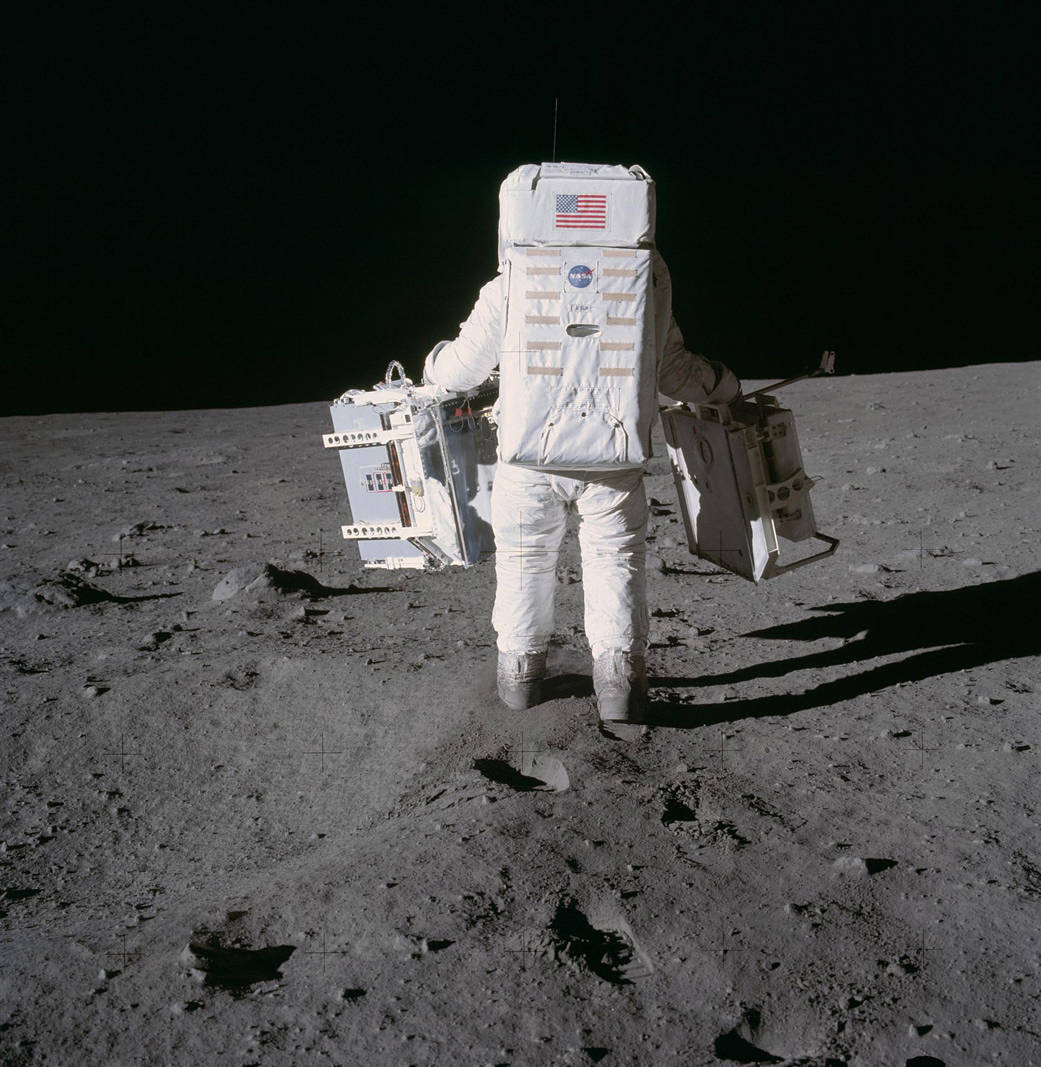
Five mirrors have been placed on the Moon. For more than fifty years, scientists have been firing lasers at them.1
This is not a figure of speech: it is literally what happens.
The mirrors
From 1969 onwards, five reflecting panels were set down on the lunar surface. Three by the American Apollo missions, two — French-made — by Soviet Lunokhod vehicles.2
These are not ordinary mirrors. Each is made up of small glass corners, cut like the inside corner of a box — three faces at right angles — a shape that sends light back exactly where it came from, whatever the angle at which it arrives. The largest, left by Apollo 15, has three hundred of them.3
From the Earth, an observatory sends a laser pulse towards one of these panels. So little light comes back that the stations detect the photons one by one. The round-trip time is measured, multiplied by the speed of light, then divided by two. This technique is called laser ranging.4
An observatory in Texas has thus been measuring the Earth–Moon distance since 1969; another, in the south of France (at Grasse), has been doing so since 1984. Other stations have joined them in Italy, New Mexico and Germany. The equipment is ageing: by 2013, all the mirrors were already sending back only about a tenth as much light as they did originally, probably because of lunar dust, and one of the two Soviet reflectors was even lost for forty years before being found again in 2010. The laser firing continues nonetheless.5
By 2013, the best of these stations was achieving a precision of the order of a millimetre. Over an average distance of about 385,000 kilometres.6
What has been discovered in this way
The Moon is moving away.
By 3.83 centimetres a year — a figure measured by laser ranging, with an uncertainty of less than a tenth of a millimetre.7
That is roughly the speed at which fingernails grow.
The cause lies not on the Moon but on the Earth. It is the Earth’s tides that push it away. By lifting the water of the oceans, the Moon very slightly slows the rotation of the Earth — and part of the energy the Earth loses, the Moon gains by moving away. (The rest is dissipated as heat in the oceans.)8
Recovering the past in the sky
These mirrors also measure the slowing caused by the tides, and this slowing is used to recalculate eclipses more than two thousand five hundred years old.9
Mirrors placed on the Moon in 1969 are used to interpret observations recorded on clay tablets more than two thousand five hundred years earlier — the oldest ones used dating from 720 BCE.10
The approach works in both directions: the tablets are used to check the calculation, and the calculation is used to understand the tablets.11
Two sources of knowledge, separated by millennia, that check each other.
Tides: why there are two
The problem
One often hears: “the Moon pulls the water, and that makes the tide”. If the explanation stopped there, there would be one high tide a day, on the side facing the Moon. Yet there are two — and the second occurs on the opposite side.
The misleading explanation
Many books explain that the bulge on the Moon’s side comes from its gravity, while the one on the other side comes from inertia or from the centrifugal force linked to the Earth’s rotation.
This presentation is misleading: it suggests that the two bulges have two different causes.
The physical explanation
Both bulges have the same cause: the Moon’s gravity. But what matters is not its total force — it is the fact that it is not the same everywhere on Earth.12
Take three runners one behind the other, linked by elastic bands, accelerating towards the Moon. The one in front is pulled hardest, the one in the middle a little less, the one at the back less still.
The group stretches: the one in front pulls away from the middle, while the one at the back falls behind.
The water on the Moon’s side is pulled harder than the centre of the Earth, so it moves forward. The centre of the Earth is pulled harder than the water on the opposite side, so that water stays behind. Seen from the Earth, this creates two opposite bulges.
The decisive test: if the Earth stopped rotating completely, there would still be two bulges. So it is not the rotation that produces the second one, but gravitational stretching.
A clarification: the Sun produces the same effect, at less than half the strength of the Moon’s. When the Sun, the Earth and the Moon are aligned (new moon and full moon), the two stretching effects add up and create spring tides.13
The seasons: a question of angle, not distance
One fact can be checked in any almanac: the Earth is closest to the Sun in early January, and furthest away in early July.14
In the depths of winter in the Northern Hemisphere, we are closer to the Sun than in summer. Distance is therefore not the cause of the seasons.
It is the tilt. The Earth’s axis of rotation is tilted by about 23 degrees. For one half of the year, the Northern Hemisphere is tilted towards the Sun; for the other half, it is tilted away.15
This changes the length of the day and the angle of the rays: light that falls straight down concentrates its energy on a small area, whereas light that strikes at a grazing angle spreads out and heats much less.
Comparing the figures
- The distance to the Sun varies by only about 3% over the year: too little to change the heating appreciably.
- The tilt, on the other hand, means that in winter the same beam of light spreads over more than twice the area it covers in summer, and that the Sun stays above the horizon for much less time — about 9 hours versus 15 in the United States.16
The two solstices are the moments when this tilt is most pronounced: around 21 June, the Northern Hemisphere leans as far as it can towards the Sun; around 21 December, as far as it can away from it. In between, at the March and September equinoxes, neither hemisphere is favoured and day equals night everywhere on Earth.17
Yet the distance explanation persists, even among educated people. In 1987, a documentary by the Harvard-Smithsonian Center for Astrophysics, A Private Universe, interviewed Harvard students on their graduation day. Several answered that it is hotter in summer because the Sun is nearer.18
The effect of the continents
Since the Sun is closer in January (summer in the Southern Hemisphere), one might expect summers there to be hotter. But two-thirds of the land above sea level lies in the Northern Hemisphere, and land warms up faster than the ocean, which stores heat. The distribution of the continents weighs more heavily on temperatures than this difference of a few per cent in distance.19
The far side of the Moon
It is not plunged in darkness. When the Moon is new (black as seen from the Earth), its far side is fully lit by the Sun. Each half of the Moon has two weeks of day, then two weeks of night.20
Why we see only one side
The Moon takes exactly the same time to rotate on its axis as it does to go round the Earth.21
A simple experiment shows this: walk in a circle around a chair while keeping your eyes fixed on it. After one complete lap of the circle, you have also turned once completely on the spot, without ever having turned your back on the chair.
In reality, we see 59% of it over time: because its orbit is slightly elliptical and its axis tilted, the Moon seems to rock gently (this phenomenon is called libration), revealing its edges.22
A misleading expression
People sometimes speak of the “dark side” of the Moon. The expression is misleading: the lit side changes over the course of the month, and the far side is in night no more often than the visible side.23
Interactive
The far side of the Moon
From the Earth, we always see the same face of the Moon. The other is sometimes called the “dark side”.
The question
Is the far side of the Moon always in darkness?
What you do Move the month on, from full Moon to full Moon. Look at the Moon from the Earth, then from the other side: where is the day, where is the night? Try a Moon that does not turn on its axis, too.
Without JavaScript, here are the animation’s data.
| Period | Hours | Source |
|---|---|---|
| One turn on its axis (relative to the stars) | 655.7 | 1 |
| One lunar day (from one noon to the next, at the same place) | 708.7 | 1 |
| Fact | Value | Source |
|---|---|---|
| One turn on its axis, one trip round the Earth | the same time | 2 |
| Each half of the Moon | two weeks of day, then two weeks of night | 3 |
The animation’s month (29.5 days) is calculated from NASA’s lunar day (708.7 hours). Sizes and distances are not to scale; the orbit is drawn as a circle, and the Moon’s slight rocking (libration, which shows us 59% of it over time) is not shown.
The takeaway The far side is in night no more often than the near side: at new Moon, it is in full daylight. We never see it because the Moon takes the same time to turn on its axis as to go round the Earth.
Photo credits 2
- Map of the Moon’s surface, made by NASA’s Scientific Visualization Studio (equirectangular projection). NASA's Scientific Visualization Studio, Public domain, source
- The Earth photographed on 7 December 1972 by the Apollo 17 crew on their way to the Moon: Africa, Antarctica and the Arabian Peninsula are visible. NASA, Apollo 17 crew, Public domain, source


Sources 3
Williams, David R., “Planetary Fact Sheet – Metric”, NASA Goddard Space Flight Center (NSSDCA), updated 18 March 2025, rows “Rotation Period (hours)” and “Length of Day (hours)”, column Moon (fourth value).
Rotation Period (hours) 1407.6 -5832.5 23.9 655.7 […] Length of Day (hours) 4222.6 2802.0 24.0 708.7
Open access open the source · checked on 28 October 2026
Fraknoi, Andrew, Morrison, David and Wolff, Sidney C., Astronomy 2e, OpenStax, 2022, chapitre 4 “Earth, Moon, and Sky”, § 4.5.
rotates on its axis in exactly the same time that it takes to revolve
Open access open the source · checked on 9 September 2026
Fraknoi, Andrew, Morrison, David and Wolff, Sidney C., Astronomy 2e, OpenStax, 2022, chapitre 4 “Earth, Moon, and Sky”, § 4.5 “Phases and Motions of the Moon”, introductory paragraph (before the subheading “Lunar Phases”) and last paragraph (section “The Moon’s Revolution and Rotation”).
[…] with the Moon starting dark and getting more and more illuminated by sunlight over the course of about two weeks. After the Moon’s disk becomes fully bright, it begins to fade, returning to dark about two weeks later. […] The back side is dark no more frequently than the front side. Since the Moon rotates, the Sun rises and sets on all sides of the Moon.
Open access open the source · checked on 9 September 2026
The first images
The first photographs of this side, taken by the Luna 3 probe, date from 7 October 1959. Twenty-nine images, noisy and blurred, covering 70% of the far side.24
These images revealed an unexpected asymmetry: the far side has far fewer large dark plains (“maria”) than the visible side.25
What else these measurements provide
- The presence of a liquid core: detected thanks to slight variations in the Moon’s rotation recorded by laser ranging, then detected again in 2011 in a reanalysis of the Apollo seismological data.
- Tests of general relativity: the continuous measurement of the lunar orbit is one of the most precise tests of Einstein’s theory as applied to the motion of celestial bodies.26
Note 1
Since 1969, lunar laser ranging (LLR) has provided high-precision measurements of the Earth–Moon distance
Murphy, Thomas W., “Lunar Laser Ranging: The Millimeter Challenge”, Reports on Progress in Physics, vol. 76, 076901, 2013
Note 2
Utilizing reflectors placed on the lunar surface by American astronauts and Soviet rovers […] a total of five passive reflectors left on the surface of the Moon […] The Apollo arrays—landed on the Apollo 11, Apollo 14, and Apollo 15 missions […] The Luna 17 and Luna 21 Soviet missions to the Moon landed the Lunokhod 1 and Lunokhod 2 rovers, each carrying identical reflector arrays built by the French […] Less than two weeks after the landing of the first retroreflector array on the Apollo 11 mission, the first accurate laser ranges to the Moon were performed on 1969 August 1
Murphy, Thomas W., “Lunar Laser Ranging: The Millimeter Challenge”, Reports on Progress in Physics, vol. 76, 076901, 2013
Note 3
The Apollo arrays—landed on the Apollo 11, Apollo 14, and Apollo 15 missions—consist of, respectively, 100, 100 and 300 3.8 cm diameter fused silica corner cube reflectors
Murphy, Thomas W., “Lunar Laser Ranging: The Millimeter Challenge”, Reports on Progress in Physics, vol. 76, 076901, 2013
Note 4
LLR measures the round-trip travel time of short pulses of laser light
Murphy, Thomas W., “Lunar Laser Ranging: The Millimeter Challenge”, Reports on Progress in Physics, vol. 76, 076901, 2013
The result is that LLR invariably operates in the single-photon detection regime.
Murphy, Thomas W., “Lunar Laser Ranging: The Millimeter Challenge”, Reports on Progress in Physics, vol. 76, 076901, 2013
Note 5
Less than two weeks after the landing of the first retroreflector array on the Apollo 11 mission, the first accurate laser ranges to the Moon were performed on 1969 August 1 from the 3.1 m telescope at the Lick Observatory. […] However, one month after the Apollo 11 landing, a long-term effort using the 2.7 m telescope at the McDonald Observatory commenced ranging to the Moon [68], providing all of the scientifically relevant observations over the next decade.
Murphy, Thomas W., “Lunar Laser Ranging: The Millimeter Challenge”, Reports on Progress in Physics, vol. 76, 076901, 2013
In 1984, a French station at the Observatoire de la Côte d'Azur (OCA) [69] began collecting accurate ranges.
Murphy, Thomas W., “Lunar Laser Ranging: The Millimeter Challenge”, Reports on Progress in Physics, vol. 76, 076901, 2013
Presently, five stations in the world exhibit LLR capability: OCA, MLRS, Apache Point, Matera, and Wetzell—although only the first three acquire data regularly. […] The laser is transmitted from the 3.5 m aperture telescope at the Apache Point Observatory in southern New Mexico
Murphy, Thomas W., “Lunar Laser Ranging: The Millimeter Challenge”, Reports on Progress in Physics, vol. 76, 076901, 2013
the apparent degradation of the lunar reflector response [23], reduced by a factor of ten across the board […] The most likely explanation is the slow accumulation of a very thin layer of dust on the reflector front surface
Murphy, Thomas W., “Lunar Laser Ranging: The Millimeter Challenge”, Reports on Progress in Physics, vol. 76, 076901, 2013
On 22 April 2010, APOLLO got a strong return from the Lunokhod 1 reflector
Murphy, Thomas W., “Lunar Laser Ranging: The Millimeter Challenge”, Reports on Progress in Physics, vol. 76, 076901, 2013
Note 6
a median statistical uncertainty per normal point of less than 3 mm
Murphy, Thomas W., “Lunar Laser Ranging: The Millimeter Challenge”, Reports on Progress in Physics, vol. 76, 076901, 2013
the time-averaged distance between Earth and Moon centers is 385 000.6 km
Murphy, Thomas W., “Lunar Laser Ranging: The Millimeter Challenge”, Reports on Progress in Physics, vol. 76, 076901, 2013
Note 7
da/dt = 38.30 ± 0.08 mm/year
Williams, James G. and Boggs, Dale H., “Secular Tidal Changes in Lunar Orbit and Earth Rotation”, Celestial Mechanics and Dynamical Astronomy, vol. 126, 2016, p. 89-129
Note 8
Terrestrial tidal dissipation also slows the rotation of the Earth
Williams, James G. and Boggs, Dale H., “Secular Tidal Changes in Lunar Orbit and Earth Rotation”, Celestial Mechanics and Dynamical Astronomy, vol. 126, 2016, p. 89-129
Tidal dissipation likewise translates into an orbital egress of the Moon at the rate of about 38 mm yr−1.
Murphy, Thomas W., “Lunar Laser Ranging: The Millimeter Challenge”, Reports on Progress in Physics, vol. 76, 076901, 2013
geophysical models of average tidal dissipation in oceans and solid Earth
Williams, James G. and Boggs, Dale H., “Secular Tidal Changes in Lunar Orbit and Earth Rotation”, Celestial Mechanics and Dynamical Astronomy, vol. 126, 2016, p. 89-129
Note 9
New compilations of records of ancient and medieval eclipses in the period 720 BC to AD 1600 […] Lunar laser ranging provides an accurate value for the Moon’s tidal acceleration […] The satellite and lunar laser ranging measurements were obtained from data collected over about 50 years or so. However, they can be applied to the past few millennia because it has been demonstrated satisfactorily that the mechanism of tidal friction has not changed significantly during this period
Stephenson, F. Richard, Morrison, Leslie V. and Hohenkerk, Catherine Y., “Measurement of the Earth’s Rotation: 720 BC to AD 2015”, Proceedings of the Royal Society A, vol. 472, 20160404, 2016
Note 10
Useful records of eclipses extend back to about 720 BC.
Stephenson, F. Richard, Morrison, Leslie V. and Hohenkerk, Catherine Y., “Measurement of the Earth’s Rotation: 720 BC to AD 2015”, Proceedings of the Royal Society A, vol. 472, 20160404, 2016
Note 11
By retrospective computation of the planetary and lunar data, a unique date can often be derived for a text.
Stephenson, F. Richard, Morrison, Leslie V. and Hohenkerk, Catherine Y., “Measurement of the Earth’s Rotation: 720 BC to AD 2015”, Proceedings of the Royal Society A, vol. 472, 20160404, 2016
Note 12
primarily the result of the Moon's differential force on the material of Earth's crust and ocean
Fraknoi, Andrew, Morrison, David and Wolff, Sidney C., Astronomy 2e, OpenStax, 2022, chapitre 4 “Earth, Moon, and Sky”
Note 13
less than half as effective as the Moon at tide raising
Fraknoi, Andrew, Morrison, David and Wolff, Sidney C., Astronomy 2e, OpenStax, 2022, chapitre 4 “Earth, Moon, and Sky”
When the Sun and Moon are lined up (at new moon or full moon), the tides produced reinforce each other
Fraknoi, Andrew, Morrison, David and Wolff, Sidney C., Astronomy 2e, OpenStax, 2022, chapitre 4 “Earth, Moon, and Sky”
Note 14
Earth is actually closest to the Sun in January, when the Northern Hemisphere is in the middle of winter.
Fraknoi, Andrew, Morrison, David and Wolff, Sidney C., Astronomy 2e, OpenStax, 2022, chapitre 4 “Earth, Moon, and Sky”
Note 15
the seasons are actually caused by the 23.5° tilt of Earth's axis
Fraknoi, Andrew, Morrison, David and Wolff, Sidney C., Astronomy 2e, OpenStax, 2022, chapitre 4 “Earth, Moon, and Sky”
Note 16
its distance from the Sun varies by only about 3%. That's not enough to cause significant variations
Fraknoi, Andrew, Morrison, David and Wolff, Sidney C., Astronomy 2e, OpenStax, 2022, chapitre 4 “Earth, Moon, and Sky”
Thus one square meter of sunlight falls on over twice the surface area in winter vs. summer.
Fraknoi, Andrew, Morrison, David and Wolff, Sidney C., Astronomy 2e, OpenStax, 2022, chapitre 4 “Earth, Moon, and Sky”
It spends 9 hours above the horizon in the United States
Fraknoi, Andrew, Morrison, David and Wolff, Sidney C., Astronomy 2e, OpenStax, 2022, chapitre 4 “Earth, Moon, and Sky”
Note 17
Halfway between the solstices, on about March 21 and September 21, the Sun is on the celestial equator. From Earth, it appears above our planet’s equator and favors neither hemisphere. Every place on Earth then receives roughly 12 hours of sunshine and 12 hours of night.
Fraknoi, Andrew, Morrison, David and Wolff, Sidney C., Astronomy 2e, OpenStax, 2022, chapitre 4 “Earth, Moon, and Sky”
Note 18
With its famous opening scene at a Harvard graduation […] interviews with Harvard graduates
Schneps, Matthew H. and Sadler, Philip M., A Private Universe, film documentaire, Harvard-Smithsonian Center for Astrophysics, 1987
even Harvard graduates still think that it is hotter in summer because the Sun is nearer
Stengler, Erik, “A Private Universe”, compte rendu, Science in School, no. 17, 2010
Note 19
The Northern Hemisphere contains 67–68 percent of Earth's land
Britannica, “Hemisphere”, Encyclopaedia Britannica, online
the land on Earth is warming more quickly than the oceans due to the oceans' heat capacity
Florida Atlantic University, Center for Environmental Studies, Climate Science Investigations South Florida (projet soutenu par la NASA), module 3, “Temperature Over Time — Scientists’ Explanation for Exploration 2”
Note 20
[…] with the Moon starting dark and getting more and more illuminated by sunlight over the course of about two weeks. After the Moon’s disk becomes fully bright, it begins to fade, returning to dark about two weeks later. […] The back side is dark no more frequently than the front side. Since the Moon rotates, the Sun rises and sets on all sides of the Moon.
Fraknoi, Andrew, Morrison, David and Wolff, Sidney C., Astronomy 2e, OpenStax, 2022, chapitre 4 “Earth, Moon, and Sky”
Note 21
rotates on its axis in exactly the same time that it takes to revolve
Fraknoi, Andrew, Morrison, David and Wolff, Sidney C., Astronomy 2e, OpenStax, 2022, chapitre 4 “Earth, Moon, and Sky”
Note 22
This rocking like a ship at sea is called libration, from the Latin for balance scale. Instead of just one side, we actually see about 59 percent of the lunar surface over the course of an orbit.
NASA Scientific Visualization Studio, “Moon Wobble”, 2011
Note 23
which side is light and which is dark changes as the Moon moves around Earth. The back side is dark no more frequently than the front side.
Fraknoi, Andrew, Morrison, David and Wolff, Sidney C., Astronomy 2e, OpenStax, 2022, chapitre 4 “Earth, Moon, and Sky”
Note 24
The first image was taken at 03:30 UT on 7 October […] A total of 29 photographs were taken, covering 70% of the far side. The photographs were very noisy and of low resolution […] Date/Time (UT): 1959-10-07
NASA, “Earth’s Moon – Luna 3”, catalogue d’images NSSDCA
Note 25
the far side has fewer maria (the dark areas) than the near side
NASA, “Earth’s Moon – Luna 3”, catalogue d’images NSSDCA
Note 26
the presence of a liquid core in the Moon having a radius of ∼350 km […] In the numerical integration of lunar rotation, degree-2 Love numbers are considered, plus a time delay for lunar tides. Dissipation is represented by a term for friction at the core-mantle boundary and five out-of-phase periodic libration terms […] dissipative processes in the lunar interior expose a liquid core
Murphy, Thomas W., “Lunar Laser Ranging: The Millimeter Challenge”, Reports on Progress in Physics, vol. 76, 076901, 2013
We reanalyzed Apollo lunar seismograms […] Our results suggest the presence of a solid inner and fluid outer core
Weber, Renee C. et al., “Seismic Detection of the Lunar Core”, Science, vol. 331, 2011, p. 309-312
Lunar laser ranging has provided many of the best tests of gravitation since the first Apollo astronauts landed on the Moon. […] geodetic precession within 0.3% of GR prediction
Murphy, Thomas W., “Lunar Laser Ranging: The Millimeter Challenge”, Reports on Progress in Physics, vol. 76, 076901, 2013
Notes and sources
- ↑
Passage Five mirrors have been placed on the Moon. For more than fifty years, scientists have been firing lasers at them.
Since 1969, lunar laser ranging (LLR) has provided high-precision measurements of the Earth–Moon distance
Source Murphy, Thomas W., “Lunar Laser Ranging: The Millimeter Challenge”, Reports on Progress in Physics, vol. 76, 076901, 2013, § 1, p. 1.
Open access open the source · checked on 9 September 2026
- ↑
Passage From 1969 onwards, five reflecting panels were set down on the lunar surface. Three by the American Apollo missions, two — French-made — by Soviet Lunokhod vehicles.
Utilizing reflectors placed on the lunar surface by American astronauts and Soviet rovers […] a total of five passive reflectors left on the surface of the Moon […] The Apollo arrays—landed on the Apollo 11, Apollo 14, and Apollo 15 missions […] The Luna 17 and Luna 21 Soviet missions to the Moon landed the Lunokhod 1 and Lunokhod 2 rovers, each carrying identical reflector arrays built by the French […] Less than two weeks after the landing of the first retroreflector array on the Apollo 11 mission, the first accurate laser ranges to the Moon were performed on 1969 August 1
Source Murphy, Thomas W., “Lunar Laser Ranging: The Millimeter Challenge”, Reports on Progress in Physics, vol. 76, 076901, 2013, § 1, p. 1; § 1.3, p. 3; § 3.1 “Brief LLR history”, p. 10.
Open access open the source · checked on 9 September 2026
- ↑
Passage Each is made up of small glass corners […] The largest, left by Apollo 15, has three hundred of them.
The Apollo arrays—landed on the Apollo 11, Apollo 14, and Apollo 15 missions—consist of, respectively, 100, 100 and 300 3.8 cm diameter fused silica corner cube reflectors
Source Murphy, Thomas W., “Lunar Laser Ranging: The Millimeter Challenge”, Reports on Progress in Physics, vol. 76, 076901, 2013, § 1.3, p. 3.
Open access open the source · checked on 9 September 2026
- ↑
Passage The round-trip time is measured, multiplied by the speed of light, then divided by two. This technique is called laser ranging.
LLR measures the round-trip travel time of short pulses of laser light
Source Murphy, Thomas W., “Lunar Laser Ranging: The Millimeter Challenge”, Reports on Progress in Physics, vol. 76, 076901, 2013, § 1, p. 1.
Open access open the source · checked on 9 September 2026
Passage So little light comes back that the stations detect the photons one by one.
The result is that LLR invariably operates in the single-photon detection regime.
Source Murphy, Thomas W., “Lunar Laser Ranging: The Millimeter Challenge”, Reports on Progress in Physics, vol. 76, 076901, 2013, § 1.3, p. 5.
Open access open the source · checked on 9 September 2026
- ↑
Passage An observatory […] has thus been measuring the Earth–Moon distance since 1969
Less than two weeks after the landing of the first retroreflector array on the Apollo 11 mission, the first accurate laser ranges to the Moon were performed on 1969 August 1 from the 3.1 m telescope at the Lick Observatory. […] However, one month after the Apollo 11 landing, a long-term effort using the 2.7 m telescope at the McDonald Observatory commenced ranging to the Moon [68], providing all of the scientifically relevant observations over the next decade.
Source Murphy, Thomas W., “Lunar Laser Ranging: The Millimeter Challenge”, Reports on Progress in Physics, vol. 76, 076901, 2013, § 3.1, p. 10.
Open access open the source · checked on 9 September 2026
Passage another, in the south of France […], has been doing so since 1984
In 1984, a French station at the Observatoire de la Côte d'Azur (OCA) [69] began collecting accurate ranges.
Source Murphy, Thomas W., “Lunar Laser Ranging: The Millimeter Challenge”, Reports on Progress in Physics, vol. 76, 076901, 2013, § 3.1, p. 10.
Open access open the source · checked on 9 September 2026
Passage Other stations have joined them […] New Mexico […].
Presently, five stations in the world exhibit LLR capability: OCA, MLRS, Apache Point, Matera, and Wetzell—although only the first three acquire data regularly. […] The laser is transmitted from the 3.5 m aperture telescope at the Apache Point Observatory in southern New Mexico
Source Murphy, Thomas W., “Lunar Laser Ranging: The Millimeter Challenge”, Reports on Progress in Physics, vol. 76, 076901, 2013, § 3.1 and § 3.2, p. 11.
Open access open the source · checked on 9 September 2026
Passage by 2013, all the mirrors were already sending back only about a tenth as much light as they did originally, probably because of lunar dust
the apparent degradation of the lunar reflector response [23], reduced by a factor of ten across the board […] The most likely explanation is the slow accumulation of a very thin layer of dust on the reflector front surface
Source Murphy, Thomas W., “Lunar Laser Ranging: The Millimeter Challenge”, Reports on Progress in Physics, vol. 76, 076901, 2013, § 1.3, p. 5; § 4.2 “Reflector degradation”, p. 13.
Open access open the source · checked on 9 September 2026
Passage one of the two Soviet reflectors was even lost for forty years before being found again in 2010
On 22 April 2010, APOLLO got a strong return from the Lunokhod 1 reflector
Source Murphy, Thomas W., “Lunar Laser Ranging: The Millimeter Challenge”, Reports on Progress in Physics, vol. 76, 076901, 2013, § 4.1, p. 13; caption of figure 18: “nearly 40 years passed without range measurements”.
Open access open the source · checked on 9 September 2026
- ↑
Passage By 2013, the best of these stations was achieving a precision of the order of a millimetre.
a median statistical uncertainty per normal point of less than 3 mm
Source Murphy, Thomas W., “Lunar Laser Ranging: The Millimeter Challenge”, Reports on Progress in Physics, vol. 76, 076901, 2013, § 3.1, p. 11; § 7, p. 19: “approaching 1 mm range precision”.
Open access open the source · checked on 9 September 2026
Passage Over an average distance of about 385,000 kilometres.
the time-averaged distance between Earth and Moon centers is 385 000.6 km
Source Murphy, Thomas W., “Lunar Laser Ranging: The Millimeter Challenge”, Reports on Progress in Physics, vol. 76, 076901, 2013, § 1.2, p. 2.
Open access open the source · checked on 9 September 2026
- ↑
Passage The Moon is moving away. By 3.83 centimetres a year […] with an uncertainty of less than a tenth of a millimetre.
da/dt = 38.30 ± 0.08 mm/year
Source Williams, James G. and Boggs, Dale H., “Secular Tidal Changes in Lunar Orbit and Earth Rotation”, Celestial Mechanics and Dynamical Astronomy, vol. 126, 2016, p. 89-129, abstract.
Open-access abstract, paywalled article open the source · checked on 9 September 2026
- ↑
Passage By lifting the water of the oceans, the Moon very slightly slows the rotation of the Earth
Terrestrial tidal dissipation also slows the rotation of the Earth
Source Williams, James G. and Boggs, Dale H., “Secular Tidal Changes in Lunar Orbit and Earth Rotation”, Celestial Mechanics and Dynamical Astronomy, vol. 126, 2016, p. 89-129, abstract.
Open-access abstract, paywalled article open the source · checked on 9 September 2026
Passage It is the Earth’s tides that push it away.
Tidal dissipation likewise translates into an orbital egress of the Moon at the rate of about 38 mm yr−1.
Source Murphy, Thomas W., “Lunar Laser Ranging: The Millimeter Challenge”, Reports on Progress in Physics, vol. 76, 076901, 2013, § 5.1, p. 14.
Open access open the source · checked on 9 September 2026
Passage The rest is dissipated as heat in the oceans.
geophysical models of average tidal dissipation in oceans and solid Earth
Source Williams, James G. and Boggs, Dale H., “Secular Tidal Changes in Lunar Orbit and Earth Rotation”, Celestial Mechanics and Dynamical Astronomy, vol. 126, 2016, p. 89-129, abstract.
Open-access abstract, paywalled article open the source · checked on 9 September 2026
- ↑
Passage These mirrors also measure the slowing caused by the tides, and this slowing is used to recalculate eclipses more than two thousand five hundred years old.
New compilations of records of ancient and medieval eclipses in the period 720 BC to AD 1600 […] Lunar laser ranging provides an accurate value for the Moon’s tidal acceleration […] The satellite and lunar laser ranging measurements were obtained from data collected over about 50 years or so. However, they can be applied to the past few millennia because it has been demonstrated satisfactorily that the mechanism of tidal friction has not changed significantly during this period
Source Stephenson, F. Richard, Morrison, Leslie V. and Hohenkerk, Catherine Y., “Measurement of the Earth’s Rotation: 720 BC to AD 2015”, Proceedings of the Royal Society A, vol. 472, 20160404, 2016, abstract; § 1(b) “Tidal friction and the behaviour of ΔT”.
Open access open the source · checked on 9 September 2026
- ↑
Passage observations recorded on clay tablets […] the oldest ones used dating from 720 BCE
Useful records of eclipses extend back to about 720 BC.
Source Stephenson, F. Richard, Morrison, Leslie V. and Hohenkerk, Catherine Y., “Measurement of the Earth’s Rotation: 720 BC to AD 2015”, Proceedings of the Royal Society A, vol. 472, 20160404, 2016, § 1(b); § 2(a)(i): “The Babylonian scribes wrote on clay tablets, using a cuneiform script”.
Open access open the source · checked on 9 September 2026
- ↑
Passage the tablets are used to check the calculation, and the calculation is used to understand the tablets
By retrospective computation of the planetary and lunar data, a unique date can often be derived for a text.
Source Stephenson, F. Richard, Morrison, Leslie V. and Hohenkerk, Catherine Y., “Measurement of the Earth’s Rotation: 720 BC to AD 2015”, Proceedings of the Royal Society A, vol. 472, 20160404, 2016, § 2(a)(i).
Open access open the source · checked on 9 September 2026
- ↑
Passage Both bulges have the same cause: the Moon’s gravity. But what matters […] it is the fact that it is not the same everywhere on Earth.
primarily the result of the Moon's differential force on the material of Earth's crust and ocean
Source Fraknoi, Andrew, Morrison, David and Wolff, Sidney C., Astronomy 2e, OpenStax, 2022, chapitre 4 “Earth, Moon, and Sky”, chapter 4 summary.
Open access open the source · checked on 9 September 2026
- ↑
Passage the Sun produces the same effect, at less than half the strength of the Moon’s
less than half as effective as the Moon at tide raising
Source Fraknoi, Andrew, Morrison, David and Wolff, Sidney C., Astronomy 2e, OpenStax, 2022, chapitre 4 “Earth, Moon, and Sky”, § 4.6.
Open access open the source · checked on 9 September 2026
Passage When the Sun, the Earth and the Moon are aligned (new moon and full moon), the two stretching effects add up and create spring tides.
When the Sun and Moon are lined up (at new moon or full moon), the tides produced reinforce each other
Source Fraknoi, Andrew, Morrison, David and Wolff, Sidney C., Astronomy 2e, OpenStax, 2022, chapitre 4 “Earth, Moon, and Sky”, § 4.6.
Open access open the source · checked on 9 September 2026
- ↑
Passage the Earth is closest to the Sun in early January
Earth is actually closest to the Sun in January, when the Northern Hemisphere is in the middle of winter.
Source Fraknoi, Andrew, Morrison, David and Wolff, Sidney C., Astronomy 2e, OpenStax, 2022, chapitre 4 “Earth, Moon, and Sky”, § 4.2.
Open access open the source · checked on 9 September 2026
- ↑
Passage The Earth’s axis of rotation is tilted by about 23 degrees.
the seasons are actually caused by the 23.5° tilt of Earth's axis
Source Fraknoi, Andrew, Morrison, David and Wolff, Sidney C., Astronomy 2e, OpenStax, 2022, chapitre 4 “Earth, Moon, and Sky”, § 4.2.
Open access open the source · checked on 9 September 2026
- ↑
Passage The distance to the Sun varies by only about 3% over the year: too little to change the heating appreciably.
its distance from the Sun varies by only about 3%. That's not enough to cause significant variations
Source Fraknoi, Andrew, Morrison, David and Wolff, Sidney C., Astronomy 2e, OpenStax, 2022, chapitre 4 “Earth, Moon, and Sky”, § 4.2.
Open access open the source · checked on 9 September 2026
Passage in winter the same beam of light spreads over more than twice the area it covers in summer
Thus one square meter of sunlight falls on over twice the surface area in winter vs. summer.
Source Fraknoi, Andrew, Morrison, David and Wolff, Sidney C., Astronomy 2e, OpenStax, 2022, chapitre 4 “Earth, Moon, and Sky”, figure 4.6, image description (rays at 73 degrees in summer, 26 degrees in winter; 1.04 m² versus 2.24 m²).
Open access open the source · checked on 9 September 2026
Passage the Sun stays above the horizon for much less time — about 9 hours versus 15 in the United States
It spends 9 hours above the horizon in the United States
Source Fraknoi, Andrew, Morrison, David and Wolff, Sidney C., Astronomy 2e, OpenStax, 2022, chapitre 4 “Earth, Moon, and Sky”, caption of figure 4.7; “about 15 hours” on 21 June.
Open access open the source · checked on 9 September 2026
- ↑
Passage at the March and September equinoxes, neither hemisphere is favoured and day equals night everywhere on Earth
Halfway between the solstices, on about March 21 and September 21, the Sun is on the celestial equator. From Earth, it appears above our planet’s equator and favors neither hemisphere. Every place on Earth then receives roughly 12 hours of sunshine and 12 hours of night.
Source Fraknoi, Andrew, Morrison, David and Wolff, Sidney C., Astronomy 2e, OpenStax, 2022, chapitre 4 “Earth, Moon, and Sky”, § 4.2, paragraph “Halfway between the solstices…”.
Open access open the source · checked on 9 September 2026
- ↑
Passage In 1987, a documentary by the Harvard-Smithsonian Center for Astrophysics, A Private Universe, interviewed Harvard students on their graduation day.
With its famous opening scene at a Harvard graduation […] interviews with Harvard graduates
Source Schneps, Matthew H. and Sadler, Philip M., A Private Universe, film documentaire, Harvard-Smithsonian Center for Astrophysics, 1987, series overview page.
Open-access overview page open the source · checked on 9 September 2026
Passage Several answered that it is hotter in summer because the Sun is nearer.
even Harvard graduates still think that it is hotter in summer because the Sun is nearer
Source Stengler, Erik, “A Private Universe”, compte rendu, Science in School, no. 17, 2010, p. 1; “short documentary feature in 1987”.
Open access open the source · checked on 9 September 2026
- ↑
Passage two-thirds of the land above sea level lies in the Northern Hemisphere
The Northern Hemisphere contains 67–68 percent of Earth's land
Source Britannica, “Hemisphere”, Encyclopaedia Britannica, online, section “Earth’s four hemispheres”.
Open access open the source · checked on 9 September 2026
Passage land warms up faster than the ocean, which stores heat
the land on Earth is warming more quickly than the oceans due to the oceans' heat capacity
Source Florida Atlantic University, Center for Environmental Studies, Climate Science Investigations South Florida (projet soutenu par la NASA), module 3, “Temperature Over Time — Scientists’ Explanation for Exploration 2”, paragraph 2.
Open access open the source · checked on 9 September 2026
- ↑
Passage Each half of the Moon has two weeks of day, then two weeks of night.
[…] with the Moon starting dark and getting more and more illuminated by sunlight over the course of about two weeks. After the Moon’s disk becomes fully bright, it begins to fade, returning to dark about two weeks later. […] The back side is dark no more frequently than the front side. Since the Moon rotates, the Sun rises and sets on all sides of the Moon.
Source Fraknoi, Andrew, Morrison, David and Wolff, Sidney C., Astronomy 2e, OpenStax, 2022, chapitre 4 “Earth, Moon, and Sky”, § 4.5 “Phases and Motions of the Moon”, introductory paragraph (before the subheading “Lunar Phases”) and last paragraph (section “The Moon’s Revolution and Rotation”).
Open access open the source · checked on 9 September 2026
- ↑
Passage The Moon takes exactly the same time to rotate on its axis as it does to go round the Earth.
rotates on its axis in exactly the same time that it takes to revolve
Source Fraknoi, Andrew, Morrison, David and Wolff, Sidney C., Astronomy 2e, OpenStax, 2022, chapitre 4 “Earth, Moon, and Sky”, § 4.5.
Open access open the source · checked on 9 September 2026
- ↑
Passage we see 59% of it over time […] (this phenomenon is called libration)
This rocking like a ship at sea is called libration, from the Latin for balance scale. Instead of just one side, we actually see about 59 percent of the lunar surface over the course of an orbit.
Source NASA Scientific Visualization Studio, “Moon Wobble”, 2011, introductory text.
Open access open the source · checked on 9 September 2026
- ↑
Passage the lit side changes over the course of the month, and the far side is in night no more often than the visible side
which side is light and which is dark changes as the Moon moves around Earth. The back side is dark no more frequently than the front side.
Source Fraknoi, Andrew, Morrison, David and Wolff, Sidney C., Astronomy 2e, OpenStax, 2022, chapitre 4 “Earth, Moon, and Sky”, § 4.5.
Open access open the source · checked on 9 September 2026
- ↑
Passage The first photographs of this side, taken by the Luna 3 probe, date from 7 October 1959. Twenty-nine images, noisy and blurred, covering 70% of the far side.
The first image was taken at 03:30 UT on 7 October […] A total of 29 photographs were taken, covering 70% of the far side. The photographs were very noisy and of low resolution […] Date/Time (UT): 1959-10-07
Source NASA, “Earth’s Moon – Luna 3”, catalogue d’images NSSDCA, caption of image Luna 3-26, then the “Date/Time (UT)” field (Location & Time Information).
Open access open the source · checked on 9 September 2026
- ↑
Passage the far side has far fewer large dark plains (“maria”) than the visible side
the far side has fewer maria (the dark areas) than the near side
Source NASA, “Earth’s Moon – Luna 3”, catalogue d’images NSSDCA, caption of image Luna 3-26.
Open access open the source · checked on 9 September 2026
- ↑
Passage The presence of a liquid core: detected thanks to slight variations in the Moon’s rotation recorded by laser ranging
the presence of a liquid core in the Moon having a radius of ∼350 km […] In the numerical integration of lunar rotation, degree-2 Love numbers are considered, plus a time delay for lunar tides. Dissipation is represented by a term for friction at the core-mantle boundary and five out-of-phase periodic libration terms […] dissipative processes in the lunar interior expose a liquid core
Source Murphy, Thomas W., “Lunar Laser Ranging: The Millimeter Challenge”, Reports on Progress in Physics, vol. 76, 076901, 2013, § 1.1, p. 2; § 2.2.1 “The Lunar interior”, p. 9; § 7, p. 18.
Open access open the source · checked on 9 September 2026
Passage then detected again in 2011 in a reanalysis of the Apollo seismological data
We reanalyzed Apollo lunar seismograms […] Our results suggest the presence of a solid inner and fluid outer core
Source Weber, Renee C. et al., “Seismic Detection of the Lunar Core”, Science, vol. 331, 2011, p. 309-312, abstract.
Open-access abstract, paywalled article open the source · checked on 9 September 2026
Passage Tests of general relativity: the continuous measurement of the lunar orbit is one of the most precise tests
Lunar laser ranging has provided many of the best tests of gravitation since the first Apollo astronauts landed on the Moon. […] geodetic precession within 0.3% of GR prediction
Source Murphy, Thomas W., “Lunar Laser Ranging: The Millimeter Challenge”, Reports on Progress in Physics, vol. 76, 076901, 2013, abstract; § 1.1, p. 2.
Open access open the source · checked on 9 September 2026
Bibliography
11
- Britannica, “Hemisphere”, Encyclopaedia Britannica, online (67 to 68% of land in the Northern Hemisphere). https://www.britannica.com/science/hemisphere
- Florida Atlantic University, Center for Environmental Studies, Climate Science Investigations South Florida (projet soutenu par la NASA), module 3, “Temperature Over Time — Scientists’ Explanation for Exploration 2” (land warms faster than the ocean; share of land by hemisphere). https://www.ces.fau.edu/nasa/module-3/regional-temperature/explanation-2.php
- Fraknoi, Andrew, Morrison, David and Wolff, Sidney C., Astronomy 2e, OpenStax, 2022, chapitre 4 “Earth, Moon, and Sky”, sections 4.2, 4.5 et 4.6, open access (seasons, tilt, perihelion in January, synchronous rotation, tides and the Sun’s share). https://openstax.org/books/astronomy-2e/pages/4-2-the-seasons
- Murphy, Thomas W., “Lunar Laser Ranging: The Millimeter Challenge”, Reports on Progress in Physics, vol. 76, 076901, 2013, open access (the five reflectors, the number of corner cubes, photon-by-photon detection, the stations, the loss of Lunokhod 1, degradation, millimetre precision, the liquid core, tests of relativity). https://tmurphy.physics.ucsd.edu/papers/rop-llr.pdf
- NASA, “Earth’s Moon – Luna 3”, catalogue d’images NSSDCA (first photograph on 7 October 1959, 29 images, fewer maria on the far side). https://nssdc.gsfc.nasa.gov/imgcat/html/object_page/lu3_26.html
- NASA Scientific Visualization Studio, “Moon Wobble”, 2011 (59% of the surface visible thanks to libration). https://svs.gsfc.nasa.gov/10836/
- Schneps, Matthew H. and Sadler, Philip M., A Private Universe, film documentaire, Harvard-Smithsonian Center for Astrophysics, 1987 (interviews with Harvard graduates on their graduation day). https://www.learner.org/series/a-private-universe/
- Stengler, Erik, “A Private Universe”, compte rendu, Science in School, no. 17, 2010 (the film dates from 1987; the graduates attribute summer to the Sun’s proximity). https://scienceinschool.org/wp-content/uploads/2014/11/issue17_privateuniverse.pdf
- Stephenson, F. Richard, Morrison, Leslie V. and Hohenkerk, Catherine Y., “Measurement of the Earth’s Rotation: 720 BC to AD 2015”, Proceedings of the Royal Society A, vol. 472, 20160404, 2016 (Babylonian tablets from 720 BCE onwards; open access). https://doi.org/10.1098/rspa.2016.0404
- Weber, Renee C. et al., “Seismic Detection of the Lunar Core”, Science, vol. 331, 2011, p. 309-312, open-access abstract (reanalysis of the Apollo seismograms, liquid outer core). https://hal-univ-paris.archives-ouvertes.fr/hal-03964121
- Williams, James G. and Boggs, Dale H., “Secular Tidal Changes in Lunar Orbit and Earth Rotation”, Celestial Mechanics and Dynamical Astronomy, vol. 126, 2016, p. 89-129 (3.83 cm a year and its uncertainty; open-access abstract). https://doi.org/10.1007/s10569-016-9702-3
Spotted an error or have a doubt? Write to us.