
This page tells two stories — why astronauts float, and why the Sun does not burn — and what they have in common: in both cases, a word has manufactured a false idea.
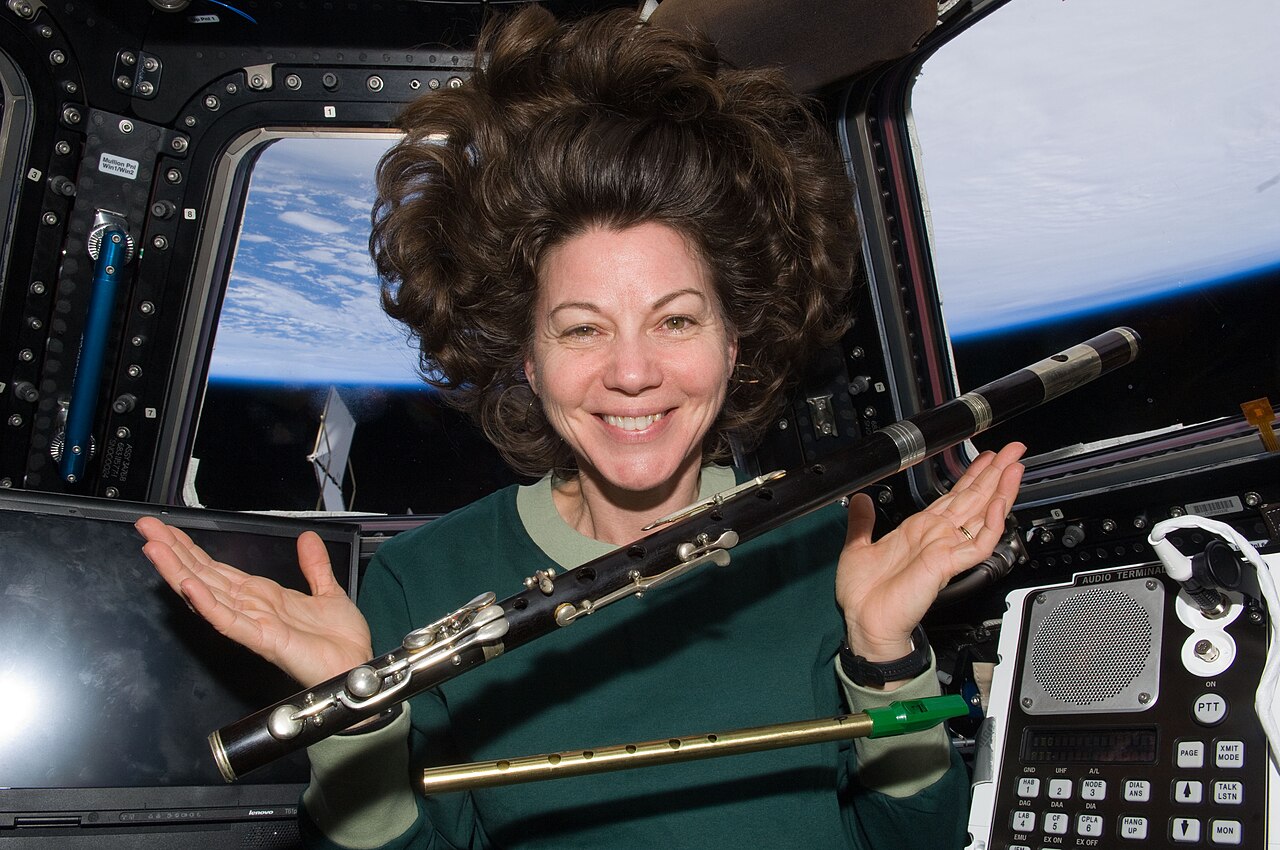
An astronaut floats in the International Space Station. Why?
Some answer: because there is no more gravity up there.1
That is false. One figure is enough to show it.
Ninety per cent
The International Space Station orbits the Earth at an altitude of about four hundred kilometres. That is far — but on the scale of the Earth, it is not much: at sea level, we are already six thousand four hundred kilometres from the centre of the Earth; the station is six thousand eight hundred from it. It is only a little further away.2
At this altitude, the acceleration due to gravity is about 8.8 m/s², compared with 9.8 m/s² at sea level.3
In other words, up there, there is about 90% of the gravity that acts at ground level. A person weighing fifty kilos who could climb a ladder all the way to the station would weigh forty-five once at the top.4
If gravity really disappeared at four hundred kilometres, the station would not orbit the Earth. It would go off in a straight line, never to return.
So why do they float?
Because they are falling.5
The station is falling towards the Earth all the time. But it is also moving sideways very fast: fast enough for the Earth’s surface to fall away beneath it exactly as fast as it descends. As it falls, it therefore keeps missing the Earth; it falls endlessly around it.6
The astronaut falls in exactly the same way, at the same time as the floor, the walls and his cup of coffee. In a vacuum, all objects fall at the same rate, whatever their mass.7
Nothing presses him against the floor: he floats — relative to the station, and not relative to the Earth.
The lift, and the happiest thought of a lifetime
Everyone has felt a tiny taste of it. In a lift that suddenly starts downwards, one feels briefly lighter; for a fraction of a second, the stomach seems to rise.
This is exactly the effect experienced in orbit, greatly weakened and very brief.
Einstein called this idea “the happiest thought of my life”. He told the story much later: he was sitting in a chair in the Patent Office in Bern when the thought struck him — if a person falls freely, he will certainly not feel his own weight. He was startled, he said, and this simple thought made a really deep impression on him. It is the starting point of his theory of gravitation. Any building lets you try the experiment.8
What the word “weight” hides
What one feels as one’s weight is the force of the floor pushing upwards under one’s feet. It is not gravity: it is the resistance of the floor. (School teaching defines weight as the Earth’s pull on a body; that is correct, and this pull does not disappear. What disappears is the sensation of it.)
In free fall, no floor pushes any more. The sensation disappears — and gravity has not changed by a single gram.
A scale shows this well. A person falling with their scale sees it read zero — not because the Earth’s pull has disappeared, but because the scale is falling at the same time as they are and no longer has anything to push against.9
The words that manufacture errors
“Zero gravity”, “there is no more gravity up there”: these are not convenient approximations. NASA itself warns that the expression “zero gravity” is misleading, and that some people think there is no gravity in space — whereas it is present more or less everywhere: it is what holds the Moon around the Earth and the Earth around the Sun.10
To speak accurately, one must distinguish two notions:
- Gravity is the Earth’s pull. In orbit, it is almost intact (90%).
- Weight, for physicists, is that same pull applied to a given body: it does not disappear either. As we have seen, what disappears in free fall is the sensation.
This is what the word impesanteur (weightlessness) denotes: the state in which one no longer feels one’s weight because one is falling. It does not say that gravity has disappeared; it says that one no longer feels it. In French, it is the official term, published in the Journal officiel: the terminology of the space sciences recommends impesanteur, and micropesanteur where English says microgravity.11
An imported term that does not help
The word “microgravité” is in common use. The prefix “micro” suggests a very weak gravity, which is false at the altitude of the station — there is 90% of it. What the word really denotes is the tiny accelerations that remain between objects falling together.12
Elsewhere, this site presents other cases where a word manufactures a fact: Mesopotamian edicts translated differently depending on the school, the name of an Australian town with two competing translations, or a palace library turned into a great imaginary academy.
Those cases came mainly from translations from one language to another. Here, the error arises from a turn of phrase adopted for convenience. And it is not the only word on this page to cause a problem: the Sun has suffered the same misadventure, with the word “burn”.
And now, the Sun
The Sun does not burn.
To burn is to combine with oxygen: that is what a log, a candle or an engine does. There is indeed oxygen in the Sun — it is even the third most abundant element, at 0.67% of its mass, far behind hydrogen and helium — but that is not at all what is happening there.13
What happens there is called fusion. At the centre, hydrogen nuclei join together and form helium.
The key point is surprising: the helium obtained weighs a little less than the hydrogen nuclei it is made from. A small part of the mass is missing at the end.
This mass has not disappeared: it has become energy (E = mc²).
Why the Sun lasts so long
One might think that the Sun has been shining for billions of years because it is enormous. That is true, but it is not the main reason.
The real reason has something paradoxical about it: the reaction runs in slow motion. It operates continuously, but each useful encounter is extraordinarily rare.
If the reaction were easier, the Sun would have used everything up long ago, and nobody would be here to read this page.
It is not its power that makes this machine last. It is its slowness.
How long does light take to get out?
The question is often asked, and the answer calls for caution.
The energy produced at the centre does not head straight outwards. It is absorbed and re-emitted billions of times by the very dense matter it passes through. It therefore zigzags its way out, which takes a very long time.
How long? One often reads a precise figure — ten thousand years, fifty thousand, a million.
These precise figures should be treated with suspicion. They depend on the model chosen to describe a solar interior that cannot be observed directly, and the published values differ widely from one another. When serious sources do not agree, the honest thing to pass on is not one of them: it is the disagreement.
Note 1
Some people think that there is no gravity in space. In fact, a small amount of gravity can be found everywhere in space.
NASA, “What Is Microgravity?” (Grades 5-8), fiche pédagogique
Note 2
At the International Space Station (ISS) altitude of 400 km (250 mi)
DeLombard, Richard and Hall, Nancy R. (NASA Glenn Research Center), “How to Demonstrate Microgravity in your Classroom”, présentation au Space Exploration Educators Conference, 2013, NTRS 20130011559, partie “Physics of microgravity”
At sea-level, we are about 6400 km (4000 mi) from the center of the Earth […] they are 6800 km (4250 mi) from the center of the Earth - just a little further away!
DeLombard, Richard and Hall, Nancy R. (NASA Glenn Research Center), “How to Demonstrate Microgravity in your Classroom”, présentation au Space Exploration Educators Conference, 2013, NTRS 20130011559, partie “Physics of microgravity”
Note 3
gravitational acceleration is 9.8 m/s2 […] gravitational acceleration at ISS altitudes is about 90% of 1–g or about 8.8 m/s2
DeLombard, Richard and Hall, Nancy R. (NASA Glenn Research Center), “How to Demonstrate Microgravity in your Classroom”, présentation au Space Exploration Educators Conference, 2013, NTRS 20130011559, partie “Physics of microgravity”
Note 4
At that altitude, Earth's gravity is about 90 percent of what it is on the planet's surface.
NASA, “What Is Microgravity?” (Grades 5-8), fiche pédagogique
if a person who weighed 100 pounds on Earth's surface could climb a ladder all the way to the space station, that person would weigh 90 pounds at the top of the ladder
NASA, “What Is Microgravity?” (Grades 5-8), fiche pédagogique
Note 5
If 90 percent of Earth's gravity reaches the space station, then why do astronauts float there? The answer is because they are in free fall.
NASA, “What Is Microgravity?” (Grades 5-8), fiche pédagogique
Note 6
It moves at a speed that matches the way Earth’s surface curves. […] An orbiting spacecraft moves at the right speed so the curve of its fall matches the curve of Earth.
NASA, “What Is Microgravity?” (Grades 5-8), fiche pédagogique
Note 7
In a vacuum, gravity causes all objects to fall at the same rate. The mass of the object does not matter.
NASA, “What Is Microgravity?” (Grades 5-8), fiche pédagogique
Note 8
I was sitting in a chair in the Patent Office in Bern when all of a sudden I was struck by a thought: "If a person falls freely, he will certainly not feel his own weight."
Einstein, Albert, conférence de Kyoto du 14 December 1922, dans The Collected Papers of Albert Einstein, vol. 13, doc. 399, Princeton University Press
I was startled. This simple thought made a really deep impression on me.
Einstein, Albert, conférence de Kyoto du 14 December 1922, dans The Collected Papers of Albert Einstein, vol. 13, doc. 399, Princeton University Press
My excitement motivated me to develop a new theory of gravitation.
Einstein, Albert, conférence de Kyoto du 14 December 1922, dans The Collected Papers of Albert Einstein, vol. 13, doc. 399, Princeton University Press
Note 9
A person falling with a bathroom scale, would not 'weigh' anything as they fall.
DeLombard, Richard and Hall, Nancy R. (NASA Glenn Research Center), “How to Demonstrate Microgravity in your Classroom”, présentation au Space Exploration Educators Conference, 2013, NTRS 20130011559, partie “Physics of microgravity”
Note 10
Microgravity is sometimes called "zero gravity," but this is misleading.
NASA, “What Is Microgravity?” (Grades 5-8), fiche pédagogique
Gravity is what holds the moon in orbit around Earth. Gravity causes Earth to orbit the sun.
NASA, “What Is Microgravity?” (Grades 5-8), fiche pédagogique
Note 11
impesanteur, n.f. — Domaine : Sciences et techniques spatiales […] micropesanteur, n.f.
impesanteur, feminine noun — Field: Space sciences and technology […] micropesanteur, feminine noun
Arrêté du 20 February 1995 relatif à la terminologie des sciences et techniques spatiales, Journal officiel de la République française, 19 March 1995
Note 12
By this definition, a microgravity environment is one in which the apparent weight of a system is small compared to its actual weight due to gravity. […] The combined acceleration levels that result from the quasi-steady and vibratory contributions are generally referred to as the microgravity environment of the spacecraft.
Rogers, Melissa J. B., Vogt, Gregory L. and Wargo, Michael J., Microgravity: A Teacher’s Guide With Activities in Science, Mathematics, and Technology, NASA, EG-1997-08-110-HQ, 1997, NTRS 19980007787
Note 13
The most abundant chemical elements in the Sun in order of decreasing mass fractions are H (73.9%), He (24.5%) and C, N, O, Ne, Fe, which make up 0.28%, 0.09%, 0.67%, 0.21%, and 0.13%, respectively.
Bergemann, Maria, Lodders, Katharina and Palme, Herbert, “The Chemical Composition of the Sun”, preprint, 2025
Notes and sources
- ↑
Passage Some answer: because there is no more gravity up there. That is false.
Some people think that there is no gravity in space. In fact, a small amount of gravity can be found everywhere in space.
Source NASA, “What Is Microgravity?” (Grades 5-8), fiche pédagogique, section “Is There Gravity in Space?”.
Open access open the source · checked on 9 September 2026
- ↑
Passage The International Space Station orbits the Earth at an altitude of about four hundred kilometres.
At the International Space Station (ISS) altitude of 400 km (250 mi)
Source DeLombard, Richard and Hall, Nancy R. (NASA Glenn Research Center), “How to Demonstrate Microgravity in your Classroom”, présentation au Space Exploration Educators Conference, 2013, NTRS 20130011559, partie “Physics of microgravity”, slide “Physics of microgravity”.
Open access open the source · checked on 9 September 2026
Passage at sea level, we are already six thousand four hundred kilometres from the centre of the Earth; the station is six thousand eight hundred from it
At sea-level, we are about 6400 km (4000 mi) from the center of the Earth […] they are 6800 km (4250 mi) from the center of the Earth - just a little further away!
Source DeLombard, Richard and Hall, Nancy R. (NASA Glenn Research Center), “How to Demonstrate Microgravity in your Classroom”, présentation au Space Exploration Educators Conference, 2013, NTRS 20130011559, partie “Physics of microgravity”, slide “Physics of microgravity”.
Open access open the source · checked on 9 September 2026
- ↑
Passage At this altitude, the acceleration due to gravity is about 8.8 m/s², compared with 9.8 m/s² at sea level.
gravitational acceleration is 9.8 m/s2 […] gravitational acceleration at ISS altitudes is about 90% of 1–g or about 8.8 m/s2
Source DeLombard, Richard and Hall, Nancy R. (NASA Glenn Research Center), “How to Demonstrate Microgravity in your Classroom”, présentation au Space Exploration Educators Conference, 2013, NTRS 20130011559, partie “Physics of microgravity”, slide “Physics of microgravity”.
Open access open the source · checked on 9 September 2026
- ↑
Passage up there, there is about 90% of the gravity that acts at ground level
At that altitude, Earth's gravity is about 90 percent of what it is on the planet's surface.
Source NASA, “What Is Microgravity?” (Grades 5-8), fiche pédagogique, section “Is There Gravity in Space?”.
Open access open the source · checked on 9 September 2026
Passage A person weighing fifty kilos who could climb a ladder all the way to the station would weigh forty-five once at the top.
if a person who weighed 100 pounds on Earth's surface could climb a ladder all the way to the space station, that person would weigh 90 pounds at the top of the ladder
Source NASA, “What Is Microgravity?” (Grades 5-8), fiche pédagogique, section “Is There Gravity in Space?”.
Open access open the source · checked on 9 September 2026
- ↑
Passage Because they are falling.
If 90 percent of Earth's gravity reaches the space station, then why do astronauts float there? The answer is because they are in free fall.
Source NASA, “What Is Microgravity?” (Grades 5-8), fiche pédagogique, section “Why Do Objects Float in Orbit?”.
Open access open the source · checked on 9 September 2026
- ↑
Passage fast enough for the Earth’s surface to fall away beneath it exactly as fast as it descends
It moves at a speed that matches the way Earth’s surface curves. […] An orbiting spacecraft moves at the right speed so the curve of its fall matches the curve of Earth.
Source NASA, “What Is Microgravity?” (Grades 5-8), fiche pédagogique, section “How Can Spacecraft Fall Around Earth?”.
Open access open the source · checked on 9 September 2026
- ↑
Passage In a vacuum, all objects fall at the same rate, whatever their mass.
In a vacuum, gravity causes all objects to fall at the same rate. The mass of the object does not matter.
Source NASA, “What Is Microgravity?” (Grades 5-8), fiche pédagogique, section “Why Do Objects Float in Orbit?”.
Open access open the source · checked on 9 September 2026
- ↑
Passage he was sitting in a chair in the Patent Office in Bern when the thought struck him — if a person falls freely, he will certainly not feel his own weight
I was sitting in a chair in the Patent Office in Bern when all of a sudden I was struck by a thought: "If a person falls freely, he will certainly not feel his own weight."
Source Einstein, Albert, conférence de Kyoto du 14 December 1922, dans The Collected Papers of Albert Einstein, vol. 13, doc. 399, Princeton University Press, p. 638.
Open access open the source · checked on 9 September 2026
Passage He was startled, he said, and this simple thought made a really deep impression on him.
I was startled. This simple thought made a really deep impression on me.
Source Einstein, Albert, conférence de Kyoto du 14 December 1922, dans The Collected Papers of Albert Einstein, vol. 13, doc. 399, Princeton University Press, p. 638.
Open access open the source · checked on 9 September 2026
Passage It is the starting point of his theory of gravitation.
My excitement motivated me to develop a new theory of gravitation.
Source Einstein, Albert, conférence de Kyoto du 14 December 1922, dans The Collected Papers of Albert Einstein, vol. 13, doc. 399, Princeton University Press, p. 638.
Open access open the source · checked on 9 September 2026
- ↑
Passage A person falling with their scale sees it read zero
A person falling with a bathroom scale, would not 'weigh' anything as they fall.
Source DeLombard, Richard and Hall, Nancy R. (NASA Glenn Research Center), “How to Demonstrate Microgravity in your Classroom”, présentation au Space Exploration Educators Conference, 2013, NTRS 20130011559, partie “Physics of microgravity”, 1st slide “Physics of microgravity”.
Open access open the source · checked on 9 September 2026
- ↑
Passage NASA itself warns that the expression “zero gravity” is misleading
Microgravity is sometimes called "zero gravity," but this is misleading.
Source NASA, “What Is Microgravity?” (Grades 5-8), fiche pédagogique, introduction.
Open access open the source · checked on 9 September 2026
Passage it is what holds the Moon around the Earth and the Earth around the Sun
Gravity is what holds the moon in orbit around Earth. Gravity causes Earth to orbit the sun.
Source NASA, “What Is Microgravity?” (Grades 5-8), fiche pédagogique, section “Is There Gravity in Space?”.
Open access open the source · checked on 9 September 2026
- ↑
Passage the terminology of the space sciences recommends impesanteur, and micropesanteur where English says microgravity
impesanteur, n.f. — Domaine : Sciences et techniques spatiales […] micropesanteur, n.f.
Editors’ translation impesanteur, feminine noun — Field: Space sciences and technology […] micropesanteur, feminine noun
Source Arrêté du 20 February 1995 relatif à la terminologie des sciences et techniques spatiales, Journal officiel de la République française, 19 March 1995, list of terms annexed to the order.
Open access open the source · checked on 9 September 2026
- ↑
Passage What the word really denotes is the tiny accelerations that remain between objects falling together.
By this definition, a microgravity environment is one in which the apparent weight of a system is small compared to its actual weight due to gravity. […] The combined acceleration levels that result from the quasi-steady and vibratory contributions are generally referred to as the microgravity environment of the spacecraft.
Source Rogers, Melissa J. B., Vogt, Gregory L. and Wargo, Michael J., Microgravity: A Teacher’s Guide With Activities in Science, Mathematics, and Technology, NASA, EG-1997-08-110-HQ, 1997, NTRS 19980007787, sections “What is Microgravity?” (p. 3 ff.) and “The Microgravity Environment of Orbiting Spacecraft”.
Open access open the source · checked on 9 September 2026
- ↑
Passage There is indeed oxygen in the Sun — it is even the third most abundant element, at 0.67% of its mass, far behind hydrogen and helium
The most abundant chemical elements in the Sun in order of decreasing mass fractions are H (73.9%), He (24.5%) and C, N, O, Ne, Fe, which make up 0.28%, 0.09%, 0.67%, 0.21%, and 0.13%, respectively.
Source Bergemann, Maria, Lodders, Katharina and Palme, Herbert, “The Chemical Composition of the Sun”, preprint, 2025, § 4, “Solar Composition”.
Open access open the source · checked on 9 September 2026
Bibliography
6
- Arrêté du 20 February 1995 relatif à la terminologie des sciences et techniques spatiales, Journal officiel de la République française, 19 March 1995, open access (recommended terms “impesanteur” and “micropesanteur”). https://www.legifrance.gouv.fr/jorf/id/JORFTEXT000000371138
- Bergemann, Maria, Lodders, Katharina and Palme, Herbert, “The Chemical Composition of the Sun”, preprint, 2025, open access (oxygen, the third element of the Sun, at 0.67% of its mass). https://arxiv.org/abs/2503.05402
- DeLombard, Richard and Hall, Nancy R. (NASA Glenn Research Center), “How to Demonstrate Microgravity in your Classroom”, présentation au Space Exploration Educators Conference, 2013, NTRS 20130011559, partie “Physics of microgravity”, open access (6,400 km versus 6,800 km from the centre of the Earth; 8.8 m/s² at the station’s altitude; the scale that reads nothing during the fall). https://ntrs.nasa.gov/api/citations/20130011559/downloads/20130011559.pdf
- Einstein, Albert, conférence de Kyoto du 14 December 1922, dans The Collected Papers of Albert Einstein, vol. 13, doc. 399, Princeton University Press, open access (“If a person falls freely, he will certainly not feel his own weight.”). https://einsteinpapers.press.princeton.edu/vol13-doc/734
- NASA, “What Is Microgravity?” (Grades 5-8), fiche pédagogique, open access (90% of Earth’s gravity at the station’s altitude; free fall; “zero gravity” misleading). https://www.nasa.gov/learning-resources/for-kids-and-students/what-is-microgravity-grades-5-8/
- Rogers, Melissa J. B., Vogt, Gregory L. and Wargo, Michael J., Microgravity: A Teacher’s Guide With Activities in Science, Mathematics, and Technology, NASA, EG-1997-08-110-HQ, 1997, NTRS 19980007787, open access (what the word “microgravity” designates: the small accelerations that remain on board a spacecraft in orbit). https://ntrs.nasa.gov/api/citations/19980007787/downloads/19980007787.pdf
Spotted an error or have a doubt? Write to us.