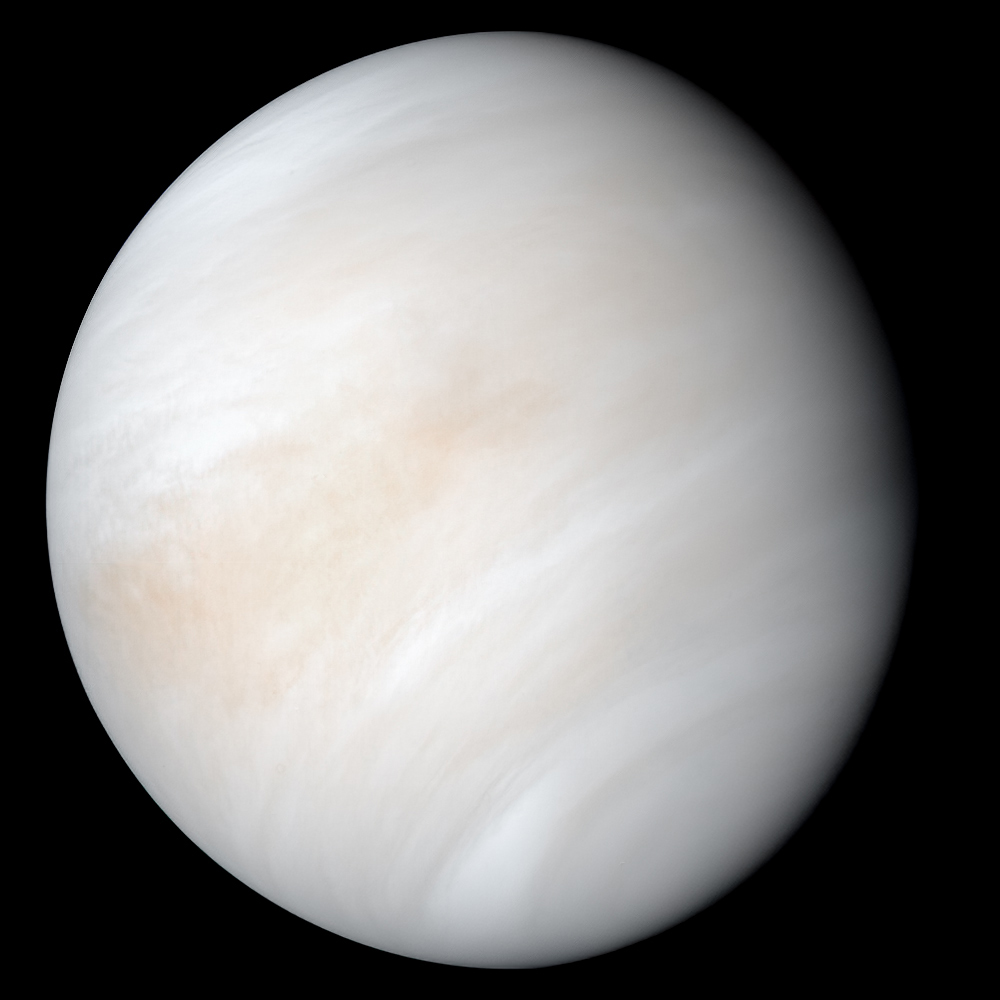

Which is the hottest planet in the Solar System?1
Almost everyone answers Mercury, because it is the closest to the Sun.
It is Venus. Yet it is much further away.
Why
On the surface of Venus, the temperature is about 467 °C. Hot enough to melt lead.2
Mercury is almost twice as close to the Sun, yet it is not as hot.
The reason fits in one sentence:
Mercury has practically no atmosphere. The heat it receives from the Sun goes straight back out into space, like a stone that cools as soon as it is taken out of the fire.
Venus is wrapped in a thick atmosphere that traps heat. Beneath its clouds of sulphuric acid, the ground heats up and can no longer cool down: this is a runaway greenhouse effect.3
So it is not distance that decides. It is what lies around the planet.
A surprising consequence
On Earth, it is hotter at the equator than at the pole, and hotter by day than by night. That seems normal.
On Venus, no respite is to be expected. No season to cool things down: the heat never lets up.4
The days, meanwhile, are bafflingly long. A day on Venus lasts 243 Earth days — longer than its year, which lasts only 225. From sunrise to sunset, 117 Earth days go by. What is more, the Sun rises there in the west: the planet spins backwards.5
Interactive
One turn on its axis
The Earth turns once on its axis in a little under 24 hours. Each of the other planets has its own rhythm.
The question
Which planet takes the longest to turn once on its axis?
What you do Set time running: the eight planets spin together, all at the same accelerated speed. Count each one’s turns and watch which way its white marker moves.
Without JavaScript, here are the animation’s data.
| Planet | One turn on its axis (hours) | Direction | Tilt of the axis (degrees) | Source |
|---|---|---|---|---|
| Mercury | 1,407.6 | forwards | 0.034 | 1 |
| Venus | 5,832.5 | backwards | 177.4 | 1 |
| Earth | 23.9 | forwards | 23.4 | 1 |
| Mars | 24.6 | forwards | 25.2 | 1 |
| Jupiter | 9.9 | forwards | 3.1 | 1 |
| Saturn | 10.7 | forwards | 26.7 | 1 |
| Uranus | 17.2 | backwards | 97.8 | 1 |
| Neptune | 16.1 | forwards | 28.3 | 1 |
NASA marks a backwards (retrograde) rotation with a minus sign; the table spells it out. The planets’ sizes are not to scale, and their tilts are drawn in the plane of the figure.
Mercury, the Earth, Mars and Jupiter are maps of their surface wrapped round a globe. Venus, Saturn, Uranus and Neptune are still photos: only their white marker turns.
The takeaway Venus is by far the slowest: one turn on its axis takes 243 Earth days, longer than its year. It also spins backwards, as Uranus does. The giants, by contrast, turn once in less than an Earth day.
Photo credits 8
- Global mosaic of Mercury’s surface, in black and white, made from images taken by the MESSENGER spacecraft (equirectangular projection). NASA/Johns Hopkins University Applied Physics Laboratory, Public domain, source
- Venus, wrapped in clouds, photographed by NASA’s Mariner 10 probe in February 1974. NASA/JPL-Caltech, Public domain, source
- Blue Marble: Next Generation, with land topography and sea-floor bathymetry, in equirectangular projection: map produced by Reto Stöckli, NASA Earth Observatory (NASA Goddard Space Flight Center). Reto Stöckli, NASA Earth Observatory, modified by NordNordWest, Public domain, source
- Global map of Mars, the MDIM 2.1 colour mosaic made from Viking Orbiter images (equirectangular projection). NASA / Jet Propulsion Lab / USGS, Public domain, source
- Cylindrical map of Jupiter, made from images taken by the Cassini spacecraft on 11 and 12 December 2000; its colours are close to those the human eye would see (PIA07782). NASA/JPL/Space Science Institute, Public domain, source
- Saturn in natural colour, from images taken by the Cassini probe (2008). NASA / JPL / Space Science Institute, Public domain, source
- Uranus photographed by the Voyager 2 probe in 1986. NASA/JPL-Caltech, Public domain, source
- Neptune, from the last whole-planet images taken by Voyager 2 through green and orange filters (1989); the Great Dark Spot is visible. NASA, Public domain, source


Sources 3
Williams, David R., “Planetary Fact Sheet – Metric”, NASA Goddard Space Flight Center (NSSDCA), updated 18 March 2025, rows “Rotation Period (hours)” and “Obliquity to Orbit (degrees)”, columns Mercury to Neptune (Moon and Pluto excluded).
Rotation Period (hours) 1407.6 -5832.5 23.9 655.7 24.6 9.9 10.7 -17.2 16.1 -153.3 […] Obliquity to Orbit (degrees) 0.034 177.4 23.4 6.7 25.2 3.1 26.7 97.8 28.3 119.5
Open access open the source · checked on 28 October 2026
NASA, “Venus: Facts”, section “Venus: Facts”.
your "day" would be 243 Earth days long — longer even than a Venus year (one trip around the Sun), which takes only 225 Earth days
Open access open the source · checked on 9 September 2026
Williams, David R., “Planetary Fact Sheet Notes”, NASA Goddard Space Flight Center (NSSDCA), updated 20 December 2021, definition of “Rotation Period (hours)”.
Negative numbers indicate retrograde (backwards relative to the Earth) rotation.
Open access open the source · checked on 28 October 2026
What it took to go and see
Now imagine what it takes to land a machine there: 467 °C and a pressure of about 93 times that of the air at sea level — the equivalent of a dive to more than nine hundred metres underwater.6
In the 1970s and 1980s, Soviet probes of the Venera programme managed it. None lasted very long: the heat and the pressure eventually crush everything.
Shorter than a film
Here is the fact we find the most striking on this page.
No probe that has landed on Venus has survived there much more than an hour. The length of a feature film, and then the machine falls silent.7
The few photographs taken on the surface of Venus were therefore taken in very little time. They are almost all we have: no one has gone back there with a camera since.
And why this programme remains so little known
This programme is one of the great technical achievements of the twentieth century. Landing a machine that works inside a pressurised oven is a feat of engineering.
Yet it remains fairly little known, at least in Europe and America. The reasons can be identified.
First, because it took place in a language that most Western scientists did not read. Second, because it belonged to a state that no longer exists, and that therefore has far fewer people to tell its story.
This is a property of knowledge, and it holds everywhere:
What is not read is not cited, and what is not cited gradually disappears from the story.
This idea appears elsewhere on this site, in connection with history: in a conflict, it is the victor’s archives that survive. Here there is neither victor nor conflict — just a language barrier and a vanished country. The result is comparable.
Did Venus have oceans?
Two incompatible accounts clash:
- “Wet Venus”: the surface was at first temperate enough to hold liquid water; then a runaway greenhouse effect, fuelled by intense volcanic activity, boiled it all away.
- “Dry Venus”: the planet was born hot, and liquid water has never been able to condense on its surface.8
How people are trying to settle it
Tereza Constantinou, a PhD student at Cambridge’s Institute of Astronomy, who authored this study with Oliver Shorttle and Paul Rimmer, frames the problem well:9
“Both of those theories are based on climate models, but we wanted to take a different approach based on observations of Venus’ current atmospheric chemistry.”10
Two competing models, and someone who goes looking for a different kind of data to decide between them.
The reasoning is elegant, and accessible to anyone. For an atmosphere to remain stable, everything removed from it must be put back: a planet’s interior and exterior are in constant chemical communication. So the team calculated how fast three molecules — water, carbon dioxide and carbonyl sulphide — are destroyed in the air of Venus. What the volcanoes emit must exactly offset these losses. And what the volcanoes emit comes from the interior.11
The result: the volcanic gases of Venus contain at most 6% water vapour. On Earth, eruptions are mostly steam, because our interior is rich in water.12
A dry interior cannot have supplied oceans.13
The approach deserves to be highlighted: no one looked at the past. The present was measured, and from it was deduced what the past could not have contained.
But it is not settled
This is the part that popular retellings leave out.
The other camp has not conceded, and the team itself does not present the matter as closed. Constantinou says so: “We won’t know for sure whether Venus can or did support life until we send probes at the end of this decade.”14
The American DAVINCI mission, which is to fly past the planet and drop a probe into its atmosphere, will be able to put this conclusion to the test.15
A sentence we wanted to quote
Here is what she said when presenting her result:
“We would have loved to find that Venus was once a planet much closer to our own, so it’s kind of sad in a way to find out that it wasn’t, but ultimately it’s more useful to focus the search on planets that are mostly likely to be able to support life – at least life as we know it.”16
A researcher who says she would have preferred the other answer — and who publishes the one her data give.
This may be the most useful sentence on this whole page.
The four rocky planets
Mercury, Venus, Earth and Mars are the four planets closest to the Sun. They are called terrestrial planets because they have solid surfaces.17
Mercury is the smallest planet in the solar system and the closest to the Sun. It goes round the Sun in 88 Earth days. By day its surface can reach 430 °C; at night, with no atmosphere to hold the heat, it drops as low as −180 °C. It has no moon.18
Mars is about half the size of the Earth. Its red colour comes from rust: the iron in its rocks, soil and dust has oxidised. Its very thin atmosphere is made mostly of carbon dioxide. It bears the largest volcano in the solar system, Olympus Mons, and two small moons, Phobos and Deimos. Mars seems to have had a watery past: ancient river valleys, deltas and lakebeds can be seen there, as well as rocks that could only have formed in liquid water.19
The Earth has its own pages: see Entry 1.6 The Earth and the Moon, and the whole of domain 7, Earth and climate, for its interior, its atmosphere and its climate.
Note 2
surface temperatures hot enough to melt lead — about 872 degrees Fahrenheit (467 Celsius)
NASA, “Venus: Facts”
Note 3
Its thick atmosphere traps heat in a runaway greenhouse effect
NASA, “Venus: Facts”
it is covered with thick clouds of sulfuric acid
Université de Cambridge, “Researchers deal a blow to theory that Venus once had liquid water on its surface”, communiqué du 2 December 2024
Note 4
don't expect any seasonal relief from the unrelenting temperatures
NASA, “Venus: Facts”
Note 5
your "day" would be 243 Earth days long — longer even than a Venus year (one trip around the Sun), which takes only 225 Earth days
NASA, “Venus: Facts”
sunrise to sunset would take 117 Earth days. And by the way, the Sun would rise in the west and set in the east, because Venus spins backward compared to Earth.
NASA, “Venus: Facts”
Note 6
And the atmospheric pressure at the surface is about 93 times what it is at sea level on Earth. […] And atmospheric pressure at the surface squeezes with the same force as being more than 3,000 feet underwater on Earth (930 meters).
NASA, “Venus: Facts”
Note 7
no lander or probe has ever survived much over an hour in the Venus environment
NASA / GSFC, “Solar System Tour — Venus”
Note 8
conditions on the surface of Venus were once temperate enough to support liquid water, but a runaway greenhouse effect caused by widespread volcanic activity caused the planet to get hotter and hotter
Université de Cambridge, “Researchers deal a blow to theory that Venus once had liquid water on its surface”, communiqué du 2 December 2024
The second theory is that Venus was born hot, and liquid water has never been able to condense at the surface.
Université de Cambridge, “Researchers deal a blow to theory that Venus once had liquid water on its surface”, communiqué du 2 December 2024
Note 9
said first author Tereza Constantinou, a PhD student at Cambridge's Institute of Astronomy
Université de Cambridge, “Researchers deal a blow to theory that Venus once had liquid water on its surface”, communiqué du 2 December 2024
Here we offer a constraint on Venus’s climate history by inferring the water content of its interior. By calculating the present rate of atmospheric destruction of H2O, CO2 and OCS, which must be restored by volcanism to maintain atmospheric stability, we show that Venus’s interior is dry.
Constantinou, Tereza, Shorttle, Oliver and Rimmer, Paul B., “A Dry Venusian Interior Constrained by Atmospheric Chemistry”, Nature Astronomy, vol. 9, no. 2, 2025 (en ligne le 2 December 2024), p. 189-198
Note 10
Both of those theories are based on climate models, but we wanted to take a different approach based on observations of Venus' current atmospheric chemistry
Université de Cambridge, “Researchers deal a blow to theory that Venus once had liquid water on its surface”, communiqué du 2 December 2024
Note 11
any chemicals being removed from the atmosphere should also be getting restored to it, since the planet's interior and exterior are in constant chemical communication with one another
Université de Cambridge, “Researchers deal a blow to theory that Venus once had liquid water on its surface”, communiqué du 2 December 2024
The researchers calculated the present destruction rate of water, carbon dioxide and carbonyl sulphide molecules in Venus’ atmosphere, which must be restored by volcanic gases to keep the atmosphere stable.
Université de Cambridge, “Researchers deal a blow to theory that Venus once had liquid water on its surface”, communiqué du 2 December 2024
Note 12
the researchers found that volcanic gases on Venus are at most six percent water
Université de Cambridge, “Researchers deal a blow to theory that Venus once had liquid water on its surface”, communiqué du 2 December 2024
On Earth, volcanic eruptions are mostly steam, due to our planet's water-rich interior.
Université de Cambridge, “Researchers deal a blow to theory that Venus once had liquid water on its surface”, communiqué du 2 December 2024
Note 13
inferred that its interior is too dry today for there ever to have been enough water for oceans to exist at its surface […] These dry eruptions suggest that Venus’s interior, the source of the magma that releases volcanic gases, is also dehydrated.
Université de Cambridge, “Researchers deal a blow to theory that Venus once had liquid water on its surface”, communiqué du 2 December 2024
Note 14
We won't know for sure whether Venus can or did support life until we send probes at the end of this decade
Université de Cambridge, “Researchers deal a blow to theory that Venus once had liquid water on its surface”, communiqué du 2 December 2024
Note 15
NASA's DAVINCI mission will be able to test and confirm whether Venus has always been a dry, inhospitable planet, with a series of flybys and a probe sent to the surface
Université de Cambridge, “Researchers deal a blow to theory that Venus once had liquid water on its surface”, communiqué du 2 December 2024
Note 16
We would have loved to find that Venus was once a planet much closer to our own, so it's kind of sad in a way to find out that it wasn't, but ultimately it's more useful to focus the search on planets that are mostly likely to be able to support life – at least life as we know it.
Université de Cambridge, “Researchers deal a blow to theory that Venus once had liquid water on its surface”, communiqué du 2 December 2024
Note 17
The first four planets from the Sun are Mercury, Venus, Earth, and Mars. These inner planets also are known as terrestrial planets because they have solid surfaces.
NASA Science, “About the Planets”
Note 18
Mercury is the smallest planet in our solar system and nearest to the Sun. […] But Mercury is the fastest planet, zipping around the Sun every 88 Earth days.
NASA, “Mercury: Facts”
Because the planet is so close to the Sun, day temperatures can reach highs of 800°F (430°C). Without an atmosphere to retain that heat at night, temperatures can dip as low as -290°F (-180°C). […] Mercury doesn't have moons.
NASA, “Mercury: Facts”
Note 19
Mars is about half the size of Earth. […] The reason Mars looks reddish is due to oxidization — or rusting — of iron in the rocks, regolith (Martian "soil"), and dust of Mars. […] Mars has a thin atmosphere made up mostly of carbon dioxide, nitrogen, and argon gases.
NASA, “Mars: Facts”
Mars is home to the largest volcano in the solar system, Olympus Mons. […] Mars has two small moons, Phobos and Deimos, that may be captured asteroids. […] Mars appears to have had a watery past, with ancient river valley networks, deltas, and lakebeds, as well as rocks and minerals on the surface that could only have formed in liquid water.
NASA, “Mars: Facts”
Notes and sources
- ↑
Passage Which is the hottest planet in the Solar System? […] It is Venus. Yet it is much further away.
making it the hottest planet in our solar system
Source NASA, “Venus: Facts”, section “Venus: Facts”.
Open access open the source · checked on 9 September 2026
- ↑
Passage On the surface of Venus, the temperature is about 467 °C. Hot enough to melt lead.
surface temperatures hot enough to melt lead — about 872 degrees Fahrenheit (467 Celsius)
Source NASA, “Venus: Facts”, section “Venus: Facts”.
Open access open the source · checked on 9 September 2026
- ↑
Passage Venus is wrapped in a thick atmosphere that traps heat. […] this is a runaway greenhouse effect.
Its thick atmosphere traps heat in a runaway greenhouse effect
Source NASA, “Venus: Facts”, section “Venus: Facts”.
Open access open the source · checked on 9 September 2026
Passage Beneath its clouds of sulphuric acid
it is covered with thick clouds of sulfuric acid
Source Université de Cambridge, “Researchers deal a blow to theory that Venus once had liquid water on its surface”, communiqué du 2 December 2024, paragraph 3 of the press release.
Open access open the source · checked on 9 September 2026
- ↑
Passage On Venus, no respite is to be expected. No season to cool things down: the heat never lets up.
don't expect any seasonal relief from the unrelenting temperatures
Source NASA, “Venus: Facts”, section “Venus: Facts”.
Open access open the source · checked on 9 September 2026
- ↑
Passage A day on Venus lasts 243 Earth days — longer than its year, which lasts only 225.
your "day" would be 243 Earth days long — longer even than a Venus year (one trip around the Sun), which takes only 225 Earth days
Source NASA, “Venus: Facts”, section “Venus: Facts”.
Open access open the source · checked on 9 September 2026
Passage From sunrise to sunset, 117 Earth days go by. What is more, the Sun rises there in the west: the planet spins backwards.
sunrise to sunset would take 117 Earth days. And by the way, the Sun would rise in the west and set in the east, because Venus spins backward compared to Earth.
Source NASA, “Venus: Facts”, section “Venus: Facts”.
Open access open the source · checked on 9 September 2026
- ↑
Passage a pressure of about 93 times that of the air at sea level — the equivalent of a dive to more than nine hundred metres underwater
And the atmospheric pressure at the surface is about 93 times what it is at sea level on Earth. […] And atmospheric pressure at the surface squeezes with the same force as being more than 3,000 feet underwater on Earth (930 meters).
Source NASA, “Venus: Facts”, introduction; section “Surface”.
Open access open the source · checked on 9 September 2026
- ↑
Passage No probe that has landed on Venus has survived there much more than an hour.
no lander or probe has ever survived much over an hour in the Venus environment
Source NASA / GSFC, “Solar System Tour — Venus”, paragraph “Solar System Tour — Venus”.
Open access open the source · checked on 9 September 2026
- ↑
Passage “Wet Venus”: the surface was at first temperate enough to hold liquid water; then a runaway greenhouse effect, fuelled by intense volcanic activity, boiled it all away.
conditions on the surface of Venus were once temperate enough to support liquid water, but a runaway greenhouse effect caused by widespread volcanic activity caused the planet to get hotter and hotter
Source Université de Cambridge, “Researchers deal a blow to theory that Venus once had liquid water on its surface”, communiqué du 2 December 2024, section on the two theories.
Open access open the source · checked on 9 September 2026
Passage “Dry Venus”: the planet was born hot, and liquid water has never been able to condense on its surface.
The second theory is that Venus was born hot, and liquid water has never been able to condense at the surface.
Source Université de Cambridge, “Researchers deal a blow to theory that Venus once had liquid water on its surface”, communiqué du 2 December 2024, section on the two theories.
Open access open the source · checked on 9 September 2026
- ↑
Passage Tereza Constantinou, a PhD student at Cambridge’s Institute of Astronomy, who authored this study with Oliver Shorttle and Paul Rimmer
said first author Tereza Constantinou, a PhD student at Cambridge's Institute of Astronomy
Source Université de Cambridge, “Researchers deal a blow to theory that Venus once had liquid water on its surface”, communiqué du 2 December 2024, paragraph 5; authors in the article’s reference.
Open access open the source · checked on 9 September 2026
Passage this study
Here we offer a constraint on Venus’s climate history by inferring the water content of its interior. By calculating the present rate of atmospheric destruction of H2O, CO2 and OCS, which must be restored by volcanism to maintain atmospheric stability, we show that Venus’s interior is dry.
Source Constantinou, Tereza, Shorttle, Oliver and Rimmer, Paul B., “A Dry Venusian Interior Constrained by Atmospheric Chemistry”, Nature Astronomy, vol. 9, no. 2, 2025 (en ligne le 2 December 2024), p. 189-198, Abstract.
Open access open the source · checked on 24 October 2026
- ↑
Passage Both of those theories are based on climate models, but we wanted to take a different approach based on observations of Venus’ current atmospheric chemistry.
Both of those theories are based on climate models, but we wanted to take a different approach based on observations of Venus' current atmospheric chemistry
Source Université de Cambridge, “Researchers deal a blow to theory that Venus once had liquid water on its surface”, communiqué du 2 December 2024, quotation from Tereza Constantinou.
Open access open the source · checked on 9 September 2026
- ↑
Passage For an atmosphere to remain stable, everything removed from it must be put back: a planet’s interior and exterior are in constant chemical communication.
any chemicals being removed from the atmosphere should also be getting restored to it, since the planet's interior and exterior are in constant chemical communication with one another
Source Université de Cambridge, “Researchers deal a blow to theory that Venus once had liquid water on its surface”, communiqué du 2 December 2024, quotation from Tereza Constantinou.
Open access open the source · checked on 9 September 2026
Passage So the team calculated how fast three molecules — water, carbon dioxide and carbonyl sulphide — are destroyed in the air of Venus.
The researchers calculated the present destruction rate of water, carbon dioxide and carbonyl sulphide molecules in Venus’ atmosphere, which must be restored by volcanic gases to keep the atmosphere stable.
Source Université de Cambridge, “Researchers deal a blow to theory that Venus once had liquid water on its surface”, communiqué du 2 December 2024, paragraph beginning “The researchers calculated”.
Open access open the source · checked on 9 September 2026
- ↑
Passage the volcanic gases of Venus contain at most 6% water vapour
the researchers found that volcanic gases on Venus are at most six percent water
Source Université de Cambridge, “Researchers deal a blow to theory that Venus once had liquid water on its surface”, communiqué du 2 December 2024, paragraph beginning “On Earth, volcanic eruptions are mostly steam” (13th of 17, not the penultimate).
Open access open the source · checked on 9 September 2026
Passage On Earth, eruptions are mostly steam, because our interior is rich in water.
On Earth, volcanic eruptions are mostly steam, due to our planet's water-rich interior.
Source Université de Cambridge, “Researchers deal a blow to theory that Venus once had liquid water on its surface”, communiqué du 2 December 2024, paragraph beginning “On Earth, volcanic eruptions are mostly steam” (13th of 17, not the penultimate).
Open access open the source · checked on 9 September 2026
- ↑
Passage A dry interior cannot have supplied oceans.
inferred that its interior is too dry today for there ever to have been enough water for oceans to exist at its surface […] These dry eruptions suggest that Venus’s interior, the source of the magma that releases volcanic gases, is also dehydrated.
Source Université de Cambridge, “Researchers deal a blow to theory that Venus once had liquid water on its surface”, communiqué du 2 December 2024, 2nd paragraph (“The researchers, from the University of…”); paragraph beginning “On Earth, volcanic eruptions are mostly steam”.
Open access open the source · checked on 9 September 2026
- ↑
Passage We won’t know for sure whether Venus can or did support life until we send probes at the end of this decade.
We won't know for sure whether Venus can or did support life until we send probes at the end of this decade
Source Université de Cambridge, “Researchers deal a blow to theory that Venus once had liquid water on its surface”, communiqué du 2 December 2024, quotation from Tereza Constantinou.
Open access open the source · checked on 9 September 2026
- ↑
Passage The American DAVINCI mission, which is to fly past the planet and drop a probe into its atmosphere, will be able to put this conclusion to the test.
NASA's DAVINCI mission will be able to test and confirm whether Venus has always been a dry, inhospitable planet, with a series of flybys and a probe sent to the surface
Source Université de Cambridge, “Researchers deal a blow to theory that Venus once had liquid water on its surface”, communiqué du 2 December 2024, paragraph on upcoming missions.
Open access open the source · checked on 9 September 2026
- ↑
Passage We would have loved to find that Venus was once a planet much closer to our own, so it’s kind of sad in a way to find out that it wasn’t, but ultimately it’s more useful to focus the search on planets that are mostly likely to be able to support life – at least life as we know it.
We would have loved to find that Venus was once a planet much closer to our own, so it's kind of sad in a way to find out that it wasn't, but ultimately it's more useful to focus the search on planets that are mostly likely to be able to support life – at least life as we know it.
Source Université de Cambridge, “Researchers deal a blow to theory that Venus once had liquid water on its surface”, communiqué du 2 December 2024, last quotation in the press release.
Open access open the source · checked on 9 September 2026
- ↑
Passage Mercury, Venus, Earth and Mars are the four planets closest to the Sun. They are called terrestrial planets because they have solid surfaces.
The first four planets from the Sun are Mercury, Venus, Earth, and Mars. These inner planets also are known as terrestrial planets because they have solid surfaces.
Source NASA Science, “About the Planets”, whole page.
Open access open the source · checked on 26 October 2026
- ↑
Passage Mercury is the smallest planet in the solar system and the closest to the Sun. It goes round the Sun in 88 Earth days.
Mercury is the smallest planet in our solar system and nearest to the Sun. […] But Mercury is the fastest planet, zipping around the Sun every 88 Earth days.
Source NASA, “Mercury: Facts”, whole page.
Open access open the source · checked on 26 October 2026
Passage By day its surface can reach 430 °C; at night, with no atmosphere to hold the heat, it drops as low as −180 °C. It has no moon.
Because the planet is so close to the Sun, day temperatures can reach highs of 800°F (430°C). Without an atmosphere to retain that heat at night, temperatures can dip as low as -290°F (-180°C). […] Mercury doesn't have moons.
Source NASA, “Mercury: Facts”, whole page.
Open access open the source · checked on 26 October 2026
- ↑
Passage Mars is about half the size of the Earth. Its red colour comes from rust: the iron in its rocks, soil and dust has oxidised. Its very thin atmosphere is made mostly of carbon dioxide.
Mars is about half the size of Earth. […] The reason Mars looks reddish is due to oxidization — or rusting — of iron in the rocks, regolith (Martian "soil"), and dust of Mars. […] Mars has a thin atmosphere made up mostly of carbon dioxide, nitrogen, and argon gases.
Source NASA, “Mars: Facts”, whole page.
Open access open the source · checked on 26 October 2026
Passage It bears the largest volcano in the solar system, Olympus Mons, and two small moons, Phobos and Deimos. Mars seems to have had a watery past: ancient river valleys, deltas and lakebeds can be seen there, as well as rocks that could only have formed in liquid water.
Mars is home to the largest volcano in the solar system, Olympus Mons. […] Mars has two small moons, Phobos and Deimos, that may be captured asteroids. […] Mars appears to have had a watery past, with ancient river valley networks, deltas, and lakebeds, as well as rocks and minerals on the surface that could only have formed in liquid water.
Source NASA, “Mars: Facts”, whole page.
Open access open the source · checked on 26 October 2026
Bibliography
7
- Constantinou, Tereza, Shorttle, Oliver and Rimmer, Paul B., “A Dry Venusian Interior Constrained by Atmospheric Chemistry”, Nature Astronomy, vol. 9, no. 2, 2025 (en ligne le 2 December 2024), p. 189-198, open access (the study itself). https://doi.org/10.1038/s41550-024-02414-5
- NASA, “Mars: Facts”, open access (the size, the rust, the thin atmosphere, Olympus Mons, Phobos and Deimos, the watery past). https://science.nasa.gov/mars/facts/
- NASA, “Mercury: Facts”, open access (the smallest planet; the 88-day year; 430 °C by day, −180 °C at night; no moon). https://science.nasa.gov/mercury/facts/
- NASA, “Venus: Facts”, open access (467 °C, pressure 93 times that on Earth, a day of 243 Earth days, sunrise in the west, no seasonal relief). https://science.nasa.gov/venus/venus-facts/
- NASA / GSFC, “Solar System Tour — Venus”, open access (no probe has survived much more than an hour on the surface). https://science.gsfc.nasa.gov/690/Venus.html
- NASA Science, “About the Planets”, open access (the four inner planets, called terrestrial because they have solid surfaces). https://science.nasa.gov/solar-system/planets/
- Université de Cambridge, “Researchers deal a blow to theory that Venus once had liquid water on its surface”, communiqué du 2 December 2024, open access (the two theories, the method, the 6% water vapour, the quotations from Tereza Constantinou). https://www.cam.ac.uk/research/news/researchers-deal-a-blow-to-theory-that-venus-once-had-liquid-water-on-its-surface
Spotted an error or have a doubt? Write to us.