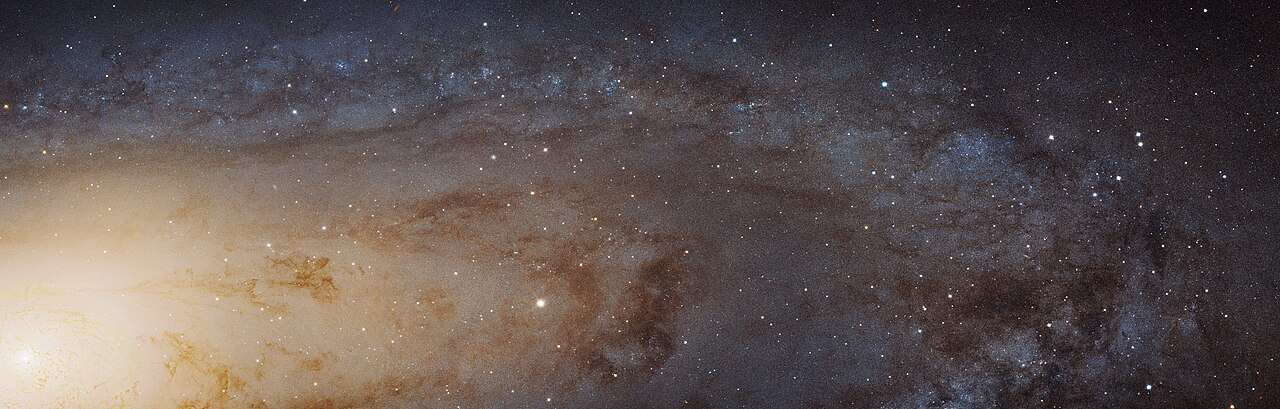

A little over a hundred years ago, nobody knew whether other galaxies existed.1
This was not simply a debate: nobody knew. It was the great open question of astronomy, and it was settled in five years — from 1920 to 1925.
The debate of 26 April 1920
On that day, in Washington, two astronomers take the stage at a museum to debate before their colleagues from the Academy of Sciences.2
The question: what are the fuzzy spiral patches that can be seen in the sky?3
Harlow Shapley, an astronomer at Mount Wilson, argues that the spirals are much smaller than the Milky Way, and therefore that they are part of it. For him, our galaxy is the Universe.4
Heber Curtis argues the opposite: they are other galaxies, immensely far away. People spoke at the time of “island universes”.5
Yet Shapley was far from narrow-minded. That day he defended a Milky Way three hundred thousand light-years across — an overestimate, but much larger than what was accepted at the time. On another point, moreover, he was right and Curtis, who placed the Sun very close to the centre, was wrong: the Sun is not at the centre.6
The plate of autumn 1923
In 1923, the astronomer Edwin Hubble spends several months scanning the Andromeda nebula with the most powerful telescope of the era — the Hooker, one hundred inches in diameter, on Mount Wilson, in California. The target is so large that he needs dozens of photographic plates to cover all of it.7
On the night of 5–6 October 1923, in poor conditions, he makes a forty-five-minute exposure that yields three suspect stars. He writes “N”, for nova, next to each one.8
Comparing this plate with the earlier ones afterwards, he finds that one of the three brightens and dims far too quickly for a nova. He derives a period of 31.4 days from it: it is a Cepheid.9
On the plate, he crosses out the “N” and writes: “VAR!”10
Then he writes to Shapley to tell him, enclosing the star’s light curve.11
Why this settles the question
Our page on light and distances tells the story of Henrietta Leavitt, who discovered that the length of a Cepheid’s cycle of variation reveals its true brightness.
This was precisely the tool Hubble needed. The period gives the true brightness; compared with the apparent brightness, it gives the distance.12
His first estimate places the star at one million light-years — more than three times the diameter Shapley gave the Milky Way. By the end of 1924, with thirty-six variable stars found in Andromeda, twelve of them Cepheids, he obtains nine hundred thousand light-years.13
Current measurements place Andromeda at about two million light-years. Hubble was therefore below the true value, which did not alter his conclusion.14
Andromeda was not a cloud within our galaxy. It was another galaxy.
One instrument for all
It is worth noting who used Leavitt’s law in this story.
Shapley used it to measure the Milky Way. Hubble used it to measure Andromeda. Both sides of the debate, and the man who settled it, were using the same instrument.
That instrument had been forged by a woman whose result appeared under the signature of the director of her observatory: the 1912 paper that states the law bears the name of Edward Pickering, and its first sentence specifies that the measurement was prepared by Miss Leavitt.15
That is the cost of an erasure. It is not only unjust to the person: it makes the story we pass on false. We say that Hubble discovered the galaxies, without saying what he was measuring with.
Shapley’s words
When Hubble’s letter reaches him, Shapley comes round at once: the evidence seems solid to him.16
A young doctoral student, Cecilia Payne, is in his office that day. Much later, she would recount what he said to her as he folded the letter:
“Here is the letter that destroyed my universe.”17
He does not dispute it and looks for no way out. He observes that his view of the world has just collapsed, and says so out loud.
There is, however, a second reaction, which nicely complements the first. In the letter he sends to Hubble, Shapley writes that his letter is the most entertaining piece of literature he has seen for a long time.18
Crushed in private, gracious in writing. The two attitudes do not contradict each other: it is possible to acknowledge one’s defeat while refusing to make a drama of it in front of one’s opponent.
It is Shapley himself and the astronomer Henry Norris Russell who then urge Hubble to present his results to their colleagues, at the end of December 1924. The paper is read in his absence and shares the prize for the best paper. The news causes no stir in the room: Hubble had informed the leading astronomers several months earlier.19
One last, surprising point
An image search for the Milky Way brings up dozens of pictures of it: a beautiful spiral, seen from above, with its arms and its bright centre.
None of these images is a photograph.
We are inside our galaxy. You cannot photograph a house from its living room. No probe will ever travel far enough to turn round and take its picture: New Horizons, for example, is more than seven billion kilometres from Earth after eighteen years of flight — a tiny distance on the scale of a galaxy.20
All these images are therefore reconstructions: drawings or computed models, based on measurements made from the inside — where the stars are, how far away, in which direction.
They are not false. But they do not mean “here is our galaxy”. They mean: here is what it would look like seen from elsewhere, if our measurements are right.
How many are there?
One would expect a number. Here are three, with the reasons why all three are honest.
- 1990s: one hundred to two hundred billion galaxies, based on the deep images from the Hubble telescope.
- 2016: at least two trillion — ten times more. The figure then goes round the world.
- 2021: the estimate comes back down to a few hundred billion.21
In twenty-five years, the number rose tenfold, then fell back by roughly as much.
The universe did not change during that time. It is the instruments and the methods that changed.
Why these two figures are so different
They do not answer the same question, and they are not obtained in the same way.
The 2016 figure is not based only on galaxies that have been seen. The visible ones are counted, then extrapolated: from the mass of the galaxies observed out to the visible limits, one estimates how many small galaxies too faint to be seen elude the telescopes. The numbers add up on one condition only: that 90% of galaxies are still invisible to our instruments.22
The 2021 figure rests on an entirely different, and particularly elegant, idea. The New Horizons probe, at more than forty times the Earth–Sun distance, sees a sky about ten times darker than the darkest accessible to the Hubble telescope. From there, the background light of the sky is measured — the sum of the light from everything that exists beyond our galaxy. Yet this light is not enough to account for two trillion galaxies. One of the lead authors summed it up simply: take all the light from the galaxies the Hubble telescope can see, double it, and that is what we see — but nothing more.23
This measurement has since been refined. In 2021, the team found a background slightly brighter than expected, without knowing where the extra came from; in 2024, with better data, it showed that this was stray light from our own galaxy.24
On one side, an estimate by extrapolation; on the other, a measurement of total light. These are not two counts that contradict each other: they are two ways of approaching the question.
What holds despite the disagreement
This point matters more than the number itself.
On every estimate, a large share of the galaxies in the universe remains too faint for us to see. The disagreement is about how many — not about the fact that we glimpse only some of them.
The number of galaxies is not an established fact written in the sky: it is an estimate, which changes every time a new instrument sees a little further into the dark.
That is why this page does not give a single number. When a figure moves this much, the honest thing to pass on is not the figure: it is the series, with its dates, and the reason for its variations.
Note 1
Though the universe is filled with billions upon billions of stars, the discovery of a single variable star in 1923 altered the course of modern astronomy. […] But in the early 1900s, most astronomers considered the Milky Way a single "island universe" of stars, with nothing observable beyond its boundaries. […] Were these spiral nebulae part of the Milky Way or were they independent island universes lying outside our galaxy? Astronomers didn't know for sure
NASA, “Hubble Views the Star that Changed the Universe”, communiqué du 23 May 2011
Note 2
In April 1920, the Natural History Museum in Washington, D.C., played host to an historic interchange on competing theories about the scale of the universe. […] Their confrontation at the 1920 meeting of the National Academy of Science in Washington is widely held to be at the crux of a major shift of humanity's view of its place in the universe.
American Physical Society, “April 26, 1920: The Shapley-Curtis Debate”, APS News, rubrique “This Month in Physics History”, April 2000
Note 3
Andromeda was cataloged as just one of many faint, fuzzy patches of light astronomers called "spiral nebulae."
NASA, “Hubble Views the Star that Changed the Universe”, communiqué du 23 May 2011
Note 4
He also argued that spiral nebulae were much smaller than the giant Milky Way and therefore must be part of our galaxy.
NASA, “Hubble Views the Star that Changed the Universe”, communiqué du 23 May 2011
Note 5
He thought the Milky Way was smaller than Shapley claimed, leaving room for other island universes beyond our galaxy.
NASA, “Hubble Views the Star that Changed the Universe”, communiqué du 23 May 2011
Note 6
Shapley championed his measurement of 300,000 light-years for the size of the Milky Way. Though Shapley overestimated its size, he was correct in asserting that the Milky Way was much larger than the commonly accepted dimensions.
NASA, “Hubble Views the Star that Changed the Universe”, communiqué du 23 May 2011
(13) Central location of the Sun. Shapley claimed this was an illusion, caused by the local star cloud now called Gould's belt. Curtis said it was God's own truth, and that our location kept us from readily seeing our own spiral arms. Once again, dust is an important part of the picture, but Shapley was nearly right
Trimble, Virginia, “The 1920 Shapley-Curtis Discussion: Background, Issues, and Aftermath”, Publications of the Astronomical Society of the Pacific, vol. 107, December 1995, p. 1133-1144
Note 7
the 100-inch Hooker telescope, the most powerful telescope of that era, at Mount Wilson Observatory in California
NASA, “Hubble Views the Star that Changed the Universe”, communiqué du 23 May 2011
He therefore took many exposures covering dozens of photographic glass plates to capture the whole nebula.
NASA, “Hubble Views the Star that Changed the Universe”, communiqué du 23 May 2011
Note 8
Under poor viewing conditions, the astronomer made a 45-minute exposure that yielded three suspected novae […] He wrote the letter "N," for nova, next to each of the three objects.
NASA, “Hubble Views the Star that Changed the Universe”, communiqué du 23 May 2011
Note 9
One of the so-called novae dimmed and brightened over a much shorter time period than seen in a typical nova.
NASA, “Hubble Views the Star that Changed the Universe”, communiqué du 23 May 2011
determining a period of 31.4 days, indicating the object was a Cepheid variable
NASA, “Hubble Views the Star that Changed the Universe”, communiqué du 23 May 2011
Note 10
Hubble crossed out the "N" next to the newfound Cepheid variable and wrote "VAR," for variable, followed by an exclamation point.
NASA, “Hubble Views the Star that Changed the Universe”, communiqué du 23 May 2011
Note 11
Then Hubble sent a letter along with a light curve of V1 to Shapley telling him of his discovery.
NASA, “Hubble Views the Star that Changed the Universe”, communiqué du 23 May 2011
Note 12
The period yielded the star's intrinsic brightness, which Hubble then used to calculate its distance.
NASA, “Hubble Views the Star that Changed the Universe”, communiqué du 23 May 2011
Note 13
The star turned out to be 1 million light-years from Earth, more than three times Shapley's calculated diameter of the Milky Way.
NASA, “Hubble Views the Star that Changed the Universe”, communiqué du 23 May 2011
By the end of 1924 Hubble had found 36 variable stars in Andromeda, 12 of which were Cepheids. Using all the Cepheids, he obtained a distance of 900,000 light-years.
NASA, “Hubble Views the Star that Changed the Universe”, communiqué du 23 May 2011
Note 14
Improved measurements now place Andromeda at 2 million light-years away.
NASA, “Hubble Views the Star that Changed the Universe”, communiqué du 23 May 2011
Note 15
The following statement regarding the periods of 25 variable stars in the Small Magellanic Cloud has been prepared by Miss Leavitt.
Leavitt, Henrietta S. and Pickering, Edward C., “Periods of 25 Variable Stars in the Small Magellanic Cloud”, Harvard College Observatory Circular, no. 173, 3 March 1912, p. 1-3
Note 16
After reading the letter, Shapley was convinced the evidence was genuine.
NASA, “Hubble Views the Star that Changed the Universe”, communiqué du 23 May 2011
Note 17
He reportedly told a colleague, "Here is the letter that destroyed my universe."
NASA, “Hubble Views the Star that Changed the Universe”, communiqué du 23 May 2011
Note 18
your letter... is the most entertaining piece of literature I have seen for a long time
Gingerich, Owen, communication au symposium no. 126 de l’Union astronomique internationale, 1988, p. 23
Note 19
Shapley and astronomer Henry Norris Russell urged Hubble to write a paper for a joint meeting […] at the end of December 1924
NASA, “Hubble Views the Star that Changed the Universe”, communiqué du 23 May 2011
Hubble's paper […] was delivered in absentia and shared the prize for the best paper.
NASA, “Hubble Views the Star that Changed the Universe”, communiqué du 23 May 2011
Hubble's discovery was not big news at the meeting because the astronomer had informed the leading astronomers of his result months earlier
NASA, “Hubble Views the Star that Changed the Universe”, communiqué du 23 May 2011
Note 20
More than 18 years after launch […] New Horizons is more than 7.3 billion kilometers (5.4 billion miles) from Earth
NOIRLab, “NOIRLab Scientist Finds Explanation for Universe’s Mysterious Background Light”, annonce ann24023 du 28 August 2024
Note 21
The Hubble Deep Field images, captured in the mid 1990s, gave the first real insight into this. Myriad faint galaxies were revealed, and it was estimated that the observable Universe contains between 100 to 200 billion galaxies [1].
ESA/Hubble, “Observable Universe contains ten times more galaxies than previously thought”, communiqué heic1620 du 13 October 2016
the total number of galaxies in the universe up to z = 8 is 2.0 (+0.7 −0.6) × 10^12 (two trillion), almost a factor of ten higher than would be seen in an all sky survey at Hubble Ultra-Deep Field depth […] there are at least 2 × 10^12 (two trillion) galaxies in the currently visible universe
Conselice, Christopher J. et al., “The Evolution of Galaxy Number Density at z < 8 and its Implications”, The Astrophysical Journal, vol. 830, 83, 2016
Note 22
we use observed galaxy stellar mass functions up to z ≈ 8 to determine how the number densities of galaxies changes as a function of time and mass limit
Conselice, Christopher J. et al., “The Evolution of Galaxy Number Density at z < 8 and its Implications”, The Astrophysical Journal, vol. 830, 83, 2016
This led to the surprising realisation that in order for the numbers to add up, some 90% of the galaxies in the observable Universe are actually too faint and too far away to be seen — yet.
ESA/Hubble, “Observable Universe contains ten times more galaxies than previously thought”, communiqué heic1620 du 13 October 2016
Note 23
The average raw level measured while New Horizons was 42–45 au from the Sun is 33.2±0.5 nW m−2 sr−1. This is ∼10× as dark as the darkest sky accessible to the Hubble Space Telescope
Lauer, Tod R. et al., “New Horizons Observations of the Cosmic Optical Background”, The Astrophysical Journal, vol. 906, 77, 2021
“Take all the light from galaxies Hubble can see, double that number, and that’s what we see – but nothing more,” said Tod Lauer of NSF’s NOIRLab, a lead author on the study.
Space Telescope Science Institute, “New Horizons Spacecraft Answers Question: How Dark Is Space?”, communiqué 2021-001 du 12 January 2021
Note 24
The results surprisingly showed that the Universe was brighter than expected, and the origin of the mysterious ‘extra light’ became the question. Now, thanks to new and improved data from New Horizons, the team [2] has determined that this extra light was actually a consequence of contaminating foreground light. […] the diffuse scatter of light produced by dust in the Milky Way
NOIRLab, “NOIRLab Scientist Finds Explanation for Universe’s Mysterious Background Light”, annonce ann24023 du 28 August 2024
Notes and sources
- ↑
Passage A little over a hundred years ago, nobody knew whether other galaxies existed.
Though the universe is filled with billions upon billions of stars, the discovery of a single variable star in 1923 altered the course of modern astronomy. […] But in the early 1900s, most astronomers considered the Milky Way a single "island universe" of stars, with nothing observable beyond its boundaries. […] Were these spiral nebulae part of the Milky Way or were they independent island universes lying outside our galaxy? Astronomers didn't know for sure
Source NASA, “Hubble Views the Star that Changed the Universe”, communiqué du 23 May 2011, introduction (before the section “Telltale Star Expands the Known Universe”).
Open access open the source · checked on 9 September 2026
- ↑
Passage On that day, in Washington, two astronomers take the stage at a museum to debate before their colleagues from the Academy of Sciences.
In April 1920, the Natural History Museum in Washington, D.C., played host to an historic interchange on competing theories about the scale of the universe. […] Their confrontation at the 1920 meeting of the National Academy of Science in Washington is widely held to be at the crux of a major shift of humanity's view of its place in the universe.
Source American Physical Society, “April 26, 1920: The Shapley-Curtis Debate”, APS News, rubrique “This Month in Physics History”, April 2000, first paragraph.
Open access open the source · checked on 9 September 2026
- ↑
Passage The question: what are the fuzzy spiral patches that can be seen in the sky?
Andromeda was cataloged as just one of many faint, fuzzy patches of light astronomers called "spiral nebulae."
Source NASA, “Hubble Views the Star that Changed the Universe”, communiqué du 23 May 2011, introduction (before the section “Telltale Star Expands the Known Universe”).
Open access open the source · checked on 9 September 2026
- ↑
Passage Harlow Shapley […] argues that the spirals are much smaller than the Milky Way, and therefore that they are part of it.
He also argued that spiral nebulae were much smaller than the giant Milky Way and therefore must be part of our galaxy.
Source NASA, “Hubble Views the Star that Changed the Universe”, communiqué du 23 May 2011, section “Telltale Star Expands the Known Universe”.
Open access open the source · checked on 9 September 2026
- ↑
Passage Heber Curtis argues the opposite: they are other galaxies, immensely far away.
He thought the Milky Way was smaller than Shapley claimed, leaving room for other island universes beyond our galaxy.
Source NASA, “Hubble Views the Star that Changed the Universe”, communiqué du 23 May 2011, section “Telltale Star”.
Open access open the source · checked on 9 September 2026
- ↑
Passage That day he defended a Milky Way three hundred thousand light-years across — an overestimate, but much larger than what was accepted at the time.
Shapley championed his measurement of 300,000 light-years for the size of the Milky Way. Though Shapley overestimated its size, he was correct in asserting that the Milky Way was much larger than the commonly accepted dimensions.
Source NASA, “Hubble Views the Star that Changed the Universe”, communiqué du 23 May 2011, section “Telltale Star”.
Open access open the source · checked on 9 September 2026
Passage On another point, moreover, he was right and Curtis, who placed the Sun very close to the centre, was wrong: the Sun is not at the centre
(13) Central location of the Sun. Shapley claimed this was an illusion, caused by the local star cloud now called Gould's belt. Curtis said it was God's own truth, and that our location kept us from readily seeing our own spiral arms. Once again, dust is an important part of the picture, but Shapley was nearly right
Source Trimble, Virginia, “The 1920 Shapley-Curtis Discussion: Background, Issues, and Aftermath”, Publications of the Astronomical Society of the Pacific, vol. 107, December 1995, p. 1133-1144, p. 1142, item (13).
Open access open the source · checked on 9 September 2026
- ↑
Passage the most powerful telescope of the era — the Hooker, one hundred inches in diameter, on Mount Wilson, in California
the 100-inch Hooker telescope, the most powerful telescope of that era, at Mount Wilson Observatory in California
Source NASA, “Hubble Views the Star that Changed the Universe”, communiqué du 23 May 2011, section “Telltale Star”.
Open access open the source · checked on 9 September 2026
Passage The target is so large that he needs dozens of photographic plates to cover all of it.
He therefore took many exposures covering dozens of photographic glass plates to capture the whole nebula.
Source NASA, “Hubble Views the Star that Changed the Universe”, communiqué du 23 May 2011, section “Telltale Star”.
Open access open the source · checked on 9 September 2026
- ↑
Passage On the night of 5–6 October 1923, in poor conditions, he makes a forty-five-minute exposure that yields three suspect stars. He writes “N”, for nova, next to each one.
Under poor viewing conditions, the astronomer made a 45-minute exposure that yielded three suspected novae […] He wrote the letter "N," for nova, next to each of the three objects.
Source NASA, “Hubble Views the Star that Changed the Universe”, communiqué du 23 May 2011, section “Telltale Star”.
Open access open the source · checked on 9 September 2026
- ↑
Passage one of the three brightens and dims far too quickly for a nova
One of the so-called novae dimmed and brightened over a much shorter time period than seen in a typical nova.
Source NASA, “Hubble Views the Star that Changed the Universe”, communiqué du 23 May 2011, section “Telltale Star Expands the Known Universe”.
Open access open the source · checked on 9 September 2026
Passage He derives a period of 31.4 days from it: it is a Cepheid.
determining a period of 31.4 days, indicating the object was a Cepheid variable
Source NASA, “Hubble Views the Star that Changed the Universe”, communiqué du 23 May 2011, section “Telltale Star”.
Open access open the source · checked on 9 September 2026
- ↑
Passage On the plate, he crosses out the “N” and writes: “VAR!”
Hubble crossed out the "N" next to the newfound Cepheid variable and wrote "VAR," for variable, followed by an exclamation point.
Source NASA, “Hubble Views the Star that Changed the Universe”, communiqué du 23 May 2011, section “Telltale Star”.
Open access open the source · checked on 9 September 2026
- ↑
Passage Then he writes to Shapley to tell him, enclosing the star’s light curve.
Then Hubble sent a letter along with a light curve of V1 to Shapley telling him of his discovery.
Source NASA, “Hubble Views the Star that Changed the Universe”, communiqué du 23 May 2011, section “Telltale Star”.
Open access open the source · checked on 9 September 2026
- ↑
Passage The period gives the true brightness; compared with the apparent brightness, it gives the distance.
The period yielded the star's intrinsic brightness, which Hubble then used to calculate its distance.
Source NASA, “Hubble Views the Star that Changed the Universe”, communiqué du 23 May 2011, section “Telltale Star”.
Open access open the source · checked on 9 September 2026
- ↑
Passage His first estimate places the star at one million light-years — more than three times the diameter Shapley gave the Milky Way.
The star turned out to be 1 million light-years from Earth, more than three times Shapley's calculated diameter of the Milky Way.
Source NASA, “Hubble Views the Star that Changed the Universe”, communiqué du 23 May 2011, section “Telltale Star”.
Open access open the source · checked on 9 September 2026
Passage By the end of 1924, with thirty-six variable stars found in Andromeda, twelve of them Cepheids, he obtains nine hundred thousand light-years.
By the end of 1924 Hubble had found 36 variable stars in Andromeda, 12 of which were Cepheids. Using all the Cepheids, he obtained a distance of 900,000 light-years.
Source NASA, “Hubble Views the Star that Changed the Universe”, communiqué du 23 May 2011, section “Telltale Star”.
Open access open the source · checked on 9 September 2026
- ↑
Passage Current measurements place Andromeda at about two million light-years.
Improved measurements now place Andromeda at 2 million light-years away.
Source NASA, “Hubble Views the Star that Changed the Universe”, communiqué du 23 May 2011, section “Telltale Star”.
Open access open the source · checked on 9 September 2026
- ↑
Passage the 1912 paper that states the law bears the name of Edward Pickering, and its first sentence specifies that the measurement was prepared by Miss Leavitt
The following statement regarding the periods of 25 variable stars in the Small Magellanic Cloud has been prepared by Miss Leavitt.
Source Leavitt, Henrietta S. and Pickering, Edward C., “Periods of 25 Variable Stars in the Small Magellanic Cloud”, Harvard College Observatory Circular, no. 173, 3 March 1912, p. 1-3, first sentence, p. 1; the paper is signed Edward C. Pickering.
Open access open the source · checked on 9 September 2026
- ↑
Passage When Hubble’s letter reaches him, Shapley comes round at once: the evidence seems solid to him.
After reading the letter, Shapley was convinced the evidence was genuine.
Source NASA, “Hubble Views the Star that Changed the Universe”, communiqué du 23 May 2011, section “Telltale Star”.
Open access open the source · checked on 9 September 2026
- ↑
Passage “Here is the letter that destroyed my universe.”
He reportedly told a colleague, "Here is the letter that destroyed my universe."
Source NASA, “Hubble Views the Star that Changed the Universe”, communiqué du 23 May 2011, section “Telltale Star Expands the Known Universe”, paragraph “For several months the astronomer continued gazing…”.
Open access open the source · checked on 9 September 2026
- ↑
Passage In the letter he sends to Hubble, Shapley writes that his letter is the most entertaining piece of literature he has seen for a long time.
your letter... is the most entertaining piece of literature I have seen for a long time
Source Gingerich, Owen, communication au symposium no. 126 de l’Union astronomique internationale, 1988, p. 23, Shapley’s reply to Hubble, quoted by Owen Gingerich.
In libraries · checked on 9 September 2026
- ↑
Passage It is Shapley himself and the astronomer Henry Norris Russell who then urge Hubble to present his results to their colleagues, at the end of December 1924.
Shapley and astronomer Henry Norris Russell urged Hubble to write a paper for a joint meeting […] at the end of December 1924
Source NASA, “Hubble Views the Star that Changed the Universe”, communiqué du 23 May 2011, section “Telltale Star”.
Open access open the source · checked on 9 September 2026
Passage The paper is read in his absence and shares the prize for the best paper.
Hubble's paper […] was delivered in absentia and shared the prize for the best paper.
Source NASA, “Hubble Views the Star that Changed the Universe”, communiqué du 23 May 2011, section “Telltale Star”.
Open access open the source · checked on 9 September 2026
Passage The news causes no stir in the room: Hubble had informed the leading astronomers several months earlier.
Hubble's discovery was not big news at the meeting because the astronomer had informed the leading astronomers of his result months earlier
Source NASA, “Hubble Views the Star that Changed the Universe”, communiqué du 23 May 2011, section “Telltale Star”.
Open access open the source · checked on 9 September 2026
- ↑
Passage New Horizons, for example, is more than seven billion kilometres from Earth after eighteen years of flight
More than 18 years after launch […] New Horizons is more than 7.3 billion kilometers (5.4 billion miles) from Earth
Source NOIRLab, “NOIRLab Scientist Finds Explanation for Universe’s Mysterious Background Light”, annonce ann24023 du 28 August 2024, paragraph 2.
Open access open the source · checked on 9 September 2026
- ↑
Passage 1990s: one hundred to two hundred billion galaxies, based on the deep images from the Hubble telescope.
The Hubble Deep Field images, captured in the mid 1990s, gave the first real insight into this. Myriad faint galaxies were revealed, and it was estimated that the observable Universe contains between 100 to 200 billion galaxies [1].
Source ESA/Hubble, “Observable Universe contains ten times more galaxies than previously thought”, communiqué heic1620 du 13 October 2016, paragraph 2.
Open access open the source · checked on 9 September 2026
Passage 2016: at least two trillion — ten times more.
the total number of galaxies in the universe up to z = 8 is 2.0 (+0.7 −0.6) × 10^12 (two trillion), almost a factor of ten higher than would be seen in an all sky survey at Hubble Ultra-Deep Field depth […] there are at least 2 × 10^12 (two trillion) galaxies in the currently visible universe
Source Conselice, Christopher J. et al., “The Evolution of Galaxy Number Density at z < 8 and its Implications”, The Astrophysical Journal, vol. 830, 83, 2016, abstract; section 4.2.
Open-access preprint open the source · checked on 9 September 2026
- ↑
Passage from the mass of the galaxies observed out to the visible limits, one estimates how many small galaxies too faint to be seen elude the telescopes
we use observed galaxy stellar mass functions up to z ≈ 8 to determine how the number densities of galaxies changes as a function of time and mass limit
Source Conselice, Christopher J. et al., “The Evolution of Galaxy Number Density at z < 8 and its Implications”, The Astrophysical Journal, vol. 830, 83, 2016, abstract.
Open-access preprint open the source · checked on 9 September 2026
Passage The numbers add up on one condition only: that 90% of galaxies are still invisible to our instruments.
This led to the surprising realisation that in order for the numbers to add up, some 90% of the galaxies in the observable Universe are actually too faint and too far away to be seen — yet.
Source ESA/Hubble, “Observable Universe contains ten times more galaxies than previously thought”, communiqué heic1620 du 13 October 2016, paragraph 3.
Open access open the source · checked on 9 September 2026
- ↑
Passage The New Horizons probe, at more than forty times the Earth–Sun distance, sees a sky about ten times darker than the darkest accessible to the Hubble telescope.
The average raw level measured while New Horizons was 42–45 au from the Sun is 33.2±0.5 nW m−2 sr−1. This is ∼10× as dark as the darkest sky accessible to the Hubble Space Telescope
Source Lauer, Tod R. et al., “New Horizons Observations of the Cosmic Optical Background”, The Astrophysical Journal, vol. 906, 77, 2021, abstract, p. 1.
Open access open the source · checked on 9 September 2026
Passage take all the light from the galaxies the Hubble telescope can see, double it, and that is what we see — but nothing more
“Take all the light from galaxies Hubble can see, double that number, and that’s what we see – but nothing more,” said Tod Lauer of NSF’s NOIRLab, a lead author on the study.
Source Space Telescope Science Institute, “New Horizons Spacecraft Answers Question: How Dark Is Space?”, communiqué 2021-001 du 12 January 2021, quotation from Tod Lauer.
Open access open the source · checked on 9 September 2026
- ↑
Passage In 2021, the team found a background slightly brighter than expected, without knowing where the extra came from; in 2024, with better data, it showed that this was stray light from our own galaxy.
The results surprisingly showed that the Universe was brighter than expected, and the origin of the mysterious ‘extra light’ became the question. Now, thanks to new and improved data from New Horizons, the team [2] has determined that this extra light was actually a consequence of contaminating foreground light. […] the diffuse scatter of light produced by dust in the Milky Way
Source NOIRLab, “NOIRLab Scientist Finds Explanation for Universe’s Mysterious Background Light”, annonce ann24023 du 28 August 2024, paragraph 1 (standfirst) and paragraph 4.
Open access open the source · checked on 9 September 2026
Bibliography
12
- American Physical Society, “April 26, 1920: The Shapley-Curtis Debate”, APS News, rubrique “This Month in Physics History”, April 2000, open access (the 1920 debate at the natural history museum in Washington, during the meeting of the Academy of Sciences). https://www.aps.org/apsnews/2000/04/shapley-curtis-debate
- Conselice, Christopher J. et al., “The Evolution of Galaxy Number Density at z < 8 and its Implications”, The Astrophysical Journal, vol. 830, 83, 2016, open-access preprint (at least two trillion galaxies, most of them too faint to be seen). https://arxiv.org/abs/1607.03909
- ESA/Hubble, “Observable Universe contains ten times more galaxies than previously thought”, communiqué heic1620 du 13 October 2016, open access (one hundred to two hundred billion galaxies based on the images of the 1990s; 90% of galaxies too faint and too far away to be seen). https://esahubble.org/news/heic1620/
- Gingerich, Owen, communication au symposium no. 126 de l’Union astronomique internationale, 1988, p. 23, in libraries (Shapley’s written reply to Hubble, describing his letter as a most entertaining text).
- Lauer, Tod R. et al., “New Horizons Observations of the Cosmic Optical Background”, The Astrophysical Journal, vol. 906, 77, 2021, open access (a sky ten times darker, measurement of the optical background). https://dspace.mit.edu/bitstream/1721.1/133770.2/4/Lauer_2021_ApJ_906_77.pdf
- Leavitt, Henrietta S. and Pickering, Edward C., “Periods of 25 Variable Stars in the Small Magellanic Cloud”, Harvard College Observatory Circular, no. 173, 3 March 1912, p. 1-3, open access (the paper that states the law, signed by Pickering). https://ui.adsabs.harvard.edu/abs/1912HarCi.173....1L
- NASA, “Hubble Views the Star that Changed the Universe”, communiqué du 23 May 2011, open access (the 1920 debate, the 1923 plates, the “VAR!”, the distances, Shapley’s remark, the December 1924 presentation). https://science.nasa.gov/missions/hubble/hubble-views-the-star-that-changed-the-universe/
- NOIRLab, “NOIRLab Scientist Finds Explanation for Universe’s Mysterious Background Light”, annonce ann24023 du 28 August 2024, open access (position of New Horizons; the excess light explained by a galactic foreground). https://noirlab.edu/public/announcements/ann24023
- NOIRLab, “NOIRLab Scientist Finds the Universe to be Brighter than Expected”, annonce ann21001 du 12 January 2021, open access. https://noirlab.edu/public/announcements/ann21001
- Payne-Gaposchkin, Cecilia, An Autobiography and Other Recollections, dir. Katherine Haramundanis, Cambridge University Press, 2e éd., 1996, in libraries.
- Space Telescope Science Institute, “New Horizons Spacecraft Answers Question: How Dark Is Space?”, communiqué 2021-001 du 12 January 2021, open access (quotation from Tod Lauer: the light of the galaxies Hubble sees, doubled, and nothing more). https://www.stsci.edu/contents/news-releases/2021/news-2021-001
- Trimble, Virginia, “The 1920 Shapley-Curtis Discussion: Background, Issues, and Aftermath”, Publications of the Astronomical Society of the Pacific, vol. 107, December 1995, p. 1133-1144, open access (date and setting of the debate, what each was right about). https://doi.org/10.1086/133671
Spotted an error or have a doubt? Write to us.