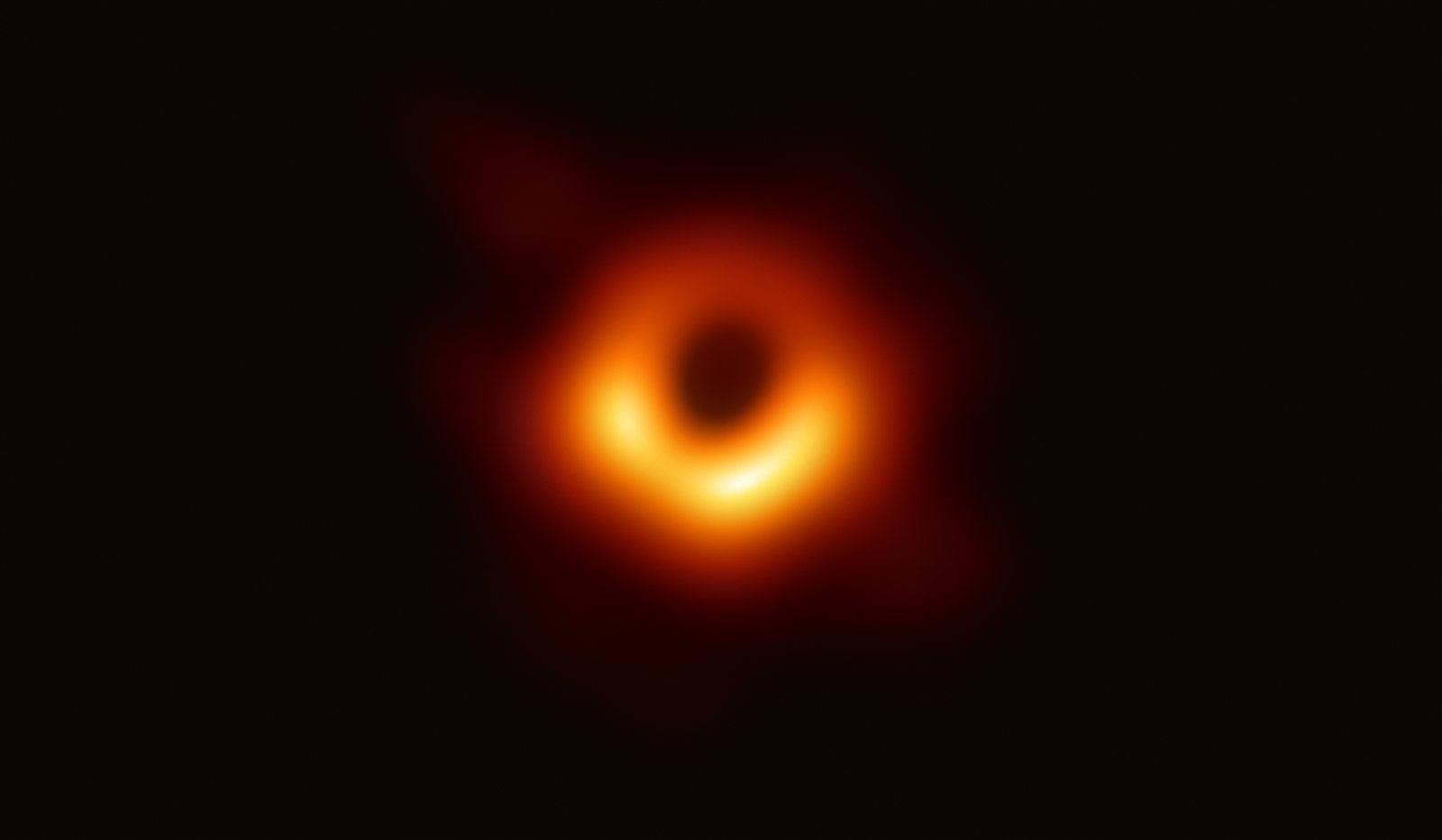
This image went around the world: a blurry orange ring surrounding a black disc. The image of the black hole in the galaxy M87, published on 10 April 2019.1
It is not a photograph.
The way it was made is more interesting than the image itself.
First, what we are talking about
A black hole is a region of space where gravity is so strong that nothing can get back out — not even light. Its boundary is called the event horizon: whatever crosses it does not come back. It is not a hole in the sky, but an enormous mass compressed into a tiny space.2
The one in the image lies at the centre of a giant elliptical galaxy called M87 (Messier 87). Its mass is about 6.5 billion times that of the Sun.3
The ring visible around it is formed by matter rotating around the black hole at a speed close to that of light. The black disc in the centre is its shadow: the zone from which no light reaches us. The ring is ten times brighter than this central depression.4
The dark zone, however, is not the black hole itself. It is wider than the horizon, because gravity bends light rays around the black hole: what we see is an enlarged mirage, and not the edge itself.5
What it really is
In April 2017, a network of radio telescopes spread across the planet — eight stations at six sites — observed the same target at the same moment. Atomic clocks, hydrogen masers, ensured that they all stayed synchronised.6
Put together, these telescopes form a virtual instrument the size of the Earth. This is what is called very long baseline interferometry.7
An image then had to be reconstructed. No telescope directly “saw” the ring: the instruments recorded radio waves at a wavelength of 1.3 millimetres, invisible to the eye, and algorithms calculated what structure could produce these measurements.8
The colour, meanwhile, is a matter of choice. The radiation captured has no visible colour. The orange represents the intensity of the signal: the lighter the shade, the stronger the emission.
None of this is fakery. But an image like this one is, for that very reason, a claim: here is what these instruments captured, reconstructed in this way, translated into these colours.
How they guarded against themselves
The researchers had a problem, and they knew it: they expected to see a ring. The theory of general relativity had predicted it for decades. The risk was therefore of unintentionally producing the image they hoped for (confirmation bias).
So they set up safeguards against themselves.
They formed four teams, each blind to the work of the other three. The teams produced their images of M87 with two different methods: an established method, called CLEAN, and a newer one.9
The four results were then compared.
All of them contained the same ring, about forty microarcseconds across — and this size matches what theory predicts for the path of light bent around the shadow of a supermassive black hole.10
That is what made the result convincing. Not the beauty of the image, but the fact that isolated groups, working with different methods, arrived at the same result. The ring also appears on all four nights of observation, with the same diameter and the same width.11
The aim of this set-up is stated in black and white in their publication: to avoid shared human bias.12
And now, what happened next
In the days following publication, the world’s press presented a single person, the computer scientist Katie Bouman, as the sole creator of the image. A photograph showing her discovering the reconstruction on her laptop went viral.
She spent the following weeks correcting this narrative.
Her clarification never varied: no algorithm and no person made this image alone. The list of the article’s signatories bears this out: it runs to several pages, and it ends at the letter Z.13
Why this story is told here
Elsewhere, this site recounts several stories of people who were erased — the page on light and distances brings them together (notably the story of Henrietta Leavitt, whose law on Cepheids was used without her name at first being given its rightful place).
Here is the reverse case: a person who is credited with too much, and who refuses that monopoly.
This is not a sentimental anecdote. It is proof that the problem is not limited to personalising or forgetting people. Attributing a complex discovery to a single person distorts the very nature of science in both directions — and it also harms the person one claims to honour, by erasing the ecosystem of engineers and researchers without whom nothing would have been possible.
A modern discovery is almost always a large-scale collective effort. That is harder to tell briefly — and that is why the media often prefer to reduce the story to a single face.
Scientific debates and controversies
A scientific image is not a passive snapshot. It is a result produced by methods — and those methods are legitimately open to criticism.
The 2022 objection: an instrumental artefact?
Japanese researchers took the public data on M87* and published a reanalysis: according to them, the ring could be a processing artefact, a structure produced by the way the array samples the sky, and not by the black hole. They later raised a similar objection to the image of the black hole in our own galaxy.14
What to take away
Neither “the image is false” nor “science is a matter of faith”.
Here are the data, here is the method, here is the published objection, and here is the discussion that follows. This is how knowledge advances — and it is worth noting that this objection was only possible because the collaboration had made its data public.
A millisecond, ten thousand years
Since this page deals with the extreme phenomena of the Universe, here is another, which a simple comparison of scale helps to grasp.
In a few milliseconds, a fast radio burst (FRB) releases a colossal amount of energy.
They fall into two families: those that repeat, and those that have been observed only once. It is not yet known whether they share the same origin.15
The day a nearby signal was picked up
In April 2020, a radio burst was detected coming from a magnetar located in our own galaxy — a neutron star with an extremely intense magnetic field. Two observatories recorded it at the same moment.16
This was proof that a magnetar can generate this type of pulse.
The essential logical distinction
That burst, however, was much less powerful than those detected in distant galaxies.
It has been shown that a magnetar can produce a radio burst. It has not been shown that all radio bursts come from magnetars.
Confusing “A can cause B” with “all B is caused by A” is a common error of reasoning. Keeping the two apart is a fundamental tool of critical thinking.
Note 1
This allows us to reconstruct event-horizon-scale images of the supermassive black hole candidate in the center of the giant elliptical galaxy M87.
Event Horizon Telescope Collaboration, “First M87 Event Horizon Telescope Results. I. The Shadow of the Supermassive Black Hole”, The Astrophysical Journal Letters, vol. 875, L1, 2019, preprint en accès libre
Note 2
A defining feature of black holes is their event horizon, a one-way causal boundary in spacetime from which not even light can escape (Schwarzschild 1916).
Event Horizon Telescope Collaboration, “First M87 Event Horizon Telescope Results. I. The Shadow of the Supermassive Black Hole”, The Astrophysical Journal Letters, vol. 875, L1, 2019
Note 3
the supermassive black hole candidate in the center of the giant elliptical galaxy M87
Event Horizon Telescope Collaboration, “First M87 Event Horizon Telescope Results. I. The Shadow of the Supermassive Black Hole”, The Astrophysical Journal Letters, vol. 875, L1, 2019
We compare our images […] and derive a central mass of M = (6.5+/-0.7) x 10^9 Msun
Event Horizon Telescope Collaboration, “First M87 Event Horizon Telescope Results. I. The Shadow of the Supermassive Black Hole”, The Astrophysical Journal Letters, vol. 875, L1, 2019
Note 4
The asymmetry in brightness in the ring can be explained in terms of relativistic beaming of the emission from a plasma rotating close to the speed of light around a black hole.
Event Horizon Telescope Collaboration, “First M87 Event Horizon Telescope Results. I. The Shadow of the Supermassive Black Hole”, The Astrophysical Journal Letters, vol. 875, L1, 2019
encompasses a central depression in brightness with a flux ratio ~10:1
Event Horizon Telescope Collaboration, “First M87 Event Horizon Telescope Results. I. The Shadow of the Supermassive Black Hole”, The Astrophysical Journal Letters, vol. 875, L1, 2019
Note 5
black holes are expected to reveal a dark shadow caused by gravitational light bending and photon capture at the event horizon […] The photon capture radius is larger than the Schwarzschild radius RS that marks the event horizon of a nonrotating black hole
Event Horizon Telescope Collaboration, “First M87 Event Horizon Telescope Results. I. The Shadow of the Supermassive Black Hole”, The Astrophysical Journal Letters, vol. 875, L1, 2019
Note 6
an EHT VLBI campaign conducted in 2017 April at a wavelength of 1.3 mm […] the EHT collaboration fielded a global VLBI array of eight stations over six geographical locations
Event Horizon Telescope Collaboration, “First M87 Event Horizon Telescope Results. I. The Shadow of the Supermassive Black Hole”, The Astrophysical Journal Letters, vol. 875, L1, 2019
Use of hydrogen maser frequency standards at all EHT sites ensures coherence across the array
Event Horizon Telescope Collaboration, “First M87 Event Horizon Telescope Results. I. The Shadow of the Supermassive Black Hole”, The Astrophysical Journal Letters, vol. 875, L1, 2019
Note 7
In this way, VLBI creates a virtual telescope that spans nearly the full diameter of the Earth.
Event Horizon Telescope Collaboration, “First M87 Event Horizon Telescope Results. I. The Shadow of the Supermassive Black Hole”, The Astrophysical Journal Letters, vol. 875, L1, 2019
Note 8
a global very long baseline interferometry array observing at a wavelength of 1.3 mm
Event Horizon Telescope Collaboration, “First M87 Event Horizon Telescope Results. I. The Shadow of the Supermassive Black Hole”, The Astrophysical Journal Letters, vol. 875, L1, 2019
Note 9
four teams, each blind to the others' work, produced images of M87
Event Horizon Telescope Collaboration, “First M87 Event Horizon Telescope Results. IV. Imaging the Central Supermassive Black Hole”, The Astrophysical Journal Letters, vol. 875, L4, 2019
In the first stage, four teams, each blind to the others' work, produced images of M87 using both an established method (CLEAN) and a newer technique (regularized maximum likelihood). […] Teams 1 and 2 focused on RML methods, while Teams 3 and 4 primarily used CLEAN.
Event Horizon Telescope Collaboration, “First M87 Event Horizon Telescope Results. IV. Imaging the Central Supermassive Black Hole”, The Astrophysical Journal Letters, vol. 875, L4, 2019
Note 10
These images show a prominent ring with a diameter of ~40 micro-as
Event Horizon Telescope Collaboration, “First M87 Event Horizon Telescope Results. IV. Imaging the Central Supermassive Black Hole”, The Astrophysical Journal Letters, vol. 875, L4, 2019
consistent with the size and shape of the lensed photon orbit encircling the "shadow" of a supermassive black hole
Event Horizon Telescope Collaboration, “First M87 Event Horizon Telescope Results. IV. Imaging the Central Supermassive Black Hole”, The Astrophysical Journal Letters, vol. 875, L4, 2019
Note 11
with its diameter and width remaining stable over four different observations carried out in different days
Event Horizon Telescope Collaboration, “First M87 Event Horizon Telescope Results. I. The Shadow of the Supermassive Black Hole”, The Astrophysical Journal Letters, vol. 875, L1, 2019
Note 12
This stage allowed us to avoid shared human bias and to assess common features among independent reconstructions.
Event Horizon Telescope Collaboration, “First M87 Event Horizon Telescope Results. IV. Imaging the Central Supermassive Black Hole”, The Astrophysical Journal Letters, vol. 875, L4, 2019
Note 13
Kazunori Akiyama […] Katherine L. Bouman […] Lucy Ziurys
Event Horizon Telescope Collaboration, “First M87 Event Horizon Telescope Results. I. The Shadow of the Supermassive Black Hole”, The Astrophysical Journal Letters, vol. 875, L1, 2019
Note 14
We report our independent image reconstruction of the M 87 from the public data of the Event Horizon Telescope Collaborators (EHTC). […] We conclude that the absence of the jet and the presence of the ring in the EHTC result are both artifacts owing to the narrow FOV setting and the u-v data sampling bias effect of the EHT array.
Miyoshi, Makoto, Kato, Yoshiaki and Makino, Junichiro, “The Jet and Resolved Features of the Central Supermassive Black Hole of M87 Observed with the Event Horizon Telescope (EHT)”, The Astrophysical Journal, vol. 933, 36, 2022
Note 15
along with the apparently one-off FRBs, we discuss the evidence for and against there being multiple source populations […] It thus appears that there are likely at least two types of FRBs, and that one-offs are not just simply less active sources.
Petroff, Emily, Hessels, Jason W. T. and Lorimer, Duncan R., “Fast Radio Bursts at the Dawn of the 2020s”, The Astronomy and Astrophysics Review, vol. 30, 2, 2022
Note 16
Here we report the detection of an extremely intense radio burst from the Galactic magnetar SGR 1935+2154 using the Canadian Hydrogen Intensity Mapping Experiment (CHIME) FRB project.
CHIME/FRB Collaboration, “A Bright Millisecond-duration Radio Burst from a Galactic Magnetar”, Nature, vol. 587, 4 November 2020, p. 54-58
On 28 April 2020, the CHIME/FRB instrument detected a dispersed radio burst during a period of unusually intense X-ray burst activity from the known Galactic magnetar SGR 1935+2154.
CHIME/FRB Collaboration, “A Bright Millisecond-duration Radio Burst from a Galactic Magnetar”, Nature, vol. 587, 4 November 2020, p. 54-58, paywalled
Notes and sources
- ↑
Passage The image of the black hole in the galaxy M87, published on 10 April 2019
This allows us to reconstruct event-horizon-scale images of the supermassive black hole candidate in the center of the giant elliptical galaxy M87.
Source Event Horizon Telescope Collaboration, “First M87 Event Horizon Telescope Results. I. The Shadow of the Supermassive Black Hole”, The Astrophysical Journal Letters, vol. 875, L1, 2019, preprint en accès libre, abstract; publication reference: ApJ, 875, L1, 2019 (April 10).
Open access open the source · checked on 24 October 2026
- ↑
Passage A black hole is a region of space where gravity is so strong that nothing can get back out — not even light.
A defining feature of black holes is their event horizon, a one-way causal boundary in spacetime from which not even light can escape (Schwarzschild 1916).
Source Event Horizon Telescope Collaboration, “First M87 Event Horizon Telescope Results. I. The Shadow of the Supermassive Black Hole”, The Astrophysical Journal Letters, vol. 875, L1, 2019, § 1 (Introduction).
Open-access preprint open the source · checked on 9 September 2026
- ↑
Passage The one in the image lies at the centre of a giant elliptical galaxy called M87
the supermassive black hole candidate in the center of the giant elliptical galaxy M87
Source Event Horizon Telescope Collaboration, “First M87 Event Horizon Telescope Results. I. The Shadow of the Supermassive Black Hole”, The Astrophysical Journal Letters, vol. 875, L1, 2019, abstract.
Open-access preprint open the source · checked on 9 September 2026
Passage Its mass is about 6.5 billion times that of the Sun.
We compare our images […] and derive a central mass of M = (6.5+/-0.7) x 10^9 Msun
Source Event Horizon Telescope Collaboration, “First M87 Event Horizon Telescope Results. I. The Shadow of the Supermassive Black Hole”, The Astrophysical Journal Letters, vol. 875, L1, 2019, abstract.
Open-access preprint open the source · checked on 9 September 2026
- ↑
Passage matter rotating around the black hole at a speed close to that of light
The asymmetry in brightness in the ring can be explained in terms of relativistic beaming of the emission from a plasma rotating close to the speed of light around a black hole.
Source Event Horizon Telescope Collaboration, “First M87 Event Horizon Telescope Results. I. The Shadow of the Supermassive Black Hole”, The Astrophysical Journal Letters, vol. 875, L1, 2019, abstract.
Open-access preprint open the source · checked on 9 September 2026
Passage The ring is ten times brighter than this central depression.
encompasses a central depression in brightness with a flux ratio ~10:1
Source Event Horizon Telescope Collaboration, “First M87 Event Horizon Telescope Results. I. The Shadow of the Supermassive Black Hole”, The Astrophysical Journal Letters, vol. 875, L1, 2019, abstract.
Open-access preprint open the source · checked on 9 September 2026
- ↑
Passage gravity bends light rays around the black hole: what we see is an enlarged mirage
black holes are expected to reveal a dark shadow caused by gravitational light bending and photon capture at the event horizon […] The photon capture radius is larger than the Schwarzschild radius RS that marks the event horizon of a nonrotating black hole
Source Event Horizon Telescope Collaboration, “First M87 Event Horizon Telescope Results. I. The Shadow of the Supermassive Black Hole”, The Astrophysical Journal Letters, vol. 875, L1, 2019, abstract and § 1 (Introduction).
Open-access preprint open the source · checked on 9 September 2026
- ↑
Passage In April 2017, a network of radio telescopes […] eight stations at six sites
an EHT VLBI campaign conducted in 2017 April at a wavelength of 1.3 mm […] the EHT collaboration fielded a global VLBI array of eight stations over six geographical locations
Source Event Horizon Telescope Collaboration, “First M87 Event Horizon Telescope Results. I. The Shadow of the Supermassive Black Hole”, The Astrophysical Journal Letters, vol. 875, L1, 2019, § 1 (Introduction) and § 3 (The Event Horizon Telescope).
Open-access preprint open the source · checked on 9 September 2026
Passage Atomic clocks, hydrogen masers, ensured that they all stayed synchronised.
Use of hydrogen maser frequency standards at all EHT sites ensures coherence across the array
Source Event Horizon Telescope Collaboration, “First M87 Event Horizon Telescope Results. I. The Shadow of the Supermassive Black Hole”, The Astrophysical Journal Letters, vol. 875, L1, 2019, body of the article.
Open-access preprint open the source · checked on 9 September 2026
- ↑
Passage Put together, these telescopes form a virtual instrument the size of the Earth.
In this way, VLBI creates a virtual telescope that spans nearly the full diameter of the Earth.
Source Event Horizon Telescope Collaboration, “First M87 Event Horizon Telescope Results. I. The Shadow of the Supermassive Black Hole”, The Astrophysical Journal Letters, vol. 875, L1, 2019, § 3 (The Event Horizon Telescope).
Open-access preprint open the source · checked on 9 September 2026
- ↑
Passage radio waves at a wavelength of 1.3 millimetres
a global very long baseline interferometry array observing at a wavelength of 1.3 mm
Source Event Horizon Telescope Collaboration, “First M87 Event Horizon Telescope Results. I. The Shadow of the Supermassive Black Hole”, The Astrophysical Journal Letters, vol. 875, L1, 2019, abstract.
Open-access preprint open the source · checked on 9 September 2026
- ↑
Passage They formed four teams, each blind to the work of the other three.
four teams, each blind to the others' work, produced images of M87
Source Event Horizon Telescope Collaboration, “First M87 Event Horizon Telescope Results. IV. Imaging the Central Supermassive Black Hole”, The Astrophysical Journal Letters, vol. 875, L4, 2019, abstract.
Open-access preprint open the source · checked on 9 September 2026
Passage with two different methods: an established method, called CLEAN, and a newer one
In the first stage, four teams, each blind to the others' work, produced images of M87 using both an established method (CLEAN) and a newer technique (regularized maximum likelihood). […] Teams 1 and 2 focused on RML methods, while Teams 3 and 4 primarily used CLEAN.
Source Event Horizon Telescope Collaboration, “First M87 Event Horizon Telescope Results. IV. Imaging the Central Supermassive Black Hole”, The Astrophysical Journal Letters, vol. 875, L4, 2019, abstract and § 5.1.
Open-access preprint open the source · checked on 9 September 2026
- ↑
Passage All of them contained the same ring, about forty microarcseconds across
These images show a prominent ring with a diameter of ~40 micro-as
Source Event Horizon Telescope Collaboration, “First M87 Event Horizon Telescope Results. IV. Imaging the Central Supermassive Black Hole”, The Astrophysical Journal Letters, vol. 875, L4, 2019, abstract.
Open-access preprint open the source · checked on 9 September 2026
Passage this size matches what theory predicts for the path of light bent around the shadow of a supermassive black hole
consistent with the size and shape of the lensed photon orbit encircling the "shadow" of a supermassive black hole
Source Event Horizon Telescope Collaboration, “First M87 Event Horizon Telescope Results. IV. Imaging the Central Supermassive Black Hole”, The Astrophysical Journal Letters, vol. 875, L4, 2019, abstract.
Open-access preprint open the source · checked on 9 September 2026
- ↑
Passage The ring also appears on all four nights of observation, with the same diameter and the same width.
with its diameter and width remaining stable over four different observations carried out in different days
Source Event Horizon Telescope Collaboration, “First M87 Event Horizon Telescope Results. I. The Shadow of the Supermassive Black Hole”, The Astrophysical Journal Letters, vol. 875, L1, 2019, abstract.
Open-access preprint open the source · checked on 9 September 2026
- ↑
Passage to avoid shared human bias
This stage allowed us to avoid shared human bias and to assess common features among independent reconstructions.
Source Event Horizon Telescope Collaboration, “First M87 Event Horizon Telescope Results. IV. Imaging the Central Supermassive Black Hole”, The Astrophysical Journal Letters, vol. 875, L4, 2019, abstract.
Open-access preprint open the source · checked on 9 September 2026
- ↑
Passage The list of the article’s signatories […] it runs to several pages, and it ends at the letter Z
Kazunori Akiyama […] Katherine L. Bouman […] Lucy Ziurys
Source Event Horizon Telescope Collaboration, “First M87 Event Horizon Telescope Results. I. The Shadow of the Supermassive Black Hole”, The Astrophysical Journal Letters, vol. 875, L1, 2019, list of authors (ORCID identifiers), pp. 11-13 of the arXiv preprint.
Open-access preprint open the source · checked on 9 September 2026
- ↑
Passage Japanese researchers took the public data on M87* and published a reanalysis: according to them, the ring could be a processing artefact
We report our independent image reconstruction of the M 87 from the public data of the Event Horizon Telescope Collaborators (EHTC). […] We conclude that the absence of the jet and the presence of the ring in the EHTC result are both artifacts owing to the narrow FOV setting and the u-v data sampling bias effect of the EHT array.
Source Miyoshi, Makoto, Kato, Yoshiaki and Makino, Junichiro, “The Jet and Resolved Features of the Central Supermassive Black Hole of M87 Observed with the Event Horizon Telescope (EHT)”, The Astrophysical Journal, vol. 933, 36, 2022, abstract.
Open access open the source · checked on 24 October 2026
- ↑
Passage They fall into two families: those that repeat, and those that have been observed only once.
along with the apparently one-off FRBs, we discuss the evidence for and against there being multiple source populations […] It thus appears that there are likely at least two types of FRBs, and that one-offs are not just simply less active sources.
Source Petroff, Emily, Hessels, Jason W. T. and Lorimer, Duncan R., “Fast Radio Bursts at the Dawn of the 2020s”, The Astronomy and Astrophysics Review, vol. 30, 2, 2022, § 1 (Introduction) and § 2.1.
Open access open the source · checked on 9 September 2026
- ↑
Passage a radio burst was detected coming from a magnetar located in our own galaxy
Here we report the detection of an extremely intense radio burst from the Galactic magnetar SGR 1935+2154 using the Canadian Hydrogen Intensity Mapping Experiment (CHIME) FRB project.
Source CHIME/FRB Collaboration, “A Bright Millisecond-duration Radio Burst from a Galactic Magnetar”, Nature, vol. 587, 4 November 2020, p. 54-58, abstract.
Paywalled · checked on 25 October 2026
Passage In April 2020, a radio burst was detected coming from a magnetar located in our own galaxy
On 28 April 2020, the CHIME/FRB instrument detected a dispersed radio burst during a period of unusually intense X-ray burst activity from the known Galactic magnetar SGR 1935+2154.
Source CHIME/FRB Collaboration, “A Bright Millisecond-duration Radio Burst from a Galactic Magnetar”, Nature, vol. 587, 4 November 2020, p. 54-58, paywalled, main text (before the “Methods” section).
Paywalled · checked on 25 October 2026
Bibliography
5
- CHIME/FRB Collaboration, “A Bright Millisecond-duration Radio Burst from a Galactic Magnetar”, Nature, vol. 587, 4 November 2020, p. 54-58, paywalled (the radio burst from a magnetar in our galaxy).
- Event Horizon Telescope Collaboration, “First M87 Event Horizon Telescope Results. I. The Shadow of the Supermassive Black Hole”, The Astrophysical Journal Letters, vol. 875, L1, 2019, open-access preprint (giant elliptical galaxy, mass of 6.5 billion solar masses, ring of 42 microarcseconds, central depression ten times less bright, eight stations at six sites, wavelength of 1.3 mm, hydrogen masers, stability over four nights). https://arxiv.org/abs/1906.11238
- Event Horizon Telescope Collaboration, “First M87 Event Horizon Telescope Results. IV. Imaging the Central Supermassive Black Hole”, The Astrophysical Journal Letters, vol. 875, L4, 2019, open-access preprint (the four blind teams, CLEAN and regularised maximum likelihood, the ring of about 40 microarcseconds, the path of bent light, shared human bias). https://arxiv.org/abs/1906.11241
- Miyoshi, Makoto, Kato, Yoshiaki and Makino, Junichiro, “The Jet and Resolved Features of the Central Supermassive Black Hole of M87 Observed with the Event Horizon Telescope (EHT)”, The Astrophysical Journal, vol. 933, 36, 2022, open access (the argument that the ring is a sampling artefact). https://doi.org/10.3847/1538-4357/ac6ddb
- Petroff, Emily, Hessels, Jason W. T. and Lorimer, Duncan R., “Fast Radio Bursts at the Dawn of the 2020s”, The Astronomy and Astrophysics Review, vol. 30, 2, 2022, open access (the two families of bursts, repeating and non-repeating). https://doi.org/10.1007/s00159-022-00139-w
Spotted an error or have a doubt? Write to us.