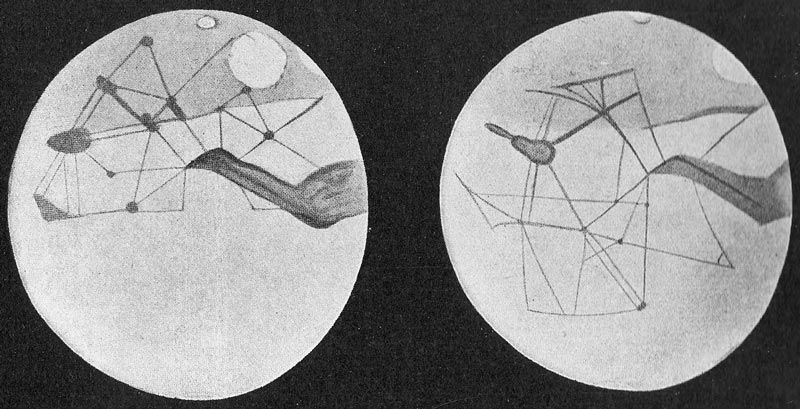

For decades, serious astronomers reported seeing lines on Mars — and some saw in them canals dug by a civilisation.
There were none.
This story is instructive because it is not about credulous people but about competent people, equipped with good instruments, who were collectively wrong.
What Schiaparelli wrote
In 1877, the Italian astronomer Giovanni Schiaparelli observed Mars and drew up a detailed map of it. The work was remarkable.1
He saw long dark lines on it, and he called them canali — an Italian word meaning channels, furrows, grooves. The term implies nothing artificial.2
What happened to the word
On its way into English, canali was translated as canals.3
Yet in English, a canal is a work dug by human hands — unlike a channel, which can be natural. A natural feature of the landscape had thus become a feat of construction.
The time was ripe: the Suez Canal had just been cut, and it was the great feat of engineering the whole world was talking about. The word “canals” immediately called that feat to mind.4
A wealthy American astronomer, Percival Lowell, then had an observatory built to study them. He concluded that they were irrigation canals dug by a civilisation dying of thirst, which would bring water from the polar caps to its deserts. He published several books, one of them entitled Mars and Its Canals.5
The idea occupied people’s minds for decades.
A common version that is too simple
One often reads that “a single mistranslation changed everything”.
The formula is too neat, and historians of science present things differently.
The canals of Mars were the product of two causes acting together.
The first is the instrument. The telescopes of the time showed Mars as a small, shimmering disc, covered with faint, blurred patches. The human eye, faced with indistinct points, has an unfortunate tendency: it connects them. It manufactures lines where there are only patches.
The second is the word. Once these lines had been christened “canals”, it became impossible to see them any other way.
As for the refutation, when it came, it did not come from reasoning: it came from a better instrument. When the first probes flew past Mars in the 1960s, they sent back close-ups. There were no canals. There were craters.6
The right formula is therefore not “the word created the illusion”, but: the word made the illusion tellable. It gave it a name, an explanation, and a story.
The most troubling part
After Schiaparelli, other astronomers began to see them, in good observatories. Not amateurs, but serious observers. Some even reported new canals, which had appeared where there had been none before.
These astronomers were not liars. They were looking at a blurred image knowing what they were supposed to find in it — and they found it.
Expectation changes what we see. This is not a character flaw: it is a property of human perception, and it affects everyone.
A hundred and twenty years later
This story is worth setting beside another, told on our page about black holes.
An international team observes a black hole with radio telescopes spread across the planet, then prepares to reconstruct its first image. These researchers have exactly Lowell’s problem: theory tells them that they ought to see a ring. The risk of manufacturing it without meaning to is enormous.
So they split into four teams that work without knowing what the others are doing, with different methods. Then they compare.
What remains to be understood is what separates the two situations.
Intelligence has nothing to do with it: Lowell and his contemporaries were not stupid. Nor does the quality of the instruments explain everything.
The difference is that, a century later, people knew the problem existed, and deliberately built a set-up capable of proving them wrong.
This is perhaps the most important lesson this site can offer about the sciences. A good method does not consist in being very clever. It consists in organising oneself in advance so that one’s own errors become visible.
The equation that was an agenda
A famous formula is supposed to calculate the number of civilisations that might exist in our galaxy. It is the Drake equation.
It was not made to calculate anything at all.
Its author himself told the story of how it came about:
“As I planned the meeting, I realized a few day[s] ahead of time we needed an agenda. And so I wrote down all the things you needed to know to predict how hard it’s going to be to detect extraterrestrial life. And looking at them it became pretty evident that if you multiplied all these together, you got a number.”7
The last sentence is decisive. The number came afterwards: it is a by-product.
The most famous formula in the search for life elsewhere is a meeting agenda.
What the formula really does
Its seven factors are not numbers. They are seven questions, each an obstacle that would have to be overcome: how many stars are born, how many have planets, on how many life appears, and so on. Each term was an item for discussion.
Jill Tarter, who for decades led the search for signals at the SETI Institute, gives the best description of it: “it’s a wonderful way to organize our ignorance.”8
And one of the seven became a measurement
This is the finest part of the story.
When the equation was written, not a single exoplanet was known — not a single planet outside the solar system. The proportion of stars that have them was pure conjecture.
The first planet orbiting a star similar to the Sun was detected in 1995 by Michel Mayor and Didier Queloz of the University of Geneva. They received the Nobel Prize in Physics for it. Since then, thousands have been found, and surveys indicate that there is at least one planet per star on average in our galaxy.9
One term out of seven has gone from guesswork to measurement. That is exactly what the equation was made to produce: not an answer, but a list of things to go and look for. It worked.
Why be wary of it all the same
The strongest objection comes down to three arguments that are easy to remember. If even one of the seven values is wrongly estimated, the result is worthless. If a factor has been forgotten, it is worthless too. If one has been added that did not count, the same applies.
The lesson to remember holds far beyond astronomy:
Multiplying seven unknown numbers does not give a known number. It gives a number that looks like a result.
It is a formidable trap, because it looks like a calculation — and mathematical notation lends it an authority it does not have.
The 1977 signal
On Monday 15 August 1977, the Ohio State University radio telescope, nicknamed Big Ear, recorded a narrow, intense radio signal. Nobody noticed it that evening.10
The next morning, the volunteer astronomer Jerry Ehman went through the previous day’s records. Line after line, the machine printed out the intensity picked up in fifty channels, in the form of digits and letters. That morning, among the usual 1s and 2s, he came across a most remarkable sequence: 6EQUJ5, in which the U denotes a signal thirty times stronger than a 1.11
Beside it, he wrote a word in red ink: “Wow!”12
The most famous signal in this whole search bears the name of an exclamation scribbled in a margin.
Two points almost always passed over in silence
First point. The signal lasted just over a minute — and that is precisely the time a fixed point in the sky takes to cross this telescope’s beam, carried along by the Earth’s rotation.13
It could therefore have lasted longer. Perhaps much longer. We will never know, because what was measured there was the limit of the instrument as much as the phenomenon.
That said, this coincidence is also what makes the signal interesting: it rose and then fell exactly as a fixed source in the sky would, and not like interference coming from the ground.14
Second point. It never recurred. Many observatories have pointed at that area. Nothing.15
Explanations, proposed and debated
Several natural hypotheses have been put forward over the decades — comets passing through that spot, a hydrogen cloud whose emission is said to have been abruptly amplified. Each has been examined, debated, and contested by other researchers.
One detail deserves to be noted in passing: some of these explanations involve objects discovered long after 1977. It is impossible to explain a phenomenon by something that is not yet known. What is unexplained in one era is sometimes simply what there is not yet a vocabulary for.
Where the question stands
The SETI Institute, which has no reason to play the matter down, puts it bluntly: the question remains open. Natural source, human interference, or something else: the mystery remains.16
Moreover, the director of the observatory at the time still maintains that the signal is of interest: the way it followed the shape of the beam indicated that it came from at least as far away as the Moon, which makes terrestrial interference very unlikely. “Efforts to re-observe it afterwards with other telescopes have been unsuccessful, so this will likely remain a perpetual mystery.”17
Note 1
Throughout the weeks surrounding the 1877 opposition the Italian astronomer Giovanni Virginio Schiaparelli (1835-1910) scrutinised Mars visually at the Brera Observatory in Milan where he was director. […] His maps of Mars were the best yet and we still use the names he gave to the various dark features, including Syrtis Major.
Jones, Barrie W., “Mars Before the Space Age”, International Journal of Astrobiology, vol. 7, no. 2, 2008, p. 143-155, preprint
Note 2
canali
channels (Italian)
Lane, K. Maria D., Geographies of Mars: Seeing and Knowing the Red Planet, University of Chicago Press, 2011
Note 3
canals
Lane, K. Maria D., Geographies of Mars: Seeing and Knowing the Red Planet, University of Chicago Press, 2011
Note 4
Suez Canal
Lane, K. Maria D., Geographies of Mars: Seeing and Knowing the Red Planet, University of Chicago Press, 2011
Note 5
That the canals and oases are of artificial origin is thus suggested by their very look; […] Lines of communication for water purposes, between the polar caps, on the one hand, and the centres of population, on the other, would be the artificial markings we should expect to perceive.
Lowell, Percival, Mars and Its Canals, Macmillan, 1906
Note 6
Its grainy black-and-white views of a barren, heavily cratered planet quashed ideas of possible intelligent life […] The images clearly showed Mars to be an ancient Moon-like body with widespread cratering, thus incontrovertibly quashing any expectations of lost civilizations on the planet.
NASA, “Mariner 4”, fiche de mission, open access
Note 7
As I planned the meeting, I realized a few day[s] ahead of time we needed an agenda. And so I wrote down all the things you needed to know to predict how hard it's going to be to detect extraterrestrial life. And looking at them it became pretty evident that if you multiplied all these together, you got a number, N, which is the number of detectable civilizations in our galaxy.
Drake, Frank, “The Drake Equation Revisited: Part I”, remarques d’ouverture à un forum de la NASA, Astrobiology Magazine, 30 September 2003
Note 8
Instead, it’s a wonderful way to organize our ignorance.
Levitt, Steven D., “Why Bother Searching for Aliens?”
Note 9
In October 1995, Michel Mayor and Didier Queloz announced the first discovery of a planet outside our solar system, an exoplanet, orbiting a solar-type star in our home galaxy, the Milky Way.
Académie royale des sciences de Suède, communiqué de presse du prix Nobel de physique 2019, 8 October 2019
Note 10
A strong, narrow-band radio signal […] detected on Monday, August 15, 1977 by the Ohio State Radio Observatory […] A signal, a strong signal, was detected – although no one would notice until the following morning.
SETI Institute, “The Wow! Signal”, page SETI 101
Note 11
That's when astronomer volunteer Jerry Ehman sat down to peruse the previous day's observations.
SETI Institute, “The Wow! Signal”, page SETI 101
a simple, line printer representation of the data in which each line displayed the radio energy for 50 different frequency channels […] binned into one of 31 steps, 0-9 and A-U
SETI Institute, “The Wow! Signal”, page SETI 101
with a U representing a signal 30 times as strong as a 1 […] The printout characters were 6EQUJ5
SETI Institute, “The Wow! Signal”, page SETI 101
Note 12
Unlike previous mornings, Ehman spotted a very conspicuous signal that lasted just over a minute – one that was so impressive he wrote WOW! on the printout next to it in red ink.
SETI Institute, “The Wow! Signal”, page SETI 101
Note 13
Ehman spotted a very conspicuous signal that lasted just over a minute
SETI Institute, “The Wow! Signal”, page SETI 101
Note 14
The signal rose and fell as one would expect from a cosmic source fixed on the sky – moving into and out of the telescope beam as the Earth rotated.
SETI Institute, “The Wow! Signal”, page SETI 101
Note 15
despite numerous follow-ups, it has never been seen again
SETI Institute, “The Wow! Signal”, page SETI 101
Note 16
Still unsolved — natural source, human interference, or something else? The mystery remains.
SETI Institute, “The Wow! Signal”, page SETI 101
Note 17
The fact that the [signal] followed the telescope's beam shape indicated it was at least as far away as the moon, and made it very unlikely to be any interfering signal
SETI Institute, “The Wow! Signal”, page SETI 101
Efforts to re-observe it afterwards with other telescopes have been unsuccessful, so this will likely remain a perpetual mystery.
SETI Institute, “The Wow! Signal”, page SETI 101
Notes and sources
- ↑
Passage In 1877, the Italian astronomer Giovanni Schiaparelli observed Mars and drew up a detailed map of it
Throughout the weeks surrounding the 1877 opposition the Italian astronomer Giovanni Virginio Schiaparelli (1835-1910) scrutinised Mars visually at the Brera Observatory in Milan where he was director. […] His maps of Mars were the best yet and we still use the names he gave to the various dark features, including Syrtis Major.
Source Jones, Barrie W., “Mars Before the Space Age”, International Journal of Astrobiology, vol. 7, no. 2, 2008, p. 143-155, preprint, section “The 1877 opposition and its legacy”, 1st and 2nd paragraphs.
Open access open the source · checked on 27 October 2026
- ↑
Passage he called them canali — an Italian word meaning channels, furrows, grooves
canali
Editors’ translation channels (Italian)
Source Lane, K. Maria D., Geographies of Mars: Seeing and Knowing the Red Planet, University of Chicago Press, 2011, chapter on Schiaparelli’s translation.
In libraries · checked on 9 September 2026
- ↑
Passage On its way into English, canali was translated as canals. Yet in English, a canal is a work dug by human hands
canals
Source Lane, K. Maria D., Geographies of Mars: Seeing and Knowing the Red Planet, University of Chicago Press, 2011, chapter on the translation and its effects.
In libraries · checked on 9 September 2026
- ↑
Passage the Suez Canal had just been cut, and it was the great feat of engineering the whole world was talking about
Suez Canal
Source Lane, K. Maria D., Geographies of Mars: Seeing and Knowing the Red Planet, University of Chicago Press, 2011, chapter on the context of nineteenth-century engineering.
In libraries · checked on 9 September 2026
- ↑
Passage He concluded that they were irrigation canals dug by a civilisation dying of thirst, which would bring water from the polar caps to its deserts. He published several books, one of them entitled Mars and Its Canals.
That the canals and oases are of artificial origin is thus suggested by their very look; […] Lines of communication for water purposes, between the polar caps, on the one hand, and the centres of population, on the other, would be the artificial markings we should expect to perceive.
Source Lowell, Percival, Mars and Its Canals, Macmillan, 1906, pp. 424-425 (part IV, “Explanation”).
Open access open the source · checked on 24 October 2026
- ↑
Passage When the first probes flew past Mars in the 1960s, they sent back close-ups. There were no canals. There were craters.
Its grainy black-and-white views of a barren, heavily cratered planet quashed ideas of possible intelligent life […] The images clearly showed Mars to be an ancient Moon-like body with widespread cratering, thus incontrovertibly quashing any expectations of lost civilizations on the planet.
Source NASA, “Mariner 4”, fiche de mission, open access, mission page, introductory paragraph and section on the results (launched on 28 November 1964, flyby on 14 July 1965).
Open access open the source · checked on 24 October 2026
- ↑
Passage As I planned the meeting, I realized a few day[s] ahead of time we needed an agenda. And so I wrote down all the things you needed to know to predict how hard it’s going to be to detect extraterrestrial life. And looking at them it became pretty evident that if you multiplied all these together, you got a number.
As I planned the meeting, I realized a few day[s] ahead of time we needed an agenda. And so I wrote down all the things you needed to know to predict how hard it's going to be to detect extraterrestrial life. And looking at them it became pretty evident that if you multiplied all these together, you got a number, N, which is the number of detectable civilizations in our galaxy.
Source Drake, Frank, “The Drake Equation Revisited: Part I”, remarques d’ouverture à un forum de la NASA, Astrobiology Magazine, 30 September 2003, Frank Drake’s opening remarks.
Open access open the source · checked on 9 September 2026
- ↑
Passage it’s a wonderful way to organize our ignorance.
Instead, it’s a wonderful way to organize our ignorance.
Source Levitt, Steven D., “Why Bother Searching for Aliens?”, episode transcript, Jill Tarter’s answer about the Drake equation (just before: “And I actually hate the fact that it’s called an equation, because in fact there are so many uncertainties,”).
Open access open the source · checked on 24 October 2026
- ↑
Passage The first planet orbiting a star similar to the Sun was detected in 1995 by Michel Mayor and Didier Queloz of the University of Geneva.
In October 1995, Michel Mayor and Didier Queloz announced the first discovery of a planet outside our solar system, an exoplanet, orbiting a solar-type star in our home galaxy, the Milky Way.
Source Académie royale des sciences de Suède, communiqué de presse du prix Nobel de physique 2019, 8 October 2019, press release (the laureates’ affiliations at the end of the release: “University of Geneva, Switzerland”).
Open access open the source · checked on 9 September 2026
- ↑
Passage On Monday 15 August 1977, the Ohio State University radio telescope, nicknamed Big Ear, recorded a narrow, intense radio signal. Nobody noticed it that evening.
A strong, narrow-band radio signal […] detected on Monday, August 15, 1977 by the Ohio State Radio Observatory […] A signal, a strong signal, was detected – although no one would notice until the following morning.
Source SETI Institute, “The Wow! Signal”, page SETI 101, standfirst and body of the page.
Open access open the source · checked on 9 September 2026
- ↑
Passage The next morning, the volunteer astronomer Jerry Ehman went through the previous day’s records.
That's when astronomer volunteer Jerry Ehman sat down to peruse the previous day's observations.
Source SETI Institute, “The Wow! Signal”, page SETI 101, body of the page.
Open access open the source · checked on 9 September 2026
Passage Line after line, the machine printed out the intensity picked up in fifty channels, in the form of digits and letters.
a simple, line printer representation of the data in which each line displayed the radio energy for 50 different frequency channels […] binned into one of 31 steps, 0-9 and A-U
Source SETI Institute, “The Wow! Signal”, page SETI 101, body of the page.
Open access open the source · checked on 9 September 2026
Passage a most remarkable sequence: 6EQUJ5, in which the U denotes a signal thirty times stronger than a 1
with a U representing a signal 30 times as strong as a 1 […] The printout characters were 6EQUJ5
Source SETI Institute, “The Wow! Signal”, page SETI 101, body of the page.
Open access open the source · checked on 9 September 2026
- ↑
Passage Beside it, he wrote a word in red ink: “Wow!”
Unlike previous mornings, Ehman spotted a very conspicuous signal that lasted just over a minute – one that was so impressive he wrote WOW! on the printout next to it in red ink.
Source SETI Institute, “The Wow! Signal”, page SETI 101, body of the page, paragraph on the discovery.
Open access open the source · checked on 9 September 2026
- ↑
Passage The signal lasted just over a minute
Ehman spotted a very conspicuous signal that lasted just over a minute
Source SETI Institute, “The Wow! Signal”, page SETI 101, body of the page.
Open access open the source · checked on 9 September 2026
- ↑
Passage it rose and then fell exactly as a fixed source in the sky would
The signal rose and fell as one would expect from a cosmic source fixed on the sky – moving into and out of the telescope beam as the Earth rotated.
Source SETI Institute, “The Wow! Signal”, page SETI 101, body of the page.
Open access open the source · checked on 9 September 2026
- ↑
Passage It never recurred. Many observatories have pointed at that area. Nothing.
despite numerous follow-ups, it has never been seen again
Source SETI Institute, “The Wow! Signal”, page SETI 101, standfirst of the page.
Open access open the source · checked on 9 September 2026
- ↑
Passage the question remains open. Natural source, human interference, or something else: the mystery remains.
Still unsolved — natural source, human interference, or something else? The mystery remains.
Source SETI Institute, “The Wow! Signal”, page SETI 101, standfirst of the page.
Open access open the source · checked on 9 September 2026
- ↑
Passage the way it followed the shape of the beam indicated that it came from at least as far away as the Moon, which makes terrestrial interference very unlikely
The fact that the [signal] followed the telescope's beam shape indicated it was at least as far away as the moon, and made it very unlikely to be any interfering signal
Source SETI Institute, “The Wow! Signal”, page SETI 101, quotation from Robert Dixon.
Open access open the source · checked on 9 September 2026
Passage Efforts to re-observe it afterwards with other telescopes have been unsuccessful, so this will likely remain a perpetual mystery.
Efforts to re-observe it afterwards with other telescopes have been unsuccessful, so this will likely remain a perpetual mystery.
Source SETI Institute, “The Wow! Signal”, page SETI 101, quotation from Robert Dixon.
Open access open the source · checked on 9 September 2026
Bibliography
8
- Académie royale des sciences de Suède, communiqué de presse du prix Nobel de physique 2019, 8 October 2019, open access (the first planet discovered around a star similar to the Sun, announced in October 1995 by Michel Mayor and Didier Queloz, of the University of Geneva). https://www.nobelprize.org/prizes/physics/2019/press-release/
- Drake, Frank, “The Drake Equation Revisited: Part I”, remarques d’ouverture à un forum de la NASA, Astrobiology Magazine, 30 September 2003, open access (the quotation about the agenda and the number obtained as a by-product). https://spacedaily.com/the-drake-equation-revisited-part-i/
- Jones, Barrie W., “Mars Before the Space Age”, International Journal of Astrobiology, vol. 7, no. 2, 2008, p. 143-155, open-access preprint (Schiaparelli’s observations in Milan at the 1877 opposition and his maps of Mars, the best of the day). https://arxiv.org/abs/0811.2700
- Lane, K. Maria D., Geographies of Mars: Seeing and Knowing the Red Planet, University of Chicago Press, 2011, in libraries (the word canali translated as canals, and the context of the Suez Canal).
- Levitt, Steven D., “Why Bother Searching for Aliens?” (entretien avec Jill Tarter), People I (Mostly) Admire, épisode 81, Freakonomics, 24 June 2022, transcription open access (Jill Tarter’s phrase about the Drake equation: “a wonderful way to organize our ignorance”). https://freakonomics.com/podcast/why-bother-searching-for-aliens/
- Lowell, Percival, Mars and Its Canals, Macmillan, 1906, open access (the thesis of the irrigation canals of a thirsting civilisation). https://archive.org/details/marsitscanals00lowe
- NASA, “Mariner 4”, fiche de mission, open access (the first close-ups of Mars, in 1965: a planet riddled with craters, which put an end to hopes of lost civilisations). https://science.nasa.gov/mission/mariner-4/
- SETI Institute, “The Wow! Signal”, page SETI 101, open access (the date, the examination of the records the next morning, the fifty channels and the code 6EQUJ5, the U, thirty times stronger than a 1, the rise and fall consistent with a source fixed in the sky, the question still open, Robert Dixon’s remarks). https://www.seti.org/research/seti-101/the-wow-signal/
Spotted an error or have a doubt? Write to us.