
“The stars we see in the sky may already be dead.” This familiar sentence is false.
It is beautiful, a little dizzying.
More precisely, it is a true sentence that has been attached to the wrong stars — which is even more interesting.
Measuring space
Astronomical distances so far exceed the human scale that the kilometre becomes unusable: it would take dozens of digits to write down the position of the nearest star. Three suitable units are therefore used, each at its own scale.
- The astronomical unit is about 150 million kilometres (exactly 149,597,870,700 metres, a value fixed in 2012): it is roughly the average distance from the Earth to the Sun. It is used within the Solar System.
- The light-year is the distance travelled by light in one year. It is a distance, not a duration — despite the word “year” it contains. It is used for the stars.
- The parsec is the unit that astronomers actually use. Its name comes from the method of measurement this page discusses.1
These distances have a consequence that is not a figure of speech: to look far is to look early. Light does not travel instantaneously. We never see an object in the sky as it is: we see it as it was when its light set out.
It is this time lag that makes possible everything this page describes — and it is also what makes the sentence it opens with false.
Why it is false
The reasoning is simple.
With the naked eye, we see only the brightest stars in our neighbourhood: a few thousand, most of them a few hundred light-years away. So we see them as they were a few centuries ago.
Now consider the lifetime of these stars. Even the most massive ones, which have the shortest lives, last millions of years.
All that remains is to compare the two numbers: a few centuries of travel, against millions of years of life. The probability that a star happened to die during that short journey is tiny — and even when it is multiplied by the number of visible stars, practically none would be expected.
Almost all the stars visible to the naked eye are still shining.
The example everyone cites is Betelgeuse, Orion’s shoulder. It will eventually explode as a supernova, but not for a very long time. That it should have exploded precisely during the few centuries its light takes to reach us would be very unlikely — though not impossible.
And why it is true
Everything changes with the instrument.
With a large telescope, we are no longer looking a few hundred light-years away: we are looking billions of light-years away.
In 2022, the Hubble telescope spotted a star that was named Earendel — “morning star” in Old English. Its light took 12.9 billion years to reach us: we see it as it was when the Universe was only 7% of its current age.2
We would never have seen it without a stroke of luck: a cluster of galaxies lies in front of it, and its gravity amplifies the light like a magnifying glass. The galaxy hosting Earendel is distorted by it into a long crescent, which the researchers named the Sunrise Arc.3
It has at least fifty times the mass of the Sun. A star of this type lives only a few million years.4
This one certainly ceased to exist a very long time ago.
So the opening sentence is not a lie. It is true of the stars seen through a telescope, and false of those seen with the naked eye.
Interactive
Looking far is looking back in time
When we look at a body in the sky, we receive light that left it some time ago. That time depends on the distance.
The question
When you look at the Sun, do you see it as it is right now?
What you do Send out the Sun’s light and watch it reach the planets one by one: the clock counts the journey time. Then choose a body, as far as Earendel: the further away it is, the older what you see.
Without JavaScript, here are the animation’s data.
| Quantity | Value | Source |
|---|---|---|
| Speed of light | 299,792,458 m/s | 1 |
| Astronomical unit (mean Earth–Sun distance) | 149,597,870,700 m | 2 |
| Planet | Mean distance from the Sun | Light travel time | Source |
|---|---|---|---|
| Mercury | 57.9 million km | 3 min 13 s (calculated) | 3 |
| Venus | 108.2 million km | 6 min 1 s (calculated) | 3 |
| The Earth | 149.6 million km | 8 min 19 s (calculated) | 3 |
| Mars | 228.0 million km | 12 min 41 s (calculated) | 3 |
| Jupiter | 778.5 million km | 43 min 17 s (calculated) | 3 |
| Saturn | 1,432.0 million km | 1 h 20 min (calculated) | 3 |
| Uranus | 2,867.0 million km | 2 h 39 min (calculated) | 3 |
| Neptune | 4,515.0 million km | 4 h 11 min (calculated) | 3 |
| Body | Distance | Light travel time | Source |
|---|---|---|---|
| The Sun | 1 astronomical unit | 8 min 19 s (calculated) | 2 |
| Neptune | 4,515 million km on average | 4 h 11 min (calculated) | 3 |
| Earendel | — | 12.9 billion years | 4 |
The travel times to the planets, and those for the Sun and Neptune, are calculated: distance divided by the speed of light. Earendel’s is given by the source. In the animation, the distances to the planets are on a logarithmic scale.
The takeaway Light takes time to travel. We see the Sun as it was eight minutes ago, and Earendel as it was 12.9 billion years ago.
Photo credits 10
- The Sun in visible light, photographed by NASA’s SDO satellite on 10 August 2024. NASA/SDO, AIA, EVE and HMI science teams, Public domain, source
- Neptune, from the last whole-planet images taken by Voyager 2 through green and orange filters (1989); the Great Dark Spot is visible. NASA, Public domain, source
- The star nicknamed Earendel (indicated by an arrow), in its host galaxy, which appears as a red smear; the whole scene is seen through the gravitational lens of a galaxy cluster lying between it and us (Hubble Space Telescope). NASA, ESA, B. Welch (JHU), D. Coe (STScI), A. Pagan (STScI), CC BY 4.0, source
- Mercury, a mosaic of images from NASA’s MESSENGER probe (2011). NASA/JHUAPL, Public domain, source
- Venus, wrapped in clouds, photographed by NASA’s Mariner 10 probe in February 1974. NASA/JPL-Caltech, Public domain, source
- The Earth photographed on 7 December 1972 by the Apollo 17 crew on their way to the Moon: Africa, Antarctica and the Arabian Peninsula are visible. NASA, Apollo 17 crew, Public domain, source
- Mars, a mosaic of 102 images from the Viking 1 orbiter (1980); in the centre, the Valles Marineris canyon. NASA / USGS (PIA04304), Public domain, source
- Jupiter photographed in full by the Hubble Space Telescope on 21 April 2014. NASA, ESA and A. Simon (Goddard), Public domain, source
- Saturn in natural colour, from images taken by the Cassini probe (2008). NASA / JPL / Space Science Institute, Public domain, source
- Uranus photographed by the Voyager 2 probe in 1986. NASA/JPL-Caltech, Public domain, source


Sources 4
Bureau international des poids et mesures, Le Système international d’unités (SI), 9ᵉ éd., 2019, section 2.3.1, p. 19.
Le mètre, symbole m, est l’unité de longueur du SI. Il est défini en prenant la valeur numérique fixée de la vitesse de la lumière dans le vide, c, égale à 299 792 458 lorsqu’elle est exprimée en m s−1, la seconde étant définie en fonction de ∆νCs. Cette définition implique la relation exacte c = 299 792 458 m s−1.
Editors’ translation The metre, symbol m, is the SI unit of length. It is defined by taking the fixed numerical value of the speed of light in vacuum, c, to be 299 792 458 when expressed in the unit m s−1, where the second is defined in terms of ∆νCs. This definition implies the exact relation c = 299 792 458 m s−1.
Open access open the source · checked on 9 September 2026
Bureau international des poids et mesures, Le Système international d’unités, chapter 4, table 8 (non-SI units accepted for use with the SI), p. 33, and note (j), p. 34.
unité astronomique […] au […] 1 au = 149 597 870 700 m […] L’unité astronomique a été définie lors de la XXVIIIe Assemblée générale de l’Union astronomique internationale (Résolution B2, 2012).
Editors’ translation astronomical unit […] au […] 1 au = 149 597 870 700 m […] The astronomical unit was defined at the XXVIII General Assembly of the International Astronomical Union (Resolution B2, 2012).
Open access · checked on 24 October 2026
Williams, David R., “Planetary Fact Sheet – Metric”, NASA Goddard Space Flight Center (NSSDCA), updated 18 March 2025, rows “Diameter (km)” and “Distance from Sun (10^6 km)”, columns Mercury to Neptune.
Diameter (km) 4879 12,104 12,756 6792 142,984 120,536 51,118 49,528 […] Distance from Sun (10^6 km) 57.9 108.2 149.6 228.0 778.5 1432.0 2867.0 4515.0
Open access open the source · checked on 27 October 2026
ESA / Hubble, communiqué heic2203, “A Record Broken: Hubble Finds the Most Distant Star Ever Seen”, 30 March 2022, press release of 30 March 2022.
its light has taken 12.9 billion years to reach Earth, appearing to us as it did when the universe was only 7 percent of its current age, at redshift 6.2
Open access open the source · checked on 9 September 2026
The question to remember
This idea comes up several times on this site: a figure always counts something specific, and you need to know what. How many languages, by which definition; how many city dwellers, by which threshold.
The same idea applies here not to a figure, but to a sentence.
A claim always concerns a specific set. The stars seen with the naked eye and the stars seen through a telescope are not the same set, and what is true of one is false of the other.
Hence the question to ask: what exactly are we talking about?
That is often where errors hide — not in the fact, but in what it is applied to.
How to measure a distance you cannot travel
One question remains: how do we know how far away a star is?
The first method relies on an effect that is easy to check: arm outstretched, thumb raised, close one eye, then the other. The thumb appears to jump against the far wall, and the closer it is, the more it jumps.
Astronomers do the same, six months apart: the Earth is then on the other side of the Sun, which makes a very wide “gap between the eyes”. Nearby stars seem to move slightly against distant ones. This is called parallax.
The difficulty: beyond a certain distance, the shift becomes too small to measure. So something else was needed to go further.
The woman who found the key
At the Harvard College Observatory, at the turn of the twentieth century, a team of women was employed to examine photographic plates of the sky. They did not use the telescopes: they analysed what others had photographed.
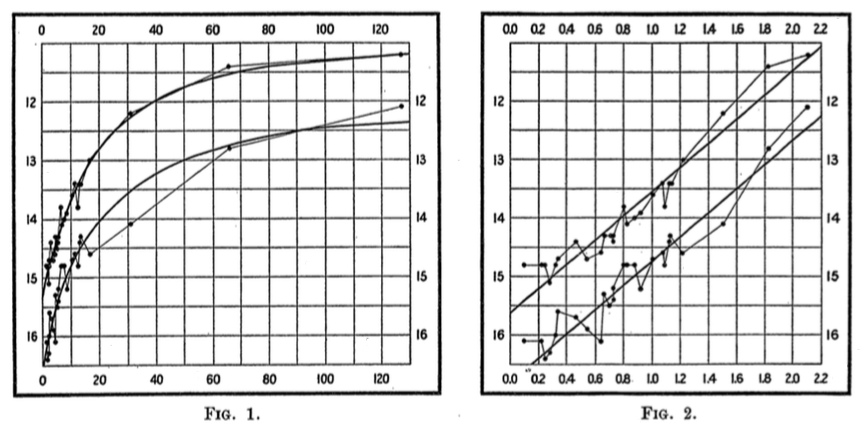
One of them was called Henrietta Swan Leavitt. In 1908 she published, under her own name, a catalogue of 1,777 variable stars — stars whose brightness rises and falls regularly — spotted in two small galaxies neighbouring ours, the Magellanic Clouds.5
In 1912, working from twenty-five of them, all in the Small Cloud, she established a strikingly simple relationship: the longer one of these stars takes to vary, the brighter it really is.6
She could see it for a specific reason: since these twenty-five stars were in the same cloud, they were all at roughly the same distance from us. Their differences in apparent brightness were therefore real differences in brightness — not differences in distance. That is what made the comparison possible. These stars are called Cepheids.
Why it was the key
The significance of this relationship is measured by the problem it solves.
From the Earth, we perceive only one thing: a star looks bright or faint. But we do not know why. It may look faint because it is very far away, or because it gives off little light. Both give the same result, and nothing lets us tell them apart.
Leavitt’s relationship gives the true brightness. Comparing it with the apparent brightness then gives the distance.
It is like a light bulb known to be exactly one hundred watts: the faintness of its apparent glow tells you how far away it is.
These stars became astronomy’s first “standard candles”. What was first known of the size of our galaxy, and of the fact that others exist, rests on this — other methods have confirmed it since.
And under whose name it was published
The Harvard circular announcing this result, in 1912, appeared under the name of Edward Pickering, the director of the observatory.7
Its first sentence states that the statement “has been prepared by Miss Leavitt”.8
A clarification, so as not to turn Pickering into a storybook villain: this was the rule for all Harvard circulars, which were signed by the director, and the 1908 catalogue had indeed appeared under Leavitt’s name. But the result that matters — the relationship that was used to measure the Universe — came out under a name other than hers. Erasure by convention is still erasure.
This story, however, ends well, and that is rare enough to be worth pointing out.
The standard reference for this article now bears two names — hers first, Pickering’s second. And the relationship she found is no longer called only the period-luminosity relationship: it is also called the Leavitt law.9
A century later, the signature has been restored. That is not always possible — but when the work can be identified, it is.
Readers of other pages on this site will recognise a pattern: a chemist who sat a competition under her initials so that no one would know she was a woman (page 9.11); six women programmers present in the photographs and absent from the articles (page 9.14); an archaeologist whose name was removed from documents because he was Jewish (page 2.14).
Leavitt is the fourth case.
Faced with any invention, one question must be asked: who was removed from the story, and why that person?
The ladder: each rung rests on the one before
“Distance ladder” is not a figure of speech. It is a real structure, and each rung is calibrated against the one below.
First rung — parallax. An outstretched finger, looked at with one eye closed, then the other, seems to jump. For a star, the same is done with the Earth, observing the star six months apart, from two opposite points of the Earth’s orbit. It is pure geometry — no assumption about the star.
Second rung — Cepheids. These are stars that pulsate. The more slowly they pulsate, the more luminous they really are. They are calibrated using parallax.
Third rung — certain supernovae. Their explosion always reaches roughly the same peak brightness. They are calibrated using Cepheids. This is the rung that reaches furthest.
A weighty consequence
An error on one rung propagates to all the rungs above it.
The distance of a galaxy billions of light-years away ultimately depends on the measurement of a star close to us. If the bottom is wrong, the whole top is wrong.
That is why care is taken to anchor the bottom of the ladder in several independent ways, rather than in just one.
Where this leads today
There is currently a famous disagreement in cosmology, discussed on our page about the history of the Universe: two methods of measuring the rate of expansion do not give the same result, and the gap is not closing.
Yet this measurement ultimately rests on the distance ladder — and therefore on pulsating stars observed in nearby galaxies. A problem in cosmology thus comes down to the way the bottom of the ladder was calibrated.
The most useful lesson of this page: faced with a distance figure, ask what it is anchored to.
The speed of light: no longer measured
Here is a fact that may seem strange, but is true.
Since 1983, the speed of light has no longer been measured. It is decided.10
It is exactly 299,792,458 metres per second — not because this number was found, but because it was decided to fix this value, and to derive the length of the metre from it.11
The definition has been turned around. It is no longer the speed that is derived from the metre: it is the metre that is derived from the speed.
Why this reversal
Because the speed of light had come to be measured more precisely than the metre itself could be defined.
The standard had become less precise than what it was used to measure. So measuring stopped, because measuring no longer served any purpose.
What this implies
No one will ever again be able to discover that the speed of light has some other value.
If a future measurement gave a different number, it would mean that the metre had changed — not light.
A constant of nature has become a convention of units. This is no sleight of hand: it is the choice to fix what is known best and to derive the rest from it. But it must be said, otherwise people would think this number had been “found”.
How it had been measured before
In several ways, and none of them consists of timing a beam over a known path.
By observing the eclipses of one of Jupiter’s moons, which seem late when the Earth is moving away. By observing the slight apparent annual shift of the stars, due to the Earth’s motion. By sending a beam to a distant mirror, through the teeth of a fast-turning wheel. With rotating mirrors. Or by an indirect calculation, from electrical and magnetic quantities.
Measuring is almost always measuring something else.
Note 1
unité astronomique […] au […] 1 au = 149 597 870 700 m […] L’unité astronomique a été définie lors de la XXVIIIe Assemblée générale de l’Union astronomique internationale (Résolution B2, 2012).
astronomical unit […] au […] 1 au = 149 597 870 700 m […] The astronomical unit was defined at the XXVIII General Assembly of the International Astronomical Union (Resolution B2, 2012).
Bureau international des poids et mesures, Le Système international d’unités
Note 2
an extremely magnified star that he called Earendel, which means "morning star" in Old English
ESA / Hubble, communiqué heic2203, “A Record Broken: Hubble Finds the Most Distant Star Ever Seen”, 30 March 2022
its light has taken 12.9 billion years to reach Earth, appearing to us as it did when the universe was only 7 percent of its current age, at redshift 6.2
ESA / Hubble, communiqué heic2203, “A Record Broken: Hubble Finds the Most Distant Star Ever Seen”, 30 March 2022
This object is designated WHL0137-LS, and we nickname the star “Earendel” from the Old English word meaning “morning star”, or “rising light”.
Welch, Brian et al., “A Highly Magnified Star at Redshift 6.2”, Nature, vol. 603, 30 March 2022, p. 815-818
Note 3
The galaxy hosting this star has been magnified and distorted by gravitational lensing into a long crescent that we named the Sunrise Arc. […] The mass of the galaxy cluster warps the fabric of space, creating a powerful natural magnifying glass that distorts and greatly amplifies the light from distant objects behind it.
ESA / Hubble, communiqué heic2203, “A Record Broken: Hubble Finds the Most Distant Star Ever Seen”, 30 March 2022
Note 4
Earendel is at least 50 times the mass of our Sun
ESA / Hubble, communiqué heic2203, “A Record Broken: Hubble Finds the Most Distant Star Ever Seen”, 30 March 2022
Note 5
Cepheid variables, the first standard candles to be developed, were noticed by Henrietta Swan Leavitt in her seminal paper cataloguing 1777 variables in the Magellanic Clouds
Breuval, Louise, Huang, Caroline D. and Riess, Adam G., “The Legacy of Henrietta Leavitt: A Re-analysis of the First Cepheid Period-Luminosity Relation”, Publications of the Astronomical Society of the Pacific, 2025
Note 6
Henrietta Swan Leavitt's discovery of the relationship between the period and luminosity (hereafter the Leavitt Law) of 25 variable stars in the Small Magellanic Cloud, published in 1912, revolutionized cosmology.
Breuval, Louise, Huang, Caroline D. and Riess, Adam G., “The Legacy of Henrietta Leavitt: A Re-analysis of the First Cepheid Period-Luminosity Relation”, Publications of the Astronomical Society of the Pacific, 2025
there is a simple relation between the brightness of the variables and their periods
Leavitt, Henrietta S. and Pickering, Edward C., “Periods of 25 Variable Stars in the Small Magellanic Cloud”, Harvard College Observatory Circular, no. 173, 3 March 1912, p. 1-3
Note 7
Edward C. Pickering
Leavitt, Henrietta S. and Pickering, Edward C., “Periods of 25 Variable Stars in the Small Magellanic Cloud”, Harvard College Observatory Circular, no. 173, 3 March 1912, p. 1-3
Note 8
The following statement regarding the periods of 25 variable stars in the Small Magellanic Cloud has been prepared by Miss Leavitt.
Leavitt, Henrietta S. and Pickering, Edward C., “Periods of 25 Variable Stars in the Small Magellanic Cloud”, Harvard College Observatory Circular, no. 173, 3 March 1912, p. 1-3
Note 9
Leavitt, Henrietta S. ; Pickering, Edward C.
Leavitt, Henrietta S. and Pickering, Edward C., “Periods of 25 Variable Stars in the Small Magellanic Cloud”, Harvard College Observatory Circular, no. 173, 3 March 1912, p. 1-3
We undertake a new test of the metallicity sensitivity of the Leavitt Law for Classical Cepheids.
Freedman, Wendy L. and Madore, Barry F., “Two New Tests of the Metallicity Sensitivity of the Cepheid Period-Luminosity Relation (The Leavitt Law)”
Note 10
Le mètre, symbole m, est l’unité de longueur du SI. Il est défini en prenant la valeur numérique fixée de la vitesse de la lumière dans le vide, c, égale à 299 792 458 lorsqu’elle est exprimée en m s−1, la seconde étant définie en fonction de ∆νCs. Cette définition implique la relation exacte c = 299 792 458 m s−1.
The metre, symbol m, is the SI unit of length. It is defined by taking the fixed numerical value of the speed of light in vacuum, c, to be 299 792 458 when expressed in the unit m s−1, where the second is defined in terms of ∆νCs. This definition implies the exact relation c = 299 792 458 m s−1.
Bureau international des poids et mesures, Le Système international d’unités
Note 11
Le mètre, symbole m, est l’unité de longueur du SI. Il est défini en prenant la valeur numérique fixée de la vitesse de la lumière dans le vide, c, égale à 299 792 458 lorsqu’elle est exprimée en m s−1, la seconde étant définie en fonction de ∆νCs. Cette définition implique la relation exacte c = 299 792 458 m s−1.
The metre, symbol m, is the SI unit of length. It is defined by taking the fixed numerical value of the speed of light in vacuum, c, to be 299 792 458 when expressed in the unit m s−1, where the second is defined in terms of ∆νCs. This definition implies the exact relation c = 299 792 458 m s−1.
Bureau international des poids et mesures, Le Système international d’unités (SI), 9ᵉ éd., 2019
Notes and sources
- ↑
Passage The astronomical unit is about 150 million kilometres (exactly 149,597,870,700 metres, a value fixed in 2012)
unité astronomique […] au […] 1 au = 149 597 870 700 m […] L’unité astronomique a été définie lors de la XXVIIIe Assemblée générale de l’Union astronomique internationale (Résolution B2, 2012).
Editors’ translation astronomical unit […] au […] 1 au = 149 597 870 700 m […] The astronomical unit was defined at the XXVIII General Assembly of the International Astronomical Union (Resolution B2, 2012).
Source Bureau international des poids et mesures, Le Système international d’unités, chapter 4, table 8 (non-SI units accepted for use with the SI), p. 33, and note (j), p. 34.
Open access open the source · checked on 24 October 2026
- ↑
Passage In 2022, the Hubble telescope spotted a star that was named Earendel — “morning star” in Old English.
an extremely magnified star that he called Earendel, which means "morning star" in Old English
Source ESA / Hubble, communiqué heic2203, “A Record Broken: Hubble Finds the Most Distant Star Ever Seen”, 30 March 2022, press release of 30 March 2022.
Open access open the source · checked on 9 September 2026
Passage Its light took 12.9 billion years to reach us: we see it as it was when the Universe was only 7% of its current age.
its light has taken 12.9 billion years to reach Earth, appearing to us as it did when the universe was only 7 percent of its current age, at redshift 6.2
Source ESA / Hubble, communiqué heic2203, “A Record Broken: Hubble Finds the Most Distant Star Ever Seen”, 30 March 2022, press release of 30 March 2022.
Open access open the source · checked on 9 September 2026
Passage a star that was named Earendel
This object is designated WHL0137-LS, and we nickname the star “Earendel” from the Old English word meaning “morning star”, or “rising light”.
Source Welch, Brian et al., “A Highly Magnified Star at Redshift 6.2”, Nature, vol. 603, 30 March 2022, p. 815-818, section “A Single Star in the First Billion Years”, first paragraph (authors’ arXiv copy).
Paywalled open the source · checked on 25 October 2026
- ↑
Passage a cluster of galaxies lies in front of it, and its gravity amplifies the light like a magnifying glass. The galaxy hosting Earendel is distorted by it into a long crescent, which the researchers named the Sunrise Arc.
The galaxy hosting this star has been magnified and distorted by gravitational lensing into a long crescent that we named the Sunrise Arc. […] The mass of the galaxy cluster warps the fabric of space, creating a powerful natural magnifying glass that distorts and greatly amplifies the light from distant objects behind it.
Source ESA / Hubble, communiqué heic2203, “A Record Broken: Hubble Finds the Most Distant Star Ever Seen”, 30 March 2022, quotation from Brian Welch, then paragraph on the cluster WHL0137-08.
Open access open the source · checked on 9 September 2026
- ↑
Passage It has at least fifty times the mass of the Sun.
Earendel is at least 50 times the mass of our Sun
Source ESA / Hubble, communiqué heic2203, “A Record Broken: Hubble Finds the Most Distant Star Ever Seen”, 30 March 2022, press release of 30 March 2022.
Open access open the source · checked on 9 September 2026
- ↑
Passage In 1908 she published, under her own name, a catalogue of 1,777 variable stars […] the Magellanic Clouds.
Cepheid variables, the first standard candles to be developed, were noticed by Henrietta Swan Leavitt in her seminal paper cataloguing 1777 variables in the Magellanic Clouds
Source Breuval, Louise, Huang, Caroline D. and Riess, Adam G., “The Legacy of Henrietta Leavitt: A Re-analysis of the First Cepheid Period-Luminosity Relation”, Publications of the Astronomical Society of the Pacific, 2025, section 1, “Introduction”, 2nd paragraph, 1st sentence.
Open access open the source · checked on 9 September 2026
- ↑
Passage In 1912, working from twenty-five of them, all in the Small Cloud
Henrietta Swan Leavitt's discovery of the relationship between the period and luminosity (hereafter the Leavitt Law) of 25 variable stars in the Small Magellanic Cloud, published in 1912, revolutionized cosmology.
Source Breuval, Louise, Huang, Caroline D. and Riess, Adam G., “The Legacy of Henrietta Leavitt: A Re-analysis of the First Cepheid Period-Luminosity Relation”, Publications of the Astronomical Society of the Pacific, 2025, abstract, 1st sentence.
Open access open the source · checked on 9 September 2026
Passage the longer one of these stars takes to vary, the brighter it really is
there is a simple relation between the brightness of the variables and their periods
Source Leavitt, Henrietta S. and Pickering, Edward C., “Periods of 25 Variable Stars in the Small Magellanic Cloud”, Harvard College Observatory Circular, no. 173, 3 March 1912, p. 1-3.
Open access open the source · checked on 9 September 2026
- ↑
Passage The Harvard circular announcing this result, in 1912, appeared under the name of Edward Pickering, the director of the observatory.
Edward C. Pickering
Source Leavitt, Henrietta S. and Pickering, Edward C., “Periods of 25 Variable Stars in the Small Magellanic Cloud”, Harvard College Observatory Circular, no. 173, 3 March 1912, p. 1-3, signature of circular no. 173.
Open access open the source · checked on 9 September 2026
- ↑
Passage Its first sentence states that the statement “has been prepared by Miss Leavitt”.
The following statement regarding the periods of 25 variable stars in the Small Magellanic Cloud has been prepared by Miss Leavitt.
Source Leavitt, Henrietta S. and Pickering, Edward C., “Periods of 25 Variable Stars in the Small Magellanic Cloud”, Harvard College Observatory Circular, no. 173, 3 March 1912, p. 1-3, first sentence, p. 1.
Open access open the source · checked on 9 September 2026
- ↑
Passage The standard reference for this article now bears two names — hers first, Pickering’s second.
Leavitt, Henrietta S. ; Pickering, Edward C.
Source Leavitt, Henrietta S. and Pickering, Edward C., “Periods of 25 Variable Stars in the Small Magellanic Cloud”, Harvard College Observatory Circular, no. 173, 3 March 1912, p. 1-3, ADS record of circular no. 173 (1912HarCi.173....1L), author line.
Open access open the source · checked on 9 September 2026
Passage the relationship she found […] it is also called the Leavitt law
We undertake a new test of the metallicity sensitivity of the Leavitt Law for Classical Cepheids.
Source Freedman, Wendy L. and Madore, Barry F., “Two New Tests of the Metallicity Sensitivity of the Cepheid Period-Luminosity Relation (The Leavitt Law)”, abstract, 1st sentence (title: “Cepheid Period-Luminosity Relation (The Leavitt Law)”).
Open access open the source · checked on 9 September 2026
- ↑
Passage Since 1983, the speed of light has no longer been measured. It is decided.
Le mètre, symbole m, est l’unité de longueur du SI. Il est défini en prenant la valeur numérique fixée de la vitesse de la lumière dans le vide, c, égale à 299 792 458 lorsqu’elle est exprimée en m s−1, la seconde étant définie en fonction de ∆νCs. Cette définition implique la relation exacte c = 299 792 458 m s−1.
Editors’ translation The metre, symbol m, is the SI unit of length. It is defined by taking the fixed numerical value of the speed of light in vacuum, c, to be 299 792 458 when expressed in the unit m s−1, where the second is defined in terms of ∆νCs. This definition implies the exact relation c = 299 792 458 m s−1.
Source Bureau international des poids et mesures, Le Système international d’unités, section 2.3.1 “The metre”, p. 19; the date appears in appendix 1 (decisions of the 17th CGPM, 1983: “Definition of the metre”).
Open access open the source · checked on 24 October 2026
- ↑
Passage It is exactly 299,792,458 metres per second — not because this number was found, but because it was decided to fix this value, and to derive the length of the metre from it.
Le mètre, symbole m, est l’unité de longueur du SI. Il est défini en prenant la valeur numérique fixée de la vitesse de la lumière dans le vide, c, égale à 299 792 458 lorsqu’elle est exprimée en m s−1, la seconde étant définie en fonction de ∆νCs. Cette définition implique la relation exacte c = 299 792 458 m s−1.
Editors’ translation The metre, symbol m, is the SI unit of length. It is defined by taking the fixed numerical value of the speed of light in vacuum, c, to be 299 792 458 when expressed in the unit m s−1, where the second is defined in terms of ∆νCs. This definition implies the exact relation c = 299 792 458 m s−1.
Source Bureau international des poids et mesures, Le Système international d’unités (SI), 9ᵉ éd., 2019, section 2.3.1, p. 19.
Open access open the source · checked on 9 September 2026
Bibliography
7
- Breuval, Louise, Huang, Caroline D. and Riess, Adam G., “The Legacy of Henrietta Leavitt: A Re-analysis of the First Cepheid Period-Luminosity Relation”, Publications of the Astronomical Society of the Pacific, 2025, open-access preprint (the catalogue of 1,777 variables in the Magellanic Clouds; the twenty-five variables in the Small Cloud published in 1912). https://arxiv.org/abs/2502.17438
- Bureau international des poids et mesures, Le Système international d’unités (SI), 9ᵉ éd., 2019, open access (the metre defined from a fixed value of the speed of light). https://www.bipm.org/en/publications/si-brochure
- ESA / Hubble, communiqué heic2203, “A Record Broken: Hubble Finds the Most Distant Star Ever Seen”, 30 March 2022, open access (12.9 billion years of travel, 7% of the age of the Universe, the magnifying cluster, the Sunrise Arc, at least fifty solar masses). https://esahubble.org/news/heic2203
- Freedman, Wendy L. and Madore, Barry F., “Two New Tests of the Metallicity Sensitivity of the Cepheid Period-Luminosity Relation (The Leavitt Law)”, The Astrophysical Journal, vol. 734, no. 1, 46, 2011, open-access preprint (the Cepheid period-luminosity relationship called the “Leavitt Law”). https://arxiv.org/abs/1103.6235
- Leavitt, Henrietta S. and Pickering, Edward C., “Periods of 25 Variable Stars in the Small Magellanic Cloud”, Harvard College Observatory Circular, no. 173, 3 March 1912, p. 1-3, open access (the twenty-five stars, the relationship, the director’s signature and the statement “prepared by Miss Leavitt”). https://ui.adsabs.harvard.edu/abs/1912HarCi.173....1L
- Leavitt, Henrietta S., “1777 Variables in the Magellanic Clouds”, Annals of Harvard College Observatory, vol. 60, no. 4, 1908, p. 87-108, open access. https://ui.adsabs.harvard.edu/abs/1908AnHar..60...87L
- Welch, Brian et al., “A Highly Magnified Star at Redshift 6.2”, Nature, vol. 603, 30 March 2022, p. 815-818, paywalled (the discovery paper for Earendel). https://doi.org/10.1038/s41586-022-04449-y
Spotted an error or have a doubt? Write to us.