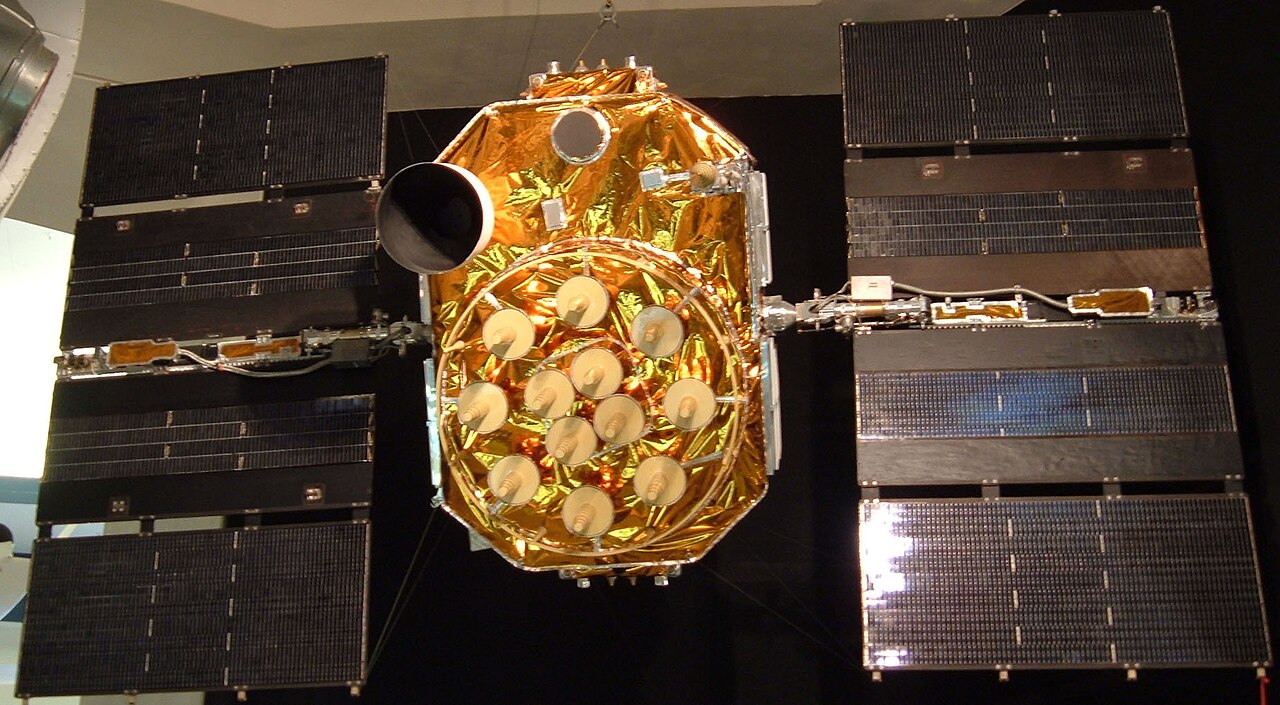

When a phone shows its position on a map, it is trusting two theories written in 1905 and 1915.1
This is not a figure of speech. It is how the device actually works.
Two effects pulling in opposite directions
The GPS system relies on twenty-four satellites carrying atomic clocks, distributed four to each of six inclined orbital planes, so that at least four satellites are almost always above the horizon, at any point on the globe.2
Two phenomena affect these clocks at the same time.
Because they move fast, their clocks run slow: this is an effect predicted by special relativity.3
Because they are high up, where the Earth’s gravity is weaker, their clocks run fast: this is an effect predicted by general relativity.
The two do not cancel out. For a GPS satellite, running fast wins: the clock in orbit ticks too fast.4
A tiny offset — does it matter?
The discrepancy is measured in billionths of a second. One might think it negligible.
It is not.
GPS calculates the position of a receiver from the time a signal takes to reach it. An error of one billionth of a second gives an error of thirty centimetres in the position.5
An offset that builds up day after day would therefore quickly make the system unusable. Neil Ashby, the physicist who wrote the standard review of the subject, says so bluntly: these shifts are so large that, without carefully accounting for them, the system would not work.6
How it is corrected
This is the part we find the most beautiful, and it is very simple.
The clock is set to run slow — before launch, in the workshop.
The clock should tick 10.23 million times per second. In reality it is set to 10.229 999 995 43 — just a tiny bit slower. Once in orbit, relativity does the rest, and the clock keeps correct time. This adjustment is made on the ground, before the clock goes into space.7
The rest — small discrepancies due to orbits that are not perfectly circular — is calculated by the receiver itself, at every moment.8
What happened at the first test
This story deserves to be told.
When the NTS-2 satellite, carrying the first caesium atomic clock placed in orbit, was launched on 23 June 1977, it was known that a relativistic correction would be needed — but no one was sure of its size, or even of its sign. And some doubted that these effects were real.9
A precaution was therefore taken: the adjustment would not be applied straight away. An on-board device allowed it to be activated later, if the measurement confirmed the prediction.10
So the clock was left running for about twenty days, without correction, and its drift was measured.11
General relativity predicted 446.5 parts per trillion. The measurement was 442.5.12
The device was then activated.
Why this page matters
The other pages in this domain are mostly devoted to errors.
A mistranslated word that produced canals on Mars. “Zero gravity”, which makes people believe that gravity disappears. “Big Bang”, which wrongly suggests an explosion. Images mistaken for photographs. Astronomers who see what they expect to see.
One might end up believing that science is mostly a long series of corrected blunders.
Yet there is another side, just as real.
A strange prediction, contrary to common sense. Put to the test with suspicion. Confirmed. Then applied on an industrial scale, and checked every day since, in the device everyone carries in their pocket.
Both things are true at once: we get things wrong a great deal, and we sometimes achieve astonishing results. The second is possible only because the first is taken seriously.
A word about words
People often speak of the “conquest of space”, and of “colonising” Mars.
This site does not use these words.
Not because they are forbidden, but because they come from a specific earthly history, in which “conquering” and “colonising” meant taking land from the people who lived on it. We have devoted an entire page to showing what this vocabulary conceals.
As for space, these words do not even describe, for the most part, what is happening: machines are sent, instruments are set down, measurements are brought back. That is remarkable enough without resorting to warlike vocabulary.
What is up there, and what we know about it
There are many more objects up there than we can see.
Surveillance networks track tens of thousands of them: those are seen, catalogued, and their trajectories are known. But models estimate far more — over a million fragments from 1 to 10 cm, which the networks do not all track.13
Neither figure is wrong. They do not answer the same question: how many do we see, or how many are there?
Faced with a figure, always ask which of the two is being given.
Note 1
On 25 November 1915, as devastating war raged throughout Europe, Albert Einstein presented the paper Die Feldgleichungen der Gravitation (“The field equations of gravitation”) to the Prussian Academy of Sciences. This paper, the last in a series of four, marked the first consistent formulation of his general theory of relativity, a task that had challenged Einstein for almost a decade. […] In his 1905 theory of relativity (later named the “special theory”), Einstein’s insistence that the laws of physics must appear identical to observers in uniform relative motion led to the prediction that space and time are neither independent nor absolute.
Physics World, “A Very Brief History of Relativity”, compte rendu (non signé) du livre de John Gribbin Einstein’s Masterwork: 1915 and the General Theory of Relativity, numéro d’August 2015, mis en ligne le 20 August 2015, open access
Note 2
The Space Segment consists essentially of 24 satellites carrying atomic clocks […] There are four satellites in each of six orbital planes inclined at 55° with respect to earth's equatorial plane, distributed so that from any point on the earth, four or more satellites are almost always above the local horizon.
Ashby, Neil, “Relativity in the Global Positioning System”, Living Reviews in Relativity, vol. 6, 1, 2003
Note 3
Gravitational frequency shifts and second-order Doppler shifts must be taken into account together. […] For a low earth orbiter such as the Space Shuttle, the velocity is so great that slowing due to time dilation is the dominant effect, while for a GPS satellite clock, the gravitational blueshift is greater.
Ashby, Neil, “Relativity in the Global Positioning System”, Living Reviews in Relativity, vol. 6, 1, 2003
Note 4
The negative sign in this result means that the standard clock in orbit is beating too fast, primarily because its frequency is gravitationally blueshifted.
Ashby, Neil, “Relativity in the Global Positioning System”, Living Reviews in Relativity, vol. 6, 1, 2003
Note 5
Timing errors of one ns will lead to positioning errors of the order of 30 cm.
Ashby, Neil, “Relativity in the Global Positioning System”, Living Reviews in Relativity, vol. 6, 1, 2003
Note 6
These clocks have gravitational and motional frequency shifts which are so large that, without carefully accounting for numerous relativistic effects, the system would not work.
Ashby, Neil, “Relativity in the Global Positioning System”, Living Reviews in Relativity, vol. 6, 1, 2003
Note 7
In order for the satellite clock to appear to an observer on the geoid to beat at the chosen frequency of 10.23 MHz, the satellite clocks are adjusted lower in frequency so that the proper frequency is: […] 10.229 999 995 43 MHz
Ashby, Neil, “Relativity in the Global Positioning System”, Living Reviews in Relativity, vol. 6, 1, 2003
This adjustment is accomplished on the ground before the clock is placed in orbit.
Ashby, Neil, “Relativity in the Global Positioning System”, Living Reviews in Relativity, vol. 6, 1, 2003
Note 8
This correction must be made by the receiver
Ashby, Neil, “Relativity in the Global Positioning System”, Living Reviews in Relativity, vol. 6, 1, 2003
Note 9
At the time of launch of the NTS-2 satellite (23 June 1977), which contained the first Cesium atomic clock to be placed in orbit
Ashby, Neil, “Relativity in the Global Positioning System”, Living Reviews in Relativity, vol. 6, 1, 2003
it was recognized that orbiting clocks would require a relativistic correction, but there was uncertainty as to its magnitude as well as its sign. Indeed, there were some who doubted that relativistic effects were truths that would need to be incorporated!
Ashby, Neil, “Relativity in the Global Positioning System”, Living Reviews in Relativity, vol. 6, 1, 2003
Note 10
A frequency synthesizer was built into the satellite clock system so that after launch, if in fact the rate of the clock in its final orbit was that predicted by general relativity, then the synthesizer could be turned on
Ashby, Neil, “Relativity in the Global Positioning System”, Living Reviews in Relativity, vol. 6, 1, 2003
Note 11
After the Cesium clock was turned on in NTS-2, it was operated for about 20 days to measure its clock rate before turning on the synthesizer [11].
Ashby, Neil, “Relativity in the Global Positioning System”, Living Reviews in Relativity, vol. 6, 1, 2003
Note 12
The frequency measured during that interval was +442.5 parts in 10^12 compared to clocks on the ground, while general relativity predicted +446.5 parts in 10^12.
Ashby, Neil, “Relativity in the Global Positioning System”, Living Reviews in Relativity, vol. 6, 1, 2003
Note 13
Number of space objects regularly tracked by Space Surveillance Networks and maintained in their catalogue […] About 47220 […] Not all objects are tracked and catalogued. The number of objects estimated based on statistical models to be in orbit […] 1.5 million space debris objects from greater than 1 cm to 10 cm
Agence spatiale européenne, “Space debris by the numbers”, page de statistiques
Notes and sources
- ↑
Passage it is trusting two theories written in 1905 and 1915
On 25 November 1915, as devastating war raged throughout Europe, Albert Einstein presented the paper Die Feldgleichungen der Gravitation (“The field equations of gravitation”) to the Prussian Academy of Sciences. This paper, the last in a series of four, marked the first consistent formulation of his general theory of relativity, a task that had challenged Einstein for almost a decade. […] In his 1905 theory of relativity (later named the “special theory”), Einstein’s insistence that the laws of physics must appear identical to observers in uniform relative motion led to the prediction that space and time are neither independent nor absolute.
Source Physics World, “A Very Brief History of Relativity”, compte rendu (non signé) du livre de John Gribbin Einstein’s Masterwork: 1915 and the General Theory of Relativity, numéro d’August 2015, mis en ligne le 20 August 2015, open access, paragraphs 1 and 3 of the body of the article.
Open access open the source · checked on 25 October 2026
- ↑
Passage The GPS system relies on twenty-four satellites carrying atomic clocks, distributed four to each of six inclined orbital planes, so that at least four satellites are almost always above the horizon
The Space Segment consists essentially of 24 satellites carrying atomic clocks […] There are four satellites in each of six orbital planes inclined at 55° with respect to earth's equatorial plane, distributed so that from any point on the earth, four or more satellites are almost always above the local horizon.
Source Ashby, Neil, “Relativity in the Global Positioning System”, Living Reviews in Relativity, vol. 6, 1, 2003, § 1, p. 5.
Open access open the source · checked on 9 September 2026
- ↑
Passage Because they move fast, their clocks run slow […] Because they are high up […] their clocks run fast
Gravitational frequency shifts and second-order Doppler shifts must be taken into account together. […] For a low earth orbiter such as the Space Shuttle, the velocity is so great that slowing due to time dilation is the dominant effect, while for a GPS satellite clock, the gravitational blueshift is greater.
Source Ashby, Neil, “Relativity in the Global Positioning System”, Living Reviews in Relativity, vol. 6, 1, 2003, § 5, p. 15-16.
Open access open the source · checked on 9 September 2026
- ↑
Passage For a GPS satellite, running fast wins: the clock in orbit ticks too fast.
The negative sign in this result means that the standard clock in orbit is beating too fast, primarily because its frequency is gravitationally blueshifted.
Source Ashby, Neil, “Relativity in the Global Positioning System”, Living Reviews in Relativity, vol. 6, 1, 2003, § 5, p. 16.
Open access open the source · checked on 9 September 2026
- ↑
Passage An error of one billionth of a second gives an error of thirty centimetres in the position.
Timing errors of one ns will lead to positioning errors of the order of 30 cm.
Source Ashby, Neil, “Relativity in the Global Positioning System”, Living Reviews in Relativity, vol. 6, 1, 2003, § 1, p. 6.
Open access open the source · checked on 9 September 2026
- ↑
Passage these shifts are so large that, without carefully accounting for them, the system would not work
These clocks have gravitational and motional frequency shifts which are so large that, without carefully accounting for numerous relativistic effects, the system would not work.
Source Ashby, Neil, “Relativity in the Global Positioning System”, Living Reviews in Relativity, vol. 6, 1, 2003, abstract.
Open access open the source · checked on 9 September 2026
- ↑
Passage The clock should tick 10.23 million times per second. In reality it is set to 10.229 999 995 43
In order for the satellite clock to appear to an observer on the geoid to beat at the chosen frequency of 10.23 MHz, the satellite clocks are adjusted lower in frequency so that the proper frequency is: […] 10.229 999 995 43 MHz
Source Ashby, Neil, “Relativity in the Global Positioning System”, Living Reviews in Relativity, vol. 6, 1, 2003, § 5, p. 16 (eq. 36).
Open access open the source · checked on 9 September 2026
Passage This adjustment is made on the ground, before the clock goes into space.
This adjustment is accomplished on the ground before the clock is placed in orbit.
Source Ashby, Neil, “Relativity in the Global Positioning System”, Living Reviews in Relativity, vol. 6, 1, 2003, § 5, p. 16.
Open access open the source · checked on 9 September 2026
- ↑
Passage The rest […] is calculated by the receiver itself
This correction must be made by the receiver
Source Ashby, Neil, “Relativity in the Global Positioning System”, Living Reviews in Relativity, vol. 6, 1, 2003, § 5, p. 17.
Open access open the source · checked on 9 September 2026
- ↑
Passage the NTS-2 satellite, carrying the first caesium atomic clock placed in orbit, was launched on 23 June 1977
At the time of launch of the NTS-2 satellite (23 June 1977), which contained the first Cesium atomic clock to be placed in orbit
Source Ashby, Neil, “Relativity in the Global Positioning System”, Living Reviews in Relativity, vol. 6, 1, 2003, § 5, p. 16.
Open access open the source · checked on 9 September 2026
Passage no one was sure of its size, or even of its sign. And some doubted that these effects were real.
it was recognized that orbiting clocks would require a relativistic correction, but there was uncertainty as to its magnitude as well as its sign. Indeed, there were some who doubted that relativistic effects were truths that would need to be incorporated!
Source Ashby, Neil, “Relativity in the Global Positioning System”, Living Reviews in Relativity, vol. 6, 1, 2003, § 5, p. 16.
Open access open the source · checked on 9 September 2026
- ↑
Passage An on-board device allowed it to be activated later, if the measurement confirmed the prediction.
A frequency synthesizer was built into the satellite clock system so that after launch, if in fact the rate of the clock in its final orbit was that predicted by general relativity, then the synthesizer could be turned on
Source Ashby, Neil, “Relativity in the Global Positioning System”, Living Reviews in Relativity, vol. 6, 1, 2003, § 5, p. 16.
Open access open the source · checked on 9 September 2026
- ↑
Passage the clock was left running for about twenty days, without correction, and its drift was measured
After the Cesium clock was turned on in NTS-2, it was operated for about 20 days to measure its clock rate before turning on the synthesizer [11].
Source Ashby, Neil, “Relativity in the Global Positioning System”, Living Reviews in Relativity, vol. 6, 1, 2003, § 5, p. 16.
Open access open the source · checked on 9 September 2026
- ↑
Passage General relativity predicted 446.5 parts per trillion. The measurement was 442.5.
The frequency measured during that interval was +442.5 parts in 10^12 compared to clocks on the ground, while general relativity predicted +446.5 parts in 10^12.
Source Ashby, Neil, “Relativity in the Global Positioning System”, Living Reviews in Relativity, vol. 6, 1, 2003, § 5, p. 17.
Open access open the source · checked on 9 September 2026
- ↑
Passage Surveillance networks track tens of thousands of them […] But models estimate far more — over a million fragments from 1 to 10 cm, which the networks do not all track
Number of space objects regularly tracked by Space Surveillance Networks and maintained in their catalogue […] About 47220 […] Not all objects are tracked and catalogued. The number of objects estimated based on statistical models to be in orbit […] 1.5 million space debris objects from greater than 1 cm to 10 cm
Source Agence spatiale européenne, “Space debris by the numbers”, page de statistiques, section “Space debris by the numbers” (statistics updated on 23 October 2026; MASTER-8 estimates, reference population 02/2026).
Open access open the source · checked on 9 September 2026
Bibliography
3
- Agence spatiale européenne, “Space debris by the numbers”, page de statistiques, open access (tracked objects and estimated debris in orbit). https://sdup.esoc.esa.int/discosweb/statistics/
- Ashby, Neil, “Relativity in the Global Positioning System”, Living Reviews in Relativity, vol. 6, 1, 2003, open access (the twenty-four satellites and their orbital planes, the size of the relativistic effects, one nanosecond for thirty centimetres, the frequency set to 10.229 999 995 43 MHz before launch, the NTS-2 test in 1977). https://doi.org/10.12942/lrr-2003-1
- Physics World, “A Very Brief History of Relativity”, compte rendu (non signé) du livre de John Gribbin Einstein’s Masterwork: 1915 and the General Theory of Relativity, numéro d’August 2015, mis en ligne le 20 August 2015, open access (special relativity in 1905; general relativity presented on 25 November 1915). https://physicsworld.com/a/a-very-brief-history-of-relativity/
Spotted an error or have a doubt? Write to us.