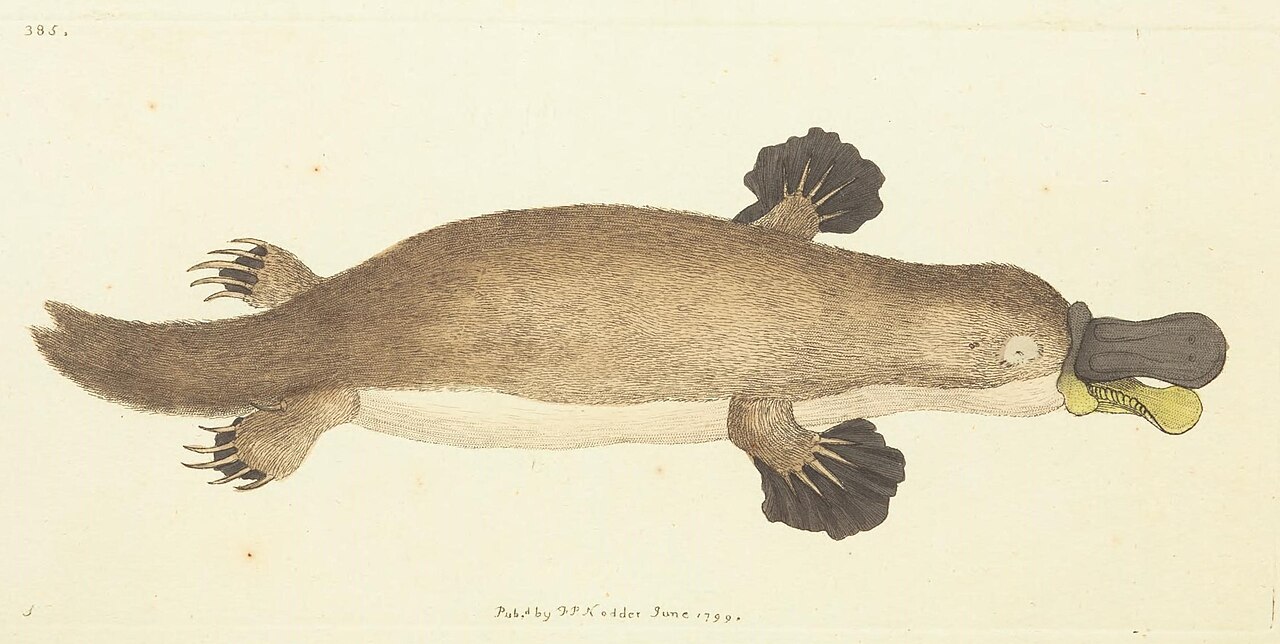

In 1799, an English scholar took a pair of scissors and cut into the skin of a dead animal to make sure nobody was playing a trick on him.
The marks of those scissor cuts are said to be still visible on the original skin, kept in London.
What happened at the British Museum
George Shaw was in charge of the natural history department of the British Museum when he received a dried skin sent from New South Wales, in Australia.
The animal was baffling: a duck’s bill, an otter’s body, a beaver’s flat tail, webbed and clawed feet.
In 1799, Shaw described it in The Naturalist’s Miscellany and gave it a scientific name (Platypus anatinus). But he also recorded his doubts in writing: at first view, he wrote, this bill “naturally excites the idea of some deceptive preparation by artificial means”, and he admitted that he almost doubted “the testimony of [his] own eyes”.1
He suspected a hoax, sewn together by a taxidermist or by sailors.
The scissors test
To settle the matter, Shaw took scissors and cut into the skin around the bill in order to detect any traces of stitching.2
He found none.
A caveat, because it bears precisely on what this page recounts: the cuts are said to be still visible on the specimen kept at the Natural History Museum in London, but this is documented by a historian of science, not by a recent physical examination by the museum. Other works see it as an institutional oral tradition. The fact is solid as regards Shaw’s action, debated as regards the relic.
Faced with an extraordinary fact, the logical approach is to test the hypothesis of a fake before accepting the extraordinary. Shaw devised a physical test with verifiable results.
Yet the doubt persisted. In 1823, the Scottish surgeon Robert Knox still attributed this suspicion to the specimen’s origin: the object had travelled via the Indian Ocean, a sea route on which Chinese sailors were credited with the ability to assemble fake creatures to sell to collectors.3
The resistance of a dogma
Once the proof of the skin’s continuity had been established, academic logic required the reality of the animal to be accepted. Scepticism nevertheless remained the rule for decades.
The difficulty lay in the definition of living things:
- By the European definition, a mammal suckled its young and gave birth to live young.
- The platypus suckles its young, but it lays eggs.4
The European scientific community remained divided for more than eighty years in the face of this theoretical inconsistency. In 1884, the biologist William Hay Caldwell settled the debate with a four-word telegram sent from Australia:5
“Monotremes oviparous, ovum meroblastic.”
Earlier, documented knowledge
While European science debated the existence or the classification of the animal, the Aboriginal peoples of Australia had known it perfectly well for tens of thousands of years.
They observed its nocturnal habits, its burrowing way of life, its egg-laying, and the male’s venomous spur. Depending on the local language, it was called mallingong, tambreet, boondaburra or gaya-dari.6
The account of the British administrator David Collins already records, under the date of November 1797, an animal found on the banks of a lake near the Hawkesbury. The animal was therefore not “discovered” in 1799: it was described for the first time by European science on that date.7
The irony of a double christening
The history of its scientific naming illustrates the isolation of the scientific institutions of the time:
- 1799: George Shaw names it Platypus anatinus.
- 1800: The German anatomist Johann Friedrich Blumenbach names it Ornithorhynchus paradoxus.8
As the name Platypus had already been given to a genus of beetles, international nomenclature combined Blumenbach’s genus name with Shaw’s species name: Ornithorhynchus anatinus.
What this story teaches
The story of the platypus illustrates a common methodological dead end: when an observed fact contradicts a classification, the initial temptation is to declare the fact impossible rather than to revise the rule.
The definition of the mammal was based solely on the fauna known in the West. The discovery of the monotremes did not break the laws of biology; it forced biology to widen categories that had been defined too narrowly.
Biological overview of the groups
| Group | Mode of reproduction | Key characteristics | Examples |
|---|---|---|---|
| Monotremes | Oviparous (lay eggs), milk secreted through the skin without teats. | Presence of a cloaca, electroreception, loss of many digestive genes, 10 sex chromosomes in the platypus. | Platypus, Echidnas. |
| Marsupials | Viviparous with a short gestation, development completed, in most species, in an abdominal pouch (marsupium). | Rudimentary placentation; in the female of most species, two uteri and two vaginas (three in kangaroos). | Kangaroo, Koala, Wombat, Opossum. |
| Placentals | Viviparous with a long gestation thanks to a complex placenta. | Advanced foetal development at birth, presence of teats. | Human, Whale, Bat, Otter. |
Sources for the table9
What is happening to them today
These groups are also the most exposed, and the Australian case is exceptional on a world scale.
In two centuries, Australia has lost more than 10% of its own land mammal species — out of 273 recorded. This figure should be set against that of continental North America, which lost only one species over the same period.10
But the most instructive thing is to understand the reason. Elsewhere in the world, extinctions occur where humans are numerous: habitat destruction, hunting, development. In Australia, it is the reverse. Most of the losses have occurred in the deserts and tropical savannas — regions far from cities, and regarded as largely unmodified.11
The main cause is therefore not direct human presence. It is two introduced predators that did not exist on this continent: the cat and the red fox. Added to these are altered fire regimes.12
The wave can in fact be traced on the map: the losses begin in the south-east around 1840, reach the centre around 1890, accelerate there between 1930 and 1960, and have continued in the north since the 1960s. This timeline tracks the spread of the cat, then the fox, across the continent.13
Note 1
So accurate is the similitude that, at first view, it naturally excites the idea of some deceptive preparation by artificial means: […] On a subject so extraordinary as the present, a degree of scepticism is not only pardonable, but laudable; and I ought perhaps to acknowledge that I almost doubt the testimony of my own eyes with respect to the structure of this animal's beak;
Shaw, George, The Naturalist’s Miscellany, vol. 10, Londres, 1799
Note 2
Ritvo, Harriet, The Platypus and the Mermaid and Other Figments of the Classifying Imagination, Harvard University Press, 1997
Note 3
It is well known that the specimens of this very extra-ordinary animal first brought to Europe were considered by many as impositions. They reached England by vessels which had navigated the Indian seas, a circumstance in itself sufficient to rouse the suspicions of the scientific naturalist, aware of the monstrous impostures which the artful Chinese had so frequently practised on European adventurers; […]
Knox, Robert, “Observations on the Anatomy of the Duck-billed Animal of New South Wales”, Memoirs of the Wernerian Natural History Society, vol. 5, 1re partie, 1824, p. 26-41, public domain
Note 4
In the following week (August 24) I shot an Ornithorhynchus whose first egg had been laid; her second egg was in a partially dilated os uteri.
Caldwell, William Hay, “The Embryology of Monotremata and Marsupialia”, Philosophical Transactions of the Royal Society of London B, vol. 178, 1887, p. 463-486
Note 5
On the 29th I sent in the telegram "Monotremes oviparous, ovum meroblastic" to a neighbouring station, where it would meet the passing mail-man, addressed to my friend Professor Liversidge, of the Sydney University, asking him to forward it to the British Association at Montreal. […] Telegram, " Monotremes oviparous, ovum meroblastic." Read in Montreal, Sept. 2, 1884.
Caldwell, William Hay, “The Embryology of Monotremata and Marsupialia”, Philosophical Transactions of the Royal Society of London B, vol. 178, 1887, p. 463-486
Note 6
Platypuses have many Aboriginal names including Mallangong, Tambreet, Gaya-dari, Boonaburra, and Lare-re-lar (Pike 1997; McKay et al. 2001).
Bino, Gilad et al., “The Platypus: Evolutionary History, Biology, and an Uncertain Future”, Journal of Mammalogy, vol. 100, no. 2, 2019, p. 308-327
With the name of boondaburra, mallingong or tambreet, Aboriginal legend talks of a union
Manchester Museum, University of Manchester, “Platypus (Ornithorhynchus anatinus)”, Museum Collections, open access
Note 7
In the second volume of Collins’s _Account of the English Colony in New South Wales_ (1802, p. 62), under date ‘November, 1797,’ there occurs the following account of what was apparently the first platypus captured by a European:-- […] The Kangaroo, the Dog, the Opossum, the Flying Squirrel, the Kangaroo Rat, a spotted Rat, the common Rat, and the large Fox-bat (if entitled to a place in this society), made up the whole catalogue of animals that were known at this time, with the exception which must now be made of an amphibious animal, of the mole species, one of which had been lately found on the banks of a lake near the Hawkesbury.
Burrell, Harry, The Platypus: Its Discovery, Zoological Position, Form and Characteristics, Habits, Life History, etc., Sydney, Angus & Robertson, 1927
Note 8
In 1800 the German anatomist Blumenbach received a skin from Sir Joseph Banks (one of two sent by Governor Hunter), and described it as _Ornithorhynchus paradoxus_.
Burrell, Harry, The Platypus: Its Discovery, Zoological Position, Form and Characteristics, Habits, Life History, etc., Sydney, Angus & Robertson, 1927
Note 9
Recordings of cortical evoked potentials showed that the bill of the platypus, previously considered to be exclusively mechanoreceptive, is also an electroreceptive organ with behavioural and electrophysiological sensitivity of ∼50 µV cm−1.
Scheich, Henning et al., “Electroreception and Electrolocation in Platypus”, Nature, vol. 319, 1986, p. 401-402
In the final curated platypus genome (mOrnAna1) 98% of the sequence was assigned to the 21 autosomes, 5 X and 5 Y chromosomes […] Analysis of genes involved in stomach function revealed that the considerable loss of digestive genes […] is shared with echidna and probably occurred in the monotreme ancestor
Zhou, Yang et al., “Platypus and Echidna Genomes Reveal Mammalian Biology and Evolution”, Nature, vol. 592, 2021, p. 756-762
Like monotremes, the embryos of marsupials are nourished during a short gestational period (about a month in kangaroos) by a yolk-sac placenta, but with no intervening egg shell. […] Most, but not all, species of marsupials possess a pouch in which the very premature young reside, receiving milk and continuing their development.
Clark, Mary Ann, Douglas, Matthew and Choi, Jung, Biology 2e, OpenStax, 2018, section 29.6 “Mammals”
Where kangaroos – and most marsupials – differ is that instead of having a single vagina and uterus, they have two completely separate pairs of vagini and uteri. […] Incredibly, the third vagina only forms when a female kangaroo becomes pregnant, creating a more direct route for a joey to be born.
Marshall, Candice, “Did You Know Kangaroos Have Three Vaginas?”, Australian Geographic, 19 December 2022
Note 10
The highly distinctive and mostly endemic Australian land mammal fauna has suffered an extraordinary rate of extinction (>10% of the 273 endemic terrestrial species) over the last ~200 y
Woinarski, John C. Z., Burbidge, Andrew A. and Harrison, Peter L., “Ongoing Unraveling of a Continental Fauna: Decline and Extinction of Australian Mammals since European Settlement”, Proceedings of the National Academy of Sciences, vol. 112, 2015, p. 4531-4540
in comparison, only one native land mammal from continental North America became extinct
Woinarski, John C. Z., Burbidge, Andrew A. and Harrison, Peter L., “Ongoing Unraveling of a Continental Fauna: Decline and Extinction of Australian Mammals since European Settlement”, Proceedings of the National Academy of Sciences, vol. 112, 2015, p. 4531-4540
Note 11
Much of the loss of Australian land mammal fauna (particularly in the vast deserts and tropical savannas) has been in areas that are remote from human population centers and recognized as relatively unmodified at global scale.
Woinarski, John C. Z., Burbidge, Andrew A. and Harrison, Peter L., “Ongoing Unraveling of a Continental Fauna: Decline and Extinction of Australian Mammals since European Settlement”, Proceedings of the National Academy of Sciences, vol. 112, 2015, p. 4531-4540
In contrast to general patterns of extinction on other continents where the main cause is habitat loss, hunting, and impacts of human development
Woinarski, John C. Z., Burbidge, Andrew A. and Harrison, Peter L., “Ongoing Unraveling of a Continental Fauna: Decline and Extinction of Australian Mammals since European Settlement”, Proceedings of the National Academy of Sciences, vol. 112, 2015, p. 4531-4540
Note 12
the loss of Australian land mammals is most likely due primarily to predation by introduced species, particularly the feral cat, Felis catus, and European red fox, Vulpes vulpes, and changed fire regimes
Woinarski, John C. Z., Burbidge, Andrew A. and Harrison, Peter L., “Ongoing Unraveling of a Continental Fauna: Decline and Extinction of Australian Mammals since European Settlement”, Proceedings of the National Academy of Sciences, vol. 112, 2015, p. 4531-4540
Note 13
a broad sequential wave of mammal losses, beginning from the first settled areas in southeastern Australia […] from the 1840s, reaching central Australia in the 1890s with rapid declines there particularly over the period of 1930–1960, and marked losses continuing from about the 1960s to the present day in much of northern Australia
Woinarski, John C. Z., Burbidge, Andrew A. and Harrison, Peter L., “Ongoing Unraveling of a Continental Fauna: Decline and Extinction of Australian Mammals since European Settlement”, Proceedings of the National Academy of Sciences, vol. 112, 2015, p. 4531-4540
Much of this timing was coincident with the continent-wide spread of the introduced cat Felis catus and the slightly later and only marginally less extensive spread of the introduced red fox Vulpes vulpes
Woinarski, John C. Z., Burbidge, Andrew A. and Harrison, Peter L., “Ongoing Unraveling of a Continental Fauna: Decline and Extinction of Australian Mammals since European Settlement”, Proceedings of the National Academy of Sciences, vol. 112, 2015, p. 4531-4540
Notes and sources
- ↑
Passage In 1799, Shaw described it […] at first view, he wrote, this bill “naturally excites the idea of some deceptive preparation by artificial means”, and he admitted that he almost doubted “the testimony of [his] own eyes”.
So accurate is the similitude that, at first view, it naturally excites the idea of some deceptive preparation by artificial means: […] On a subject so extraordinary as the present, a degree of scepticism is not only pardonable, but laudable; and I ought perhaps to acknowledge that I almost doubt the testimony of my own eyes with respect to the structure of this animal's beak;
Source Shaw, George, The Naturalist’s Miscellany, vol. 10, Londres, 1799, English text of the entry “The Duck-Billed Platypus, Platypus anatinus” (pl. 385-386), no. CXVIII, June 1799.
Public domain open the source · checked on 24 October 2026
- ↑
Passage Shaw took scissors and cut into the skin around the bill in order to detect any traces of stitching. He found none.
Source Ritvo, Harriet, The Platypus and the Mermaid and Other Figments of the Classifying Imagination, Harvard University Press, 1997, chapter on the reception of the Australian specimens.
In libraries · checked on 9 September 2026
- ↑
Passage In 1823, the Scottish surgeon Robert Knox still attributed this suspicion to the specimen’s origin
It is well known that the specimens of this very extra-ordinary animal first brought to Europe were considered by many as impositions. They reached England by vessels which had navigated the Indian seas, a circumstance in itself sufficient to rouse the suspicions of the scientific naturalist, aware of the monstrous impostures which the artful Chinese had so frequently practised on European adventurers; […]
Source Knox, Robert, “Observations on the Anatomy of the Duck-billed Animal of New South Wales”, Memoirs of the Wernerian Natural History Society, vol. 5, 1re partie, 1824, p. 26-41, public domain, beginning of the article (art. III, read on 17 May 1823), p. 27 of vol. V, part 1.
Public domain · checked on 24 October 2026
- ↑
Passage The platypus […] lays eggs.
In the following week (August 24) I shot an Ornithorhynchus whose first egg had been laid; her second egg was in a partially dilated os uteri.
Source Caldwell, William Hay, “The Embryology of Monotremata and Marsupialia”, Philosophical Transactions of the Royal Society of London B, vol. 178, 1887, p. 463-486, account of the egg collection (text transcribed on Embryology UNSW, without original pagination).
Public domain · checked on 9 September 2026
- ↑
Passage In 1884, the biologist William Hay Caldwell settled the debate with a four-word telegram
On the 29th I sent in the telegram "Monotremes oviparous, ovum meroblastic" to a neighbouring station, where it would meet the passing mail-man, addressed to my friend Professor Liversidge, of the Sydney University, asking him to forward it to the British Association at Montreal. […] Telegram, " Monotremes oviparous, ovum meroblastic." Read in Montreal, Sept. 2, 1884.
Source Caldwell, William Hay, “The Embryology of Monotremata and Marsupialia”, Philosophical Transactions of the Royal Society of London B, vol. 178, 1887, p. 463-486, introduction (account of the egg collection); bibliography, no. 15 (text transcribed on Embryology UNSW, without original pagination).
Public domain · checked on 9 September 2026
- ↑
Passage Depending on the local language, it was called mallingong, tambreet, boondaburra or gaya-dari.
Platypuses have many Aboriginal names including Mallangong, Tambreet, Gaya-dari, Boonaburra, and Lare-re-lar (Pike 1997; McKay et al. 2001).
Source Bino, Gilad et al., “The Platypus: Evolutionary History, Biology, and an Uncertain Future”, Journal of Mammalogy, vol. 100, no. 2, 2019, p. 308-327, section “Aboriginal Knowledge and Use”, single paragraph.
Open access open the source · checked on 27 October 2026
Passage it was called mallingong, tambreet, boondaburra
With the name of boondaburra, mallingong or tambreet, Aboriginal legend talks of a union
Source Manchester Museum, University of Manchester, “Platypus (Ornithorhynchus anatinus)”, Museum Collections, open access, body of the entry.
Open access open the source · checked on 27 October 2026
- ↑
Passage The account of the British administrator David Collins already records, under the date of November 1797, an animal found on the banks of a lake near the Hawkesbury.
In the second volume of Collins’s _Account of the English Colony in New South Wales_ (1802, p. 62), under date ‘November, 1797,’ there occurs the following account of what was apparently the first platypus captured by a European:-- […] The Kangaroo, the Dog, the Opossum, the Flying Squirrel, the Kangaroo Rat, a spotted Rat, the common Rat, and the large Fox-bat (if entitled to a place in this society), made up the whole catalogue of animals that were known at this time, with the exception which must now be made of an amphibious animal, of the mole species, one of which had been lately found on the banks of a lake near the Hawkesbury.
Source Burrell, Harry, The Platypus: Its Discovery, Zoological Position, Form and Characteristics, Habits, Life History, etc., Sydney, Angus & Robertson, 1927, ch. II (“Discovery and Early Descriptions”), introduction and opening of the quotation from Collins (vol. 2, 1802, p. 62).
Public domain open the source · checked on 27 October 2026
- ↑
Passage 1800: The German anatomist Johann Friedrich Blumenbach names it Ornithorhynchus paradoxus.
In 1800 the German anatomist Blumenbach received a skin from Sir Joseph Banks (one of two sent by Governor Hunter), and described it as _Ornithorhynchus paradoxus_.
Source Burrell, Harry, The Platypus: Its Discovery, Zoological Position, Form and Characteristics, Habits, Life History, etc., Sydney, Angus & Robertson, 1927, ch. I, 1st paragraph, sentence following the mention of Shaw’s description (1799).
Public domain open the source · checked on 27 October 2026
- ↑
Passage electroreception
Recordings of cortical evoked potentials showed that the bill of the platypus, previously considered to be exclusively mechanoreceptive, is also an electroreceptive organ with behavioural and electrophysiological sensitivity of ∼50 µV cm−1.
Source Scheich, Henning et al., “Electroreception and Electrolocation in Platypus”, Nature, vol. 319, 1986, p. 401-402, abstract (penultimate sentence).
Paywalled · checked on 25 October 2026
Passage loss of many digestive genes, 10 sex chromosomes in the platypus
In the final curated platypus genome (mOrnAna1) 98% of the sequence was assigned to the 21 autosomes, 5 X and 5 Y chromosomes […] Analysis of genes involved in stomach function revealed that the considerable loss of digestive genes […] is shared with echidna and probably occurred in the monotreme ancestor
Source Zhou, Yang et al., “Platypus and Echidna Genomes Reveal Mammalian Biology and Evolution”, Nature, vol. 592, 2021, p. 756-762, section “Chromosome-scale monotreme genomes”; section “Eco-evolutionary adaptation of diet”.
Open access · checked on 24 October 2026
Passage Viviparous with a short gestation, development completed, in most species, in an abdominal pouch
Like monotremes, the embryos of marsupials are nourished during a short gestational period (about a month in kangaroos) by a yolk-sac placenta, but with no intervening egg shell. […] Most, but not all, species of marsupials possess a pouch in which the very premature young reside, receiving milk and continuing their development.
Source Clark, Mary Ann, Douglas, Matthew and Choi, Jung, Biology 2e, OpenStax, 2018, section 29.6 “Mammals”, § 29.6, subsection “Living Mammals”, paragraph on marsupials.
Open access open the source · checked on 27 October 2026
Passage in the female of most species, two uteri and two vaginas (three in kangaroos)
Where kangaroos – and most marsupials – differ is that instead of having a single vagina and uterus, they have two completely separate pairs of vagini and uteri. […] Incredibly, the third vagina only forms when a female kangaroo becomes pregnant, creating a more direct route for a joey to be born.
Source Marshall, Candice, “Did You Know Kangaroos Have Three Vaginas?”, Australian Geographic, 19 December 2022, 14th paragraph and 19th paragraph.
Open access open the source · checked on 27 October 2026
- ↑
Passage Australia has lost more than 10% of its own land mammal species — out of 273 recorded
The highly distinctive and mostly endemic Australian land mammal fauna has suffered an extraordinary rate of extinction (>10% of the 273 endemic terrestrial species) over the last ~200 y
Source Woinarski, John C. Z., Burbidge, Andrew A. and Harrison, Peter L., “Ongoing Unraveling of a Continental Fauna: Decline and Extinction of Australian Mammals since European Settlement”, Proceedings of the National Academy of Sciences, vol. 112, 2015, p. 4531-4540, abstract.
Open access open the source · checked on 9 September 2026
Passage continental North America, which lost only one species over the same period
in comparison, only one native land mammal from continental North America became extinct
Source Woinarski, John C. Z., Burbidge, Andrew A. and Harrison, Peter L., “Ongoing Unraveling of a Continental Fauna: Decline and Extinction of Australian Mammals since European Settlement”, Proceedings of the National Academy of Sciences, vol. 112, 2015, p. 4531-4540, abstract.
Open access open the source · checked on 9 September 2026
- ↑
Passage Most of the losses have occurred in the deserts and tropical savannas — regions far from cities, and regarded as largely unmodified.
Much of the loss of Australian land mammal fauna (particularly in the vast deserts and tropical savannas) has been in areas that are remote from human population centers and recognized as relatively unmodified at global scale.
Source Woinarski, John C. Z., Burbidge, Andrew A. and Harrison, Peter L., “Ongoing Unraveling of a Continental Fauna: Decline and Extinction of Australian Mammals since European Settlement”, Proceedings of the National Academy of Sciences, vol. 112, 2015, p. 4531-4540, abstract.
Open access open the source · checked on 9 September 2026
Passage Elsewhere in the world, extinctions occur where humans are numerous: habitat destruction, hunting, development.
In contrast to general patterns of extinction on other continents where the main cause is habitat loss, hunting, and impacts of human development
Source Woinarski, John C. Z., Burbidge, Andrew A. and Harrison, Peter L., “Ongoing Unraveling of a Continental Fauna: Decline and Extinction of Australian Mammals since European Settlement”, Proceedings of the National Academy of Sciences, vol. 112, 2015, p. 4531-4540, abstract.
Open access open the source · checked on 9 September 2026
- ↑
Passage two introduced predators that did not exist on this continent: the cat and the red fox. Added to these are altered fire regimes.
the loss of Australian land mammals is most likely due primarily to predation by introduced species, particularly the feral cat, Felis catus, and European red fox, Vulpes vulpes, and changed fire regimes
Source Woinarski, John C. Z., Burbidge, Andrew A. and Harrison, Peter L., “Ongoing Unraveling of a Continental Fauna: Decline and Extinction of Australian Mammals since European Settlement”, Proceedings of the National Academy of Sciences, vol. 112, 2015, p. 4531-4540, abstract.
Open access open the source · checked on 9 September 2026
- ↑
Passage the losses begin in the south-east around 1840, reach the centre around 1890, accelerate there between 1930 and 1960, and have continued in the north since the 1960s
a broad sequential wave of mammal losses, beginning from the first settled areas in southeastern Australia […] from the 1840s, reaching central Australia in the 1890s with rapid declines there particularly over the period of 1930–1960, and marked losses continuing from about the 1960s to the present day in much of northern Australia
Source Woinarski, John C. Z., Burbidge, Andrew A. and Harrison, Peter L., “Ongoing Unraveling of a Continental Fauna: Decline and Extinction of Australian Mammals since European Settlement”, Proceedings of the National Academy of Sciences, vol. 112, 2015, p. 4531-4540, section “The Pattern and Drivers of Terrestrial Mammal Decline Since European Settlement of Australia”.
Open access open the source · checked on 9 September 2026
Passage This timeline tracks the spread of the cat, then the fox, across the continent.
Much of this timing was coincident with the continent-wide spread of the introduced cat Felis catus and the slightly later and only marginally less extensive spread of the introduced red fox Vulpes vulpes
Source Woinarski, John C. Z., Burbidge, Andrew A. and Harrison, Peter L., “Ongoing Unraveling of a Continental Fauna: Decline and Extinction of Australian Mammals since European Settlement”, Proceedings of the National Academy of Sciences, vol. 112, 2015, p. 4531-4540, body of the article.
Open access open the source · checked on 9 September 2026
Bibliography
16
- Bino, Gilad et al., “The Platypus: Evolutionary History, Biology, and an Uncertain Future”, Journal of Mammalogy, vol. 100, no. 2, 2019, p. 308-327, open access (the Aboriginal names of the platypus, including Mallangong, Tambreet, Gaya-dari and Boonaburra). https://doi.org/10.1093/jmammal/gyz058
- Blumenbach, Johann Friedrich, “Über das Schnabelthier (Ornithorhynchus paradoxus), ein neuentdecktes Geschlecht von Säugthieren des fünften Welttheils”, Magazin für den neuesten Zustand der Naturkunde, vol. 2, 1800, p. 205-214, public domain (the second name given to the animal).
- Burrell, Harry, The Platypus: Its Discovery, Zoological Position, Form and Characteristics, Habits, Life History, etc., Sydney, Angus & Robertson, 1927, public domain (Collins’s account dated November 1797, quoted from the 1802 vol. 2, the observations of Aboriginal hunting passed on by Governor Hunter to Home, and the name given by Blumenbach in 1800). https://www.gutenberg.org/ebooks/78386
- Caldwell, William Hay, “The Embryology of Monotremata and Marsupialia”, Philosophical Transactions of the Royal Society of London B, vol. 178, 1887, p. 463-486, public domain (the first-hand account of sending the telegram and the demonstration of egg-laying).
- Clark, Mary Ann, Douglas, Matthew and Choi, Jung, Biology 2e, OpenStax, 2018, section 29.6 “Mammals”, open access (the short gestation of marsupials and the pouch, present in most species). https://openstax.org/books/biology-2e/pages/29-6-mammals
- Collins, David, An Account of the English Colony in New South Wales, London, 1802, public domain (the animal recorded in November 1797 near the Hawkesbury). https://gutenberg.org/ebooks/12565
- Knox, Robert, “Observations on the Anatomy of the Duck-billed Animal of New South Wales”, Memoirs of the Wernerian Natural History Society, vol. 5, 1re partie, 1824, p. 26-41, public domain (the suspicion linked to the Indian Ocean route).
- Manchester Museum, University of Manchester, “Platypus (Ornithorhynchus anatinus)”, Museum Collections, open access (the names boondaburra, mallingong and tambreet). https://museumcollections.manchester.ac.uk/collections/narrative/20e4d2fe-9df7-37ae-aa3a-eeb04983c452
- Marshall, Candice, “Did You Know Kangaroos Have Three Vaginas?”, Australian Geographic, 19 December 2022, open access (with Mark Eldridge of the Australian Museum: the two uteri and two vaginas of most marsupials; the third vagina formed during pregnancy in kangaroos). https://www.australiangeographic.com.au/news/2022/12/did-you-know-kangaroos-have-three-vaginas/
- Moyal, Ann, Platypus: The Extraordinary Story of How a Curious Creature Baffled the World, Washington, Smithsonian Institution Press, 2001, in libraries (the full story, from 1799 to 1884; the Aboriginal names).
- Ritvo, Harriet, The Platypus and the Mermaid and Other Figments of the Classifying Imagination, Harvard University Press, 1997, in libraries (the scissor cuts and the reception of the Australian specimens).
- Scheich, Henning et al., “Electroreception and Electrolocation in Platypus”, Nature, vol. 319, 1986, p. 401-402, paywalled (the electroreception of the bill).
- Shaw, George, The Naturalist’s Miscellany, vol. 10, Londres, 1799, public domain (the description of the animal and the written reservations about the authenticity of the skin).
- Tyndale-Biscoe, Hugh, Life of Marsupials, CSIRO Publishing, 2005, in libraries (marsupial biology: short gestation, pouch, reproductive system).
- Woinarski, John C. Z., Burbidge, Andrew A. and Harrison, Peter L., “Ongoing Unraveling of a Continental Fauna: Decline and Extinction of Australian Mammals since European Settlement”, Proceedings of the National Academy of Sciences, vol. 112, 2015, p. 4531-4540, open access (more than 10% of the 273 endemic land species extinct; the comparison with North America; the losses in remote and little-modified regions; the cat, the red fox and fire regimes; the chronological wave of disappearances). https://doi.org/10.1073/pnas.1417301112
- Zhou, Yang et al., “Platypus and Echidna Genomes Reveal Mammalian Biology and Evolution”, Nature, vol. 592, 2021, p. 756-762, open access (the ten sex chromosomes and the loss of stomach genes).
Spotted an error or have a doubt? Write to us.