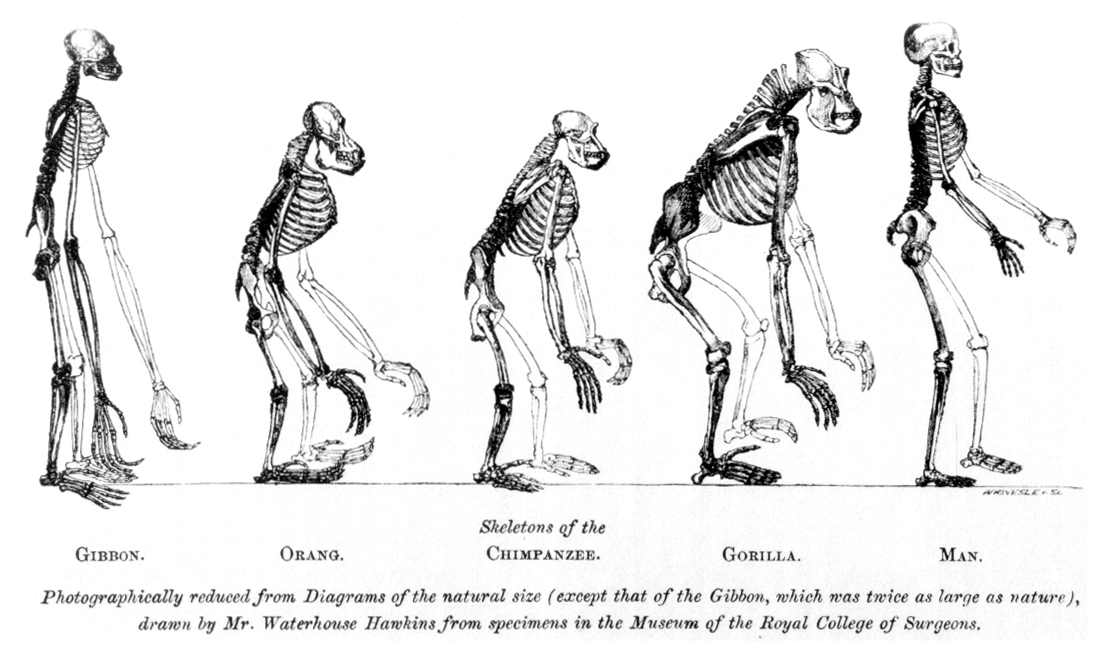

We are not descended from present-day apes.
This statement is true but incomplete: it does not say what should take its place.
Two scientific facts replace it:
- First: we are cousins. A present-day chimpanzee is not our ancestor. We share a common ancestor that lived 6 to 8 million years ago, which was neither a human nor a chimpanzee. Since that split, the two lineages have had exactly the same amount of time to evolve.
- Second: we are great apes. Under the rules of phylogenetic classification, a group includes all the descendants of a common ancestor. Since we are descended from the common ancestor of all great apes, itself a primate, the human species is biologically a primate and a great ape, just as birds are dinosaurs.1
The question of coexistence
“If we are descended from that ancestor, why do the other apes still exist?”
A new species does not erase the previous one. When a population splits into two isolated groups, each group follows its own evolutionary path: one species gives rise to two distinct lineages that coexist.2
The error of the ladder model
The idea that the common ancestor looked like a chimpanzee rests on a misconception: the chimpanzee lineage supposedly stood still while the human lineage “progressed”. This is a mistaken picture of evolution as a ladder.
In reality, our lineage and that of the chimpanzees split six to eight million years ago. Since then, both have changed — and not only ours.3
Both of today’s species are recent. The chimpanzee (Pan troglodytes) split from the bonobo only one and a half to two million years ago; Homo sapiens appeared about 300,000 years ago. Neither is the ancestor of the other, and neither “waited” while the other moved forward.4
No living species is more “evolved” than another: since their common ancestor, all have been evolving for exactly the same length of time.5
What this classification does not say
The position of the human species within the living world provides no basis for analysing variation within the human species.
- Distinct scales: Phylogenetic classification compares species. Differences between human populations fall within the scope of population genetics.
- Scientific consensus: Genetics establishes that the human species is not divided into biologically distinct “races”: there is more genetic variation within groups than between them.6
Overview of the primate order
The primate order includes more than 500 species, divided into 79 genera, in the tropical Americas, mainland Africa, Madagascar and Asia. The first division separates two suborders: the strepsirrhines — lemurs, lorises, galagos — and the haplorhines, which bring together all the others, tarsiers included. Within the order, the following major groups are distinguished:7
| Main groups | Example species | Geographical area |
|---|---|---|
| Strepsirrhines | Lemurs, lorises, galagos | Madagascar, sub-Saharan Africa, South and Southeast Asia |
| New World monkeys (Platyrrhines) | Marmosets, capuchins, howler monkeys | Central and South America |
| Old World monkeys (Cercopithecids) | Macaques, baboons, mandrills | Africa, Asia |
| Hylobatids (lesser apes) | Gibbons, siamangs | Southeast Asia |
| Hominids (great apes) | Orangutans, gorillas, chimpanzees, bonobos, humans | Southeast Asia and equatorial Africa; humans everywhere |
Conservation status and legal issues
In 2017, a large proportion of non-human primates were threatened with extinction.
- Two figures, and they do not measure the same thing. The 2017 reference study gives them side by side: about 60% of species threatened with extinction, and about 75% whose numbers are declining. The second is higher because a species can decline without yet being classified as threatened. The first counts a status, the second a trend.
- The threat is not evenly distributed. It affects 87% of species in Madagascar, 73% in Asia, but 37% in mainland Africa and 36% in the tropical Americas. A global average of 60% hides a more than twofold difference between regions.
- The cause is named plainly: market demand, global and local, which drives the destruction of forests — industrial agriculture, extensive livestock farming, logging, mining, drilling, dams, new roads.
- A shifting figure. Species counts and the proportion assessed as threatened change from one version of the Red List to the next. Two causes may be intertwined here: species are genuinely deteriorating, and new species are described and then assessed in turn. A rising proportion does not by itself say which of the two causes dominates.
- Legal debates: Movements such as the Great Ape Project argue for extending fundamental rights to non-human great apes: the right to life, the protection of individual liberty and the prohibition of torture.8
Note 1
DNA also shows that our species and chimpanzees diverged from a common ancestor species that lived between 8 and 6 million years ago.
Smithsonian Institution, Human Origins Program, “Genetics”
Note 2
In this highly simplified phylogeny, a speciation event occurred resulting in two lineages. […] Since that speciation event, both lineages have had an equal amount of time to evolve. […] Evolution produces a pattern of relationships among lineages that is tree-like, not ladder-like.
University of California Museum of Paleontology, Understanding Evolution, “Trees, not ladders”
Note 3
DNA also shows that our species and chimpanzees diverged from a common ancestor species that lived between 8 and 6 million years ago.
Smithsonian Institution, Human Origins Program, “Genetics”
Note 4
They diverged from a common ancestor between 1.5 and 2 million years ago and live in different areas of tropical Africa. […] The study confirmed a main separation between chimpanzees and bonobos approximately 1.5 million years ago, and the presence of four chimpanzee subspecies in different regions.
Wellcome Sanger Institute, “Ancient Interbreeding between Chimpanzees and Bonobos Revealed”, communiqué de presse sur une étude dirigée par Tomàs Marquès-Bonet et publiée dans Science, open access
In combination with an age of 315 ± 34 thousand years (as determined by thermoluminescence dating), this evidence makes Jebel Irhoud the oldest and richest African Middle Stone Age hominin site that documents early stages of the H. sapiens clade in which key features of modern morphology were established.
Hublin, Jean-Jacques et al., “New Fossils from Jebel Irhoud, Morocco, and the Pan-African Origin of Homo sapiens*”, *Nature, vol. 546, 2017, p. 289-292
Note 5
Any other interpretation runs the risk of invoking the fallacy of a progressive evolutionary scale. […] The lineages leading to contemporary species have all been evolving for exactly the same amount of time.
Gregory, T. Ryan, “Understanding Evolutionary Trees”, Evolution: Education and Outreach, vol. 1, 2008, p. 121-137
Note 6
Race does not provide an accurate representation of human biological variation. It was never accurate in the past, and it remains inaccurate when referencing contemporary human populations. Humans are not divided biologically into distinct continental types or racial genetic clusters.
American Association of Biological Anthropologists, “AABA Statement on Race & Racism”, 27 March 2019, open access
There is more genetic variation within self-identified racial groups than between them.
National Human Genome Research Institute, “Race”, Talking Glossary of Genomic and Genetic Terms, open access
Note 7
Current information shows the existence of 504 species in 79 genera distributed in the Neotropics, mainland Africa, Madagascar, and Asia.
Estrada, Alejandro et al., “Impending Extinction Crisis of the World’s Primates: Why Primates Matter”, Science Advances, vol. 3, e1600946, 2017
Order Primates is divided into two groups: Strepsirrhini (“turned-nosed”) and Haplorhini (“simple-nosed”) primates. Strepsirrhines, also called the wet-nosed primates, include prosimians like the bush babies and pottos of Africa, the lemurs of Madagascar, and the lorises of Southeast Asia. Haplorhines, or dry-nosed primates, include tarsiers (Figure 29.42) and simians (New World monkeys, Old World monkeys, apes, and humans).
Clark, Mary Ann, Douglas, Matthew and Choi, Jung, Biology 2e, OpenStax, chapter 29.7 “The Evolution of Primates”
Note 8
~60% of primate species are now threatened with extinction and ~75% have declining populations
Estrada, Alejandro et al., “Impending Extinction Crisis of the World’s Primates: Why Primates Matter”, Science Advances, vol. 3, e1600946, 2017
87% of species in Madagascar are threatened, as are 73% in Asia, 37% in mainland Africa, and 36% in the Neotropics
Estrada, Alejandro et al., “Impending Extinction Crisis of the World’s Primates: Why Primates Matter”, Science Advances, vol. 3, e1600946, 2017
mainly global and local market demands, leading to extensive habitat loss through the expansion of industrial agriculture, large-scale cattle ranching, logging, oil and gas drilling, mining, dam building, and the construction of new road networks
Estrada, Alejandro et al., “Impending Extinction Crisis of the World’s Primates: Why Primates Matter”, Science Advances, vol. 3, e1600946, 2017
So far around 45,000 of these have been assessed for inclusion on the IUCN Red List. […] It is important to recognize that species may change in Red List category just because better information has become available; a category change does not necessarily mean that the species' status has changed.
UICN, Guidelines for Appropriate Uses of Red List Data, n.d.
The right to life, the protection of individual liberty and the prohibition of torture are proposed by the Great Ape Project as minimum conditions in the relationship between men and great apes. […] We propose to extend the granting of rights on an equal basis to all hominids/great apes: humans, chimpanzees, bonobos, gorillas and orangutans.
Projeto GAP (Great Ape Project), “World Declaration on Great Apes Rights”, n.d.
Notes and sources
- ↑
Passage We share a common ancestor that lived 6 to 8 million years ago
DNA also shows that our species and chimpanzees diverged from a common ancestor species that lived between 8 and 6 million years ago.
Source Smithsonian Institution, Human Origins Program, “Genetics”, section “Primate Family Tree”.
Open access open the source · checked on 27 October 2026
- ↑
Passage A new species does not erase the previous one […] one species gives rise to two distinct lineages that coexist
In this highly simplified phylogeny, a speciation event occurred resulting in two lineages. […] Since that speciation event, both lineages have had an equal amount of time to evolve. […] Evolution produces a pattern of relationships among lineages that is tree-like, not ladder-like.
Source University of California Museum of Paleontology, Understanding Evolution, “Trees, not ladders”, teaching page “Trees, not ladders” (Evolution 101, evo_07).
Open access open the source · checked on 24 October 2026
- ↑
Passage our lineage and that of the chimpanzees split six to eight million years ago
DNA also shows that our species and chimpanzees diverged from a common ancestor species that lived between 8 and 6 million years ago.
Source Smithsonian Institution, Human Origins Program, “Genetics”, section “Primate Family Tree”.
Open access open the source · checked on 27 October 2026
- ↑
Passage The chimpanzee (Pan troglodytes) split from the bonobo only one and a half to two million years ago
They diverged from a common ancestor between 1.5 and 2 million years ago and live in different areas of tropical Africa. […] The study confirmed a main separation between chimpanzees and bonobos approximately 1.5 million years ago, and the presence of four chimpanzee subspecies in different regions.
Source Wellcome Sanger Institute, “Ancient Interbreeding between Chimpanzees and Bonobos Revealed”, communiqué de presse sur une étude dirigée par Tomàs Marquès-Bonet et publiée dans Science, open access, text of the press release.
Open access open the source · checked on 25 October 2026
Passage Homo sapiens appeared about 300,000 years ago
In combination with an age of 315 ± 34 thousand years (as determined by thermoluminescence dating), this evidence makes Jebel Irhoud the oldest and richest African Middle Stone Age hominin site that documents early stages of the H. sapiens clade in which key features of modern morphology were established.
Source Hublin, Jean-Jacques et al., “New Fossils from Jebel Irhoud, Morocco, and the Pan-African Origin of Homo sapiens*”, *Nature, vol. 546, 2017, p. 289-292, abstract.
Paywalled · checked on 25 October 2026
- ↑
Passage This is a mistaken picture of evolution as a ladder […] since their common ancestor, all have been evolving for exactly the same length of time
Any other interpretation runs the risk of invoking the fallacy of a progressive evolutionary scale. […] The lineages leading to contemporary species have all been evolving for exactly the same amount of time.
Source Gregory, T. Ryan, “Understanding Evolutionary Trees”, Evolution: Education and Outreach, vol. 1, 2008, p. 121-137, sections “Misconception #6: Long Branch Implies no Change” and “Misconception #7: Different Lineage Ages for Modern Species” (caption of figure 16).
Open access · checked on 24 October 2026
- ↑
Passage Genetics establishes that the human species is not divided into biologically distinct “races”
Race does not provide an accurate representation of human biological variation. It was never accurate in the past, and it remains inaccurate when referencing contemporary human populations. Humans are not divided biologically into distinct continental types or racial genetic clusters.
Source American Association of Biological Anthropologists, “AABA Statement on Race & Racism”, 27 March 2019, open access, “Executive Summary”, first paragraph.
Open access open the source · checked on 27 October 2026
Passage there is more genetic variation within groups than between them.
There is more genetic variation within self-identified racial groups than between them.
Source National Human Genome Research Institute, “Race”, Talking Glossary of Genomic and Genetic Terms, open access, “Narration” section (text by Vence L. Bonham Jr.), not the definition.
Open access open the source · checked on 27 October 2026
- ↑
Passage more than 500 species, divided into 79 genera, in the tropical Americas, mainland Africa, Madagascar and Asia
Current information shows the existence of 504 species in 79 genera distributed in the Neotropics, mainland Africa, Madagascar, and Asia.
Source Estrada, Alejandro et al., “Impending Extinction Crisis of the World’s Primates: Why Primates Matter”, Science Advances, vol. 3, e1600946, 2017, abstract.
Open access open the source · checked on 9 September 2026
Passage The first division separates two suborders: the strepsirrhines — lemurs, lorises, galagos — and the haplorhines
Order Primates is divided into two groups: Strepsirrhini (“turned-nosed”) and Haplorhini (“simple-nosed”) primates. Strepsirrhines, also called the wet-nosed primates, include prosimians like the bush babies and pottos of Africa, the lemurs of Madagascar, and the lorises of Southeast Asia. Haplorhines, or dry-nosed primates, include tarsiers (Figure 29.42) and simians (New World monkeys, Old World monkeys, apes, and humans).
Source Clark, Mary Ann, Douglas, Matthew and Choi, Jung, Biology 2e, OpenStax, chapter 29.7 “The Evolution of Primates”, chapter 29.7 “The Evolution of Primates”, subsection “Characteristics of Primates”, 2nd paragraph.
Open access open the source · checked on 27 October 2026
- ↑
Passage about 60% of species threatened with extinction, and about 75% whose numbers are declining
~60% of primate species are now threatened with extinction and ~75% have declining populations
Source Estrada, Alejandro et al., “Impending Extinction Crisis of the World’s Primates: Why Primates Matter”, Science Advances, vol. 3, e1600946, 2017, abstract.
Open access open the source · checked on 9 September 2026
Passage 87% of species in Madagascar, 73% in Asia, but 37% in mainland Africa and 36% in the tropical Americas
87% of species in Madagascar are threatened, as are 73% in Asia, 37% in mainland Africa, and 36% in the Neotropics
Source Estrada, Alejandro et al., “Impending Extinction Crisis of the World’s Primates: Why Primates Matter”, Science Advances, vol. 3, e1600946, 2017, body of the article.
Open access open the source · checked on 9 September 2026
Passage market demand, global and local, which drives the destruction of forests — industrial agriculture, extensive livestock farming, logging, mining, drilling, dams, new roads
mainly global and local market demands, leading to extensive habitat loss through the expansion of industrial agriculture, large-scale cattle ranching, logging, oil and gas drilling, mining, dam building, and the construction of new road networks
Source Estrada, Alejandro et al., “Impending Extinction Crisis of the World’s Primates: Why Primates Matter”, Science Advances, vol. 3, e1600946, 2017, abstract.
Open access open the source · checked on 9 September 2026
Passage Species counts and the proportion assessed as threatened change from one version of the Red List to the next.
So far around 45,000 of these have been assessed for inclusion on the IUCN Red List. […] It is important to recognize that species may change in Red List category just because better information has become available; a category change does not necessarily mean that the species' status has changed.
Source UICN, Guidelines for Appropriate Uses of Red List Data, n.d., “The IUCN Red List of Threatened Species™ - the key facts”, item 3b; then table “appropriate and inappropriate uses”, row “Monitoring and evaluation”, column “Inappropriate uses”.
Open access open the source · checked on 27 October 2026
Passage Movements such as the Great Ape Project argue for extending fundamental rights to non-human great apes: the right to life, the protection of individual liberty and the prohibition of torture.
The right to life, the protection of individual liberty and the prohibition of torture are proposed by the Great Ape Project as minimum conditions in the relationship between men and great apes. […] We propose to extend the granting of rights on an equal basis to all hominids/great apes: humans, chimpanzees, bonobos, gorillas and orangutans.
Source Projeto GAP (Great Ape Project), “World Declaration on Great Apes Rights”, n.d., “World Declaration on Great Apes Rights” page, introduction, before the list of the three principles.
Open access open the source · checked on 27 October 2026
Bibliography
15
- American Association of Biological Anthropologists, “AABA Statement on Race & Racism”, 27 March 2019, open access (race does not represent human biological variation accurately; no distinct continental types or racial genetic clusters). https://bioanth.org/about/aaba-statement-on-race-racism/
- Cavalieri, Paola and Singer, Peter (ed.), The Great Ape Project: Equality Beyond Humanity, Fourth Estate, 1993, in libraries (the debate on a legal status for great apes).
- Clark, Mary Ann, Douglas, Matthew and Choi, Jung, Biology 2e, OpenStax, open access (the division of primates into strepsirrhines and haplorhines, tarsiers included in the latter). https://openstax.org/details/books/biology-2e
- Estrada, Alejandro et al., “Impending Extinction Crisis of the World’s Primates: Why Primates Matter”, Science Advances, vol. 3, e1600946, 2017, open access (504 species in 79 genera; about 60% threatened and 75% declining; the regional distribution of the threat; the causes named). https://doi.org/10.1126/sciadv.1600946
- Fleagle, John G., Primate Adaptation and Evolution, Academic Press, 2013, in libraries (the suborders and the major groups of primates).
- Gregory, T. Ryan, “Understanding Evolutionary Trees”, Evolution: Education and Outreach, vol. 1, 2008, p. 121-137, open access (the scale of beings and linear representations of evolution).
- Hublin, Jean-Jacques et al., “New Fossils from Jebel Irhoud, Morocco, and the Pan-African Origin of Homo sapiens*”, *Nature, vol. 546, 2017, p. 289-292, paywalled (the age at which our species appeared; see Entry 3.1).
- Lewontin, Richard C., “The Apportionment of Human Diversity”, Evolutionary Biology, vol. 6, 1972, p. 381-398, in libraries (the apportionment of human genetic diversity; see Entry 2.1).
- National Human Genome Research Institute, “Race”, Talking Glossary of Genomic and Genetic Terms, open access (more genetic variation within groups than between them). https://www.genome.gov/genetics-glossary/Race
- Projeto GAP (Great Ape Project), “World Declaration on Great Apes Rights”, n.d., open access (the three rights — life, individual liberty, prohibition of torture — that the movement asks to extend to great apes). https://www.projetogap.org/en/orld-declaration-of-the-rights-of-great-apes/
- Smithsonian Institution, Human Origins Program, “Genetics”, open access (the common ancestor of humans and chimpanzees, which lived between 8 and 6 million years ago). https://humanorigins.si.edu/evidence/genetics
- UICN, Guidelines for Appropriate Uses of Red List Data, n.d., open access (a change of category may reflect better information rather than a genuine change in status; assessment still incomplete). https://portals.iucn.org/library/sites/library/files/documents/Rep-2009-007.pdf
- UICN, Liste rouge des espèces menacées, ordre Primates, open access (the proportions under threat, which change with each version). https://www.iucnredlist.org/
- University of California Museum of Paleontology, Understanding Evolution, “Trees, not ladders”, open access (reading trees and the coexistence of lineages). https://evolution.berkeley.edu/
- Wellcome Sanger Institute, “Ancient Interbreeding between Chimpanzees and Bonobos Revealed”, communiqué de presse sur une étude dirigée par Tomàs Marquès-Bonet et publiée dans Science, open access (the split between chimpanzees and bonobos, 1.5 to 2 million years ago). https://www.sanger.ac.uk/news/view/ancient-interbreeding-between-chimpanzees-and-bonobos-revealed
Spotted an error or have a doubt? Write to us.