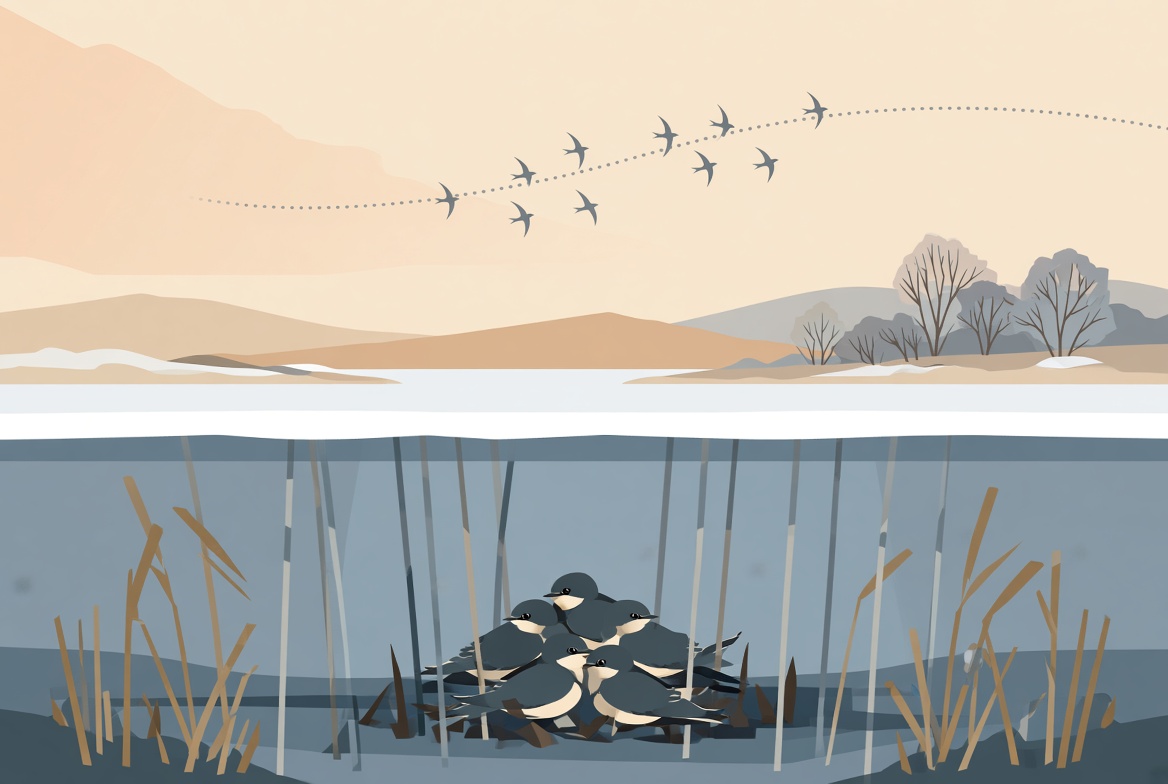
For a very long time, nobody knew where birds went in winter.
They left. They came back. In between, nothing.
Migrating, and living in groups
A migration is a regular, seasonal movement between two areas used for different purposes — most often an area where animals breed and an area where they spend the harsh season. It is neither wandering nor flight: the journey is repeated, year after year, often on the same dates and along the same routes.
The reason is almost always food. At high latitudes, summer brings great abundance and very long days in which to raise young; winter offers nothing. Leaving is costly, but staying would cost more.
The distances covered are greater than one might imagine. Every year the Arctic tern travels from the Arctic to the Antarctic and back. Tags fitted to individual birds record circuits of 50,000 to 90,000 kilometres a year: this is the longest regular journey known in any animal, and it is made by a bird weighing around a hundred grams. The East African wildebeest follows the rains in a loop. The humpback whale feeds near the poles and gives birth in the tropics, where it fasts. The monarch, for its part, takes several generations to complete its cycle: the individual that sets off again in spring is not the one that arrived in autumn.1
To find their way, these animals do not rely on a single sense but on a whole array of cues: the position of the Sun, that of the stars, the Earth’s magnetic field, smells, the shape of coastlines and of the terrain. When one cue is missing, the others compensate — which explains why it was so difficult to establish which one mattered.2
Living together
Many of these movements are made in groups, and a group is more than the sum of its individuals. It brings three measurable advantages: more eyes to spot a predator, less individual risk of being the one that gets caught, and sometimes less effort — birds flying in formation save energy by making use of the wake of the birds ahead.3
It also comes at a cost: food has to be shared, and diseases spread faster.
One point needs to be made straight away, because everything else on this page depends on it. A group that moves in a coordinated way does not necessarily have a leader, nor does it necessarily follow a plan. A flock of starlings rippling across the sky obeys no one: each bird adjusts its position to its six or seven immediate neighbours, and the overall shape arises from these local adjustments. What, seen from outside, looks like a collective decision is merely a simple rule, applied by each individual.
This is precisely the trap that this page will examine: we have words — instinct, leader, decision — that give the impression of explaining, when all they do is name.
What could not be known
The problem was not a lack of curiosity: the question has been documented since Antiquity. The problem was the complete absence of instruments for observing over long distances.
For want of any means of measurement, the gap was filled with explanations: Aristotle believed that certain swallows, instead of migrating, hibernated in holes, and that certain birds changed into other species (redstarts becoming robins in winter); in the sixteenth century, people still imagined them spending the winter under water, among the reeds. It took the invention of ringing — the first numbered rings were fitted in Denmark in 1899 — and then the emergence of Argos tags and satellite tracking, to map their real routes.4
The fundamental lesson remains the same:
The question was not too difficult. It lacked an instrument.
As long as something cannot be measured, a question remains open — and speculation takes the place of observation.
The word “instinct”
Here is a word that needs examining, because it is used so widely:
“The bird migrates by instinct.” “It’s maternal instinct.” “Salmon swim up the river by instinct.”
The question is what these sentences actually contribute.
They name. They do not explain.
To the question how does a bird find its way?, the answer by instinct teaches nothing. It supplies a tautological label in place of a mechanism.
Yet the real mechanisms exist and are still being brought to light: magnetoreception, celestial cues, circannual clocks and social learning.5
This site has listed some thirty words that produce a false belief. This one is of a particular kind: it does not mislead about the nature of a fact, it gives the illusion of having explained it.
Note on rigour: In modern ethology, the term “instinct” retains a restricted technical use to refer to fixed motor patterns (Fixed Action Patterns). It should not, however, be confused with a causal explanation of behaviour.
The word “instinct” was disowned by those who used it
Here is a fundamental chapter in the history of the behavioural sciences.
In the 1950s, the study of animal behaviour rested largely on a strict dichotomy between “innate” and “learned” behaviours.
In 1953, the psychologist Daniel Lehrman published a thorough critique. His central argument is decisive:
Classifying a behaviour as “innate” says nothing about how it developed. The word does not describe a mechanism: it implicitly declares that there is nothing left to analyse.6
The reversal
In 1963, one of the founders of modern ethology — Niko Tinbergen, a future Nobel laureate — wrote a sentence that deserves to be read carefully.
What he considers “heuristically harmful” is not the distinction itself: it is calling a behaviour “innate” at the end of a series of eliminations — one learning process has been ruled out, then another, so whatever remains must be innate.7
In other words: he does not condemn the word, he condemns the way it is arrived at. Declaring that something is innate because nothing has been found that could have taught it amounts to drawing a conclusion from an absence.
Put another way: framing the question in these terms blocks research.
Tinbergen came round to Lehrman’s critique. Konrad Lorenz maintained his position. This debate profoundly restructured the discipline.
What can legitimately be said
The methodological consequence is precise:
Only conclusions formulated negatively are sound. One can establish that a given factor plays no part — for example, that a bird reared in acoustic isolation still produces, in some species, the basic structure of its species’ song.8
But one cannot conclude that a behaviour is “free of ontogeny”. All behaviour arises in the course of development: the environment in the womb or in the egg, maternal steroids, early sensory stimulation.
A classic example: in many bird species, the overall coordination of a courtship display is functional without prior learning — but the detail and fine-tuning of its performance are shaped by social experience.
Neither entirely innate, nor entirely learned. The question itself was badly posed.
How many meanings in a single word?
In their critical review of ethological concepts, the researchers Matteo Mameli and Patrick Bateson (2006) listed twenty-six different definitions of “innateness” in the scientific literature, before singling out eight with distinct properties.9
Their argument is unanswerable: as long as it has not been proved that these eight properties are correlated with one another — which the data contradict — the word is a source of ambiguity.
Two people can use the word “innate” while thinking of completely different properties without realising it.
The six meanings and the writing rule
As early as 1991, Patrick Bateson pointed out that a behaviour described as “innate” could mean:
- Present at birth;
- Caused by a genetic difference;
- Shaped by natural selection;
- Invariant during development;
- Shared by all members of a species;
- Not learned.
These six criteria do not necessarily coincide. A behaviour can be present at birth without being shared by the whole species, or be shaped by natural selection while still requiring learning.
Bateson draws a simple conclusion from this: classifying behaviour into “innate” and “not innate” merely causes confusion.10
Comparison with a functional term
The word “reflex” rests on an identified neural arc: receptor, afferent nerve, spinal centre, motor neuron, effector. It can be observed, measured and timed.
“Instinct” does not refer to a circuit. It is a label stuck on something not yet explained.
A warning about anthropomorphism
The analysis of collective behaviour frequently suffers from anthropomorphic projections: leader, hierarchy, discipline, society.
The history of the concept of the “alpha wolf” illustrates this bias: based on observations of unrelated captive animals, this invalid model took more than fifty years to be corrected in popular culture (the researcher L. David Mech having invalidated his own initial theory himself).11
Visible order does not prove there is a leader
Faced with a flock of starlings, a shoal of fish or a column of ants, the mind immediately looks for someone in command. Yet no individual is in charge. These patterns emerge from very simple local rules — keeping a distance from one’s immediate neighbours, matching one’s speed and direction to theirs, dodging an approaching predator.12
How it was measured
This was known from computer models, but it had never been checked on real birds. A team did so by photographing, from a rooftop in Rome, flocks of several thousand starlings — with two cameras set some distance apart, which makes it possible to reconstruct the position of each bird in three dimensions.13
Result: each starling adjusts its trajectory to six or seven neighbours.14
Then comes the detail that changes everything. These six or seven are not the birds located within so many metres. They are the six or seven nearest, whatever the distance between them.15
The nuance seems slight. It is decisive. In a tight flock, six neighbours fit within a metre; in a spread-out flock, they have to be sought much further away. The bird counts neighbours, it does not measure a distance.
The authors explain why this matters: when a falcon attacks, the flock stretches and scatters. A rule based on distance would then leave some birds alone, out of reach of any neighbour — the group would tear apart. A rule based on number holds firm. Counting one’s neighbours rather than measuring them is what keeps the flock from breaking up at the very moment it is attacked. It is the same mechanism as the one described in our page on chance and data (9.6), where individual behaviours added together produce a statistical regularity.16
The methodological rule remains strict: settle a question only where empirical research settles it, and document the state of uncertainty where it does not.
Note 1
The Baltic terns completed a 50,000 km annual migration circuit, exploiting ocean regions of high productivity
Alerstam, Thomas et al., “Hypotheses and Tracking Results about the Longest Migration: The Case of the Arctic Tern”, Ecology and Evolution, vol. 9, no. 17, 2019, p. 9511-9531
The total travel distance in the course of the non-breeding period was 90,000 ± 2000 km, which substantially exceeds previous estimates for this species.
Fijn, R. C., Hiemstra, D., Phillips, R. A. et van der Winden, J., “Arctic Terns Sterna paradisaea from the Netherlands Migrate Record Distances across Three Oceans to Wilkes Land, East Antarctica”, Ardea, vol. 101, no. 1, 2013, p. 3-12
Note 2
I contend that any long-distance navigational task consists of three phases and that no single cue or mechanism will enable animals to navigate with pinpoint accuracy over thousands of kilometres. Multiscale and multisensory cue integration in the brain is needed.
Mouritsen, Henrik, “Long-Distance Navigation and Magnetoreception in Migratory Animals”, Nature, vol. 558, 2018, p. 50-59
Note 3
For example, grouping can improve group vigilance [4–7], reduce the chance of being encountered by predators [5,8], dilute an individual's risk of being attacked [9–14] […] In a final treatment, we implement such a grouping penalty in order to model the realistic constraints of limited resources and the resulting scramble competition for food [30, 36, 40, 49].
Olson, Randal S., Haley, Patrick B., Dyer, Fred C. and Adami, Christoph, “Exploring the Evolution of a Trade-off between Vigilance and Foraging in Group-living Organisms”, Royal Society Open Science, vol. 2, 150135, 2015 (preprint arXiv:1408.1906)
Note 4
A great number of birds also go into hiding; they do not all migrate, as is generally supposed, to warmer countries. […] others, that are at a distance from such places, decline the trouble of migration and simply hide themselves where they are. Swallows, for instance, have been often found in holes, quite denuded of their feathers […] attamen in Septentrionalibus aquis sæpius casu piscatoris extrahuntur hirundines, in modum conglomeratæ massæ: quæ ore ad os & alas ad alam, & pede ad pedem post principium autumni sese inter cannas descensuræ colligarunt.
A great number of birds also go into hiding; they do not all migrate, as is generally supposed, to warmer countries. […] others, that are at a distance from such places, decline the trouble of migration and simply hide themselves where they are. Swallows, for instance, have been often found in holes, quite denuded of their feathers […] yet in northern waters fishermen quite often draw out swallows by chance, clustered in a mass: beak to beak, wing to wing and foot to foot, they have bound themselves together after the beginning of autumn, about to descend among the reeds.
Aristote, Histoire des animaux, livres VIII et IX
No doubt he spent a lot of time during the years to come analysing what he saw, and subsequently in the summer of 1899, to be precise on the 5th of June, he ringed the first Starling with a tiny aluminium ring with the inscription: 'VIBORG 1'. Before the end of the year he had ringed 165 Starlings, nearly all adults.
Preuss, Niels Otto, “Hans Christian Cornelius Mortensen: Aspects of His Life and of the History of Bird Ringing”, Ardea, vol. 89, 2001, p. 1-6
Note 5
The three biological compasses used by migratory birds are based on information from the sun […] stars and the geomagnetic field […] and their use is tightly connected to the diel and circannual time sense.
Åkesson, Susanne and Helm, Barbara, “Endogenous Programs and Flexibility in Bird Migration”, Frontiers in Ecology and Evolution, vol. 8, 78, 2020
Note 6
Of Lehrman’s main points, the most crucial is his insistence that classifying behaviors into ‘innate’ and ‘non-innate’, ‘learned’ or ‘non-learned’, or ‘acquired’ and ‘inherited’ is counter productive because it doesn’t tell us anything about how behavior actually develops; […]
Marler, Peter, “Innateness and the Instinct to Learn”, Anais da Academia Brasileira de Ciências, vol. 76, no. 2, 2004, p. 189-200
Note 7
application of the adjective 'innate' to behavior characters […] on the basis of eliminations of different kinds is heuristically harmful
Tinbergen, Niko, “On Aims and Methods of Ethology”, Zeitschrift für Tierpsychologie, vol. 20, no. 4, 1963, p. 410-433
Note 8
For example, in some songbird species, a bird deprived of conspecific song models will develop songs that are still somewhat species-typical, i.e., that have many but not all of the characteristics of good species song. An example is the Song Sparrow (Melospiza melodia).
Brenowitz, Eliot A. and Beecher, Michael D., “An Ecological and Neurobiological Perspective on the Evolution of Vocal Learning”, Frontiers in Ecology and Evolution, vol. 11, 1193903, 2023
Note 9
We have considered 26 different candidates for scientific successor to the folk concept of innateness (Table 1), and none is problem-free. […] We are therefore left with these eight proposals: (3), (12), (18), (19), (21), (22), (23), (25).
Mameli, Matteo and Bateson, Patrick, “Innateness and the Sciences”, Biology & Philosophy, vol. 21, no. 2, 2006, p. 155-188
Note 10
The word ‘innate’ has many different meanings attached to it: present at birth; a behavioural difference caused by a genetic difference; adapted over the course of evolution; unchanging throughout development; shared by all members of a species; and not learned. […] A classification of behaviour into innate and not innate merely causes confusion.
Bateson, Patrick, Behaviour, Development and Evolution, Open Book Publishers, 2017
Note 11
Most research on the social dynamics of wolf packs, however, has been conducted on non-natural assortments of captive wolves. […] Attempting to apply information about the behavior of assemblages of unrelated captive wolves
Mech, L. David, “Alpha Status, Dominance, and Division of Labor in Wolf Packs”, Canadian Journal of Zoology, vol. 77, no. 8, 1999, p. 1196-1203
Note 12
Self-organization theory suggests that much of complex group behavior may be coordinated by relatively simple interactions among the members of the group.
Couzin, Iain D. and Krause, Jens, “Self-Organization and Collective Behavior in Vertebrates”, Advances in the Study of Behavior, vol. 32, 2003, p. 1-75
Note 13
Numerical models indicate that collective animal behaviour may emerge from simple local rules of interaction among the individuals. However, very little is known about the nature of such interaction, so that models and theories mostly rely on aprioristic assumptions.
Ballerini, Michele et al., “Interaction Ruling Animal Collective Behaviour Depends on Topological Rather than Metric Distance: Evidence from a Field Study”, Proceedings of the National Academy of Sciences, vol. 105, no. 4, 2008, p. 1232-1237
By reconstructing the three-dimensional position of individual birds in airborne flocks of few thousands members […] Images were taken in Rome, from the terrace of Palazzo Massimo […] We used stereo photography (32,33). The distance between stereo cameras (baseline) was d=25m.
Ballerini, Michele et al., “Interaction Ruling Animal Collective Behaviour Depends on Topological Rather than Metric Distance: Evidence from a Field Study”, Proceedings of the National Academy of Sciences, vol. 105, no. 4, 2008, p. 1232-1237
Note 14
we discover that each bird interacts on average with a fixed number of neighbours (six-seven)
Ballerini, Michele et al., “Interaction Ruling Animal Collective Behaviour Depends on Topological Rather than Metric Distance: Evidence from a Field Study”, Proceedings of the National Academy of Sciences, vol. 105, no. 4, 2008, p. 1232-1237
Note 15
the interaction does not depend on the metric distance, as most current models and theories assume, but rather on the topological distance […] rather than with all neighbours within a fixed metric distance
Ballerini, Michele et al., “Interaction Ruling Animal Collective Behaviour Depends on Topological Rather than Metric Distance: Evidence from a Field Study”, Proceedings of the National Academy of Sciences, vol. 105, no. 4, 2008, p. 1232-1237
Note 16
We argue that a topological interaction is indispensable to maintain flock's cohesion against the large density changes caused by external perturbations, typically predation.
Ballerini, Michele et al., “Interaction Ruling Animal Collective Behaviour Depends on Topological Rather than Metric Distance: Evidence from a Field Study”, Proceedings of the National Academy of Sciences, vol. 105, no. 4, 2008, p. 1232-1237
Notes and sources
- ↑
Passage Every year the Arctic tern travels from the Arctic to the Antarctic and back […] circuits of 50,000 to 90,000 kilometres a year
The Baltic terns completed a 50,000 km annual migration circuit, exploiting ocean regions of high productivity
Source Alerstam, Thomas et al., “Hypotheses and Tracking Results about the Longest Migration: The Case of the Arctic Tern”, Ecology and Evolution, vol. 9, no. 17, 2019, p. 9511-9531, abstract.
Open access open the source · checked on 25 October 2026
Passage Every year the Arctic tern travels from the Arctic to the Antarctic and back […] circuits of 50,000 to 90,000 kilometres a year
The total travel distance in the course of the non-breeding period was 90,000 ± 2000 km, which substantially exceeds previous estimates for this species.
Source Fijn, R. C., Hiemstra, D., Phillips, R. A. et van der Winden, J., “Arctic Terns Sterna paradisaea from the Netherlands Migrate Record Distances across Three Oceans to Wilkes Land, East Antarctica”, Ardea, vol. 101, no. 1, 2013, p. 3-12, abstract.
Open access open the source · checked on 25 October 2026
- ↑
Passage these animals do not rely on a single sense but on a whole array of cues
I contend that any long-distance navigational task consists of three phases and that no single cue or mechanism will enable animals to navigate with pinpoint accuracy over thousands of kilometres. Multiscale and multisensory cue integration in the brain is needed.
Source Mouritsen, Henrik, “Long-Distance Navigation and Magnetoreception in Migratory Animals”, Nature, vol. 558, 2018, p. 50-59, abstract.
Paywalled · checked on 25 October 2026
- ↑
Passage more eyes to spot a predator, less individual risk of being the one that gets caught […] It also comes at a cost: food has to be shared
For example, grouping can improve group vigilance [4–7], reduce the chance of being encountered by predators [5,8], dilute an individual's risk of being attacked [9–14] […] In a final treatment, we implement such a grouping penalty in order to model the realistic constraints of limited resources and the resulting scramble competition for food [30, 36, 40, 49].
Source Olson, Randal S., Haley, Patrick B., Dyer, Fred C. and Adami, Christoph, “Exploring the Evolution of a Trade-off between Vigilance and Foraging in Group-living Organisms”, Royal Society Open Science, vol. 2, 150135, 2015 (preprint arXiv:1408.1906), introduction, 2nd paragraph (benefits); methods, section “Explicit cost of grouping” (cost).
Open access open the source · checked on 27 October 2026
- ↑
Passage Aristotle believed that certain swallows, instead of migrating, hibernated in holes […] in the sixteenth century, people still imagined them spending the winter under water, among the reeds
A great number of birds also go into hiding; they do not all migrate, as is generally supposed, to warmer countries. […] others, that are at a distance from such places, decline the trouble of migration and simply hide themselves where they are. Swallows, for instance, have been often found in holes, quite denuded of their feathers […] attamen in Septentrionalibus aquis sæpius casu piscatoris extrahuntur hirundines, in modum conglomeratæ massæ: quæ ore ad os & alas ad alam, & pede ad pedem post principium autumni sese inter cannas descensuræ colligarunt.
Editors’ translation A great number of birds also go into hiding; they do not all migrate, as is generally supposed, to warmer countries. […] others, that are at a distance from such places, decline the trouble of migration and simply hide themselves where they are. Swallows, for instance, have been often found in holes, quite denuded of their feathers […] yet in northern waters fishermen quite often draw out swallows by chance, clustered in a mass: beak to beak, wing to wing and foot to foot, they have bound themselves together after the beginning of autumn, about to descend among the reeds.
Source Aristote, Histoire des animaux, livres VIII et IX, Aristotle, History of Animals, book VIII, ch. 16 (trans. D’Arcy W. Thompson); Olaus Magnus, book XIX, ch. XXIX, p. 673.
Public domain open the source 1 open the source 2 · checked on 9 September 2026
Passage the first numbered rings were fitted in Denmark in 1899
No doubt he spent a lot of time during the years to come analysing what he saw, and subsequently in the summer of 1899, to be precise on the 5th of June, he ringed the first Starling with a tiny aluminium ring with the inscription: 'VIBORG 1'. Before the end of the year he had ringed 165 Starlings, nearly all adults.
Source Preuss, Niels Otto, “Hans Christian Cornelius Mortensen: Aspects of His Life and of the History of Bird Ringing”, Ardea, vol. 89, 2001, p. 1-6, p. 2.
Open access open the source · checked on 24 October 2026
- ↑
Passage the real mechanisms exist […] magnetoreception, celestial cues, circannual clocks
The three biological compasses used by migratory birds are based on information from the sun […] stars and the geomagnetic field […] and their use is tightly connected to the diel and circannual time sense.
Source Åkesson, Susanne and Helm, Barbara, “Endogenous Programs and Flexibility in Bird Migration”, Frontiers in Ecology and Evolution, vol. 8, 78, 2020, “Migration Programs for Time and Space” section, “Space” subsection.
Open access open the source · checked on 27 October 2026
- ↑
Passage Classifying a behaviour as “innate” says nothing about how it developed.
Of Lehrman’s main points, the most crucial is his insistence that classifying behaviors into ‘innate’ and ‘non-innate’, ‘learned’ or ‘non-learned’, or ‘acquired’ and ‘inherited’ is counter productive because it doesn’t tell us anything about how behavior actually develops; […]
Source Marler, Peter, “Innateness and the Instinct to Learn”, Anais da Academia Brasileira de Ciências, vol. 76, no. 2, 2004, p. 189-200, p. 192, section on the question “innate or not innate”, start of the paragraph on Lehrman.
Open access open the source · checked on 27 October 2026
- ↑
Passage What he considers “heuristically harmful” […] is calling a behaviour “innate” at the end of a series of eliminations
application of the adjective 'innate' to behavior characters […] on the basis of eliminations of different kinds is heuristically harmful
Source Tinbergen, Niko, “On Aims and Methods of Ethology”, Zeitschrift für Tierpsychologie, vol. 20, no. 4, 1963, p. 410-433, p. 425.
Open access open the source · checked on 9 September 2026
- ↑
Passage a bird reared in acoustic isolation still produces, in some species, the basic structure of its species’ song
For example, in some songbird species, a bird deprived of conspecific song models will develop songs that are still somewhat species-typical, i.e., that have many but not all of the characteristics of good species song. An example is the Song Sparrow (Melospiza melodia).
Source Brenowitz, Eliot A. and Beecher, Michael D., “An Ecological and Neurobiological Perspective on the Evolution of Vocal Learning”, Frontiers in Ecology and Evolution, vol. 11, 1193903, 2023, § 2 (“Vocal production learning”).
Open access open the source · checked on 27 October 2026
- ↑
Passage listed twenty-six different definitions of “innateness” in the scientific literature, before singling out eight with distinct properties
We have considered 26 different candidates for scientific successor to the folk concept of innateness (Table 1), and none is problem-free. […] We are therefore left with these eight proposals: (3), (12), (18), (19), (21), (22), (23), (25).
Source Mameli, Matteo and Bateson, Patrick, “Innateness and the Sciences”, Biology & Philosophy, vol. 21, no. 2, 2006, p. 155-188, p. 176-177 (section discussing the candidates, table 1).
Paywalled · checked on 25 October 2026
- ↑
Passage Present at birth; […] Not learned. […] classifying behaviour into “innate” and “not innate” merely causes confusion
The word ‘innate’ has many different meanings attached to it: present at birth; a behavioural difference caused by a genetic difference; adapted over the course of evolution; unchanging throughout development; shared by all members of a species; and not learned. […] A classification of behaviour into innate and not innate merely causes confusion.
Source Bateson, Patrick, Behaviour, Development and Evolution, Open Book Publishers, 2017, ch. 3 (“Rules and Reciprocity”), p. 27 (first sentence) and p. 28.
Open access open the source · checked on 27 October 2026
- ↑
Passage The history of the concept of the “alpha wolf” illustrates this bias: based on observations of unrelated captive animals
Most research on the social dynamics of wolf packs, however, has been conducted on non-natural assortments of captive wolves. […] Attempting to apply information about the behavior of assemblages of unrelated captive wolves
Source Mech, L. David, “Alpha Status, Dominance, and Division of Labor in Wolf Packs”, Canadian Journal of Zoology, vol. 77, no. 8, 1999, p. 1196-1203, abstract and introduction.
Open access · checked on 9 September 2026
- ↑
Passage These patterns emerge from very simple local rules
Self-organization theory suggests that much of complex group behavior may be coordinated by relatively simple interactions among the members of the group.
Source Couzin, Iain D. and Krause, Jens, “Self-Organization and Collective Behavior in Vertebrates”, Advances in the Study of Behavior, vol. 32, 2003, p. 1-75, section 1.1 “Overview”, p. 2 of the “in press” version.
Paywalled · checked on 25 October 2026
- ↑
Passage This was known from computer models, but it had never been checked on real birds.
Numerical models indicate that collective animal behaviour may emerge from simple local rules of interaction among the individuals. However, very little is known about the nature of such interaction, so that models and theories mostly rely on aprioristic assumptions.
Source Ballerini, Michele et al., “Interaction Ruling Animal Collective Behaviour Depends on Topological Rather than Metric Distance: Evidence from a Field Study”, Proceedings of the National Academy of Sciences, vol. 105, no. 4, 2008, p. 1232-1237, abstract.
Open access open the source · checked on 9 September 2026
Passage by photographing, from a rooftop in Rome, flocks of several thousand starlings — with two cameras set some distance apart, which makes it possible to reconstruct the position of each bird in three dimensions
By reconstructing the three-dimensional position of individual birds in airborne flocks of few thousands members […] Images were taken in Rome, from the terrace of Palazzo Massimo […] We used stereo photography (32,33). The distance between stereo cameras (baseline) was d=25m.
Source Ballerini, Michele et al., “Interaction Ruling Animal Collective Behaviour Depends on Topological Rather than Metric Distance: Evidence from a Field Study”, Proceedings of the National Academy of Sciences, vol. 105, no. 4, 2008, p. 1232-1237, abstract; Materials and Methods (“Location and materials”, “Experimental technique”).
Open access open the source · checked on 9 September 2026
- ↑
Passage each starling adjusts its trajectory to six or seven neighbours
we discover that each bird interacts on average with a fixed number of neighbours (six-seven)
Source Ballerini, Michele et al., “Interaction Ruling Animal Collective Behaviour Depends on Topological Rather than Metric Distance: Evidence from a Field Study”, Proceedings of the National Academy of Sciences, vol. 105, no. 4, 2008, p. 1232-1237, abstract.
Open access open the source · checked on 9 September 2026
- ↑
Passage These six or seven are not the birds located within so many metres. They are the six or seven nearest, whatever the distance between them.
the interaction does not depend on the metric distance, as most current models and theories assume, but rather on the topological distance […] rather than with all neighbours within a fixed metric distance
Source Ballerini, Michele et al., “Interaction Ruling Animal Collective Behaviour Depends on Topological Rather than Metric Distance: Evidence from a Field Study”, Proceedings of the National Academy of Sciences, vol. 105, no. 4, 2008, p. 1232-1237, abstract.
Open access open the source · checked on 9 September 2026
- ↑
Passage Counting one’s neighbours rather than measuring them is what keeps the flock from breaking up at the very moment it is attacked.
We argue that a topological interaction is indispensable to maintain flock's cohesion against the large density changes caused by external perturbations, typically predation.
Source Ballerini, Michele et al., “Interaction Ruling Animal Collective Behaviour Depends on Topological Rather than Metric Distance: Evidence from a Field Study”, Proceedings of the National Academy of Sciences, vol. 105, no. 4, 2008, p. 1232-1237, abstract.
Open access open the source · checked on 9 September 2026
Bibliography
18
- Åkesson, Susanne and Helm, Barbara, “Endogenous Programs and Flexibility in Bird Migration”, Frontiers in Ecology and Evolution, vol. 8, 78, 2020, open access (sun, star and magnetic compasses; their use tied to the diel and circannual time sense). https://doi.org/10.3389/fevo.2020.00078
- Alerstam, Thomas et al., “Hypotheses and Tracking Results about the Longest Migration: The Case of the Arctic Tern”, Ecology and Evolution, vol. 9, no. 17, 2019, p. 9511-9531, open access (the annual journeys of terns tracked with geolocators). https://doi.org/10.1002/ece3.5459
- Aristote, Histoire des animaux, livres VIII et IX, public domain (the supposed hibernation of swallows and the metamorphosis of redstarts) ; et Olaus Magnus, Historia de gentibus septentrionalibus, Rome, 1555, public domain (swallows spending the winter under water). http://classics.mit.edu/Aristotle/history_anim.8.viii.html ; https://runeberg.org/olmagnus/0759.html
- Ballerini, Michele et al., “Interaction Ruling Animal Collective Behaviour Depends on Topological Rather than Metric Distance: Evidence from a Field Study”, Proceedings of the National Academy of Sciences, vol. 105, no. 4, 2008, p. 1232-1237, open access (the three-dimensional reconstruction of flocks photographed above Rome; the six to seven neighbours; the topological rather than metric interaction; cohesion maintained under a predator’s attack). https://arxiv.org/abs/0709.1916
- Bateson, Patrick, Behaviour, Development and Evolution, Open Book Publishers, 2017, open access. https://doi.org/10.11647/OBP.0097
- Bateson, Patrick, “Are There Principles of Behavioural Development?”, dans The Development and Integration of Behaviour, Cambridge University Press, 1991, p. 19-39, in libraries (the six meanings of the word “innate”).
- Brenowitz, Eliot A. and Beecher, Michael D., “An Ecological and Neurobiological Perspective on the Evolution of Vocal Learning”, Frontiers in Ecology and Evolution, vol. 11, 1193903, 2023, open access (a bird deprived of models still produces a song that is partly typical of its species). https://doi.org/10.3389/fevo.2023.1193903
- Couzin, Iain D. and Krause, Jens, “Self-Organization and Collective Behavior in Vertebrates”, Advances in the Study of Behavior, vol. 32, 2003, p. 1-75, paywalled (local rules and order without a leader; the benefits and costs of group living).
- Fijn, R. C., Hiemstra, D., Phillips, R. A. et van der Winden, J., “Arctic Terns Sterna paradisaea from the Netherlands Migrate Record Distances across Three Oceans to Wilkes Land, East Antarctica”, Ardea, vol. 101, no. 1, 2013, p. 3-12, open access (terns from the Netherlands tracked to Antarctica: about 90,000 km outside the breeding season). https://nora.nerc.ac.uk/id/eprint/502154
- Lehrman, Daniel S., “A Critique of Konrad Lorenz’s Theory of Instinctive Behavior”, The Quarterly Review of Biology, vol. 28, no. 4, 1953, p. 337-363, paywalled (classifying a behaviour as innate says nothing about its development).
- Mameli, Matteo and Bateson, Patrick, “Innateness and the Sciences”, Biology & Philosophy, vol. 21, no. 2, 2006, p. 155-188, paywalled (twenty-six definitions listed, eight distinct properties).
- Marler, Peter and Tamura, Miwako, “Culturally Transmitted Patterns of Vocal Behavior in Sparrows”, Science, vol. 146, 1964, p. 1483-1486, paywalled (the song of birds reared in acoustic isolation).
- Marler, Peter, “Innateness and the Instinct to Learn”, Anais da Academia Brasileira de Ciências, vol. 76, no. 2, 2004, p. 189-200, open access (p. 192: according to Lehrman, classifying a behaviour as innate or not says nothing about its development). https://www.redalyc.org/pdf/327/32776202.pdf
- Mech, L. David, “Alpha Status, Dominance, and Division of Labor in Wolf Packs”, Canadian Journal of Zoology, vol. 77, no. 8, 1999, p. 1196-1203, open access (see Entry 5.8).
- Mouritsen, Henrik, “Long-Distance Navigation and Magnetoreception in Migratory Animals”, Nature, vol. 558, 2018, p. 50-59, paywalled (magnetoreception, celestial cues, circannual clocks).
- Olson, Randal S., Haley, Patrick B., Dyer, Fred C. and Adami, Christoph, “Exploring the Evolution of a Trade-off between Vigilance and Foraging in Group-living Organisms”, Royal Society Open Science, vol. 2, 150135, 2015, open access (the benefits of group living, vigilance and risk dilution, and its cost in food). https://doi.org/10.1098/rsos.150135
- Preuss, Niels Otto, “Hans Christian Cornelius Mortensen: Aspects of His Life and of the History of Bird Ringing”, Ardea, vol. 89, 2001, p. 1-6, open access (the first numbered rings). https://ringmaerkning.dk/
- Tinbergen, Niko, “On Aims and Methods of Ethology”, Zeitschrift für Tierpsychologie, vol. 20, no. 4, 1963, p. 410-433, open access (p. 425: applying the adjective “innate” to a behaviour after successive eliminations is judged heuristically harmful). https://www.esf.edu/biology/faculty/documents/Tinbergen1963onethology.pdf
Spotted an error or have a doubt? Write to us.