
Nine out of ten marine species do not yet have a name.
This is the most frequently cited figure: 91% of the species in the sea remain to be described, compared with 86% for all species on the planet. It comes from an estimate published in 2011, which predicts about 8.7 million species on Earth, of which 2.2 million are in the ocean.1
This figure is disputed, and that should be said from the outset. A team bringing together more than one hundred and twenty marine taxonomists replied as early as 2012 that such a total is unlikely, and that only between one third and two thirds of marine species remain to be described. The gap does not come from the observations but from the method: the first estimate extrapolates from the shape of the classification, the second directly asks the specialists of each group.2
What no one disputes is the direction: the sea is the main area of our ignorance. It is the exact extent that is debated.
This page lies at its heart.
The place of this page in the encyclopaedia
In a classic animal encyclopaedia, priority generally goes to the large vertebrates: lions, whales or primates. The figures from scientific research confirm this attention bias.
Yet the groups covered here — molluscs, crustaceans, sea urchins, sponges, jellyfish, marine worms — make up the greater part of animal biomass and diversity.
This page is deliberately extensive. Not out of aesthetic preference, but because these organisms dominate the living world in numbers and in ecological impact.
The octopus: established facts and the limits of knowledge
The study of cephalopods benefits from separating rigorous observations from speculative interpretations.
Anatomy and lineage
- Evolutionary divergence: The mollusc lineage split from the one leading to vertebrates a very long time ago; the first cephalopods appeared about 530 million years ago.
- Nervous structure: A key part of their brain retains the basic organisation of invertebrate nerve centres. Most of their neurons are located in their arms.3
Experimental results on behaviour
In 2016, a study put seven octopuses through a five-level test. They were first taught to open an L-shaped container to take the food. Then they had to pass it through a narrow hole cut in a transparent partition — which required them to pull, release, then push. Next, the object’s orientation changed. Then the partition became opaque. Then the orientation was drawn at random on each trial.4
All seven octopuses succeeded at every level.5
The most interesting result, however, is not the one you might expect. At each change of rule, their performance dropped — they took longer. Then they adapted so quickly that, taken together, working times did not differ significantly from one level to the next.6
In other words, what the experiment measures is not that they knew how to do it: it is that they relearned quickly. The authors call this behavioural flexibility.7
What remains to be established
The authors of the study say so from the outset: octopuses have large brains and complex behaviours, but relatively little is known about their cognitive abilities. Seven animals make a small sample. Variability from one individual to another is high, and its causes are poorly identified.8
What is established is the capacity for learning, adapting and changing strategy. What is not established is the nature of their subjective experience.9
Scientific neutrality and errors of interpretation
Two opposing analytical biases distort the study of living things:
- Anthropomorphism: Projecting human emotional categories onto a radically different nervous system.
- Dogmatic reductionism: Rejecting on principle any form of inner experience in the absence of experimental evidence to the contrary.
These two approaches share the same flaw: settling on a conclusion before anything has been measured.
Editorial rule
This encyclopaedia applies a strict method:
The state of scientific research is reported without extrapolation. Where science has not settled a question, the doubt and the subject of the disagreement are made explicit.
Asserting an unsupported certainty risks leaving the reader with false information. Correcting a statement that has taken hold among the public is a complex process, as the history of reference publications on wildlife shows.
The cowrie: the role of a mollusc in the global economy
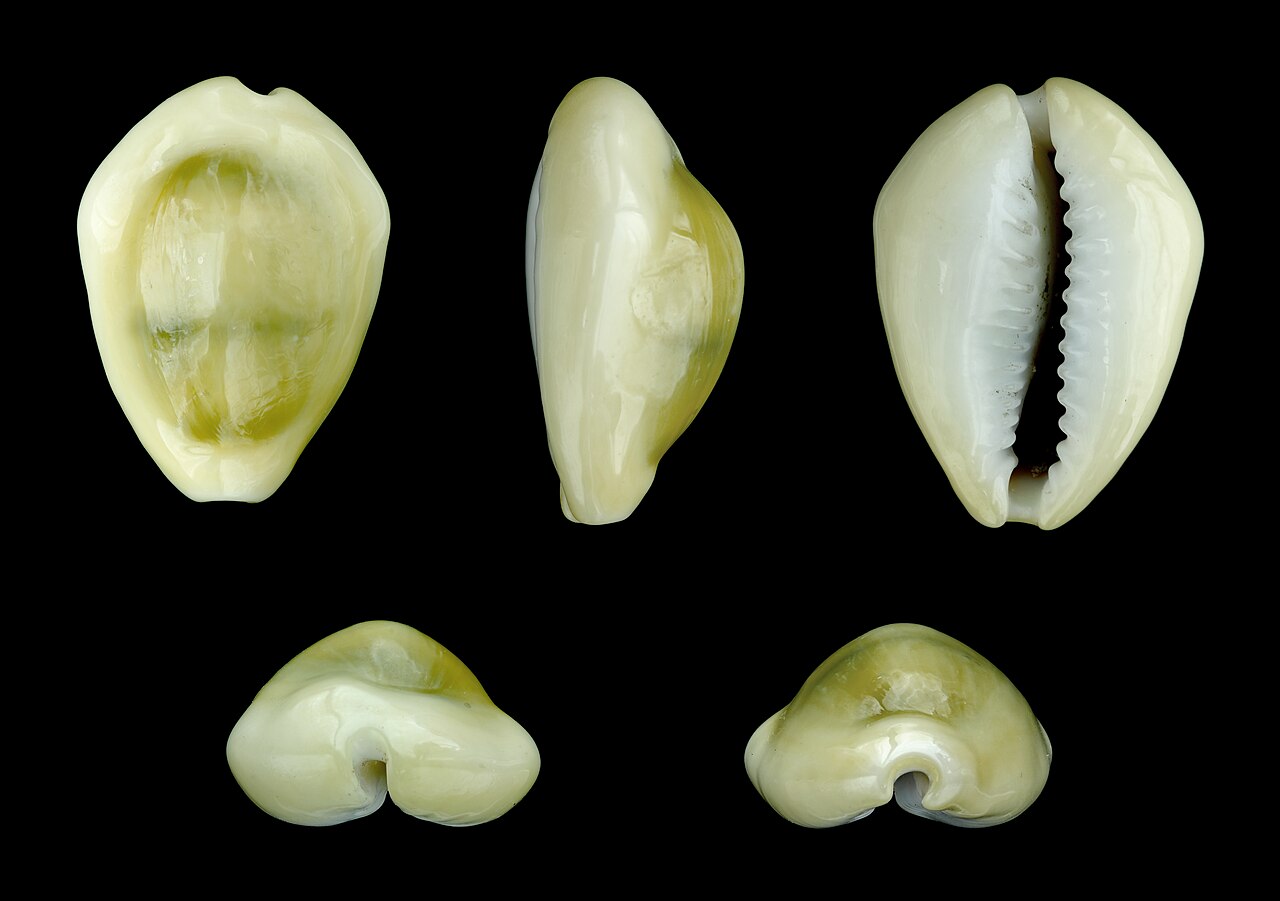
The impact of invertebrates extends beyond the strictly biological field. The shell of the cowrie (Monetaria moneta), a small marine mollusc, served as a medium of exchange on an international scale.10
- Fishing: Fished mainly in the Maldive Islands, in the Indian Ocean.
- Export: Shipped in billions of shells.
- Use: Used as everyday currency in West Africa and Asia over several centuries.
This trade required structured maritime networks, precise accounting and a global commercial agreement. It was a major economic system based on a marine biological resource.
Exploring marine biodiversity
Whichever estimate is adopted, the biological inventory of the oceans is still largely to be done.
Most current data concern coastal and shallow areas, which are easy to reach. Knowledge of the marine environment depends directly on the state of the technology for reaching the depths and observing them.
Ecological functions: the case of filtration
Numerical data on the role of marine organisms must be analysed rigorously.
Revising the oyster example
The often-quoted filtration figure of “190 litres of water per day per oyster” corresponds to optimal laboratory conditions (targeted temperature and salinity). It does not reflect an annual average. In the natural environment, the rate is far more variable: on reefs measured on site, small oysters filtered on average about 1.2 litres per hour.11
A more representative indicator comes from a historical comparison of the same ecosystem:
- Chesapeake Bay (historical): Oyster populations filtered the entire volume of the estuary in 3 to 4 days.
- Chesapeake Bay (present): In the northern part of the bay, oysters have fallen to less than 1% of their numbers in the early nineteenth century. Overall filtration now takes more than 300 days.12
Impact on the environment
A restored oyster reef can remove up to ten times more nitrogen from the environment than a nearby unrestored bottom. In a single Maryland waterway, Harris Creek, the restored reefs remove each year as much nitrogen as 20,000 bags of garden fertiliser.13
Other filtering organisms
The work of filtration is shared by many sessile organisms:
| Organism | Indicative filtration capacity | Ecosystem impact |
|---|---|---|
| Oyster (Crassostrea virginica) | 4 to 34 L/h (depending on conditions) | Clarification of estuaries, nitrogen retention |
| Sponge (one-kilogram individual) | up to 24,000 L/day | Bacterial purification, nutrient cycling |
Sources for the table14
The clarity and chemical quality of coastal waters depend on the combined action of these immobile benthic organisms.
Ecosystems and human pressures
Marine invertebrates hold a central place in the balance of the ocean, and two pressures weigh on them today:
- Ocean acidification: The absorption of atmospheric CO₂ lowers marine pH and reduces the availability of carbonate ions, which are essential to the calcification of molluscs and corals. (See Entry 7.13, Human impact and climate change.)
- Bottom trawling: The mechanical destruction of benthic habitats directly affects populations of filter-feeding invertebrates and the associated food webs.15
Note 1
it predicts ∼8.7 million (±1.3 million SE) eukaryotic species globally, of which ∼2.2 million (±0.18 million SE) are marine […] some 86% of existing species on Earth and 91% of species in the ocean still await description
Mora, Camilo et al., “How Many Species Are There on Earth and in the Ocean?”, PLoS Biology, vol. 9, no. 8, e1001127, 2011
In spite of 250 years of taxonomic classification and over 1.2 million species already catalogued in a central database, our results suggest that some 86% of existing species on Earth and 91% of species in the ocean still await description.
Mora, Camilo et al., “How Many Species Are There on Earth and in the Ocean?”, PLoS Biology, vol. 9, no. 8, e1001127, 2011, open access
Note 2
Currently, between one-third and two-thirds of marine species may be undescribed, and previous estimates of there being well over one million marine species appear highly unlikely. […] We each limited our estimates to groups for which we have close working knowledge.
Appeltans, Ward et al., “The Magnitude of Global Marine Species Diversity”, Current Biology, vol. 22, no. 23, 2012, p. 2189-2202
Note 3
Cephalopods evolved during the Cambrian (∼530 Ma) from a monoplacophoran-like mollusc in which the conical, external shell was modified into a chambered buoyancy apparatus.
Kröger, Björn, Vinther, Jakob and Fuchs, Dirk, “Cephalopod Origin and Evolution”, BioEssays, vol. 33, 2011, p. 602-613
The arm nervous system, containing two-thirds of the total 500 million neurons in the octopus nervous system, may function rather autonomously […] The octopus VL still maintains the basic morphological organization of invertebrate ganglia, with monopolar neurons whose cell bodies are organized in an outer layer and which send their processes into an internal neuropil.
Hochner, Binyamin, Shomrat, Tal and Fiorito, Graziano, “The Octopus: A Model for a Comparative Analysis of the Evolution of Learning and Memory Mechanisms”, The Biological Bulletin, vol. 210, 2006, p. 308-317
Note 4
Here we present data from a five-level learning and problem-solving experiment. Seven octopuses (Octopus vulgaris) were first trained to open an L shaped container to retrieve food (level 0).
Richter, Jonas N., Hochner, Binyamin and Kuba, Michael J., “Pull or Push? Octopuses Solve a Puzzle Problem”, PLOS ONE, vol. 11, no. 3, e0152048, 2016
they had to retrieve this L shaped container […] through a tight fitting hole in a clear Perspex partition (level 1). This required the octopuses to perform both pull and release or push actions.
Richter, Jonas N., Hochner, Binyamin and Kuba, Michael J., “Pull or Push? Octopuses Solve a Puzzle Problem”, PLOS ONE, vol. 11, no. 3, e0152048, 2016
a different consistent orientation of the object (level 2) at the start of the trial, an opaque barrier (level 3) or a random orientation of the object (level 4)
Richter, Jonas N., Hochner, Binyamin and Kuba, Michael J., “Pull or Push? Octopuses Solve a Puzzle Problem”, PLOS ONE, vol. 11, no. 3, e0152048, 2016
Note 5
All octopuses were successful in reaching criterion in all levels of the task.
Richter, Jonas N., Hochner, Binyamin and Kuba, Michael J., “Pull or Push? Octopuses Solve a Puzzle Problem”, PLOS ONE, vol. 11, no. 3, e0152048, 2016
Note 6
At the onset of each new level the performance of the animals dropped, shown as an increase in working times. However, they adapted quickly so that overall working times were not significantly different between levels.
Richter, Jonas N., Hochner, Binyamin and Kuba, Michael J., “Pull or Push? Octopuses Solve a Puzzle Problem”, PLOS ONE, vol. 11, no. 3, e0152048, 2016
Note 7
Our findings indicate that octopuses show behavioral flexibility by quickly adapting to a change in a task.
Richter, Jonas N., Hochner, Binyamin and Kuba, Michael J., “Pull or Push? Octopuses Solve a Puzzle Problem”, PLOS ONE, vol. 11, no. 3, e0152048, 2016
Note 8
Octopuses have large brains and exhibit complex behaviors, but relatively little is known about their cognitive abilities.
Richter, Jonas N., Hochner, Binyamin and Kuba, Michael J., “Pull or Push? Octopuses Solve a Puzzle Problem”, PLOS ONE, vol. 11, no. 3, e0152048, 2016
Note 9
Subsumed within this challenge is the study of subjective experience in non-human animals: a particularly difficult endeavor that becomes even more so, as one crosses the great evolutionary divide between vertebrate and invertebrate phyla. […] We believe such a review is timely, particularly considering cephalopods' impressive learning and memory abilities, rich behavioral repertoire, and the relative complexity of their nervous systems and sensory capabilities. […] We highlight the current lack of evidence as well as potentially informative areas that warrant further investigation to support the view expressed here. […] Cephalopods commonly adopt dynamic, flexible predatory strategies that include selective, opportunistic, and plastic foraging behaviors in response to changing environmental conditions (Hanlon and Messenger, 2018).
Ponte, Giovanna, Chiandetti, Cinzia, Edelman, David B., Imperadore, Pamela, Pieroni, Eleonora Maria and Fiorito, Graziano, “Cephalopod Behavior: From Neural Plasticity to Consciousness”, Frontiers in Systems Neuroscience, vol. 15, 787139, 2022
Note 10
The shell money of the slave trade consisted of thousands of millions of little cowrie shells, most of them fished in the lagoons of the far-off Maldive Islands of the Indian Ocean. They came to West Africa in a journey lasting a year or more, shipped initially by Arab merchants who took them to North Africa for export across the Sahara, and later by the European trading companies who carried them to Lisbon, Amsterdam, or London as ballast.
Hogendorn, Jan and Johnson, Marion, The Shell Money of the Slave Trade, Cambridge University Press, 1986
Note 11
Although direct comparisons could not be made due to the small size of oysters on the study reefs (mean shell height, 36.1 mm), our calculated rates (mean, 1.21 L h−1) were similar to published laboratory measured rates for oysters of this size. However, the wide variability in measured removal by the oyster reefs suggests that individual oyster feeding rates in nature may be much more variable than in the laboratory.
Grizzle, Raymond E., Greene, Jennifer K. and Coen, Loren D., “Seston Removal by Natural and Constructed Intertidal Eastern Oyster (Crassostrea virginica) Reefs: A Comparison with Previous Laboratory Studies, and the Value of In Situ Methods”, Estuaries and Coasts, vol. 31, 2008, p. 1208-1220
Note 12
At peak abundance, sometime prior to 1870 (Wharton, 1957), Newell (1988) estimates that oysters could filter the water of the bay every 3.3 days.
National Research Council, Nonnative Oysters in the Chesapeake Bay, National Academies Press, 2004, chapter 2 “Introduction and Overview”
We developed a statistical model to simultaneously estimate effects of fishing and disease on oysters in upper Chesapeake Bay during 1980 to 2009. […] We found that oyster abundance declined 99.7% (90% credibility interval [CI], 98.3 to 99.9%) since the early 1800s
Wilberg, Michael J., Livings, M. E., Barkman, J. S., Morris, B. T. and Robinson, J. M., “Overfishing, Disease, Habitat Loss, and Potential Extirpation of Oysters in Upper Chesapeake Bay”, Marine Ecology Progress Series, vol. 436, 2011, p. 131-144
In 1988, the Bay's considerably depleted oyster population, said Newell, would have taken more than 300 days to do the same. Today's further diminished stocks would likely take even longer.
Leffler, Merrill, “Oyster Reefs: Key to Restoring Bay Grasses?”, Maryland Marine Notes, vol. 19, no. 1, janvier-February 2001, Maryland Sea Grant College
Note 13
A study led by researcher Lisa Kellogg of the Virginia Institute of Marine Science shows that a restored oyster reef can remove up to 10 times more nitrogen from Chesapeake Bay waters than an unrestored area nearby, providing additional evidence that reef restoration can contribute to efforts to improve water quality in the nation’s largest estuary.
Malmquist, David, “Study shows restored oyster reef worth its weight in nutrients”, Virginia Institute of Marine Science, 1 May 2013
In Harris Creek (Maryland) alone, restored reefs each year remove nitrogen equivalent to roughly 20,000 bags of 10-10-10 garden fertilizer.
NOAA Fisheries (NOAA Chesapeake Bay Office), “Oyster Reefs Provide Habitat and Filter Water, Findings Show”, 18 March 2021
Note 14
Current-Induced Flow through Living Sponges in Nature ; Sponge-Associated Microorganisms
Taylor, Michael W. et al., “Sponge-Associated Microorganisms”, Microbiology and Molecular Biology Reviews, vol. 71, no. 2, 2007, p. 295-347, open access ; et Vogel, Steven, “Current-Induced Flow through Living Sponges in Nature”, Proceedings of the National Academy of Sciences, vol. 74, 1977, p. 2069-2071
Note 15
Rising atmospheric carbon dioxide (CO2), primarily from human fossil fuel combustion, reduces ocean pH and causes wholesale shifts in seawater carbonate chemistry. […] One well-known effect is the lowering of calcium carbonate saturation states, which impacts shell-forming marine organisms from plankton to benthic molluscs, echinoderms, and corals.
Doney, Scott C. et al., “Ocean Acidification: The Other CO₂ Problem”, Annual Review of Marine Science, vol. 1, 2009, p. 169-192
Notes and sources
- ↑
Passage 91% of the species in the sea remain to be described, compared with 86% for all species on the planet […] about 8.7 million species on Earth, of which 2.2 million are in the ocean
it predicts ∼8.7 million (±1.3 million SE) eukaryotic species globally, of which ∼2.2 million (±0.18 million SE) are marine […] some 86% of existing species on Earth and 91% of species in the ocean still await description
Source Mora, Camilo et al., “How Many Species Are There on Earth and in the Ocean?”, PLoS Biology, vol. 9, no. 8, e1001127, 2011, abstract.
Open access open the source · checked on 9 September 2026
Passage 91% of the species in the sea remain to be described
In spite of 250 years of taxonomic classification and over 1.2 million species already catalogued in a central database, our results suggest that some 86% of existing species on Earth and 91% of species in the ocean still await description.
Source Mora, Camilo et al., “How Many Species Are There on Earth and in the Ocean?”, PLoS Biology, vol. 9, no. 8, e1001127, 2011, open access, abstract.
Open access open the source · checked on 24 October 2026
- ↑
Passage A team bringing together more than one hundred and twenty marine taxonomists replied as early as 2012 that such a total is unlikely […] the second directly asks the specialists of each group
Currently, between one-third and two-thirds of marine species may be undescribed, and previous estimates of there being well over one million marine species appear highly unlikely. […] We each limited our estimates to groups for which we have close working knowledge.
Source Appeltans, Ward et al., “The Magnitude of Global Marine Species Diversity”, Current Biology, vol. 22, no. 23, 2012, p. 2189-2202, abstract (“Conclusions”), p. 2191; introduction, p. 2192.
Open access · checked on 24 October 2026
- ↑
Passage the first cephalopods appeared about 530 million years ago
Cephalopods evolved during the Cambrian (∼530 Ma) from a monoplacophoran-like mollusc in which the conical, external shell was modified into a chambered buoyancy apparatus.
Source Kröger, Björn, Vinther, Jakob and Fuchs, Dirk, “Cephalopod Origin and Evolution”, BioEssays, vol. 33, 2011, p. 602-613, abstract.
Paywalled open the source · checked on 9 September 2026
Passage A key part of their brain retains the basic organisation of invertebrate nerve centres. Most of their neurons are located in their arms.
The arm nervous system, containing two-thirds of the total 500 million neurons in the octopus nervous system, may function rather autonomously […] The octopus VL still maintains the basic morphological organization of invertebrate ganglia, with monopolar neurons whose cell bodies are organized in an outer layer and which send their processes into an internal neuropil.
Source Hochner, Binyamin, Shomrat, Tal and Fiorito, Graziano, “The Octopus: A Model for a Comparative Analysis of the Evolution of Learning and Memory Mechanisms”, The Biological Bulletin, vol. 210, 2006, p. 308-317, section “Organization of the Octopus Brain”, 2nd paragraph; then “Concluding Remarks”, 3rd paragraph.
Paywalled · checked on 25 October 2026
- ↑
Passage a study put seven octopuses through a five-level test. They were first taught to open an L-shaped container
Here we present data from a five-level learning and problem-solving experiment. Seven octopuses (Octopus vulgaris) were first trained to open an L shaped container to retrieve food (level 0).
Source Richter, Jonas N., Hochner, Binyamin and Kuba, Michael J., “Pull or Push? Octopuses Solve a Puzzle Problem”, PLOS ONE, vol. 11, no. 3, e0152048, 2016, abstract.
Open access open the source · checked on 9 September 2026
Passage they had to pass it through a narrow hole cut in a transparent partition — which required them to pull, release, then push
they had to retrieve this L shaped container […] through a tight fitting hole in a clear Perspex partition (level 1). This required the octopuses to perform both pull and release or push actions.
Source Richter, Jonas N., Hochner, Binyamin and Kuba, Michael J., “Pull or Push? Octopuses Solve a Puzzle Problem”, PLOS ONE, vol. 11, no. 3, e0152048, 2016, abstract.
Open access open the source · checked on 9 September 2026
Passage the object’s orientation changed. Then the partition became opaque. Then the orientation was drawn at random on each trial.
a different consistent orientation of the object (level 2) at the start of the trial, an opaque barrier (level 3) or a random orientation of the object (level 4)
Source Richter, Jonas N., Hochner, Binyamin and Kuba, Michael J., “Pull or Push? Octopuses Solve a Puzzle Problem”, PLOS ONE, vol. 11, no. 3, e0152048, 2016, abstract.
Open access open the source · checked on 9 September 2026
- ↑
Passage All seven octopuses succeeded at every level.
All octopuses were successful in reaching criterion in all levels of the task.
Source Richter, Jonas N., Hochner, Binyamin and Kuba, Michael J., “Pull or Push? Octopuses Solve a Puzzle Problem”, PLOS ONE, vol. 11, no. 3, e0152048, 2016, abstract.
Open access open the source · checked on 9 September 2026
- ↑
Passage At each change of rule, their performance dropped — they took longer. Then they adapted so quickly that […] working times did not differ significantly from one level to the next.
At the onset of each new level the performance of the animals dropped, shown as an increase in working times. However, they adapted quickly so that overall working times were not significantly different between levels.
Source Richter, Jonas N., Hochner, Binyamin and Kuba, Michael J., “Pull or Push? Octopuses Solve a Puzzle Problem”, PLOS ONE, vol. 11, no. 3, e0152048, 2016, abstract.
Open access open the source · checked on 9 September 2026
- ↑
Passage The authors call this behavioural flexibility.
Our findings indicate that octopuses show behavioral flexibility by quickly adapting to a change in a task.
Source Richter, Jonas N., Hochner, Binyamin and Kuba, Michael J., “Pull or Push? Octopuses Solve a Puzzle Problem”, PLOS ONE, vol. 11, no. 3, e0152048, 2016, abstract.
Open access open the source · checked on 9 September 2026
- ↑
Passage octopuses have large brains and complex behaviours, but relatively little is known about their cognitive abilities
Octopuses have large brains and exhibit complex behaviors, but relatively little is known about their cognitive abilities.
Source Richter, Jonas N., Hochner, Binyamin and Kuba, Michael J., “Pull or Push? Octopuses Solve a Puzzle Problem”, PLOS ONE, vol. 11, no. 3, e0152048, 2016, abstract.
Open access open the source · checked on 9 September 2026
- ↑
Passage What is established is the capacity for learning, adapting and changing strategy. What is not established is the nature of their subjective experience.
Subsumed within this challenge is the study of subjective experience in non-human animals: a particularly difficult endeavor that becomes even more so, as one crosses the great evolutionary divide between vertebrate and invertebrate phyla. […] We believe such a review is timely, particularly considering cephalopods' impressive learning and memory abilities, rich behavioral repertoire, and the relative complexity of their nervous systems and sensory capabilities. […] We highlight the current lack of evidence as well as potentially informative areas that warrant further investigation to support the view expressed here. […] Cephalopods commonly adopt dynamic, flexible predatory strategies that include selective, opportunistic, and plastic foraging behaviors in response to changing environmental conditions (Hanlon and Messenger, 2018).
Source Ponte, Giovanna, Chiandetti, Cinzia, Edelman, David B., Imperadore, Pamela, Pieroni, Eleonora Maria and Fiorito, Graziano, “Cephalopod Behavior: From Neural Plasticity to Consciousness”, Frontiers in Systems Neuroscience, vol. 15, 787139, 2022, abstract, 3rd, 5th and 9th sentences; then section “Cephalopod Cognition”, subsection “Discriminatory and Anticipatory Behaviors”, 1st sentence of the paragraph on predatory strategies.
Open access open the source · checked on 27 October 2026
- ↑
Passage The shell of the cowrie (Monetaria moneta), a small marine mollusc, served as a medium of exchange on an international scale […] Fished mainly in the Maldive Islands […] Shipped in billions of shells.
The shell money of the slave trade consisted of thousands of millions of little cowrie shells, most of them fished in the lagoons of the far-off Maldive Islands of the Indian Ocean. They came to West Africa in a journey lasting a year or more, shipped initially by Arab merchants who took them to North Africa for export across the Sahara, and later by the European trading companies who carried them to Lisbon, Amsterdam, or London as ballast.
Source Hogendorn, Jan and Johnson, Marion, The Shell Money of the Slave Trade, Cambridge University Press, 1986, “Introduction”, p. 1, 1st paragraph (the only passage shown without a subscription by the publisher, under “Summary”).
In libraries; beginning of the introduction freely readable on the publisher’s site open the source · checked on 27 October 2026
- ↑
Passage In the natural environment, the rate is far more variable: on reefs measured on site, small oysters filtered on average about 1.2 litres per hour.
Although direct comparisons could not be made due to the small size of oysters on the study reefs (mean shell height, 36.1 mm), our calculated rates (mean, 1.21 L h−1) were similar to published laboratory measured rates for oysters of this size. However, the wide variability in measured removal by the oyster reefs suggests that individual oyster feeding rates in nature may be much more variable than in the laboratory.
Source Grizzle, Raymond E., Greene, Jennifer K. and Coen, Loren D., “Seston Removal by Natural and Constructed Intertidal Eastern Oyster (Crassostrea virginica) Reefs: A Comparison with Previous Laboratory Studies, and the Value of In Situ Methods”, Estuaries and Coasts, vol. 31, 2008, p. 1208-1220, abstract.
Paywalled open the source · checked on 9 September 2026
- ↑
Passage Oyster populations filtered the entire volume of the estuary in 3 to 4 days.
At peak abundance, sometime prior to 1870 (Wharton, 1957), Newell (1988) estimates that oysters could filter the water of the bay every 3.3 days.
Source National Research Council, Nonnative Oysters in the Chesapeake Bay, National Academies Press, 2004, chapter 2 “Introduction and Overview”, chapter 2 “Introduction and Overview”, p. 15.
Open access open the source · checked on 27 October 2026
Passage In the northern part of the bay, oysters have fallen to less than 1% of their numbers in the early nineteenth century.
We developed a statistical model to simultaneously estimate effects of fishing and disease on oysters in upper Chesapeake Bay during 1980 to 2009. […] We found that oyster abundance declined 99.7% (90% credibility interval [CI], 98.3 to 99.9%) since the early 1800s
Source Wilberg, Michael J., Livings, M. E., Barkman, J. S., Morris, B. T. and Robinson, J. M., “Overfishing, Disease, Habitat Loss, and Potential Extirpation of Oysters in Upper Chesapeake Bay”, Marine Ecology Progress Series, vol. 436, 2011, p. 131-144, abstract, p. 131.
Open access open the source · checked on 25 October 2026
Passage Overall filtration now takes more than 300 days.
In 1988, the Bay's considerably depleted oyster population, said Newell, would have taken more than 300 days to do the same. Today's further diminished stocks would likely take even longer.
Source Leffler, Merrill, “Oyster Reefs: Key to Restoring Bay Grasses?”, Maryland Marine Notes, vol. 19, no. 1, janvier-February 2001, Maryland Sea Grant College, main article of the issue.
Open access open the source · checked on 25 October 2026
- ↑
Passage A restored oyster reef can remove up to ten times more nitrogen from the environment than a nearby unrestored bottom.
A study led by researcher Lisa Kellogg of the Virginia Institute of Marine Science shows that a restored oyster reef can remove up to 10 times more nitrogen from Chesapeake Bay waters than an unrestored area nearby, providing additional evidence that reef restoration can contribute to efforts to improve water quality in the nation’s largest estuary.
Source Malmquist, David, “Study shows restored oyster reef worth its weight in nutrients”, Virginia Institute of Marine Science, 1 May 2013, first paragraph.
Open access open the source · checked on 25 October 2026
Passage In a single Maryland waterway, Harris Creek, the restored reefs remove each year as much nitrogen as 20,000 bags of garden fertiliser.
In Harris Creek (Maryland) alone, restored reefs each year remove nitrogen equivalent to roughly 20,000 bags of 10-10-10 garden fertilizer.
Source NOAA Fisheries (NOAA Chesapeake Bay Office), “Oyster Reefs Provide Habitat and Filter Water, Findings Show”, 18 March 2021, body of the article.
Open access open the source · checked on 25 October 2026
- ↑
Passage Sponge (one-kilogram individual) […] up to 24,000 L/day
Current-Induced Flow through Living Sponges in Nature ; Sponge-Associated Microorganisms
Source Taylor, Michael W. et al., “Sponge-Associated Microorganisms”, Microbiology and Molecular Biology Reviews, vol. 71, no. 2, 2007, p. 295-347, open access ; et Vogel, Steven, “Current-Induced Flow through Living Sponges in Nature”, Proceedings of the National Academy of Sciences, vol. 74, 1977, p. 2069-2071, filtration rate measurements.
Open access · checked on 9 September 2026
- ↑
Passage The absorption of atmospheric CO₂ lowers marine pH and reduces the availability of carbonate ions, which are essential to the calcification
Rising atmospheric carbon dioxide (CO2), primarily from human fossil fuel combustion, reduces ocean pH and causes wholesale shifts in seawater carbonate chemistry. […] One well-known effect is the lowering of calcium carbonate saturation states, which impacts shell-forming marine organisms from plankton to benthic molluscs, echinoderms, and corals.
Source Doney, Scott C. et al., “Ocean Acidification: The Other CO₂ Problem”, Annual Review of Marine Science, vol. 1, 2009, p. 169-192, abstract.
Paywalled · checked on 25 October 2026
Bibliography
17
- Appeltans, Ward et al., “The Magnitude of Global Marine Species Diversity”, Current Biology, vol. 22, no. 23, 2012, p. 2189-2202, open access (the competing estimate, based on consulting the specialists of each group).
- Doney, Scott C. et al., “Ocean Acidification: The Other CO₂ Problem”, Annual Review of Marine Science, vol. 1, 2009, p. 169-192, paywalled (carbonate ions and calcification).
- Godfrey-Smith, Peter, Other Minds: The Octopus, the Sea, and the Deep Origins of Consciousness, Farrar, Straus and Giroux, 2016, in libraries (the question of subjective experience, raised without being settled). French translation: Le Prince des profondeurs, Flammarion, 2018.
- Grizzle, Raymond E., Greene, Jennifer K. and Coen, Loren D., “Seston Removal by Natural and Constructed Intertidal Eastern Oyster (Crassostrea virginica) Reefs: A Comparison with Previous Laboratory Studies, and the Value of In Situ Methods”, Estuaries and Coasts, vol. 31, 2008, p. 1208-1220, paywalled, open-access abstract (the average rate of about 1.2 litres per hour measured on site in small oysters, and its high variability in the natural environment). https://doi.org/10.1007/s12237-008-9098-8
- Hochner, Binyamin, Shomrat, Tal and Fiorito, Graziano, “The Octopus: A Model for a Comparative Analysis of the Evolution of Learning and Memory Mechanisms”, The Biological Bulletin, vol. 210, 2006, p. 308-317, paywalled (the nervous system of cephalopods and the distribution of neurons).
- Hogendorn, Jan and Johnson, Marion, The Shell Money of the Slave Trade, Cambridge University Press, 1986, in libraries (the cowrie, from the Maldives to West Africa; see Entry 2.11).
- Kröger, Björn, Vinther, Jakob and Fuchs, Dirk, “Cephalopod Origin and Evolution”, BioEssays, vol. 33, 2011, p. 602-613, paywalled (the appearance of cephalopods and the divergence of the lineages). https://doi.org/10.1002/bies.201100001
- Leffler, Merrill, “Oyster Reefs: Key to Restoring Bay Grasses?”, Maryland Marine Notes, vol. 19, no. 1, janvier-February 2001, Maryland Sea Grant College, open access (Roger Newell’s calculations: in 1988, the oysters of Chesapeake Bay would have taken more than 300 days to filter all of its water). https://mdsg.umd.edu/sites/default/files/files/MN19_1.PDF
- Malmquist, David, “Study shows restored oyster reef worth its weight in nutrients”, Virginia Institute of Marine Science, 1 May 2013, open access (Lisa Kellogg’s study: a restored oyster reef removes up to ten times more nitrogen than a nearby unrestored bottom). https://www.vims.edu/newsandevents/topstories/archives/2013/oyster_nutrient_removal.php
- Mora, Camilo et al., “How Many Species Are There on Earth and in the Ocean?”, PLoS Biology, vol. 9, no. 8, e1001127, 2011, open access (2.2 million marine species predicted; 91% undescribed). https://doi.org/10.1371/journal.pbio.1001127
- National Research Council, Nonnative Oysters in the Chesapeake Bay, National Academies Press, 2004, open access (Newell’s estimate: before 1870, oysters could filter the bay’s water every 3.3 days). https://doi.org/10.17226/10796
- Newell, Roger I. E., “Ecological Changes in Chesapeake Bay”, dans Understanding the Estuary, Chesapeake Research Consortium, 1988, p. 536-546, in libraries (the volume of the bay once filtered in a few days).
- NOAA Fisheries (NOAA Chesapeake Bay Office), “Oyster Reefs Provide Habitat and Filter Water, Findings Show”, 18 March 2021, open access (in Harris Creek, Maryland, alone, the restored reefs remove each year the nitrogen equivalent of about 20,000 bags of garden fertiliser). https://www.fisheries.noaa.gov/feature-story/oyster-reefs-provide-habitat-and-filter-water-findings-show
- Ponte, Giovanna, Chiandetti, Cinzia, Edelman, David B., Imperadore, Pamela, Pieroni, Eleonora Maria and Fiorito, Graziano, “Cephalopod Behavior: From Neural Plasticity to Consciousness”, Frontiers in Systems Neuroscience, vol. 15, 787139, 2022, open access (the learning abilities and behavioural flexibility of cephalopods, well documented; subjective experience, still lacking sufficient evidence). https://doi.org/10.3389/fnsys.2021.787139
- Richter, Jonas N., Hochner, Binyamin and Kuba, Michael J., “Pull or Push? Octopuses Solve a Puzzle Problem”, PLOS ONE, vol. 11, no. 3, e0152048, 2016, open access (the seven octopuses, the five levels, the L-shaped container, the drop in performance at each change of rule and the rapid adaptation; behavioural flexibility; how little is known about their cognitive abilities). https://doi.org/10.1371/journal.pone.0152048
- Taylor, Michael W. et al., “Sponge-Associated Microorganisms”, Microbiology and Molecular Biology Reviews, vol. 71, no. 2, 2007, p. 295-347, open access ; et Vogel, Steven, “Current-Induced Flow through Living Sponges in Nature”, Proceedings of the National Academy of Sciences, vol. 74, 1977, p. 2069-2071, open access (the filtration rates of sponges).
- Wilberg, Michael J., Livings, M. E., Barkman, J. S., Morris, B. T. and Robinson, J. M., “Overfishing, Disease, Habitat Loss, and Potential Extirpation of Oysters in Upper Chesapeake Bay”, Marine Ecology Progress Series, vol. 436, 2011, p. 131-144, open access (in the northern part of Chesapeake Bay, the number of oysters has fallen by 99.7% since the early nineteenth century). https://www.int-res.com/abstracts/meps/v436/p131-144/
Spotted an error or have a doubt? Write to us.