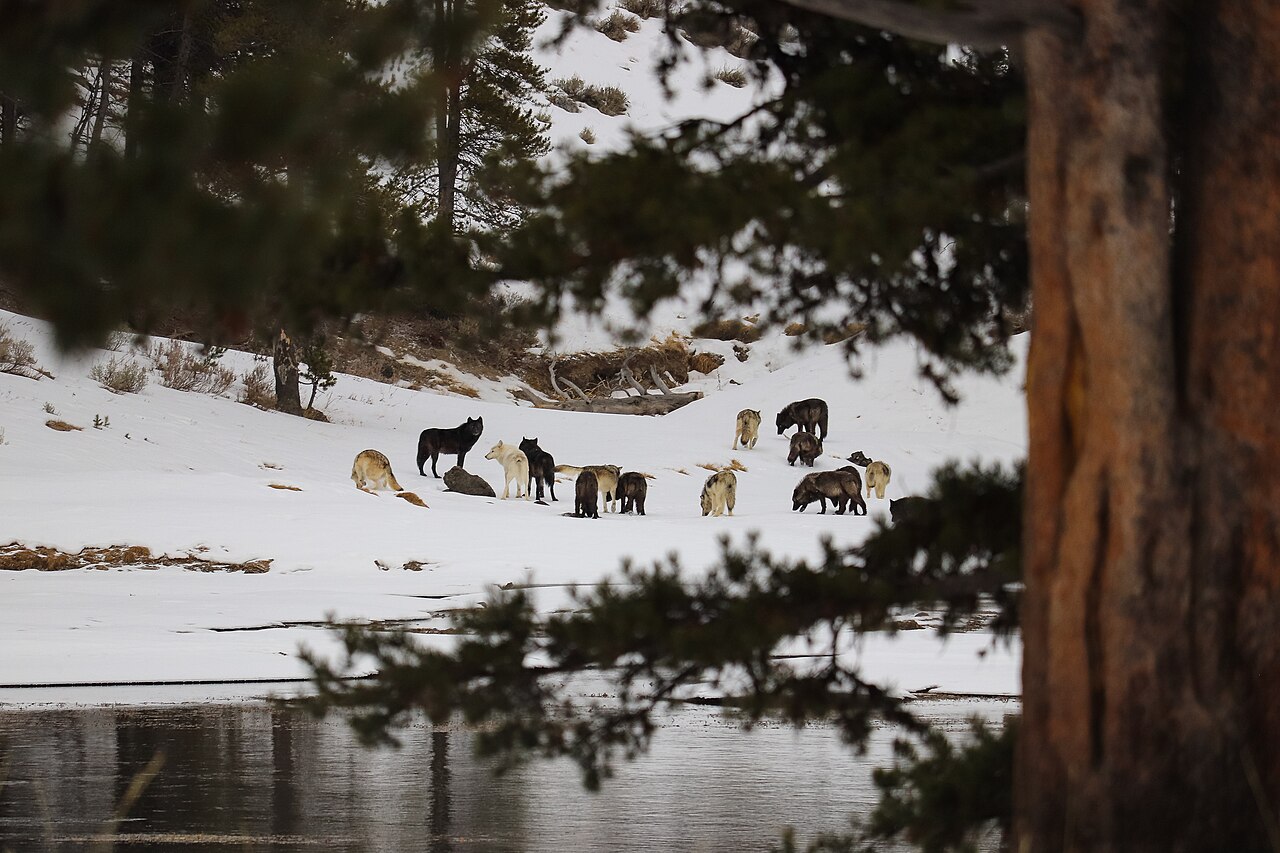

The alpha wolf does not exist.
This claim is neither an opinion nor a recent one. The man who spread the idea spent the last twenty years of his working life trying to take it back.
He did not succeed. That is the story worth telling.
The origin of the idea
In the mid-twentieth century, nobody knew how to follow wild wolves. Winter, the forest, the distances: it was impossible.
So they were studied in captivity.
Adult wolves, from different places and unrelated to one another, were taken and put together in an enclosure — the one at Basel Zoo, where observations began as early as 1934.1
This set-up deserves close examination, because everything follows from it. Animals that, in the wild, range in families over territories of several hundred square kilometres, shut up together in an enclosure, among strangers.
What happened? What was bound to happen. They fought over food, space and right of way. The biggest and most aggressive gained the upper hand. The ranks were given names: alpha, beta, omega. It was a Swiss zoologist, Rudolf Schenkel, who used the word “alpha” in 1947, after observing wolves at Basel Zoo.2
The conclusion drawn was that this is how wolves lived.
A comparison to test the reasoning
In 2010, thirty-three miners were trapped underground in Chile for sixty-nine days.
One could have studied those thirty-three men, in that hole, during those sixty-nine days, and drawn conclusions from them about human behaviour in general.
The approach would seem absurd. Yet that is exactly what was done with wolves.
The observation set-up produced what it observed.
This mechanism appears elsewhere on this site, with the canals people thought they saw on Mars. Nobody lied, and nobody observed carelessly. It was the way of observing that manufactured the result.
What he did next
The biologist who had written the book was L. David Mech. His book came out in 1970 and became a lasting success. In it he took up Schenkel’s word “alpha”, because that was all that science knew at the time.3
Then, from 1986 onwards, he went to Ellesmere Island, in the Canadian Arctic, where the wolves tolerate the presence of humans. He spent whole summers there observing free-living packs.4
What he observed bore no resemblance to a power struggle.
A wolf pack is a family. A pair that has young, and its offspring from previous years. The “leaders” are not the strongest: they are the parents.5
In 1999, he published the correction in a scientific journal.6
The real subject of this page
Mech could have stopped there. He did not.
He publicly asked people to stop using the word, and he repeated this for years.7
His book, on the other hand, went on selling. As late as 2020, Mech acknowledged that he was partly responsible for spreading the idea, through this book that was still on sale.8
The book remained on sale for fifty-two years, until it was withdrawn in 2022.9
This fact is worth pausing on. A scientist understood that he had been wrong. He wrote it, he published it, he repeated it for twenty years. The book went on selling in bookshops, with the error it contained.
The word’s career outside biology
The word “alpha”, for its part, did not stay with wolves.
It was used to justify dog-training methods based on dominance — since the dog descends from the wolf, and the wolf supposedly obeys the strongest.
It was used to give a veneer of nature to a certain idea of leadership among humans: supposedly there are alphas and the rest, and this comes from nature.
But it does not come from nature. It comes from an enclosure.
Three families, three ways of being in the world
The order Carnivora comprises about 300 species of placental mammals (see Entry 5.7, Rodents and small mammals). Within this order, ways of hunting and of living together vary widely; felids, canids and ursids offer three examples.10
- Canids (wolves, foxes, African wild dogs): specialists in endurance and the group. Their strategy rests on cooperation, tracking over long distances and a family-based social structure organised around clear rules.
- Felids (lions, tigers, lynxes): hypercarnivory and the perfection of ambush hunting. Retractable claws, night vision, lightning acceleration. With the notable exception of the lion — which lives in prides to defend a territory against other predators — felids are strictly solitary. Among them, interaction with others of their kind is limited to reproduction and territory.
- Ursids (brown bears, grizzlies, pandas): power and opportunism. Although classified among the carnivores, most are generalist omnivores. Solitary, they adapt their behaviour through the seasons, building up massive reserves before entering winter torpor. They have no pack and no permanent dominance: their contacts are dictated solely by the availability of resources (as during salmon runs).
Dominance is not what drives these species. For the solitary felid, it has no meaning. For the bear, it comes down to mutual avoidance or temporary precedence over food. For the canid, it gives way to kinship ties.
The most widely told wolf story in the world
You may know it: biology teachers all over the world use it.
Wolves had been eradicated from Yellowstone Park in 1926. They were reintroduced there in 1995. From then on, according to the story, the forest came back, the rivers changed course, the whole ecosystem regained its balance.11
This story is being unravelled, and has been for twenty years.
The timeline
- 2004 — in the upper Gallatin (Montana), on the edge of the park, photographs document a recovery of willows.
- 2008 — other researchers publish photographs that dispute it.
- 2010 — the aspens had not grown back, even though the elk population of the northern winter range had fallen by about 60%. (Caution about the scope: depending on whether one counts the whole park or a specific study area, the reported decline ranges from 20% to over 60%. One must always ask what territory a percentage refers to.)
- 2011 — across 315 stands monitored, densities of tall stems fell by 12% at the landscape scale.
- 2024 — a twenty-year field experiment concludes that the return of wolves was not enough to restore the habitat.12
The latest episode, in 2025
In early 2025, one team reported the opposite: a strong cascade. Its figure went round the world: a 1,500% increase in willow crown volume, measured at twenty-five riverside sites between 2001 and 2020. The authors claim the effect exceeds most trophic cascades documented worldwide.13
In October 2025, another team published in the same journal a comment demonstrating that this conclusion is invalid.
The main criticism deserves to be understood, because it is crystal clear. The authors had not measured crown volume: they had calculated it from plant height, using a formula that defines volume precisely as a function of that same height.14
In other words: you supply a height, the formula returns a volume, and you then announce that the volume has increased. But the volume was never anything other than the height, dressed up differently. An argument that assumes what it claims to prove is called circular.
Other criticisms follow, and the list is in itself a lesson in method: violated calculation assumptions, plots compared without being matched, equilibrium indicators applied to a system that is not at equilibrium, selectively framed photographs, and the omission of human hunting among the possible causes.15
The debate continues: in 2026, in another journal, the challenged authors replied to a new critique by Daniel MacNulty and his colleagues, this time targeting their study on aspens.16
The two teams worked on the same height measurements.
The disagreement is not about the facts. It is about how to treat them.
What the researchers say
The ecologist Tom Hobbs, of Colorado State University, who studies how willows have responded to the reintroduction:
“The story of wolves in Yellowstone has been made true by repeated telling, not by good science.”17
He adds that the cascade story is presented as an indisputable fact when it is not: a fine story, simple and clear, but in reality more nuanced, more complex, and perhaps false.
The supposed mechanism — that of fear — does not stand up well to measurement. A 2009 study based on 727 elk faecal samples showed that their willow consumption depended more on snow conditions than on the presence of wolves: if there is a cascade, it would work through the fall in numbers, not through fear.18
The story also glosses over a crucial point: if the vegetation changed when elk numbers fell, human hunting may have contributed as much as the wolves. This omission is one of the criticisms made in 2025.
A conclusion to avoid
It would be wrong to conclude: “scientists contradict each other, so we know nothing”.
It is the reverse.
We know precisely where the disagreement lies, on what data, and for what reasons of method. Both articles can be consulted, and one can check who is right on each point.
A well-documented disagreement is worth more than a vague agreement.
Honesty cuts both ways: yes, stands of aspen and willow are thriving again — in places. But large areas remain damaged and may never recover.
Wolves are not a magic wand.
Large predators and us: the question of safeguards
Wherever the wolf, the bear or the lynx returns, the question ceases to be purely biological: it becomes social and economic.
The debate revolves around two realities that clash on the ground:
- The protection of biodiversity: large carnivores play an important role in maintaining natural balances and removing sick animals. Their presence is protected by international regulations (Bern Convention, Habitats Directive).
- The vulnerability of livestock farming: the return of predators imposes heavy constraints on farmers (livestock guardian dogs such as Pyrenean mountain dogs, electric fences, human presence). Despite these measures, predation causes stress, financial losses and a significant mental workload.
There is no simple solution. Management tools range from strict protection, through compensation for losses, to regulated defensive or cull shooting. The task is not to pass moral judgement, but to measure the real costs — financial and human — of sharing territory.
One last clarification, to avoid the opposite error
Saying that the alpha wolf does not exist does not mean that wolves live in disorder.
They have an organisation, and it is highly structured.
It is that of a family.
Note 1
Die Beobachtungen, welche dieser Arbeit zugrundeliegen, wurden 1934 begonnen. Sie galten zuerst fast ausschliesslich […] den Wolfsrudeln, die der Basler zoologische Garten […] beherbergte
The observations on which this work is based were begun in 1934. At first they concerned almost exclusively […] the wolf packs that the Basel zoological garden […] housed
Schenkel, Rudolf, “Ausdrucks-Studien an Wölfen: Gefangenschafts-Beobachtungen”, Behaviour, vol. 1, no. 2, 1947, p. 81-129
Note 2
Im Basler zoologischen Garten, wo ich seit 1934 Gelegenheit hatte, Beobachtungen an 2 nacheinander gehaltenen Wolfsrudeln zu machen, wurden bis 10 Wölfe auf kleinem Raum – ca. 10 m × 20 m Bodenfläche – beisammengehalten. […] Durch unablässige Kontrolle und Unterdrückung allfälliger (gleichgeschlechtiger) Konkurrenten wahren diese beiden „α-Tiere“ ihre soziale Position.
In the Basel zoological garden, where since 1934 I have had the opportunity to make observations on 2 wolf packs kept one after the other, up to 10 wolves were kept together in a small space – about 10 m × 20 m of floor area. […] Through constant control and suppression of any (same-sex) competitors, these two “α-animals” maintain their social position.
Schenkel, Rudolf, “Ausdrucks-Studien an Wölfen: Gefangenschafts-Beobachtungen”, Behaviour, vol. 1, no. 2, 1947, p. 81-129
Note 3
The concept of the alpha wolf is well ingrained in the popular wolf literature, at least partly because of my book “The Wolf: Ecology and Behavior of an Endangered Species,” written in 1968, published in 1970, republished in paperback in 1981, and in print until 2022.
Mech, L. David, “Wolf News and Information”, site de l’auteur
Note 4
A pack of two to eight adult wolves (Canis lupus arctos) and their pups was observed during ten summers (1986-95) on Ellesmere Island, Northwest Territories, Canada. The author habituated the wolf pack to his presence in the first summer
Mech, L. David, “A Ten-year History of the Demography and Productivity of an Arctic Wolf Pack”, Arctic, vol. 48, no. 4, 1995, p. 329-332
Note 5
I conclude that the typical wolf pack is a family, with the adult parents guiding the activities of the group in a division-of-labor system in which the female predominates primarily in such activities as pup care and defense and the male primarily during foraging and food-provisioning and the travels associated with them.
Mech, L. David, “Alpha Status, Dominance, and Division of Labor in Wolf Packs”, Canadian Journal of Zoology, vol. 77, 1999, p. 1196-1203
However, in natural wolf packs, the alpha male or female are merely the breeding animals, the parents of the pack, and dominance contests with other wolves are rare, if they exist at all.
Mech, L. David, “Alpha Status, Dominance, and Division of Labor in Wolf Packs”, Canadian Journal of Zoology, vol. 77, 1999, p. 1196-1203
Note 6
The prevailing view of a wolf (Canis lupus) pack is that of a group of individuals ever vying for dominance but held in check by the "alpha" pair, the alpha male and alpha female. Most research on the social dynamics of wolf packs, however, has been conducted on non-natural assortments of captive wolves.
Mech, L. David, “Alpha Status, Dominance, and Division of Labor in Wolf Packs”, Canadian Journal of Zoology, vol. 77, 1999, p. 1196-1203
Note 7
Most other general wolf books have relied considerably on The Wolf for information, thus spreading the misinformation about alpha wolves far and wide. […] Hopefully it will take fewer than 20 years for the media and the public to fully adopt the correct terminology and thus to once and for all end the outmoded view of the wolf pack […]
Mech, L. David, “Whatever Happened to the Term Alpha Wolf?”, International Wolf, vol. 18, no. 4, hiver 2008, p. 4-9
Note 8
I am to blame for that by publicizing the alpha concept in The Wolf, which is still being sold.
International Wolf Center, “50 Years in Print, L. David Mech’s The Wolf Remains Relevant”, International Wolf, été 2020, p. 8-9
Note 9
written in 1968, published in 1970, republished in paperback in 1981, and in print until 2022
Mech, L. David, “Wolf News and Information”, site de l’auteur
The Wolf was taken out of print in 2022
Winter, Carissa, “Debunking the Alpha Wolf: Why We Need to Rethink Our Understanding of Wolf Packs”, International Wolf Center, 11 April 2023
Note 10
Some ambush prey, overtaking it in a sudden burst of speed, others chase prey over long distances and slowly tire it out. […] Carnivores exhibit varying degrees of sociality, ranging from solitary (bears, for example) to colonial (California sea lions, for example).
Myers, Phil and Poor, Allison, “Carnivora”, Animal Diversity Web, University of Michigan Museum of Zoology, undated
Species Count: 302
University of Glasgow, School of Biodiversity, One Health & Veterinary Medicine, Hunterian Taxonomy, “Order - Carnivora”, classification based on the Catalogue of Life (March 2025)
Note 11
1926: The last wolf pack in Yellowstone is killed, although reports of single wolves continue. […] 1995 and 1996: 31 gray wolves from western Canada relocated to Yellowstone.
National Park Service, “Wolf Restoration”, Yellowstone National Park
Note 12
“This study not only confirms that elk are responsible for the decline of aspen in Yellowstone beginning in the 1890s, but also that none of the aspen groves studied after wolf restoration appear to be regenerating, even in areas risky to elk,” said Kauffman. Because the fear of wolves does not appear to be benefiting aspen, the authors conclude that if the Northern Range elk population does not continue to decline — their numbers are 40 percent of what they were before wolves — many of Yellowstone’s aspen stands are unlikely to recover.
Ecological Society of America, “Are Wolves Saving Yellowstone’s Aspen Trees from Elk?”, communiqué de presse, 1 September 2010
To test these hypotheses, we conducted a 20‐year, factorial experiment that crossed simulated beaver dams […] We found that willows grew to heights expected for restored communities only in the presence of dams and reduced browsing. Willows experiencing ambient conditions remained well below this expectation.
Hobbs, N. Thompson, Johnston, Danielle B., Marshall, Kristin N., Wolf, Evan C. and Cooper, David J., “Does Restoring Apex Predators to Food Webs Restore Ecosystems? Large Carnivores in Yellowstone as a Model System”, Ecological Monographs, vol. 94, e1598, 2024
Here, we present results from a decade-long experiment in Yellowstone showing that moderating browsing alone was not sufficient to restore riparian zones along small streams. Instead, restoration of willow communities depended on removing browsing and restoring hydrological conditions that prevailed before the removal of wolves.
Marshall, Kristin N., Hobbs, N. Thompson and Cooper, David J., “Stream Hydrology Limits Recovery of Riparian Ecosystems after Wolf Reintroduction”, Proceedings of the Royal Society B, vol. 280, 20122977, 2013
The study, funded by the National Science Foundation and published in Ecological Monographs challenges the commonly held belief that the reintroduction of wolves to Yellowstone National Park restored an ecosystem degraded by their absence. […] The widespread changes stabilized into an alternative ecological state that resisted returning to previous conditions once the carnivores were restored, according to authors of the study, Tom Hobbs and David Cooper.
DeLoss, Jayme, “Apex Predators Not a Quick Fix for Restoring Ecosystems, 20-Year CSU Study Finds”, Ecological Society of America (blog EcoTone), 7 February 2024
Where the Gallatin Valley is relatively narrow (high predation risk), willows began releasing in 1999 and by 2002 were relatively tall (150–250 cm). […] Time series photographs of the Gallatin River floodplain (foreground) and an unnamed tributary (center) showing the status of riparian willow communities in (a) summer of 1924, (b) summer of 1949, (c) late spring of 1961, and (d) summer of 2003 […] The willow along the Gallatin River were taller in 2003, but the willow along the unnamed tributary in the upland have not grown taller in 2003.
Ripple, William J. and Beschta, Robert L., “Wolves, Elk, Willows, and Trophic Cascades in the Upper Gallatin Range of Southwestern Montana, USA”, Forest Ecology and Management, vol. 200, 2004, p. 161-181
Note 13
Available online 14 January 2025 […] Data from a 20-year study (2001–2020) revealed a relatively strong trophic cascade
Ripple, William J., Beschta, Robert L., Wolf, Christopher, Painter, Luke E. and Wirsing, Aaron J., “The Strength of the Yellowstone Trophic Cascade after Wolf Reintroduction”, Global Ecology and Conservation, vol. 58, e03428, 2025
Data from a 20-year study (2001–2020) revealed a relatively strong trophic cascade, with a ~1500 % increase in average willow crown volume […] We considered northern range sites from the Cooper and Hobbs (2023) dataset where willows were fully accessible to ungulates (i.e., 4 control sites and 21 additional observational sites).
Ripple, William J., Beschta, Robert L., Wolf, Christopher, Painter, Luke E. and Wirsing, Aaron J., “The Strength of the Yellowstone Trophic Cascade after Wolf Reintroduction”, Global Ecology and Conservation, vol. 58, e03428, 2025
one they claim exceeds the strength of most cascades documented worldwide
MacNulty, Daniel R., Cooper, David J., Procko, Michael and Clark-Wolf, Tyler J., “Flawed Analysis Invalidates Claim of a Strong Yellowstone Trophic Cascade after Wolf Reintroduction: A Comment on Ripple et al. (2025)”
Note 14
Ripple et al. converted the willow heights reported by Hobbs et al. into crown volume estimates using an unpublished regression model that predicts crown volume from plant height (Kauffman and Cummings 2024). […] Because height is used to calculate volume, it appears in both the predictor and the response.
MacNulty, Daniel R., Cooper, David J., Procko, Michael and Clark-Wolf, Tyler J., “Flawed Analysis Invalidates Claim of a Strong Yellowstone Trophic Cascade after Wolf Reintroduction: A Comment on Ripple et al. (2025)”
Note 15
These include use of a tautological volume model, violations of key modeling assumptions, comparisons across unmatched plots, and the misapplication of equilibrium-based metrics in a non-equilibrium system. Additionally, Ripple et al. rely on selectively framed photographic evidence and omit critical drivers such as human hunting in their causal attribution.
MacNulty, Daniel R., Cooper, David J., Procko, Michael and Clark-Wolf, Tyler J., “Flawed Analysis Invalidates Claim of a Strong Yellowstone Trophic Cascade after Wolf Reintroduction: A Comment on Ripple et al
Note 16
An ecologically significant trophic cascade in Yellowstone: Response to MacNulty, et al. (2026) […] Forest Ecology and Management […] Overstating trophic cascade strength following large carnivore restoration in Yellowstone: a comment on Painter et al (2025) […] Changing aspen stand structure following large carnivore restoration in Yellowstone
Crossref, metadata record for DOI 10.1016/j.foreco.2025.123449 (Painter, Luke E., Beschta, Robert L. and Ripple, William J., “An Ecologically Significant Trophic Cascade in Yellowstone: Response to MacNulty, et al. (2026)”, Forest Ecology and Management, vol. 605, 123449, 2026)
Note 17
The story of wolves in Yellowstone has been made true by repeated telling, not by good science,
Hobbs, N. Thompson, cité dans “The Ecology of Fear: Elk Responses to Wolves in Yellowstone Are Not What We Thought”, Western Confluence, repris par Colorado State University (In the News), 6 January 2014
Note 18
In summary, willow consumption was more strongly affected by snow conditions than by the presence of wolves.
Creel, Scott and Christianson, David, “Wolf Presence and Increased Willow Consumption by Yellowstone Elk: Implications for Trophic Cascades”, Ecology, vol. 90, no. 9, September 2009, p. 2454-2466
Notes and sources
- ↑
Passage the one at Basel Zoo, where observations began as early as 1934
Die Beobachtungen, welche dieser Arbeit zugrundeliegen, wurden 1934 begonnen. Sie galten zuerst fast ausschliesslich […] den Wolfsrudeln, die der Basler zoologische Garten […] beherbergte
Editors’ translation The observations on which this work is based were begun in 1934. At first they concerned almost exclusively […] the wolf packs that the Basel zoological garden […] housed
Source Schenkel, Rudolf, “Ausdrucks-Studien an Wölfen: Gefangenschafts-Beobachtungen”, Behaviour, vol. 1, no. 2, 1947, p. 81-129, introduction, p. 81.
Open access open the source · checked on 9 September 2026
- ↑
Passage It was a Swiss zoologist, Rudolf Schenkel, who used the word “alpha” in 1947, after observing wolves at Basel Zoo.
Im Basler zoologischen Garten, wo ich seit 1934 Gelegenheit hatte, Beobachtungen an 2 nacheinander gehaltenen Wolfsrudeln zu machen, wurden bis 10 Wölfe auf kleinem Raum – ca. 10 m × 20 m Bodenfläche – beisammengehalten. […] Durch unablässige Kontrolle und Unterdrückung allfälliger (gleichgeschlechtiger) Konkurrenten wahren diese beiden „α-Tiere“ ihre soziale Position.
Editors’ translation In the Basel zoological garden, where since 1934 I have had the opportunity to make observations on 2 wolf packs kept one after the other, up to 10 wolves were kept together in a small space – about 10 m × 20 m of floor area. […] Through constant control and suppression of any (same-sex) competitors, these two “α-animals” maintain their social position.
Source Schenkel, Rudolf, “Ausdrucks-Studien an Wölfen: Gefangenschafts-Beobachtungen”, Behaviour, vol. 1, no. 2, 1947, p. 81-129, p. 85 then p. 87.
Open access open the source · checked on 24 October 2026
- ↑
Passage His book came out in 1970
The concept of the alpha wolf is well ingrained in the popular wolf literature, at least partly because of my book “The Wolf: Ecology and Behavior of an Endangered Species,” written in 1968, published in 1970, republished in paperback in 1981, and in print until 2022.
Source Mech, L. David, “Wolf News and Information”, site de l’auteur, “Wolf News and Information” page, paragraph on the term “alpha”.
Open access open the source · checked on 9 September 2026
- ↑
Passage from 1986 onwards, he went to Ellesmere Island, in the Canadian Arctic, where the wolves tolerate the presence of humans
A pack of two to eight adult wolves (Canis lupus arctos) and their pups was observed during ten summers (1986-95) on Ellesmere Island, Northwest Territories, Canada. The author habituated the wolf pack to his presence in the first summer
Source Mech, L. David, “A Ten-year History of the Demography and Productivity of an Arctic Wolf Pack”, Arctic, vol. 48, no. 4, 1995, p. 329-332, abstract.
Open access open the source · checked on 24 October 2026
- ↑
Passage A wolf pack is a family. A pair that has young, and its offspring from previous years.
I conclude that the typical wolf pack is a family, with the adult parents guiding the activities of the group in a division-of-labor system in which the female predominates primarily in such activities as pup care and defense and the male primarily during foraging and food-provisioning and the travels associated with them.
Source Mech, L. David, “Alpha Status, Dominance, and Division of Labor in Wolf Packs”, Canadian Journal of Zoology, vol. 77, 1999, p. 1196-1203, abstract.
Open access · checked on 24 October 2026
Passage The “leaders” are not the strongest: they are the parents.
However, in natural wolf packs, the alpha male or female are merely the breeding animals, the parents of the pack, and dominance contests with other wolves are rare, if they exist at all.
Source Mech, L. David, “Alpha Status, Dominance, and Division of Labor in Wolf Packs”, Canadian Journal of Zoology, vol. 77, 1999, p. 1196-1203, section “Alpha status”, 6th paragraph (web version, unpaginated, published by the International Wolf Center).
Open access open the source · checked on 27 October 2026
- ↑
Passage In 1999, he published the correction in a scientific journal
The prevailing view of a wolf (Canis lupus) pack is that of a group of individuals ever vying for dominance but held in check by the "alpha" pair, the alpha male and alpha female. Most research on the social dynamics of wolf packs, however, has been conducted on non-natural assortments of captive wolves.
Source Mech, L. David, “Alpha Status, Dominance, and Division of Labor in Wolf Packs”, Canadian Journal of Zoology, vol. 77, 1999, p. 1196-1203, abstract, first two sentences; Canadian Journal of Zoology, vol. 77, no. 8, 1999.
Open access · checked on 24 October 2026
- ↑
Passage He publicly asked people to stop using the word, and he repeated this for years.
Most other general wolf books have relied considerably on The Wolf for information, thus spreading the misinformation about alpha wolves far and wide. […] Hopefully it will take fewer than 20 years for the media and the public to fully adopt the correct terminology and thus to once and for all end the outmoded view of the wolf pack […]
Source Mech, L. David, “Whatever Happened to the Term Alpha Wolf?”, International Wolf, vol. 18, no. 4, hiver 2008, p. 4-9, p. 8 and p. 9 (end of the article).
Open access · checked on 24 October 2026
- ↑
Passage As late as 2020, Mech acknowledged that he was partly responsible for spreading the idea, through this book that was still on sale.
I am to blame for that by publicizing the alpha concept in The Wolf, which is still being sold.
Source International Wolf Center, “50 Years in Print, L. David Mech’s The Wolf Remains Relevant”, International Wolf, été 2020, p. 8-9, interview with L. David Mech.
Open access open the source · checked on 24 October 2026
- ↑
Passage The book remained on sale for fifty-two years
written in 1968, published in 1970, republished in paperback in 1981, and in print until 2022
Source Mech, L. David, “Wolf News and Information”, site de l’auteur, presentation of The Wolf.
Open access open the source · checked on 24 October 2026
Passage until it was withdrawn in 2022
The Wolf was taken out of print in 2022
Source Winter, Carissa, “Debunking the Alpha Wolf: Why We Need to Rethink Our Understanding of Wolf Packs”, International Wolf Center, 11 April 2023, article.
Open access open the source · checked on 24 October 2026
- ↑
Passage Within this order, ways of hunting and of living together vary widely; felids, canids and ursids offer three examples.
Some ambush prey, overtaking it in a sudden burst of speed, others chase prey over long distances and slowly tire it out. […] Carnivores exhibit varying degrees of sociality, ranging from solitary (bears, for example) to colonial (California sea lions, for example).
Source Myers, Phil and Poor, Allison, “Carnivora”, Animal Diversity Web, University of Michigan Museum of Zoology, undated, “Food Habits” section, 2nd paragraph; “Behavior” section, 2nd paragraph.
Open access open the source · checked on 27 October 2026
Passage The order Carnivora comprises about 300 species of placental mammals
Species Count: 302
Source University of Glasgow, School of Biodiversity, One Health & Veterinary Medicine, Hunterian Taxonomy, “Order - Carnivora”, classification based on the Catalogue of Life (March 2025), “Order - Carnivora” page, count for the order (classification based on the Catalogue of Life, March 2025; pinnipeds included).
Open access open the source · checked on 27 October 2026
- ↑
Passage Wolves had been eradicated from Yellowstone Park in 1926. They were reintroduced there in 1995.
1926: The last wolf pack in Yellowstone is killed, although reports of single wolves continue. […] 1995 and 1996: 31 gray wolves from western Canada relocated to Yellowstone.
Source National Park Service, “Wolf Restoration”, Yellowstone National Park, timeline.
Open access open the source · checked on 9 September 2026
- ↑
Passage 2010 — the aspens had not grown back, even though the elk population of the northern winter range had fallen
“This study not only confirms that elk are responsible for the decline of aspen in Yellowstone beginning in the 1890s, but also that none of the aspen groves studied after wolf restoration appear to be regenerating, even in areas risky to elk,” said Kauffman. Because the fear of wolves does not appear to be benefiting aspen, the authors conclude that if the Northern Range elk population does not continue to decline — their numbers are 40 percent of what they were before wolves — many of Yellowstone’s aspen stands are unlikely to recover.
Source Ecological Society of America, “Are Wolves Saving Yellowstone’s Aspen Trees from Elk?”, communiqué de presse, 1 September 2010, press release, 6th and 7th paragraphs (Kauffman quotation and following paragraph, continuous text).
Open access open the source · checked on 9 September 2026
Passage 2024 — a twenty-year field experiment concludes that the return of wolves was not enough to restore the habitat.
To test these hypotheses, we conducted a 20‐year, factorial experiment that crossed simulated beaver dams […] We found that willows grew to heights expected for restored communities only in the presence of dams and reduced browsing. Willows experiencing ambient conditions remained well below this expectation.
Source Hobbs, N. Thompson, Johnston, Danielle B., Marshall, Kristin N., Wolf, Evan C. and Cooper, David J., “Does Restoring Apex Predators to Food Webs Restore Ecosystems? Large Carnivores in Yellowstone as a Model System”, Ecological Monographs, vol. 94, e1598, 2024, abstract, e1598.
Paywalled open the source · checked on 25 October 2026
Passage a twenty-year field experiment concludes that the return of wolves was not enough to restore the habitat
Here, we present results from a decade-long experiment in Yellowstone showing that moderating browsing alone was not sufficient to restore riparian zones along small streams. Instead, restoration of willow communities depended on removing browsing and restoring hydrological conditions that prevailed before the removal of wolves.
Source Marshall, Kristin N., Hobbs, N. Thompson and Cooper, David J., “Stream Hydrology Limits Recovery of Riparian Ecosystems after Wolf Reintroduction”, Proceedings of the Royal Society B, vol. 280, 20122977, 2013, abstract.
Open access · checked on 24 October 2026
Passage 2024 — a twenty-year field experiment concludes that the return of wolves was not enough to restore the habitat.
The study, funded by the National Science Foundation and published in Ecological Monographs challenges the commonly held belief that the reintroduction of wolves to Yellowstone National Park restored an ecosystem degraded by their absence. […] The widespread changes stabilized into an alternative ecological state that resisted returning to previous conditions once the carnivores were restored, according to authors of the study, Tom Hobbs and David Cooper.
Source DeLoss, Jayme, “Apex Predators Not a Quick Fix for Restoring Ecosystems, 20-Year CSU Study Finds”, Ecological Society of America (blog EcoTone), 7 February 2024, ESA blog post, first paragraphs.
Open access open the source · checked on 25 October 2026
Passage 2004 — in the upper Gallatin (Montana), on the edge of the park, photographs document a recovery of willows.
Where the Gallatin Valley is relatively narrow (high predation risk), willows began releasing in 1999 and by 2002 were relatively tall (150–250 cm). […] Time series photographs of the Gallatin River floodplain (foreground) and an unnamed tributary (center) showing the status of riparian willow communities in (a) summer of 1924, (b) summer of 1949, (c) late spring of 1961, and (d) summer of 2003 […] The willow along the Gallatin River were taller in 2003, but the willow along the unnamed tributary in the upland have not grown taller in 2003.
Source Ripple, William J. and Beschta, Robert L., “Wolves, Elk, Willows, and Trophic Cascades in the Upper Gallatin Range of Southwestern Montana, USA”, Forest Ecology and Management, vol. 200, 2004, p. 161-181, abstract (p. 161), then caption of Figure 3 (p. 169); location of the site p. 163 (“the Gallatin River originates high in northwestern YNP and initially flows west to the edge of the park boundary”).
Open access open the source · checked on 27 October 2026
- ↑
Passage In early 2025, one team reported the opposite: a strong cascade.
Available online 14 January 2025 […] Data from a 20-year study (2001–2020) revealed a relatively strong trophic cascade
Source Ripple, William J., Beschta, Robert L., Wolf, Christopher, Painter, Luke E. and Wirsing, Aaron J., “The Strength of the Yellowstone Trophic Cascade after Wolf Reintroduction”, Global Ecology and Conservation, vol. 58, e03428, 2025, p. 1 (dates) and abstract.
Open access open the source · checked on 9 September 2026
Passage In early 2025, one team reported the opposite: a strong cascade […] a 1,500% increase in willow crown volume, measured at twenty-five riverside sites between 2001 and 2020
Data from a 20-year study (2001–2020) revealed a relatively strong trophic cascade, with a ~1500 % increase in average willow crown volume […] We considered northern range sites from the Cooper and Hobbs (2023) dataset where willows were fully accessible to ungulates (i.e., 4 control sites and 21 additional observational sites).
Source Ripple, William J., Beschta, Robert L., Wolf, Christopher, Painter, Luke E. and Wirsing, Aaron J., “The Strength of the Yellowstone Trophic Cascade after Wolf Reintroduction”, Global Ecology and Conservation, vol. 58, e03428, 2025, abstract; section 2 (Materials and methods), p. 2.
Open access open the source · checked on 9 September 2026
Passage The authors claim the effect exceeds most trophic cascades documented worldwide.
one they claim exceeds the strength of most cascades documented worldwide
Source MacNulty, Daniel R., Cooper, David J., Procko, Michael and Clark-Wolf, Tyler J., “Flawed Analysis Invalidates Claim of a Strong Yellowstone Trophic Cascade after Wolf Reintroduction: A Comment on Ripple et al. (2025)”, first paragraph of the main text.
Open access open the source · checked on 9 September 2026
- ↑
Passage they had calculated it from plant height, using a formula that defines volume precisely as a function of that same height
Ripple et al. converted the willow heights reported by Hobbs et al. into crown volume estimates using an unpublished regression model that predicts crown volume from plant height (Kauffman and Cummings 2024). […] Because height is used to calculate volume, it appears in both the predictor and the response.
Source MacNulty, Daniel R., Cooper, David J., Procko, Michael and Clark-Wolf, Tyler J., “Flawed Analysis Invalidates Claim of a Strong Yellowstone Trophic Cascade after Wolf Reintroduction: A Comment on Ripple et al. (2025)”, main text, 2nd paragraph, and section “Tautological model”.
Open access open the source · checked on 9 September 2026
- ↑
Passage An argument that assumes what it claims to prove […] violated calculation assumptions, plots compared without being matched […] selectively framed photographs, and the omission of human hunting
These include use of a tautological volume model, violations of key modeling assumptions, comparisons across unmatched plots, and the misapplication of equilibrium-based metrics in a non-equilibrium system. Additionally, Ripple et al. rely on selectively framed photographic evidence and omit critical drivers such as human hunting in their causal attribution.
Source MacNulty, Daniel R., Cooper, David J., Procko, Michael and Clark-Wolf, Tyler J., “Flawed Analysis Invalidates Claim of a Strong Yellowstone Trophic Cascade after Wolf Reintroduction: A Comment on Ripple et al, abstract.
Open access open the source · checked on 24 October 2026
- ↑
Passage in 2026, in another journal, the challenged authors replied to a new critique by Daniel MacNulty and his colleagues, this time targeting their study on aspens
An ecologically significant trophic cascade in Yellowstone: Response to MacNulty, et al. (2026) […] Forest Ecology and Management […] Overstating trophic cascade strength following large carnivore restoration in Yellowstone: a comment on Painter et al (2025) […] Changing aspen stand structure following large carnivore restoration in Yellowstone
Source Crossref, metadata record for DOI 10.1016/j.foreco.2025.123449 (Painter, Luke E., Beschta, Robert L. and Ripple, William J., “An Ecologically Significant Trophic Cascade in Yellowstone: Response to MacNulty, et al. (2026)”, Forest Ecology and Management, vol. 605, 123449, 2026), Crossref record: “title” and “container-title” fields; reference list, entries bib16 (MacNulty, 2026) and bib21 (Painter, 2025, For. Ecol. Manag.).
Open access open the source · checked on 27 October 2026
- ↑
Passage The story of wolves in Yellowstone has been made true by repeated telling, not by good science.
The story of wolves in Yellowstone has been made true by repeated telling, not by good science,
Source Hobbs, N. Thompson, cité dans “The Ecology of Fear: Elk Responses to Wolves in Yellowstone Are Not What We Thought”, Western Confluence, repris par Colorado State University (In the News), 6 January 2014, first paragraph of the article (quotation from Tom Hobbs, Colorado State University).
Open access open the source · checked on 24 October 2026
- ↑
Passage their willow consumption depended more on snow conditions than on the presence of wolves
In summary, willow consumption was more strongly affected by snow conditions than by the presence of wolves.
Source Creel, Scott and Christianson, David, “Wolf Presence and Increased Willow Consumption by Yellowstone Elk: Implications for Trophic Cascades”, Ecology, vol. 90, no. 9, September 2009, p. 2454-2466, abstract, penultimate part.
Paywalled · checked on 25 October 2026
Bibliography
26
- Creel, Scott and Christianson, David, “Wolf Presence and Increased Willow Consumption by Yellowstone Elk: Implications for Trophic Cascades”, Ecology, vol. 90, no. 9, September 2009, p. 2454-2466 (the 727 faecal samples; snow conditions more decisive than the presence of wolves).
- Crossref, metadata record for DOI 10.1016/j.foreco.2025.123449 (Painter, Luke E., Beschta, Robert L. and Ripple, William J., “An Ecologically Significant Trophic Cascade in Yellowstone: Response to MacNulty, et al. (2026)”, Forest Ecology and Management, vol. 605, 123449, 2026), open access (the title of the reply, the journal, and in the reference list the comment by MacNulty et al. targeting Painter et al.’s 2025 article on aspen). https://api.crossref.org/works/10.1016/j.foreco.2025.123449
- DeLoss, Jayme, “Apex Predators Not a Quick Fix for Restoring Ecosystems, 20-Year CSU Study Finds”, Ecological Society of America (blog EcoTone), 7 February 2024, open access (the study by Hobbs and Cooper published in Ecological Monographs in 2024: it challenges the idea that the return of wolves restored the Yellowstone ecosystem, which remained in a different state; accessed 25 October 2026). https://esa.org/blog/2024/02/07/apex-predators-not-a-quick-fix-for-restoring-ecosystems-20-year-csu-study-finds/
- Ecological Society of America, “Are Wolves Saving Yellowstone’s Aspen Trees from Elk?”, communiqué de presse, 1 September 2010, open access (the study by Kauffman, Brodie and Jules published in Ecology: no aspen grove regenerating after the return of wolves, even though the elk of the northern winter range number only 40% of what they did before wolves). https://esa.org/blog/2010/09/01/are-wolves-saving-yellowstones-aspen-trees-from-elk/
- Hobbs, N. Thompson, Johnston, Danielle B., Marshall, Kristin N., Wolf, Evan C. and Cooper, David J., “Does Restoring Apex Predators to Food Webs Restore Ecosystems? Large Carnivores in Yellowstone as a Model System”, Ecological Monographs, vol. 94, e1598, 2024 (the twenty-year field experiment crossing simulated beaver dams with browsing exclusion: willows reach the height of a restored habitat only with both; an ecosystem that does not return to its state before the return of wolves). https://doi.org/10.1002/ecm.1598
- Hobbs, N. Thompson, cité dans “The Ecology of Fear: Elk Responses to Wolves in Yellowstone Are Not What We Thought”, Western Confluence, repris par Colorado State University (In the News), 6 January 2014 (the warning against a story made true by repetition). https://newsmediarelations.colostate.edu/inthenews/the-ecology-of-fear-elk-responses-to-wolves-in-yellowstone-are-not-what-we-thought/
- Hunter, Luke, Carnivores of the World, 2e éd., Princeton University Press, 2019 (the 250 species of terrestrial carnivores; felids, canids, ursids).
- International Wolf Center, “50 Years in Print, L. David Mech’s The Wolf Remains Relevant”, International Wolf, été 2020, p. 8-9, open access (Mech acknowledges in 2020 his part in spreading the idea, through a book still on sale). https://wolf.org/wp-content/uploads/2020/06/IW_summer2020_50yrs.pdf
- Kauffman, Matthew J., Brodie, Jedediah F. and Jules, Erik S., “Are Wolves Saving Yellowstone’s Aspen? A Landscape-Level Test of a Behaviorally Mediated Trophic Cascade”, Ecology, vol. 91, 2010, p. 2742-2755.
- MacNulty, Daniel R., Cooper, David J., Procko, Michael and Clark-Wolf, Tyler J., “Flawed Analysis Invalidates Claim of a Strong Yellowstone Trophic Cascade after Wolf Reintroduction: A Comment on Ripple et al. (2025)”, Global Ecology and Conservation, vol. 63, e03899, 13 October 2025, p. 1-6,, open access (tautological volume model, violations of modelling assumptions, comparison of unmatched plots, equilibrium metrics applied to a non-equilibrium system; and the omission of human hunting among the causes). https://doi.org/10.1016/j.gecco.2025.e03899
- Marshall, Kristin N., Hobbs, N. Thompson and Cooper, David J., “Stream Hydrology Limits Recovery of Riparian Ecosystems after Wolf Reintroduction”, Proceedings of the Royal Society B, vol. 280, 20122977, 2013 (willows and hydrology).
- Mech, L. David, The Wolf: The Ecology and Behavior of an Endangered Species, Natural History Press, 1970 ; réimprimé par University of Minnesota Press jusqu’à son retrait en 2022.
- Mech, L. David, “Alpha Status, Dominance, and Division of Labor in Wolf Packs”, Canadian Journal of Zoology, vol. 77, 1999, p. 1196-1203 (the correction: a pack is a family).
- Mech, L. David, “Whatever Happened to the Term Alpha Wolf?”, International Wolf, vol. 18, no. 4, hiver 2008, p. 4-9 (his call to abandon the term).
- Mech, L. David, “Wolf News and Information”, site de l’auteur, open access (the publishing history of The Wolf: published in 1970, reissued in 1981, on sale until 2022). https://www.davemech.org/wolf-news-and-info/
- Mech, L. David, “A Ten-year History of the Demography and Productivity of an Arctic Wolf Pack”, Arctic, vol. 48, no. 4, 1995, p. 329-332, open access (the ten summers of observing a pack on Ellesmere Island, from 1986). https://doi.org/10.14430/arctic1255
- Myers, Phil and Poor, Allison, “Carnivora”, Animal Diversity Web, University of Michigan Museum of Zoology, undated, open access (the diversity of the order: ambush hunting or endurance pursuit, solitary or colonial life). https://animaldiversity.org/accounts/Carnivora/
- National Park Service, “Wolf Restoration”, Yellowstone National Park, open access (the last pack killed in 1926; the reintroduction of 1995-1996). https://www.nps.gov/yell/learn/nature/wolf-restoration.htm
- Painter, Luke E., Beschta, Robert L. and Ripple, William J., “An Ecologically Significant Trophic Cascade in Yellowstone: Response to MacNulty, et al. (2026)”, Forest Ecology and Management, vol. 605, 123449, 2026, paywalled (the challenged authors’ reply to a comment by MacNulty et al. published in the same journal, which targeted their 2025 article on aspens). https://doi.org/10.1016/j.foreco.2025.123449
- Ripple, William J. and Beschta, Robert L., “Wolves, Elk, Willows, and Trophic Cascades in the Upper Gallatin Range of Southwestern Montana, USA”, Forest Ecology and Management, vol. 200, 2004, p. 161-181, open access, website of the Trophic Cascades Program at Oregon State University (the recovery of willows in the upper Gallatin, documented by photographic series). https://trophiccascades.forestry.oregonstate.edu/sites/default/files/Wolveselkandwillowspatten.pdf
- Ripple, William J., Beschta, Robert L., Wolf, Christopher, Painter, Luke E. and Wirsing, Aaron J., “The Strength of the Yellowstone Trophic Cascade after Wolf Reintroduction”, Global Ecology and Conservation, vol. 58, e03428, 2025, open access (the announced 1,500% increase in willow crown volume, at twenty-five riverside sites from 2001 to 2020, and the claim of an effect greater than most documented cascades). https://doi.org/10.1016/j.gecco.2025.e03428
- Ripple, William J. and Beschta, Robert L., “Wolves and the Ecology of Fear: Can Predation Risk Structure Ecosystems?”, BioScience, vol. 54, 2004, p. 755-766 (the original account of the willow recovery).
- Schenkel, Rudolf, “Ausdrucks-Studien an Wölfen: Gefangenschafts-Beobachtungen”, Behaviour, vol. 1, no. 2, 1947, p. 81-129, open access (the origin of the word “alpha”, in captive wolves at Basel Zoo; the observations begun in 1934). https://chwolf.org/assets/documents/woelfe-kennenlernen/Int-Publikationen/Ausdrucksstudien-an-woelfen_R-Schenkel_1947.pdf
- Smith, Douglas W., Stahler, Daniel R. and MacNulty, Daniel R. (ed.), Yellowstone Wolves: Science and Discovery in the World’s First National Park, University of Chicago Press, 2020.
- University of Glasgow, School of Biodiversity, One Health & Veterinary Medicine, Hunterian Taxonomy, “Order - Carnivora”, classification based on the Catalogue of Life (March 2025), open access (302 species of Carnivora, pinnipeds included). https://www.gla.ac.uk/schools/bohvm/taxonomy/chordata/vertebrata/mammalia/carnivora/
- Winter, Carissa, “Debunking the Alpha Wolf: Why We Need to Rethink Our Understanding of Wolf Packs”, International Wolf Center, 11 April 2023, open access (the withdrawal of The Wolf in 2022). https://wolf.org/headlines/debunking-the-alpha-wolf-why-we-need-to-rethink-our-understanding-of-wolf-packs
Spotted an error or have a doubt? Write to us.