
How many species of animals and plants are there on Earth?
Scientists give several answers: about two million. Eight million seven hundred thousand. Eleven million. Billions.
All of them are serious. None of them is a joke.
What has actually been counted
First, what is solid.
After two hundred and fifty years of work, about two and a half million species are listed in a global database, the Catalogue of Life — there were one million two hundred thousand in 2011, when the study discussed below was carried out. These are the ones that have been found, described and named.1
It must be made clear from the outset who did the naming. This work was not done in a laboratory cut off from the world: it went hand in hand with the colonial expansions of the eighteenth and nineteenth centuries. The great European museums built their collections through colonial networks and sea expeditions — millions of specimens collected, shipped and described in Paris, London or Leiden. Many species today bear the name of the European naturalist who first described them according to the rules, even though they had been known, named and used for centuries by local populations.2
This does not cancel out two centuries of systematics. It tells us where our data come from, and why tropical biodiversity was long described from studies in the Northern Hemisphere.
Even that figure is not entirely certain, because of synonyms: the same species may have been discovered twice, in two countries, by two people who did not know each other, and given two different names. Someone then has to realise that it is the same animal.
So much for what has been recorded. Now for what exists.
The widest gap on this entire site
Before 2011, specialists put forward estimates ranging from three to one hundred million species.3
In 2011, a team published a new method. Its authors noticed that the way species are distributed among the major groups of classification — genera, families, orders, classes — follows a regular and predictable pattern. By extending this pattern, the total for a group can be estimated without having to count its species.4
What makes the method serious: they first tested it on well-known groups, to check that it found the right result where the answer was already known. Only then did they apply it to the rest.5
Their result: about 8.7 million species, with a margin of plus or minus 1.3 million — of which 2.2 million are in the ocean.6
Other teams, using other methods, arrive at about two million. Or at eleven million. More recent work puts forward figures in the billions, by counting micro-organisms.7
The most direct challenge came as early as 2012, and it concerned the marine figure: more than one hundred and twenty ocean taxonomists judged that a total of more than one million marine species was unlikely, whereas the 2011 study predicted 2.2 million. Their method does not extrapolate the shape of the classification: it directly asks the specialists of each group. Our page on marine invertebrates (5.3) returns to this disagreement.8
From about two million to billions. This is the widest gap this site has encountered, across all subjects.
Interactive
How many species?
Researchers do not agree on the number of living species. Before seeing their figures, make your own estimate.
The question
How many species live on Earth?
What you do First place your own estimate on the scale. Then compare it with what has actually been recorded, and with the researchers’ estimates.
Without JavaScript, here are the animation’s data.
| Database | Species listed | Source |
|---|---|---|
| Catalogue of Life (2026) | about 2.5 million | 1 |
| Who | Estimate | Source |
|---|---|---|
| Costello et al., 2012 | 1.8 to 2.0 million | 2 |
| Specialists, before 2011 | 3 to 100 million | 3 |
| Mora et al., 2011 | 8.7 million, give or take 1.3 million | 4 |
| Chapman, 2009 | about 11 million | 5 |
| Larsen et al., 2017 (micro-organisms included) | 1 to 6 billion | 6 |
| Species | Not yet described | Source |
|---|---|---|
| All | 86% | 7 |
| In the ocean | 91% | 7 |
The scale is logarithmic: each mark is ten times the one before. The recorded figure is the sum of the Catalogue of Life’s four counters (animals, plants, fungi, other kingdoms). Mora et al.’s range (7.4 to 10 million) is calculated from 8.7 ± 1.3; their estimate covers eukaryotes.
The takeaway About two and a half million species have been recorded. Estimates of the total range from about two million to billions: no figure commands agreement. Here, “we don’t know” is a scientific answer.
Sources 7
Catalogue of Life, version COL26.10 XR, 16 October 2026, home page, per-kingdom counters (Animalia, Plantae, Fungi, other kingdoms; total 2,458,683), active version “COL26.10 XR” released on 16 October 2026; accessed on 24 October 2026.
1.800.193 species in COL […] 408.109 species in COL […] 174.658 species in COL […] 75.723 species in COL
Open access open the source · checked on 25 October 2026
Costello, Mark J., Wilson, Simon P. and Houlding, Brett, “Predicting Total Global Species Richness Using Rates of Species Description and Estimates of Taxonomic Effort”, Systematic Biology, vol. 61, no. 5, 2012, p. 871-883, abstract.
We predict that there may be 1.8–2.0 million species on Earth, of which about 0.3 million are marine, significantly less than some previous estimates.
Open access open the source · checked on 9 September 2026
Mora, Camilo, Tittensor, Derek P., Adl, Sina, Simpson, Alastair G. B. and Worm, Boris, “How Many Species Are There on Earth and in the Ocean?”, PLoS Biology, vol. 9, no. 8, e1001127, 2011, introduction.
Globally, our best approximation to the total number of species is based on the opinion of taxonomic experts, whose estimates range between 3 and 100 million species
Open access open the source · checked on 9 September 2026
Mora, Camilo, Tittensor, Derek P., Adl, Sina, Simpson, Alastair G. B. and Worm, Boris, “How Many Species Are There on Earth and in the Ocean?”, PLoS Biology, vol. 9, no. 8, e1001127, 2011, abstract.
it predicts ~8.7 million (±1.3 million SE) eukaryotic species globally, of which ~2.2 million (±0.18 million SE) are marine
Open access open the source · checked on 9 September 2026
Chapman, Arthur D., Numbers of Living Species in Australia and the World, Australian Biological Resources Study, 2009, Introduction, p. 2.
In this report figures of close to 11 million species worldwide and about 570.000 for Australia are accepted.
Open access · checked on 24 October 2026
Larsen, Brendan B. et al., “Inordinate Fondness Multiplied and Redistributed: The Number of Species on Earth and the New Pie of Life”, The Quarterly Review of Biology, vol. 92, 2017, p. 229-265, abstract.
Our estimates suggest that there are likely to be at least 1 to 6 billion species on Earth. Furthermore, in contrast to previous estimates, the new Pie of Life is dominated by bacteria (approximately 70–90% of species) and insects are only one of many hyperdiverse groups.
Paywalled · checked on 25 October 2026
Mora, Camilo, Tittensor, Derek P., Adl, Sina, Simpson, Alastair G. B. and Worm, Boris, “How Many Species Are There on Earth and in the Ocean?”, PLoS Biology, vol. 9, no. 8, e1001127, 2011, abstract.
our results suggest that some 86% of existing species on Earth and 91% of species in the ocean still await description
Open access open the source · checked on 9 September 2026
What one team decided to do
In 2014, researchers reviewed all of this literature. They read the methods, compared the results, measured the disagreements.
Then they published their work without giving a figure.9
Not out of laziness or excessive caution, but because, after examination, they judged that no number could honestly be put forward.
This site does the same elsewhere: it declines to give a single number of galaxies (1.2), it sets out the two estimates of Ceres’s share of the asteroid belt without deciding between them (1.9), and it shows that the number of states of matter depends on the question being asked (4.1). Here, professional researchers do it, and publish it in a journal.
The point deserves to be stressed, because it is rarely heard: “I don’t know” is a scientific answer.
Why they disagree
One might think that the disagreement comes from the counting: that some simply searched better than others.
That is not the case.
The disagreement comes first from the definition. What exactly a species is remains an open question, so familiar to biologists that it has a name: the species problem. There are several competing definitions, and each has its difficulties.10
This is not some remote quarrel over words. Even among birds and reptiles, which are very well studied, the division into species changes over time: two thought to be distinct are merged, one thought to be single is split.
This mechanism has already appeared elsewhere on this site. How many languages are there in the world? How many people live in cities? How many planets? How many states of matter?
To count, you must first decide what you are counting.
What has not yet been seen
The 2011 team drew an implication from its estimate: despite two hundred and fifty years of classification work, 86% of all species and 91% of marine species still await description.11
In other words: most of the living world has no name.
The authors themselves spell out what follows, and it is not a resigned observation: closing this gap will require a renewed interest in exploration and taxonomy — the discipline that describes and names species — and a continuing effort to place the data in public databases.12
An uncomfortable question then arises. Why do we know so little about what remains?13
The most misleading image of evolution
Everyone knows it: a stooping ape on the left, then increasingly upright silhouettes, then a man standing on the right.
It has an author, a date and a title. It was drawn in 1965 by Rudolph Zallinger, for Early Man, a volume in the Time-Life series, under the title “The Road to *Homo sapiens*”.
The text said the opposite of the drawing
This is what makes the case so telling.
The original text accompanying the illustration specified that the fourth figure was probably a side branch, and that the seventh led to a dead end. In other words: the author knew, and wrote, that this was not a single file.14
But a drawing is remembered better than a caption.
And the folding did the rest
The original illustration had fifteen figures, on a fold-out.
On the folded version in the book, only six could still be seen.
Fifteen silhouettes spread across a wide space can suggest a bush. Six silhouettes in a row suggest a progression. The false idea was not added by anyone: it appeared in the folding.
Reading direction finished the job. We read from left to right, so we read a transformation.
What we should see instead
The palaeontologist Stephen Jay Gould devoted an entire essay to this image. In his words:
“Life is a copiously branching bush, continually pruned by the grim reaper of extinction, not a ladder of predictable progress.”15
A bush, not a ladder. Many branches going off in every direction, most of which come to an end.
One last thing, which becomes obvious as soon as you look for it: all the figures are male, and the last one is a white man. An image meant to represent all of humanity represents only a small fraction of its members.
Why this page insists
Because this illustration is probably the most widely circulated representation of evolution in the world. It has been copied, parodied, printed on T-shirts.
It teaches millions of people exactly the opposite of what the science it claims to illustrate says.
Nobody lied. The author knew. The text said so. A layout constraint was all it took.
There is no ladder
One last idea remains to be dismantled, and it is the most persistent.
We instinctively rank animals from the simplest to the most complex: the sponge at the bottom, then the worm, the fish, the reptile, the mammal, and us at the top.
This ladder exists. It has an author and a date.
It is Aristotle’s scale of beings, taken up later under the name of the “great chain of being”: inert matter at the very bottom, plants, animals, humans at the top, and above them the angels.16
It was therefore invented more than two thousand years before the idea of evolution. It has outlived it.
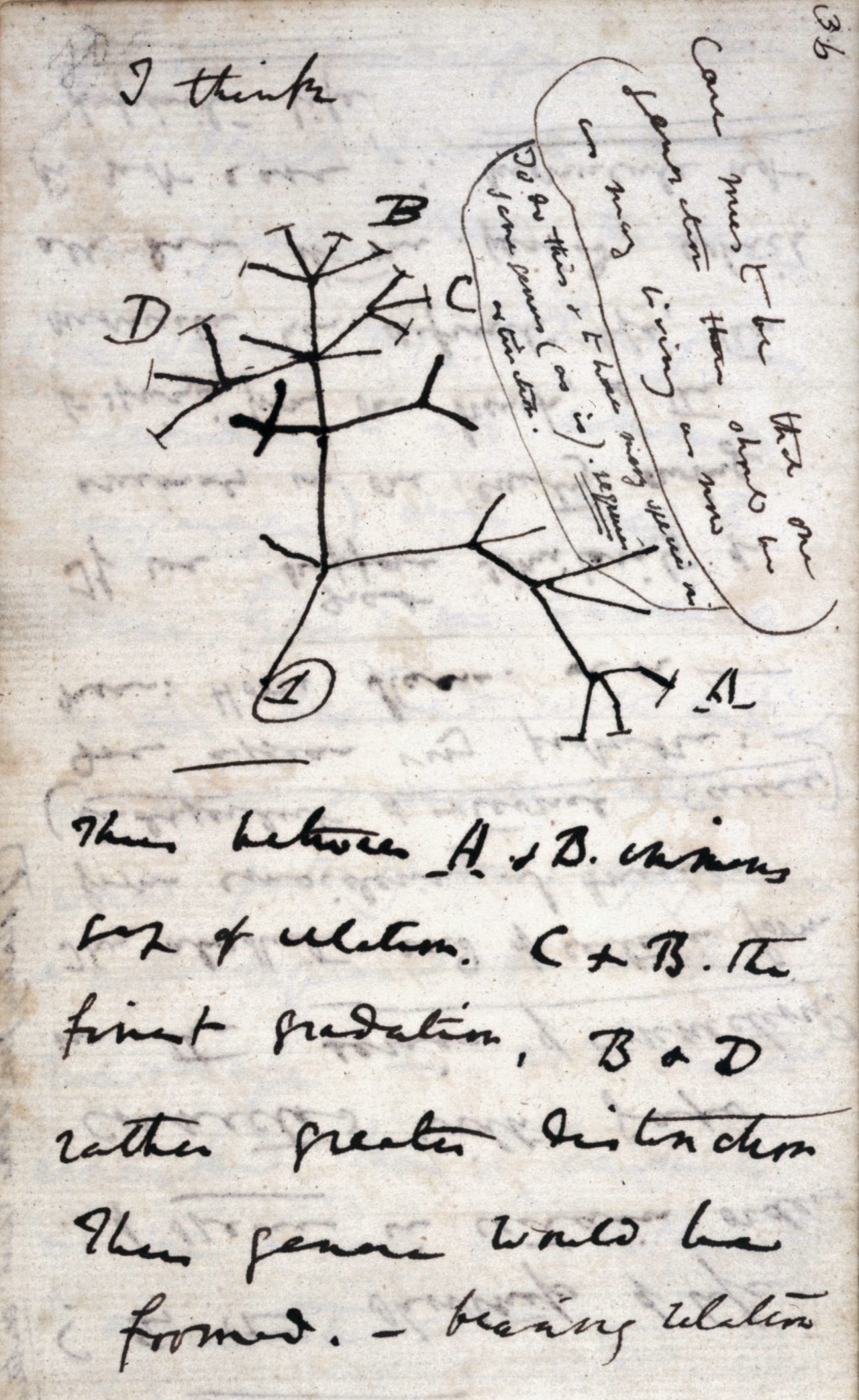
Darwin himself wrote as early as 1837: It is absurd to talk of one animal being higher than another.17
And yet — as historians of science note — his theory did not abolish the ladder: it gave it a new engine. The hierarchy of nature was replaced by an “evolutionary ladder”, and some read evolution as a march towards perfection.
This site gives other examples of the pattern: a correction that never catches up with the error.
So how should we see things?
Not as a ladder, but as a tree — or more precisely, as a phylogenetic tree.
When two lineages split, both then have exactly the same amount of time to evolve. Today’s mosses are not the ancestors of the other plants, nor failed versions of them: they are their cousins.18
The same goes for us and chimpanzees. We are not descended from them. We share a common ancestor, which was neither one nor the other.
Reading a tree without being misled
An evolutionary tree is not read from bottom to top like an ascent, nor from left to right like a historical timeline. Only the order of the branchings matters.
- Nodes are common ancestors, not present-day species.
- Rotating a branch around a node changes nothing in scientific reality. Placing human beings on the right, in the centre or on the left of a phylogenetic diagram does not express any superiority.
- Visual proximity at the tips of the branches is misleading. Two species placed side by side on a sheet of paper are not necessarily more closely related in evolutionary terms than two species set far apart in the drawing: what matters is the depth of the last common ancestor they share.19
Interactive
Rotating a tree
An evolutionary tree reads like a family tree: each node is a common ancestor. But it can be drawn in many ways.
The question
In this drawing, are mammals more closely related to turtles or to birds?
What you do Rotate the branches around their nodes, then answer the question: which is the closest relative of mammals?
Without JavaScript, here are the animation’s data.
| Pair | Last common ancestor | Source |
|---|---|---|
| Turtles and birds | node B, the more recent one | 1 |
| Mammals and turtles | node A | 1 |
| Mammals and birds | node A | 1 |
The tree follows the source’s example: turtles and birds share one ancestor with mammals, which makes them equally closely related to mammals.
The takeaway Rotating a branch changes nothing in the relationships. What counts is the last common ancestor, not the position in the drawing.
Photo credits 3
- Vulpes vulgaris, the fox: hand-coloured print, between 1818 and 1842 (Iconographia Zoologica, Special Collections, University of Amsterdam). Jacques Christophe Werner and Charles Philibert de Lasteyrie, Public domain, source
- Testudo mauretanica, a land tortoise: print, between 1700 and 1880 (Iconographia Zoologica, Special Collections, University of Amsterdam). Unknown author, Public domain, source
- Erythacus rubecula, the robin: hand-coloured print, between 1700 and 1880 (Iconographia Zoologica, Special Collections, University of Amsterdam). Unknown author, Public domain, source
Sources 1
Gregory, T. Ryan, “Understanding Evolutionary Trees”, Evolution: Education and Outreach, vol. 1, 2008, p. 121-137, sections “Misconception #3: Reading across the Tips” and “Misconception #9: More Intervening Nodes Equals More Distantly Related”.
A more rapid approach is to mentally rotate a few internal nodes with no effect on the topology of the tree, as shown in Fig. 11b. […] In Fig. 17a, both turtles and birds share one ancestor with mammals (node W), making them equally closely related to mammals.
Open access · checked on 24 October 2026
The exact formulation, the one used by specialists, is as follows:
A character can be ancestral or derived. But this makes no sense when applied to a whole animal — because every living species shows a mixture of both.20
This rules out the opposite error at the same time. Saying that there is no ladder does not mean that everything is equal and that nothing can be asserted. It means that “more evolved” is not a property of living beings. It is a place we assign to them.
Note 1
In spite of 250 years of taxonomic classification and over 1.2 million species already catalogued in a central database
Mora, Camilo, Tittensor, Derek P., Adl, Sina, Simpson, Alastair G. B. and Worm, Boris, “How Many Species Are There on Earth and in the Ocean?”, PLoS Biology, vol. 9, no. 8, e1001127, 2011
1.800.193 species in COL […] 408.109 species in COL […] 174.658 species in COL […] 75.723 species in COL
Catalogue of Life, version COL26.10 XR, 16 October 2026
Note 2
Museums holding national collections, most notably the British Museum, are usually associated with this type of collecting, but scientific collections in general and natural history collections in particular also played an important role in colonial collecting. […] The history of Enlightenment science, including the natural sciences, is inseparably entwined with the history of European colonialism.
Das, Samir and Lowe, Miranda, “Nature Read in Black and White: Decolonial Approaches to Interpreting Natural History Collections”, Journal of Natural Science Collections, vol. 6, 2018, p. 4-14
Note 3
Globally, our best approximation to the total number of species is based on the opinion of taxonomic experts, whose estimates range between 3 and 100 million species
Mora, Camilo, Tittensor, Derek P., Adl, Sina, Simpson, Alastair G. B. and Worm, Boris, “How Many Species Are There on Earth and in the Ocean?”, PLoS Biology, vol. 9, no. 8, e1001127, 2011
Note 4
the higher taxonomic classification of species (i.e., the assignment of species to phylum, class, order, family, and genus) follows a consistent and predictable pattern from which the total number of species in a taxonomic group can be estimated
Mora, Camilo, Tittensor, Derek P., Adl, Sina, Simpson, Alastair G. B. and Worm, Boris, “How Many Species Are There on Earth and in the Ocean?”, PLoS Biology, vol. 9, no. 8, e1001127, 2011
Note 5
This approach was validated against well-known taxa
Mora, Camilo, Tittensor, Derek P., Adl, Sina, Simpson, Alastair G. B. and Worm, Boris, “How Many Species Are There on Earth and in the Ocean?”, PLoS Biology, vol. 9, no. 8, e1001127, 2011
Note 6
it predicts ~8.7 million (±1.3 million SE) eukaryotic species globally, of which ~2.2 million (±0.18 million SE) are marine
Mora, Camilo, Tittensor, Derek P., Adl, Sina, Simpson, Alastair G. B. and Worm, Boris, “How Many Species Are There on Earth and in the Ocean?”, PLoS Biology, vol. 9, no. 8, e1001127, 2011
Note 7
We predict that there may be 1.8–2.0 million species on Earth, of which about 0.3 million are marine, significantly less than some previous estimates.
Costello, Mark J., Wilson, Simon P. and Houlding, Brett, “Predicting Total Global Species Richness Using Rates of Species Description and Estimates of Taxonomic Effort”, Systematic Biology, vol. 61, no. 5, 2012, p. 871-883
In this report figures of close to 11 million species worldwide and about 570.000 for Australia are accepted.
Chapman, Arthur D., Numbers of Living Species in Australia and the World, Australian Biological Resources Study, 2009
Our estimates suggest that there are likely to be at least 1 to 6 billion species on Earth. Furthermore, in contrast to previous estimates, the new Pie of Life is dominated by bacteria (approximately 70–90% of species) and insects are only one of many hyperdiverse groups.
Larsen, Brendan B. et al., “Inordinate Fondness Multiplied and Redistributed: The Number of Species on Earth and the New Pie of Life”, The Quarterly Review of Biology, vol. 92, 2017, p. 229-265
Note 8
Currently, between one-third and two-thirds of marine species may be undescribed, and previous estimates of there being well over one million marine species appear highly unlikely. […] We each limited our estimates to groups for which we have close working knowledge.
Appeltans, Ward et al., “The Magnitude of Global Marine Species Diversity”, Current Biology, vol. 22, no. 23, 2012, p. 2189-2202
Note 9
We demonstrate that after more than six decades, estimates of global species richness have failed to converge, remain highly uncertain, and in many cases, are logically inconsistent.
Caley, M. Julian, Fisher, Rebecca and Mengersen, Kerrie, “Global Species Richness Estimates Have Not Converged”, Trends in Ecology & Evolution, vol. 29, no. 4, 2014, p. 187-188
Note 10
The nature of species is controversial in biology and philosophy. Biologists disagree on the definition of the term ‘species,’ and philosophers disagree over the ontological status of species. […] Biologists offer over twenty definitions of the term ‘species’ (Hey 2001).
Ereshefsky, Marc, “Species”, Stanford Encyclopedia of Philosophy, Stanford University, 2002, revised 2022
Note 11
our results suggest that some 86% of existing species on Earth and 91% of species in the ocean still await description
Mora, Camilo, Tittensor, Derek P., Adl, Sina, Simpson, Alastair G. B. and Worm, Boris, “How Many Species Are There on Earth and in the Ocean?”, PLoS Biology, vol. 9, no. 8, e1001127, 2011
Note 12
Closing this knowledge gap will require a renewed interest in exploration and taxonomy, and a continuing effort to catalogue existing biodiversity data in publicly available databases.
Mora, Camilo, Tittensor, Derek P., Adl, Sina, Simpson, Alastair G. B. and Worm, Boris, “How Many Species Are There on Earth and in the Ocean?”, PLoS Biology, vol. 9, no. 8, e1001127, 2011
Note 13
We are astonishingly ignorant about how many species are alive on earth today […] Part of the problem is that taxonomic effort is approximately divided 1∶ 1∶ 1 among vertebrates, plants, and invertebrates, whereas plant species are roughly 10 times, and invertebrates 100 times, more numerous than vertebrates.
May, Robert M., “Why Worry about How Many Species and Their Loss?”, PLoS Biology, vol. 9, no. 8, e1001130, 2011
Note 14
When the foldout page is closed, this image in the 1965 Time-Life book Early Man, drawn by Rudolph Zallinger ’42BFA, ’71MFA, shows only six steps in human evolution. […] The full fold-out spread showed 15 individuals, starting with Pliopithecus and ending with Homo sapiens. […] The captions specify that several of the species were not ancestors of humans. Proconsul, second in line, was “the ancestor of the chimpanzee,” and Oreopithecus, the fourth, was “a likely side branch on man’s family tree.”
Giller, Geoffrey and Conniff, Richard, “Iconic. Almost by accident.”, Yale Alumni Magazine, vol. 78, no. 2, November-December 2014
Note 15
Life is a copiously branching bush, continually pruned by the grim reaper of extinction, not a ladder of predictable progress.
Gould, Stephen Jay, Wonderful Life: The Burgess Shale and the Nature of History, W. W. Norton, 1989
Note 16
Aristotle’s History of Animals also placed animals in a hierarchy, ranking animals above plants due to what he claimed were their abilities to sense the world around them and to move. […] This concept of “higher” and “lower” organisms was expanded upon by scholars in the Medieval period to form the Scala Naturae (Latin for “ladder of being”). This “Great Chain of Being,” depicting a hierarchy of beings with God at the top and minerals at the bottom (Figure 2.2), was thought by medieval Christians to have been decreed by God; in this Great Chain, humans were placed closer to God than other species.
Namie, Joylin, “The Beginnings of Evolutionary Thinking”, in Shook, Beth, Nelson, Katie, Aguilera, Kelsie and Braff, Lara (eds), Explorations: An Open Invitation to Biological Anthropology, 2nd ed., chap. 2, section 2.1, LibreTexts
Note 17
It is absurd to talk of one animal being higher than another
Darwin, Charles, Notebook B, 1837, dans Barrett, Paul H. et al. (dir.), Charles Darwin’s Notebooks, 1836-1844, Cambridge University Press, 1987
It is absurd to talk of one animal being higher than another.— We consider those, when the (intellectual faculties cerebral structure) most developed, as highest.—
Darwin, Charles, Notebook B, 1837, dans Barrett, Paul H. et al
Note 18
Since that speciation event, both lineages have had an equal amount of time to evolve.
University of California Museum of Paleontology, Understanding Evolution, “Trees, not ladders”
Note 19
A more rapid approach is to mentally rotate a few internal nodes with no effect on the topology of the tree, as shown in Fig. 11b. […] In Fig. 17a, both turtles and birds share one ancestor with mammals (node W), making them equally closely related to mammals.
Gregory, T. Ryan, “Understanding Evolutionary Trees”, Evolution: Education and Outreach, vol. 1, 2008, p. 121-137
Note 20
Consequently, whereas character states can be relatively ancestral (plesiomorphic) or derived (apomorphic), these concepts are nonsensical when applied to whole organisms.
Gregory, T. Ryan, “Understanding Evolutionary Trees”, Evolution: Education and Outreach, vol. 1, 2008, p. 121-137
Notes and sources
- ↑
Passage After two hundred and fifty years of work
In spite of 250 years of taxonomic classification and over 1.2 million species already catalogued in a central database
Source Mora, Camilo, Tittensor, Derek P., Adl, Sina, Simpson, Alastair G. B. and Worm, Boris, “How Many Species Are There on Earth and in the Ocean?”, PLoS Biology, vol. 9, no. 8, e1001127, 2011, abstract.
Open access open the source · checked on 9 September 2026
Passage about two and a half million species are listed in a global database, the Catalogue of Life
1.800.193 species in COL […] 408.109 species in COL […] 174.658 species in COL […] 75.723 species in COL
Source Catalogue of Life, version COL26.10 XR, 16 October 2026, home page, per-kingdom counters (Animalia, Plantae, Fungi, other kingdoms; total 2,458,683), active version “COL26.10 XR” released on 16 October 2026; accessed on 24 October 2026.
Open access open the source · checked on 25 October 2026
- ↑
Passage The great European museums built their collections through colonial networks
Museums holding national collections, most notably the British Museum, are usually associated with this type of collecting, but scientific collections in general and natural history collections in particular also played an important role in colonial collecting. […] The history of Enlightenment science, including the natural sciences, is inseparably entwined with the history of European colonialism.
Source Das, Samir and Lowe, Miranda, “Nature Read in Black and White: Decolonial Approaches to Interpreting Natural History Collections”, Journal of Natural Science Collections, vol. 6, 2018, p. 4-14, p. 6.
Open access · checked on 9 September 2026
- ↑
Passage Before 2011, specialists put forward estimates ranging from three to one hundred million species.
Globally, our best approximation to the total number of species is based on the opinion of taxonomic experts, whose estimates range between 3 and 100 million species
Source Mora, Camilo, Tittensor, Derek P., Adl, Sina, Simpson, Alastair G. B. and Worm, Boris, “How Many Species Are There on Earth and in the Ocean?”, PLoS Biology, vol. 9, no. 8, e1001127, 2011, introduction.
Open access open the source · checked on 9 September 2026
- ↑
Passage the way species are distributed among the major groups of classification […] follows a regular and predictable pattern
the higher taxonomic classification of species (i.e., the assignment of species to phylum, class, order, family, and genus) follows a consistent and predictable pattern from which the total number of species in a taxonomic group can be estimated
Source Mora, Camilo, Tittensor, Derek P., Adl, Sina, Simpson, Alastair G. B. and Worm, Boris, “How Many Species Are There on Earth and in the Ocean?”, PLoS Biology, vol. 9, no. 8, e1001127, 2011, abstract.
Open access open the source · checked on 9 September 2026
- ↑
Passage they first tested it on well-known groups, to check that it found the right result
This approach was validated against well-known taxa
Source Mora, Camilo, Tittensor, Derek P., Adl, Sina, Simpson, Alastair G. B. and Worm, Boris, “How Many Species Are There on Earth and in the Ocean?”, PLoS Biology, vol. 9, no. 8, e1001127, 2011, abstract.
Open access open the source · checked on 9 September 2026
- ↑
Passage about 8.7 million species, with a margin of plus or minus 1.3 million — of which 2.2 million are in the ocean
it predicts ~8.7 million (±1.3 million SE) eukaryotic species globally, of which ~2.2 million (±0.18 million SE) are marine
Source Mora, Camilo, Tittensor, Derek P., Adl, Sina, Simpson, Alastair G. B. and Worm, Boris, “How Many Species Are There on Earth and in the Ocean?”, PLoS Biology, vol. 9, no. 8, e1001127, 2011, abstract.
Open access open the source · checked on 9 September 2026
- ↑
Passage Other teams, using other methods, arrive at about two million.
We predict that there may be 1.8–2.0 million species on Earth, of which about 0.3 million are marine, significantly less than some previous estimates.
Source Costello, Mark J., Wilson, Simon P. and Houlding, Brett, “Predicting Total Global Species Richness Using Rates of Species Description and Estimates of Taxonomic Effort”, Systematic Biology, vol. 61, no. 5, 2012, p. 871-883, abstract.
Open access open the source · checked on 9 September 2026
Passage Or at eleven million.
In this report figures of close to 11 million species worldwide and about 570.000 for Australia are accepted.
Source Chapman, Arthur D., Numbers of Living Species in Australia and the World, Australian Biological Resources Study, 2009, Introduction, p. 2.
Open access open the source · checked on 24 October 2026
Passage More recent work puts forward figures in the billions, by counting micro-organisms.
Our estimates suggest that there are likely to be at least 1 to 6 billion species on Earth. Furthermore, in contrast to previous estimates, the new Pie of Life is dominated by bacteria (approximately 70–90% of species) and insects are only one of many hyperdiverse groups.
Source Larsen, Brendan B. et al., “Inordinate Fondness Multiplied and Redistributed: The Number of Species on Earth and the New Pie of Life”, The Quarterly Review of Biology, vol. 92, 2017, p. 229-265, abstract.
Paywalled · checked on 25 October 2026
- ↑
Passage more than one hundred and twenty ocean taxonomists judged that a total of more than one million marine species was unlikely […] Their method […] directly asks the specialists of each group.
Currently, between one-third and two-thirds of marine species may be undescribed, and previous estimates of there being well over one million marine species appear highly unlikely. […] We each limited our estimates to groups for which we have close working knowledge.
Source Appeltans, Ward et al., “The Magnitude of Global Marine Species Diversity”, Current Biology, vol. 22, no. 23, 2012, p. 2189-2202, abstract (“Conclusions”); introduction, on the method of estimation by expert opinion.
Open access · checked on 24 October 2026
- ↑
Passage In 2014, researchers reviewed all of this literature […] Then they published their work without giving a figure.
We demonstrate that after more than six decades, estimates of global species richness have failed to converge, remain highly uncertain, and in many cases, are logically inconsistent.
Source Caley, M. Julian, Fisher, Rebecca and Mengersen, Kerrie, “Global Species Richness Estimates Have Not Converged”, Trends in Ecology & Evolution, vol. 29, no. 4, 2014, p. 187-188, abstract.
Paywalled · checked on 9 September 2026
- ↑
Passage What exactly a species is remains an open question […] There are several competing definitions
The nature of species is controversial in biology and philosophy. Biologists disagree on the definition of the term ‘species,’ and philosophers disagree over the ontological status of species. […] Biologists offer over twenty definitions of the term ‘species’ (Hey 2001).
Source Ereshefsky, Marc, “Species”, Stanford Encyclopedia of Philosophy, Stanford University, 2002, revised 2022, introduction, 1st paragraph (first two sentences); § 1 (“Overview”), 1st paragraph.
Open access open the source · checked on 27 October 2026
- ↑
Passage 86% of all species and 91% of marine species still await description
our results suggest that some 86% of existing species on Earth and 91% of species in the ocean still await description
Source Mora, Camilo, Tittensor, Derek P., Adl, Sina, Simpson, Alastair G. B. and Worm, Boris, “How Many Species Are There on Earth and in the Ocean?”, PLoS Biology, vol. 9, no. 8, e1001127, 2011, abstract.
Open access open the source · checked on 9 September 2026
- ↑
Passage closing this gap will require a renewed interest in exploration and taxonomy […] and a continuing effort to place the data in public databases
Closing this knowledge gap will require a renewed interest in exploration and taxonomy, and a continuing effort to catalogue existing biodiversity data in publicly available databases.
Source Mora, Camilo, Tittensor, Derek P., Adl, Sina, Simpson, Alastair G. B. and Worm, Boris, “How Many Species Are There on Earth and in the Ocean?”, PLoS Biology, vol. 9, no. 8, e1001127, 2011, non-technical summary (Author Summary).
Open access open the source · checked on 9 September 2026
- ↑
Passage Why do we know so little about what remains?
We are astonishingly ignorant about how many species are alive on earth today […] Part of the problem is that taxonomic effort is approximately divided 1∶ 1∶ 1 among vertebrates, plants, and invertebrates, whereas plant species are roughly 10 times, and invertebrates 100 times, more numerous than vertebrates.
Source May, Robert M., “Why Worry about How Many Species and Their Loss?”, PLoS Biology, vol. 9, no. 8, e1001130, 2011, abstract; then third paragraph of the text.
Open access · checked on 24 October 2026
- ↑
Passage drawn in 1965 by Rudolph Zallinger […] The original text […] specified that the fourth figure was probably a side branch […] The original illustration had fifteen figures, on a fold-out.
When the foldout page is closed, this image in the 1965 Time-Life book Early Man, drawn by Rudolph Zallinger ’42BFA, ’71MFA, shows only six steps in human evolution. […] The full fold-out spread showed 15 individuals, starting with Pliopithecus and ending with Homo sapiens. […] The captions specify that several of the species were not ancestors of humans. Proconsul, second in line, was “the ancestor of the chimpanzee,” and Oreopithecus, the fourth, was “a likely side branch on man’s family tree.”
Source Giller, Geoffrey and Conniff, Richard, “Iconic. Almost by accident.”, Yale Alumni Magazine, vol. 78, no. 2, November-December 2014, caption of the opening illustration; body of the article, paragraphs on “The Road to Homo Sapiens” and on the original captions.
Open access open the source · checked on 27 October 2026
- ↑
Passage Life is a copiously branching bush, continually pruned by the grim reaper of extinction, not a ladder of predictable progress.
Life is a copiously branching bush, continually pruned by the grim reaper of extinction, not a ladder of predictable progress.
Source Gould, Stephen Jay, Wonderful Life: The Burgess Shale and the Nature of History, W. W. Norton, 1989, chapter 1.
In libraries · checked on 9 September 2026
- ↑
Passage It is Aristotle’s scale of beings, taken up later under the name of the “great chain of being”
Aristotle’s History of Animals also placed animals in a hierarchy, ranking animals above plants due to what he claimed were their abilities to sense the world around them and to move. […] This concept of “higher” and “lower” organisms was expanded upon by scholars in the Medieval period to form the Scala Naturae (Latin for “ladder of being”). This “Great Chain of Being,” depicting a hierarchy of beings with God at the top and minerals at the bottom (Figure 2.2), was thought by medieval Christians to have been decreed by God; in this Great Chain, humans were placed closer to God than other species.
Source Namie, Joylin, “The Beginnings of Evolutionary Thinking”, in Shook, Beth, Nelson, Katie, Aguilera, Kelsie and Braff, Lara (eds), Explorations: An Open Invitation to Biological Anthropology, 2nd ed., chap. 2, section 2.1, LibreTexts, section 2.1, 3rd paragraph of the text.
Open access open the source · checked on 27 October 2026
- ↑
Passage It is absurd to talk of one animal being higher than another
It is absurd to talk of one animal being higher than another
Source Darwin, Charles, Notebook B, 1837, dans Barrett, Paul H. et al. (dir.), Charles Darwin’s Notebooks, 1836-1844, Cambridge University Press, 1987, Notebook B, p. 74.
In libraries · checked on 9 September 2026
Passage Darwin himself wrote as early as 1837: It is absurd to talk of one animal being higher than another
It is absurd to talk of one animal being higher than another.— We consider those, when the (intellectual faculties cerebral structure) most developed, as highest.—
Source Darwin, Charles, Notebook B, 1837, dans Barrett, Paul H. et al, Notebook B, page [74] of the notebook.
Open access open the source · checked on 24 October 2026
- ↑
Passage When two lineages split, both then have exactly the same amount of time to evolve.
Since that speciation event, both lineages have had an equal amount of time to evolve.
Source University of California Museum of Paleontology, Understanding Evolution, “Trees, not ladders”, Evolution 101, page “evo_07” (example of the fern, the pine and the rose), before the section “Misconceptions about humans”.
Open access open the source · checked on 24 October 2026
- ↑
Passage Nodes are common ancestors, not present-day species […] Rotating a branch around a node changes nothing
A more rapid approach is to mentally rotate a few internal nodes with no effect on the topology of the tree, as shown in Fig. 11b. […] In Fig. 17a, both turtles and birds share one ancestor with mammals (node W), making them equally closely related to mammals.
Source Gregory, T. Ryan, “Understanding Evolutionary Trees”, Evolution: Education and Outreach, vol. 1, 2008, p. 121-137, sections “Misconception #3: Reading across the Tips” and “Misconception #9: More Intervening Nodes Equals More Distantly Related”.
Open access · checked on 24 October 2026
- ↑
Passage A character can be ancestral or derived. But this makes no sense when applied to a whole animal
Consequently, whereas character states can be relatively ancestral (plesiomorphic) or derived (apomorphic), these concepts are nonsensical when applied to whole organisms.
Source Gregory, T. Ryan, “Understanding Evolutionary Trees”, Evolution: Education and Outreach, vol. 1, 2008, p. 121-137, section “Misconception #6: Long Branch Implies no Change (or “Less Diverse Equals Basal Equals Ancestral”)”.
Open access · checked on 24 October 2026
Bibliography
20
- Appeltans, Ward et al., “The Magnitude of Global Marine Species Diversity”, Current Biology, vol. 22, no. 23, 2012, p. 2189-2202, open access (the competing estimate for the marine environment, based on consulting specialists).
- Caley, M. Julian, Fisher, Rebecca and Mengersen, Kerrie, “Global Species Richness Estimates Have Not Converged”, Trends in Ecology & Evolution, vol. 29, no. 4, 2014, p. 187-188, paywalled (the review of the estimates that declines to give one).
- Catalogue of Life, version COL26.10 XR, 16 October 2026, open access (the number of catalogued species: about 2.46 million when the per-kingdom counters on the home page are added together). https://doi.org/10.48580/dgzlf
- Chapman, Arthur D., Numbers of Living Species in Australia and the World, Australian Biological Resources Study, 2009, open access (an estimate of eleven million).
- Costello, Mark J., Wilson, Simon P. and Houlding, Brett, “Predicting Total Global Species Richness Using Rates of Species Description and Estimates of Taxonomic Effort”, Systematic Biology, vol. 61, no. 5, 2012, p. 871-883, open access (an estimate of 1.8 to 2 million species). http://hdl.handle.net/2262/67357
- Costello, Mark J., May, Robert M. and Stork, Nigel E., “Can We Name Earth’s Species Before They Go Extinct?”, Science, vol. 339, 2013, p. 413-416, paywalled.
- Darwin, Charles, Notebook B, 1837, dans Barrett, Paul H. et al. (dir.), Charles Darwin’s Notebooks, 1836-1844, Cambridge University Press, 1987, in libraries (“It is absurd to talk of one animal being higher than another”).
- Das, Samir and Lowe, Miranda, “Nature Read in Black and White: Decolonial Approaches to Interpreting Natural History Collections”, Journal of Natural Science Collections, vol. 6, 2018, p. 4-14, open access (colonial collections and the “discoverer” bias).
- Ereshefsky, Marc, “Species”, Stanford Encyclopedia of Philosophy, Stanford University, 2002, revised 2022, open access (the contested nature of species; over twenty definitions offered by biologists). https://plato.stanford.edu/entries/species/
- Giller, Geoffrey and Conniff, Richard, “Iconic. Almost by accident.”, Yale Alumni Magazine, vol. 78, no. 2, November-December 2014, open access (Zallinger’s illustration in Early Man, 1965: the fifteen-figure fold-out and the captions that set several figures outside the human line). https://yalealumnimagazine.org/articles/3977-march-of-progress
- Gould, Stephen Jay, Wonderful Life: The Burgess Shale and the Nature of History, W. W. Norton, 1989, in libraries (life as a bush pruned by extinction, not as a ladder of progress). French translation: La Vie est belle, Seuil, 1991.
- Gregory, T. Ryan, “Understanding Evolutionary Trees”, Evolution: Education and Outreach, vol. 1, 2008, p. 121-137, open access (misconceptions about reading trees; ancestral and derived characters).
- Howell, F. Clark, Early Man, Time-Life Books, 1965, in libraries (the illustration “The Road to *Homo sapiens*”, the fifteen-figure fold-out, and the text that contradicts it).
- Larsen, Brendan B. et al., “Inordinate Fondness Multiplied and Redistributed: The Number of Species on Earth and the New Pie of Life”, The Quarterly Review of Biology, vol. 92, 2017, p. 229-265, paywalled (the estimates in the billions, micro-organisms included).
- Lovejoy, Arthur O., The Great Chain of Being, Harvard University Press, 1936, in libraries (the scale of beings, from Aristotle to its modern survivals).
- May, Robert M., “Why Worry about How Many Species and Their Loss?”, PLoS Biology, vol. 9, no. 8, e1001130, 2011, open access (the commentary published with the study).
- Mora, Camilo, Tittensor, Derek P., Adl, Sina, Simpson, Alastair G. B. and Worm, Boris, “How Many Species Are There on Earth and in the Ocean?”, PLoS Biology, vol. 9, no. 8, e1001127, 2011, open access (the regular pattern of classification; validation on well-known groups; 8.7 ± 1.3 million, of which 2.2 million marine; 1.2 million species catalogued in 250 years; 86% and 91% undescribed; the call for exploration and taxonomy). https://doi.org/10.1371/journal.pbio.1001127
- Namie, Joylin, “The Beginnings of Evolutionary Thinking”, in Shook, Beth, Nelson, Katie, Aguilera, Kelsie and Braff, Lara (eds), Explorations: An Open Invitation to Biological Anthropology, 2nd ed., chap. 2, section 2.1, LibreTexts, open access (Aristotle’s hierarchy of living things, developed in the Middle Ages into the Scala Naturae or “Great Chain of Being”, from God down to minerals). https://socialsci.libretexts.org/Bookshelves/Anthropology/Biological_Anthropology/EXPLORATIONS%3A_An_Open_Invitation_to_Biological_Anthropology_2e/02%3A_A_History_of_Evolutionary_Thought/2.01%3A_The_Beginnings_of_Evolutionary_Thinking
- University of California Museum of Paleontology, Understanding Evolution, “Trees, not ladders”, open access (reading phylogenetic trees). https://evolution.berkeley.edu/
- Zachos, Frank E., Species Concepts in Biology, Springer, 2016, in libraries (the species problem and its competing definitions).
Spotted an error or have a doubt? Write to us.